Photography Merit Badge
Las Vegas Area Council
Big Horn District
2015 Merit Badge Pow Wow
Requirement #1
• Explain how the following elements and
terms affect the quality of a picture:
a) Light-natural light/ambient, flash
b) Exposure-aperture (F-stops), shutter speed, depth
of field
c) Composition-rule of thirds, leading lines,
framing, depth
d) Angle of view
e) Stopping action
Requirement #2
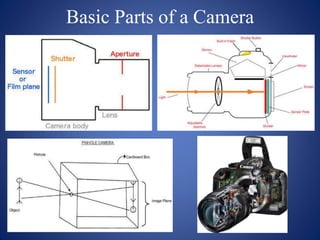
• Explain the basic parts and operation of a film
camera or digital camera.
• Explain how an exposure is made when you
take a picture.
Requirement #3
• Discuss with your counselor the differences
between a film camera and a digital camera.
• Describe how computer software allows you
to make adjustments to a digital photograph
after it is taken.
Requirement #4
• Do the following…
a) Produce a picture story using the photojournalistic
technique of documenting an event. Share your plan
with your counselor and get your counselor's input
and approval before you proceed. Then, using either a
film camera or a digital camera, produce your
approved picture story. Process your images and
select eight to 12 images that best tell your story.
Arrange your images in order, then mount the prints
on a poster board. If you are using digital images, you
may create a slide show on your computer or produce
printouts for your poster board. Share your picture
story with your counselor.
Requirement #4
• …or do the following:
b) Choose a topic that interests you to photograph
for an exhibit or display. Get your counselor's
approval, then photograph (digital or film) your
topic. Process your images. Choose 20 of your
favorite images and mount them on poster board.
Share your display with your counselor. If you
are using digital images, you may create a slide
show on your computer or produce printouts for
your poster board.
Requirement #5
• Discuss with your counselor the career
opportunities in photography.
• Pick one that interests you and explain how to
prepare for such a career.
• Discuss with your counselor the education
and training such a career would require.
Basic Parts of a Camera
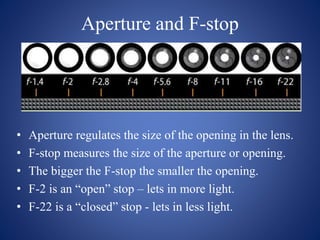
Aperture and F-stop
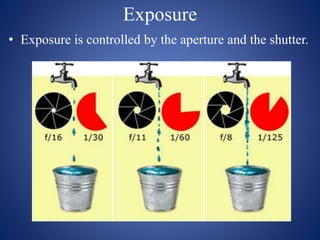
• Aperture regulates the size of the opening in the lens.
• F-stop measures the size of the aperture or opening.
• The bigger the F-stop the smaller the opening.
• F-2 is an “open” stop – lets in more light.
• F-22 is a “closed” stop - lets in less light.
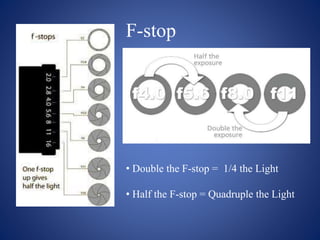
F-stop
• Double the F-stop = 1/4 the Light
• Half the F-stop = Quadruple the Light
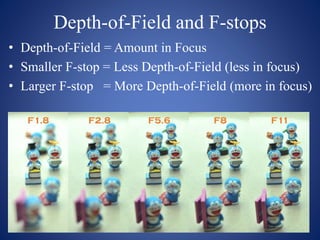
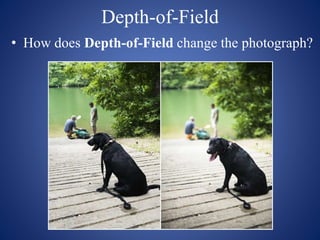
Depth-of-Field and F-stops
• Depth-of-Field = Amount in Focus
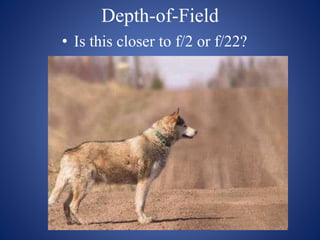
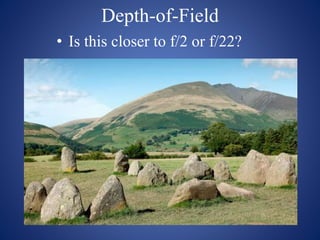
• Smaller F-stop = Less Depth-of-Field (less in focus)
• Larger F-stop = More Depth-of-Field (more in focus)
Depth-of-Field
• How does Depth-of-Field change the photograph?
Depth-of-Field
• Is this closer to f/2 or f/22?
Depth-of-Field
• Is this closer to f/2 or f/22?
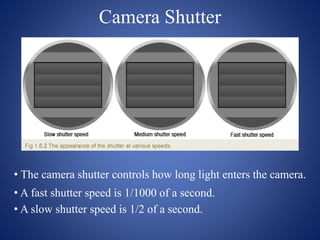
Camera Shutter
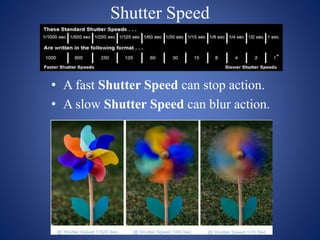
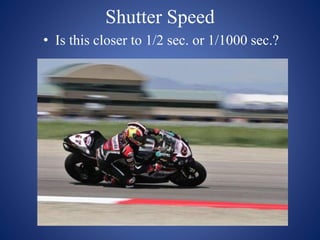
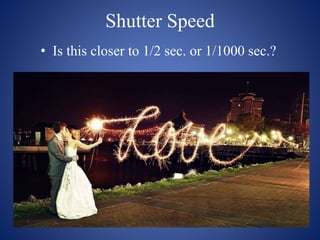
• The camera shutter controls how long light enters the camera.
• A fast shutter speed is 1/1000 of a second.
• A slow shutter speed is 1/2 of a second.
Shutter Speed
• A fast Shutter Speed can stop action.
• A slow Shutter Speed can blur action.
Stopping Action
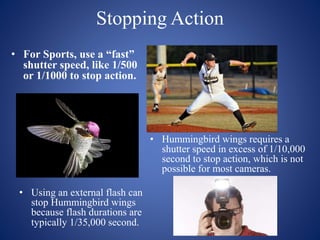
• For Sports, use a “fast”
shutter speed, like 1/500
or 1/1000 to stop action.
• Hummingbird wings requires a
shutter speed in excess of 1/10,000
second to stop action, which is not
possible for most cameras.
• Using an external flash can
stop Hummingbird wings
because flash durations are
typically 1/35,000 second.
Shutter Speed
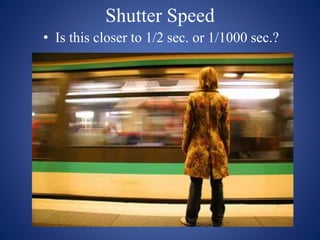
• Is this closer to 1/2 sec. or 1/1000 sec.?
Shutter Speed
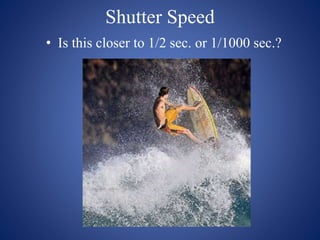
• Is this closer to 1/2 sec. or 1/1000 sec.?
Shutter Speed
• Is this closer to 1/2 sec. or 1/1000 sec.?
Shutter Speed
• Is this closer to 1/2 sec. or 1/1000 sec.?
Exposure
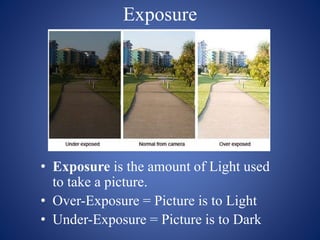
• Exposure is the amount of Light used
to take a picture.
• Over-Exposure = Picture is to Light
• Under-Exposure = Picture is to Dark
Exposure
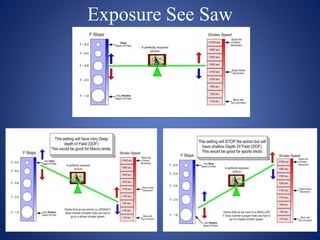
• Exposure is controlled by the aperture and the shutter.
Exposure See Saw
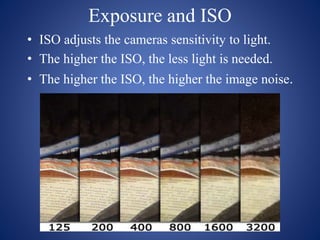
Exposure and ISO
• ISO adjusts the cameras sensitivity to light.
• The higher the ISO, the less light is needed.
• The higher the ISO, the higher the image noise.
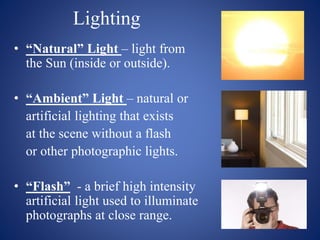
Lighting
• “Natural” Light – light from
the Sun (inside or outside).
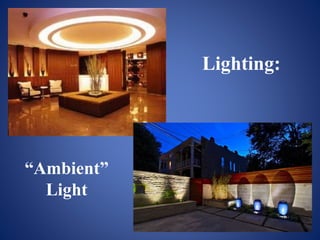
• “Ambient” Light – natural or
artificial lighting that exists
at the scene without a flash
or other photographic lights.
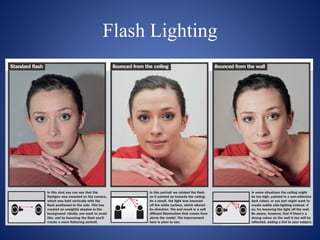
• “Flash” - a brief high intensity
artificial light used to illuminate
photographs at close range.
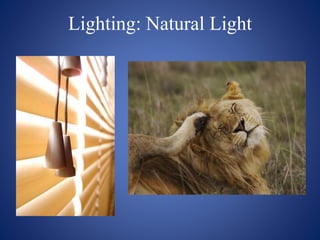
Lighting: Natural Light
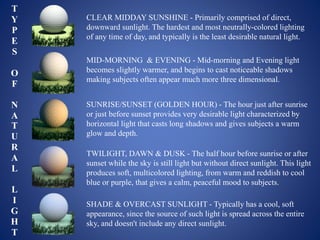
CLEAR MIDDAY SUNSHINE - Primarily comprised of direct,
downward sunlight. The hardest and most neutrally-colored lighting
of any time of day, and typically is the least desirable natural light.
MID-MORNING & EVENING - Mid-morning and Evening light
becomes slightly warmer, and begins to cast noticeable shadows
making subjects often appear much more three dimensional.
SUNRISE/SUNSET (GOLDEN HOUR) - The hour just after sunrise
or just before sunset provides very desirable light characterized by
horizontal light that casts long shadows and gives subjects a warm
glow and depth.
TWILIGHT, DAWN & DUSK - The half hour before sunrise or after
sunset while the sky is still light but without direct sunlight. This light
produces soft, multicolored lighting, from warm and reddish to cool
blue or purple, that gives a calm, peaceful mood to subjects.
SHADE & OVERCAST SUNLIGHT - Typically has a cool, soft
appearance, since the source of such light is spread across the entire
sky, and doesn't include any direct sunlight.
T
Y
P
E
S
O
F
N
A
T
U
R
A
L
L
I
G
H
T
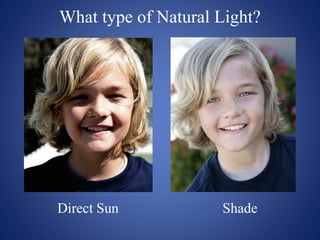
What type of Natural Light?
Direct Sun Shade
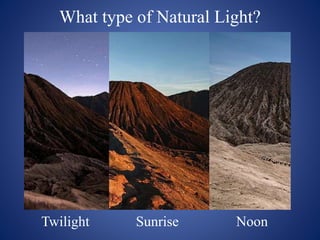
What type of Natural Light?
Twilight NoonSunrise
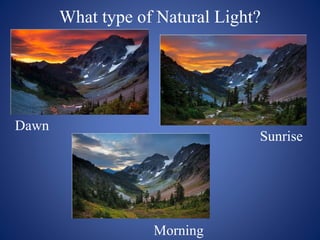
What type of Natural Light?
Dawn
Morning
Sunrise
Lighting:
“Ambient”
Light
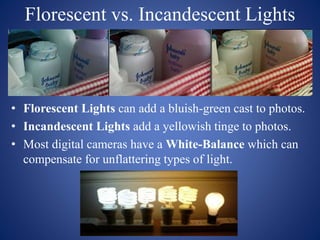
Florescent vs. Incandescent Lights
• Florescent Lights can add a bluish-green cast to photos.
• Incandescent Lights add a yellowish tinge to photos.
• Most digital cameras have a White-Balance which can
compensate for unflattering types of light.
Flash Lighting
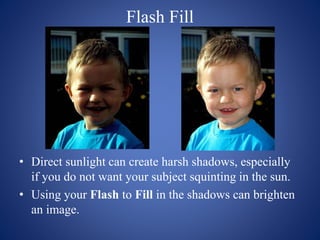
Flash Fill
• Direct sunlight can create harsh shadows, especially
if you do not want your subject squinting in the sun.
• Using your Flash to Fill in the shadows can brighten
an image.
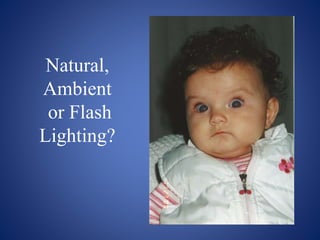
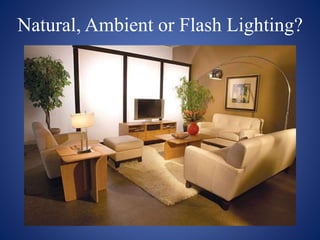
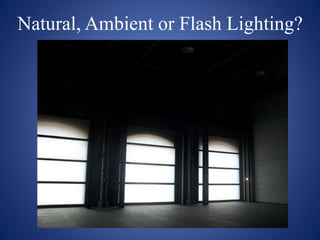
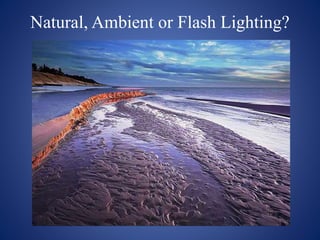
Natural, Ambient or Flash Lighting?
Natural,
Ambient
or Flash
Lighting?
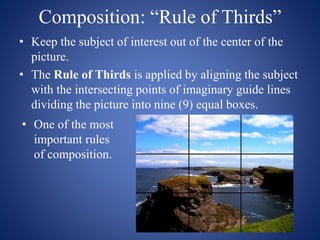
Composition: “Rule of Thirds”
• Keep the subject of interest out of the center of the
picture.
• The Rule of Thirds is applied by aligning the subject
with the intersecting points of imaginary guide lines
dividing the picture into nine (9) equal boxes.
• One of the most
important rules
of composition.
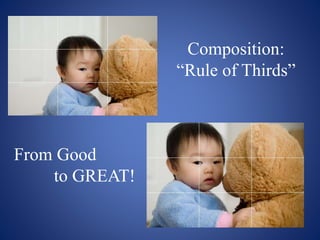
Composition:
“Rule of Thirds”
From Good
to GREAT!
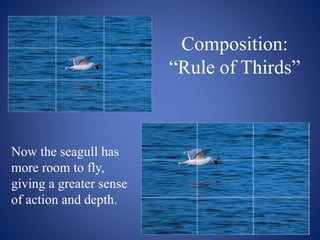
Composition:
“Rule of Thirds”
Now the seagull has
more room to fly,
giving a greater sense
of action and depth.
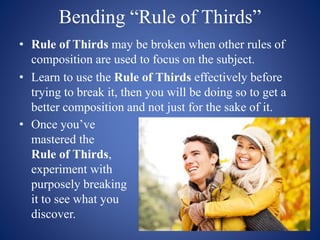
Bending “Rule of Thirds”
• Rule of Thirds may be broken when other rules of
composition are used to focus on the subject.
• Learn to use the Rule of Thirds effectively before
trying to break it, then you will be doing so to get a
better composition and not just for the sake of it.
• Once you’ve
mastered the
Rule of Thirds,
experiment with
purposely breaking
it to see what you
discover.
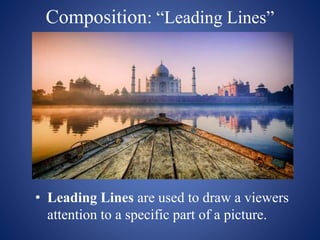
Composition: “Leading Lines”
• Leading Lines are used to draw a viewers
attention to a specific part of a picture.
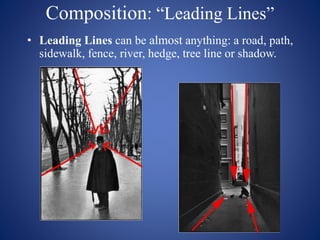
Composition: “Leading Lines”
• Leading Lines can be almost anything: a road, path,
sidewalk, fence, river, hedge, tree line or shadow.
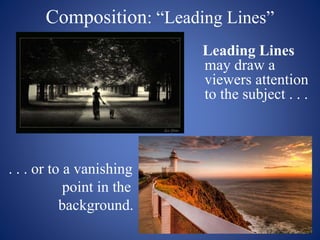
Composition: “Leading Lines”
Leading Lines
may draw a
viewers attention
to the subject . . .
. . . or to a vanishing
point in the
background.
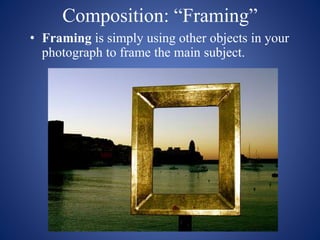
Composition: “Framing”
• Framing is simply using other objects in your
photograph to frame the main subject.
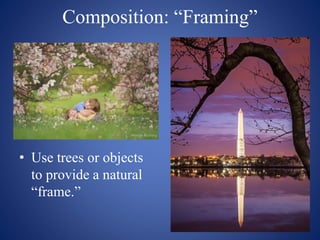
Composition: “Framing”
• Use trees or objects
to provide a natural
“frame.”
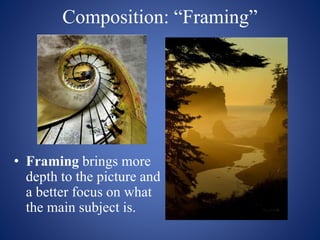
Composition: “Framing”
• Framing brings more
depth to the picture and
a better focus on what
the main subject is.
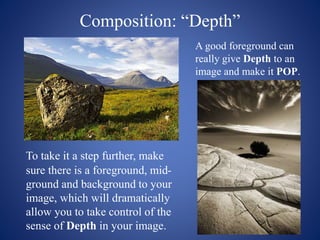
Composition: “Depth”
To take it a step further, make
sure there is a foreground, mid-
ground and background to your
image, which will dramatically
allow you to take control of the
sense of Depth in your image.
A good foreground can
really give Depth to an
image and make it POP.
Composition: “Depth”
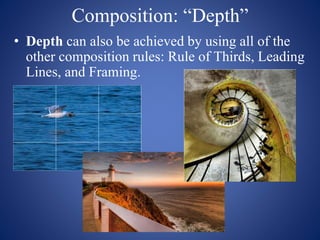
• Depth can also be achieved by using all of the
other composition rules: Rule of Thirds, Leading
Lines, and Framing.
Composition: “Depth”
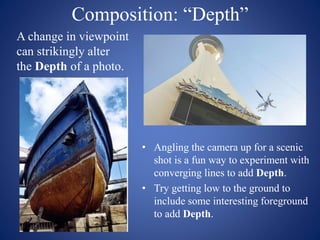
• Angling the camera up for a scenic
shot is a fun way to experiment with
converging lines to add Depth.
• Try getting low to the ground to
include some interesting foreground
to add Depth.
A change in viewpoint
can strikingly alter
the Depth of a photo.
Depth with Light
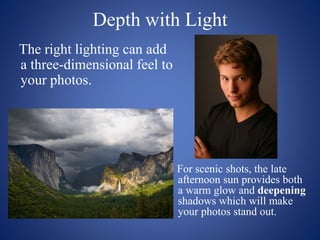
The right lighting can add
a three-dimensional feel to
your photos.
For scenic shots, the late
afternoon sun provides both
a warm glow and deepening
shadows which will make
your photos stand out.
Depth with Lenses
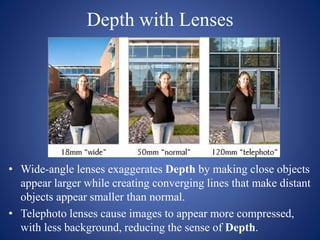
• Wide-angle lenses exaggerates Depth by making close objects
appear larger while creating converging lines that make distant
objects appear smaller than normal.
• Telephoto lenses cause images to appear more compressed,
with less background, reducing the sense of Depth.
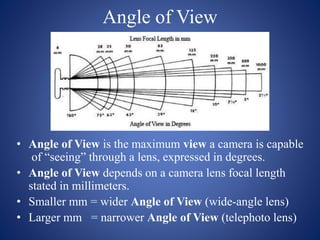
Angle of View
• Angle of View is the maximum view a camera is capable
of “seeing” through a lens, expressed in degrees.
• Angle of View depends on a camera lens focal length
stated in millimeters.
• Smaller mm = wider Angle of View (wide-angle lens)
• Larger mm = narrower Angle of View (telephoto lens)
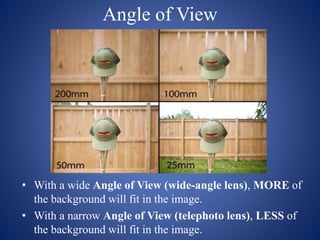
Angle of View
• With a wide Angle of View (wide-angle lens), MORE of
the background will fit in the image.
• With a narrow Angle of View (telephoto lens), LESS of
the background will fit in the image.
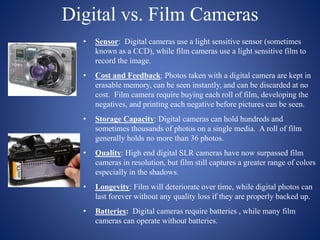
Digital vs. Film Cameras
• Sensor: Digital cameras use a light sensitive sensor (sometimes
known as a CCD), while film cameras use a light sensitive film to
record the image.
• Cost and Feedback: Photos taken with a digital camera are kept in
erasable memory, can be seen instantly, and can be discarded at no
cost. Film camera require buying each roll of film, developing the
negatives, and printing each negative before pictures can be seen.
• Storage Capacity: Digital cameras can hold hundreds and
sometimes thousands of photos on a single media. A roll of film
generally holds no more than 36 photos.
• Quality: High end digital SLR cameras have now surpassed film
cameras in resolution, but film still captures a greater range of colors
especially in the shadows.
• Longevity: Film will deteriorate over time, while digital photos can
last forever without any quality loss if they are properly backed up.
• Batteries: Digital cameras require batteries , while many film
cameras can operate without batteries.
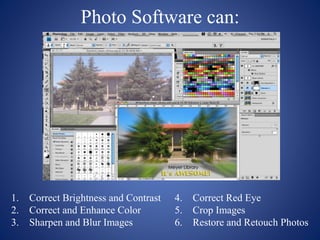
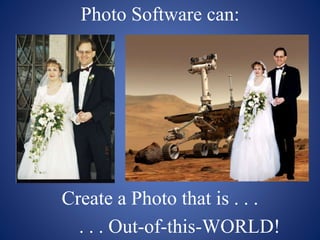
Photo Software can:
1. Correct Brightness and Contrast
2. Correct and Enhance Color
3. Sharpen and Blur Images
4. Correct Red Eye
5. Crop Images
6. Restore and Retouch Photos
Photo Software can:
Create a Photo that is . . .
. . . Out-of-this-WORLD!
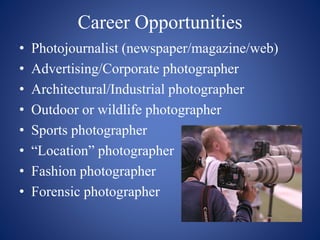
Career Opportunities
• Photojournalist (newspaper/magazine/web)
• Advertising/Corporate photographer
• Architectural/Industrial photographer
• Outdoor or wildlife photographer
• Sports photographer
• “Location” photographer
• Fashion photographer
• Forensic photographer
Education Requirements
• Four (4) years of college (B.A. degree) and/or
2+ years apprenticeship as photographer’s assistant
• Lots of hard work!
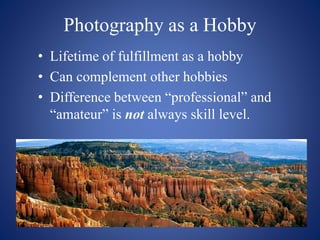
Photography as a Hobby
• Lifetime of fulfillment as a hobby
• Can complement other hobbies
• Difference between “professional” and
“amateur” is not always skill level.

Photography Merit Badge Powerpoint

  • 1.
    Photography Merit Badge LasVegas Area Council Big Horn District 2015 Merit Badge Pow Wow
  • 2.
    Requirement #1 • Explainhow the following elements and terms affect the quality of a picture: a) Light-natural light/ambient, flash b) Exposure-aperture (F-stops), shutter speed, depth of field c) Composition-rule of thirds, leading lines, framing, depth d) Angle of view e) Stopping action
  • 3.
    Requirement #2 • Explainthe basic parts and operation of a film camera or digital camera. • Explain how an exposure is made when you take a picture.
  • 4.
    Requirement #3 • Discusswith your counselor the differences between a film camera and a digital camera. • Describe how computer software allows you to make adjustments to a digital photograph after it is taken.
  • 5.
    Requirement #4 • Dothe following… a) Produce a picture story using the photojournalistic technique of documenting an event. Share your plan with your counselor and get your counselor's input and approval before you proceed. Then, using either a film camera or a digital camera, produce your approved picture story. Process your images and select eight to 12 images that best tell your story. Arrange your images in order, then mount the prints on a poster board. If you are using digital images, you may create a slide show on your computer or produce printouts for your poster board. Share your picture story with your counselor.
  • 6.
    Requirement #4 • …ordo the following: b) Choose a topic that interests you to photograph for an exhibit or display. Get your counselor's approval, then photograph (digital or film) your topic. Process your images. Choose 20 of your favorite images and mount them on poster board. Share your display with your counselor. If you are using digital images, you may create a slide show on your computer or produce printouts for your poster board.
  • 7.
    Requirement #5 • Discusswith your counselor the career opportunities in photography. • Pick one that interests you and explain how to prepare for such a career. • Discuss with your counselor the education and training such a career would require.
  • 8.
  • 9.
    Aperture and F-stop •Aperture regulates the size of the opening in the lens. • F-stop measures the size of the aperture or opening. • The bigger the F-stop the smaller the opening. • F-2 is an “open” stop – lets in more light. • F-22 is a “closed” stop - lets in less light.
  • 10.
    F-stop • Double theF-stop = 1/4 the Light • Half the F-stop = Quadruple the Light
  • 11.
    Depth-of-Field and F-stops •Depth-of-Field = Amount in Focus • Smaller F-stop = Less Depth-of-Field (less in focus) • Larger F-stop = More Depth-of-Field (more in focus)
  • 12.
    Depth-of-Field • How doesDepth-of-Field change the photograph?
  • 13.
    Depth-of-Field • Is thiscloser to f/2 or f/22?
  • 14.
    Depth-of-Field • Is thiscloser to f/2 or f/22?
  • 15.
    Camera Shutter • Thecamera shutter controls how long light enters the camera. • A fast shutter speed is 1/1000 of a second. • A slow shutter speed is 1/2 of a second.
  • 16.
    Shutter Speed • Afast Shutter Speed can stop action. • A slow Shutter Speed can blur action.
  • 17.
    Stopping Action • ForSports, use a “fast” shutter speed, like 1/500 or 1/1000 to stop action. • Hummingbird wings requires a shutter speed in excess of 1/10,000 second to stop action, which is not possible for most cameras. • Using an external flash can stop Hummingbird wings because flash durations are typically 1/35,000 second.
  • 18.
    Shutter Speed • Isthis closer to 1/2 sec. or 1/1000 sec.?
  • 19.
    Shutter Speed • Isthis closer to 1/2 sec. or 1/1000 sec.?
  • 20.
    Shutter Speed • Isthis closer to 1/2 sec. or 1/1000 sec.?
  • 21.
    Shutter Speed • Isthis closer to 1/2 sec. or 1/1000 sec.?
  • 22.
    Exposure • Exposure isthe amount of Light used to take a picture. • Over-Exposure = Picture is to Light • Under-Exposure = Picture is to Dark
  • 23.
    Exposure • Exposure iscontrolled by the aperture and the shutter.
  • 24.
  • 25.
    Exposure and ISO •ISO adjusts the cameras sensitivity to light. • The higher the ISO, the less light is needed. • The higher the ISO, the higher the image noise.
  • 26.
    Lighting • “Natural” Light– light from the Sun (inside or outside). • “Ambient” Light – natural or artificial lighting that exists at the scene without a flash or other photographic lights. • “Flash” - a brief high intensity artificial light used to illuminate photographs at close range.
  • 27.
  • 28.
    CLEAR MIDDAY SUNSHINE- Primarily comprised of direct, downward sunlight. The hardest and most neutrally-colored lighting of any time of day, and typically is the least desirable natural light. MID-MORNING & EVENING - Mid-morning and Evening light becomes slightly warmer, and begins to cast noticeable shadows making subjects often appear much more three dimensional. SUNRISE/SUNSET (GOLDEN HOUR) - The hour just after sunrise or just before sunset provides very desirable light characterized by horizontal light that casts long shadows and gives subjects a warm glow and depth. TWILIGHT, DAWN & DUSK - The half hour before sunrise or after sunset while the sky is still light but without direct sunlight. This light produces soft, multicolored lighting, from warm and reddish to cool blue or purple, that gives a calm, peaceful mood to subjects. SHADE & OVERCAST SUNLIGHT - Typically has a cool, soft appearance, since the source of such light is spread across the entire sky, and doesn't include any direct sunlight. T Y P E S O F N A T U R A L L I G H T
  • 29.
    What type ofNatural Light? Direct Sun Shade
  • 30.
    What type ofNatural Light? Twilight NoonSunrise
  • 31.
    What type ofNatural Light? Dawn Morning Sunrise
  • 32.
  • 33.
    Florescent vs. IncandescentLights • Florescent Lights can add a bluish-green cast to photos. • Incandescent Lights add a yellowish tinge to photos. • Most digital cameras have a White-Balance which can compensate for unflattering types of light.
  • 34.
  • 35.
    Flash Fill • Directsunlight can create harsh shadows, especially if you do not want your subject squinting in the sun. • Using your Flash to Fill in the shadows can brighten an image.
  • 36.
    Natural, Ambient orFlash Lighting?
  • 37.
    Natural, Ambient orFlash Lighting?
  • 38.
    Natural, Ambient orFlash Lighting?
  • 39.
  • 40.
    Composition: “Rule ofThirds” • Keep the subject of interest out of the center of the picture. • The Rule of Thirds is applied by aligning the subject with the intersecting points of imaginary guide lines dividing the picture into nine (9) equal boxes. • One of the most important rules of composition.
  • 41.
  • 42.
    Composition: “Rule of Thirds” Nowthe seagull has more room to fly, giving a greater sense of action and depth.
  • 43.
    Bending “Rule ofThirds” • Rule of Thirds may be broken when other rules of composition are used to focus on the subject. • Learn to use the Rule of Thirds effectively before trying to break it, then you will be doing so to get a better composition and not just for the sake of it. • Once you’ve mastered the Rule of Thirds, experiment with purposely breaking it to see what you discover.
  • 44.
    Composition: “Leading Lines” •Leading Lines are used to draw a viewers attention to a specific part of a picture.
  • 45.
    Composition: “Leading Lines” •Leading Lines can be almost anything: a road, path, sidewalk, fence, river, hedge, tree line or shadow.
  • 46.
    Composition: “Leading Lines” LeadingLines may draw a viewers attention to the subject . . . . . . or to a vanishing point in the background.
  • 47.
    Composition: “Framing” • Framingis simply using other objects in your photograph to frame the main subject.
  • 48.
    Composition: “Framing” • Usetrees or objects to provide a natural “frame.”
  • 49.
    Composition: “Framing” • Framingbrings more depth to the picture and a better focus on what the main subject is.
  • 50.
    Composition: “Depth” To takeit a step further, make sure there is a foreground, mid- ground and background to your image, which will dramatically allow you to take control of the sense of Depth in your image. A good foreground can really give Depth to an image and make it POP.
  • 51.
    Composition: “Depth” • Depthcan also be achieved by using all of the other composition rules: Rule of Thirds, Leading Lines, and Framing.
  • 52.
    Composition: “Depth” • Anglingthe camera up for a scenic shot is a fun way to experiment with converging lines to add Depth. • Try getting low to the ground to include some interesting foreground to add Depth. A change in viewpoint can strikingly alter the Depth of a photo.
  • 53.
    Depth with Light Theright lighting can add a three-dimensional feel to your photos. For scenic shots, the late afternoon sun provides both a warm glow and deepening shadows which will make your photos stand out.
  • 54.
    Depth with Lenses •Wide-angle lenses exaggerates Depth by making close objects appear larger while creating converging lines that make distant objects appear smaller than normal. • Telephoto lenses cause images to appear more compressed, with less background, reducing the sense of Depth.
  • 55.
    Angle of View •Angle of View is the maximum view a camera is capable of “seeing” through a lens, expressed in degrees. • Angle of View depends on a camera lens focal length stated in millimeters. • Smaller mm = wider Angle of View (wide-angle lens) • Larger mm = narrower Angle of View (telephoto lens)
  • 56.
    Angle of View •With a wide Angle of View (wide-angle lens), MORE of the background will fit in the image. • With a narrow Angle of View (telephoto lens), LESS of the background will fit in the image.
  • 57.
    Digital vs. FilmCameras • Sensor: Digital cameras use a light sensitive sensor (sometimes known as a CCD), while film cameras use a light sensitive film to record the image. • Cost and Feedback: Photos taken with a digital camera are kept in erasable memory, can be seen instantly, and can be discarded at no cost. Film camera require buying each roll of film, developing the negatives, and printing each negative before pictures can be seen. • Storage Capacity: Digital cameras can hold hundreds and sometimes thousands of photos on a single media. A roll of film generally holds no more than 36 photos. • Quality: High end digital SLR cameras have now surpassed film cameras in resolution, but film still captures a greater range of colors especially in the shadows. • Longevity: Film will deteriorate over time, while digital photos can last forever without any quality loss if they are properly backed up. • Batteries: Digital cameras require batteries , while many film cameras can operate without batteries.
  • 58.
    Photo Software can: 1.Correct Brightness and Contrast 2. Correct and Enhance Color 3. Sharpen and Blur Images 4. Correct Red Eye 5. Crop Images 6. Restore and Retouch Photos
  • 59.
    Photo Software can: Createa Photo that is . . . . . . Out-of-this-WORLD!
  • 60.
    Career Opportunities • Photojournalist(newspaper/magazine/web) • Advertising/Corporate photographer • Architectural/Industrial photographer • Outdoor or wildlife photographer • Sports photographer • “Location” photographer • Fashion photographer • Forensic photographer
  • 61.
    Education Requirements • Four(4) years of college (B.A. degree) and/or 2+ years apprenticeship as photographer’s assistant • Lots of hard work!
  • 62.
    Photography as aHobby • Lifetime of fulfillment as a hobby • Can complement other hobbies • Difference between “professional” and “amateur” is not always skill level.