PHOTOGRAPHY FOR BEGINNERS
Kieran Hamilton
CONTENTS
 What should I shoot?
 Types and styles of photography
 Composition
 Pattern, texture and form
 Using lines
 Light
 General tips for improving your photography
 1 hour photo walk
 Peer review
WHAT SHOULD I SHOOT?
Why do you want to get into photography?
 Artistic
 Communicate a message or idea
 Memories
 Complement or document other activities
WHAT ARE YOU INTERESTED IN?
People find they like photographing things they are
interested in anyway
 Buildings and architecture
 Animals
 Landscape
 Macro photography
 Street photography
 Urban
 Objects
STILL NOT SURE?
 Take your camera everywhere with you – don’t be
afraid or embarrassed about taking pictures in
public
 Maybe start by asking yourself which type of
photography you like to look at the most
 Challenge yourself with subjects you wouldn’t
usually focus on
 Experiment
TYPES & STYLES OF PHOTOGRAPHY
 Landscape/Seascape (natural)
 Cityscape
 Portrait
 Macro
 Urban/Industrial
 Architectural
 Street Photography
 Many more...
THINGS TO CONSIDER
Several key areas which you should consider:
 Light
 Shape
 Texture
 Pattern
 Colour
 Composition
LIGHT and COMPOSITION are the most important!
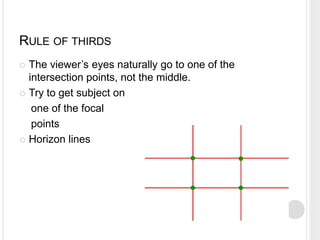
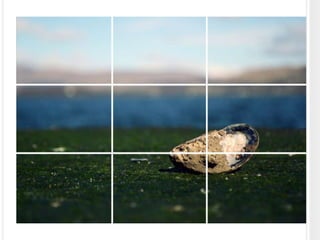
RULE OF THIRDS
 The viewer’s eyes naturally go to one of the
intersection points, not the middle.
 Try to get subject on
one of the focal
points
 Horizon lines
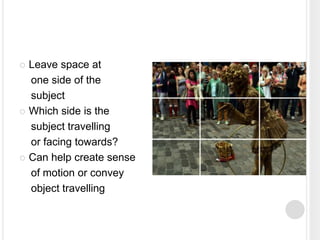
 Leave space at
one side of the
subject
 Which side is the
subject travelling
or facing towards?
 Can help create sense
of motion or convey
object travelling
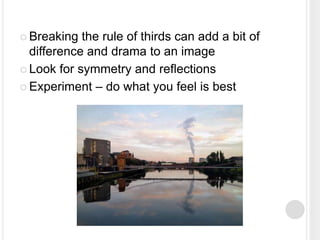
 Breaking the rule of thirds can add a bit of
difference and drama to an image
 Look for symmetry and reflections
 Experiment – do what you feel is best
FRAMING AND BACKGROUND
 Have something of interest in the foreground, as
well as something in the middle ground and
background – creates depth and distance
 More than one subject (use thirds)
 Frame shots between two objects e.g. Trees,
buildings
 Adjust your focus to blur the background or
foreground to give extra focus to the main subject
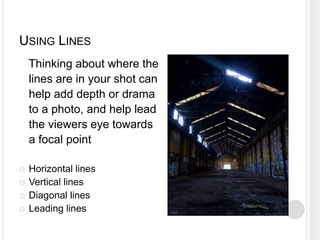
USING LINES
Thinking about where the
lines are in your shot can
help add depth or drama
to a photo, and help lead
the viewers eye towards
a focal point
 Horizontal lines
 Vertical lines
 Diagonal lines
 Leading lines
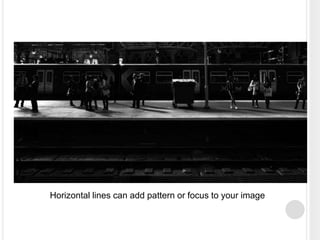
Horizontal lines can add pattern or focus to your image
PATTERN, TEXTURE AND FORM
 Look for repetitive patterns
 Breaks in a pattern can be interesting
 Reoccurring shapes
 Interesting shapes and form – stand side on, not
front on for depth and 3 dimensional images
 Use light and shadow to emphasise form and
texture
LIGHT
 Early morning and late afternoon - soft light
 Midday – harsh (hard) light
 Sunrise and sunset - vivid colour and silhouettes
 Watch for blown out skies – better to have
foreground dark
 Night photography – long exposure, use tripod or
flash
 Cloudy weather low contrast – but can be dramatic
‘SOFT’ LIGHT
 The closer to the light source the broader the light
 The broader the light the softer the light
 Less contrast and distinct shadows and highlights
 Portrait photography
 Soft skin textures
 e.g. Someone sitting next to a window or a lamp.
‘HARD’ LIGHT
 The further away from the light source the harder
the light
 More pronounced shadows and highlights
 Landscape photography – far away from the sun
(light source)
 Street photography
Using a Flash
 Removes shadows
 Lights up foreground – but darkens background
 Red eye and reflections (glass, mirrors)
GENERAL TIPS
 Learn your camera’s controls off by heart
 Always try for straight horizon lines
 Don’t worry about other people looking at you
 ... But don’t make ‘subjects’ uncomfortable – don’t
be a creep!
 Change your perspective – get down on the floor or
stand on something
 Have fun!
Slides available online at

Workshop

  • 1.
  • 2.
    CONTENTS  What shouldI shoot?  Types and styles of photography  Composition  Pattern, texture and form  Using lines  Light  General tips for improving your photography  1 hour photo walk  Peer review
  • 3.
    WHAT SHOULD ISHOOT? Why do you want to get into photography?  Artistic  Communicate a message or idea  Memories  Complement or document other activities
  • 4.
    WHAT ARE YOUINTERESTED IN? People find they like photographing things they are interested in anyway  Buildings and architecture  Animals  Landscape  Macro photography  Street photography  Urban  Objects
  • 5.
    STILL NOT SURE? Take your camera everywhere with you – don’t be afraid or embarrassed about taking pictures in public  Maybe start by asking yourself which type of photography you like to look at the most  Challenge yourself with subjects you wouldn’t usually focus on  Experiment
  • 6.
    TYPES & STYLESOF PHOTOGRAPHY  Landscape/Seascape (natural)  Cityscape  Portrait  Macro  Urban/Industrial  Architectural  Street Photography  Many more...
  • 7.
    THINGS TO CONSIDER Severalkey areas which you should consider:  Light  Shape  Texture  Pattern  Colour  Composition LIGHT and COMPOSITION are the most important!
  • 8.
    RULE OF THIRDS The viewer’s eyes naturally go to one of the intersection points, not the middle.  Try to get subject on one of the focal points  Horizon lines
  • 10.
     Leave spaceat one side of the subject  Which side is the subject travelling or facing towards?  Can help create sense of motion or convey object travelling
  • 11.
     Breaking therule of thirds can add a bit of difference and drama to an image  Look for symmetry and reflections  Experiment – do what you feel is best
  • 12.
    FRAMING AND BACKGROUND Have something of interest in the foreground, as well as something in the middle ground and background – creates depth and distance  More than one subject (use thirds)  Frame shots between two objects e.g. Trees, buildings  Adjust your focus to blur the background or foreground to give extra focus to the main subject
  • 13.
    USING LINES Thinking aboutwhere the lines are in your shot can help add depth or drama to a photo, and help lead the viewers eye towards a focal point  Horizontal lines  Vertical lines  Diagonal lines  Leading lines
  • 14.
    Horizontal lines canadd pattern or focus to your image
  • 15.
    PATTERN, TEXTURE ANDFORM  Look for repetitive patterns  Breaks in a pattern can be interesting  Reoccurring shapes  Interesting shapes and form – stand side on, not front on for depth and 3 dimensional images  Use light and shadow to emphasise form and texture
  • 16.
    LIGHT  Early morningand late afternoon - soft light  Midday – harsh (hard) light  Sunrise and sunset - vivid colour and silhouettes  Watch for blown out skies – better to have foreground dark  Night photography – long exposure, use tripod or flash  Cloudy weather low contrast – but can be dramatic
  • 17.
    ‘SOFT’ LIGHT  Thecloser to the light source the broader the light  The broader the light the softer the light  Less contrast and distinct shadows and highlights  Portrait photography  Soft skin textures  e.g. Someone sitting next to a window or a lamp.
  • 18.
    ‘HARD’ LIGHT  Thefurther away from the light source the harder the light  More pronounced shadows and highlights  Landscape photography – far away from the sun (light source)  Street photography Using a Flash  Removes shadows  Lights up foreground – but darkens background  Red eye and reflections (glass, mirrors)
  • 19.
    GENERAL TIPS  Learnyour camera’s controls off by heart  Always try for straight horizon lines  Don’t worry about other people looking at you  ... But don’t make ‘subjects’ uncomfortable – don’t be a creep!  Change your perspective – get down on the floor or stand on something  Have fun! Slides available online at

Editor's Notes

  • #5 People often find they like taking pictures of things they have an interest in anyway. Other activities you do are a good starting point for photography. Another