 What is the target audience of a media product?
 What is audience profiling?
 What is a niche audience?
 What is the demographic profiling model?
 What is the socio-economic profiling model?
 Target audiences directly through their needs and desires,
which is more effective for advertisers, broadcasters and
publishers.
 Advertisers aim to link the ideologies of the product to those
of the consumer:
 Values (political, social, religious)
 Culture (High culture vs. Popular culture)
 Attitudes
 Lifestyles (habits and hobbies)
Cross-Cultural Consumer Characteristics (The Four Cs)
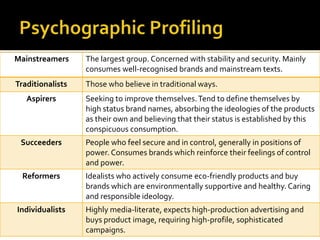
 Categorise people in terms of their personal aspirations. Profiles audiences in terms of needs and desires.
Classification:
 Mainstreamers: The largest group. Concerned with stability and security. Mainly consumes well-recognised brands and
mainstream texts.
 Traditionalists: Those who believe in traditional ways.
 Aspirers: Seeking to improve themselves.Tend to define themselves by high status brand names, absorbing the
ideologies of the products as their own and believing that their status is established by this conspicuous consumption.
 Succeeders: People who feel secure and in control, generally in positions of power.Consumes brands which reinforce their
feelings of control and power.
 Reformers: Idealists who actively consume eco-friendly products and buy brands which are environmentally supportive
and healthy.Caring and responsible ideology.
 Individualists: Highly media-literate, expects high-production advertising and buys product image, requiring high-profile,
sophisticated campaigns.
Mainstreamers The largest group. Concerned with stability and security. Mainly
consumes well-recognised brands and mainstream texts.
Traditionalists Those who believe in traditional ways.
Aspirers Seeking to improve themselves.Tend to define themselves by
high status brand names, absorbing the ideologies of the products
as their own and believing that their status is established by this
conspicuous consumption.
Succeeders People who feel secure and in control, generally in positions of
power. Consumes brands which reinforce their feelings of control
and power.
Reformers Idealists who actively consume eco-friendly products and buy
brands which are environmentally supportive and healthy. Caring
and responsible ideology.
Individualists Highly media-literate, expects high-production advertising and
buys product image, requiring high-profile, sophisticated
campaigns.
Mainstreamers The largest group. Concerned with stability and security. Mainly consumes
well-recognised brands and mainstream texts.
Traditionalists Those who believe in traditional ways.
Aspirers Seeking to improve themselves. Tend to define themselves by high status
brand names, absorbing the ideologies of the products as their own and
believing that their status is established by this conspicuous consumption.
Succeeders People who feel secure and in control, generally in positions of power.
Consumes brands which reinforce their feelings of control and power.
Reformers Idealists who actively consume eco-friendly products and buy brands which are
environmentally supportive and healthy. Caring and responsible ideology.
Individualists Highly media-literate, expects high-production advertising and buys product
image, requiring high-profile, sophisticated campaigns.
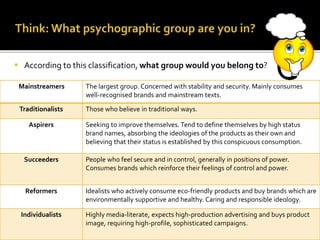
 According to this classification, what group would you belong to?
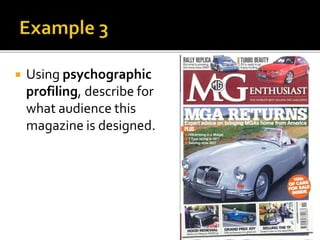
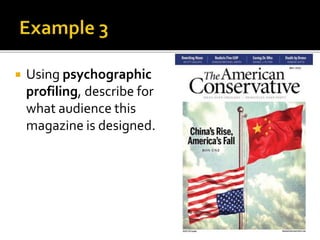
 Using psychographic
profiling, describe for
what audience this
magazine is designed.
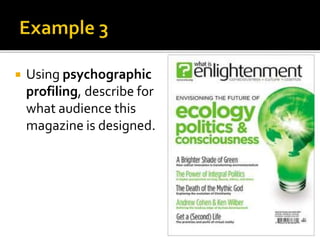
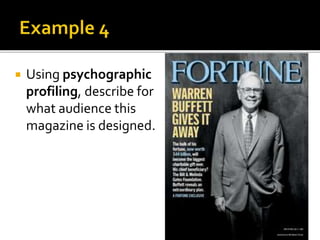
 Using psychographic
profiling, describe for
what audience this
magazine is designed.
 Using psychographic
profiling, describe for
what audience this
magazine is designed.
 Using psychographic
profiling, describe for
what audience this
magazine is designed.
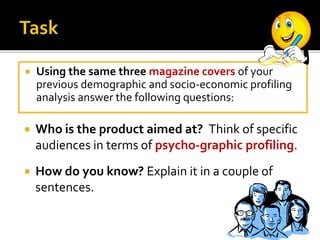
 Using the same three magazine covers of your
previous demographic and socio-economic profiling
analysis answer the following questions:
 Who is the product aimed at? Think of specific
audiences in terms of psycho-graphic profiling.
 How do you know? Explain it in a couple of
sentences.
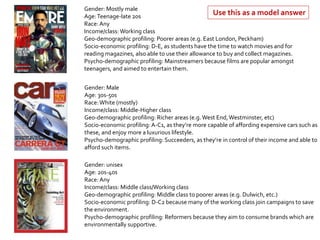
Gender: Mostly male
Age:Teenage-late 20s
Race: Any
Income/class: Working class
Geo-demographic profiling: Poorer areas (e.g. East London, Peckham)
Socio-economic profiling: D-E, as students have the time to watch movies and for
reading magazines, also able to use their allowance to buy and collect magazines.
Psycho-demographic profiling: Mainstreamers because films are popular amongst
teenagers, and aimed to entertain them.
Gender: Male
Age: 30s-50s
Race:White (mostly)
Income/class: Middle-Higher class
Geo-demographic profiling: Richer areas (e.g.West End,Westminster, etc)
Socio-economic profiling: A-C1, as they’re more capable of affording expensive cars such as
these, and enjoy more a luxurious lifestyle.
Psycho-demographic profiling: Succeeders, as they’re in control of their income and able to
afford such items.
Gender: unisex
Age: 20s-40s
Race: Any
Income/class: Middle class/Working class
Geo-demographic profiling: Middle class to poorer areas (e.g. Dulwich, etc.)
Socio-economic profiling: D-C2 because many of the working class join campaigns to save
the environment.
Psycho-demographic profiling: Reformers because they aim to consume brands which are
environmentally supportive.
Use this as a model answer
 What is demographic profiling model?
 What are the main six criteria in the demographic
profiling model?
 What is the socio-economic model?
 What is the psychographic profiling model?
 What psychographic group are you in?
Progress Bar:
Circle your effort level for today’s lesson.
1 2 3 4 5
WWW EBI
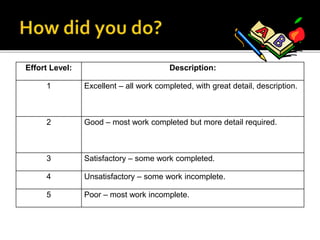
Effort Level: Description:
1 Excellent – all work completed, with great detail, description.
2 Good – most work completed but more detail required.
3 Satisfactory – some work completed.
4 Unsatisfactory – some work incomplete.
5 Poor – most work incomplete.

Lesson 4_Audience profiling 3_Psycho-graphic profiling model

  • 2.
     What isthe target audience of a media product?  What is audience profiling?  What is a niche audience?  What is the demographic profiling model?  What is the socio-economic profiling model?
  • 3.
     Target audiencesdirectly through their needs and desires, which is more effective for advertisers, broadcasters and publishers.  Advertisers aim to link the ideologies of the product to those of the consumer:  Values (political, social, religious)  Culture (High culture vs. Popular culture)  Attitudes  Lifestyles (habits and hobbies)
  • 4.
    Cross-Cultural Consumer Characteristics(The Four Cs)  Categorise people in terms of their personal aspirations. Profiles audiences in terms of needs and desires. Classification:  Mainstreamers: The largest group. Concerned with stability and security. Mainly consumes well-recognised brands and mainstream texts.  Traditionalists: Those who believe in traditional ways.  Aspirers: Seeking to improve themselves.Tend to define themselves by high status brand names, absorbing the ideologies of the products as their own and believing that their status is established by this conspicuous consumption.  Succeeders: People who feel secure and in control, generally in positions of power.Consumes brands which reinforce their feelings of control and power.  Reformers: Idealists who actively consume eco-friendly products and buy brands which are environmentally supportive and healthy.Caring and responsible ideology.  Individualists: Highly media-literate, expects high-production advertising and buys product image, requiring high-profile, sophisticated campaigns.
  • 5.
    Mainstreamers The largestgroup. Concerned with stability and security. Mainly consumes well-recognised brands and mainstream texts. Traditionalists Those who believe in traditional ways. Aspirers Seeking to improve themselves.Tend to define themselves by high status brand names, absorbing the ideologies of the products as their own and believing that their status is established by this conspicuous consumption. Succeeders People who feel secure and in control, generally in positions of power. Consumes brands which reinforce their feelings of control and power. Reformers Idealists who actively consume eco-friendly products and buy brands which are environmentally supportive and healthy. Caring and responsible ideology. Individualists Highly media-literate, expects high-production advertising and buys product image, requiring high-profile, sophisticated campaigns.
  • 6.
    Mainstreamers The largestgroup. Concerned with stability and security. Mainly consumes well-recognised brands and mainstream texts. Traditionalists Those who believe in traditional ways. Aspirers Seeking to improve themselves. Tend to define themselves by high status brand names, absorbing the ideologies of the products as their own and believing that their status is established by this conspicuous consumption. Succeeders People who feel secure and in control, generally in positions of power. Consumes brands which reinforce their feelings of control and power. Reformers Idealists who actively consume eco-friendly products and buy brands which are environmentally supportive and healthy. Caring and responsible ideology. Individualists Highly media-literate, expects high-production advertising and buys product image, requiring high-profile, sophisticated campaigns.  According to this classification, what group would you belong to?
  • 7.
     Using psychographic profiling,describe for what audience this magazine is designed.
  • 8.
     Using psychographic profiling,describe for what audience this magazine is designed.
  • 9.
     Using psychographic profiling,describe for what audience this magazine is designed.
  • 10.
     Using psychographic profiling,describe for what audience this magazine is designed.
  • 11.
     Using thesame three magazine covers of your previous demographic and socio-economic profiling analysis answer the following questions:  Who is the product aimed at? Think of specific audiences in terms of psycho-graphic profiling.  How do you know? Explain it in a couple of sentences.
  • 12.
    Gender: Mostly male Age:Teenage-late20s Race: Any Income/class: Working class Geo-demographic profiling: Poorer areas (e.g. East London, Peckham) Socio-economic profiling: D-E, as students have the time to watch movies and for reading magazines, also able to use their allowance to buy and collect magazines. Psycho-demographic profiling: Mainstreamers because films are popular amongst teenagers, and aimed to entertain them. Gender: Male Age: 30s-50s Race:White (mostly) Income/class: Middle-Higher class Geo-demographic profiling: Richer areas (e.g.West End,Westminster, etc) Socio-economic profiling: A-C1, as they’re more capable of affording expensive cars such as these, and enjoy more a luxurious lifestyle. Psycho-demographic profiling: Succeeders, as they’re in control of their income and able to afford such items. Gender: unisex Age: 20s-40s Race: Any Income/class: Middle class/Working class Geo-demographic profiling: Middle class to poorer areas (e.g. Dulwich, etc.) Socio-economic profiling: D-C2 because many of the working class join campaigns to save the environment. Psycho-demographic profiling: Reformers because they aim to consume brands which are environmentally supportive. Use this as a model answer
  • 13.
     What isdemographic profiling model?  What are the main six criteria in the demographic profiling model?  What is the socio-economic model?  What is the psychographic profiling model?  What psychographic group are you in?
  • 14.
    Progress Bar: Circle youreffort level for today’s lesson. 1 2 3 4 5 WWW EBI
  • 15.
    Effort Level: Description: 1Excellent – all work completed, with great detail, description. 2 Good – most work completed but more detail required. 3 Satisfactory – some work completed. 4 Unsatisfactory – some work incomplete. 5 Poor – most work incomplete.