Creative Media Production Management Project
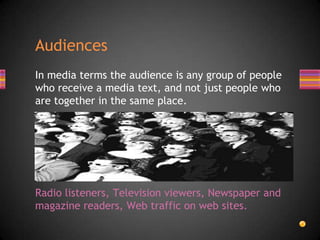
In media terms the audience is any group of people
who receive a media text, and not just people who
are together in the same place.
Radio listeners, Television viewers, Newspaper and
magazine readers, Web traffic on web sites.
Audiences
All media texts are produced with an
audience in mind – that is to say a
group of people who will receive the
text and make some sort of sense out
of it.
Audiences
A media producer has to know who is the
potential audience, and as much about them
as possible.
The three main methods of Audience
Research that you should be aware of are:
1. Demographics
2. Psychographics
3. Research Organisations
Audience Research
A common and traditional method of audience
research is known as demographics.
This defines the adult population largely by the work
that they do.
It breaks the population down into 6 groups, and
labels them by using a letter code to describe the
income and status of the members of each group.
Demographics
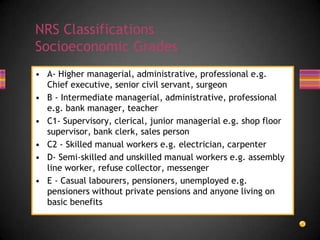
• A- Higher managerial, administrative, professional e.g.
Chief executive, senior civil servant, surgeon
• B - Intermediate managerial, administrative, professional
e.g. bank manager, teacher
• C1- Supervisory, clerical, junior managerial e.g. shop floor
supervisor, bank clerk, sales person
• C2 - Skilled manual workers e.g. electrician, carpenter
• D- Semi-skilled and unskilled manual workers e.g. assembly
line worker, refuse collector, messenger
• E - Casual labourers, pensioners, unemployed e.g.
pensioners without private pensions and anyone living on
basic benefits
NRS Classifications
Socioeconomic Grades
Which category would they fall into?
Which media products do they consume?
A
B
C1
C2
D
E
It does not tell the media producers some things
they would like to know, such as how much money
each group has to spend each week.
Some skilled manual workers, like electricians, earn
more money each week than say a teacher, but they
probably do not spend it in the same way.
Also demographics is only about the main earner in a
household so young people at home – for example,
are not included.
Criticisms
An alternative demographic measure of a person may include
information such as:
– Area of Residence (Rural/City)
– Mobility
– Age
– Gender
– Sexual Orientation
– Place of Origin (Ethnicity)
– Religion
– Disabilities/Health
– Languages
Demographics
This is a way of describing an audience by
looking at the behaviour and personality
traits of its members.
Psychographics labels a particular type of
person and makes an assessment about their
viewing and spending habits.
Psychographics
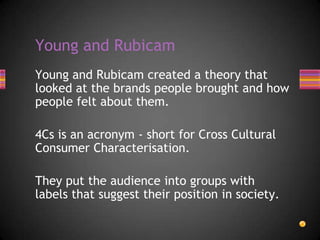
Young and Rubicam created a theory that
looked at the brands people brought and how
people felt about them.
4Cs is an acronym - short for Cross Cultural
Consumer Characterisation.
They put the audience into groups with
labels that suggest their position in society.
Young and Rubicam
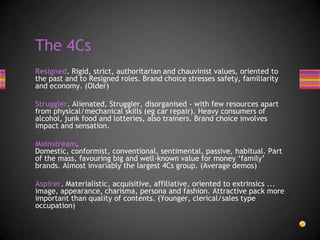
Resigned. Rigid, strict, authoritarian and chauvinist values, oriented to
the past and to Resigned roles. Brand choice stresses safety, familiarity
and economy. (Older)
Struggler. Alienated, Struggler, disorganised - with few resources apart
from physical/mechanical skills (eg car repair). Heavy consumers of
alcohol, junk food and lotteries, also trainers. Brand choice involves
impact and sensation.
Mainstream.
Domestic, conformist, conventional, sentimental, passive, habitual. Part
of the mass, favouring big and well-known value for money ‘family’
brands. Almost invariably the largest 4Cs group. (Average demos)
Aspirer. Materialistic, acquisitive, affiliative, oriented to extrinsics ...
image, appearance, charisma, persona and fashion. Attractive pack more
important than quality of contents. (Younger, clerical/sales type
occupation)
The 4Cs
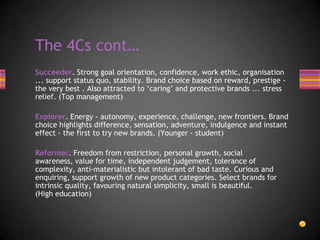
Succeeder. Strong goal orientation, confidence, work ethic, organisation
... support status quo, stability. Brand choice based on reward, prestige -
the very best . Also attracted to ‘caring’ and protective brands ... stress
relief. (Top management)
Explorer. Energy - autonomy, experience, challenge, new frontiers. Brand
choice highlights difference, sensation, adventure, indulgence and instant
effect - the first to try new brands. (Younger - student)
Reformer. Freedom from restriction, personal growth, social
awareness, value for time, independent judgement, tolerance of
complexity, anti-materialistic but intolerant of bad taste. Curious and
enquiring, support growth of new product categories. Select brands for
intrinsic quality, favouring natural simplicity, small is beautiful.
(High education)
The 4Cs cont…
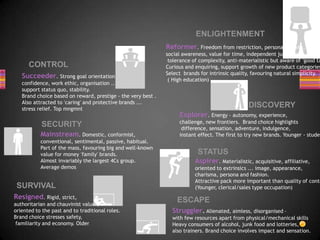
DISCOVERY
ENLIGHTENMENT
Struggler. Alienated, aimless, disorganised –
with few resources apart from physical/mechanical skills
Heavy consumers of alcohol, junk food and lotteries,
also trainers. Brand choice involves impact and sensation.
Aspirer. Materialistic, acquisitive, affiliative,
oriented to extrinsics ... image, appearance,
charisma, persona and fashion.
Attractive pack more important than quality of conte
(Younger, clerical/sales type occupation)
Mainstream. Domestic, conformist,
conventional, sentimental, passive, habitual.
Part of the mass, favouring big and well-known
value for money ‘family’ brands.
Almost invariably the largest 4Cs group.
Average demos
SECURITY
Resigned. Rigid, strict,
authoritarian and chauvinist values,
oriented to the past and to traditional roles.
Brand choice stresses safety,
familiarity and economy. Older
SURVIVAL
ESCAPE
Reformer. Freedom from restriction, personal growth,
social awareness, value for time, independent judgement,
tolerance of complexity, anti-materialistic but aware of ‘good ta
Curious and enquiring, support growth of new product categories
Select brands for intrinsic quality, favouring natural simplicity.
( High education)
STATUS
Succeeder. Strong goal orientation,
confidence, work ethic, organisation ...
support status quo, stability.
Brand choice based on reward, prestige - the very best .
Also attracted to ‘caring’ and protective brands ...
stress relief. Top mngmnt
CONTROL
Explorer. Energy - autonomy, experience,
challenge, new frontiers. Brand choice highlights
difference, sensation, adventure, indulgence,
instant effect. The first to try new brands. Younger - studen
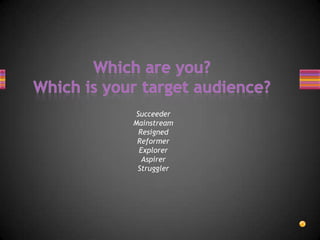
Succeeder
Mainstream
Resigned
Reformer
Explorer
Aspirer
Struggler
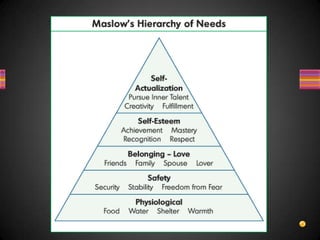
Hierarchy of Needs
An American psychologist, Abraham Maslow, suggested that we
all have different layers of needs.
We have to achieve certain needs before going on to the next
layer.
His Hierarchy of Needs suggests that once people have their
basic needs met like housing, food, safety, shopping,
technology, and a job they can then go on to satisfy
successively ‘higher needs’ that occupy a set hierarchy or
system of ranking.
An alternative psychographic measure of a person might
include:
– Interests
– Activities
– Opinions
– Behavioural Patterns
– Habits
– Lifestyle
– Perceptions
– Hobbies
Psychographics
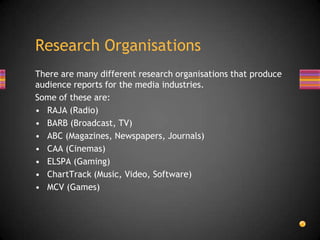
There are many different research organisations that produce
audience reports for the media industries.
Some of these are:
• RAJA (Radio)
• BARB (Broadcast, TV)
• ABC (Magazines, Newspapers, Journals)
• CAA (Cinemas)
• ELSPA (Gaming)
• ChartTrack (Music, Video, Software)
• MCV (Games)
Research Organisations
Find out the latest research facts and
figures
Summarise these in note form and/or in a
mind-map
Original information, gathered by the researcher.
Such as:
• Observations
• Interviews
• Questionnaires or Surveys
Complete at least one of the above as part of your research
into your target audience
Primary Research
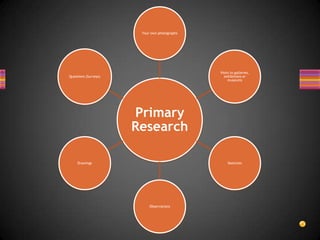
Primary
Research
Your own photographs
Visits to galleries,
exhibitions or
museums
Sketches
Observations
Drawings
Questions (Surveys)
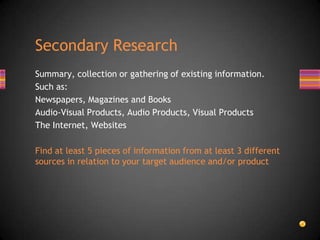
Summary, collection or gathering of existing information.
Such as:
Newspapers, Magazines and Books
Audio-Visual Products, Audio Products, Visual Products
The Internet, Websites
Find at least 5 pieces of information from at least 3 different
sources in relation to your target audience and/or product
Secondary Research
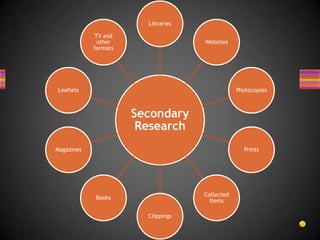
Secondary
Research
Libraries
Websites
Photocopies
Prints
Collected
Items
Clippings
Books
Magazines
Leaflets
TV and
other
formats

Audiences

  • 1.
    Creative Media ProductionManagement Project
  • 2.
    In media termsthe audience is any group of people who receive a media text, and not just people who are together in the same place. Radio listeners, Television viewers, Newspaper and magazine readers, Web traffic on web sites. Audiences
  • 3.
    All media textsare produced with an audience in mind – that is to say a group of people who will receive the text and make some sort of sense out of it. Audiences
  • 4.
    A media producerhas to know who is the potential audience, and as much about them as possible. The three main methods of Audience Research that you should be aware of are: 1. Demographics 2. Psychographics 3. Research Organisations Audience Research
  • 5.
    A common andtraditional method of audience research is known as demographics. This defines the adult population largely by the work that they do. It breaks the population down into 6 groups, and labels them by using a letter code to describe the income and status of the members of each group. Demographics
  • 6.
    • A- Highermanagerial, administrative, professional e.g. Chief executive, senior civil servant, surgeon • B - Intermediate managerial, administrative, professional e.g. bank manager, teacher • C1- Supervisory, clerical, junior managerial e.g. shop floor supervisor, bank clerk, sales person • C2 - Skilled manual workers e.g. electrician, carpenter • D- Semi-skilled and unskilled manual workers e.g. assembly line worker, refuse collector, messenger • E - Casual labourers, pensioners, unemployed e.g. pensioners without private pensions and anyone living on basic benefits NRS Classifications Socioeconomic Grades
  • 7.
    Which category wouldthey fall into? Which media products do they consume?
  • 8.
  • 9.
    It does nottell the media producers some things they would like to know, such as how much money each group has to spend each week. Some skilled manual workers, like electricians, earn more money each week than say a teacher, but they probably do not spend it in the same way. Also demographics is only about the main earner in a household so young people at home – for example, are not included. Criticisms
  • 10.
    An alternative demographicmeasure of a person may include information such as: – Area of Residence (Rural/City) – Mobility – Age – Gender – Sexual Orientation – Place of Origin (Ethnicity) – Religion – Disabilities/Health – Languages Demographics
  • 11.
    This is away of describing an audience by looking at the behaviour and personality traits of its members. Psychographics labels a particular type of person and makes an assessment about their viewing and spending habits. Psychographics
  • 12.
    Young and Rubicamcreated a theory that looked at the brands people brought and how people felt about them. 4Cs is an acronym - short for Cross Cultural Consumer Characterisation. They put the audience into groups with labels that suggest their position in society. Young and Rubicam
  • 13.
    Resigned. Rigid, strict,authoritarian and chauvinist values, oriented to the past and to Resigned roles. Brand choice stresses safety, familiarity and economy. (Older) Struggler. Alienated, Struggler, disorganised - with few resources apart from physical/mechanical skills (eg car repair). Heavy consumers of alcohol, junk food and lotteries, also trainers. Brand choice involves impact and sensation. Mainstream. Domestic, conformist, conventional, sentimental, passive, habitual. Part of the mass, favouring big and well-known value for money ‘family’ brands. Almost invariably the largest 4Cs group. (Average demos) Aspirer. Materialistic, acquisitive, affiliative, oriented to extrinsics ... image, appearance, charisma, persona and fashion. Attractive pack more important than quality of contents. (Younger, clerical/sales type occupation) The 4Cs
  • 14.
    Succeeder. Strong goalorientation, confidence, work ethic, organisation ... support status quo, stability. Brand choice based on reward, prestige - the very best . Also attracted to ‘caring’ and protective brands ... stress relief. (Top management) Explorer. Energy - autonomy, experience, challenge, new frontiers. Brand choice highlights difference, sensation, adventure, indulgence and instant effect - the first to try new brands. (Younger - student) Reformer. Freedom from restriction, personal growth, social awareness, value for time, independent judgement, tolerance of complexity, anti-materialistic but intolerant of bad taste. Curious and enquiring, support growth of new product categories. Select brands for intrinsic quality, favouring natural simplicity, small is beautiful. (High education) The 4Cs cont…
  • 15.
    DISCOVERY ENLIGHTENMENT Struggler. Alienated, aimless,disorganised – with few resources apart from physical/mechanical skills Heavy consumers of alcohol, junk food and lotteries, also trainers. Brand choice involves impact and sensation. Aspirer. Materialistic, acquisitive, affiliative, oriented to extrinsics ... image, appearance, charisma, persona and fashion. Attractive pack more important than quality of conte (Younger, clerical/sales type occupation) Mainstream. Domestic, conformist, conventional, sentimental, passive, habitual. Part of the mass, favouring big and well-known value for money ‘family’ brands. Almost invariably the largest 4Cs group. Average demos SECURITY Resigned. Rigid, strict, authoritarian and chauvinist values, oriented to the past and to traditional roles. Brand choice stresses safety, familiarity and economy. Older SURVIVAL ESCAPE Reformer. Freedom from restriction, personal growth, social awareness, value for time, independent judgement, tolerance of complexity, anti-materialistic but aware of ‘good ta Curious and enquiring, support growth of new product categories Select brands for intrinsic quality, favouring natural simplicity. ( High education) STATUS Succeeder. Strong goal orientation, confidence, work ethic, organisation ... support status quo, stability. Brand choice based on reward, prestige - the very best . Also attracted to ‘caring’ and protective brands ... stress relief. Top mngmnt CONTROL Explorer. Energy - autonomy, experience, challenge, new frontiers. Brand choice highlights difference, sensation, adventure, indulgence, instant effect. The first to try new brands. Younger - studen
  • 16.
  • 17.
    Hierarchy of Needs AnAmerican psychologist, Abraham Maslow, suggested that we all have different layers of needs. We have to achieve certain needs before going on to the next layer. His Hierarchy of Needs suggests that once people have their basic needs met like housing, food, safety, shopping, technology, and a job they can then go on to satisfy successively ‘higher needs’ that occupy a set hierarchy or system of ranking.
  • 19.
    An alternative psychographicmeasure of a person might include: – Interests – Activities – Opinions – Behavioural Patterns – Habits – Lifestyle – Perceptions – Hobbies Psychographics
  • 20.
    There are manydifferent research organisations that produce audience reports for the media industries. Some of these are: • RAJA (Radio) • BARB (Broadcast, TV) • ABC (Magazines, Newspapers, Journals) • CAA (Cinemas) • ELSPA (Gaming) • ChartTrack (Music, Video, Software) • MCV (Games) Research Organisations
  • 21.
    Find out thelatest research facts and figures Summarise these in note form and/or in a mind-map
  • 22.
    Original information, gatheredby the researcher. Such as: • Observations • Interviews • Questionnaires or Surveys Complete at least one of the above as part of your research into your target audience Primary Research
  • 23.
    Primary Research Your own photographs Visitsto galleries, exhibitions or museums Sketches Observations Drawings Questions (Surveys)
  • 24.
    Summary, collection orgathering of existing information. Such as: Newspapers, Magazines and Books Audio-Visual Products, Audio Products, Visual Products The Internet, Websites Find at least 5 pieces of information from at least 3 different sources in relation to your target audience and/or product Secondary Research
  • 25.