FLASH ANIMATION
STRUCTURE AND PERSPECTIVE
Marvin B. Broñoso
Flash Animation Teacher
Olongapo Wesley School, Inc.
09186975164
Learning Competencies
The learners will be able to . . .
• draw a single and two point perspective
drawing.
• draw objects in proportion by knowing the
center of a drawing.
• understand the structure and form of an object.
2
OVERVIEW
3
At this point, you will try to draw a realistic object. But
first, you need to learn how to see and understand a
structure and perspective. A 3D drawing may sound
overwhelming, but for a general drawing, you only
need to learn the basics and practice to develop a feel
for it.
PERSPECTIVE DRAWING
4
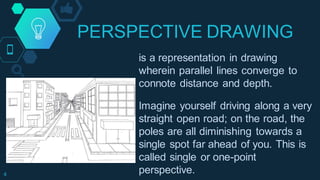
is a representation in drawing
wherein parallel lines converge to
connote distance and depth.
Imagine yourself driving along a very
straight open road; on the road, the
poles are all diminishing towards a
single spot far ahead of you. This is
called single or one-point
perspective.
ONE-POINT PERSPECTIVE DRAWING
5
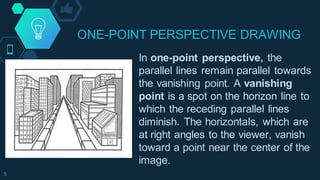
In one-point perspective, the
parallel lines remain parallel towards
the vanishing point. A vanishing
point is a spot on the horizon line to
which the receding parallel lines
diminish. The horizontals, which are
at right angles to the viewer, vanish
toward a point near the center of the
image.
ONE-POINT PERSPECTIVE DRAWING
6
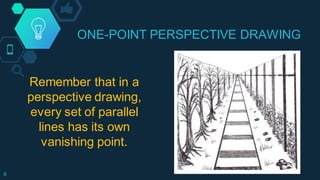
Remember that in a
perspective drawing,
every set of parallel
lines has its own
vanishing point.
ACTIVITY
7
PREPARE YOUR:
☺ Pencil
☺ Eraser
☺ Ruler
☺ Short Bond Paper
P1 ACTIVITY
8
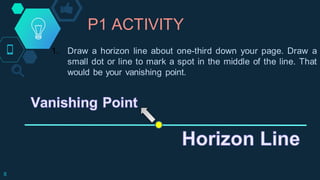
1. Draw a horizon line about one-third down your page. Draw a
small dot or line to mark a spot in the middle of the line. That
would be your vanishing point.
P2 ACTIVITY
9
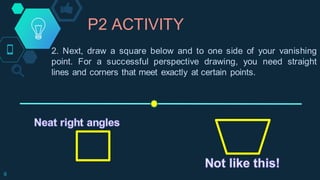
2. Next, draw a square below and to one side of your vanishing
point. For a successful perspective drawing, you need straight
lines and corners that meet exactly at certain points.
P3 ACTIVITY
10
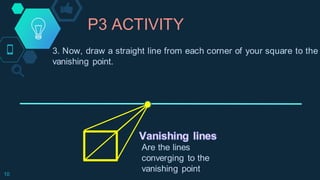
3. Now, draw a straight line from each corner of your square to the
vanishing point.
Are the lines
converging to the
vanishing point
P4 ACTIVITY
11
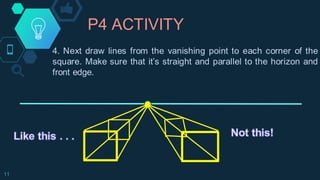
4. Next draw lines from the vanishing point to each corner of the
square. Make sure that it’s straight and parallel to the horizon and
front edge.
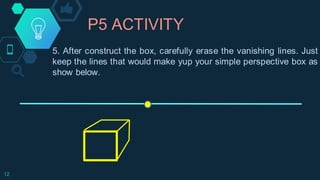
P5 ACTIVITY
12
5. After construct the box, carefully erase the vanishing lines. Just
keep the lines that would make yup your simple perspective box as
show below.
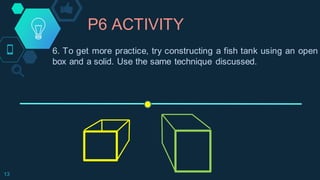
P6 ACTIVITY
13
6. To get more practice, try constructing a fish tank using an open
box and a solid. Use the same technique discussed.
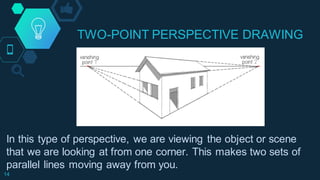
TWO-POINT PERSPECTIVE DRAWING
14
In this type of perspective, we are viewing the object or scene
that we are looking at from one corner. This makes two sets of
parallel lines moving away from you.
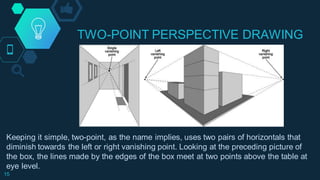
TWO-POINT PERSPECTIVE DRAWING
15
Keeping it simple, two-point, as the name implies, uses two pairs of horizontals that
diminish towards the left or right vanishing point. Looking at the preceding picture of
the box, the lines made by the edges of the box meet at two points above the table at
eye level.
ACTIVITY
16
PREPARE YOUR:
☺ Pencil
☺ Eraser
☺ Ruler
☺ Short Bond Paper
P1 ACTIVITY
17
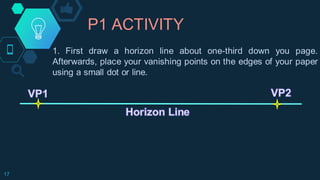
1. First draw a horizon line about one-third down you page.
Afterwards, place your vanishing points on the edges of your paper
using a small dot or line.
P2 ACTIVITY
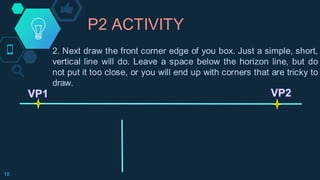
18
2. Next draw the front corner edge of you box. Just a simple, short,
vertical line will do. Leave a space below the horizon line, but do
not put it too close, or you will end up with corners that are tricky to
draw.
P3 ACTIVITY
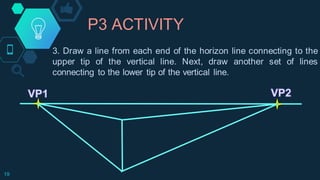
19
3. Draw a line from each end of the horizon line connecting to the
upper tip of the vertical line. Next, draw another set of lines
connecting to the lower tip of the vertical line.
P4 ACTIVITY
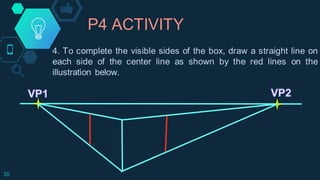
20
4. To complete the visible sides of the box, draw a straight line on
each side of the center line as shown by the red lines on the
illustration below.
P5 ACTIVITY
21
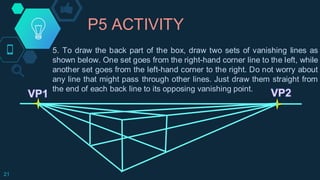
5. To draw the back part of the box, draw two sets of vanishing lines as
shown below. One set goes from the right-hand corner line to the left, while
another set goes from the left-hand corner to the right. Do not worry about
any line that might pass through other lines. Just draw them straight from
the end of each back line to its opposing vanishing point.
P6 ACTIVITY
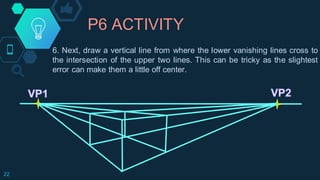
22
6. Next, draw a vertical line from where the lower vanishing lines cross to
the intersection of the upper two lines. This can be tricky as the slightest
error can make them a little off center.
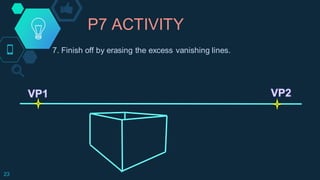
P7 ACTIVITY
23
7. Finish off by erasing the excess vanishing lines.
LAST ACTIVITY
24
ACTIVITY
25
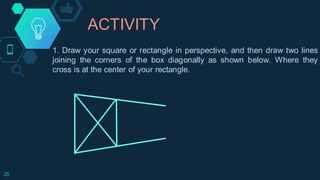
1. Draw your square or rectangle in perspective, and then draw two lines
joining the corners of the box diagonally as shown below. Where they
cross is at the center of your rectangle.
ACTIVITY
26
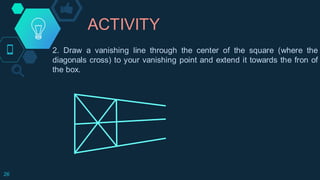
2. Draw a vanishing line through the center of the square (where the
diagonals cross) to your vanishing point and extend it towards the fron of
the box.
ACTIVITY
27
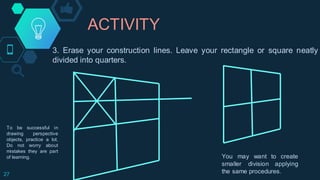
3. Erase your construction lines. Leave your rectangle or square neatly
divided into quarters.
You may want to create
smaller division applying
the same procedures.
To be successful in
drawing perspective
objects, practice a lot.
Do not worry about
mistakes they are part
of learning.
Perceiving Structure and Form
28
Now that you were able to practice drawing in perspective, it is time
to start observing objects. Seeing an object’s structure is important
because it would ensure that an object drawn is in proportion. It
would resemble the details of a drawing.
To start seeing the structure of an object, you must first need to
ignore the surface details and look for the bigger shapes. Look for
three-dimensional objects that you may sketch in perspective.
Begin with simple objects like toys made out of cardboard boxes or
a rocket made from a paper tube and a cone.
Performance Task:
29
STRUCTURING PRACTICE
1. Search a simple object that is perfect for a subject.
2. Imagine that you are going to sculpt it from a piece of
stone. Ask yourself what rough shape you will carve out
first.
3. Start drawing on you paper. Draw the perspective as
precisely as you can. It doesn’t have to be perfect.
a. concentrate on getting the overall proportion and
placement.
b. For a complex form, it would be practical to begin with
the largest section.
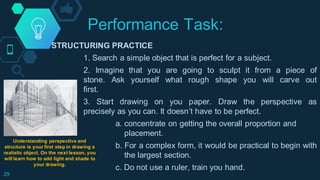
c. Do not use a ruler, train you hand.
Understanding perspective and
structure is your first step in drawing a
realistic object. On the next lesson, you
will learn how to add light and shade to
your drawing.
TERMINOLOGIES
30
One-point perspective
The simplest method of making a three-dimension objects.
Vanishing Point
Is that spot on the horizon line to which the receding parallel lines
diminish.
Vanishing Lines
Are the lines converging to the vanishing point.
Written Work
31
Answer the following questions precisely and concisely.
1. Differentiate a single perspective from a two-point perspective
drawing.
2. How important are vanishing lines and vanishing points in a
perspective drawing?
3. What object did you choose to practice drawing the structure?
Why did you choose that object?
Prepare for
Lesson 5
Tone and Shading
32
33
Credits
Special thanks to all the people who made and released these
awesome resources for free:
◇ Presentation template by SlidesCarnival
◇ Lesson by Marvin Broñoso
◇ Reference book by Digital Whizkids (Computer Animation)
◇ Clipart by ….
■ https://www.studentartguide.com/
■ https://btran14.files.wordpress.com/
■ https://www.craftsy.com/
■ https://www.mathartfun.com/
■ https://hopeafterbetrayal.com/hab-2018
34
SLIDE CONTROL ICONS
35

LESSON 4 - Flash Animation

  • 1.
    FLASH ANIMATION STRUCTURE ANDPERSPECTIVE Marvin B. Broñoso Flash Animation Teacher Olongapo Wesley School, Inc. 09186975164
  • 2.
    Learning Competencies The learnerswill be able to . . . • draw a single and two point perspective drawing. • draw objects in proportion by knowing the center of a drawing. • understand the structure and form of an object. 2
  • 3.
    OVERVIEW 3 At this point,you will try to draw a realistic object. But first, you need to learn how to see and understand a structure and perspective. A 3D drawing may sound overwhelming, but for a general drawing, you only need to learn the basics and practice to develop a feel for it.
  • 4.
    PERSPECTIVE DRAWING 4 is arepresentation in drawing wherein parallel lines converge to connote distance and depth. Imagine yourself driving along a very straight open road; on the road, the poles are all diminishing towards a single spot far ahead of you. This is called single or one-point perspective.
  • 5.
    ONE-POINT PERSPECTIVE DRAWING 5 Inone-point perspective, the parallel lines remain parallel towards the vanishing point. A vanishing point is a spot on the horizon line to which the receding parallel lines diminish. The horizontals, which are at right angles to the viewer, vanish toward a point near the center of the image.
  • 6.
    ONE-POINT PERSPECTIVE DRAWING 6 Rememberthat in a perspective drawing, every set of parallel lines has its own vanishing point.
  • 7.
    ACTIVITY 7 PREPARE YOUR: ☺ Pencil ☺Eraser ☺ Ruler ☺ Short Bond Paper
  • 8.
    P1 ACTIVITY 8 1. Drawa horizon line about one-third down your page. Draw a small dot or line to mark a spot in the middle of the line. That would be your vanishing point.
  • 9.
    P2 ACTIVITY 9 2. Next,draw a square below and to one side of your vanishing point. For a successful perspective drawing, you need straight lines and corners that meet exactly at certain points.
  • 10.
    P3 ACTIVITY 10 3. Now,draw a straight line from each corner of your square to the vanishing point. Are the lines converging to the vanishing point
  • 11.
    P4 ACTIVITY 11 4. Nextdraw lines from the vanishing point to each corner of the square. Make sure that it’s straight and parallel to the horizon and front edge.
  • 12.
    P5 ACTIVITY 12 5. Afterconstruct the box, carefully erase the vanishing lines. Just keep the lines that would make yup your simple perspective box as show below.
  • 13.
    P6 ACTIVITY 13 6. Toget more practice, try constructing a fish tank using an open box and a solid. Use the same technique discussed.
  • 14.
    TWO-POINT PERSPECTIVE DRAWING 14 Inthis type of perspective, we are viewing the object or scene that we are looking at from one corner. This makes two sets of parallel lines moving away from you.
  • 15.
    TWO-POINT PERSPECTIVE DRAWING 15 Keepingit simple, two-point, as the name implies, uses two pairs of horizontals that diminish towards the left or right vanishing point. Looking at the preceding picture of the box, the lines made by the edges of the box meet at two points above the table at eye level.
  • 16.
    ACTIVITY 16 PREPARE YOUR: ☺ Pencil ☺Eraser ☺ Ruler ☺ Short Bond Paper
  • 17.
    P1 ACTIVITY 17 1. Firstdraw a horizon line about one-third down you page. Afterwards, place your vanishing points on the edges of your paper using a small dot or line.
  • 18.
    P2 ACTIVITY 18 2. Nextdraw the front corner edge of you box. Just a simple, short, vertical line will do. Leave a space below the horizon line, but do not put it too close, or you will end up with corners that are tricky to draw.
  • 19.
    P3 ACTIVITY 19 3. Drawa line from each end of the horizon line connecting to the upper tip of the vertical line. Next, draw another set of lines connecting to the lower tip of the vertical line.
  • 20.
    P4 ACTIVITY 20 4. Tocomplete the visible sides of the box, draw a straight line on each side of the center line as shown by the red lines on the illustration below.
  • 21.
    P5 ACTIVITY 21 5. Todraw the back part of the box, draw two sets of vanishing lines as shown below. One set goes from the right-hand corner line to the left, while another set goes from the left-hand corner to the right. Do not worry about any line that might pass through other lines. Just draw them straight from the end of each back line to its opposing vanishing point.
  • 22.
    P6 ACTIVITY 22 6. Next,draw a vertical line from where the lower vanishing lines cross to the intersection of the upper two lines. This can be tricky as the slightest error can make them a little off center.
  • 23.
    P7 ACTIVITY 23 7. Finishoff by erasing the excess vanishing lines.
  • 24.
  • 25.
    ACTIVITY 25 1. Draw yoursquare or rectangle in perspective, and then draw two lines joining the corners of the box diagonally as shown below. Where they cross is at the center of your rectangle.
  • 26.
    ACTIVITY 26 2. Draw avanishing line through the center of the square (where the diagonals cross) to your vanishing point and extend it towards the fron of the box.
  • 27.
    ACTIVITY 27 3. Erase yourconstruction lines. Leave your rectangle or square neatly divided into quarters. You may want to create smaller division applying the same procedures. To be successful in drawing perspective objects, practice a lot. Do not worry about mistakes they are part of learning.
  • 28.
    Perceiving Structure andForm 28 Now that you were able to practice drawing in perspective, it is time to start observing objects. Seeing an object’s structure is important because it would ensure that an object drawn is in proportion. It would resemble the details of a drawing. To start seeing the structure of an object, you must first need to ignore the surface details and look for the bigger shapes. Look for three-dimensional objects that you may sketch in perspective. Begin with simple objects like toys made out of cardboard boxes or a rocket made from a paper tube and a cone.
  • 29.
    Performance Task: 29 STRUCTURING PRACTICE 1.Search a simple object that is perfect for a subject. 2. Imagine that you are going to sculpt it from a piece of stone. Ask yourself what rough shape you will carve out first. 3. Start drawing on you paper. Draw the perspective as precisely as you can. It doesn’t have to be perfect. a. concentrate on getting the overall proportion and placement. b. For a complex form, it would be practical to begin with the largest section. c. Do not use a ruler, train you hand. Understanding perspective and structure is your first step in drawing a realistic object. On the next lesson, you will learn how to add light and shade to your drawing.
  • 30.
    TERMINOLOGIES 30 One-point perspective The simplestmethod of making a three-dimension objects. Vanishing Point Is that spot on the horizon line to which the receding parallel lines diminish. Vanishing Lines Are the lines converging to the vanishing point.
  • 31.
    Written Work 31 Answer thefollowing questions precisely and concisely. 1. Differentiate a single perspective from a two-point perspective drawing. 2. How important are vanishing lines and vanishing points in a perspective drawing? 3. What object did you choose to practice drawing the structure? Why did you choose that object?
  • 32.
  • 33.
  • 34.
    Credits Special thanks toall the people who made and released these awesome resources for free: ◇ Presentation template by SlidesCarnival ◇ Lesson by Marvin Broñoso ◇ Reference book by Digital Whizkids (Computer Animation) ◇ Clipart by …. ■ https://www.studentartguide.com/ ■ https://btran14.files.wordpress.com/ ■ https://www.craftsy.com/ ■ https://www.mathartfun.com/ ■ https://hopeafterbetrayal.com/hab-2018 34
  • 35.