Unit 1 Lesson 3 Surface Water and Groundwater
Copyright © Houghton Mifflin Harcourt Publishing Company
Getting Your Feet Wet
Copyright © Houghton Mifflin Harcourt Publishing Company
Where on Earth is fresh water found?
• Only 3% of Earth’s water is fresh water, and most
of that is frozen as ice and snow. So only about
1% of Earth’s water is fresh liquid water.
• This fresh liquid water is found both on and below
Earth’s surface.
• This tiny percentage of Earth’s water must meet
the large demand that all living things have for
fresh, clean water.
Unit 1 Lesson 3 Surface Water and Groundwater
Where on Earth is fresh water found?
• Water that collects on Earth’s surface is called
surface water. It is found in streams, rivers, and
lakes.
• It may begin as precipitation in the form of rain,
snow, sleet, or hail. On Earth’s surface, it flows
from higher ground to lower ground.
• The water that flows across Earth’s surface is
called runoff. Eventually, runoff can enter bodies
of water.
Copyright © Houghton Mifflin Harcourt Publishing Company
Unit 1 Lesson 3 Surface Water and Groundwater
Where on Earth is fresh water found?
• Some rainwater and water from streams seeps
down into the ground, collecting in spaces
between rock particles.
• Water found in the spaces between rock particles
below Earth’s surface is called groundwater.
• The water table is the upper boundary of the
rock or sediment that is saturated with water.
Copyright © Houghton Mifflin Harcourt Publishing Company
Unit 1 Lesson 3 Surface Water and Groundwater
Where on Earth is fresh water found?
Copyright © Houghton Mifflin Harcourt Publishing Company
Unit 1 Lesson 3 Surface Water and Groundwater
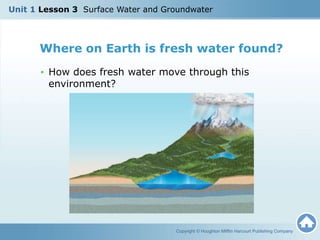
• How does fresh water move through this
environment?
Cry Me a River
Copyright © Houghton Mifflin Harcourt Publishing Company
How does water move on Earth’s
surface?
• Water trickling down a hillside may flow together
to form a stream, eroding soil and rock to make a
channel.
• A channel is the path that a stream follows. Over
time, the channel gets wider and deeper, as the
stream erodes rock and soil.
• Streams typically flow along weaknesses in
bedrock.
Unit 1 Lesson 3 Surface Water and Groundwater
How does water move on Earth’s
surface?
• A tributary is a smaller stream that feeds into a
river and eventually into a river system.
• A river system is a network of streams and rivers
that drains an area of its runoff.
Copyright © Houghton Mifflin Harcourt Publishing Company
Unit 1 Lesson 3 Surface Water and Groundwater
How does water move on Earth’s
surface?
• A watershed is the area of land drained by a
river system.
• Streams, rivers, flood plains, lakes, ponds,
wetlands, and groundwater all contribute water to
a watershed.
• Watersheds are separated from one another by a
ridge or an area of higher ground called a divide.
Copyright © Houghton Mifflin Harcourt Publishing Company
Unit 1 Lesson 3 Surface Water and Groundwater
How does water move on Earth’s
surface?
• Gradient is a measure of the change in elevation
over a certain distance. In other words, it is a
measure of the slope of the land.
• A river’s flow is the amount of water that moves
through the river channel in a given amount of
time.
• Materials carried by a stream are called stream
load. Rivers eventually deposit their stream loads
downstream.
Copyright © Houghton Mifflin Harcourt Publishing Company
Unit 1 Lesson 3 Surface Water and Groundwater
How does water move on Earth’s
surface?
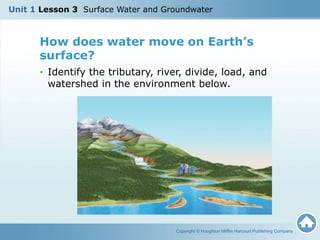
• Identify the tributary, river, divide, load, and
watershed in the environment below.
Copyright © Houghton Mifflin Harcourt Publishing Company
Unit 1 Lesson 3 Surface Water and Groundwater
In Deep Water
Copyright © Houghton Mifflin Harcourt Publishing Company
How does groundwater flow?
• When water trickles down from the surface and
reaches a rock layer with no pores or cracks, the
water pools to form an aquifer.
• An aquifer is a rock layer that stores groundwater
and allows the flow of groundwater.
• The water table can rise or fall depending on the
amount of water in the aquifer.
Unit 1 Lesson 3 Surface Water and Groundwater
How does groundwater flow?
• An aquifer stores water in open spaces, or pores,
between particles of rock or soil.
• The storage space in an aquifer is measured by
porosity, which is the percentage of the rock that
is composed of pore space.
• The greater the pore space is, the higher the
porosity is.
Copyright © Houghton Mifflin Harcourt Publishing Company
Unit 1 Lesson 3 Surface Water and Groundwater
How does groundwater flow?
• Permeability is a measure of how easily water can
flow through an aquifer.
• High permeability means that the pores in the
aquifer are connected to one another, so that
water can flow easily.
• A useful aquifer has both high porosity and high
permeability.
Copyright © Houghton Mifflin Harcourt Publishing Company
Unit 1 Lesson 3 Surface Water and Groundwater
How does groundwater flow?
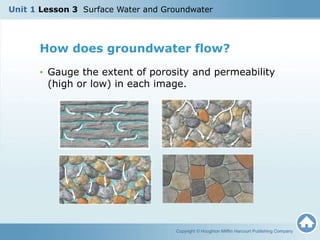
• Gauge the extent of porosity and permeability
(high or low) in each image.
Copyright © Houghton Mifflin Harcourt Publishing Company
Unit 1 Lesson 3 Surface Water and Groundwater
How does groundwater flow?
• The process by which surface water trickles down
and enters an aquifer is called recharge. It occurs
in an area called the recharge zone.
• The process by which groundwater becomes
surface water is called discharge and happens in
discharge zones.
• Through discharge and recharge, the same water
circulates between surface water and
groundwater.
Copyright © Houghton Mifflin Harcourt Publishing Company
Unit 1 Lesson 3 Surface Water and Groundwater
How does groundwater flow?
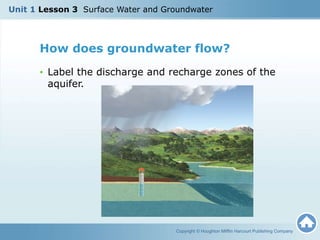
• Label the discharge and recharge zones of the
aquifer.
Copyright © Houghton Mifflin Harcourt Publishing Company
Unit 1 Lesson 3 Surface Water and Groundwater
Making a Splash
Copyright © Houghton Mifflin Harcourt Publishing Company
How do people use surface water and
groundwater?
• In a typical home, about 50% of all water used is
for washing clothes, bathing, washing dishes, and
flushing toilets.
• About 33% is used to water lawns and gardens.
The rest is used for drinking, cooking, and
washing hands.
• In the United States, about 40% of fresh water is
used for agricultural activities like growing crops
and raising livestock.
Unit 1 Lesson 3 Surface Water and Groundwater
How do people use surface water and
groundwater?
• About 45% of the fresh water used in the United
States is used for industry.
• Surface water in rivers, streams, and lakes is used
to transport products and people, and for various
recreational activities.
Copyright © Houghton Mifflin Harcourt Publishing Company
Unit 1 Lesson 3 Surface Water and Groundwater
Troubled Waters
Copyright © Houghton Mifflin Harcourt Publishing Company
• The limited supply of fresh water must be
managed to meet the demands of a growing
population.
• Scientists estimate that about 1 billion people
around the world do not have an adequate supply
of clean, fresh water.
• Scientists are developing technologies to obtain
clean, fresh water to meet global needs.

Lesson 3 surface water and groundwater

  • 1.
    Unit 1 Lesson3 Surface Water and Groundwater Copyright © Houghton Mifflin Harcourt Publishing Company
  • 2.
    Getting Your FeetWet Copyright © Houghton Mifflin Harcourt Publishing Company Where on Earth is fresh water found? • Only 3% of Earth’s water is fresh water, and most of that is frozen as ice and snow. So only about 1% of Earth’s water is fresh liquid water. • This fresh liquid water is found both on and below Earth’s surface. • This tiny percentage of Earth’s water must meet the large demand that all living things have for fresh, clean water. Unit 1 Lesson 3 Surface Water and Groundwater
  • 3.
    Where on Earthis fresh water found? • Water that collects on Earth’s surface is called surface water. It is found in streams, rivers, and lakes. • It may begin as precipitation in the form of rain, snow, sleet, or hail. On Earth’s surface, it flows from higher ground to lower ground. • The water that flows across Earth’s surface is called runoff. Eventually, runoff can enter bodies of water. Copyright © Houghton Mifflin Harcourt Publishing Company Unit 1 Lesson 3 Surface Water and Groundwater
  • 4.
    Where on Earthis fresh water found? • Some rainwater and water from streams seeps down into the ground, collecting in spaces between rock particles. • Water found in the spaces between rock particles below Earth’s surface is called groundwater. • The water table is the upper boundary of the rock or sediment that is saturated with water. Copyright © Houghton Mifflin Harcourt Publishing Company Unit 1 Lesson 3 Surface Water and Groundwater
  • 5.
    Where on Earthis fresh water found? Copyright © Houghton Mifflin Harcourt Publishing Company Unit 1 Lesson 3 Surface Water and Groundwater • How does fresh water move through this environment?
  • 6.
    Cry Me aRiver Copyright © Houghton Mifflin Harcourt Publishing Company How does water move on Earth’s surface? • Water trickling down a hillside may flow together to form a stream, eroding soil and rock to make a channel. • A channel is the path that a stream follows. Over time, the channel gets wider and deeper, as the stream erodes rock and soil. • Streams typically flow along weaknesses in bedrock. Unit 1 Lesson 3 Surface Water and Groundwater
  • 7.
    How does watermove on Earth’s surface? • A tributary is a smaller stream that feeds into a river and eventually into a river system. • A river system is a network of streams and rivers that drains an area of its runoff. Copyright © Houghton Mifflin Harcourt Publishing Company Unit 1 Lesson 3 Surface Water and Groundwater
  • 8.
    How does watermove on Earth’s surface? • A watershed is the area of land drained by a river system. • Streams, rivers, flood plains, lakes, ponds, wetlands, and groundwater all contribute water to a watershed. • Watersheds are separated from one another by a ridge or an area of higher ground called a divide. Copyright © Houghton Mifflin Harcourt Publishing Company Unit 1 Lesson 3 Surface Water and Groundwater
  • 9.
    How does watermove on Earth’s surface? • Gradient is a measure of the change in elevation over a certain distance. In other words, it is a measure of the slope of the land. • A river’s flow is the amount of water that moves through the river channel in a given amount of time. • Materials carried by a stream are called stream load. Rivers eventually deposit their stream loads downstream. Copyright © Houghton Mifflin Harcourt Publishing Company Unit 1 Lesson 3 Surface Water and Groundwater
  • 10.
    How does watermove on Earth’s surface? • Identify the tributary, river, divide, load, and watershed in the environment below. Copyright © Houghton Mifflin Harcourt Publishing Company Unit 1 Lesson 3 Surface Water and Groundwater
  • 11.
    In Deep Water Copyright© Houghton Mifflin Harcourt Publishing Company How does groundwater flow? • When water trickles down from the surface and reaches a rock layer with no pores or cracks, the water pools to form an aquifer. • An aquifer is a rock layer that stores groundwater and allows the flow of groundwater. • The water table can rise or fall depending on the amount of water in the aquifer. Unit 1 Lesson 3 Surface Water and Groundwater
  • 12.
    How does groundwaterflow? • An aquifer stores water in open spaces, or pores, between particles of rock or soil. • The storage space in an aquifer is measured by porosity, which is the percentage of the rock that is composed of pore space. • The greater the pore space is, the higher the porosity is. Copyright © Houghton Mifflin Harcourt Publishing Company Unit 1 Lesson 3 Surface Water and Groundwater
  • 13.
    How does groundwaterflow? • Permeability is a measure of how easily water can flow through an aquifer. • High permeability means that the pores in the aquifer are connected to one another, so that water can flow easily. • A useful aquifer has both high porosity and high permeability. Copyright © Houghton Mifflin Harcourt Publishing Company Unit 1 Lesson 3 Surface Water and Groundwater
  • 14.
    How does groundwaterflow? • Gauge the extent of porosity and permeability (high or low) in each image. Copyright © Houghton Mifflin Harcourt Publishing Company Unit 1 Lesson 3 Surface Water and Groundwater
  • 15.
    How does groundwaterflow? • The process by which surface water trickles down and enters an aquifer is called recharge. It occurs in an area called the recharge zone. • The process by which groundwater becomes surface water is called discharge and happens in discharge zones. • Through discharge and recharge, the same water circulates between surface water and groundwater. Copyright © Houghton Mifflin Harcourt Publishing Company Unit 1 Lesson 3 Surface Water and Groundwater
  • 16.
    How does groundwaterflow? • Label the discharge and recharge zones of the aquifer. Copyright © Houghton Mifflin Harcourt Publishing Company Unit 1 Lesson 3 Surface Water and Groundwater
  • 17.
    Making a Splash Copyright© Houghton Mifflin Harcourt Publishing Company How do people use surface water and groundwater? • In a typical home, about 50% of all water used is for washing clothes, bathing, washing dishes, and flushing toilets. • About 33% is used to water lawns and gardens. The rest is used for drinking, cooking, and washing hands. • In the United States, about 40% of fresh water is used for agricultural activities like growing crops and raising livestock. Unit 1 Lesson 3 Surface Water and Groundwater
  • 18.
    How do peopleuse surface water and groundwater? • About 45% of the fresh water used in the United States is used for industry. • Surface water in rivers, streams, and lakes is used to transport products and people, and for various recreational activities. Copyright © Houghton Mifflin Harcourt Publishing Company Unit 1 Lesson 3 Surface Water and Groundwater
  • 19.
    Unit 1 Lesson3 Surface Water and Groundwater Troubled Waters Copyright © Houghton Mifflin Harcourt Publishing Company • The limited supply of fresh water must be managed to meet the demands of a growing population. • Scientists estimate that about 1 billion people around the world do not have an adequate supply of clean, fresh water. • Scientists are developing technologies to obtain clean, fresh water to meet global needs.