UNDERSTAND THE
POWERPOINT
ENVIRONMENT
POWERPOINT 2010 KEY TERMS
FILE – the presentation
made in Microsoft
PowerPoint.
PPTX - An extension name
of the file.
SLIDE – the basic unit of a
presentation.
- it contain one or
many objects.
PLACEHOLDERS – are
boxes made up of dashed
lines.
LAYOUTS – refers to the
arrangement of objects on
the slide.
THEMES – refers to the
background color and
design of the slide.
QUICK STYLES – are sets
of formatting options that
apply to the objects.
TEMPLATES– are ready-
made presentations with
background design.
DIFFERENT VIEWS IN POWERPOINT
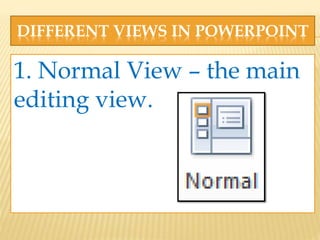
1. Normal View – the main
editing view.
DIFFERENT VIEWS IN POWERPOINT
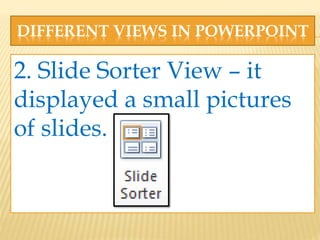
2. Slide Sorter View – it
displayed a small pictures
of slides.
DIFFERENT VIEWS IN POWERPOINT
3. Reading View – each slide
fills the screen to preview the
presentation.
DIFFERENT VIEWS IN POWERPOINT
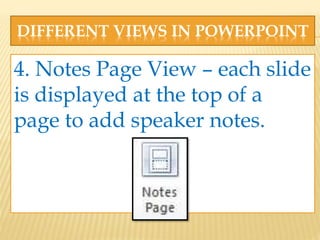
4. Notes Page View – each slide
is displayed at the top of a
page to add speaker notes.
DIFFERENT VIEWS IN POWERPOINT
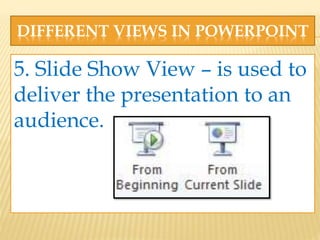
5. Slide Show View – is used to
deliver the presentation to an
audience.
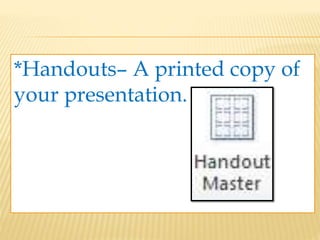
*Handouts– A printed copy of
your presentation.
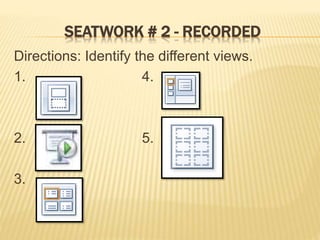
SEATWORK # 2 - RECORDED
Directions: Identify the different views.
1. 4.
2. 5.
3.
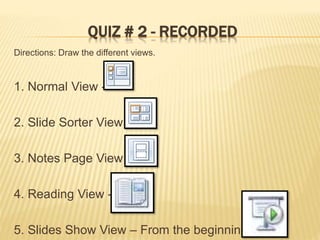
QUIZ # 2 - RECORDED
Directions: Draw the different views.
1. Normal View -
2. Slide Sorter View -
3. Notes Page View -
4. Reading View -
5. Slides Show View – From the beginning -
Directions: Matching Type – Choose the letter
of
the correct answer.
A 6. placeholder a. it is where we place the object.
D 7. Templates b. it is the design of the slide.
B 8. Themes c. it is the position of objects in
slide.
E 9. PPTX d. it is the ready-made
presentation.
C 10. Layouts e. extension name of presentation

Lesson 2 understand the powerpoint environment

  • 1.
  • 2.
    POWERPOINT 2010 KEYTERMS FILE – the presentation made in Microsoft PowerPoint. PPTX - An extension name of the file.
  • 3.
    SLIDE – thebasic unit of a presentation. - it contain one or many objects.
  • 4.
    PLACEHOLDERS – are boxesmade up of dashed lines.
  • 5.
    LAYOUTS – refersto the arrangement of objects on the slide.
  • 6.
    THEMES – refersto the background color and design of the slide.
  • 7.
    QUICK STYLES –are sets of formatting options that apply to the objects.
  • 8.
    TEMPLATES– are ready- madepresentations with background design.
  • 9.
    DIFFERENT VIEWS INPOWERPOINT 1. Normal View – the main editing view.
  • 10.
    DIFFERENT VIEWS INPOWERPOINT 2. Slide Sorter View – it displayed a small pictures of slides.
  • 11.
    DIFFERENT VIEWS INPOWERPOINT 3. Reading View – each slide fills the screen to preview the presentation.
  • 12.
    DIFFERENT VIEWS INPOWERPOINT 4. Notes Page View – each slide is displayed at the top of a page to add speaker notes.
  • 13.
    DIFFERENT VIEWS INPOWERPOINT 5. Slide Show View – is used to deliver the presentation to an audience.
  • 14.
    *Handouts– A printedcopy of your presentation.
  • 15.
    SEATWORK # 2- RECORDED Directions: Identify the different views. 1. 4. 2. 5. 3.
  • 16.
    QUIZ # 2- RECORDED Directions: Draw the different views. 1. Normal View - 2. Slide Sorter View - 3. Notes Page View - 4. Reading View - 5. Slides Show View – From the beginning -
  • 17.
    Directions: Matching Type– Choose the letter of the correct answer. A 6. placeholder a. it is where we place the object. D 7. Templates b. it is the design of the slide. B 8. Themes c. it is the position of objects in slide. E 9. PPTX d. it is the ready-made presentation. C 10. Layouts e. extension name of presentation