Bicol University
College of Agriculture and
Forestry
Guinobatan, Albay
James Jordan M. Diaz
III- Bachelor in Agricultural Technology major
in Agricultural Technology Education
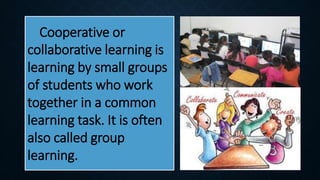
Cooperative or
collaborative learning is
learning by small groups
of students who work
together in a common
learning task. It is often
also called group
learning.
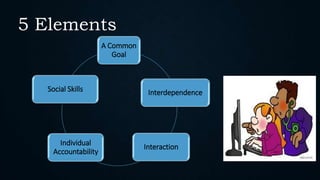
A Common
Goal
Interdependence
Interaction
Individual
Accountability
Social Skills
5 Elements
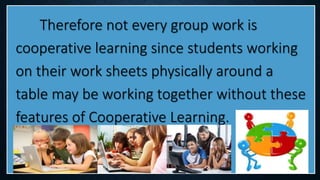
Therefore not every group work is
cooperative learning since students working
on their work sheets physically around a
table may be working together without these
features of Cooperative Learning.
It is manifested that cooperative learning in
it’s true sense is advantageous since it:
a) encourages active learning, while motivating
students;
b) increases academic performance;
c) promotes literacy and language skills; and
d) improves teacher’s effectiveness.
There are studies which shows that cooperative
learning enhances personal and social development
among students of all ages, while enhancing self-
esteem and improving social relations between
racially and culturally different students.
Researches have made studies on the
learning interaction between the students and
the computer. This studies have great value
since it has been a long standing fear that the
computer may foster students learning in
isolation that hinders the development of the
students social skills.
Now this mystical fear has been
contradicted by the studies which show
that when students work with computers
in groups, they cluster and interact with
each other for advice and mutual help.
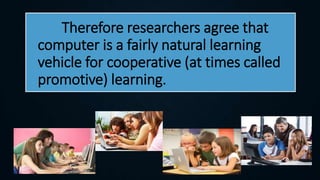
Therefore researchers agree that
computer is a fairly natural learning
vehicle for cooperative (at times called
promotive) learning.
Educators are still wary about the computer’s
role in cooperative learning. Thus, they pose the
position that the use of computers do not
automatically result in cooperative learning.
In this case, therefore, assign the teacher several
task in order to ensure collaborative learning. These
are:
•assigning students to mix ability teams;
•establishing positive interdependence;
•teaching cooperative social skills;
•insuring individual accountability; and
•helping groups process information.
These are in addition to assigning a common
work goal in which each member of the group will
realize that their group will not succeed unless
everyone contributes to the group success. It is also
important for the teacher to limit learning group
clusters (six is the ideal number in a group) so that
there can be closer involvement in thinking and
learning.
Researcher see that assigning lower-ability students
in a group, while assigning higher-ability students in
another group do not really create a better learning
environment. Grouping of students with various ability
levels appears more conducive to effective group
learning.
THANK YOU!!

Lesson 13 cooperative learning with computer

  • 1.
    Bicol University College ofAgriculture and Forestry Guinobatan, Albay James Jordan M. Diaz III- Bachelor in Agricultural Technology major in Agricultural Technology Education
  • 2.
    Cooperative or collaborative learningis learning by small groups of students who work together in a common learning task. It is often also called group learning.
  • 3.
  • 4.
    Therefore not everygroup work is cooperative learning since students working on their work sheets physically around a table may be working together without these features of Cooperative Learning.
  • 5.
    It is manifestedthat cooperative learning in it’s true sense is advantageous since it: a) encourages active learning, while motivating students; b) increases academic performance; c) promotes literacy and language skills; and d) improves teacher’s effectiveness.
  • 6.
    There are studieswhich shows that cooperative learning enhances personal and social development among students of all ages, while enhancing self- esteem and improving social relations between racially and culturally different students.
  • 8.
    Researches have madestudies on the learning interaction between the students and the computer. This studies have great value since it has been a long standing fear that the computer may foster students learning in isolation that hinders the development of the students social skills.
  • 9.
    Now this mysticalfear has been contradicted by the studies which show that when students work with computers in groups, they cluster and interact with each other for advice and mutual help.
  • 10.
    Therefore researchers agreethat computer is a fairly natural learning vehicle for cooperative (at times called promotive) learning.
  • 12.
    Educators are stillwary about the computer’s role in cooperative learning. Thus, they pose the position that the use of computers do not automatically result in cooperative learning.
  • 13.
    In this case,therefore, assign the teacher several task in order to ensure collaborative learning. These are: •assigning students to mix ability teams; •establishing positive interdependence; •teaching cooperative social skills; •insuring individual accountability; and •helping groups process information.
  • 14.
    These are inaddition to assigning a common work goal in which each member of the group will realize that their group will not succeed unless everyone contributes to the group success. It is also important for the teacher to limit learning group clusters (six is the ideal number in a group) so that there can be closer involvement in thinking and learning.
  • 15.
    Researcher see thatassigning lower-ability students in a group, while assigning higher-ability students in another group do not really create a better learning environment. Grouping of students with various ability levels appears more conducive to effective group learning.
  • 17.