LESSON 10 By: Nick  John  Zach
Big Idea Compromise
Big Idea Facts Took parts from the New Jersey and Virginia Plan Gave proportional representation in the House of Representatives. Gave equal representation in the Senate
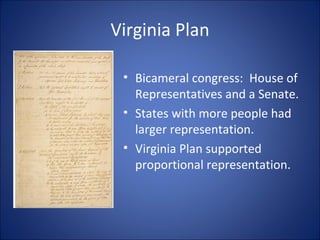
Virginia Plan Bicameral congress:  House of Representatives and a Senate.  States with more people had larger representation. Virginia Plan supported proportional representation.
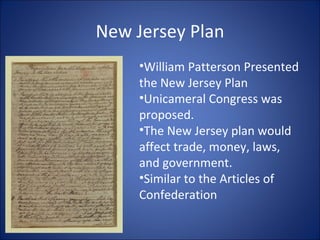
New Jersey Plan William Patterson Presented the New Jersey Plan Unicameral Congress was proposed.  The New Jersey plan would affect trade, money, laws, and government. Similar to the Articles of Confederation
Great Compromise A mix of the two previous plans. Equal representation in the Senate Proportional representation in the House. House developed bills, and veto power given to senate.
The Connecticut Compromise The Constitutional Convention produced three distinct plans of government:  three shared the same basic distribution of powers but differed significantly in their structures. This is because the members of the convention all agreed on where they ought to go, but disagreed on how to get there. there was, in fact, only one real problem at the Convention: that of state representation.
The Solution If neither plan would work, what is the solution?   The delegation from Connecticut proposed a  compromise , that is a deal where both sides would give up something.  The proponents of the Virginia Plan had to give up proportional representation in both houses, and the other side gave up the idea of a unicameral congress. The result was a Bicameral Congress with  Equal Representation in the Upper House , and  Proportional Representation in the Lower House .
Why does this work? It gives both sides  a means of self-defense . If the Larger states pass a measure in the lower house that is prejudicial to the interests of the small states,then the small states can combine and defeat it in the Senate. If the Smaller states pass legislation prejudicial to the interests of the larger ones in the Senate,then the larger states can defeat it in the House. In order for a bill to become law, it must satisfy the interests of both large and small states.
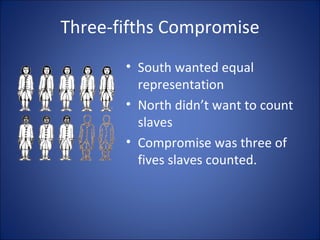
Three-fifths Compromise South wanted equal representation North didn’t want to count slaves Compromise was three of fives slaves counted.
Cricital Thinking Activity Objective:  Work together to form a plan. Steps:  Get into group of five. Select a spokesperson. Allow time for revisions. Have entire class agree on one plan. 5.  Compare all plans to each other.
Student Tasks Nick Feraco-Powerpoint Zach Runzo- Researched Information John George- Researched information

Lesson 10

  • 1.
    LESSON 10 By:Nick John Zach
  • 2.
  • 3.
    Big Idea FactsTook parts from the New Jersey and Virginia Plan Gave proportional representation in the House of Representatives. Gave equal representation in the Senate
  • 4.
    Virginia Plan Bicameralcongress: House of Representatives and a Senate. States with more people had larger representation. Virginia Plan supported proportional representation.
  • 5.
    New Jersey PlanWilliam Patterson Presented the New Jersey Plan Unicameral Congress was proposed. The New Jersey plan would affect trade, money, laws, and government. Similar to the Articles of Confederation
  • 6.
    Great Compromise Amix of the two previous plans. Equal representation in the Senate Proportional representation in the House. House developed bills, and veto power given to senate.
  • 7.
    The Connecticut CompromiseThe Constitutional Convention produced three distinct plans of government: three shared the same basic distribution of powers but differed significantly in their structures. This is because the members of the convention all agreed on where they ought to go, but disagreed on how to get there. there was, in fact, only one real problem at the Convention: that of state representation.
  • 8.
    The Solution Ifneither plan would work, what is the solution? The delegation from Connecticut proposed a compromise , that is a deal where both sides would give up something. The proponents of the Virginia Plan had to give up proportional representation in both houses, and the other side gave up the idea of a unicameral congress. The result was a Bicameral Congress with Equal Representation in the Upper House , and Proportional Representation in the Lower House .
  • 9.
    Why does thiswork? It gives both sides a means of self-defense . If the Larger states pass a measure in the lower house that is prejudicial to the interests of the small states,then the small states can combine and defeat it in the Senate. If the Smaller states pass legislation prejudicial to the interests of the larger ones in the Senate,then the larger states can defeat it in the House. In order for a bill to become law, it must satisfy the interests of both large and small states.
  • 10.
    Three-fifths Compromise Southwanted equal representation North didn’t want to count slaves Compromise was three of fives slaves counted.
  • 11.
    Cricital Thinking ActivityObjective: Work together to form a plan. Steps: Get into group of five. Select a spokesperson. Allow time for revisions. Have entire class agree on one plan. 5. Compare all plans to each other.
  • 12.
    Student Tasks NickFeraco-Powerpoint Zach Runzo- Researched Information John George- Researched information