THE CONSTITUTION
CONSTITUTIONAL   CONVENTION Philadelphia – May 1787 55 delegates  “ Founding  Fathers” Only Rhode Island not there G. Washington led the  convention James Madison kept historical record “ Father of the Constitution”
VIRIGINIA PLAN 3 branches of gov’t   Legislative, executive, judicial Congress (legislature) made up of 2 houses   people elect lower house;   lower house elects upper house Representation based on population
NEW  JERSEY  PLAN Legislature with only 1 house Each state has same number of representatives
GREAT COMPROMISE (CONNECTICUT) Proposed a bicameral legislature House of Representatives based on population Senate 2 from each state
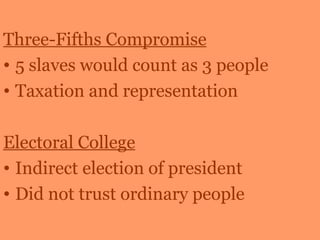
Three-Fifths Compromise 5 slaves would count as 3 people Taxation and representation Electoral College Indirect election of president Did not trust ordinary people
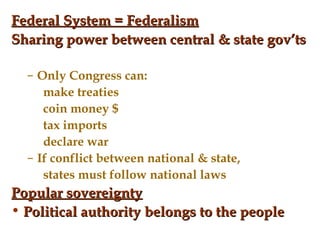
Federal System = Federalism Sharing power between central & state gov’ts Only Congress can: make treaties coin money $ tax imports declare war If conflict between national & state, states must follow national laws Popular sovereignty Political authority belongs to the people
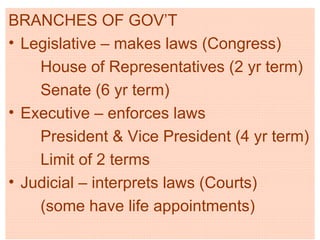
BRANCHES OF GOV’T Legislative – makes laws (Congress) House of Representatives (2 yr term) Senate (6 yr term) Executive – enforces laws  President & Vice President (4 yr term) Limit of 2 terms Judicial – interprets laws (Courts) (some have life appointments)
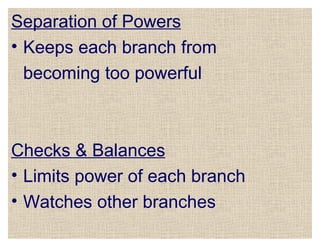
Separation of Powers Keeps each branch from becoming too powerful Checks & Balances Limits power of each branch Watches other branches
Antifederalists Those who opposed Constitution Too much power in nat’l gov’t Feared loss of citizens’ freedoms Federalists Supported Constitution Believed citizens’ rights safe because: each state had bill of rights House of Rep. chosen by people Promise of Bill of Rights = ratification
Federalists Papers 85 organized essays written by  Alexander Hamilton – 50 James Madison – 30 John Jay – 5 written to convince the public that the new central gov’t would not overpower the people
Anti-Federalist Writings written by people using pen names  Patrick Henry Richard Henry Lee Samuel Adams James Monroe written to convince the public of the danger that the new central gov’t would be without a statement of individual rights (Bill of Rights).
Ratification  – approval under Constitution – only 9 states needed Some states ratified w/ promise of a bill of rights Amendments  – way of changing the Constitution
Bill of Rights First 10 amendments  List of guaranteed rights of individuals Restricts gov’t action against citizens Any powers not in Constitution are given to states & people
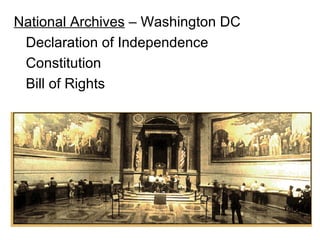
National Archives  – Washington DC Declaration of Independence Constitution Bill of Rights

12 the constitution-antifederalist

  • 1.
  • 2.
    CONSTITUTIONAL CONVENTION Philadelphia – May 1787 55 delegates “ Founding Fathers” Only Rhode Island not there G. Washington led the convention James Madison kept historical record “ Father of the Constitution”
  • 3.
    VIRIGINIA PLAN 3branches of gov’t Legislative, executive, judicial Congress (legislature) made up of 2 houses people elect lower house; lower house elects upper house Representation based on population
  • 4.
    NEW JERSEY PLAN Legislature with only 1 house Each state has same number of representatives
  • 5.
    GREAT COMPROMISE (CONNECTICUT)Proposed a bicameral legislature House of Representatives based on population Senate 2 from each state
  • 6.
    Three-Fifths Compromise 5slaves would count as 3 people Taxation and representation Electoral College Indirect election of president Did not trust ordinary people
  • 7.
    Federal System =Federalism Sharing power between central & state gov’ts Only Congress can: make treaties coin money $ tax imports declare war If conflict between national & state, states must follow national laws Popular sovereignty Political authority belongs to the people
  • 8.
    BRANCHES OF GOV’TLegislative – makes laws (Congress) House of Representatives (2 yr term) Senate (6 yr term) Executive – enforces laws President & Vice President (4 yr term) Limit of 2 terms Judicial – interprets laws (Courts) (some have life appointments)
  • 9.
    Separation of PowersKeeps each branch from becoming too powerful Checks & Balances Limits power of each branch Watches other branches
  • 10.
    Antifederalists Those whoopposed Constitution Too much power in nat’l gov’t Feared loss of citizens’ freedoms Federalists Supported Constitution Believed citizens’ rights safe because: each state had bill of rights House of Rep. chosen by people Promise of Bill of Rights = ratification
  • 11.
    Federalists Papers 85organized essays written by Alexander Hamilton – 50 James Madison – 30 John Jay – 5 written to convince the public that the new central gov’t would not overpower the people
  • 12.
    Anti-Federalist Writings writtenby people using pen names Patrick Henry Richard Henry Lee Samuel Adams James Monroe written to convince the public of the danger that the new central gov’t would be without a statement of individual rights (Bill of Rights).
  • 13.
    Ratification –approval under Constitution – only 9 states needed Some states ratified w/ promise of a bill of rights Amendments – way of changing the Constitution
  • 14.
    Bill of RightsFirst 10 amendments List of guaranteed rights of individuals Restricts gov’t action against citizens Any powers not in Constitution are given to states & people
  • 15.
    National Archives – Washington DC Declaration of Independence Constitution Bill of Rights