U.S. Government 
Chapter 1 – Section 1
 Government 
 Public policy 
 Legislative power 
 Executive power 
 Judicial power 
 Constitution 
 Dictatorship 
 Democracy 
 State 
 Sovereign
 Section Objectives: 
 Define government and the basic powers every 
government holds 
 Describe the four defining characteristics of the state 
 Identify four theories that attempt to explain the origin 
of the state 
 Understand the purpose of government in the United 
States and other countries. 
 4.4 Understand the basic features of major 
forms of governance in the world.
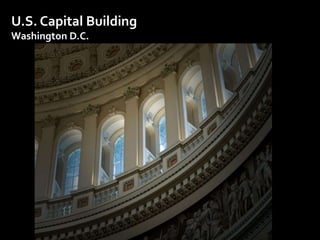
United States Capital Building 
Washington D.C.
United States Capital Building 
U.S. House of Representatives
United States Capital Building 
U.S. House Senate
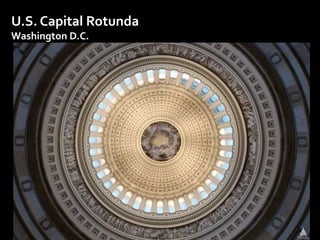
U.S. Capital Rotunda 
Washington D.C.
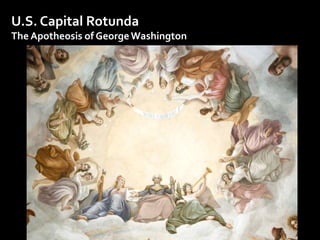
U.S. Capital Rotunda 
The Apotheosis of George Washington
U.S. Capital Rotunda 
The Apotheosis of George Washington
U.S. Capital Building 
Washington D.C.
 Government- the institution through which a 
society makes and enforces its public policies. 
 Those public polices are everything government 
decides to do. 
 Public policy includes (but is not limited to): 
 Taxation Defense 
 Education Health Care 
 Civil Rights Environment
 Every government has three types of power: 
 Legislative power – the power to make law 
 Executive power – the power to execute, 
administer and enforce law 
 Judicial power – the power to interpret law 
 These powers are often outlined in a 
country’s constitution 
 Constitution – a body of fundamental laws
 Dictatorship – ultimate power is held by one 
person 
 Autocracy 
 Oligarchy 
 Democracy – supreme authority is held by 
the people 
 Presidential 
 Parliamentary
 Throughout history, the state has emerged as 
the dominant political unit in the world. 
 There are more than 190 states in the world. 
 A state is a legal entity, not to be confused with a 
nation or a country. (More on the next slide) 
 Each state possesses four characteristics: 
 Population Territory 
 Sovereignty Government
 According to the Leopold Bloom in James 
Joyce’s novel Ulysses, a nation is, 
 “the same people living in the same place” 
 Nations can have similar ethnicity, language, 
religion 
 “territorially bounded groups with a common 
heritage.” 
 Still…not a state.
 Each state must have people, or a population. 
 The size of that population has nothing to do 
with the existence of the state. 
 Vatican City (the world’s smallest state) is only .2 
square miles (.3 km) and only has 770 citizens. 
 China has around 1.36 billion citizens.
 A state must also have land, or territory. 
 States can vary in size. 
 They can be as small as San Marino (24 square 
miles) 
 Or as big as Russia - 6.6 million square miles. 
 Or Slovakia – 30,500 sq. miles 
▪ (49, 000 sq. km)
 Every state is sovereign. 
 This means that it has supreme and absolute power 
within its own territory and can decide its own 
foreign and domestic policies. 
 A sovereign state is neither subordinate nor 
responsible to any other authority. 
 The states within the United States, however, 
are not sovereign because they are 
subordinate to the Constitution of the U.S.
 Every state must be politically organized. This 
means that every state must have a 
government. 
 A government is the agency through which a 
state exerts its will and works to accomplish its 
goals. 
 Without government, we might face a life 
described by Thomas Hobbes which that would 
be “nasty, brutish, and short.”
 What does government do? 
“We the people of the United States, in order to 
form a more perfect union, establish justice, 
insure domestic tranquility, provide for the 
common defense, promote the general welfare, 
and secure the blessings of liberty to ourselves 
and our posterity, do ordain and establish this 
Constitution for the United States of America.” 
Preamble to the U.S. Constitution
 What does government do? 
“We the people of the United States, in order to 
form a more perfect union, establish justice, 
insure domestic tranquility, provide for the 
common defense, promote the general welfare, 
and secure the blessings of liberty to ourselves 
and our posterity, do ordain and establish this 
Constitution for the United States of America.” 
Preamble to the U.S. Constitution
 What does government do? 
“We the people of the United States, in order to 
form a more perfect union, establish justice, 
insure domestic tranquility, provide for the 
common defense, promote the general welfare, 
and secure the blessings of liberty to ourselves 
and our posterity, do ordain and establish this 
Constitution for the United States of America.” 
Preamble to the U.S. Constitution
 What does government do? 
“We the people of the United States, in order to 
form a more perfect union, establish justice, 
insure domestic tranquility, provide for the 
common defense, promote the general welfare, 
and secure the blessings of liberty to ourselves 
and our posterity, do ordain and establish this 
Constitution for the United States of America.” 
Preamble to the U.S. Constitution
 What does government do? 
“We the people of the United States, in order to 
form a more perfect union, establish justice, 
insure domestic tranquility, provide for the 
common defense, promote the general welfare, 
and secure the blessings of liberty to ourselves 
and our posterity, do ordain and establish this 
Constitution for the United States of America.” 
Preamble to the U.S. Constitution
 What does government do? 
“We the people of the United States, in order to 
form a more perfect union, establish justice, 
insure domestic tranquility, provide for the 
common defense, promote the general welfare, 
and secure the blessings of liberty to ourselves 
and our posterity, do ordain and establish this 
Constitution for the United States of America.” 
Preamble to the U.S. Constitution
 What does government do? 
“We the people of the United States, in order to 
form a more perfect union, establish justice, 
insure domestic tranquility, provide for the 
common defense, promote the general welfare, 
and secure the blessings of liberty to ourselves 
and our posterity, do ordain and establish this 
Constitution for the United States of America.” 
Preamble to the U.S. Constitution
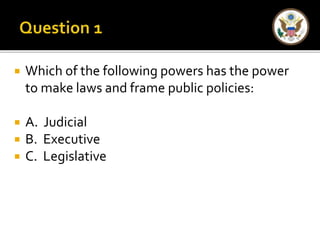
 Which of the following powers has the power 
to make laws and frame public policies: 
 A. Judicial 
 B. Executive 
 C. Legislative
 Which of the following powers has the power 
to make laws and frame public policies: 
 A. Judicial 
 B. Executive 
 C. Legislative
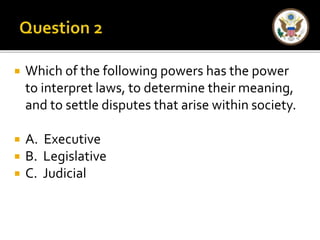
 Which of the following powers has the power 
to interpret laws, to determine their meaning, 
and to settle disputes that arise within society. 
 A. Executive 
 B. Legislative 
 C. Judicial
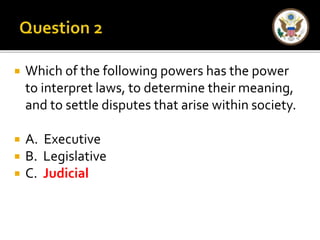
 Which of the following powers has the power 
to interpret laws, to determine their meaning, 
and to settle disputes that arise within society. 
 A. Executive 
 B. Legislative 
 C. Judicial
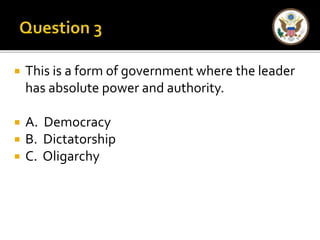
 This is a form of government where the leader 
has absolute power and authority. 
 A. Democracy 
 B. Dictatorship 
 C. Oligarchy
 This is a form of government where the leader 
has absolute power and authority. 
 A. Democracy 
 B. Dictatorship 
 C. Oligarchy
 In a _________, supreme authority rests with 
the people. 
 A. Anarchy 
 B. Oligarchy 
 C. Democracy
 In a _________, supreme authority rests with 
the people. 
 A. Anarchy 
 B. Oligarchy 
 C. Democracy
 Which is NOT one of the four characteristics 
that a state has: 
 A. Population 
 B. Territory 
 C. Dictatorship
 Which is NOT one of the four characteristics 
that a state has: 
 A. Population 
 B. Territory 
 C. Dictatorship
 If a state is ______________, supreme and 
absolute power within its own territory and can 
decide its own foreign and domestic policies. 
 A. Representative 
 B. Decisive 
 C. Sovereign
 If a state is ______________, supreme and 
absolute power within its own territory and can 
decide its own foreign and domestic policies. 
 A. Representative 
 B. Decisive 
 C. Sovereign
U.S. Government -- Chapter 1 Section 1 "Government and the State"

U.S. Government -- Chapter 1 Section 1 "Government and the State"

  • 1.
    U.S. Government Chapter1 – Section 1
  • 2.
     Government Public policy  Legislative power  Executive power  Judicial power  Constitution  Dictatorship  Democracy  State  Sovereign
  • 3.
     Section Objectives:  Define government and the basic powers every government holds  Describe the four defining characteristics of the state  Identify four theories that attempt to explain the origin of the state  Understand the purpose of government in the United States and other countries.  4.4 Understand the basic features of major forms of governance in the world.
  • 4.
    United States CapitalBuilding Washington D.C.
  • 5.
    United States CapitalBuilding U.S. House of Representatives
  • 6.
    United States CapitalBuilding U.S. House Senate
  • 7.
    U.S. Capital Rotunda Washington D.C.
  • 8.
    U.S. Capital Rotunda The Apotheosis of George Washington
  • 9.
    U.S. Capital Rotunda The Apotheosis of George Washington
  • 10.
    U.S. Capital Building Washington D.C.
  • 11.
     Government- theinstitution through which a society makes and enforces its public policies.  Those public polices are everything government decides to do.  Public policy includes (but is not limited to):  Taxation Defense  Education Health Care  Civil Rights Environment
  • 12.
     Every governmenthas three types of power:  Legislative power – the power to make law  Executive power – the power to execute, administer and enforce law  Judicial power – the power to interpret law  These powers are often outlined in a country’s constitution  Constitution – a body of fundamental laws
  • 13.
     Dictatorship –ultimate power is held by one person  Autocracy  Oligarchy  Democracy – supreme authority is held by the people  Presidential  Parliamentary
  • 14.
     Throughout history,the state has emerged as the dominant political unit in the world.  There are more than 190 states in the world.  A state is a legal entity, not to be confused with a nation or a country. (More on the next slide)  Each state possesses four characteristics:  Population Territory  Sovereignty Government
  • 15.
     According tothe Leopold Bloom in James Joyce’s novel Ulysses, a nation is,  “the same people living in the same place”  Nations can have similar ethnicity, language, religion  “territorially bounded groups with a common heritage.”  Still…not a state.
  • 16.
     Each statemust have people, or a population.  The size of that population has nothing to do with the existence of the state.  Vatican City (the world’s smallest state) is only .2 square miles (.3 km) and only has 770 citizens.  China has around 1.36 billion citizens.
  • 17.
     A statemust also have land, or territory.  States can vary in size.  They can be as small as San Marino (24 square miles)  Or as big as Russia - 6.6 million square miles.  Or Slovakia – 30,500 sq. miles ▪ (49, 000 sq. km)
  • 18.
     Every stateis sovereign.  This means that it has supreme and absolute power within its own territory and can decide its own foreign and domestic policies.  A sovereign state is neither subordinate nor responsible to any other authority.  The states within the United States, however, are not sovereign because they are subordinate to the Constitution of the U.S.
  • 19.
     Every statemust be politically organized. This means that every state must have a government.  A government is the agency through which a state exerts its will and works to accomplish its goals.  Without government, we might face a life described by Thomas Hobbes which that would be “nasty, brutish, and short.”
  • 20.
     What doesgovernment do? “We the people of the United States, in order to form a more perfect union, establish justice, insure domestic tranquility, provide for the common defense, promote the general welfare, and secure the blessings of liberty to ourselves and our posterity, do ordain and establish this Constitution for the United States of America.” Preamble to the U.S. Constitution
  • 21.
     What doesgovernment do? “We the people of the United States, in order to form a more perfect union, establish justice, insure domestic tranquility, provide for the common defense, promote the general welfare, and secure the blessings of liberty to ourselves and our posterity, do ordain and establish this Constitution for the United States of America.” Preamble to the U.S. Constitution
  • 22.
     What doesgovernment do? “We the people of the United States, in order to form a more perfect union, establish justice, insure domestic tranquility, provide for the common defense, promote the general welfare, and secure the blessings of liberty to ourselves and our posterity, do ordain and establish this Constitution for the United States of America.” Preamble to the U.S. Constitution
  • 23.
     What doesgovernment do? “We the people of the United States, in order to form a more perfect union, establish justice, insure domestic tranquility, provide for the common defense, promote the general welfare, and secure the blessings of liberty to ourselves and our posterity, do ordain and establish this Constitution for the United States of America.” Preamble to the U.S. Constitution
  • 24.
     What doesgovernment do? “We the people of the United States, in order to form a more perfect union, establish justice, insure domestic tranquility, provide for the common defense, promote the general welfare, and secure the blessings of liberty to ourselves and our posterity, do ordain and establish this Constitution for the United States of America.” Preamble to the U.S. Constitution
  • 25.
     What doesgovernment do? “We the people of the United States, in order to form a more perfect union, establish justice, insure domestic tranquility, provide for the common defense, promote the general welfare, and secure the blessings of liberty to ourselves and our posterity, do ordain and establish this Constitution for the United States of America.” Preamble to the U.S. Constitution
  • 26.
     What doesgovernment do? “We the people of the United States, in order to form a more perfect union, establish justice, insure domestic tranquility, provide for the common defense, promote the general welfare, and secure the blessings of liberty to ourselves and our posterity, do ordain and establish this Constitution for the United States of America.” Preamble to the U.S. Constitution
  • 27.
     Which ofthe following powers has the power to make laws and frame public policies:  A. Judicial  B. Executive  C. Legislative
  • 28.
     Which ofthe following powers has the power to make laws and frame public policies:  A. Judicial  B. Executive  C. Legislative
  • 29.
     Which ofthe following powers has the power to interpret laws, to determine their meaning, and to settle disputes that arise within society.  A. Executive  B. Legislative  C. Judicial
  • 30.
     Which ofthe following powers has the power to interpret laws, to determine their meaning, and to settle disputes that arise within society.  A. Executive  B. Legislative  C. Judicial
  • 31.
     This isa form of government where the leader has absolute power and authority.  A. Democracy  B. Dictatorship  C. Oligarchy
  • 32.
     This isa form of government where the leader has absolute power and authority.  A. Democracy  B. Dictatorship  C. Oligarchy
  • 33.
     In a_________, supreme authority rests with the people.  A. Anarchy  B. Oligarchy  C. Democracy
  • 34.
     In a_________, supreme authority rests with the people.  A. Anarchy  B. Oligarchy  C. Democracy
  • 35.
     Which isNOT one of the four characteristics that a state has:  A. Population  B. Territory  C. Dictatorship
  • 36.
     Which isNOT one of the four characteristics that a state has:  A. Population  B. Territory  C. Dictatorship
  • 37.
     If astate is ______________, supreme and absolute power within its own territory and can decide its own foreign and domestic policies.  A. Representative  B. Decisive  C. Sovereign
  • 38.
     If astate is ______________, supreme and absolute power within its own territory and can decide its own foreign and domestic policies.  A. Representative  B. Decisive  C. Sovereign