U.S. Government 
Chapter 2 – Section 4
Framers 
Virginia Plan 
New Jersey Plan 
Connecticut Compromise 
Three-Fifths Compromise 
Commerce & Slave Trade Compromise
Section Objectives: 
1. Identify the Framers of the Constitution and discuss how 
the delegates organized the proceedings at the 
Philadelphia Convention 
2. Compare and contrast the VA Plan and the NJ Plan. 
3. Summarize the major compromises made at the 
Constitutional Convention and their effects 
4. Identify some sources from which the Framers of the 
Constitution drew inspiration. 
5.2 Understand specific institutions which shaped the 
principles of the United States Constitution.
United State Constitution 
National Archives 
Washington D.C.
12 of 13 states sent delegates to Philadelphia. 
 Many of the men who attended had fought in the 
Revolutionary war. 
 They had been members of the Continental 
Congress or Congress of the Confederation. 
 7 had been governors. 
Group of delegates who attended the 
Philadelphia Convention were called framers.
Ben Franklin was the oldest delegate at 81. 
The rest of the delegates ages ranged from 
mid 30s to 40s.
.
“Scene at the Signing of the Constitution of the United States” 
Artist: Howard Chandler Christy
Framers met in Independence Hall (Philadelphia, 
PA) 
Began work in May, 1787 
George Washington elected president of the 
convention 
All states had one vote on matters 
To protect themselves from outside pressures, the 
delegates adopted a rule of secrecy
Because of his detailed accounts and the 
large contribution to the convention, James 
Madison is considered the father of the 
Constitution. 
On May 30, 1787 the delegates agreed that a 
new Constitution should be written (rather 
than revising the AoC)
1. What was the goal of the Framers when the 
met at Independence Hall? 
(b) How did that goal change? 
2. The Framers abandoned the Articles of 
Confederation in favor of an entirely new 
Constitution. Do you agree with their 
decision? Why or why not?
Virginia was the first state to offer the first 
plan for a constitution. 
It called for a new government with 3 
separate branches: legislative, executive, 
judicial 
 Bicameral legislature 
 Lower house = House of Representatives 
 Upper house = Senate
Representation in each house was to be based 
either upon each state’s population (proportional 
representation) or by amount of money it gave to 
the central government. 
Lower House (House of Representatives) would be 
popularly elected in each state 
Upper House (Senate) would be selected by the 
House from a list of persons nominated by state 
legislatures.
Under the VA Plan, Congress would have all 
powers it had under the Articles, plus: 
 Veto any law in conflict with federal law 
 Use force to make states obey laws 
The Virginia Plan created a new constitution 
by thoroughly revising the AoC 
 Its goal was to establish a national govt. with 
greatly expanded powers 
 The power to enforce.
Explain the meaning behind this illustration.
Not nearly as thorough of a revision as the Virginia 
Plan 
Retained the unicameral congress of the 
Confederation 
Each state remained equally represented 
The N.J. Plan added to Congress’s powers: 
 Power to tax (power of the purse) 
 Power to regulate trade among states
Also called for an executive of more than one 
person (plural executive) 
 Executive chosen by Congress 
 Could be removed at the request of the majority 
of states’ governors. 
A federal judiciary would be established 
 One supreme tribunal (court) appointed by an 
executive
The large states expected to dominate the 
new government. 
How would states be represented in 
Congress? 
 Equal 
 Proportional
Agreed that Congress should be 2 houses. 
In the smaller Senate, the states would be 
represented equally. (Equal representation) 
In the House, the representation of each state 
would be based on its population. (Proportional 
representation) 
It combined basic features of the Virginia and New 
Jersey plans. 
Often called “the Great Compromise”
Agreed that Congress should be 2 houses. 
In the smaller Senate, the states would be 
represented equally. (Equal representation) 
In the House, the representation of each state 
would be based on its population. 
(Proportional representation) 
It combined basic features of the Virginia and 
New Jersey plans. 
Sometimes called “the Great Compromise”
Dealt with how to determine the pop. of states 
Should slaves be counted in the population of the 
southern states? 
 delegates of southern states said that slaves should be counted. 
Said all free people should be counted and only 3/5 of all 
other people (“other people” = slaves). 
Southerners could count their slaves, but they had to pay 
for them. 
Disappeared with the adoption of the 13th amendment. 
(abolished slavery)
Using the chart on 
page 52 and what you 
know about the 3/5 
Compromise, tell why 
(other than moral 
reasons) the northern 
states might have 
wished to abolish 
slavery?
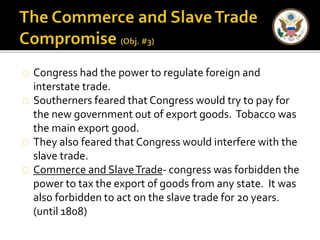
Congress had the power to regulate foreign and 
interstate trade. 
Southerners feared that Congress would try to pay for 
the new government out of export goods. Tobacco was 
the main export good. 
They also feared that Congress would interfere with the 
slave trade. 
Commerce and Slave Trade- congress was forbidden the 
power to tax the export of goods from any state. It was 
also forbidden to act on the slave trade for 20 years. 
(until 1808)
Aside from drawing from their own past experiences, 
the framers drew from other sources. 
The Framers were familiar with the works of: 
 Commentaries on the Laws of England - William Blackstone 
 The Spirit of the Laws – Baron de Montesquieu 
 Social Contract – Jean Jacques Rousseau 
 Two Treatises of Government – John Locke
The Constitution was signed on September 
17, 1787
The group of delegates who attended the 
Philadelphia Convention were called: 
A. Framers 
B. Founding Fathers 
C. Citizens
Who was the oldest delegate at the 
Constitutional Convention? 
A. Thomas Jefferson 
B. George Washington 
C. Ben Franklin
What plan called for a bicameral congress? 
A. New Jersey 
B. Virginia 
C. Commerce and Slave Trade
This compromise agreed that Congress 
should use both equal and proportional 
representation. 
A. New Jersey 
B. Three-Fifths 
C. Connecticut
The compromise stated that Congress was 
forbidden the power to tax the export of 
goods from any state. It was also forbidden 
to act on the slave trade. 
A. Commerce and Slave Trade 
B. Three-Fifths Compromise 
C. Congressional Restrictions
Who is considered “The Father of the 
Constitution”? 
A. Thomas Jefferson 
B. Benjamin Franklin 
C. James Madison 
b) Why is this person considered the be the 
Father of the Constitution?
According to the Three-Fifths Compromise, 
how many citizens to be counted toward a 
state’s population would 20 slaves count?

U.S. Government -- Chater 2,Section 4 "Creating the Constitution"

  • 1.
    U.S. Government Chapter2 – Section 4
  • 2.
    Framers Virginia Plan New Jersey Plan Connecticut Compromise Three-Fifths Compromise Commerce & Slave Trade Compromise
  • 3.
    Section Objectives: 1.Identify the Framers of the Constitution and discuss how the delegates organized the proceedings at the Philadelphia Convention 2. Compare and contrast the VA Plan and the NJ Plan. 3. Summarize the major compromises made at the Constitutional Convention and their effects 4. Identify some sources from which the Framers of the Constitution drew inspiration. 5.2 Understand specific institutions which shaped the principles of the United States Constitution.
  • 4.
    United State Constitution National Archives Washington D.C.
  • 5.
    12 of 13states sent delegates to Philadelphia.  Many of the men who attended had fought in the Revolutionary war.  They had been members of the Continental Congress or Congress of the Confederation.  7 had been governors. Group of delegates who attended the Philadelphia Convention were called framers.
  • 6.
    Ben Franklin wasthe oldest delegate at 81. The rest of the delegates ages ranged from mid 30s to 40s.
  • 7.
  • 8.
    “Scene at theSigning of the Constitution of the United States” Artist: Howard Chandler Christy
  • 10.
    Framers met inIndependence Hall (Philadelphia, PA) Began work in May, 1787 George Washington elected president of the convention All states had one vote on matters To protect themselves from outside pressures, the delegates adopted a rule of secrecy
  • 11.
    Because of hisdetailed accounts and the large contribution to the convention, James Madison is considered the father of the Constitution. On May 30, 1787 the delegates agreed that a new Constitution should be written (rather than revising the AoC)
  • 12.
    1. What wasthe goal of the Framers when the met at Independence Hall? (b) How did that goal change? 2. The Framers abandoned the Articles of Confederation in favor of an entirely new Constitution. Do you agree with their decision? Why or why not?
  • 13.
    Virginia was thefirst state to offer the first plan for a constitution. It called for a new government with 3 separate branches: legislative, executive, judicial  Bicameral legislature  Lower house = House of Representatives  Upper house = Senate
  • 14.
    Representation in eachhouse was to be based either upon each state’s population (proportional representation) or by amount of money it gave to the central government. Lower House (House of Representatives) would be popularly elected in each state Upper House (Senate) would be selected by the House from a list of persons nominated by state legislatures.
  • 15.
    Under the VAPlan, Congress would have all powers it had under the Articles, plus:  Veto any law in conflict with federal law  Use force to make states obey laws The Virginia Plan created a new constitution by thoroughly revising the AoC  Its goal was to establish a national govt. with greatly expanded powers  The power to enforce.
  • 16.
    Explain the meaningbehind this illustration.
  • 17.
    Not nearly asthorough of a revision as the Virginia Plan Retained the unicameral congress of the Confederation Each state remained equally represented The N.J. Plan added to Congress’s powers:  Power to tax (power of the purse)  Power to regulate trade among states
  • 18.
    Also called foran executive of more than one person (plural executive)  Executive chosen by Congress  Could be removed at the request of the majority of states’ governors. A federal judiciary would be established  One supreme tribunal (court) appointed by an executive
  • 19.
    The large statesexpected to dominate the new government. How would states be represented in Congress?  Equal  Proportional
  • 20.
    Agreed that Congressshould be 2 houses. In the smaller Senate, the states would be represented equally. (Equal representation) In the House, the representation of each state would be based on its population. (Proportional representation) It combined basic features of the Virginia and New Jersey plans. Often called “the Great Compromise”
  • 21.
    Agreed that Congressshould be 2 houses. In the smaller Senate, the states would be represented equally. (Equal representation) In the House, the representation of each state would be based on its population. (Proportional representation) It combined basic features of the Virginia and New Jersey plans. Sometimes called “the Great Compromise”
  • 22.
    Dealt with howto determine the pop. of states Should slaves be counted in the population of the southern states?  delegates of southern states said that slaves should be counted. Said all free people should be counted and only 3/5 of all other people (“other people” = slaves). Southerners could count their slaves, but they had to pay for them. Disappeared with the adoption of the 13th amendment. (abolished slavery)
  • 23.
    Using the charton page 52 and what you know about the 3/5 Compromise, tell why (other than moral reasons) the northern states might have wished to abolish slavery?
  • 24.
    Congress had thepower to regulate foreign and interstate trade. Southerners feared that Congress would try to pay for the new government out of export goods. Tobacco was the main export good. They also feared that Congress would interfere with the slave trade. Commerce and Slave Trade- congress was forbidden the power to tax the export of goods from any state. It was also forbidden to act on the slave trade for 20 years. (until 1808)
  • 25.
    Aside from drawingfrom their own past experiences, the framers drew from other sources. The Framers were familiar with the works of:  Commentaries on the Laws of England - William Blackstone  The Spirit of the Laws – Baron de Montesquieu  Social Contract – Jean Jacques Rousseau  Two Treatises of Government – John Locke
  • 26.
    The Constitution wassigned on September 17, 1787
  • 27.
    The group ofdelegates who attended the Philadelphia Convention were called: A. Framers B. Founding Fathers C. Citizens
  • 28.
    Who was theoldest delegate at the Constitutional Convention? A. Thomas Jefferson B. George Washington C. Ben Franklin
  • 29.
    What plan calledfor a bicameral congress? A. New Jersey B. Virginia C. Commerce and Slave Trade
  • 30.
    This compromise agreedthat Congress should use both equal and proportional representation. A. New Jersey B. Three-Fifths C. Connecticut
  • 31.
    The compromise statedthat Congress was forbidden the power to tax the export of goods from any state. It was also forbidden to act on the slave trade. A. Commerce and Slave Trade B. Three-Fifths Compromise C. Congressional Restrictions
  • 32.
    Who is considered“The Father of the Constitution”? A. Thomas Jefferson B. Benjamin Franklin C. James Madison b) Why is this person considered the be the Father of the Constitution?
  • 33.
    According to theThree-Fifths Compromise, how many citizens to be counted toward a state’s population would 20 slaves count?