Chapter 8 Section 3 Notes The Constitution
Chapter 8 Section 3 Terms Const. Convention Virginia Plan New Jersey Plan Great Compromise Three-fifths Compromise Federalism Legislative branch Executive branch Judicial branch Checks and Balances
The Constitutional Convention In Feb of 1787, delegates from each state went to Philadelphia to revise the Articles The whole thing was kept secret James Madison was the driving force behind the convention Washington and Franklin were also there African Americas, Native Americans and women were not invited Jefferson and Adams were not there because they were overseas.
The Virigina Plan The Big State plan, proposed by Madison Set up a strong central government with three branches Representation would be based on population (which made big states happy and small states mad)
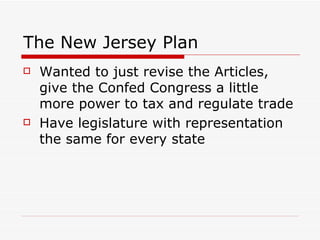
The New Jersey Plan Wanted to just revise the Articles, give the Confed Congress a little more power to tax and regulate trade Have legislature with representation the same for every state
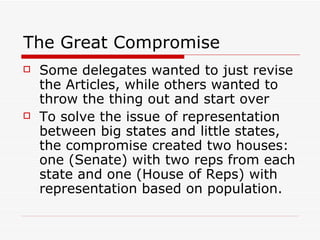
The Great Compromise Some delegates wanted to just revise the Articles, while others wanted to throw the thing out and start over To solve the issue of representation between big states and little states, the compromise created two houses: one (Senate) with two reps from each state and one (House of Reps) with representation based on population.
Three-Fifths Compromise The Southern states had an economy based on slavery  They wanted their slaves to count in the population so they could get more representatives in the house The Northern states didn’t like this because they feared if the South had more people in gov, it could get what it wanted all the time The  Three-fifths Compromise  said that all slaves would count as 3/5s of a person for population The word “slave” was left out of the Constitution
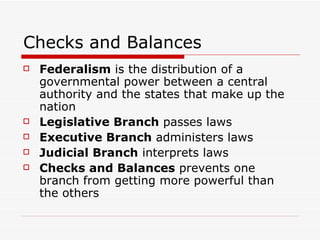
Checks and Balances Federalism  is the distribution of a governmental power between a central authority and the states that make up the nation Legislative Branch  passes laws Executive Branch  administers laws Judicial Branch  interprets laws Checks and Balances  prevents one branch from getting more powerful than the others

Chapter 8 Section 3 Notes

  • 1.
    Chapter 8 Section3 Notes The Constitution
  • 2.
    Chapter 8 Section3 Terms Const. Convention Virginia Plan New Jersey Plan Great Compromise Three-fifths Compromise Federalism Legislative branch Executive branch Judicial branch Checks and Balances
  • 3.
    The Constitutional ConventionIn Feb of 1787, delegates from each state went to Philadelphia to revise the Articles The whole thing was kept secret James Madison was the driving force behind the convention Washington and Franklin were also there African Americas, Native Americans and women were not invited Jefferson and Adams were not there because they were overseas.
  • 4.
    The Virigina PlanThe Big State plan, proposed by Madison Set up a strong central government with three branches Representation would be based on population (which made big states happy and small states mad)
  • 5.
    The New JerseyPlan Wanted to just revise the Articles, give the Confed Congress a little more power to tax and regulate trade Have legislature with representation the same for every state
  • 6.
    The Great CompromiseSome delegates wanted to just revise the Articles, while others wanted to throw the thing out and start over To solve the issue of representation between big states and little states, the compromise created two houses: one (Senate) with two reps from each state and one (House of Reps) with representation based on population.
  • 7.
    Three-Fifths Compromise TheSouthern states had an economy based on slavery They wanted their slaves to count in the population so they could get more representatives in the house The Northern states didn’t like this because they feared if the South had more people in gov, it could get what it wanted all the time The Three-fifths Compromise said that all slaves would count as 3/5s of a person for population The word “slave” was left out of the Constitution
  • 8.
    Checks and BalancesFederalism is the distribution of a governmental power between a central authority and the states that make up the nation Legislative Branch passes laws Executive Branch administers laws Judicial Branch interprets laws Checks and Balances prevents one branch from getting more powerful than the others