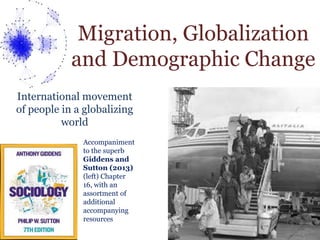
Migration, Globalization
and Demographic Change
International movement
of people in a globalizing
world
Accompaniment
to the superb
Giddens and
Sutton (2013)
(left) Chapter
16, with an
assortment of
additional
accompanying
resources
Migration in a Global Age: introduction
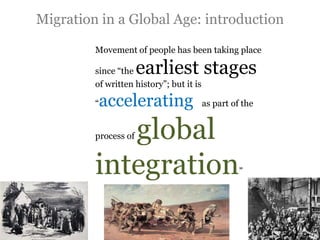
Movement of people has been taking place
since “the earliest stages
of written history”; but it is
“accelerating as part of the
process of global
integration”
.
E______, c_______ and
p_______ ties between are
reflected in increasing migration
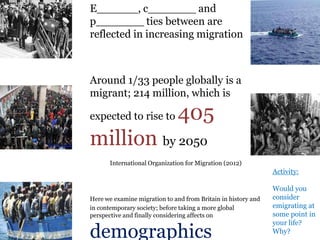
Around 1/33 people globally is a
migrant; 214 million, which is
expected to rise to 405
million by 2050
International Organization for Migration (2012)
Here we examine migration to and from Britain in history and
in contemporary society; before taking a more global
perspective and finally considering affects on
demographics
Activity:
Would you
consider
emigrating at
some point in
your life?
Why?
.
Immigration = people migrating
_____ a country
Emigration = people migrating
______ a country
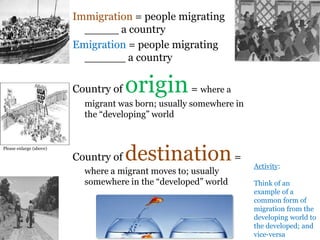
Country of origin= where a
migrant was born; usually somewhere in
the “developing” world
Country of destination=
where a migrant moves to; usually
somewhere in the “developed” world
Activity:
Think of an
example of a
common form of
migration from the
developing world to
the developed; and
vice-versa
Please enlarge (above)
.
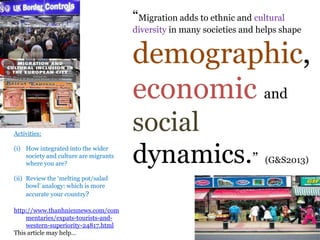
“Migration adds to ethnic and cultural
diversity in many societies and helps shape
demographic,
economic and
social
dynamics.” (G&S2013)
Activities:
(i) How integrated into the wider
society and culture are migrants
where you are?
(ii) Review the „melting pot/salad
bowl‟ analogy: which is more
accurate your country?
http://www.thanhniennews.com/com
mentaries/expats-tourists-and-
western-superiority-24817.html
This article may help…
.
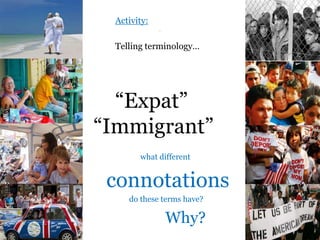
Activity:
Telling terminology…
“Expat”
“Immigrant”
what different
connotations
do these terms have?
Why?
.
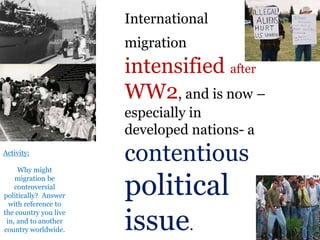
International
migration
intensified after
WW2, and is now –
especially in
developed nations- a
contentious
political
issue.
Activity:
Why might
migration be
controversial
politically? Answer
with reference to
the country you live
in, and to another
country worldwide.
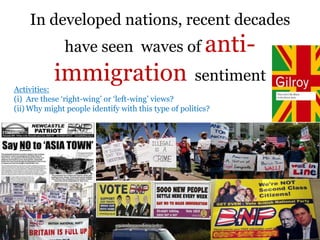
In developed nations, recent decades
have seen waves of anti-
immigration sentiment
.
Activities:
(i) Are these „right-wing‟ or „left-wing‟ views?
(ii) Why might people identify with this type of politics?
.
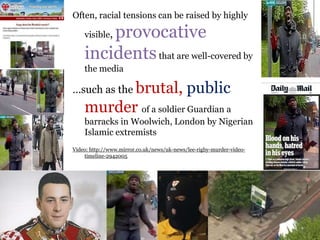
Often, racial tensions can be raised by highly
visible, provocative
incidentsthat are well-covered by
the media
…such as the brutal, public
murder of a soldier Guardian a
barracks in Woolwich, London by Nigerian
Islamic extremists
Video: http://www.mirror.co.uk/news/uk-news/lee-rigby-murder-video-
timeline-2942005
.
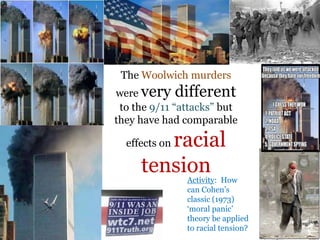
The Woolwich murders
were very different
to the 9/11 “attacks” but
they have had comparable
effects on racial
tensionActivity: How
can Cohen‟s
classic (1973)
„moral panic‟
theory be applied
to racial tension?
.
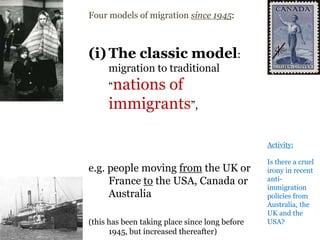
Four models of migration since 1945:
(i) The classic model:
migration to traditional
“nations of
immigrants”,
e.g. people moving from the UK or
France to the USA, Canada or
Australia
(this has been taking place since long before
1945, but increased thereafter)
Activity:
Is there a cruel
irony in recent
anti-
immigration
policies from
Australia, the
UK and the
USA?
.
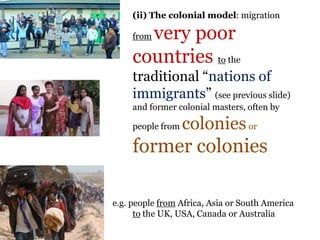
(ii) The colonial model: migration
from very poor
countries to the
traditional “nations of
immigrants” (see previous slide)
and former colonial masters, often by
people from coloniesor
former colonies
e.g. people from Africa, Asia or South America
to the UK, USA, Canada or Australia
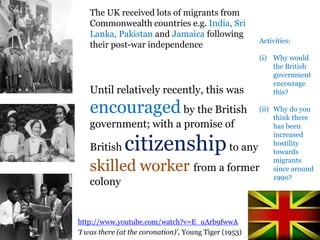
.The UK received lots of migrants from
Commonwealth countries e.g. India, Sri
Lanka, Pakistan and Jamaica following
their post-war independence
Until relatively recently, this was
encouragedby the British
government; with a promise of
British citizenshipto any
skilled worker from a former
colony
http://www.youtube.com/watch?v=E_uArb9fwwA
‘I was there (at the coronation)’, Young Tiger (1953)
Activities:
(i) Why would
the British
government
encourage
this?
(ii) Why do you
think there
has been
increased
hostility
towards
migrants
since around
1990?
.
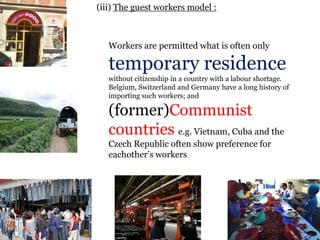
(iii) The guest workers model :
Workers are permitted what is often only
temporary residence
without citizenship in a country with a labour shortage.
Belgium, Switzerland and Germany have a long history of
importing such workers; and
(former)Communist
countries e.g. Vietnam, Cuba and the
Czech Republic often show preference for
eachother‟s workers
.
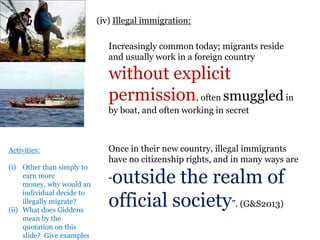
(iv) Illegal immigration:
Increasingly common today; migrants reside
and usually work in a foreign country
without explicit
permission, often smuggledin
by boat, and often working in secret
Once in their new country, illegal immigrants
have no citizenship rights, and in many ways are
“outside the realm of
official society”. (G&S2013)
Activities:
(i) Other than simply to
earn more
money, why would an
individual decide to
illegally migrate?
(ii) What does Giddens
mean by the
quotation on this
slide? Give examples
.
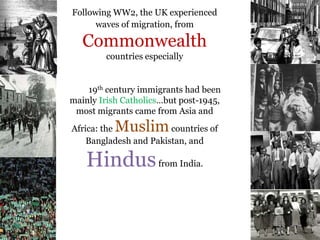
Following WW2, the UK experienced
waves of migration, from
Commonwealth
countries especially
19th century immigrants had been
mainly Irish Catholics…but post-1945,
most migrants came from Asia and
Africa: the Muslimcountries of
Bangladesh and Pakistan, and
Hindusfrom India.
.
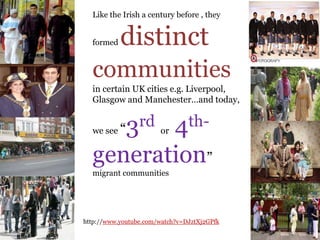
Like the Irish a century before , they
formed distinct
communities
in certain UK cities e.g. Liverpool,
Glasgow and Manchester…and today,
we see “3rd or 4th-
generation”
migrant communities
http://www.youtube.com/watch?v=DJztXj2GPfk
.
.
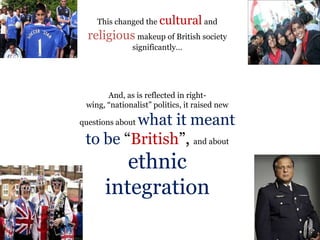
This changed the cultural and
religious makeup of British society
significantly…
And, as is reflected in right-
wing, “nationalist” politics, it raised new
questions about what it meant
to be “British”, and about
ethnic
integration
.
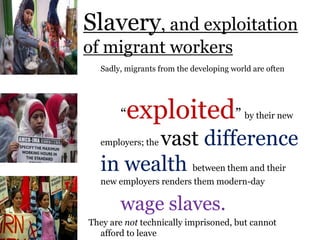
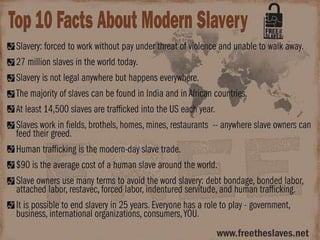
Sadly, migrants from the developing world are often
“exploited” by their new
employers; the vast difference
in wealth between them and their
new employers renders them modern-day
wage slaves.
They are not technically imprisoned, but cannot
afford to leave
Slavery, and exploitation
of migrant workers
.
.
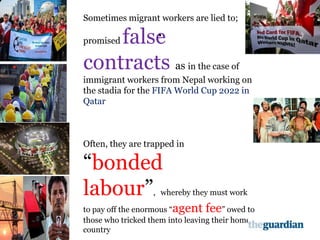
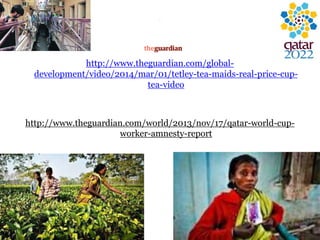
Sometimes migrant workers are lied to;
promised false
contracts as in the case of
immigrant workers from Nepal working on
the stadia for the FIFA World Cup 2022 in
Qatar
Often, they are trapped in
“bonded
labour”, whereby they must work
to pay off the enormous “agent fee” owed to
those who tricked them into leaving their home
country
.
http://www.theguardian.com/global-
development/video/2014/mar/01/tetley-tea-maids-real-price-cup-
tea-video
http://www.theguardian.com/world/2013/nov/17/qatar-world-cup-
worker-amnesty-report
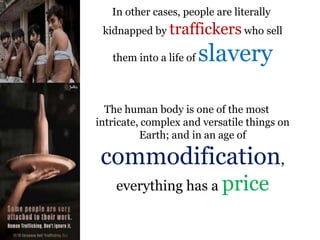
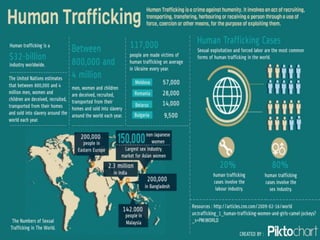
.In other cases, people are literally
kidnapped by traffickers who sell
them into a life of slavery
The human body is one of the most
intricate, complex and versatile things on
Earth; and in an age of
commodification,
everything has a price
.
Promises of jobsin overseas
companies, and individuals
posing as potential
friendsin public or
online, are common tools used to
trap people into what is one of
the most insidious
products of
globalization
.
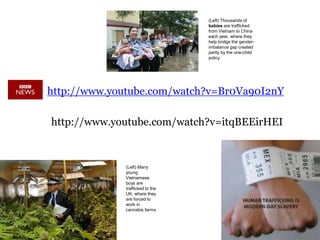
http://www.youtube.com/watch?v=Br0Va90I2nY
http://www.youtube.com/watch?v=itqBEEirHEI
(Left) Many
young
Vietnamese
boys are
trafficked to the
UK, where they
are forced to
work in
cannabis farms
(Left) Thousands of
babies are trafficked
from Vietnam to China
each year, where they
help bridge the gender-
imbalance gap created
partly by the one-child
policy
.
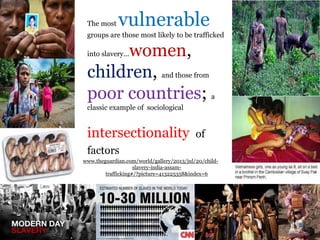
The most vulnerable
groups are those most likely to be trafficked
into slavery…women,
children, and those from
poor countries; a
classic example of sociological
intersectionality of
factors
www.theguardian.com/world/gallery/2013/jul/20/child-
slavery-india-assam-
trafficking#/?picture=413225358&index=6
Migration and demographic theory
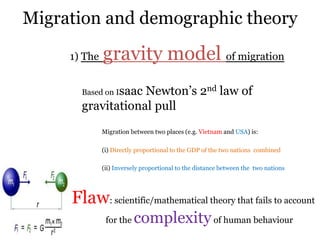
1) The gravity model of migration
Based on Isaac Newton‟s 2nd law of
gravitational pull
Migration between two places (e.g. Vietnam and USA) is:
(i) Directly proportional to the GDP of the two nations combined
(ii) Inversely proportional to the distance between the two nations
Flaw: scientific/mathematical theory that fails to account
for the complexityof human behaviour
.
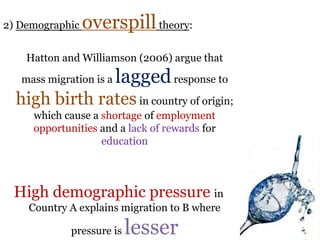
2) Demographic overspilltheory:
Hatton and Williamson (2006) argue that
mass migration is a laggedresponse to
high birth ratesin country of origin;
which cause a shortage of employment
opportunities and a lack of rewards for
education
High demographic pressure in
Country A explains migration to B where
pressure is lesser
.
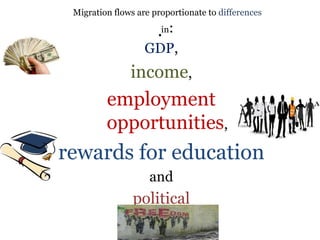
Migration flows are proportionate to differences
in:
GDP,
income,
employment
opportunities,
rewards for education
and
political
.
Flaw: According to Farques (2011), demographic
overspill theory appliesin the case of
developing  developed world
migration…
…but not to migration within either
the developing or developed world
3) Farques (2011): Two-way
relationship between demographics
and migration
Previous theories on migration
assumed a one-way
relationship between
demographicsin the country of
origin, and rates of migration…
.
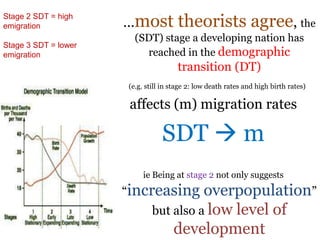
…most theorists agree, the
(SDT) stage a developing nation has
reached in the demographic
transition (DT)
(e.g. still in stage 2: low death rates and high birth rates)
affects (m) migration rates
SDT  m
ie Being at stage 2 not only suggests
“increasing overpopulation”
but also a low level of
development
Stage 2 SDT = high
emigration
Stage 3 SDT = lower
emigration
.
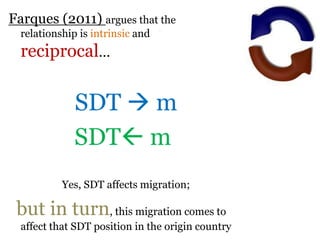
Farques (2011) argues that the
relationship is intrinsic and
reciprocal…
SDT  m
SDT m
Yes, SDT affects migration;
but in turn, this migration comes to
affect that SDT position in the origin country
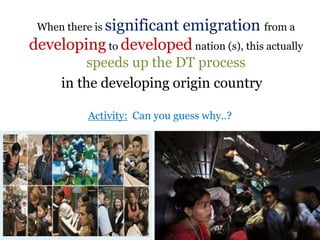
.When there is significant emigration from a
developing to developed nation (s), this actually
speeds up the DT process
in the developing origin country
Activity: Can you guess why..?
.
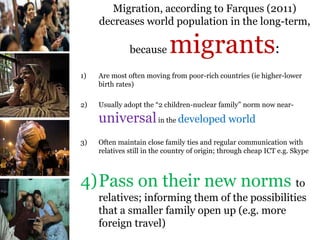
Migration, according to Farques (2011)
decreases world population in the long-term,
because migrants:
1) Are most often moving from poor-rich countries (ie higher-lower
birth rates)
2) Usually adopt the “2 children-nuclear family” norm now near-
universalin the developed world
3) Often maintain close family ties and regular communication with
relatives still in the country of origin; through cheap ICT e.g. Skype
4)Pass on their new norms to
relatives; informing them of the possibilities
that a smaller family open up (e.g. more
foreign travel)

Migration, Globalization and Demographic Change

  • 1.
    Migration, Globalization and DemographicChange International movement of people in a globalizing world Accompaniment to the superb Giddens and Sutton (2013) (left) Chapter 16, with an assortment of additional accompanying resources
  • 2.
    Migration in aGlobal Age: introduction Movement of people has been taking place since “the earliest stages of written history”; but it is “accelerating as part of the process of global integration”
  • 3.
    . E______, c_______ and p_______ties between are reflected in increasing migration Around 1/33 people globally is a migrant; 214 million, which is expected to rise to 405 million by 2050 International Organization for Migration (2012) Here we examine migration to and from Britain in history and in contemporary society; before taking a more global perspective and finally considering affects on demographics Activity: Would you consider emigrating at some point in your life? Why?
  • 4.
    . Immigration = peoplemigrating _____ a country Emigration = people migrating ______ a country Country of origin= where a migrant was born; usually somewhere in the “developing” world Country of destination= where a migrant moves to; usually somewhere in the “developed” world Activity: Think of an example of a common form of migration from the developing world to the developed; and vice-versa Please enlarge (above)
  • 5.
    . “Migration adds toethnic and cultural diversity in many societies and helps shape demographic, economic and social dynamics.” (G&S2013) Activities: (i) How integrated into the wider society and culture are migrants where you are? (ii) Review the „melting pot/salad bowl‟ analogy: which is more accurate your country? http://www.thanhniennews.com/com mentaries/expats-tourists-and- western-superiority-24817.html This article may help…
  • 6.
  • 7.
    . International migration intensified after WW2, andis now – especially in developed nations- a contentious political issue. Activity: Why might migration be controversial politically? Answer with reference to the country you live in, and to another country worldwide.
  • 8.
    In developed nations,recent decades have seen waves of anti- immigration sentiment . Activities: (i) Are these „right-wing‟ or „left-wing‟ views? (ii) Why might people identify with this type of politics?
  • 9.
    . Often, racial tensionscan be raised by highly visible, provocative incidentsthat are well-covered by the media …such as the brutal, public murder of a soldier Guardian a barracks in Woolwich, London by Nigerian Islamic extremists Video: http://www.mirror.co.uk/news/uk-news/lee-rigby-murder-video- timeline-2942005
  • 10.
    . The Woolwich murders werevery different to the 9/11 “attacks” but they have had comparable effects on racial tensionActivity: How can Cohen‟s classic (1973) „moral panic‟ theory be applied to racial tension?
  • 11.
    . Four models ofmigration since 1945: (i) The classic model: migration to traditional “nations of immigrants”, e.g. people moving from the UK or France to the USA, Canada or Australia (this has been taking place since long before 1945, but increased thereafter) Activity: Is there a cruel irony in recent anti- immigration policies from Australia, the UK and the USA?
  • 12.
    . (ii) The colonialmodel: migration from very poor countries to the traditional “nations of immigrants” (see previous slide) and former colonial masters, often by people from coloniesor former colonies e.g. people from Africa, Asia or South America to the UK, USA, Canada or Australia
  • 13.
    .The UK receivedlots of migrants from Commonwealth countries e.g. India, Sri Lanka, Pakistan and Jamaica following their post-war independence Until relatively recently, this was encouragedby the British government; with a promise of British citizenshipto any skilled worker from a former colony http://www.youtube.com/watch?v=E_uArb9fwwA ‘I was there (at the coronation)’, Young Tiger (1953) Activities: (i) Why would the British government encourage this? (ii) Why do you think there has been increased hostility towards migrants since around 1990?
  • 14.
    . (iii) The guestworkers model : Workers are permitted what is often only temporary residence without citizenship in a country with a labour shortage. Belgium, Switzerland and Germany have a long history of importing such workers; and (former)Communist countries e.g. Vietnam, Cuba and the Czech Republic often show preference for eachother‟s workers
  • 15.
    . (iv) Illegal immigration: Increasinglycommon today; migrants reside and usually work in a foreign country without explicit permission, often smuggledin by boat, and often working in secret Once in their new country, illegal immigrants have no citizenship rights, and in many ways are “outside the realm of official society”. (G&S2013) Activities: (i) Other than simply to earn more money, why would an individual decide to illegally migrate? (ii) What does Giddens mean by the quotation on this slide? Give examples
  • 16.
    . Following WW2, theUK experienced waves of migration, from Commonwealth countries especially 19th century immigrants had been mainly Irish Catholics…but post-1945, most migrants came from Asia and Africa: the Muslimcountries of Bangladesh and Pakistan, and Hindusfrom India.
  • 17.
    . Like the Irisha century before , they formed distinct communities in certain UK cities e.g. Liverpool, Glasgow and Manchester…and today, we see “3rd or 4th- generation” migrant communities http://www.youtube.com/watch?v=DJztXj2GPfk
  • 18.
    . . This changed thecultural and religious makeup of British society significantly… And, as is reflected in right- wing, “nationalist” politics, it raised new questions about what it meant to be “British”, and about ethnic integration
  • 19.
    . Sadly, migrants fromthe developing world are often “exploited” by their new employers; the vast difference in wealth between them and their new employers renders them modern-day wage slaves. They are not technically imprisoned, but cannot afford to leave Slavery, and exploitation of migrant workers
  • 20.
    . . Sometimes migrant workersare lied to; promised false contracts as in the case of immigrant workers from Nepal working on the stadia for the FIFA World Cup 2022 in Qatar Often, they are trapped in “bonded labour”, whereby they must work to pay off the enormous “agent fee” owed to those who tricked them into leaving their home country
  • 21.
  • 22.
    .In other cases,people are literally kidnapped by traffickers who sell them into a life of slavery The human body is one of the most intricate, complex and versatile things on Earth; and in an age of commodification, everything has a price
  • 23.
    . Promises of jobsinoverseas companies, and individuals posing as potential friendsin public or online, are common tools used to trap people into what is one of the most insidious products of globalization
  • 24.
    . http://www.youtube.com/watch?v=Br0Va90I2nY http://www.youtube.com/watch?v=itqBEEirHEI (Left) Many young Vietnamese boys are traffickedto the UK, where they are forced to work in cannabis farms (Left) Thousands of babies are trafficked from Vietnam to China each year, where they help bridge the gender- imbalance gap created partly by the one-child policy
  • 26.
    . The most vulnerable groupsare those most likely to be trafficked into slavery…women, children, and those from poor countries; a classic example of sociological intersectionality of factors www.theguardian.com/world/gallery/2013/jul/20/child- slavery-india-assam- trafficking#/?picture=413225358&index=6
  • 28.
    Migration and demographictheory 1) The gravity model of migration Based on Isaac Newton‟s 2nd law of gravitational pull Migration between two places (e.g. Vietnam and USA) is: (i) Directly proportional to the GDP of the two nations combined (ii) Inversely proportional to the distance between the two nations Flaw: scientific/mathematical theory that fails to account for the complexityof human behaviour
  • 29.
    . 2) Demographic overspilltheory: Hattonand Williamson (2006) argue that mass migration is a laggedresponse to high birth ratesin country of origin; which cause a shortage of employment opportunities and a lack of rewards for education High demographic pressure in Country A explains migration to B where pressure is lesser
  • 30.
    . Migration flows areproportionate to differences in: GDP, income, employment opportunities, rewards for education and political
  • 31.
    . Flaw: According toFarques (2011), demographic overspill theory appliesin the case of developing  developed world migration… …but not to migration within either the developing or developed world
  • 32.
    3) Farques (2011):Two-way relationship between demographics and migration Previous theories on migration assumed a one-way relationship between demographicsin the country of origin, and rates of migration…
  • 33.
    . …most theorists agree,the (SDT) stage a developing nation has reached in the demographic transition (DT) (e.g. still in stage 2: low death rates and high birth rates) affects (m) migration rates SDT  m ie Being at stage 2 not only suggests “increasing overpopulation” but also a low level of development Stage 2 SDT = high emigration Stage 3 SDT = lower emigration
  • 34.
    . Farques (2011) arguesthat the relationship is intrinsic and reciprocal… SDT  m SDT m Yes, SDT affects migration; but in turn, this migration comes to affect that SDT position in the origin country
  • 35.
    .When there issignificant emigration from a developing to developed nation (s), this actually speeds up the DT process in the developing origin country Activity: Can you guess why..?
  • 36.
    . Migration, according toFarques (2011) decreases world population in the long-term, because migrants: 1) Are most often moving from poor-rich countries (ie higher-lower birth rates) 2) Usually adopt the “2 children-nuclear family” norm now near- universalin the developed world 3) Often maintain close family ties and regular communication with relatives still in the country of origin; through cheap ICT e.g. Skype 4)Pass on their new norms to relatives; informing them of the possibilities that a smaller family open up (e.g. more foreign travel)