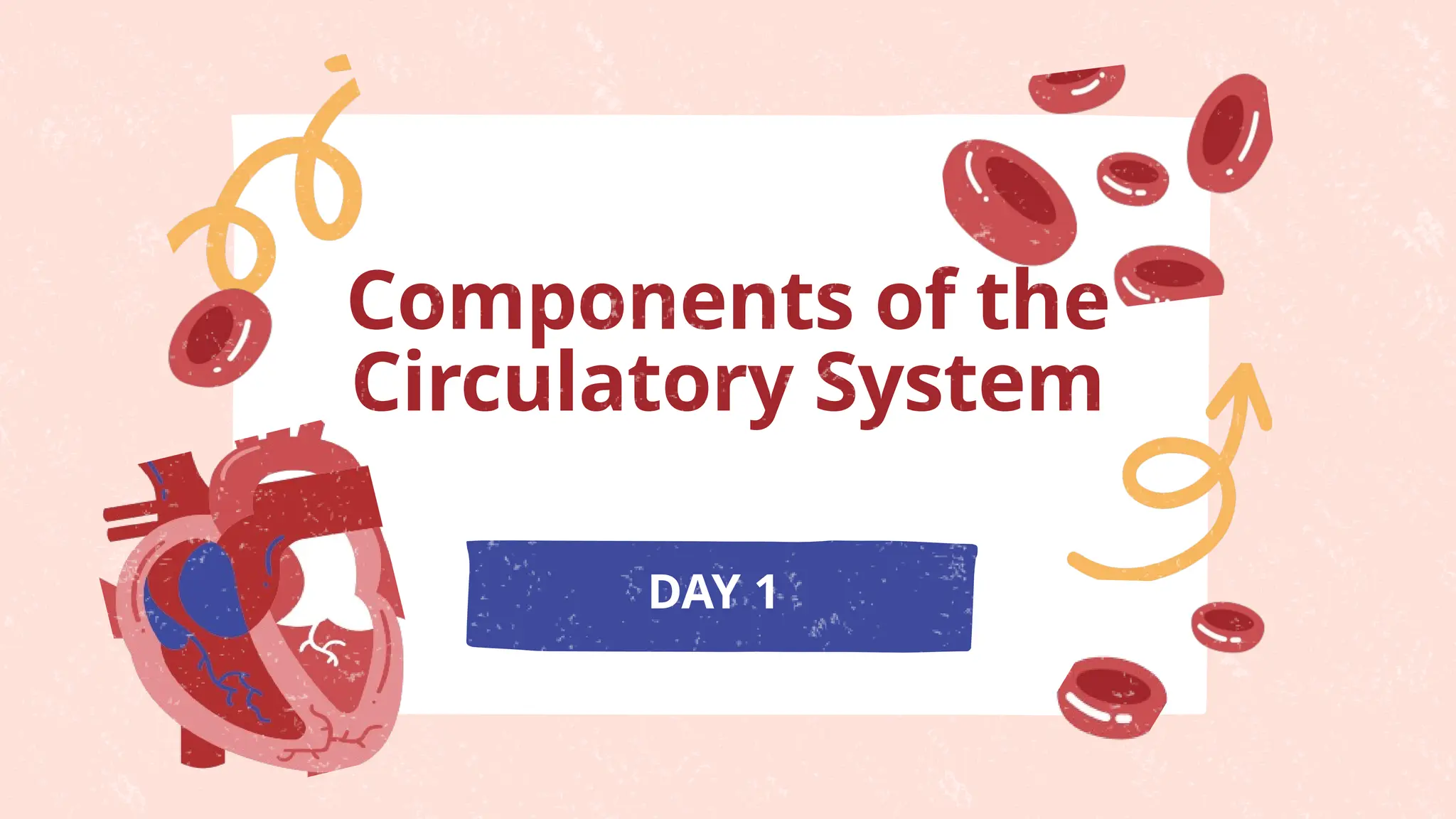
Components of the
Circulatory System
DAY 1
2
1.What did you notice about
how blood moves?
2. Which part seems most
important to keep your
body alive?
3
Why Circulatory system is
important?
4
Reflection: (1 whole)
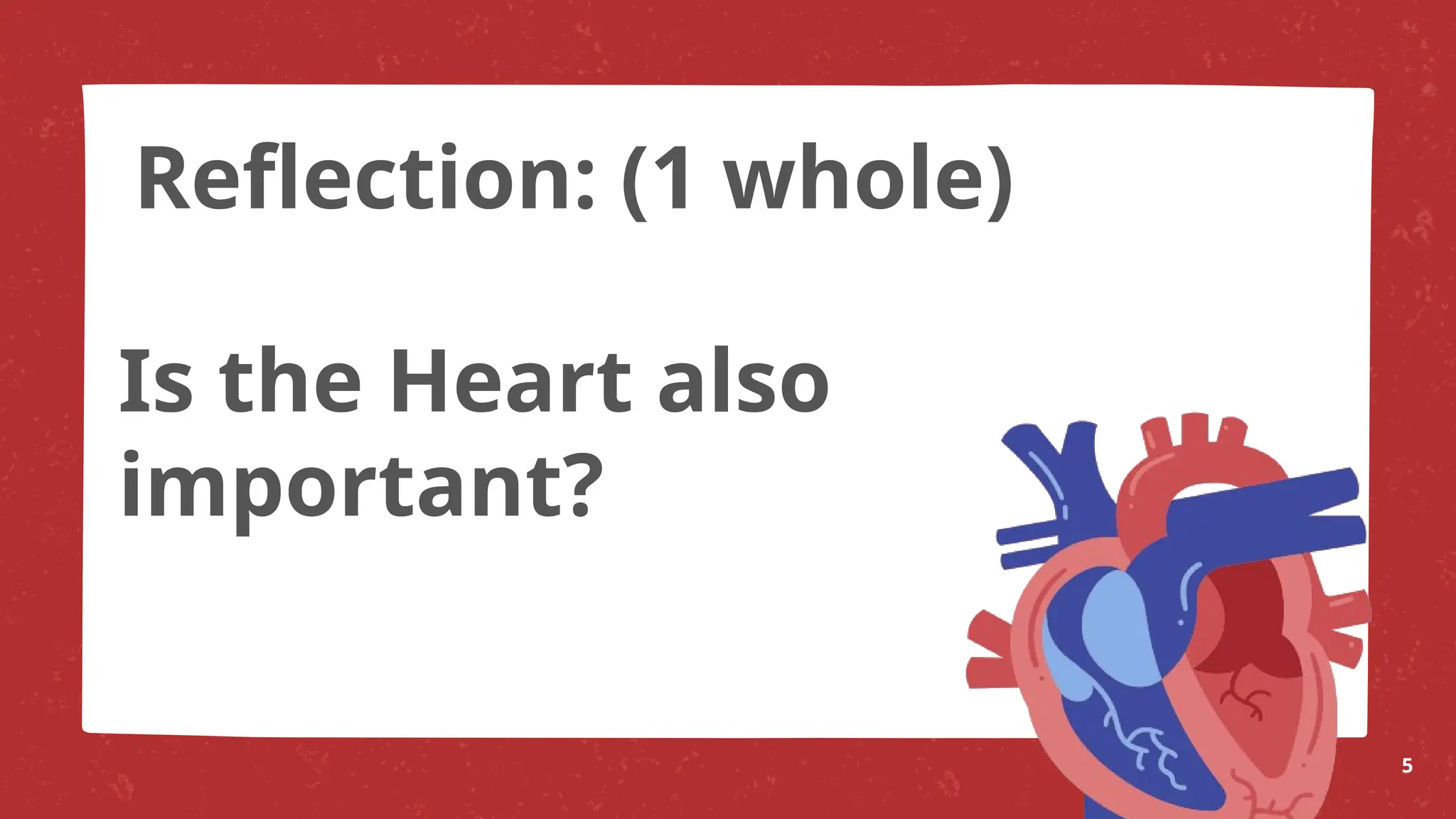
Is the Heart also
important?
5
Reflection: (1 whole)
“Circulatory System Stations”
6
Group Activity:
Instructions: 3 Groups
1. Heart Station: Model or diagram of the heart;
identify chambers, valves, and flow of blood
2. Blood Vessels Station: Arteries vs. veins vs.
capillaries; observe diagrams and use yarn or colored
strings to simulate vessel types.
3. Blood Station: Examine images of plasma, RBCs,
WBCs, platelets and match them with their functions.
7
Group Activity: “Circulatory System
Stations”
You will choose a representative per
group and present in the class.
Each representative will explain the
relationship of their structure,
function and connection to other
parts 8
Group Activity: “Circulatory System
Stations”
9
10
Circulatory System: Functions, Diseases,
and Healthy Habits
You will choose a representative per
group and present in the class.
Each representative will explain the
relationship of their structure,
function and connection to other
parts 11
Circulatory System: Functions, Diseases,
and Healthy Habits
• What is the main job of the heart?
• What makes veins different from
arteries?
• What part of the blood helps fight
infection?
12
Pass the red ball – When music stops,
answer a question!
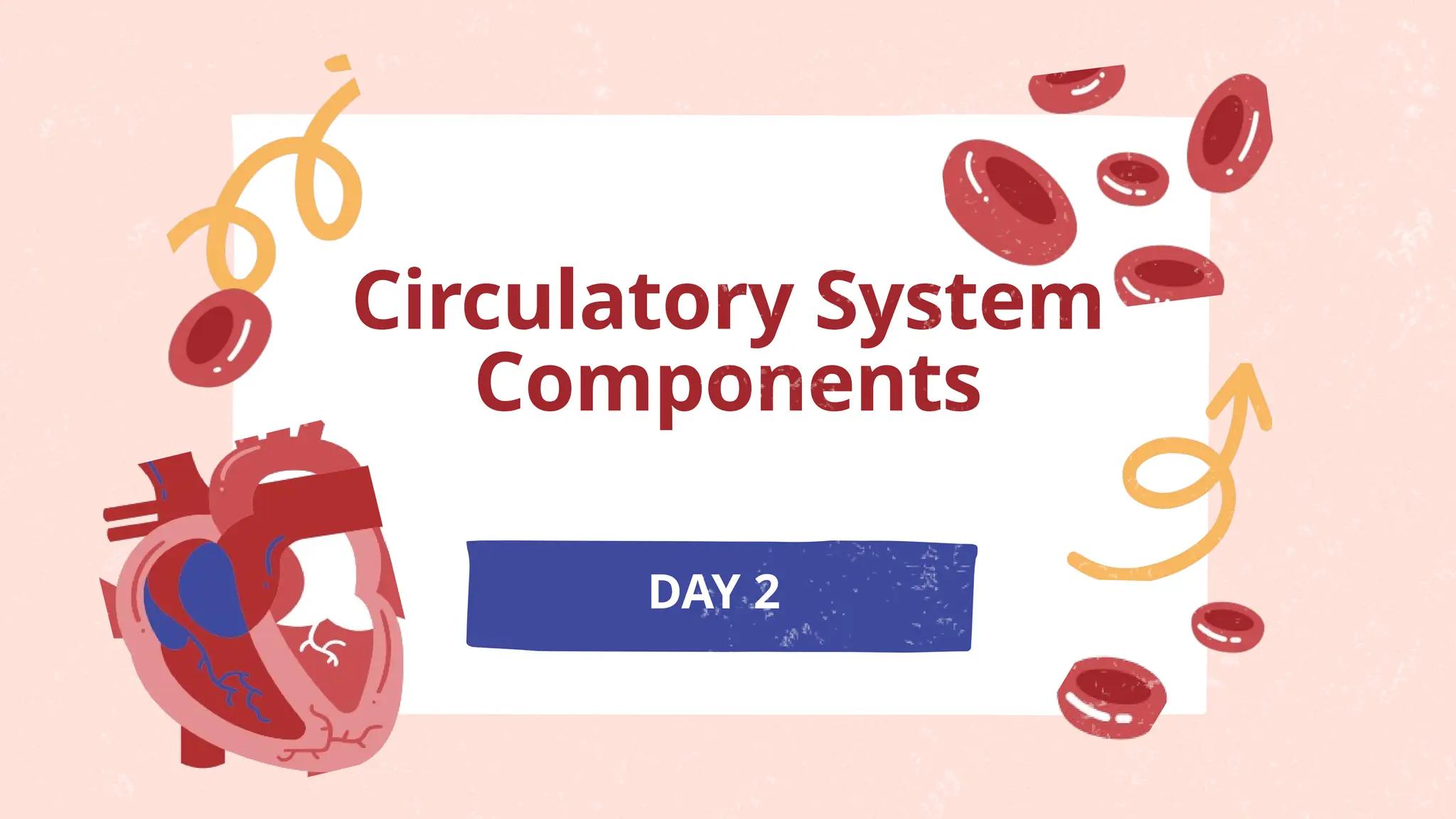
Circulatory System
Components
DAY 2
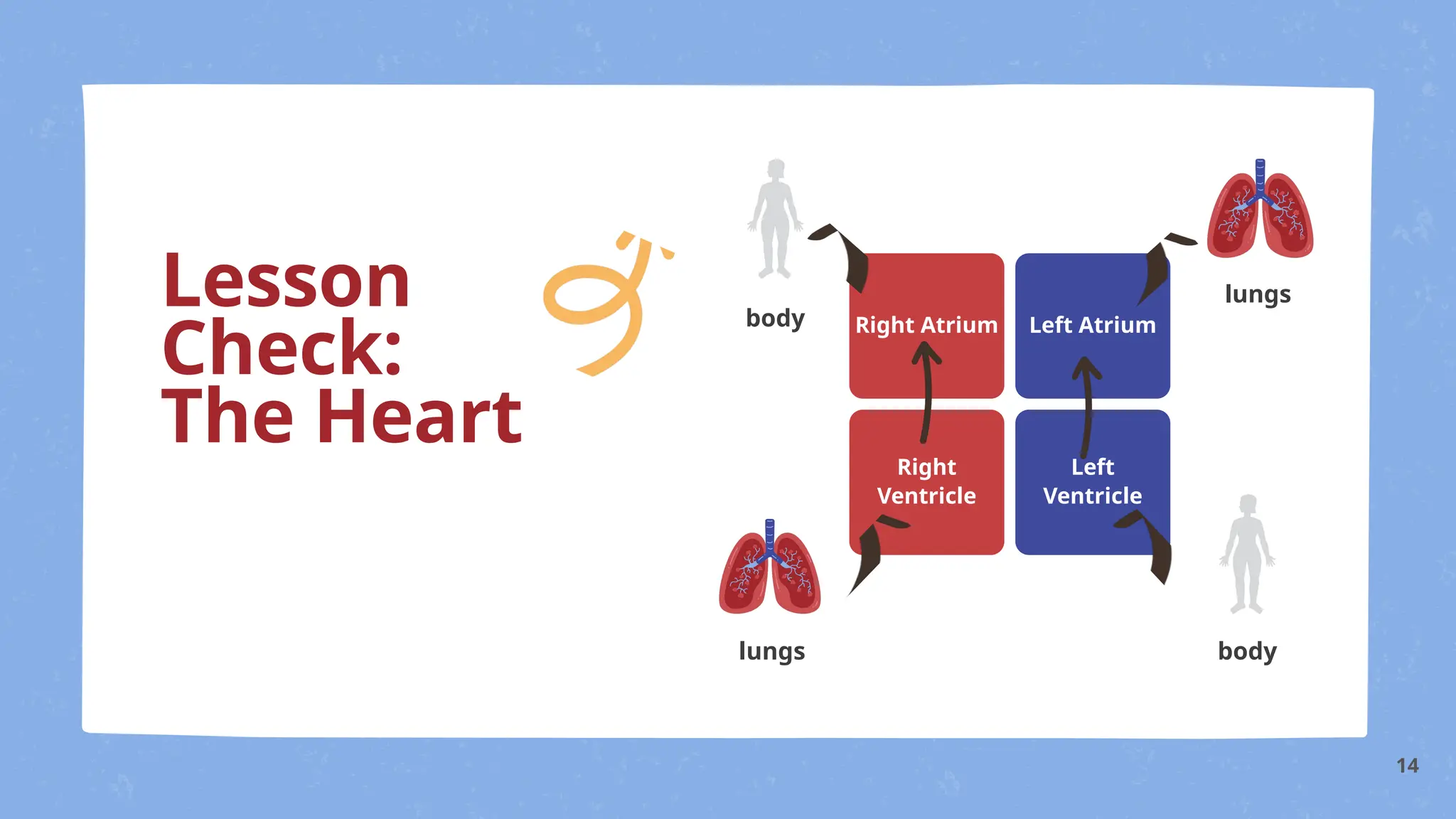
Lesson
Check:
The Heart
ANSWER KEY
Right Atrium Left Atrium
Right
Ventricle
Left
Ventricle
body
lungs
lungs
body
14
1
2
1
2
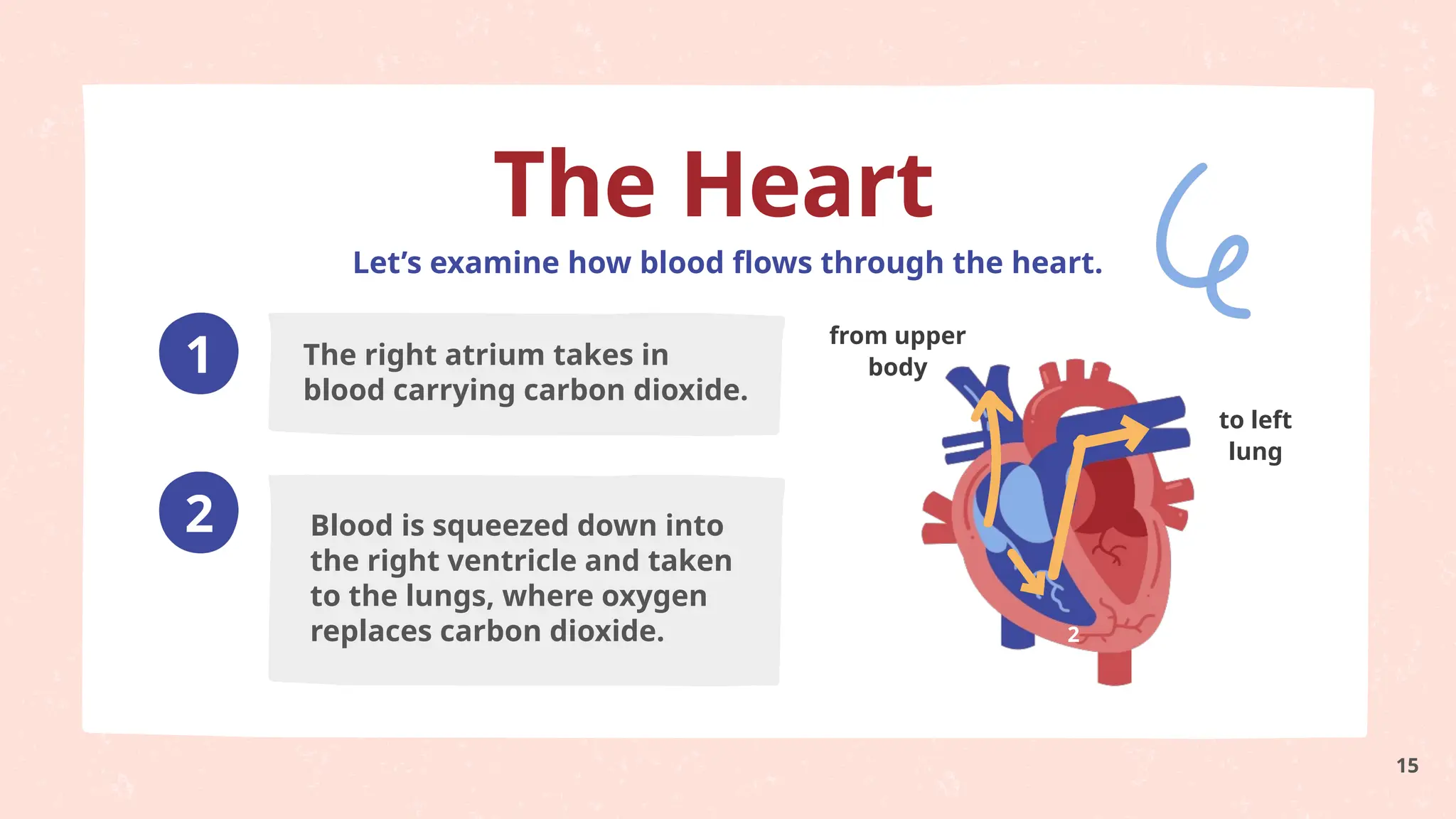
Let’s examine how blood flows through the heart.
The Heart
The right atrium takes in
blood carrying carbon dioxide.
Blood is squeezed down into
the right ventricle and taken
to the lungs, where oxygen
replaces carbon dioxide.
from upper
body
to left
lung
15
3
4
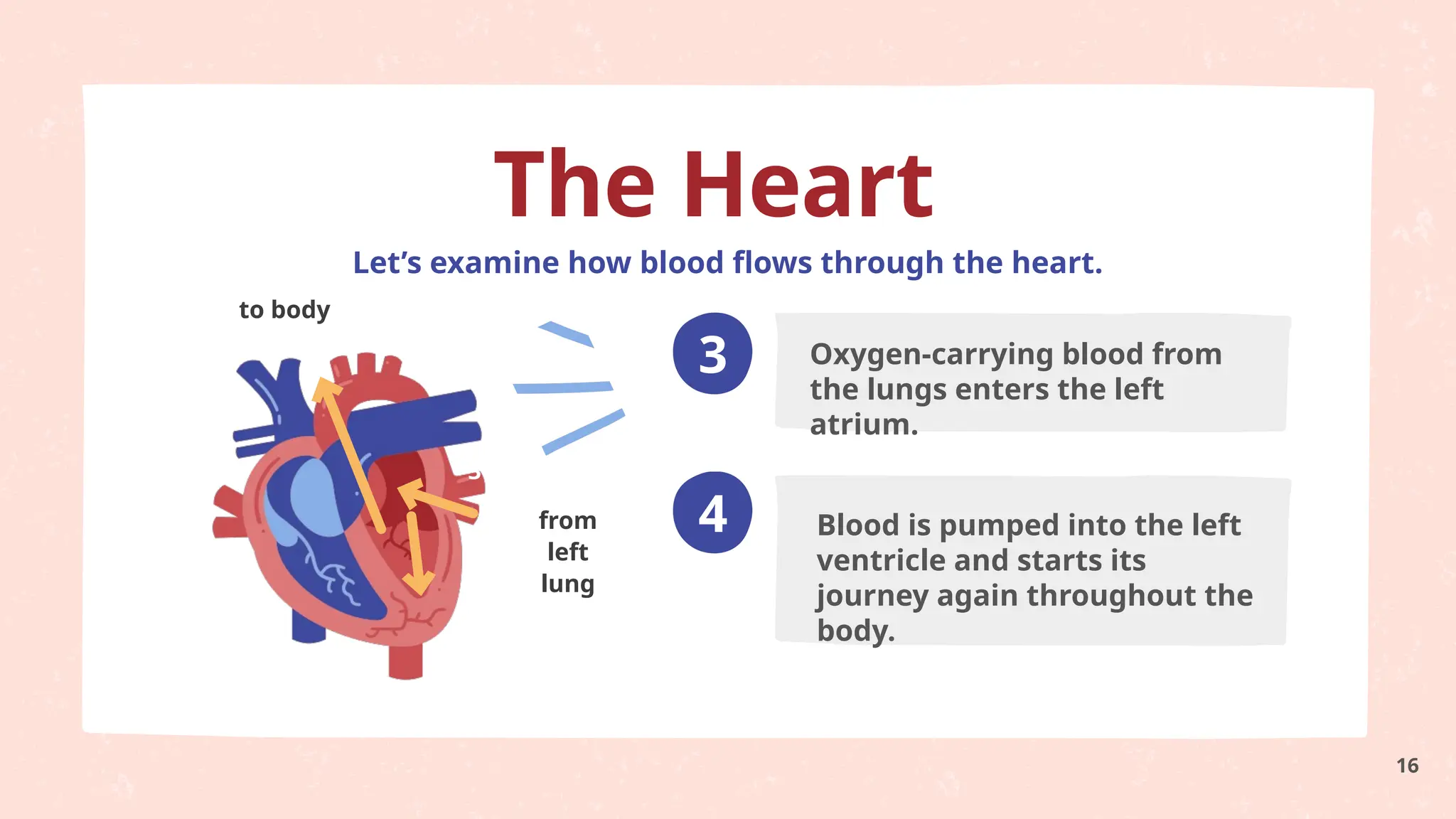
Oxygen-carrying blood from
the lungs enters the left
atrium.
Blood is pumped into the left
ventricle and starts its
journey again throughout the
body.
to body
from
left
lung
Let’s examine how blood flows through the heart.
The Heart
3
4
16
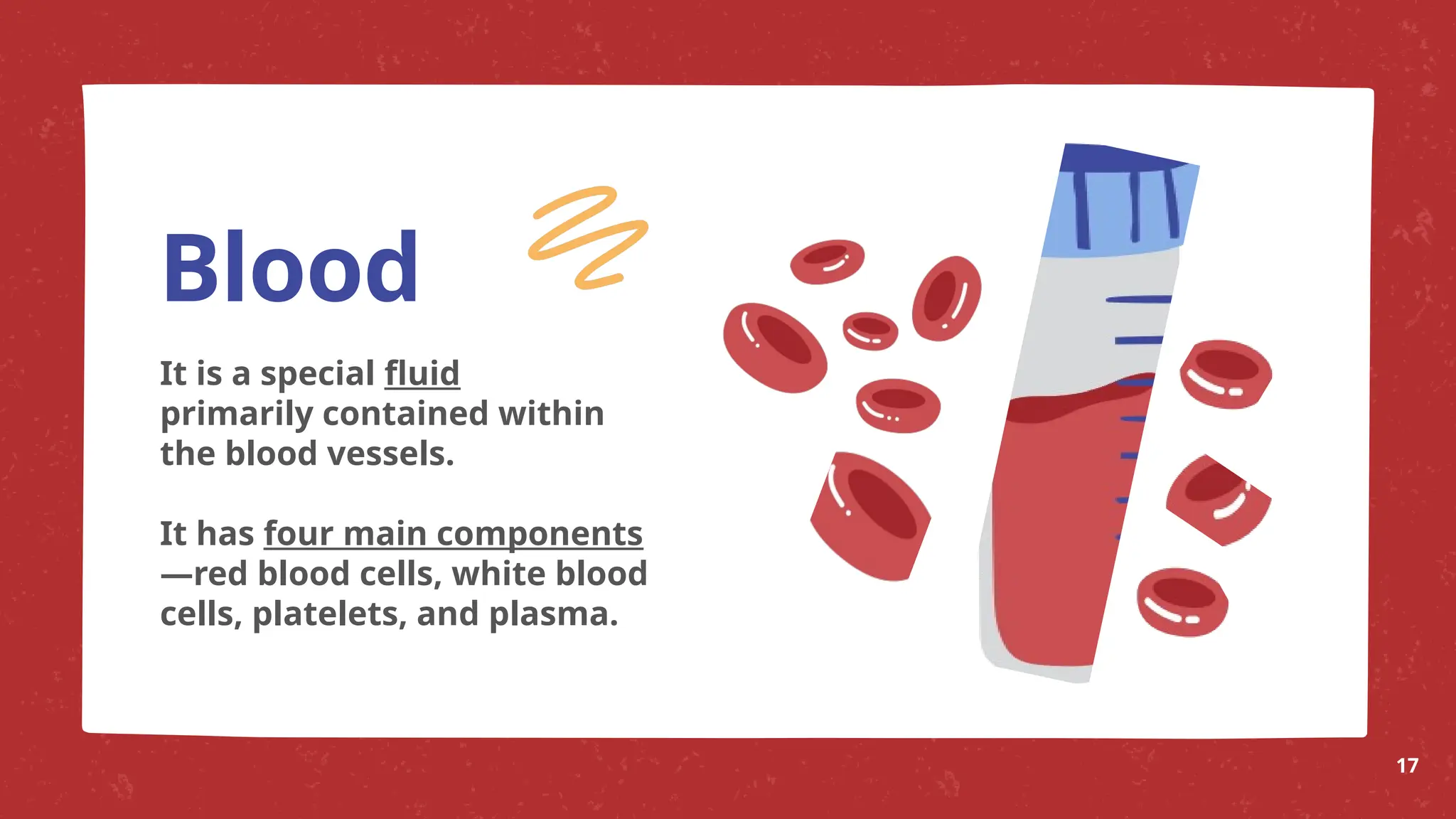
It is a special fluid
primarily contained within
the blood vessels.
It has four main components
—red blood cells, white blood
cells, platelets, and plasma.
Blood
17
Blood
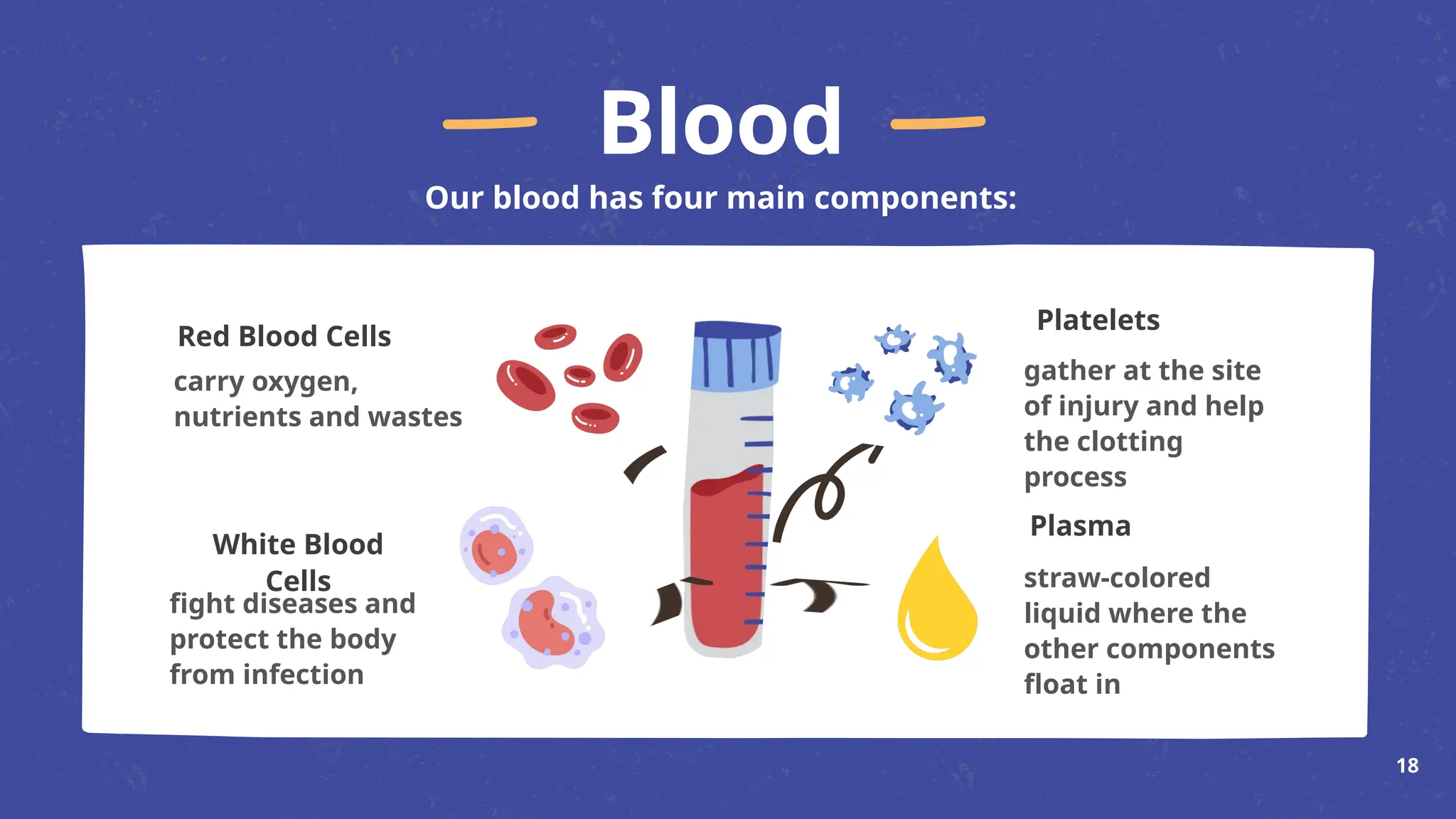
Our blood has four main components:
carry oxygen,
nutrients and wastes
fight diseases and
protect the body
from infection
straw-colored
liquid where the
other components
float in
gather at the site
of injury and help
the clotting
process
Red Blood Cells
White Blood
Cells
Platelets
Plasma
18
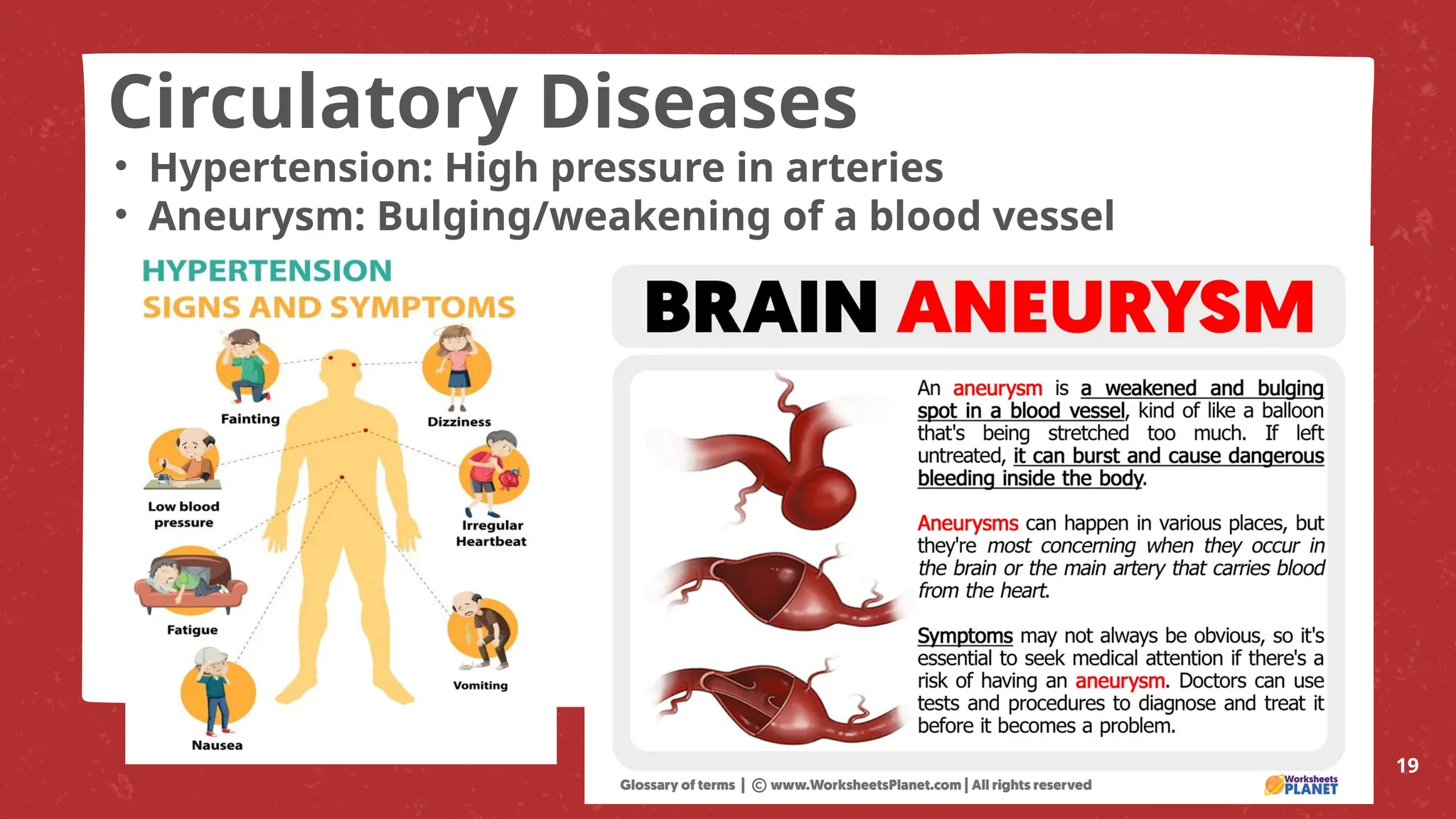
• Hypertension: High pressure in arteries
• Aneurysm: Bulging/weakening of a blood vessel
19
Circulatory Diseases
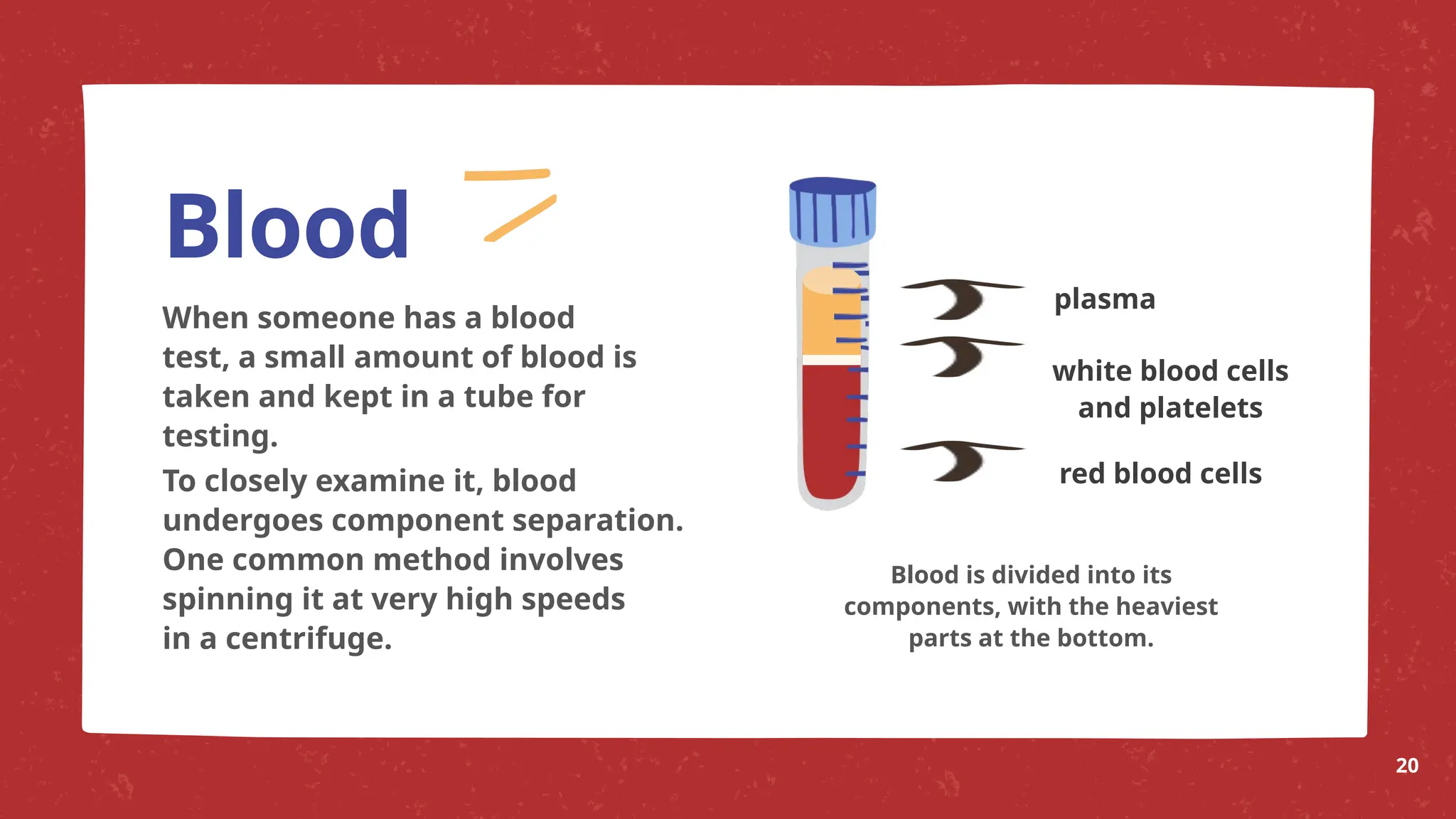
When someone has a blood
test, a small amount of blood is
taken and kept in a tube for
testing.
To closely examine it, blood
undergoes component separation.
One common method involves
spinning it at very high speeds
in a centrifuge.
Blood
Blood is divided into its
components, with the heaviest
parts at the bottom.
plasma
white blood cells
and platelets
red blood cells
20
Blood Vessels
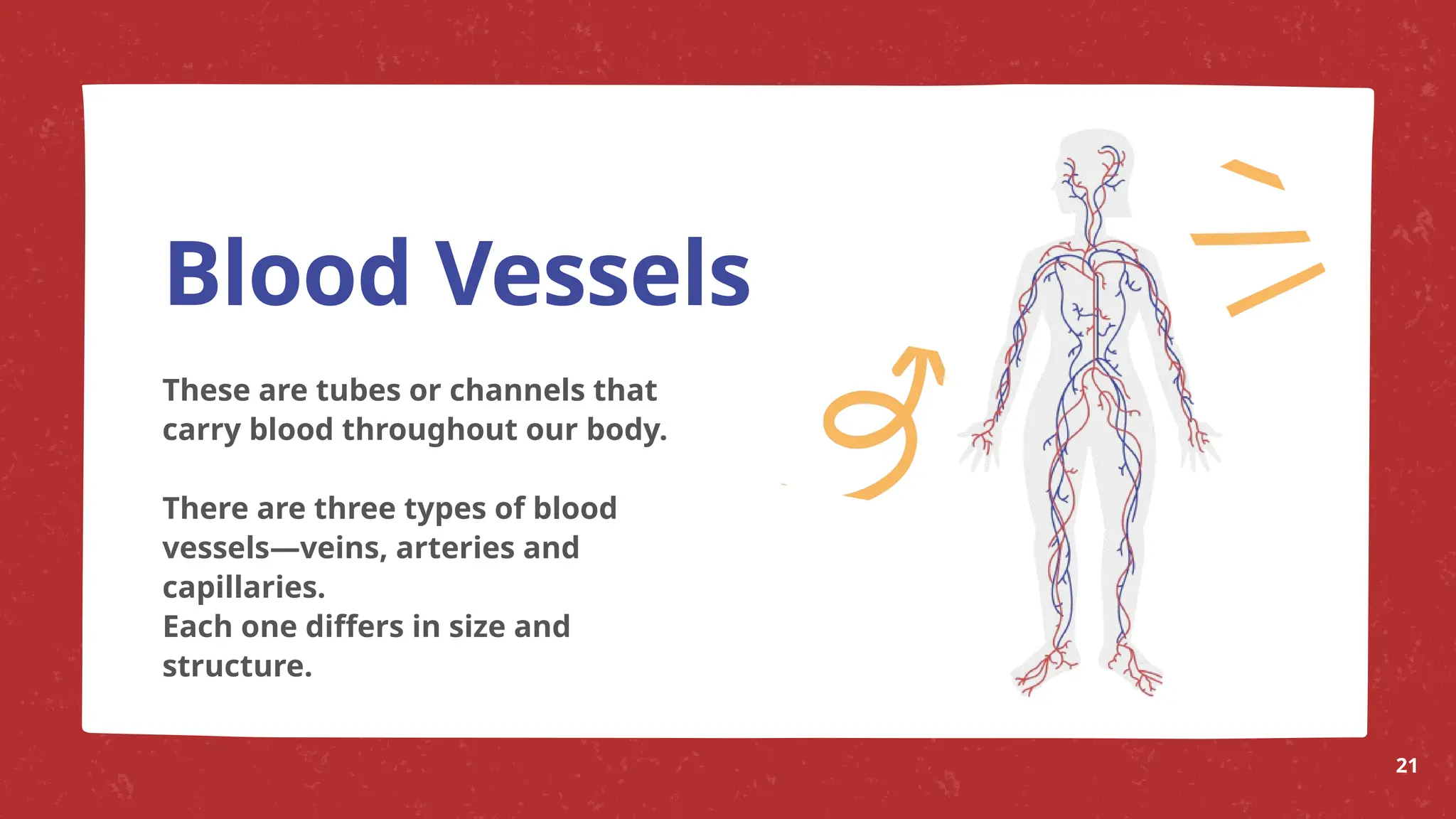
These are tubes or channels that
carry blood throughout our body.
There are three types of blood
vessels—veins, arteries and
capillaries.
Each one differs in size and
structure.
21
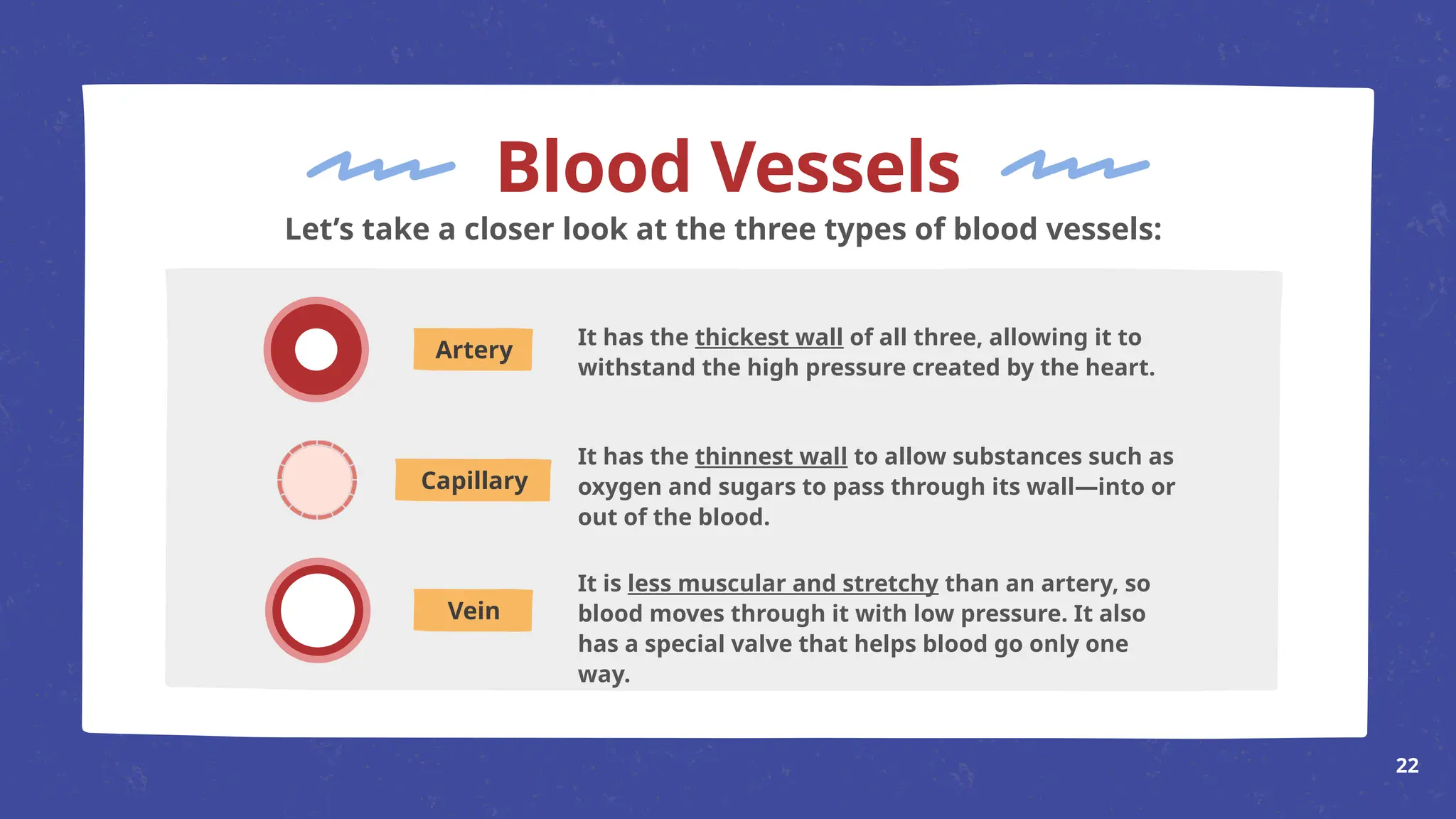
Artery
Capillary
Vein
Blood Vessels
It has the thickest wall of all three, allowing it to
withstand the high pressure created by the heart.
It has the thinnest wall to allow substances such as
oxygen and sugars to pass through its wall—into or
out of the blood.
It is less muscular and stretchy than an artery, so
blood moves through it with low pressure. It also
has a special valve that helps blood go only one
way.
Let’s take a closer look at the three types of blood vessels:
22
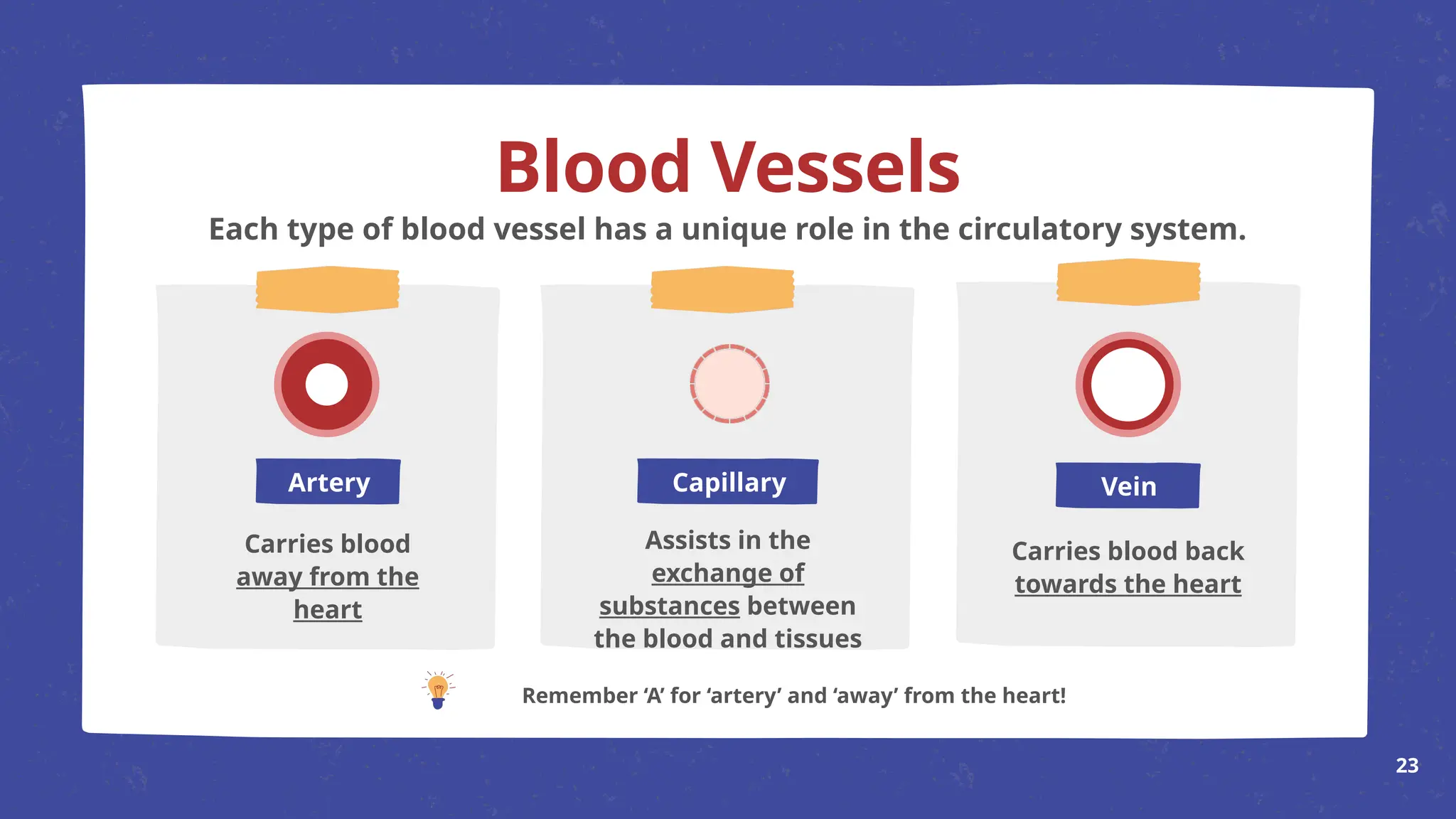
Carries blood
away from the
heart
Remember ‘A’ for ‘artery’ and ‘away’ from the heart!
TIP
Blood Vessels
Each type of blood vessel has a unique role in the circulatory system.
Artery Capillary
Assists in the
exchange of
substances between
the blood and tissues
Vein
Carries blood back
towards the heart
23
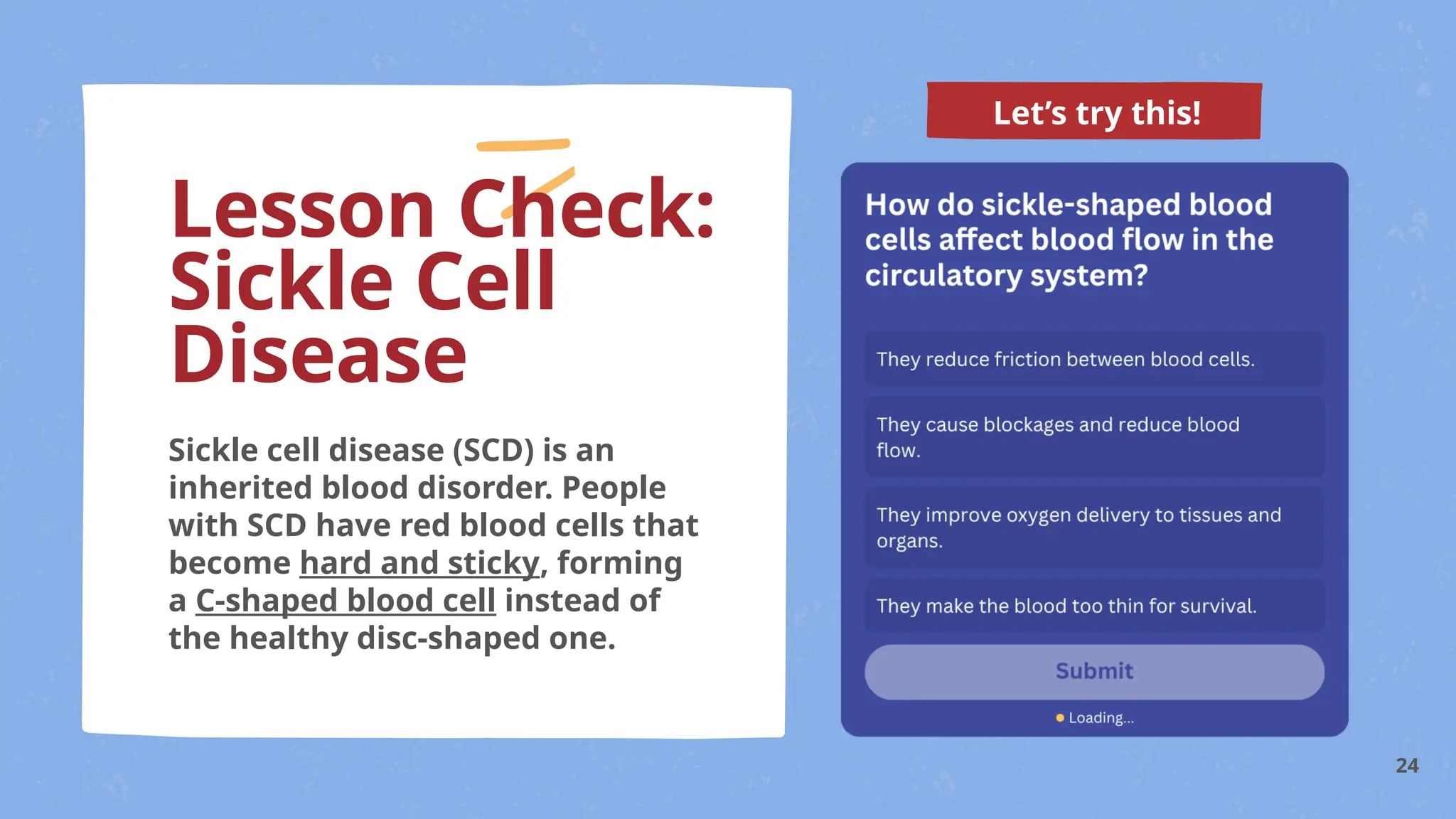
Let’s try this!
Sickle cell disease (SCD) is an
inherited blood disorder. People
with SCD have red blood cells that
become hard and sticky, forming
a C-shaped blood cell instead of
the healthy disc-shaped one.
Lesson Check:
Sickle Cell
Disease
24
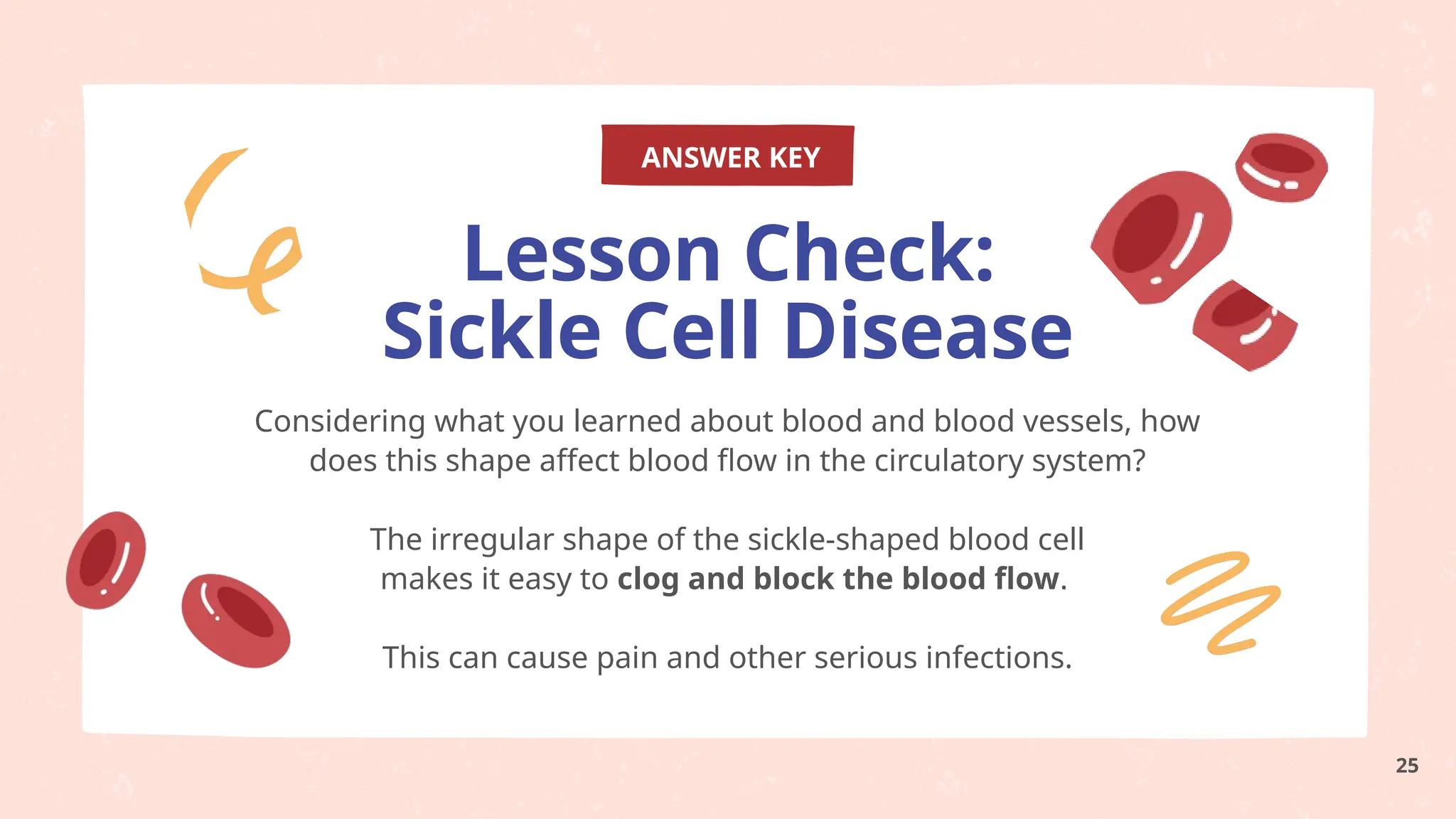
ANSWER KEY
Considering what you learned about blood and blood vessels, how
does this shape affect blood flow in the circulatory system?
The irregular shape of the sickle-shaped blood cell
makes it easy to clog and block the blood flow.
This can cause pain and other serious infections.
Lesson Check:
Sickle Cell Disease
25
Blood Blood Vessels
Heart
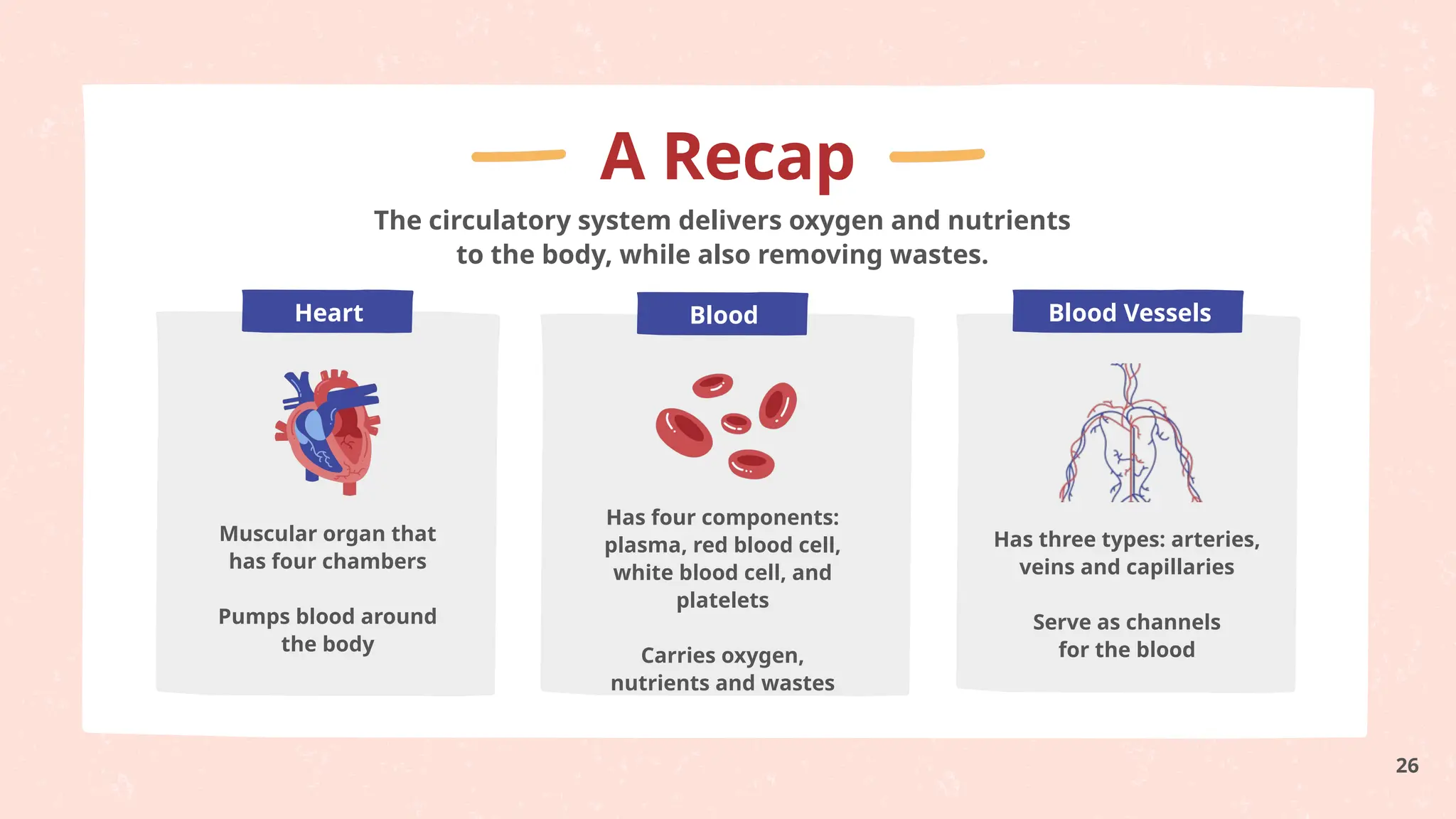
A Recap
The circulatory system delivers oxygen and nutrients
to the body, while also removing wastes.
Muscular organ that
has four chambers
Pumps blood around
the body
Has four components:
plasma, red blood cell,
white blood cell, and
platelets
Carries oxygen,
nutrients and wastes
Has three types: arteries,
veins and capillaries
Serve as channels
for the blood
26
Write a story as though you are
a red blood cell.
Some guide questions you can use
are:
• What do you look like?
• What is your job?
• Where are you found?
• Where do you travel from and to?
A Day in the Life of
a Red Blood Cell
27
Circulatory System
Stations
DAY 3
Warm-up Activity (Quick
Recap)
29
"What is one function of
blood that you
remember?"
30
Think-Pair-Share:
Role-Play: Be the Heart
Hero!
Form groups of 3–4.
31
Activity 1 - Role-Play:
"Be the Heart Hero!"
32
33
The components of the
circulatory system
34
Create a short skit or poster
about:
One heart disease
(hypertension/aneurysm)
35
Create a short skit or poster
about:
Healthy tips to prevent it
36
Create a short skit or poster
about:
Time: 30 minutes prep +
3–5 minutes presentation
37
Create a short skit or poster
about:
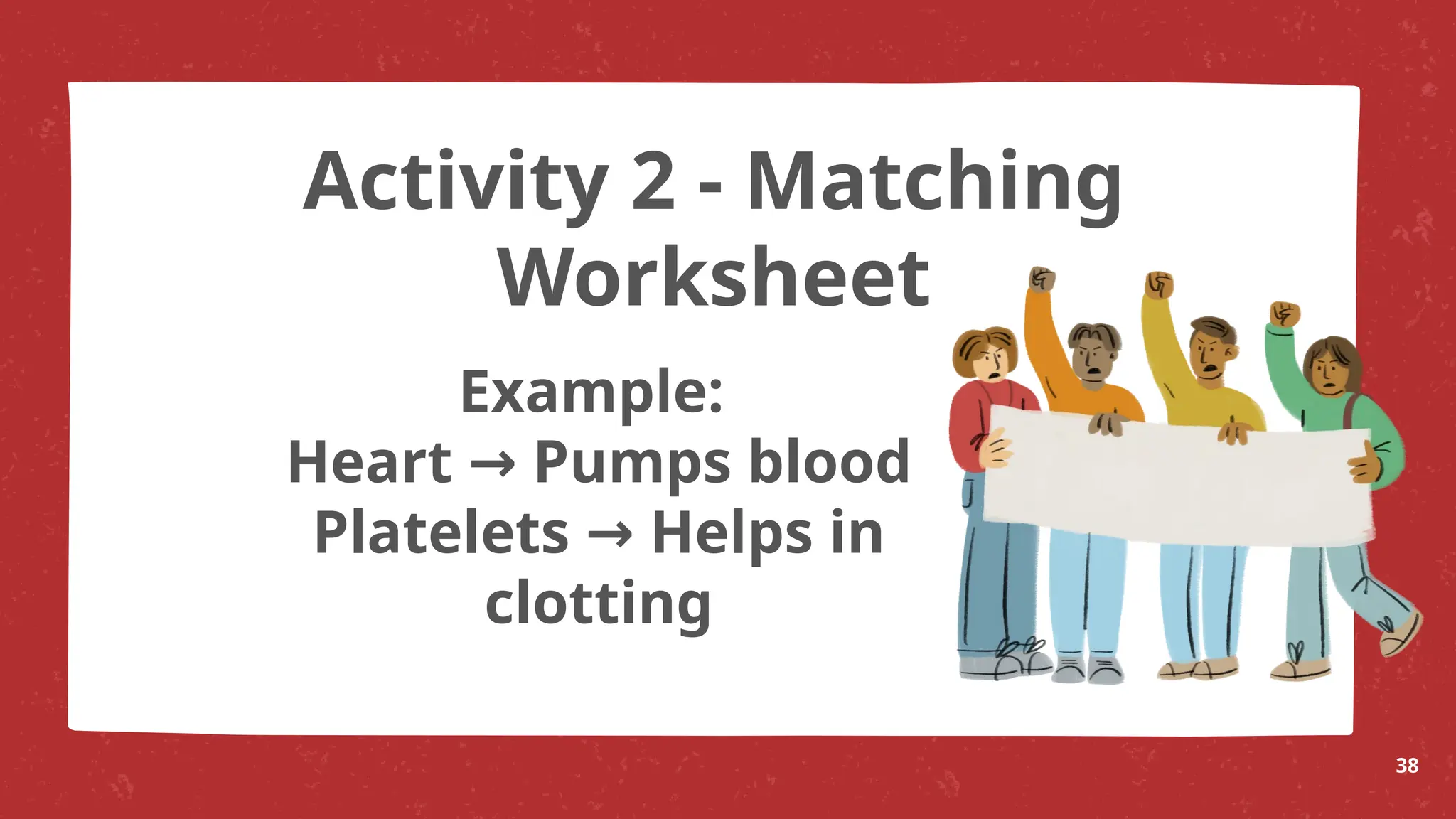
Example:
Heart Pumps blood
→
Platelets Helps in
→
clotting
38
Activity 2 - Matching
Worksheet
Write 3 things you learned today
about the circulatory system.
Write 1 habit you will change or
continue for a healthier heart.
39
Activity 3 - Exit Pass
"Heart Toss Trivia!"
Use a soft ball: whoever catches it
answers a review question.
40
Bonus Game (If Time Allows)
What carries oxygen in blood?
Which blood vessel brings blood
back to the heart?
41
Bonus Game (If Time Allows)
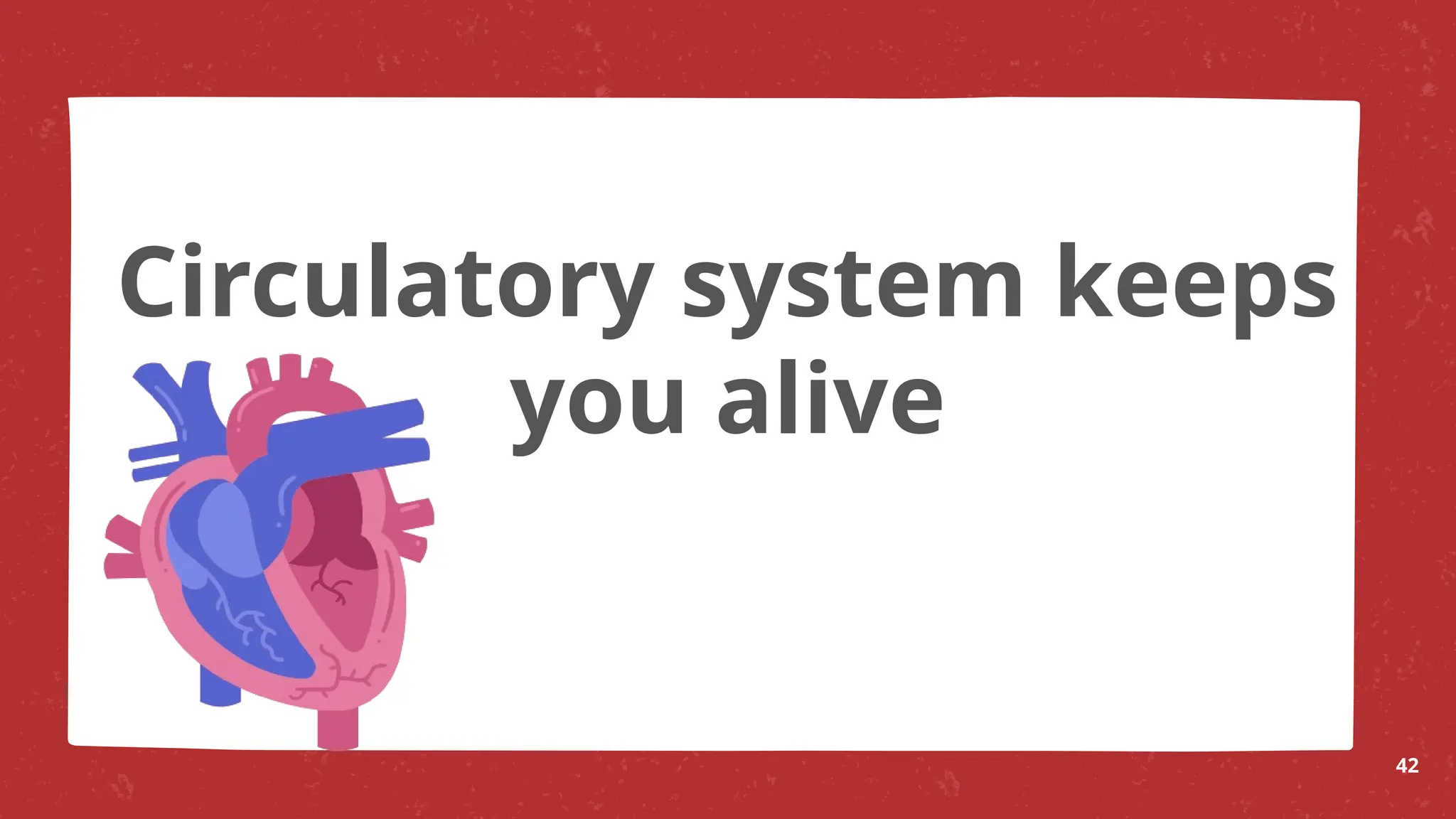
Circulatory system keeps
you alive
42
Diseases can be prevented with
healthy habits
43
You can be a Heart Hero!
44
Reminder: Long test is tomorrow
45
Stay active. Stay healthy. Protect
your heart.
46
Understanding the
Circulatory System”
DAY 4
• What is the function of the
arteries?
• What happens in the capillaries?
• Which blood component fights
infection?
48
“Pass the Pulse”
Multiple Choice (7 items, 2 point each
= 14 points)
Instructions: Read each question
carefully. Encircle the letter of the
best answer.
49
Long Test Overview

grade 9 circulatory system struncture and function

  • 1.
  • 2.
  • 3.
    1.What did younotice about how blood moves? 2. Which part seems most important to keep your body alive? 3
  • 4.
    Why Circulatory systemis important? 4 Reflection: (1 whole)
  • 5.
    Is the Heartalso important? 5 Reflection: (1 whole)
  • 6.
  • 7.
    Instructions: 3 Groups 1.Heart Station: Model or diagram of the heart; identify chambers, valves, and flow of blood 2. Blood Vessels Station: Arteries vs. veins vs. capillaries; observe diagrams and use yarn or colored strings to simulate vessel types. 3. Blood Station: Examine images of plasma, RBCs, WBCs, platelets and match them with their functions. 7 Group Activity: “Circulatory System Stations”
  • 8.
    You will choosea representative per group and present in the class. Each representative will explain the relationship of their structure, function and connection to other parts 8 Group Activity: “Circulatory System Stations”
  • 9.
  • 10.
    10 Circulatory System: Functions,Diseases, and Healthy Habits
  • 11.
    You will choosea representative per group and present in the class. Each representative will explain the relationship of their structure, function and connection to other parts 11 Circulatory System: Functions, Diseases, and Healthy Habits
  • 12.
    • What isthe main job of the heart? • What makes veins different from arteries? • What part of the blood helps fight infection? 12 Pass the red ball – When music stops, answer a question!
  • 13.
  • 14.
    Lesson Check: The Heart ANSWER KEY RightAtrium Left Atrium Right Ventricle Left Ventricle body lungs lungs body 14
  • 15.
    1 2 1 2 Let’s examine howblood flows through the heart. The Heart The right atrium takes in blood carrying carbon dioxide. Blood is squeezed down into the right ventricle and taken to the lungs, where oxygen replaces carbon dioxide. from upper body to left lung 15
  • 16.
    3 4 Oxygen-carrying blood from thelungs enters the left atrium. Blood is pumped into the left ventricle and starts its journey again throughout the body. to body from left lung Let’s examine how blood flows through the heart. The Heart 3 4 16
  • 17.
    It is aspecial fluid primarily contained within the blood vessels. It has four main components —red blood cells, white blood cells, platelets, and plasma. Blood 17
  • 18.
    Blood Our blood hasfour main components: carry oxygen, nutrients and wastes fight diseases and protect the body from infection straw-colored liquid where the other components float in gather at the site of injury and help the clotting process Red Blood Cells White Blood Cells Platelets Plasma 18
  • 19.
    • Hypertension: Highpressure in arteries • Aneurysm: Bulging/weakening of a blood vessel 19 Circulatory Diseases
  • 20.
    When someone hasa blood test, a small amount of blood is taken and kept in a tube for testing. To closely examine it, blood undergoes component separation. One common method involves spinning it at very high speeds in a centrifuge. Blood Blood is divided into its components, with the heaviest parts at the bottom. plasma white blood cells and platelets red blood cells 20
  • 21.
    Blood Vessels These aretubes or channels that carry blood throughout our body. There are three types of blood vessels—veins, arteries and capillaries. Each one differs in size and structure. 21
  • 22.
    Artery Capillary Vein Blood Vessels It hasthe thickest wall of all three, allowing it to withstand the high pressure created by the heart. It has the thinnest wall to allow substances such as oxygen and sugars to pass through its wall—into or out of the blood. It is less muscular and stretchy than an artery, so blood moves through it with low pressure. It also has a special valve that helps blood go only one way. Let’s take a closer look at the three types of blood vessels: 22
  • 23.
    Carries blood away fromthe heart Remember ‘A’ for ‘artery’ and ‘away’ from the heart! TIP Blood Vessels Each type of blood vessel has a unique role in the circulatory system. Artery Capillary Assists in the exchange of substances between the blood and tissues Vein Carries blood back towards the heart 23
  • 24.
    Let’s try this! Sicklecell disease (SCD) is an inherited blood disorder. People with SCD have red blood cells that become hard and sticky, forming a C-shaped blood cell instead of the healthy disc-shaped one. Lesson Check: Sickle Cell Disease 24
  • 25.
    ANSWER KEY Considering whatyou learned about blood and blood vessels, how does this shape affect blood flow in the circulatory system? The irregular shape of the sickle-shaped blood cell makes it easy to clog and block the blood flow. This can cause pain and other serious infections. Lesson Check: Sickle Cell Disease 25
  • 26.
    Blood Blood Vessels Heart ARecap The circulatory system delivers oxygen and nutrients to the body, while also removing wastes. Muscular organ that has four chambers Pumps blood around the body Has four components: plasma, red blood cell, white blood cell, and platelets Carries oxygen, nutrients and wastes Has three types: arteries, veins and capillaries Serve as channels for the blood 26
  • 27.
    Write a storyas though you are a red blood cell. Some guide questions you can use are: • What do you look like? • What is your job? • Where are you found? • Where do you travel from and to? A Day in the Life of a Red Blood Cell 27
  • 28.
  • 29.
  • 30.
    "What is onefunction of blood that you remember?" 30 Think-Pair-Share:
  • 31.
    Role-Play: Be theHeart Hero! Form groups of 3–4. 31 Activity 1 - Role-Play:
  • 32.
    "Be the HeartHero!" 32
  • 33.
  • 34.
    The components ofthe circulatory system 34 Create a short skit or poster about:
  • 35.
  • 36.
    Healthy tips toprevent it 36 Create a short skit or poster about:
  • 37.
    Time: 30 minutesprep + 3–5 minutes presentation 37 Create a short skit or poster about:
  • 38.
    Example: Heart Pumps blood → PlateletsHelps in → clotting 38 Activity 2 - Matching Worksheet
  • 39.
    Write 3 thingsyou learned today about the circulatory system. Write 1 habit you will change or continue for a healthier heart. 39 Activity 3 - Exit Pass
  • 40.
    "Heart Toss Trivia!" Usea soft ball: whoever catches it answers a review question. 40 Bonus Game (If Time Allows)

  • 41.
    What carries oxygenin blood? Which blood vessel brings blood back to the heart? 41 Bonus Game (If Time Allows)
  • 42.
  • 43.
    Diseases can beprevented with healthy habits 43
  • 44.
    You can bea Heart Hero! 44
  • 45.
    Reminder: Long testis tomorrow 45
  • 46.
    Stay active. Stayhealthy. Protect your heart. 46
  • 47.
  • 48.
    • What isthe function of the arteries? • What happens in the capillaries? • Which blood component fights infection? 48 “Pass the Pulse”
  • 49.
    Multiple Choice (7items, 2 point each = 14 points) Instructions: Read each question carefully. Encircle the letter of the best answer. 49 Long Test Overview