To know the insight about the
past and foresight for the future.
To know the financial position and future
course of action of the company.
Objective:-
 Future

Group is India’s largest retailer and one of the
leading business houses.

 Its

founder and Group CEO is Mr.Kishore Biyani .

 Future

Group’s retail network touches the lives of
more than 200 million Indians in 73 cities and 65
rural locations across the country.

 Currently

operates around 1,000 stores spread over
16 million square feet of retail space.
Introduction about large format retail industry
 The Indian retail industry has experienced high
growth over the last decade.
 The industry is moving towards a modern concept
of retailing.
 The size of India's retail market was estimated at
US$ 435 billion in 2010.
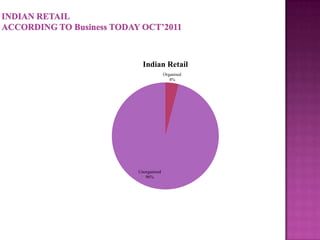
 Of this, US$ 414 billion (95% of the market) was
traditional retail and US$ 21 billion (5% of the
market) was organized retail.


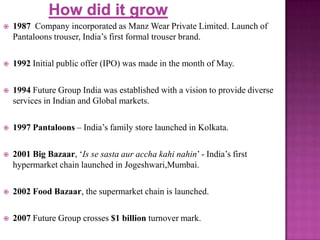
1987 Company incorporated as Manz Wear Private Limited. Launch of
Pantaloons trouser, India’s first formal trouser brand.



1992 Initial public offer (IPO) was made in the month of May.



1994 Future Group India was established with a vision to provide diverse
services in Indian and Global markets.



1997 Pantaloons – India’s family store launched in Kolkata.



2001 Big Bazaar, ‘Is se sasta aur accha kahi nahin’ - India’s first
hypermarket chain launched in Jogeshwari,Mumbai.



2002 Food Bazaar, the supermarket chain is launched.



2007 Future Group crosses $1 billion turnover mark.
Indian Retail
Organised
4%

Unorganised
96%
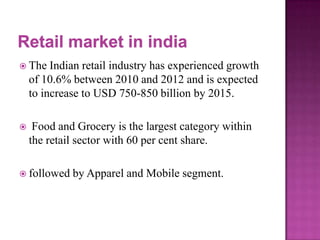
 The

Indian retail industry has experienced growth
of 10.6% between 2010 and 2012 and is expected
to increase to USD 750-850 billion by 2015.



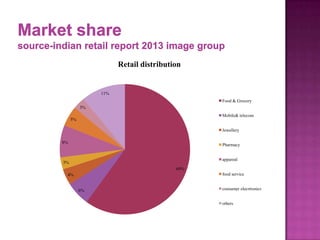
Food and Grocery is the largest category within
the retail sector with 60 per cent share.

 followed

by Apparel and Mobile segment.
Retail distribution

11%
Food & Grocery

3%
Mobile& telecom

5%

Jewellery
8%

Pharmacy

appareal

3%
60%

food service

4%

6%

consumer elecrtronics
others
1) Pantaloon Retail Ltd, a Future group venture:
2) Shoppers Stop Ltd:
3) Spencer’s Retail
4) Lifestyle Retail- Landmark group venture
Other major domestic players in India are Bharti Retail, Tata Trent, Globus, Aditya Birla
‘More’, and Reliance retail.
 Future

Group was founded on a simple idea:
Rewrite rules, retain values.
 Founded in 1987 by Retail king Kishor Biyani.
 Future Group brings multiple
products, opportunities and services to millions of
customers in India.
 Through over 16 million sq.ft of retail space.
 Serve customer in 95 cities across the country.
 Help India to shop, save and realize dreams, and
aspirations to live a better quality of life everyday.
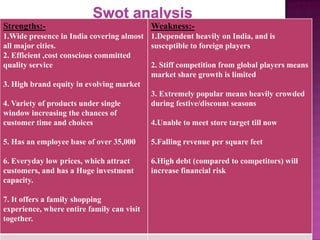
Strengths:-

Weakness:-

1.Wide presence in India covering almost 1.Dependent heavily on India, and is
all major cities.
susceptible to foreign players
2. Efficient ,cost conscious committed
quality service
2. Stiff competition from global players means
market share growth is limited
3. High brand equity in evolving market
3. Extremely popular means heavily crowded
4. Variety of products under single
during festive/discount seasons
window increasing the chances of
customer time and choices
4.Unable to meet store target till now
5. Has an employee base of over 35,000

5.Falling revenue per square feet

6. Everyday low prices, which attract
customers, and has a Huge investment
capacity.

6.High debt (compared to competitors) will
increase financial risk

7. It offers a family shopping
experience, where entire family can visit
together.
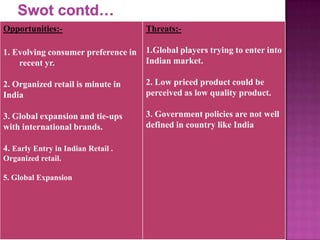
Opportunities:-

Threats:-

1. Evolving consumer preference in
recent yr.

1.Global players trying to enter into
Indian market.

2. Organized retail is minute in
India

2. Low priced product could be
perceived as low quality product.

3. Global expansion and tie-ups
with international brands.

3. Government policies are not well
defined in country like India

4. Early Entry in Indian Retail .
Organized retail.
5. Global Expansion
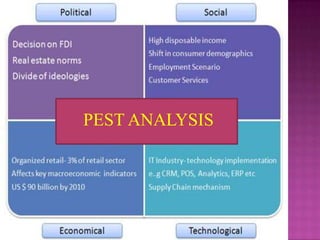
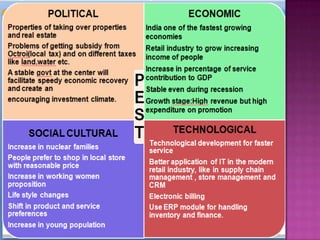
PEST ANALYSIS


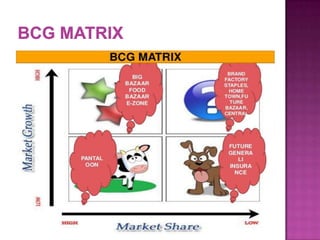
The BCG matrix is a chart that had been created by Bruce
Henderson for the Boston Consulting Group in 1968 to help
corporations with analyzing their business units or product
lines. This helps the company allocate resources and is used as
an analytical tool in brand marketing, product
management, strategic management, and portfolio analysis.



SBUs can be shown within any of the four quadrants
(Star, Question Mark, Cash Cow, Dog) as a circle whose area
represents their size. With different colours, competitors may
also be shown.
The precise location is determined by the two axes, market
Growth as the Y axis, Market Share as the X axis.
Alternatively, changes over or two years can be shown by
shading or other differences in design.xx.[1] Thus, Star products
are currently have high growth and high market share however
question mark is product with low share but high growth. Cash
Cow has high share but low growth. Finally, dog is product that
has low growth and low share.


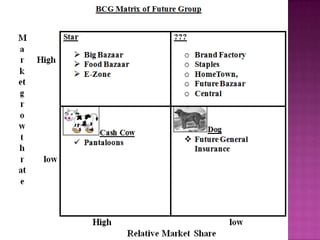
These are the conclusions for Future Group products, how
they are lying in the BCG matrix is given below:
 Cash Cow: The market share value of these products
which are in this Cash Cow are high and relative market
growth rate is low, that is why they are lying in BCG
Matrix at Cash cow point.
 Star: The market share value of these products which are
in Star are high and relative market growth rate is also
high, that is why they are lying in BCG Matrix at Star
point.
 ???: The market share value of these products which are
in ??? is low and relative market growth rate of is
high, that is they are lying in BCG Matrix at??? Point. At
this point, Company makes their investment on this
product to get the point of CASH COW and STAR in BCG
matrix.
 Dog: The market share value of these products which are
lying in Dog is low and relative market growth rate is also
low, so that is why they are lying in BCG Matrix at Dog
point.

SUPPLY CHAIN
FSC Supply Chain Solutions team studies the business
imperatives of customers and designs customized supply chain
solutions in collaboration with the customers. FSC Supply Chain
Solutions are sector specific which include the following:








Supply chain consulting to define business needs and logistics
opportunities
Distribution and Transportation network analysis and design
Warehouse and Facility modeling and layout, including evaluation
of Infrastructure and mechanization needs
Evaluation and implementation of Technology
Labor management opportunity assessment
Operational analysis and improvement
3PL capabilities of high-end Warehousing, Express and
Customized Movement Solutions
 Future

Supply Chains, a specialized subsidiary, offers a
strategic, focused and combine approach to meet the
group’s large supply chain requirements as well as
those of select suppliers and business partners.
 Future Supply Chains provides integrated end-to-end
supply chain management, warehousing and
distribution, multi-modal transportation and container
freight stations.
 Operates 5 major verticals:
Warehousing, Transportation, International
Logistics, Brand Distribution and Reverse Logistics
 Current

warehouse footprint of over 3.5 million square feet
with 67 warehouses across 32 locations.
 Dedicated fleet of over 400 vehicles and an outsourced fleet
of 400 trucks that move goods across India in the most
efficient and cost-effective manner
 Li & Fung, the Hong Kong-based largest retail supply chain
company, is an investor and partner of Future Supply Chains.
 Integrated state- of- the- art Warehousing and Distribution
services is a core competency of FSC Contract Logistics. We
partner with our customers to effectively reduce their Timeto- Market™ and Cost- to- Market™; thereby helping them
increase their revenues and profitability.
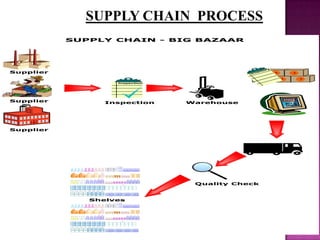
SUPPLY CHAIN PROCESS
FSC has established capabilities to study customer’s current
supply chain processes and Re-engineer, Build & Implement
customized Supply Chain solutions for Automotive and Auto
Components Industry in collaboration with the customer.
FSC as a supply chain partner is responsive, flexible, and highly
proactive, with the ability to service Intermediate and Last Mile.
FSC Services for Automotive Supply Chain are Inbound 2 Manufacturing (I2M)
 Managing Raw material stores
 Vendor Managed Inventory (VMI)
 Distribution
 Reducing Inventory holding costs
 Streamlining processes
 Automotive Spare parts Warehousing and Distribution
Legal ppt  future group 2

Legal ppt future group 2

  • 1.
    To know theinsight about the past and foresight for the future. To know the financial position and future course of action of the company. Objective:-
  • 2.
     Future Group isIndia’s largest retailer and one of the leading business houses.  Its founder and Group CEO is Mr.Kishore Biyani .  Future Group’s retail network touches the lives of more than 200 million Indians in 73 cities and 65 rural locations across the country.  Currently operates around 1,000 stores spread over 16 million square feet of retail space.
  • 3.
    Introduction about largeformat retail industry  The Indian retail industry has experienced high growth over the last decade.  The industry is moving towards a modern concept of retailing.  The size of India's retail market was estimated at US$ 435 billion in 2010.  Of this, US$ 414 billion (95% of the market) was traditional retail and US$ 21 billion (5% of the market) was organized retail.
  • 4.
     1987 Company incorporatedas Manz Wear Private Limited. Launch of Pantaloons trouser, India’s first formal trouser brand.  1992 Initial public offer (IPO) was made in the month of May.  1994 Future Group India was established with a vision to provide diverse services in Indian and Global markets.  1997 Pantaloons – India’s family store launched in Kolkata.  2001 Big Bazaar, ‘Is se sasta aur accha kahi nahin’ - India’s first hypermarket chain launched in Jogeshwari,Mumbai.  2002 Food Bazaar, the supermarket chain is launched.  2007 Future Group crosses $1 billion turnover mark.
  • 5.
  • 6.
     The Indian retailindustry has experienced growth of 10.6% between 2010 and 2012 and is expected to increase to USD 750-850 billion by 2015.  Food and Grocery is the largest category within the retail sector with 60 per cent share.  followed by Apparel and Mobile segment.
  • 7.
    Retail distribution 11% Food &Grocery 3% Mobile& telecom 5% Jewellery 8% Pharmacy appareal 3% 60% food service 4% 6% consumer elecrtronics others
  • 8.
    1) Pantaloon RetailLtd, a Future group venture: 2) Shoppers Stop Ltd: 3) Spencer’s Retail 4) Lifestyle Retail- Landmark group venture Other major domestic players in India are Bharti Retail, Tata Trent, Globus, Aditya Birla ‘More’, and Reliance retail.
  • 9.
     Future Group wasfounded on a simple idea: Rewrite rules, retain values.  Founded in 1987 by Retail king Kishor Biyani.  Future Group brings multiple products, opportunities and services to millions of customers in India.  Through over 16 million sq.ft of retail space.  Serve customer in 95 cities across the country.  Help India to shop, save and realize dreams, and aspirations to live a better quality of life everyday.
  • 11.
    Strengths:- Weakness:- 1.Wide presence inIndia covering almost 1.Dependent heavily on India, and is all major cities. susceptible to foreign players 2. Efficient ,cost conscious committed quality service 2. Stiff competition from global players means market share growth is limited 3. High brand equity in evolving market 3. Extremely popular means heavily crowded 4. Variety of products under single during festive/discount seasons window increasing the chances of customer time and choices 4.Unable to meet store target till now 5. Has an employee base of over 35,000 5.Falling revenue per square feet 6. Everyday low prices, which attract customers, and has a Huge investment capacity. 6.High debt (compared to competitors) will increase financial risk 7. It offers a family shopping experience, where entire family can visit together.
  • 12.
    Opportunities:- Threats:- 1. Evolving consumerpreference in recent yr. 1.Global players trying to enter into Indian market. 2. Organized retail is minute in India 2. Low priced product could be perceived as low quality product. 3. Global expansion and tie-ups with international brands. 3. Government policies are not well defined in country like India 4. Early Entry in Indian Retail . Organized retail. 5. Global Expansion
  • 13.
  • 15.
     The BCG matrixis a chart that had been created by Bruce Henderson for the Boston Consulting Group in 1968 to help corporations with analyzing their business units or product lines. This helps the company allocate resources and is used as an analytical tool in brand marketing, product management, strategic management, and portfolio analysis.  SBUs can be shown within any of the four quadrants (Star, Question Mark, Cash Cow, Dog) as a circle whose area represents their size. With different colours, competitors may also be shown. The precise location is determined by the two axes, market Growth as the Y axis, Market Share as the X axis. Alternatively, changes over or two years can be shown by shading or other differences in design.xx.[1] Thus, Star products are currently have high growth and high market share however question mark is product with low share but high growth. Cash Cow has high share but low growth. Finally, dog is product that has low growth and low share. 
  • 18.
    These are theconclusions for Future Group products, how they are lying in the BCG matrix is given below:  Cash Cow: The market share value of these products which are in this Cash Cow are high and relative market growth rate is low, that is why they are lying in BCG Matrix at Cash cow point.  Star: The market share value of these products which are in Star are high and relative market growth rate is also high, that is why they are lying in BCG Matrix at Star point.  ???: The market share value of these products which are in ??? is low and relative market growth rate of is high, that is they are lying in BCG Matrix at??? Point. At this point, Company makes their investment on this product to get the point of CASH COW and STAR in BCG matrix.  Dog: The market share value of these products which are lying in Dog is low and relative market growth rate is also low, so that is why they are lying in BCG Matrix at Dog point. 
  • 19.
  • 20.
    FSC Supply ChainSolutions team studies the business imperatives of customers and designs customized supply chain solutions in collaboration with the customers. FSC Supply Chain Solutions are sector specific which include the following:        Supply chain consulting to define business needs and logistics opportunities Distribution and Transportation network analysis and design Warehouse and Facility modeling and layout, including evaluation of Infrastructure and mechanization needs Evaluation and implementation of Technology Labor management opportunity assessment Operational analysis and improvement 3PL capabilities of high-end Warehousing, Express and Customized Movement Solutions
  • 21.
     Future Supply Chains,a specialized subsidiary, offers a strategic, focused and combine approach to meet the group’s large supply chain requirements as well as those of select suppliers and business partners.  Future Supply Chains provides integrated end-to-end supply chain management, warehousing and distribution, multi-modal transportation and container freight stations.  Operates 5 major verticals: Warehousing, Transportation, International Logistics, Brand Distribution and Reverse Logistics
  • 22.
     Current warehouse footprintof over 3.5 million square feet with 67 warehouses across 32 locations.  Dedicated fleet of over 400 vehicles and an outsourced fleet of 400 trucks that move goods across India in the most efficient and cost-effective manner  Li & Fung, the Hong Kong-based largest retail supply chain company, is an investor and partner of Future Supply Chains.  Integrated state- of- the- art Warehousing and Distribution services is a core competency of FSC Contract Logistics. We partner with our customers to effectively reduce their Timeto- Market™ and Cost- to- Market™; thereby helping them increase their revenues and profitability.
  • 23.
  • 24.
    FSC has establishedcapabilities to study customer’s current supply chain processes and Re-engineer, Build & Implement customized Supply Chain solutions for Automotive and Auto Components Industry in collaboration with the customer. FSC as a supply chain partner is responsive, flexible, and highly proactive, with the ability to service Intermediate and Last Mile. FSC Services for Automotive Supply Chain are Inbound 2 Manufacturing (I2M)  Managing Raw material stores  Vendor Managed Inventory (VMI)  Distribution  Reducing Inventory holding costs  Streamlining processes  Automotive Spare parts Warehousing and Distribution