TRAINING NEW EMPLOYEES
Presenter Name
Presentation Date
Some Definitions
•
• MERGER:
• A Merger or Amalgamation is an arrangement whereby the assets of two or more companies
become vested in one company (which may or may not be one of the original two companies). It
is a legal process by which two or more companies are joined together to form a new entity or
one or more companies are absorbed by another company and as a consequence the
amalgamating company loses its existence and its shareholders become the shareholders of the
new or amalgamated company.
• Mergers and acquisitions take place for many strategic business reasons, but the most common
reasons for any business combination are economic at their core. Following are some of the
various economic reasons:
• Increasing capabilities
• Gaining a competitive advantage or larger market share
• Diversifying products or services
• Replacing leadership
• Cutting costs
• A number of companies used mergers and acquisitions to grow and survive during the global
financial crisis
Some Definitions
• DEMERGER:
• Demerger is a business strategy in which a single business is
broken into components, either to operate on their own, to be
sold or to be dissolved. A de-merger allows a large company, such
as a conglomerate, to split off its various brands to invite or
prevent an acquisition, to raise capital by selling off components
that are no longer part of the business's core product line, or to
create separate legal entities to handle different operations.
• De-merger is undertaken basically for the following reasons:
• The first as an exercise in corporate restructuring.
• To give effect to kind of family partitions in case of family owned
enterprises.
• To help each of the segments operate more smoothly, as they can
now focus on a more specific task
APPLICABLE INDIAN LAWS
Companies Act, 1956 – [Sec 391-394]
Listing Agreement
Accounting Standard - 14
SEBI Takeover Code (in case of acquisition by/of a listed
company)
Company Court Rules
FEMA (in case of merger of companies having foreign
capital)
Competition Act, 2002
Income Tax Act, 1961
Indian Stamp Act
The Case: PFRL and ABFRL
• In a bid to capitalise on its large market presence in
the branded fashion space in India, Aditya Birla
Nuvo Ltd. (“ABNL”) announced consolidation of its
branded apparels businesses under its listed
subsidiary - Pantaloons Fashion & Retail Limited
(“PFRL”).
• Under the consolidation, the apparel businesses of
group holding company ABNL demerged its branded
apparel retailing division “Madura Fashion” and the
Aditya Birla Nuvo group holding company MGLRCL
demerged luxury branded apparel retailing division
“Madura Lifestyle” into listed firm Pantaloons
Fashion & Retail Ltd (PFRL).
• PFRL would be renamed as Aditya Birla Fashion &
Retail Ltd (ABFR). This combined entity would be the
product of the merger of Madura Garments, Madura
Lifestyle with Pantaloons Fashion and Retail.
• The consolidation will unlock shareholder value and
give investors an opportunity to invest in the fast-
growing fashion space through Aditya Birla Fashion
and Retail Ltd (ABFRL).
The Case: PFRL and ABFRL
The complete consolidation process involves a
series of mergers & demergers which are:
• Demerger of Pantaloons from Future Retail.
Merger of Pantaloons Fashion & Retail with
Aditya Birla Nuvo.
• Demerger of Madura Fashion (the branded
apparel retail division) and Madura Lifestyle
(the luxury branded apparel retailing arm of
ABNL).
• Merger of Madura Fashions & Madura Lifestyle
into Pantaloons Fashions to form Pantaloons
Fashion & Retail.
ANNOUNCEMENT DATE FOR MERGER
3rd May 2015.
The merger is expected to take three months to
complete.
COMPANY PROFILE: PANTALOONS
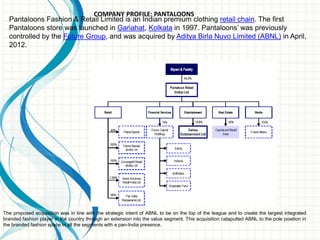
Pantaloons Fashion & Retail Limited is an Indian premium clothing retail chain. The first
Pantaloons store was launched in Gariahat, Kolkata in 1997. Pantaloons’ was previously
controlled by the Future Group, and was acquired by Aditya Birla Nuvo Limited (ABNL) in April,
2012.
The proposed acquisition was in line with the strategic intent of ABNL to be on the top of the league and to create the largest integrated
branded fashion player in the country through an extension into the value segment. This acquisition catapulted ABNL to the pole position in
the branded fashion space in all the segments with a pan-India presence.
COMPANY PROFILE: PANTALOONS
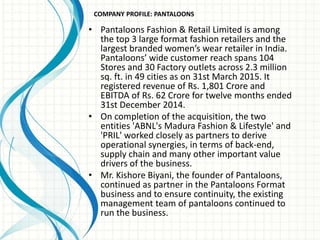
• Pantaloons Fashion & Retail Limited is among
the top 3 large format fashion retailers and the
largest branded women’s wear retailer in India.
Pantaloons’ wide customer reach spans 104
Stores and 30 Factory outlets across 2.3 million
sq. ft. in 49 cities as on 31st March 2015. It
registered revenue of Rs. 1,801 Crore and
EBITDA of Rs. 62 Crore for twelve months ended
31st December 2014.
• On completion of the acquisition, the two
entities 'ABNL's Madura Fashion & Lifestyle' and
'PRIL' worked closely as partners to derive
operational synergies, in terms of back-end,
supply chain and many other important value
drivers of the business.
• Mr. Kishore Biyani, the founder of Pantaloons,
continued as partner in the Pantaloons Format
business and to ensure continuity, the existing
management team of pantaloons continued to
run the business.
COMPANY PROFILE: PANTALOONS
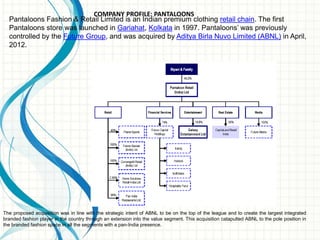
Pantaloons Fashion & Retail Limited is an Indian premium clothing retail chain. The first
Pantaloons store was launched in Gariahat, Kolkata in 1997. Pantaloons’ was previously
controlled by the Future Group, and was acquired by Aditya Birla Nuvo Limited (ABNL) in April,
2012.
The proposed acquisition was in line with the strategic intent of ABNL to be on the top of the league and to create the largest integrated
branded fashion player in the country through an extension into the value segment. This acquisition catapulted ABNL to the pole position in
the branded fashion space in all the segments with a pan-India presence.
Welcome
• Familiarize yourself with
your new assignment1
• Explore your new
environment2
• Meet your new
colleagues3
Today’s Overview
Learning Objectives
• Technology
• Procedure
• Policies
• Benefits
NEW WORK
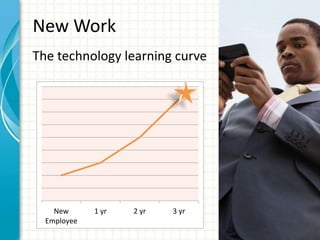
New Work
The technology learning curve
New
Employee
1 yr 2 yr 3 yr
Who’s Who
Lead Contact information
Jim Jim@company.com
Dee Dee@gcompany.com
Mavis Mavis@company.com
Doug Doug@company.com
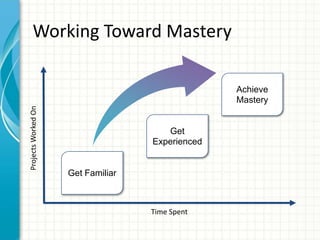
Time Spent
ProjectsWorkedOn
Get Familiar
Achieve
Mastery
Working Toward Mastery
Get
Experienced
Doing Your Best Work
• Working from home
• Working offsite
• Technology
requirements
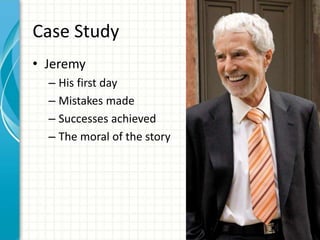
Case Study
• Jeremy
– His first day
– Mistakes made
– Successes achieved
– The moral of the story
Discussion
• What we can learn
from Jeremy
• Best practices
• Take-aways
Summary
• Define your challenges
– Technological as well as personal
• Set realistic expectation
– Mastery is not achieved overnight
• Keep your eye on the goal
– Mentorship programs
Resources
• <Intranet site text here>
<hyperlink here>
• <Additional reading material text here>
<hyperlink here>
• This slide deck and related resources:
<hyperlink here>
QUESTIONS?
APPENDIX

Pantaloons

  • 1.
    TRAINING NEW EMPLOYEES PresenterName Presentation Date
  • 2.
    Some Definitions • • MERGER: •A Merger or Amalgamation is an arrangement whereby the assets of two or more companies become vested in one company (which may or may not be one of the original two companies). It is a legal process by which two or more companies are joined together to form a new entity or one or more companies are absorbed by another company and as a consequence the amalgamating company loses its existence and its shareholders become the shareholders of the new or amalgamated company. • Mergers and acquisitions take place for many strategic business reasons, but the most common reasons for any business combination are economic at their core. Following are some of the various economic reasons: • Increasing capabilities • Gaining a competitive advantage or larger market share • Diversifying products or services • Replacing leadership • Cutting costs • A number of companies used mergers and acquisitions to grow and survive during the global financial crisis
  • 3.
    Some Definitions • DEMERGER: •Demerger is a business strategy in which a single business is broken into components, either to operate on their own, to be sold or to be dissolved. A de-merger allows a large company, such as a conglomerate, to split off its various brands to invite or prevent an acquisition, to raise capital by selling off components that are no longer part of the business's core product line, or to create separate legal entities to handle different operations. • De-merger is undertaken basically for the following reasons: • The first as an exercise in corporate restructuring. • To give effect to kind of family partitions in case of family owned enterprises. • To help each of the segments operate more smoothly, as they can now focus on a more specific task
  • 4.
    APPLICABLE INDIAN LAWS CompaniesAct, 1956 – [Sec 391-394] Listing Agreement Accounting Standard - 14 SEBI Takeover Code (in case of acquisition by/of a listed company) Company Court Rules FEMA (in case of merger of companies having foreign capital) Competition Act, 2002 Income Tax Act, 1961 Indian Stamp Act
  • 5.
    The Case: PFRLand ABFRL • In a bid to capitalise on its large market presence in the branded fashion space in India, Aditya Birla Nuvo Ltd. (“ABNL”) announced consolidation of its branded apparels businesses under its listed subsidiary - Pantaloons Fashion & Retail Limited (“PFRL”). • Under the consolidation, the apparel businesses of group holding company ABNL demerged its branded apparel retailing division “Madura Fashion” and the Aditya Birla Nuvo group holding company MGLRCL demerged luxury branded apparel retailing division “Madura Lifestyle” into listed firm Pantaloons Fashion & Retail Ltd (PFRL). • PFRL would be renamed as Aditya Birla Fashion & Retail Ltd (ABFR). This combined entity would be the product of the merger of Madura Garments, Madura Lifestyle with Pantaloons Fashion and Retail. • The consolidation will unlock shareholder value and give investors an opportunity to invest in the fast- growing fashion space through Aditya Birla Fashion and Retail Ltd (ABFRL).
  • 6.
    The Case: PFRLand ABFRL The complete consolidation process involves a series of mergers & demergers which are: • Demerger of Pantaloons from Future Retail. Merger of Pantaloons Fashion & Retail with Aditya Birla Nuvo. • Demerger of Madura Fashion (the branded apparel retail division) and Madura Lifestyle (the luxury branded apparel retailing arm of ABNL). • Merger of Madura Fashions & Madura Lifestyle into Pantaloons Fashions to form Pantaloons Fashion & Retail. ANNOUNCEMENT DATE FOR MERGER 3rd May 2015. The merger is expected to take three months to complete.
  • 7.
    COMPANY PROFILE: PANTALOONS PantaloonsFashion & Retail Limited is an Indian premium clothing retail chain. The first Pantaloons store was launched in Gariahat, Kolkata in 1997. Pantaloons’ was previously controlled by the Future Group, and was acquired by Aditya Birla Nuvo Limited (ABNL) in April, 2012. The proposed acquisition was in line with the strategic intent of ABNL to be on the top of the league and to create the largest integrated branded fashion player in the country through an extension into the value segment. This acquisition catapulted ABNL to the pole position in the branded fashion space in all the segments with a pan-India presence.
  • 8.
    COMPANY PROFILE: PANTALOONS •Pantaloons Fashion & Retail Limited is among the top 3 large format fashion retailers and the largest branded women’s wear retailer in India. Pantaloons’ wide customer reach spans 104 Stores and 30 Factory outlets across 2.3 million sq. ft. in 49 cities as on 31st March 2015. It registered revenue of Rs. 1,801 Crore and EBITDA of Rs. 62 Crore for twelve months ended 31st December 2014. • On completion of the acquisition, the two entities 'ABNL's Madura Fashion & Lifestyle' and 'PRIL' worked closely as partners to derive operational synergies, in terms of back-end, supply chain and many other important value drivers of the business. • Mr. Kishore Biyani, the founder of Pantaloons, continued as partner in the Pantaloons Format business and to ensure continuity, the existing management team of pantaloons continued to run the business.
  • 9.
    COMPANY PROFILE: PANTALOONS PantaloonsFashion & Retail Limited is an Indian premium clothing retail chain. The first Pantaloons store was launched in Gariahat, Kolkata in 1997. Pantaloons’ was previously controlled by the Future Group, and was acquired by Aditya Birla Nuvo Limited (ABNL) in April, 2012. The proposed acquisition was in line with the strategic intent of ABNL to be on the top of the league and to create the largest integrated branded fashion player in the country through an extension into the value segment. This acquisition catapulted ABNL to the pole position in the branded fashion space in all the segments with a pan-India presence.
  • 10.
  • 11.
    • Familiarize yourselfwith your new assignment1 • Explore your new environment2 • Meet your new colleagues3 Today’s Overview
  • 12.
    Learning Objectives • Technology •Procedure • Policies • Benefits
  • 13.
  • 14.
    New Work The technologylearning curve New Employee 1 yr 2 yr 3 yr
  • 15.
    Who’s Who Lead Contactinformation Jim Jim@company.com Dee Dee@gcompany.com Mavis Mavis@company.com Doug Doug@company.com
  • 16.
  • 17.
    Doing Your BestWork • Working from home • Working offsite • Technology requirements
  • 18.
    Case Study • Jeremy –His first day – Mistakes made – Successes achieved – The moral of the story
  • 19.
    Discussion • What wecan learn from Jeremy • Best practices • Take-aways
  • 20.
    Summary • Define yourchallenges – Technological as well as personal • Set realistic expectation – Mastery is not achieved overnight • Keep your eye on the goal – Mentorship programs
  • 21.
    Resources • <Intranet sitetext here> <hyperlink here> • <Additional reading material text here> <hyperlink here> • This slide deck and related resources: <hyperlink here>
  • 22.
  • 23.