
GREEN BUILDINGS & LEED
By: Ar. & Env. Designer M.Tariq
Nov 14, 2018
AR-2017
CECOS
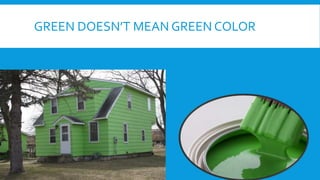
GREEN DOESN’T MEAN GREEN COLOR
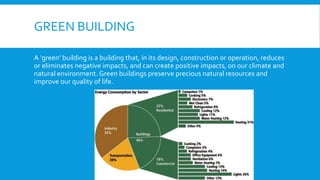
GREEN BUILDING
A ‘green’ building is a building that, in its design, construction or operation, reduces
or eliminates negative impacts, and can create positive impacts, on our climate and
natural environment. Green buildings preserve precious natural resources and
improve our quality of life.
 There are a number of features which can make a building ‘green’.These include:
 Efficient use of energy, water and other resources
 Use of renewable energy, such as solar energy
 Pollution and waste reduction measures, and the enabling of re-use and recycling
 Good indoor environmental air quality
 Use of materials that are non-toxic, sustainable.
 Consideration of the environment in design, construction and operation
 Consideration of the quality of life of occupants in design, construction and
operation
 Any building can be a green building, whether it’s a home, an office, a school, a
hospital, a community center, or any other type of structure, provided it includes
features listed in last slide.
HOW CANWE MAKE OUR BUILDINGS GREEN?
 Taking an intelligent approach to energy
 Minimising energy use in all stages of a building’s life-cycle, making new and
renovated buildings more comfortable and less expensive to run.
 Integrating renewable and low-carbon technologies to supply buildings’ energy
needs, once their design has maximised inbuilt and natural efficiencies.
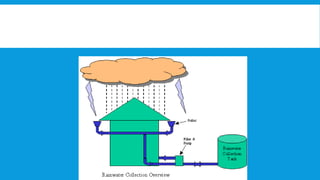
 Safeguarding water resources
 Exploring ways to improve drinking and waste water efficiency and management,
harvesting water for safe indoor use in innovative ways, and generally minimising
water use in buildings.
 Considering the impact of buildings and their surroundings on stormwater and
drainage infrastructure.
 Promoting health and wellbeing
 Bringing fresh air inside, delivering good indoor air quality through ventilation,
and avoiding materials and chemicals that create harmful or toxic emissions.
 Incorporating natural light and views to ensure building users’ comfort and
enjoyment of their surroundings, and reducing lighting energy needs in the
process.
 Designing for ears as well as eyes. Acoustics and proper sound insulation play
important roles in helping concentration, recuperation, and peaceful enjoyment
of a building in educational, health and residential buildings.
 Keeping our environment green
 Recognizing that our urban environment should preserve nature, and ensuring
diverse wildlife and land quality are protected or enhanced, by, for example,
remediating and building on polluted land or creating new green spaces.
 Looking for ways we can make our urban areas more productive, bringing
agriculture into our cities.
 Creating resilient and flexible structures
 Adapting to our changing climate, ensuring resilience to events such as flooding,
earthquakes or fires so that our buildings stand the test of time and keep people and their
belongings safe.
 Connecting communities and people
 Creating diverse environments that connect and enhance communities, asking what a
building will add to its context in terms of positive economic and social effects, and
engaging local communities in planning.
 Ensuring transport and distance to amenities are considered in design, reducing the
impact of personal transport on the environment, and encouraging environmentally
friendly options such as walking or cycling.
 Exploring the potential of both ‘smart’ and information communications technologies to
communicate better with the world around us, for example through smart electricity grids
that understand how to transport energy where and when it is needed.
 Considering all stages of a building's life-cycle
 Seeking to lower environmental impacts and maximise social and economic value
over a building's whole life-cycle (from design, construction, operation and
maintenance, through to renovation and eventual demolition).
 Ensuring that embodied resources, such as the energy or water used to produce
and transport the materials in the building are minimised so that buildings are
truly low impact.
THE BENEFITS OF GREEN BUILDINGS
 Environmental
 One of the most important types of benefit green buildings offer is to our climate
and the natural environment. Green buildings can not only reduce or eliminate
negative impacts on the environment, by using less water, energy or natural
resources, but they can - in many cases - have a positive impact on the
environment (at the building or city scales) by generating their own energy or
increasing biodiversity.
 At a global level:
 The building sector has the largest potential for significantly reducing greenhouse
gas emissions compared to other major emitting sectors – UNEP, 2009.
 This emissions savings potential is said to be as much as 84 gigatonnes of CO2
(GtCO2) by 2050, through direct measures in buildings such as energy efficiency,
fuel switching and the use of renewable energy – UNEP, 2016.
 The building sector has the potential to make energy savings of 50% or more in
2050, in support of limiting global temperature rises to 2°C– UNEP, 2016.
 Economic
 Green buildings offer a number of economic or financial benefits, which are
relevant to a range of different people or groups of people.These include cost
savings on utility bills for tenants or households (through energy and water
efficiency); lower construction costs and higher property value for building
developers; increased occupancy rates or operating costs for building owners.
 Social
 Green building benefits go beyond economics and the environment, and have been shown
to bring positive social impacts too. Many of these benefits are around the health and
wellbeing of people who work in green offices or live in green homes.
 Workers in green, well-ventilated offices record a 101 per cent increase in cognitive scores
(brain function) - HarvardT.H. Chan School of Public Health / Syracuse University Center of
Excellence / SUNY Upstate Medical School, 2015.
 Employees in offices with windows slept an average of 46 minutes more per night -
American Academy of Sleep Medicine, 2013.
 Research suggests that better indoor air quality (low concentrations of CO2 and
pollutants, and high ventilation rates) can lead to improvements in performance of up to 8
per cent–Park andYoon, 2011.
WHAT IS A GREEN BUILDING RATING
TOOL?
 Green building rating tools – also known as certification – are used to assess and
recognize buildings which meet certain green requirements or standards.
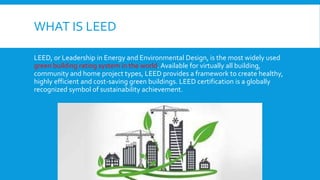
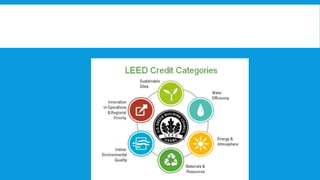
WHAT IS LEED
LEED, or Leadership in Energy and Environmental Design, is the most widely used
green building rating system in the world. Available for virtually all building,
community and home project types, LEED provides a framework to create healthy,
highly efficient and cost-saving green buildings. LEED certification is a globally
recognized symbol of sustainability achievement.
 LOCATION &TRANSPORTATION
 This category rewards thoughtful decisions about building location, with credits
that encourage compact development, alternative transportation, and connection
with amenities such as restaurants and parks.
 SUSTAINABLE SITES
 The Sustainable Sites category focuses on the environment surrounding the
building, awarding credits for projects that emphasize the vital relationships
among buildings, ecosystems, and ecosystem services. It focuses on restoring
project site elements, integrating the site with local and regional ecosystems, and
preserving the biodiversity that natural systems rely on.
 WATER EFFICIENCY
 The Water Efficiency section addresses water holistically, looking at indoor use,
outdoor use, specialized uses, and metering.The section is based on an “efficiency
first” approach to water conservation.
 ENERGY & ATMOSPHERE
 The Energy and Atmosphere category approaches energy from a holistic
perspective, addressing energy use reduction, energy-efficient design strategies,
and renewable energy sources.
 MATERIAL & RESOURCES
 The Materials and Resources credit category focuses on minimizing the embodied
energy and other impacts associated with the extraction, processing, transport,
maintenance, and disposal of building materials.The requirements are designed
to support a life-cycle approach that improves performance and promotes
resource efficiency.
 INDOOR ENVIRONMENTAL QUALITY
 The Indoor Environmental Quality category rewards decisions made by project
teams about indoor air quality and thermal, visual, and acoustic comfort. Green
buildings with good indoor environmental quality protect the health and comfort
of building occupants.
 INNOVATION
 Sustainable design strategies and measures are constantly evolving and
improving. New technologies are continually introduced to the marketplace, and
up-to-date scientific research influences building design strategies.The purpose
of this LEED category is to recognize projects for innovative building features and
sustainable building practices and strategies.
 INTEGRATIVE PROCESS
 Beginning in pre-design and continuing throughout the design phases, identify
and use opportunities to achieve synergies across disciplines and building
systems.
LEED PROFESSIONAL
 LEED Green Associate: There are no prerequisites or eligibility requirements.
However, we do recommended that you have exposure to LEED and green
building concepts through education, volunteering, or work experience.
 LEED AP with specialty: only for Architects & other dessigners having a related
degree and knowledge.

Green buildings & Leed

  • 1.
    GREEN BUILDINGS &LEED By: Ar. & Env. Designer M.Tariq Nov 14, 2018 AR-2017 CECOS
  • 2.
  • 4.
    GREEN BUILDING A ‘green’building is a building that, in its design, construction or operation, reduces or eliminates negative impacts, and can create positive impacts, on our climate and natural environment. Green buildings preserve precious natural resources and improve our quality of life.
  • 5.
     There area number of features which can make a building ‘green’.These include:  Efficient use of energy, water and other resources  Use of renewable energy, such as solar energy  Pollution and waste reduction measures, and the enabling of re-use and recycling  Good indoor environmental air quality  Use of materials that are non-toxic, sustainable.  Consideration of the environment in design, construction and operation  Consideration of the quality of life of occupants in design, construction and operation
  • 6.
     Any buildingcan be a green building, whether it’s a home, an office, a school, a hospital, a community center, or any other type of structure, provided it includes features listed in last slide.
  • 7.
    HOW CANWE MAKEOUR BUILDINGS GREEN?  Taking an intelligent approach to energy  Minimising energy use in all stages of a building’s life-cycle, making new and renovated buildings more comfortable and less expensive to run.  Integrating renewable and low-carbon technologies to supply buildings’ energy needs, once their design has maximised inbuilt and natural efficiencies.  Safeguarding water resources  Exploring ways to improve drinking and waste water efficiency and management, harvesting water for safe indoor use in innovative ways, and generally minimising water use in buildings.  Considering the impact of buildings and their surroundings on stormwater and drainage infrastructure.
  • 8.
     Promoting healthand wellbeing  Bringing fresh air inside, delivering good indoor air quality through ventilation, and avoiding materials and chemicals that create harmful or toxic emissions.  Incorporating natural light and views to ensure building users’ comfort and enjoyment of their surroundings, and reducing lighting energy needs in the process.  Designing for ears as well as eyes. Acoustics and proper sound insulation play important roles in helping concentration, recuperation, and peaceful enjoyment of a building in educational, health and residential buildings.
  • 9.
     Keeping ourenvironment green  Recognizing that our urban environment should preserve nature, and ensuring diverse wildlife and land quality are protected or enhanced, by, for example, remediating and building on polluted land or creating new green spaces.  Looking for ways we can make our urban areas more productive, bringing agriculture into our cities.
  • 10.
     Creating resilientand flexible structures  Adapting to our changing climate, ensuring resilience to events such as flooding, earthquakes or fires so that our buildings stand the test of time and keep people and their belongings safe.  Connecting communities and people  Creating diverse environments that connect and enhance communities, asking what a building will add to its context in terms of positive economic and social effects, and engaging local communities in planning.  Ensuring transport and distance to amenities are considered in design, reducing the impact of personal transport on the environment, and encouraging environmentally friendly options such as walking or cycling.  Exploring the potential of both ‘smart’ and information communications technologies to communicate better with the world around us, for example through smart electricity grids that understand how to transport energy where and when it is needed.
  • 11.
     Considering allstages of a building's life-cycle  Seeking to lower environmental impacts and maximise social and economic value over a building's whole life-cycle (from design, construction, operation and maintenance, through to renovation and eventual demolition).  Ensuring that embodied resources, such as the energy or water used to produce and transport the materials in the building are minimised so that buildings are truly low impact.
  • 12.
    THE BENEFITS OFGREEN BUILDINGS  Environmental  One of the most important types of benefit green buildings offer is to our climate and the natural environment. Green buildings can not only reduce or eliminate negative impacts on the environment, by using less water, energy or natural resources, but they can - in many cases - have a positive impact on the environment (at the building or city scales) by generating their own energy or increasing biodiversity.
  • 13.
     At aglobal level:  The building sector has the largest potential for significantly reducing greenhouse gas emissions compared to other major emitting sectors – UNEP, 2009.  This emissions savings potential is said to be as much as 84 gigatonnes of CO2 (GtCO2) by 2050, through direct measures in buildings such as energy efficiency, fuel switching and the use of renewable energy – UNEP, 2016.  The building sector has the potential to make energy savings of 50% or more in 2050, in support of limiting global temperature rises to 2°C– UNEP, 2016.
  • 14.
     Economic  Greenbuildings offer a number of economic or financial benefits, which are relevant to a range of different people or groups of people.These include cost savings on utility bills for tenants or households (through energy and water efficiency); lower construction costs and higher property value for building developers; increased occupancy rates or operating costs for building owners.
  • 15.
     Social  Greenbuilding benefits go beyond economics and the environment, and have been shown to bring positive social impacts too. Many of these benefits are around the health and wellbeing of people who work in green offices or live in green homes.  Workers in green, well-ventilated offices record a 101 per cent increase in cognitive scores (brain function) - HarvardT.H. Chan School of Public Health / Syracuse University Center of Excellence / SUNY Upstate Medical School, 2015.  Employees in offices with windows slept an average of 46 minutes more per night - American Academy of Sleep Medicine, 2013.  Research suggests that better indoor air quality (low concentrations of CO2 and pollutants, and high ventilation rates) can lead to improvements in performance of up to 8 per cent–Park andYoon, 2011.
  • 16.
    WHAT IS AGREEN BUILDING RATING TOOL?  Green building rating tools – also known as certification – are used to assess and recognize buildings which meet certain green requirements or standards.
  • 17.
    WHAT IS LEED LEED,or Leadership in Energy and Environmental Design, is the most widely used green building rating system in the world. Available for virtually all building, community and home project types, LEED provides a framework to create healthy, highly efficient and cost-saving green buildings. LEED certification is a globally recognized symbol of sustainability achievement.
  • 19.
     LOCATION &TRANSPORTATION This category rewards thoughtful decisions about building location, with credits that encourage compact development, alternative transportation, and connection with amenities such as restaurants and parks.  SUSTAINABLE SITES  The Sustainable Sites category focuses on the environment surrounding the building, awarding credits for projects that emphasize the vital relationships among buildings, ecosystems, and ecosystem services. It focuses on restoring project site elements, integrating the site with local and regional ecosystems, and preserving the biodiversity that natural systems rely on.
  • 20.
     WATER EFFICIENCY The Water Efficiency section addresses water holistically, looking at indoor use, outdoor use, specialized uses, and metering.The section is based on an “efficiency first” approach to water conservation.  ENERGY & ATMOSPHERE  The Energy and Atmosphere category approaches energy from a holistic perspective, addressing energy use reduction, energy-efficient design strategies, and renewable energy sources.
  • 22.
     MATERIAL &RESOURCES  The Materials and Resources credit category focuses on minimizing the embodied energy and other impacts associated with the extraction, processing, transport, maintenance, and disposal of building materials.The requirements are designed to support a life-cycle approach that improves performance and promotes resource efficiency.  INDOOR ENVIRONMENTAL QUALITY  The Indoor Environmental Quality category rewards decisions made by project teams about indoor air quality and thermal, visual, and acoustic comfort. Green buildings with good indoor environmental quality protect the health and comfort of building occupants.
  • 23.
     INNOVATION  Sustainabledesign strategies and measures are constantly evolving and improving. New technologies are continually introduced to the marketplace, and up-to-date scientific research influences building design strategies.The purpose of this LEED category is to recognize projects for innovative building features and sustainable building practices and strategies.  INTEGRATIVE PROCESS  Beginning in pre-design and continuing throughout the design phases, identify and use opportunities to achieve synergies across disciplines and building systems.
  • 24.
    LEED PROFESSIONAL  LEEDGreen Associate: There are no prerequisites or eligibility requirements. However, we do recommended that you have exposure to LEED and green building concepts through education, volunteering, or work experience.  LEED AP with specialty: only for Architects & other dessigners having a related degree and knowledge.