GREEN
BUILDING
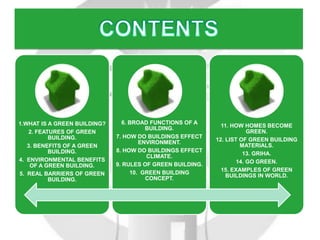
1.WHAT IS A GREEN BUILDING?     6. BROAD FUNCTIONS OF A
                                        BUILDING.             11. HOW HOMES BECOME
   2. FEATURES OF GREEN                                                 GREEN.
          BUILDING.           7. HOW DO BUILDINGS EFFECT
                                      ENVIRONMENT.          12. LIST OF GREEN BUILDING
   3. BENEFITS OF A GREEN                                            MATERIALS.
          BUILDING.           8. HOW DO BUILDINGS EFFECT
                                        CLIMATE.                      13. GRIHA.
4. ENVIRONMENTAL BENEFITS                                           14. GO GREEN.
    OF A GREEN BUILDING.      9. RULES OF GREEN BUILDING.
                                   10. GREEN BUILDING         15. EXAMPLES OF GREEN
5. REAL BARRIERS OF GREEN                                       BUILDINGS IN WORLD.
          BUILDING.                     CONCEPT.
What is a
                       GREEN BUILDING ?

We can still SAVE THE EARTH !!
What is a GREEN BUILDING ?

  Green building - also known as sustainable or high performance
    building - is the practice to:

   Have minimum demand for electricity, water and other natural
    resources(in construction, demolition and operation).

   Generate all its electricity on site through renewable means.

   Strive to cater to all its water demand through sustainable
    processes such as rain water harvesting.

   It could also strive to grow its own food in site.

   It would recycle and reuse all its waste on site.

We can still SAVE THE EARTH !!
What are GREEN FEATURES ?

       Minimal disturbance to landscapes and site condition
       Use of Recycled and Environmental Friendly Building
       materials
       Use of Non-Toxic and recycled/recyclable Materials
       Efficient use of Water and Water Recycling
       Use of Energy Efficient and Eco-Friendly Equipment
       Use of Renewable Energy
       Quality of Indoor Air Quality for Human Safety and Comfort
       Effective Controls and Building Management Systems


We can still SAVE THE EARTH !!
Benefits of a GREEN BUILDING

       a lighter ecological footprint

       reduction in operating energy

       reduction in water costs

       reduction in first costs and enhanced asset value

       increased productivity of occupants

       health and safety benefits


We can still SAVE THE EARTH !!
ENVIRONMENTAL BENEFITS


               Enhance and protect biodiversity and
                ecosystems

               Improve air and water quality

               Reduce waste streams

               Conserve and restore natural
                resources

We can still SAVE THE EARTH !!
REAL BARRIERS TO GO GREEN


  a lack of planning and developer education.

  a lack of knowledge about local vendors and resources

  difficult local land use officials.

  Rather than taking the initiative, several developers only work to

  improve business practices when competition forces them to do so.


We can still SAVE THE EARTH !!
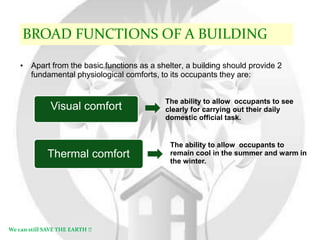
BROAD FUNCTIONS OF A BUILDING

    • Apart from the basic functions as a shelter, a building should provide 2
      fundamental physiological comforts, to its occupants they are:


                                             The ability to allow occupants to see
               Visual comfort                clearly for carrying out their daily
                                             domestic official task.


                                              The ability to allow occupants to
              Thermal comfort                 remain cool in the summer and warm in
                                              the winter.


We can still SAVE THE EARTH !!
These comforts can be provided in two ways:


                    Naturally      (Using sunlight, natural
                                   wind, evaporation, trees, etc) thus
                                   saving energy.


                                    (Using electric lighting, AC’s, etc) thus
                    Artificially    relying on large scale energy generation
                                    leading to pollution and green house
                                    gas emission.


We can still SAVE THE EARTH !!
Lack of proper information and tendencies to follow
    fashionable trends that are short lived often lead us
    to provide comfort condition in our building at the
    cost of very high energy consumption.


   It should be our Endeavour to help secure energy
   and resource for future of our country through
   green buildings and habitats suitable for our
   country and people.


We can still SAVE THE EARTH !!
HOW DO BUILDING EFFECT
                        ENVIRONMENT??
To provide all the comforts listed above , a building needs to consume resources for
construction and operation. In our country, a well designed building is built out of
concrete and brick, and may have a design life up to 100 years. During such a period,
a building can consume unimaginable quantities of resources.
Building consume resources such as:

                        Land           Farms, forests, fertile land, marshes etc.
                        Soil           Earth,sand,stone,clay,lime,silica,etc.
                        Trees          Wood, ply, board, shuttering, etc.
                        Metals         Steel, iron, aluminum, copper, lead, etc.
                        plastics       PVC, UPVC, PU, etc.
                        Water          Construction, landscape, cooling,
                                       washing, drinking, flushing, etc.
                        Electricity    Cooling/ heating, lighting, pumping,
                                       entertainment/ working, etc.
We can still SAVE THE EARTH !!
And building generates wastes such as:
                    Site wastes           Cut trees, and vegetation and
                                          excavated soil, blasted stones,
                                          rubbles, etc.
                    Construction wastes   Metal boxes/cans, broken bricks,
                                          shuttering oil, etc.
                    Sewage/ sullage       Black water, grey water, etc.
                    Organic wastes        Peels, vegetables, fruits, etc.
                    Recyclable wastes     Paper, glass, metals, etc.
                    Non-Recyclable        Demolition debris, all plastics,
                    wastes                synthetics, fibers, etc.

                    E wastes              CD, electronic, hardware, etc.
                    Chemical wastes       Adhesive, paints, etc.


We can still SAVE
THE EARTH !!
HOW DO BUILDING EFFECT CLIMATE??
   The energy used to heat and power our buildings leads to the
    consumption of large amounts of energy, mainly from burning
    fossil fuels - oil, natural gas and coal - which generate significant
    amounts of carbon dioxide (CO2), the most widespread
    greenhouse gas.
   Reducing the energy use and greenhouse gas emissions
    produced by buildings is therefore fundamental to the effort to
    slow the pace of global climate change. Buildings may be
    associated with the release of greenhouse gases in other ways,
    for example, construction and demolition debris that degrades in
    landfills may generate methane, and the extraction and
    manufacturing of building materials may also generate
    greenhouse gas emissions.


We can still SAVE THE EARTH !!
RULES OF GREEN BUILDING


                                              SUSTAINABLE
                                              ENVIRONMENT


                        REGULATIONS                                   QUALITY
                                                                    MANAGEMENT


                               PERFORMATION
                                                            BODY HEALTH
                                STANDARDS


We can still SAVE THE
EARTH !!
GREEN BUILDING CONCEPT
        The `Green Building' concept is gaining importance in
      various countries, including India. These are buildings that
        ensure that waste is minimized at every stage during the
       construction and operation of the building, resulting in low
             costs, according to experts in the technology.


     The techniques associated with the `Green Building' include
       measures to prevent erosion of soil, rainwater harvesting,
     preparation of landscapes to reduce heat, reduction in usage
      of potable water, recycling of waste water and use of world
                    class energy efficient practices.


We can still SAVE THE EARTH !!
HOW HOME BECOMES GREEN
SELECTION CRITERIA OF GREEN BUILDING
               MATERIALS
 Resource Efficiency
   – Recycled content
   – Renewable
   – Efficient manufacturing process
   – Local availability
   – Easily recyclable
   – Recyclable Packaging
   – Product Durability


 Energy Conservation


 Water Conservation
LIST OF GREEN BUILDING MATERIALS
 Flooring: Flooring is good place to start when trying to make greener
  building choices. Some woods are less renewable than others, and carpet
  often contains VOCs (volatile organic compounds) that have a negative effect
  on indoor air quality. Bamboo has become a popular choice for flooring, since
  it replenishes very quickly. Cork, which is removed from the outside of a living
  tree at intervals, is attractive, natural, very renewable and gentle on the
  human body. Other green flooring options include sisal, eucalyptus, recycled
  carpet tiles, recycled rubber, wool carpeting, linoleum and reclaimed wood.
 Cement:
  On driveways and walkways, specially engineered cement that is porous and allows
  water to sink in rather than run off and pollute waterways is environmentally friendly.
  Also, using light-colored concrete, especially in urban areas, helps reduce
  temperature. For buildings, a relatively new technology called TX Active has emerged,
  which actually "eats" pollution.


 Insulation:
   Insulation is very important in green construction because it helps conserve energy. In
  the past, asbestos was used for insulation, but it has since been banned or restricted
  in many countries because of health hazards. Good sustainable choices for insulation
  are those made from recycled newspaper and wood pulp, soy, cotton, recycled plastic
  or cork.


 Glass:
  Break through in technology have made glass a popular green building material.
  Windows constructed of layered panes separated by sealed, gas-filled compartments
  provide insulation that conserves energy. Additionally, windows and doors can also be
  covered in special low-emissivity coatings that use or block natural solar rays to help
  regulate indoor temperatures.
 Roofing:
  An important feature of green roofing is its durability; sustainability can often be as
  simple as avoiding or limiting waste. Composite cedar shingles resist moisture, mildew
  and insects, which extends their life. Metal roofing materials that have solar reflective
  qualities also have advantages, especially in hot climates. Living roofs, which are
  covered in hearty plant life, reduce the "heat island effect" that is caused by a lack of
  evapotranspiration in areas that have a lot of concrete and asphalt surfaces.
GRIHA- “Green Rating for Integrated Habitat
                                     Assessment”
GRIHA is India’s national rating system for green buildings. It has been
 developed by TERI( The Energy and Resources Institute) and is endorsed by
 MNRE( Ministry of New and Renewable Energy).
 GRIHA attempts to minimize a building’s resource consumption, waste
 generation and overall ecological/environmental impact by comparing them to
 certain nationally accepted limits/benchmarks.
 It does so using the five ‘R’ philosophy of sustainable development namely-
   REFUSE- To blindly adopt international trends, material, technologies,
    products, etc. specially in cases where local substitutes/equivalents are
    available.
   REDUCE- The dependence on high energy products, systems, processes,
    etc.
   REUSE- Materials, products, traditional technologies, so as to reduce the
    cost incurred in designing building as well as to operate them.
   RECYCLE- All possible wastes generated from the building site during
    construction, operation and demolition.
   REINVENT- Engineering systems, designs and practices such that India
    creates global examples that the world can follow rather than us following
GO GREEN !


From the planning stage through occupancy, green buildings offer many opportunities to
                                  the developer and its occupants


 Developers who have successfully navigated their way through the process of
                          building green have become converts and
                                 no longer see it as a difficult task


              Going Green has led to an enhancement of many a developer’s
                                          corporate image!


We can still SAVE THE EARTH !!
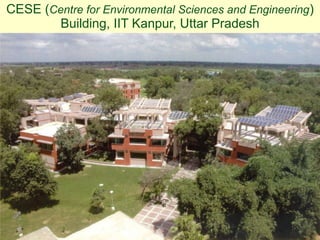
CESE (Centre for Environmental Sciences and Engineering)
        Building, IIT Kanpur, Uttar Pradesh
SUZLON ONE EARTH GREEN BUILDING AT PUNE
TERI RETREAT BUILDING AT GURGAON
COMMON WEALTH GAMES VILLAGE, NEW DELHI
ALAMADEN TOWER, SAN JOSE, CALIFORNIA, USA
THE CHICAGO CENTER FOR GREEN
TECHNOLOGY, CHICAGO, ILLINOIS, USA
ROCKY MOUNTAIN INSTITUTE, BOULDER, COLORADO, USA
MCDONALD HEADQUATERS, OAK BROOK, ILLINOIS, USA
START THINKING GREEN
Green building

Green building

  • 2.
  • 3.
    1.WHAT IS AGREEN BUILDING? 6. BROAD FUNCTIONS OF A BUILDING. 11. HOW HOMES BECOME 2. FEATURES OF GREEN GREEN. BUILDING. 7. HOW DO BUILDINGS EFFECT ENVIRONMENT. 12. LIST OF GREEN BUILDING 3. BENEFITS OF A GREEN MATERIALS. BUILDING. 8. HOW DO BUILDINGS EFFECT CLIMATE. 13. GRIHA. 4. ENVIRONMENTAL BENEFITS 14. GO GREEN. OF A GREEN BUILDING. 9. RULES OF GREEN BUILDING. 10. GREEN BUILDING 15. EXAMPLES OF GREEN 5. REAL BARRIERS OF GREEN BUILDINGS IN WORLD. BUILDING. CONCEPT.
  • 4.
    What is a GREEN BUILDING ? We can still SAVE THE EARTH !!
  • 5.
    What is aGREEN BUILDING ? Green building - also known as sustainable or high performance building - is the practice to:  Have minimum demand for electricity, water and other natural resources(in construction, demolition and operation).  Generate all its electricity on site through renewable means.  Strive to cater to all its water demand through sustainable processes such as rain water harvesting.  It could also strive to grow its own food in site.  It would recycle and reuse all its waste on site. We can still SAVE THE EARTH !!
  • 6.
    What are GREENFEATURES ? Minimal disturbance to landscapes and site condition Use of Recycled and Environmental Friendly Building materials Use of Non-Toxic and recycled/recyclable Materials Efficient use of Water and Water Recycling Use of Energy Efficient and Eco-Friendly Equipment Use of Renewable Energy Quality of Indoor Air Quality for Human Safety and Comfort Effective Controls and Building Management Systems We can still SAVE THE EARTH !!
  • 7.
    Benefits of aGREEN BUILDING  a lighter ecological footprint  reduction in operating energy  reduction in water costs  reduction in first costs and enhanced asset value  increased productivity of occupants  health and safety benefits We can still SAVE THE EARTH !!
  • 8.
    ENVIRONMENTAL BENEFITS  Enhance and protect biodiversity and ecosystems  Improve air and water quality  Reduce waste streams  Conserve and restore natural resources We can still SAVE THE EARTH !!
  • 9.
    REAL BARRIERS TOGO GREEN a lack of planning and developer education. a lack of knowledge about local vendors and resources difficult local land use officials. Rather than taking the initiative, several developers only work to improve business practices when competition forces them to do so. We can still SAVE THE EARTH !!
  • 10.
    BROAD FUNCTIONS OFA BUILDING • Apart from the basic functions as a shelter, a building should provide 2 fundamental physiological comforts, to its occupants they are: The ability to allow occupants to see Visual comfort clearly for carrying out their daily domestic official task. The ability to allow occupants to Thermal comfort remain cool in the summer and warm in the winter. We can still SAVE THE EARTH !!
  • 11.
    These comforts canbe provided in two ways: Naturally (Using sunlight, natural wind, evaporation, trees, etc) thus saving energy. (Using electric lighting, AC’s, etc) thus Artificially relying on large scale energy generation leading to pollution and green house gas emission. We can still SAVE THE EARTH !!
  • 12.
    Lack of properinformation and tendencies to follow fashionable trends that are short lived often lead us to provide comfort condition in our building at the cost of very high energy consumption. It should be our Endeavour to help secure energy and resource for future of our country through green buildings and habitats suitable for our country and people. We can still SAVE THE EARTH !!
  • 13.
    HOW DO BUILDINGEFFECT ENVIRONMENT?? To provide all the comforts listed above , a building needs to consume resources for construction and operation. In our country, a well designed building is built out of concrete and brick, and may have a design life up to 100 years. During such a period, a building can consume unimaginable quantities of resources. Building consume resources such as: Land Farms, forests, fertile land, marshes etc. Soil Earth,sand,stone,clay,lime,silica,etc. Trees Wood, ply, board, shuttering, etc. Metals Steel, iron, aluminum, copper, lead, etc. plastics PVC, UPVC, PU, etc. Water Construction, landscape, cooling, washing, drinking, flushing, etc. Electricity Cooling/ heating, lighting, pumping, entertainment/ working, etc. We can still SAVE THE EARTH !!
  • 14.
    And building generateswastes such as: Site wastes Cut trees, and vegetation and excavated soil, blasted stones, rubbles, etc. Construction wastes Metal boxes/cans, broken bricks, shuttering oil, etc. Sewage/ sullage Black water, grey water, etc. Organic wastes Peels, vegetables, fruits, etc. Recyclable wastes Paper, glass, metals, etc. Non-Recyclable Demolition debris, all plastics, wastes synthetics, fibers, etc. E wastes CD, electronic, hardware, etc. Chemical wastes Adhesive, paints, etc. We can still SAVE THE EARTH !!
  • 15.
    HOW DO BUILDINGEFFECT CLIMATE??  The energy used to heat and power our buildings leads to the consumption of large amounts of energy, mainly from burning fossil fuels - oil, natural gas and coal - which generate significant amounts of carbon dioxide (CO2), the most widespread greenhouse gas.  Reducing the energy use and greenhouse gas emissions produced by buildings is therefore fundamental to the effort to slow the pace of global climate change. Buildings may be associated with the release of greenhouse gases in other ways, for example, construction and demolition debris that degrades in landfills may generate methane, and the extraction and manufacturing of building materials may also generate greenhouse gas emissions. We can still SAVE THE EARTH !!
  • 16.
    RULES OF GREENBUILDING SUSTAINABLE ENVIRONMENT REGULATIONS QUALITY MANAGEMENT PERFORMATION BODY HEALTH STANDARDS We can still SAVE THE EARTH !!
  • 17.
    GREEN BUILDING CONCEPT The `Green Building' concept is gaining importance in various countries, including India. These are buildings that ensure that waste is minimized at every stage during the construction and operation of the building, resulting in low costs, according to experts in the technology. The techniques associated with the `Green Building' include measures to prevent erosion of soil, rainwater harvesting, preparation of landscapes to reduce heat, reduction in usage of potable water, recycling of waste water and use of world class energy efficient practices. We can still SAVE THE EARTH !!
  • 18.
  • 19.
    SELECTION CRITERIA OFGREEN BUILDING MATERIALS  Resource Efficiency – Recycled content – Renewable – Efficient manufacturing process – Local availability – Easily recyclable – Recyclable Packaging – Product Durability  Energy Conservation  Water Conservation
  • 20.
    LIST OF GREENBUILDING MATERIALS  Flooring: Flooring is good place to start when trying to make greener building choices. Some woods are less renewable than others, and carpet often contains VOCs (volatile organic compounds) that have a negative effect on indoor air quality. Bamboo has become a popular choice for flooring, since it replenishes very quickly. Cork, which is removed from the outside of a living tree at intervals, is attractive, natural, very renewable and gentle on the human body. Other green flooring options include sisal, eucalyptus, recycled carpet tiles, recycled rubber, wool carpeting, linoleum and reclaimed wood.
  • 21.
     Cement: On driveways and walkways, specially engineered cement that is porous and allows water to sink in rather than run off and pollute waterways is environmentally friendly. Also, using light-colored concrete, especially in urban areas, helps reduce temperature. For buildings, a relatively new technology called TX Active has emerged, which actually "eats" pollution.  Insulation: Insulation is very important in green construction because it helps conserve energy. In the past, asbestos was used for insulation, but it has since been banned or restricted in many countries because of health hazards. Good sustainable choices for insulation are those made from recycled newspaper and wood pulp, soy, cotton, recycled plastic or cork.  Glass: Break through in technology have made glass a popular green building material. Windows constructed of layered panes separated by sealed, gas-filled compartments provide insulation that conserves energy. Additionally, windows and doors can also be covered in special low-emissivity coatings that use or block natural solar rays to help regulate indoor temperatures.
  • 22.
     Roofing: An important feature of green roofing is its durability; sustainability can often be as simple as avoiding or limiting waste. Composite cedar shingles resist moisture, mildew and insects, which extends their life. Metal roofing materials that have solar reflective qualities also have advantages, especially in hot climates. Living roofs, which are covered in hearty plant life, reduce the "heat island effect" that is caused by a lack of evapotranspiration in areas that have a lot of concrete and asphalt surfaces.
  • 23.
    GRIHA- “Green Ratingfor Integrated Habitat Assessment” GRIHA is India’s national rating system for green buildings. It has been developed by TERI( The Energy and Resources Institute) and is endorsed by MNRE( Ministry of New and Renewable Energy). GRIHA attempts to minimize a building’s resource consumption, waste generation and overall ecological/environmental impact by comparing them to certain nationally accepted limits/benchmarks. It does so using the five ‘R’ philosophy of sustainable development namely-  REFUSE- To blindly adopt international trends, material, technologies, products, etc. specially in cases where local substitutes/equivalents are available.  REDUCE- The dependence on high energy products, systems, processes, etc.  REUSE- Materials, products, traditional technologies, so as to reduce the cost incurred in designing building as well as to operate them.  RECYCLE- All possible wastes generated from the building site during construction, operation and demolition.  REINVENT- Engineering systems, designs and practices such that India creates global examples that the world can follow rather than us following
  • 24.
    GO GREEN ! Fromthe planning stage through occupancy, green buildings offer many opportunities to the developer and its occupants Developers who have successfully navigated their way through the process of building green have become converts and no longer see it as a difficult task Going Green has led to an enhancement of many a developer’s corporate image! We can still SAVE THE EARTH !!
  • 25.
    CESE (Centre forEnvironmental Sciences and Engineering) Building, IIT Kanpur, Uttar Pradesh
  • 26.
    SUZLON ONE EARTHGREEN BUILDING AT PUNE
  • 27.
  • 28.
    COMMON WEALTH GAMESVILLAGE, NEW DELHI
  • 29.
    ALAMADEN TOWER, SANJOSE, CALIFORNIA, USA
  • 30.
    THE CHICAGO CENTERFOR GREEN TECHNOLOGY, CHICAGO, ILLINOIS, USA
  • 31.
    ROCKY MOUNTAIN INSTITUTE,BOULDER, COLORADO, USA
  • 32.
    MCDONALD HEADQUATERS, OAKBROOK, ILLINOIS, USA
  • 33.