GREEN BUILDING MATERIALS
Dr.S.KANCHANA
ASSOCIATE PROFESSOR
DEPARTMENT OF CIVIL ENGINEERING
SRI RAMAKRISHNA ENGINEERINGCOLLEGE
COIMBATORE
Why green buildings?
• Better living for all and future generations' is an universal dream.
• With increasing urbanization, natural resources are being utilized rapidly
and erratically without any planning and equivalent replenishment. This is
not sustainable development.
• Future generations will not have any natural resources
• Nature’s basic rule is to be adopted, 'Reduce, reuse and recycle', i.e., reduce
the requirement, reuse the waste and recycle to use.
Impacts of conventional Building
construction
• Conventional Building construction refers to the traditional method of
construction where the construction knowledge is passed from one generation to
the other associated to the wet construction (in-situ) using reinforced concrete.
• Conventional building construction practices negatively impact on the
environment and caused detrimental environmental issues. Greenhouse gas
emission, natural resource depletion, biodiversity degradation, disturbing the
natural hydrological cycles, heat island effect and human health impacts are
accounted as some of socio-environmental problems in construction sector.
Green building
• Green building also known as sustainable or high performance building - is the
practice of: Increasing the efficiency with which buildings and their sites use and
harvest energy, water, and materials; and Protecting and restoring human health
and the environment, throughout the building life-cycle: sitting, design,
construction, operation, maintenance, renovation and deconstruction.
• These are buildings that ensure that waste is minimized at every stage during the
construction and operation of the building, resulting in low costs, according to
experts in the technology.
• The techniques associated with the `Green Building' include measures to prevent
erosion of soil, rainwater harvesting, preparation of landscapes to reduce heat,
reduction in usage of potable water, recycling of waste water and use of world
class energy efficient practices.
WHAT MAKES GREEN BUILDINGS?
• A green building is a structure that is environmentally responsible and resource-
efficient throughout its life cycle.
• These objectives expand and complement the classical building design concerns
of economy, utility, durability, and comfort. Green buildings are designed to
reduce the overall impact of the built environment on human health and the
natural environment by:
• Efficiently using energy, water, and other resources.
• Protecting occupant health and improving employee productivity.
• Reducing waste, pollution and environment degradation.
Components of Green Building
• Energy Efficiency and Renewable Energy.
• Water Efficiency.
• Environmentally Preferable Building Materials and Specifications.
• Waste Reduction.
• Toxics Reduction.
• Indoor Air Quality.
• Smart Growth and Sustainable Development.
CHARACTERISTICSOF GREEN
BUILDINGS
• Location and transport.
• Sustainable sites.
• Efficient use of water.
• Energy and atmosphere.
• Materials and resources.
• Indoor environmental quality.
• Design innovation.
• Regional priority.
Benefits of Green Building
• The world over, evidence is growing that green buildings bring multiple benefits.
• They provide some of the most effective means to achieving a range of global
goals, such as addressing climate change, creating sustainable and thriving
communities, and driving economic growth.
• The benefits of green buildings can be grouped within three categories:
environmental, economic and social. Here, we provide a range of facts and
statistics from various third-party sources that present these benefits.
Environmental Benefits
• At a global level:
• This emissions savings potential is said to be as much as 84 gigatonnes of CO2 (GtCO2) by
2050, through direct measures in buildings such as energy efficiency, fuel switching and
the use of renewable energy.
• The building sector has the potential to make energy savings of 50% or more in 2050, in
support of limiting global temperature rises to 2°C (above pre-industrial levels)
• At a building level:
• Green buildings certified by the Indian Green Building Council (IGBC) results in energy
savings of 40 - 50% and water savings of 20 - 30% compared to conventional buildings in
India.
• Green buildings achieving the Green Star certification in South Africa have been shown to
save on average between 30 - 40% energy and carbon emissions every year, and between
20 - 30% potable water every year, when compared to the industry norm.
• Green buildings achieving the LEED certification in the US and other countries consume 25
per cent less energy and 11 per cent less water, than non-green buildings.
Economic Benefits
• Green buildings offer a number of economic or financial benefits, which are relevant to a range
of different people or groups of people.
• These include cost savings on utility bills for tenants or households (through energy and water
efficiency); lower construction costs and higher property value for building developers;
increased occupancy rates or operating costs for building owners; and job creation.
• At a global level:
• Global energy efficiency measures could save an estimated €280 to €410 billion in savings on
energy spending (and the equivalent to almost double the annual electricity consumption of
the United States)
• At a country level:
• Canada’s green building industry generated $23.45 billion in GDP and represented nearly
300,000 full-time jobs in 2014 .
• Green building is projected to account for more than 3.3 million U.S. jobs by 2018 .
• At a building level:
• Building owners report that green buildings - whether new or renovated - command a 7 per
cent increase in asset value over traditional building.
Social Benefits
• Green building benefits go beyond economics and the environment, and have
been shown to bring positive social impacts too. Many of these benefits are
around the health and wellbeing of people who work in green offices or live in
green homes.
• Workers in green, well-ventilated offices record a 101 per cent increase in
cognitive scores (brain function).
• Employees in offices with windows slept an average of 46 minutes more per night.
• Research suggests that better indoor air quality (low concentrations of CO2 and
pollutants, and high ventilation rates) can lead to improvements in performance
of up to 8 per cent.
Site selection and planning
• The location where the green building is indented to be constructed and the
environment surround the location play an important role in the overall
sustainability of the green building.
• The site that is selected for the construction not only must satisfy the building
project but also the municipality under which the site is constructed. This means
that, a building in the site must be constructed such a way that the surrounding
natural environment and the related ecosystem is not affected in any means.
• While conducting the procedures for site selection, the surrounding waterways,
nearby farmland and protected wetlands must be taken as main considerations in
the decision.
• The projects that help in the restoration and the protection of natural habitats
• Projects that are planned and developed on brownfield sites
• The projects that maximize the open space
• The project that help in connecting different communities and favoring overall
development goals.
• Encouraging the occupants to bicycle to their work by provision of bicycle garage
• Projects that provide facility for the storage of low-emission and energy efficient
vehicles, for example electric cars.
• Projects that provide access to public transportation in a convenient manner.
• Projects that supports the provision of storm water storage. For example, the
provision of green roofs.
• The projects that help in the reduction of heat island effects.
Key Factors in Site Selection and Planning
• 1. Selecting appropriate site
• 2. Site ecology and ecological Survey
• 3. Site Planning
• Analysis
• Erosion and sedimentation control
• Microclimate
• Facilities for differently abled
• Facilities for construction workforce
Selecting appropriate site
• Choose site with close proximity to amenities
• Schools, market, hospitals, etc.
• This will minimize travel distance and time
• Access to public transportation within the vicinity
• Bus stops and rail stations
• Allows alternate modes of transportation and minimizes pollution due to use of
automobiles.
Site ecology and ecological Survey
• Site ecology defines distinctive land characteristics
• Soil and physical
• Ecological survey – important factor for the development of the project.
• Requirement under the regulations of EIA.
• Benefits of Ecological Survey – Helps in identifying species or habitat existing on
land
• Defines potential constraints for development – appropriate mitigation measures
can be incorporated.
• Protects biodiversity and reduces habitat loss.
Site Planning
• Site Analysis
• Climate Analysis
• Minimize site disturbances
• Restoring project site elements
• Integrating the site with local and regional ecosystems
• Preserving the existing biodiversity
Site Analysis
• Studying the existing features in the site
• Existing topography, soil, underground water levels, vegetation, etc.
Climate Analysis
• Wind flow and cross ventilation – Important factors in building design
• Wind direction and pattern are studied by wind rose diagram
• Wind rose diagram is a graphical representation of wind condition, directions and
speed.
Benefits of preserving natural topography
• Preserves biodiversity
• Enhances microclimate
• Improves on-site air quality
• Lessened construction cost by preserving contours
Green Building Materials
• We are traditionally using earth bricks, concrete, and wood in construction.
• They have been, and continue to be used in everyday construction,
meaning the continued destruction of trees for timber, and the mining of
resources to produce cement for binding sand, gravel, and bricks.
• Green building materials are composed of renewable, rather than non
renewable resources.
• Green materials are environmentally responsible because impacts are
considered over the life of the product.
• For a better world, there are new processes, and sustainable as well
as green building material alternatives that can be used in construction
today.
Sustainable and Green Building Materials
That Can Be Used in Construction
• Bamboo is considered one of the best eco-
friendly building materials.
• It has an incredibly high self-generation rate,
with some being reported to have grown up to
three feet within 24 hours.
• It continues spreading and growing without
having to be replanted after harvest.
• Bamboo is a perennial grass and not wood and
grows on every continent, except Europe and
Antarctica.
• It also has a high strength-to-weight ratio,
even greater comprehensive strength than
concrete and brick, and lasts incredibly long.
• It is, therefore, the best choice for flooring and
cabinetry.
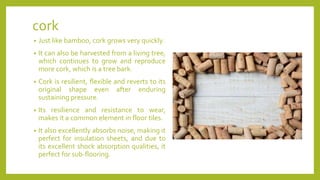
cork
• Just like bamboo, cork grows very quickly.
• It can also be harvested from a living tree,
which continues to grow and reproduce
more cork, which is a tree bark.
• Cork is resilient, flexible and reverts to its
original shape even after enduring
sustaining pressure.
• Its resilience and resistance to wear,
makes it a common element in floor tiles.
• It also excellently absorbs noise, making it
perfect for insulation sheets, and due to
its excellent shock absorption qualities, it
perfect for sub-flooring.
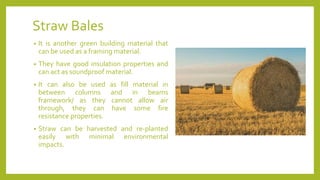
Straw Bales
• It is another green building material that
can be used as a framing material.
• They have good insulation properties and
can act as soundproof material.
• It can also be used as fill material in
between columns and in beams
framework/ as they cannot allow air
through, they can have some fire
resistance properties.
• Straw can be harvested and re-planted
easily with minimal environmental
impacts.
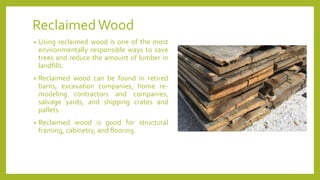
ReclaimedWood
• Using reclaimed wood is one of the most
environmentally responsible ways to save
trees and reduce the amount of lumber in
landfills.
• Reclaimed wood can be found in retired
barns, excavation companies, home re-
modeling contractors and companies,
salvage yards, and shipping crates and
pallets.
• Reclaimed wood is good for structural
framing, cabinetry, and flooring.
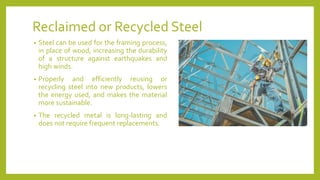
Reclaimed or Recycled Steel
• Steel can be used for the framing process,
in place of wood, increasing the durability
of a structure against earthquakes and
high winds.
• Properly and efficiently reusing or
recycling steel into new products, lowers
the energy used, and makes the material
more sustainable.
• The recycled metal is long-lasting and
does not require frequent replacements.
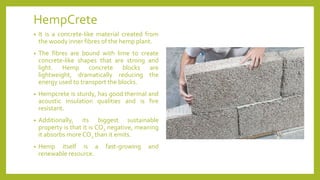
HempCrete
• It is a concrete-like material created from
the woody inner fibres of the hemp plant.
• The fibres are bound with lime to create
concrete-like shapes that are strong and
light. Hemp concrete blocks are
lightweight, dramatically reducing the
energy used to transport the blocks.
• Hempcrete is sturdy, has good thermal and
acoustic insulation qualities and is fire
resistant.
• Additionally, its biggest sustainable
property is that it is CO2 negative, meaning
it absorbs more CO2 than it emits.
• Hemp itself is a fast-growing and
renewable resource.
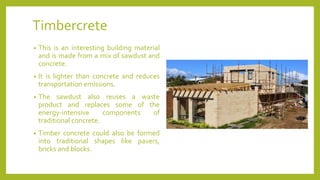
Timbercrete
• This is an interesting building material
and is made from a mix of sawdust and
concrete.
• It is lighter than concrete and reduces
transportation emissions.
• The sawdust also reuses a waste
product and replaces some of the
energy-intensive components of
traditional concrete.
• Timber concrete could also be formed
into traditional shapes like pavers,
bricks and blocks.
References
• https://igbc.in/
• https://archive.epa.gov/greenbuilding/web/html/components.html#:~:text=Energ
y%20Efficiency%20and%20Renewable%20Energy,Waste%20Reduction
• https://igbc.in/assets/html_pdfs/IGBC_Green_New_Buildings_Rating_System_(Ve
rsion_3.0_with_Fifth_Addendum).pdf
• https://theconstructor.org/building/buildings/green-building-materials/7028/

Green Building Materials.pptx

  • 1.
    GREEN BUILDING MATERIALS Dr.S.KANCHANA ASSOCIATEPROFESSOR DEPARTMENT OF CIVIL ENGINEERING SRI RAMAKRISHNA ENGINEERINGCOLLEGE COIMBATORE
  • 2.
    Why green buildings? •Better living for all and future generations' is an universal dream. • With increasing urbanization, natural resources are being utilized rapidly and erratically without any planning and equivalent replenishment. This is not sustainable development. • Future generations will not have any natural resources • Nature’s basic rule is to be adopted, 'Reduce, reuse and recycle', i.e., reduce the requirement, reuse the waste and recycle to use.
  • 3.
    Impacts of conventionalBuilding construction • Conventional Building construction refers to the traditional method of construction where the construction knowledge is passed from one generation to the other associated to the wet construction (in-situ) using reinforced concrete. • Conventional building construction practices negatively impact on the environment and caused detrimental environmental issues. Greenhouse gas emission, natural resource depletion, biodiversity degradation, disturbing the natural hydrological cycles, heat island effect and human health impacts are accounted as some of socio-environmental problems in construction sector.
  • 4.
    Green building • Greenbuilding also known as sustainable or high performance building - is the practice of: Increasing the efficiency with which buildings and their sites use and harvest energy, water, and materials; and Protecting and restoring human health and the environment, throughout the building life-cycle: sitting, design, construction, operation, maintenance, renovation and deconstruction. • These are buildings that ensure that waste is minimized at every stage during the construction and operation of the building, resulting in low costs, according to experts in the technology. • The techniques associated with the `Green Building' include measures to prevent erosion of soil, rainwater harvesting, preparation of landscapes to reduce heat, reduction in usage of potable water, recycling of waste water and use of world class energy efficient practices.
  • 5.
    WHAT MAKES GREENBUILDINGS? • A green building is a structure that is environmentally responsible and resource- efficient throughout its life cycle. • These objectives expand and complement the classical building design concerns of economy, utility, durability, and comfort. Green buildings are designed to reduce the overall impact of the built environment on human health and the natural environment by: • Efficiently using energy, water, and other resources. • Protecting occupant health and improving employee productivity. • Reducing waste, pollution and environment degradation.
  • 6.
    Components of GreenBuilding • Energy Efficiency and Renewable Energy. • Water Efficiency. • Environmentally Preferable Building Materials and Specifications. • Waste Reduction. • Toxics Reduction. • Indoor Air Quality. • Smart Growth and Sustainable Development.
  • 7.
    CHARACTERISTICSOF GREEN BUILDINGS • Locationand transport. • Sustainable sites. • Efficient use of water. • Energy and atmosphere. • Materials and resources. • Indoor environmental quality. • Design innovation. • Regional priority.
  • 8.
    Benefits of GreenBuilding • The world over, evidence is growing that green buildings bring multiple benefits. • They provide some of the most effective means to achieving a range of global goals, such as addressing climate change, creating sustainable and thriving communities, and driving economic growth. • The benefits of green buildings can be grouped within three categories: environmental, economic and social. Here, we provide a range of facts and statistics from various third-party sources that present these benefits.
  • 9.
    Environmental Benefits • Ata global level: • This emissions savings potential is said to be as much as 84 gigatonnes of CO2 (GtCO2) by 2050, through direct measures in buildings such as energy efficiency, fuel switching and the use of renewable energy. • The building sector has the potential to make energy savings of 50% or more in 2050, in support of limiting global temperature rises to 2°C (above pre-industrial levels) • At a building level: • Green buildings certified by the Indian Green Building Council (IGBC) results in energy savings of 40 - 50% and water savings of 20 - 30% compared to conventional buildings in India. • Green buildings achieving the Green Star certification in South Africa have been shown to save on average between 30 - 40% energy and carbon emissions every year, and between 20 - 30% potable water every year, when compared to the industry norm. • Green buildings achieving the LEED certification in the US and other countries consume 25 per cent less energy and 11 per cent less water, than non-green buildings.
  • 10.
    Economic Benefits • Greenbuildings offer a number of economic or financial benefits, which are relevant to a range of different people or groups of people. • These include cost savings on utility bills for tenants or households (through energy and water efficiency); lower construction costs and higher property value for building developers; increased occupancy rates or operating costs for building owners; and job creation. • At a global level: • Global energy efficiency measures could save an estimated €280 to €410 billion in savings on energy spending (and the equivalent to almost double the annual electricity consumption of the United States) • At a country level: • Canada’s green building industry generated $23.45 billion in GDP and represented nearly 300,000 full-time jobs in 2014 . • Green building is projected to account for more than 3.3 million U.S. jobs by 2018 . • At a building level: • Building owners report that green buildings - whether new or renovated - command a 7 per cent increase in asset value over traditional building.
  • 11.
    Social Benefits • Greenbuilding benefits go beyond economics and the environment, and have been shown to bring positive social impacts too. Many of these benefits are around the health and wellbeing of people who work in green offices or live in green homes. • Workers in green, well-ventilated offices record a 101 per cent increase in cognitive scores (brain function). • Employees in offices with windows slept an average of 46 minutes more per night. • Research suggests that better indoor air quality (low concentrations of CO2 and pollutants, and high ventilation rates) can lead to improvements in performance of up to 8 per cent.
  • 12.
    Site selection andplanning • The location where the green building is indented to be constructed and the environment surround the location play an important role in the overall sustainability of the green building. • The site that is selected for the construction not only must satisfy the building project but also the municipality under which the site is constructed. This means that, a building in the site must be constructed such a way that the surrounding natural environment and the related ecosystem is not affected in any means. • While conducting the procedures for site selection, the surrounding waterways, nearby farmland and protected wetlands must be taken as main considerations in the decision.
  • 13.
    • The projectsthat help in the restoration and the protection of natural habitats • Projects that are planned and developed on brownfield sites • The projects that maximize the open space • The project that help in connecting different communities and favoring overall development goals. • Encouraging the occupants to bicycle to their work by provision of bicycle garage • Projects that provide facility for the storage of low-emission and energy efficient vehicles, for example electric cars. • Projects that provide access to public transportation in a convenient manner. • Projects that supports the provision of storm water storage. For example, the provision of green roofs. • The projects that help in the reduction of heat island effects.
  • 14.
    Key Factors inSite Selection and Planning • 1. Selecting appropriate site • 2. Site ecology and ecological Survey • 3. Site Planning • Analysis • Erosion and sedimentation control • Microclimate • Facilities for differently abled • Facilities for construction workforce
  • 15.
    Selecting appropriate site •Choose site with close proximity to amenities • Schools, market, hospitals, etc. • This will minimize travel distance and time • Access to public transportation within the vicinity • Bus stops and rail stations • Allows alternate modes of transportation and minimizes pollution due to use of automobiles.
  • 16.
    Site ecology andecological Survey • Site ecology defines distinctive land characteristics • Soil and physical • Ecological survey – important factor for the development of the project. • Requirement under the regulations of EIA. • Benefits of Ecological Survey – Helps in identifying species or habitat existing on land • Defines potential constraints for development – appropriate mitigation measures can be incorporated. • Protects biodiversity and reduces habitat loss.
  • 17.
    Site Planning • SiteAnalysis • Climate Analysis • Minimize site disturbances • Restoring project site elements • Integrating the site with local and regional ecosystems • Preserving the existing biodiversity
  • 18.
    Site Analysis • Studyingthe existing features in the site • Existing topography, soil, underground water levels, vegetation, etc.
  • 19.
    Climate Analysis • Windflow and cross ventilation – Important factors in building design • Wind direction and pattern are studied by wind rose diagram • Wind rose diagram is a graphical representation of wind condition, directions and speed.
  • 20.
    Benefits of preservingnatural topography • Preserves biodiversity • Enhances microclimate • Improves on-site air quality • Lessened construction cost by preserving contours
  • 21.
    Green Building Materials •We are traditionally using earth bricks, concrete, and wood in construction. • They have been, and continue to be used in everyday construction, meaning the continued destruction of trees for timber, and the mining of resources to produce cement for binding sand, gravel, and bricks. • Green building materials are composed of renewable, rather than non renewable resources. • Green materials are environmentally responsible because impacts are considered over the life of the product. • For a better world, there are new processes, and sustainable as well as green building material alternatives that can be used in construction today.
  • 22.
    Sustainable and GreenBuilding Materials That Can Be Used in Construction • Bamboo is considered one of the best eco- friendly building materials. • It has an incredibly high self-generation rate, with some being reported to have grown up to three feet within 24 hours. • It continues spreading and growing without having to be replanted after harvest. • Bamboo is a perennial grass and not wood and grows on every continent, except Europe and Antarctica. • It also has a high strength-to-weight ratio, even greater comprehensive strength than concrete and brick, and lasts incredibly long. • It is, therefore, the best choice for flooring and cabinetry.
  • 23.
    cork • Just likebamboo, cork grows very quickly. • It can also be harvested from a living tree, which continues to grow and reproduce more cork, which is a tree bark. • Cork is resilient, flexible and reverts to its original shape even after enduring sustaining pressure. • Its resilience and resistance to wear, makes it a common element in floor tiles. • It also excellently absorbs noise, making it perfect for insulation sheets, and due to its excellent shock absorption qualities, it perfect for sub-flooring.
  • 24.
    Straw Bales • Itis another green building material that can be used as a framing material. • They have good insulation properties and can act as soundproof material. • It can also be used as fill material in between columns and in beams framework/ as they cannot allow air through, they can have some fire resistance properties. • Straw can be harvested and re-planted easily with minimal environmental impacts.
  • 25.
    ReclaimedWood • Using reclaimedwood is one of the most environmentally responsible ways to save trees and reduce the amount of lumber in landfills. • Reclaimed wood can be found in retired barns, excavation companies, home re- modeling contractors and companies, salvage yards, and shipping crates and pallets. • Reclaimed wood is good for structural framing, cabinetry, and flooring.
  • 26.
    Reclaimed or RecycledSteel • Steel can be used for the framing process, in place of wood, increasing the durability of a structure against earthquakes and high winds. • Properly and efficiently reusing or recycling steel into new products, lowers the energy used, and makes the material more sustainable. • The recycled metal is long-lasting and does not require frequent replacements.
  • 27.
    HempCrete • It isa concrete-like material created from the woody inner fibres of the hemp plant. • The fibres are bound with lime to create concrete-like shapes that are strong and light. Hemp concrete blocks are lightweight, dramatically reducing the energy used to transport the blocks. • Hempcrete is sturdy, has good thermal and acoustic insulation qualities and is fire resistant. • Additionally, its biggest sustainable property is that it is CO2 negative, meaning it absorbs more CO2 than it emits. • Hemp itself is a fast-growing and renewable resource.
  • 28.
    Timbercrete • This isan interesting building material and is made from a mix of sawdust and concrete. • It is lighter than concrete and reduces transportation emissions. • The sawdust also reuses a waste product and replaces some of the energy-intensive components of traditional concrete. • Timber concrete could also be formed into traditional shapes like pavers, bricks and blocks.
  • 29.
    References • https://igbc.in/ • https://archive.epa.gov/greenbuilding/web/html/components.html#:~:text=Energ y%20Efficiency%20and%20Renewable%20Energy,Waste%20Reduction •https://igbc.in/assets/html_pdfs/IGBC_Green_New_Buildings_Rating_System_(Ve rsion_3.0_with_Fifth_Addendum).pdf • https://theconstructor.org/building/buildings/green-building-materials/7028/