Department of Electrical and Electronics Engineering
Subject : Signals and Digital Signal Processing
(21EE63)
Module 1
Introduction to Signals
Overview of Presentation
• Objective of the Module.
• Introduction: Definitions of a Signal and a System.
• Classification of Signals.
• Basic Operations on Signals.
• Basic Elementary Signals.
• Time-domain representations for LTI systems:
Convolution.
• Convolution Sum and Convolution Integral.
• Properties of impulse response representation.
Dept of EEE, GNDECB
2
Objective of the Module.
To study the classification of signals.
To study the operation on signals.
To study the types of signal.
To study the properties of a system.
Dept of EEE, GNDECB 3
Introduction: Definitions of a Signal and a
System
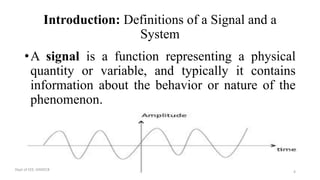
•A signal is a function representing a physical
quantity or variable, and typically it contains
information about the behavior or nature of the
phenomenon.
Dept of EEE, GNDECB
4
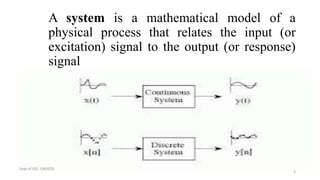
A system is a mathematical model of a
physical process that relates the input (or
excitation) signal to the output (or response)
signal
Dept of EEE, GNDECB
5
Classification of Signals
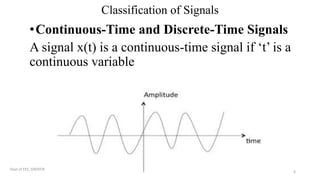
•Continuous-Time and Discrete-Time Signals
A signal x(t) is a continuous-time signal if ‘t’ is a
continuous variable
Dept of EEE, GNDECB
6
•Discrete-time signal is defined at discrete times,
a discrete-time signal is often identified as a
sequence of numbers, denoted by {x,) or x[n],
where n = integer
Dept of EEE, GNDECB 7
Deterministic and
Random Signals
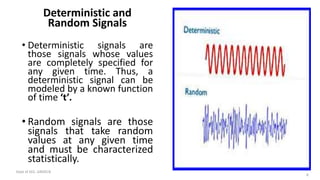
• Deterministic signals are
those signals whose values
are completely specified for
any given time. Thus, a
deterministic signal can be
modeled by a known function
of time ‘t’.
• Random signals are those
signals that take random
values at any given time
and must be characterized
statistically.
Dept of EEE, GNDECB
8
Even and Odd Signals
A signal x( t ) or x[n] is referred to as an even
signal if
x (- t) = x(t) or x [-n] = x [n]
Dept of EEE, GNDECB 9
A signal x( t ) or x[n] is referred to as an odd
signal if
x(-t) = - x(t) or x[- n] = - x[n]
Dept of EEE, GNDECB 10
• Periodic and Non-periodic Signals
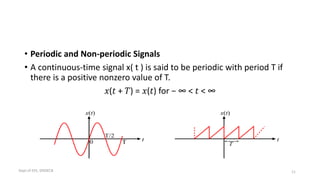
• A continuous-time signal x( t ) is said to be periodic with period T if
there is a positive nonzero value of T.
𝑥(𝑡 + 𝑇) = 𝑥(𝑡) for − ∞ < 𝑡 < ∞
Dept of EEE, GNDECB 11
Energy and Power Signals
A signal is said to be an energy signal if and
only if its total energy E is finite, i.e., 0 < 𝐸 < ∞.
For an energy signal, the average power P = 0.
The nonperiodic signals are the examples of
energy signals.
A signal is said to be a power signal if its
average power P is finite, i.e., 0 < 𝑃 < ∞. For a
power signal, the total energy E = ∞. The
periodic signals are the examples of power
signals.
Dept of EEE, GNDECB
12
Basic Operations on signals
The operations performed on signals can be
broadly classified into two kinds
•Operations on dependent variables
•Operations on independent variables
Dept of EEE, GNDECB
13
Operations on dependent variables
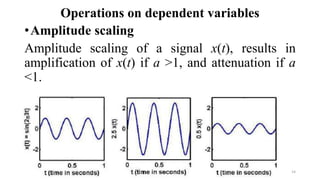
•Amplitude scaling
Amplitude scaling of a signal x(t), results in
amplification of x(t) if a >1, and attenuation if a
<1.
14
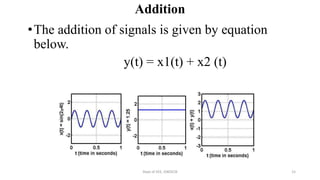
Addition
•The addition of signals is given by equation
below.
y(t) = x1(t) + x2 (t)
Dept of EEE, GNDECB 15
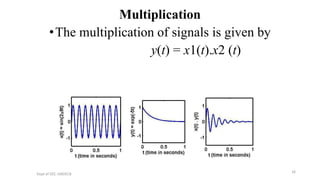
Multiplication
•The multiplication of signals is given by
y(t) = x1(t).x2 (t)
Dept of EEE, GNDECB
16
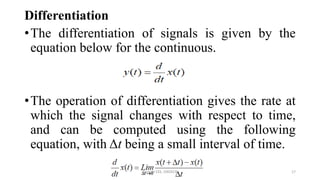
Differentiation
•The differentiation of signals is given by the
equation below for the continuous.
•The operation of differentiation gives the rate at
which the signal changes with respect to time,
and can be computed using the following
equation, with Δt being a small interval of time.
Dept of EEE, GNDECB 17
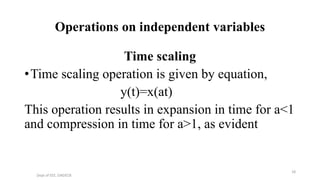
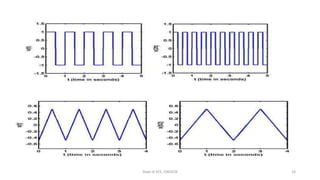
Operations on independent variables
Time scaling
•Time scaling operation is given by equation,
y(t)=x(at)
This operation results in expansion in time for a<1
and compression in time for a>1, as evident
Dept of EEE, GNDECB
18
Dept of EEE, GNDECB 19
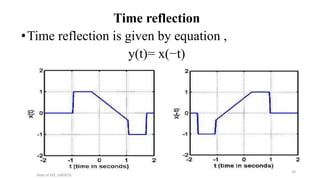
Time reflection
•Time reflection is given by equation ,
y(t)= x(−t)
Dept of EEE, GNDECB
20
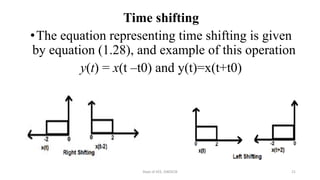
Time shifting
•The equation representing time shifting is given
by equation (1.28), and example of this operation
y(t) = x(t –t0) and y(t)=x(t+t0)
Dept of EEE, GNDECB 21
Elementary Signals
Exponential signals:
•The exponential signal given by equation, is a
monotonically increasing function if a> 0, and a<0
Dept of EEE, GNDECB
22
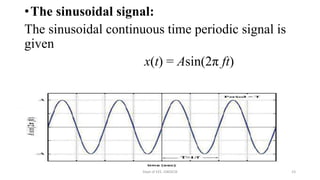
•The sinusoidal signal:
The sinusoidal continuous time periodic signal is
given
x(t) = Asin(2π ft)
Dept of EEE, GNDECB 23
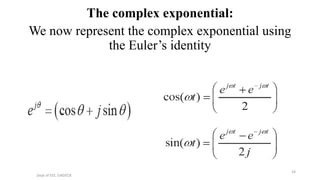
The complex exponential:
We now represent the complex exponential using
the Euler’s identity
Dept of EEE, GNDECB
24
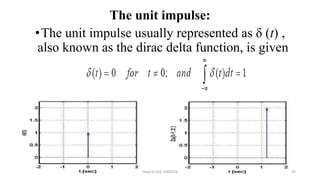
The unit impulse:
•The unit impulse usually represented as δ (t) ,
also known as the dirac delta function, is given
Dept of EEE, GNDECB 25
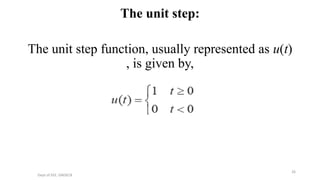
The unit step:
The unit step function, usually represented as u(t)
, is given by,
Dept of EEE, GNDECB
26
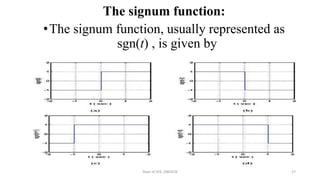
The signum function:
•The signum function, usually represented as
sgn(t) , is given by
Dept of EEE, GNDECB 27
Properties of System
•Stability
•Memory
•Causality
•Inevitability
•Linearity
•Time invariance
Dept of EEE, GNDECB
28
Outcomes
Knowledge on classification of signals.
Learnt the basic operation on signals.
Knowledge on types of signals.
Understand the properties of system.
Dept of EEE, GNDECB
29

Digital Signal Processing Module 1 Introduction to signals

  • 1.
    Department of Electricaland Electronics Engineering Subject : Signals and Digital Signal Processing (21EE63) Module 1 Introduction to Signals
  • 2.
    Overview of Presentation •Objective of the Module. • Introduction: Definitions of a Signal and a System. • Classification of Signals. • Basic Operations on Signals. • Basic Elementary Signals. • Basic Elementary Signals. • Time-domain representations for LTI systems: Convolution. • Convolution Sum and Convolution Integral. • Properties of impulse response representation. Dept of EEE, GNDECB 2
  • 3.
    Objective of theModule. To study the classification of signals. To study the operation on signals. To study the types of signal. To study the properties of a system. Dept of EEE, GNDECB 3
  • 4.
    Introduction: Definitions ofa Signal and a System •A signal is a function representing a physical quantity or variable, and typically it contains information about the behavior or nature of the phenomenon. Dept of EEE, GNDECB 4
  • 5.
    A system isa mathematical model of a physical process that relates the input (or excitation) signal to the output (or response) signal Dept of EEE, GNDECB 5
  • 6.
    Classification of Signals •Continuous-Timeand Discrete-Time Signals A signal x(t) is a continuous-time signal if ‘t’ is a continuous variable Dept of EEE, GNDECB 6
  • 7.
    •Discrete-time signal isdefined at discrete times, a discrete-time signal is often identified as a sequence of numbers, denoted by {x,) or x[n], where n = integer Dept of EEE, GNDECB 7
  • 8.
    Deterministic and Random Signals •Deterministic signals are those signals whose values are completely specified for any given time. Thus, a deterministic signal can be modeled by a known function of time ‘t’. • Random signals are those signals that take random values at any given time and must be characterized statistically. Dept of EEE, GNDECB 8
  • 9.
    Even and OddSignals A signal x( t ) or x[n] is referred to as an even signal if x (- t) = x(t) or x [-n] = x [n] Dept of EEE, GNDECB 9
  • 10.
    A signal x(t ) or x[n] is referred to as an odd signal if x(-t) = - x(t) or x[- n] = - x[n] Dept of EEE, GNDECB 10
  • 11.
    • Periodic andNon-periodic Signals • A continuous-time signal x( t ) is said to be periodic with period T if there is a positive nonzero value of T. 𝑥(𝑡 + 𝑇) = 𝑥(𝑡) for − ∞ < 𝑡 < ∞ Dept of EEE, GNDECB 11
  • 12.
    Energy and PowerSignals A signal is said to be an energy signal if and only if its total energy E is finite, i.e., 0 < 𝐸 < ∞. For an energy signal, the average power P = 0. The nonperiodic signals are the examples of energy signals. A signal is said to be a power signal if its average power P is finite, i.e., 0 < 𝑃 < ∞. For a power signal, the total energy E = ∞. The periodic signals are the examples of power signals. Dept of EEE, GNDECB 12
  • 13.
    Basic Operations onsignals The operations performed on signals can be broadly classified into two kinds •Operations on dependent variables •Operations on independent variables Dept of EEE, GNDECB 13
  • 14.
    Operations on dependentvariables •Amplitude scaling Amplitude scaling of a signal x(t), results in amplification of x(t) if a >1, and attenuation if a <1. 14
  • 15.
    Addition •The addition ofsignals is given by equation below. y(t) = x1(t) + x2 (t) Dept of EEE, GNDECB 15
  • 16.
    Multiplication •The multiplication ofsignals is given by y(t) = x1(t).x2 (t) Dept of EEE, GNDECB 16
  • 17.
    Differentiation •The differentiation ofsignals is given by the equation below for the continuous. •The operation of differentiation gives the rate at which the signal changes with respect to time, and can be computed using the following equation, with Δt being a small interval of time. Dept of EEE, GNDECB 17
  • 18.
    Operations on independentvariables Time scaling •Time scaling operation is given by equation, y(t)=x(at) This operation results in expansion in time for a<1 and compression in time for a>1, as evident Dept of EEE, GNDECB 18
  • 19.
    Dept of EEE,GNDECB 19
  • 20.
    Time reflection •Time reflectionis given by equation , y(t)= x(−t) Dept of EEE, GNDECB 20
  • 21.
    Time shifting •The equationrepresenting time shifting is given by equation (1.28), and example of this operation y(t) = x(t –t0) and y(t)=x(t+t0) Dept of EEE, GNDECB 21
  • 22.
    Elementary Signals Exponential signals: •Theexponential signal given by equation, is a monotonically increasing function if a> 0, and a<0 Dept of EEE, GNDECB 22
  • 23.
    •The sinusoidal signal: Thesinusoidal continuous time periodic signal is given x(t) = Asin(2π ft) Dept of EEE, GNDECB 23
  • 24.
    The complex exponential: Wenow represent the complex exponential using the Euler’s identity Dept of EEE, GNDECB 24
  • 25.
    The unit impulse: •Theunit impulse usually represented as δ (t) , also known as the dirac delta function, is given Dept of EEE, GNDECB 25
  • 26.
    The unit step: Theunit step function, usually represented as u(t) , is given by, Dept of EEE, GNDECB 26
  • 27.
    The signum function: •Thesignum function, usually represented as sgn(t) , is given by Dept of EEE, GNDECB 27
  • 28.
  • 29.
    Outcomes Knowledge on classificationof signals. Learnt the basic operation on signals. Knowledge on types of signals. Understand the properties of system. Dept of EEE, GNDECB 29