Switch…Case Statement
             Prakash Khaire
   B V Patel Inst. of BMC & IT, Gopalvidyanagar
Switch Multiple Selection
              Structure
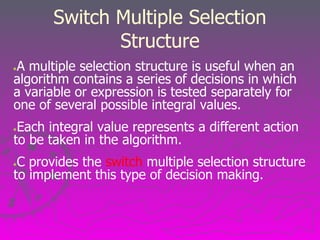
A multiple selection structure is useful when an
●
algorithm contains a series of decisions in which
a variable or expression is tested separately for
one of several possible integral values.
●Each integral value represents a different action
to be taken in the algorithm.
●C provides the switch multiple selection structure
to implement this type of decision making.
Switch-Case Structures
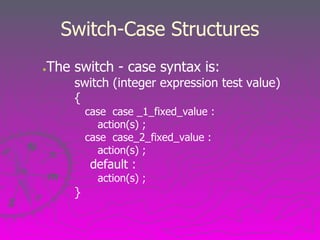
The switch - case syntax is:
●

     switch (integer expression test value)
     {
         case case _1_fixed_value :
           action(s) ;
         case case_2_fixed_value :
           action(s) ;
          default :
           action(s) ;
     }
Switch-Case Structures
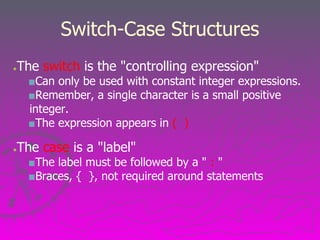
The switch is the "controlling expression"
●

    ■Can only be used with constant integer expressions.
    ■Remember, a single character is a small positive
    integer.
    ■The expression appears in ( )

The case is a "label"
●

    ■The label must be followed by a " : "
    ■Braces, { }, not required around statements
Switch-Case Structures
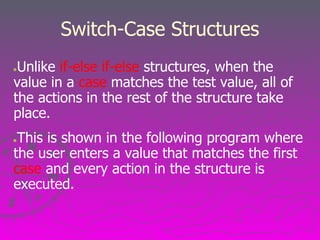
●Unlike if-else if-else structures, when the
value in a case matches the test value, all of
the actions in the rest of the structure take
place.
●This is shown in the following program where
the user enters a value that matches the first
case and every action in the structure is
executed.
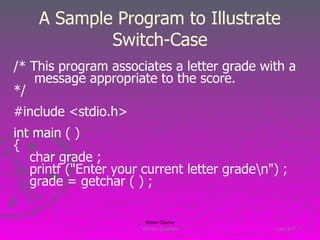
A Sample Program to Illustrate
            Switch-Case
/* This program associates a letter grade with a
    message appropriate to the score.
*/
#include <stdio.h>
int main ( )
{
   char grade ;
   printf ("Enter your current letter graden") ;
   grade = getchar ( ) ;

                        Winter Quarter
                       Winter Quarter          Lect 9 P. *
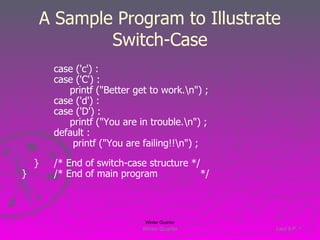
A Sample Program to Illustrate
                Switch-Case
         case ('c') :
         case ('C') :
            printf ("Better get to work.n") ;
         case ('d') :
         case ('D') :
            printf ("You are in trouble.n") ;
         default :
             printf ("You are failing!!n") ;

    }    /* End of switch-case structure */
}        /* End of main program            */


                               Winter Quarter
                              Winter Quarter     Lect 9 P. *
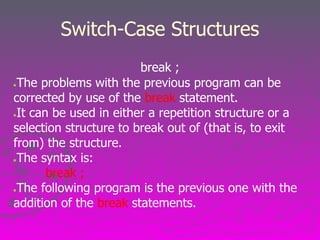
Switch-Case Structures
                        break ;
●The problems with the previous program can be

corrected by use of the break statement.
●It can be used in either a repetition structure or a

selection structure to break out of (that is, to exit
from) the structure.
●The syntax is:

       break ;
●The following program is the previous one with the

addition of the break statements.
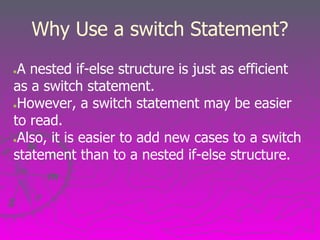
Why Use a switch Statement?
●A nested if-else structure is just as efficient
as a switch statement.
●However, a switch statement may be easier

to read.
●Also, it is easier to add new cases to a switch

statement than to a nested if-else structure.

Lecture13 control statementswitch.ppt

  • 1.
    Switch…Case Statement Prakash Khaire B V Patel Inst. of BMC & IT, Gopalvidyanagar
  • 2.
    Switch Multiple Selection Structure A multiple selection structure is useful when an ● algorithm contains a series of decisions in which a variable or expression is tested separately for one of several possible integral values. ●Each integral value represents a different action to be taken in the algorithm. ●C provides the switch multiple selection structure to implement this type of decision making.
  • 3.
    Switch-Case Structures The switch- case syntax is: ● switch (integer expression test value) { case case _1_fixed_value : action(s) ; case case_2_fixed_value : action(s) ; default : action(s) ; }
  • 4.
    Switch-Case Structures The switchis the "controlling expression" ● ■Can only be used with constant integer expressions. ■Remember, a single character is a small positive integer. ■The expression appears in ( ) The case is a "label" ● ■The label must be followed by a " : " ■Braces, { }, not required around statements
  • 5.
    Switch-Case Structures ●Unlike if-elseif-else structures, when the value in a case matches the test value, all of the actions in the rest of the structure take place. ●This is shown in the following program where the user enters a value that matches the first case and every action in the structure is executed.
  • 6.
    A Sample Programto Illustrate Switch-Case /* This program associates a letter grade with a message appropriate to the score. */ #include <stdio.h> int main ( ) { char grade ; printf ("Enter your current letter graden") ; grade = getchar ( ) ; Winter Quarter Winter Quarter Lect 9 P. *
  • 7.
    A Sample Programto Illustrate Switch-Case case ('c') : case ('C') : printf ("Better get to work.n") ; case ('d') : case ('D') : printf ("You are in trouble.n") ; default : printf ("You are failing!!n") ; } /* End of switch-case structure */ } /* End of main program */ Winter Quarter Winter Quarter Lect 9 P. *
  • 8.
    Switch-Case Structures break ; ●The problems with the previous program can be corrected by use of the break statement. ●It can be used in either a repetition structure or a selection structure to break out of (that is, to exit from) the structure. ●The syntax is: break ; ●The following program is the previous one with the addition of the break statements.
  • 9.
    Why Use aswitch Statement? ●A nested if-else structure is just as efficient as a switch statement. ●However, a switch statement may be easier to read. ●Also, it is easier to add new cases to a switch statement than to a nested if-else structure.