Control-Flow Analysis

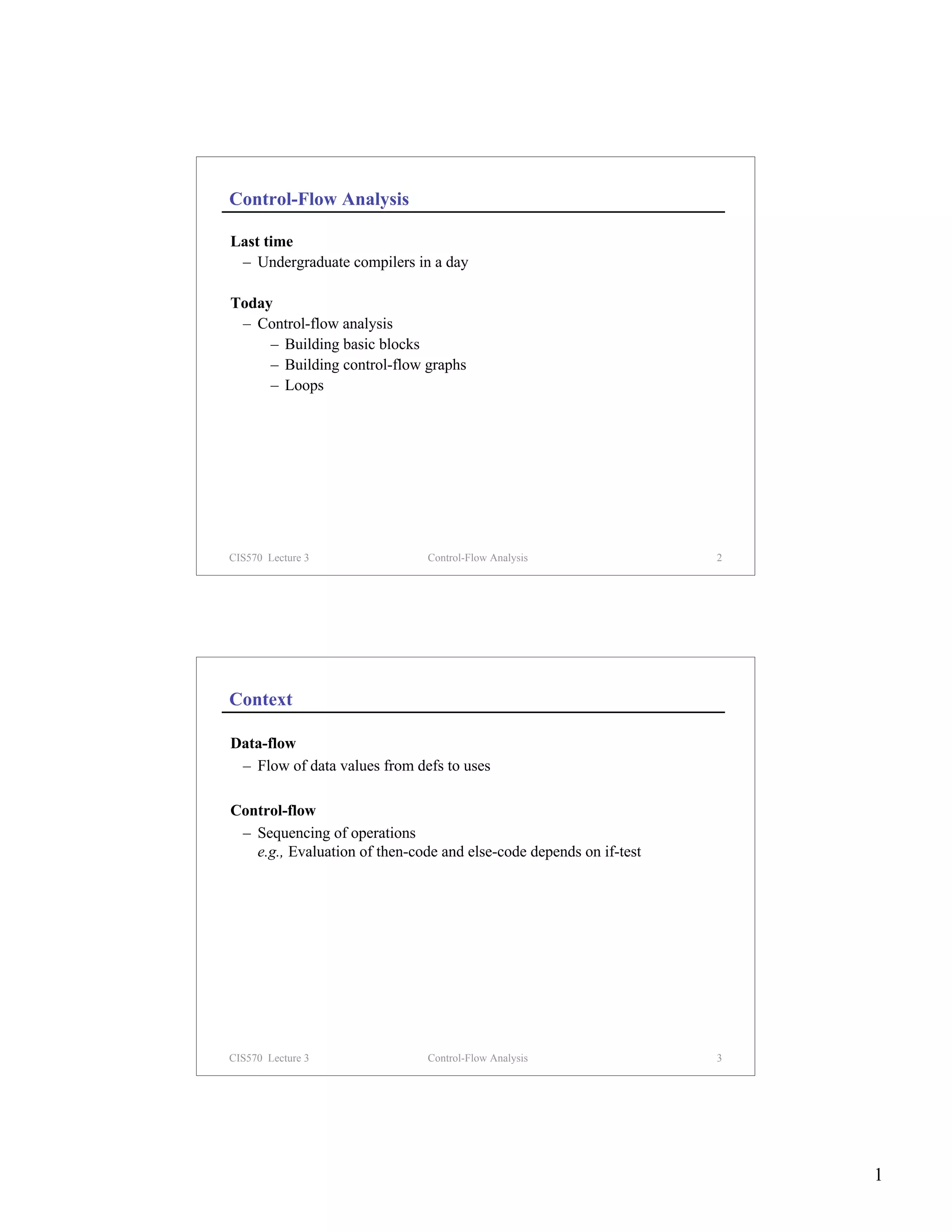
Last time
 – Undergraduate compilers in a day

Today
 – Control-flow analysis
     – Building basic blocks
     – Building control-flow graphs
     – Loops


CIS570 Lecture 3               Control-Flow Analysis                2


Context

Data-flow
 – Flow of data values from defs to uses

Control-flow
 – Sequencing of operations
   e.g., Evaluation of then-code and else-code depends on if-test


CIS570 Lecture 3               Control-Flow Analysis                3


                                                                        1
Representing Control-Flow

High-level representation
 – Control flow is implicit in an AST

Low-level representation:
 – Use a Control-flow graph (CFG)
     – Nodes represent statements (low-level linear IR)
     – Edges represent explicit flow of control

Other options
 – Control dependences in program dependence graph (PDG) [Ferrante87]
 – Dependences on explicit state in value dependence graph (VDG) [Weise 94]


CIS570 Lecture 3              Control-Flow Analysis                              4


What Is Control-Flow Analysis?

Control-flow analysis discovers the flow of control within a procedure
(e.g., builds a CFG, identifies loops)
                                                  1 a := 0
Example                                             b := a * b
1         a := 0
                                                          3    c := b/d
2         b := a *    b                                        c < x?
3    L1: c := b/d
4         if c < x    goto L2                                      5    e := b / c
5         e := b /    c                                                 f := e + 1
6         f := e +    1
7    L2: g := f                                       7   g := f
8         h := t -    g                                   h := t - g
9         if e > 0    goto L3                             e > 0?
10   goto L1                                              No             Yes
11   L3: return                         10   goto                  11   return
CIS570 Lecture 3              Control-Flow Analysis                              5


                                                                                     2
Basic Blocks

Definition
 – A basic block is a sequence of straight line code that can be entered only
    at the beginning and exited only at the end


                                g := f
                                h := t - g
                                e > 0?
                                   No   Yes
Building basic blocks
 – Identify leaders
      – The first instruction in a procedure, or
      – The target of any branch, or
      – An instruction immediately following a branch (implicit target)
 – Gobble all subsequent instructions until the next leader


CIS570 Lecture 3                  Control-Flow Analysis                         6


Algorithm for Building Basic Blocks

Input: List of n instructions (instr[i] = ith instruction)
Output: Set of leaders & list of basic blocks
        (block[x] is block with leader x)

leaders = {1}                    // First instruction is a leader
for i = 1 to n                   // Find all leaders
     if instr[i] is a branch
          leaders = leaders ∪ set of potential targets of instr[i]
foreach x ∈ leaders
     block[x] = { x }
     i = x+1                     // Fill out x’s basic block
     while i ≤ n and i ∉ leaders
          block[x] = block[x] ∪ { i }
          i=i+1


CIS570 Lecture 3                  Control-Flow Analysis                         7


                                                                                    3
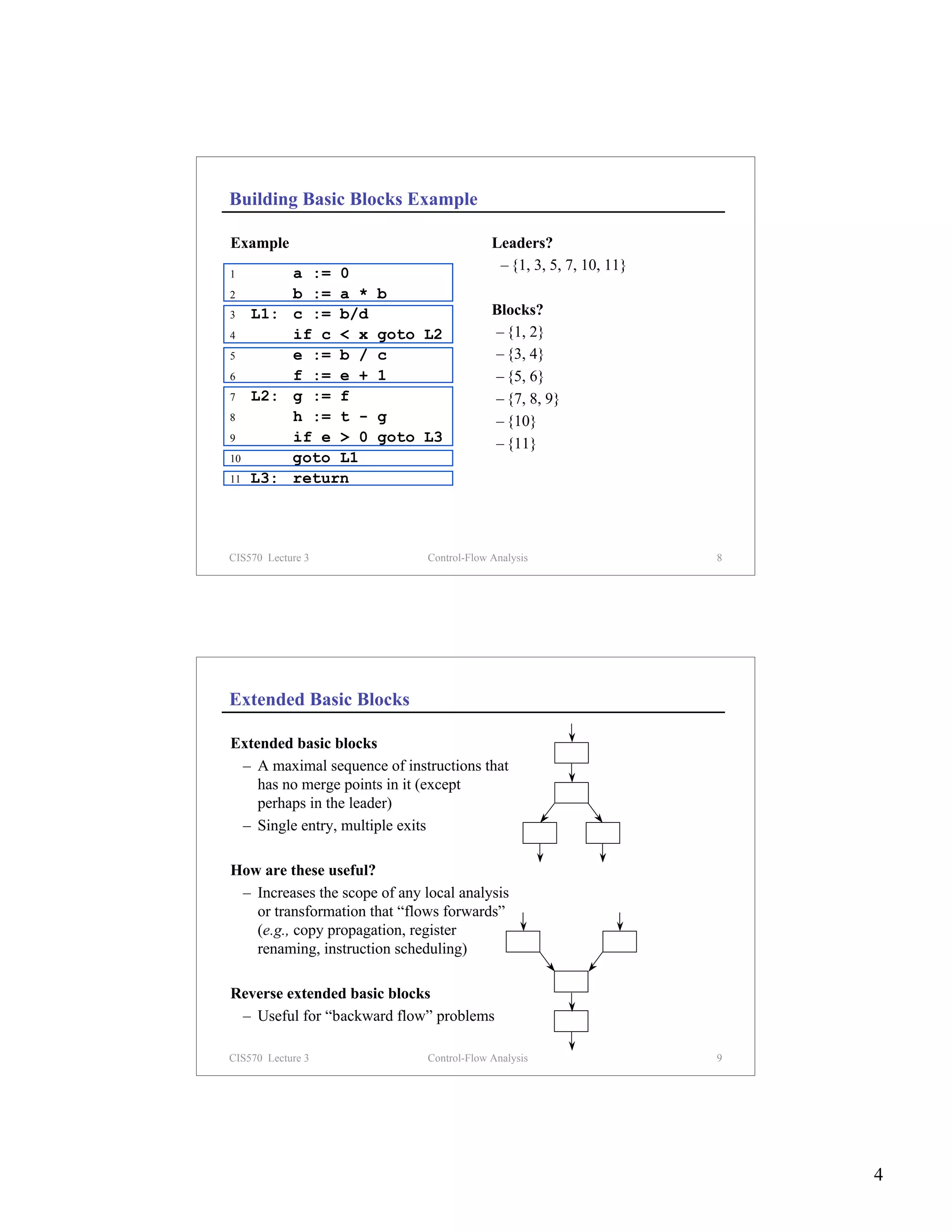
Building Basic Blocks Example

Example                                     Leaders?
1        a := 0                              – {1, 3, 5, 7, 10, 11}
2        b := a *      b
3    L1: c := b/d                           Blocks?
4        if c < x      goto L2              – {1, 2}
5        e := b /      c                    – {3, 4}
6        f := e +      1                    – {5, 6}
7    L2: g := f                             – {7, 8, 9}
8        h := t -      g                    – {10}
9        if e > 0      goto L3              – {11}
10       goto L1
11   L3: return


CIS570 Lecture 3               Control-Flow Analysis                  8


Extended Basic Blocks

Extended basic blocks
 – A maximal sequence of instructions that
    has no merge points in it (except
    perhaps in the leader)
 – Single entry, multiple exits

How are these useful?
 – Increases the scope of any local analysis
   or transformation that “flows forwards”
   (e.g., copy propagation, register
   renaming, instruction scheduling)

Reverse extended basic blocks
 – Useful for “backward flow” problems

CIS570 Lecture 3               Control-Flow Analysis                  9


                                                                          4
Building a CFG from Basic Blocks

Construction
 – Each CFG node represents a basic block
 – There is an edge from node i to j if
     – Last statement of block i branches to the first statement of j, or
     – Block i does not end with an unconditional branch and is
       immediately followed in program order by block j (fall through)
Input: A list of m basic blocks (block)
Output: A CFG where each node is a basic block1                      1
                                                          goto L1:
for i = 1 to m
     x = last instruction of block[i]                                2

     if instr x is a branch                              L1:
                                                    5
          for each target (to block j) of instr x
                create an edge from block i to block j
     if instr x is not an unconditional branch
          create an edge from block i to block i+1
CIS570 Lecture 3                 Control-Flow Analysis                      10


Details

Multiple edges between two nodes
                ...
        if (a<b) goto L2
 L2: ...
 – Combine these edges into one edge

Unreachable code
       ...                       – Perform DFS from entry node
       goto L1                   – Mark each basic block as it is visited
 L0: a = 10                      – Unmarked blocks are unreachable
 L1: ...


CIS570 Lecture 3                 Control-Flow Analysis                      11


                                                                                 5
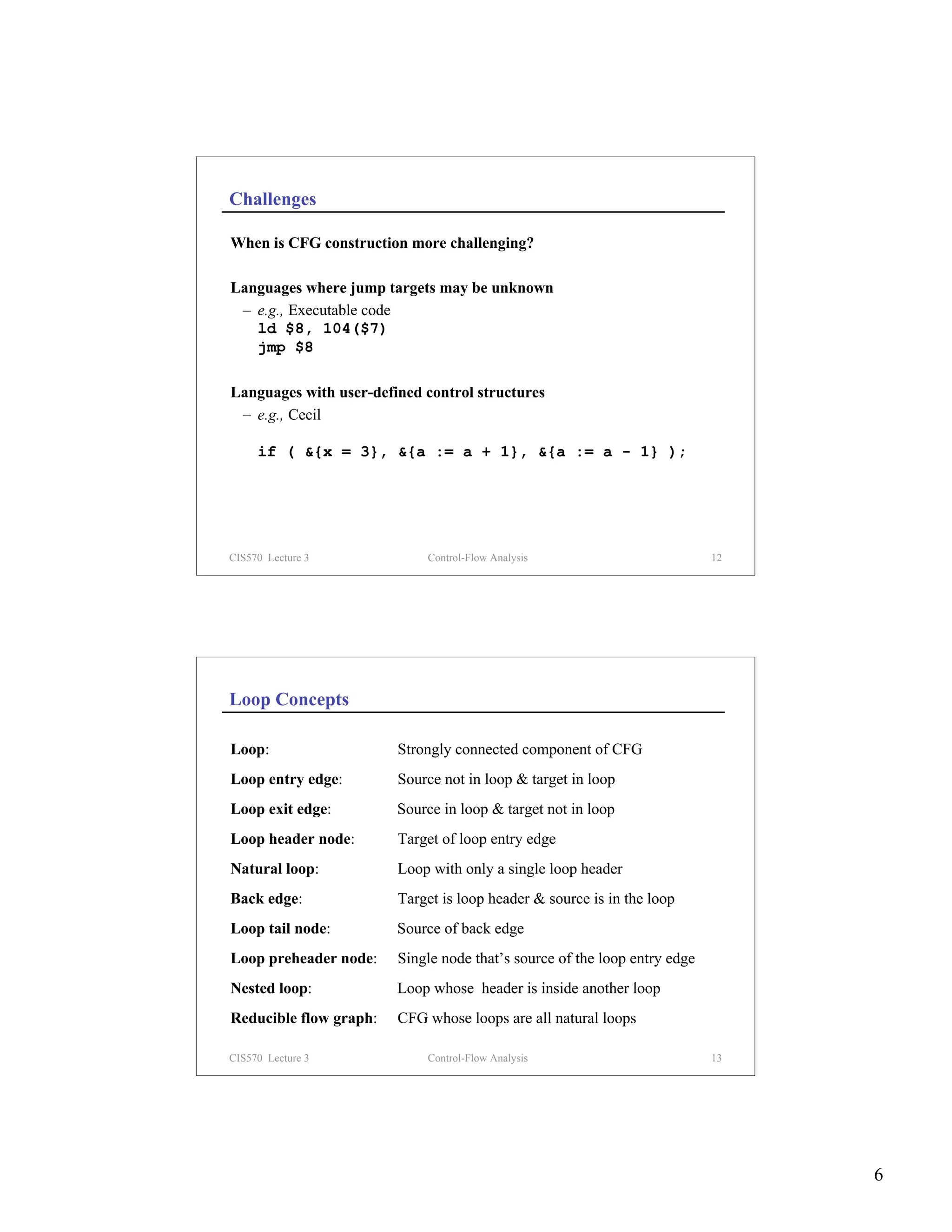
Challenges

When is CFG construction more challenging?

Languages where jump targets may be unknown
 – e.g., Executable code
   ld $8, 104($7)
   jmp $8

Languages with user-defined control structures
 – e.g., Cecil

     if ( &{x = 3}, &{a := a + 1}, &{a := a - 1} );


CIS570 Lecture 3            Control-Flow Analysis                          12


Loop Concepts

Loop:                   Strongly connected component of CFG
Loop entry edge:        Source not in loop & target in loop
Loop exit edge:         Source in loop & target not in loop
Loop header node:       Target of loop entry edge
Natural loop:           Loop with only a single loop header
Back edge:              Target is loop header & source is in the loop
Loop tail node:         Source of back edge
Loop preheader node:    Single node that’s source of the loop entry edge
Nested loop:            Loop whose header is inside another loop
Reducible flow graph:   CFG whose loops are all natural loops

CIS570 Lecture 3            Control-Flow Analysis                          13


                                                                                6
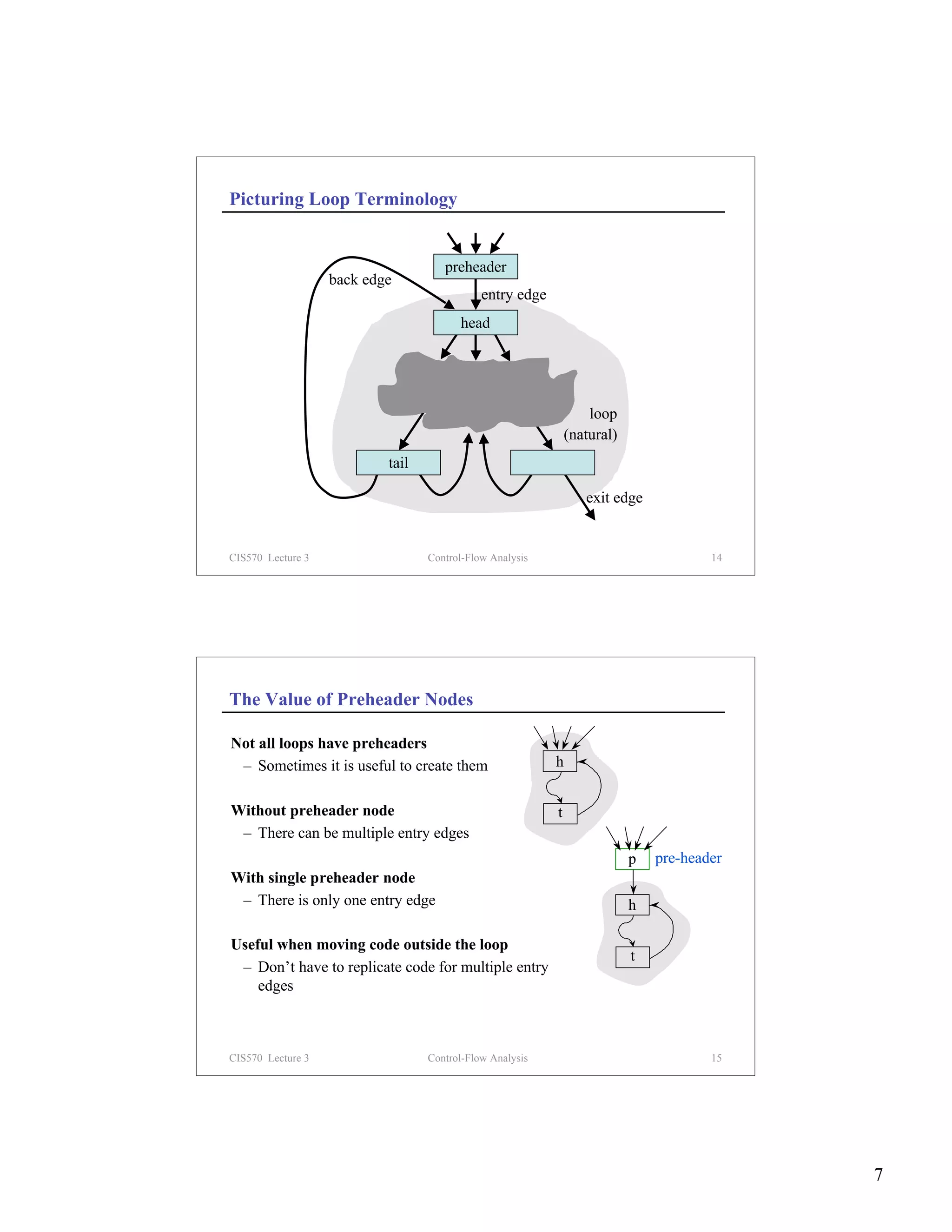
Picturing Loop Terminology


                                     preheader
                   back edge
                                             entry edge
                                        head


                                                                  loop
                                                              (natural)
                           tail

                                                                 exit edge


CIS570 Lecture 3                  Control-Flow Analysis                               14


The Value of Preheader Nodes

Not all loops have preheaders
 – Sometimes it is useful to create them                  h


Without preheader node                                    t
 – There can be multiple entry edges
                                                                          p   pre-header
With single preheader node
 – There is only one entry edge                                           h

Useful when moving code outside the loop
                                                                          t
 – Don’t have to replicate code for multiple entry
    edges


CIS570 Lecture 3                  Control-Flow Analysis                               15


                                                                                           7
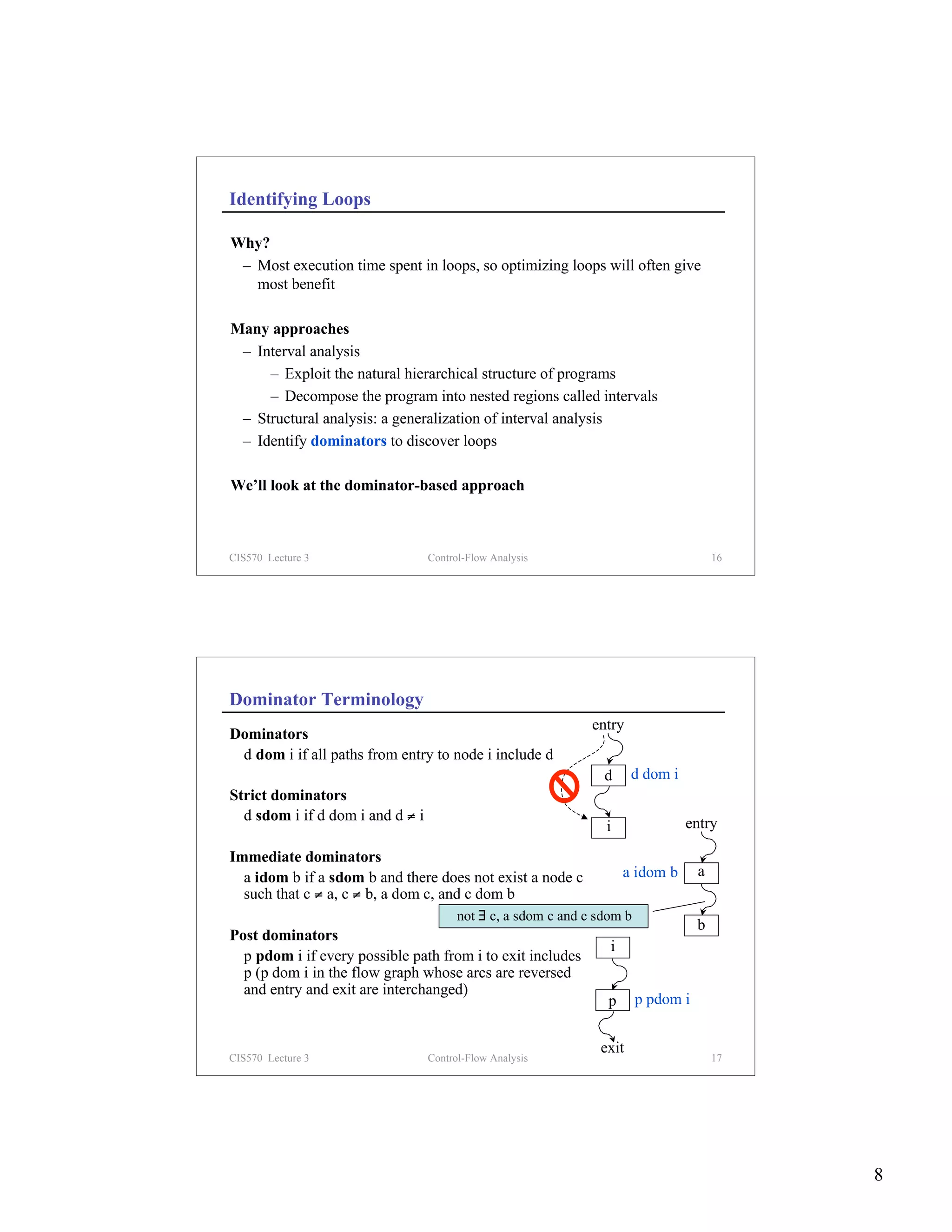
Identifying Loops

Why?
 – Most execution time spent in loops, so optimizing loops will often give
   most benefit

Many approaches
 – Interval analysis
     – Exploit the natural hierarchical structure of programs
     – Decompose the program into nested regions called intervals
 – Structural analysis: a generalization of interval analysis
 – Identify dominators to discover loops

We’ll look at the dominator-based approach


CIS570 Lecture 3                  Control-Flow Analysis                                 16


Dominator Terminology
                                                               entry
Dominators
 d dom i if all paths from entry to node i include d
                                                                 d     d dom i
Strict dominators
  d sdom i if d dom i and d ≠ i                                                  entry
                                                                 i
Immediate dominators
  a idom b if a sdom b and there does not exist a node c              a idom b      a
  such that c ≠ a, c ≠ b, a dom c, and c dom b
                                        not ∃ c, a sdom c and c sdom b
                                                                                    b
Post dominators
                                                                  i
  p pdom i if every possible path from i to exit includes
  p (p dom i in the flow graph whose arcs are reversed
  and entry and exit are interchanged)
                                                                 p       p pdom i


                                                                exit
CIS570 Lecture 3                  Control-Flow Analysis                                 17


                                                                                             8
Identifying Natural Loops with Dominators
Back edges                                                 t
 A back edge of a natural loop is one whose target                       back edge
 dominates its source
                                                           s
Natural loop
 The natural loop of a back edge (m→n), where n            n
 dominates m, is the set of nodes x such that n                          natural
 dominates x and there is a path from x to m not                          loop
 containing n                                              m
                                                                              a
                           a               The target, c, of the              b
Example
                                           edge (d→c) does not
 This loop has two         b                                                  c
                                           dominate its source, d,
 entry points,                             so (d→c) does not
 c and d              c        d                                              d
                                           define a natural loop
                               e                                              e
CIS570 Lecture 3               Control-Flow Analysis                                 18


Computing Dominators

Input: Set of nodes N (in CFG) and an entry node s
Output: Dom[i] = set of all nodes that dominate node i

Dom(s) = {s}                               Key Idea
for each n ∈ N – {s}                         If a node dominates all
     Dom[n] = N                              predecessors of node n, then it
repeat                                       also dominates node n
     change = false
     for each n ∈ N – {s}                     p1       p2     p3        pred[n]
          D = {n} ∪ (∩p∈pred(n) Dom[p])
          if D ≠ Dom[n]                                n
               change = true
               Dom[n] = D
until !change             x ∈ Dom(p ) ^ x ∈ Dom(p ) ^ x ∈ Dom(p ) ⇒ x ∈ Dom(n)
                                   1                   2             3


CIS570 Lecture 3               Control-Flow Analysis                                 19


                                                                                          9
Computing Dominators (example)

Input: Set of nodes N and an entry node s
Output: Dom[i] = set of all nodes that dominate node i         s   {s}

Dom(s) = {s}                          {n, p, q, r, s} q               r {n, p, q, r, s}
for each n ∈ N – {s}
                                                              p {n, p, q, r, s}
     Dom[n] = N
repeat                                                        n {n, p, q, r, s}
     change = false                           Initially
     for each n ∈ N – {s}                            Dom[s] = {s}
          D = {n} ∪ (∩p∈pred(n) Dom[p])              Dom[q] = {n, p, q, r, s}. . .
          if D ≠ Dom[n]                       Finally
               change = true                         Dom[q] = {q, s}
               Dom[n] = D                            Dom[r] = {r, s}
until !change                                        Dom[p] = {p, s}
                                                     Dom[n] = {n, p, s}
CIS570 Lecture 3                 Control-Flow Analysis                          20


Reducibility

Definition
 – A CFG is reducible (well-structured) if we can partition its edges into
    two disjoint sets, the forward edges and the back edges, such that
      – The forward edges form an acyclic graph in which every node can be
         reached from the entry node
      – The back edges consist only of edges whose targets dominate their
         sources
 – Non-natural loops ⇔ irreducibility
Structured control-flow constructs give rise to reducible CFGs
Value of reducibility
 – Dominance useful in identifying loops
 – Simplifies code transformations (every loop has a single header)
 – Permits interval analysis


CIS570 Lecture 3                 Control-Flow Analysis                          21


                                                                                          10
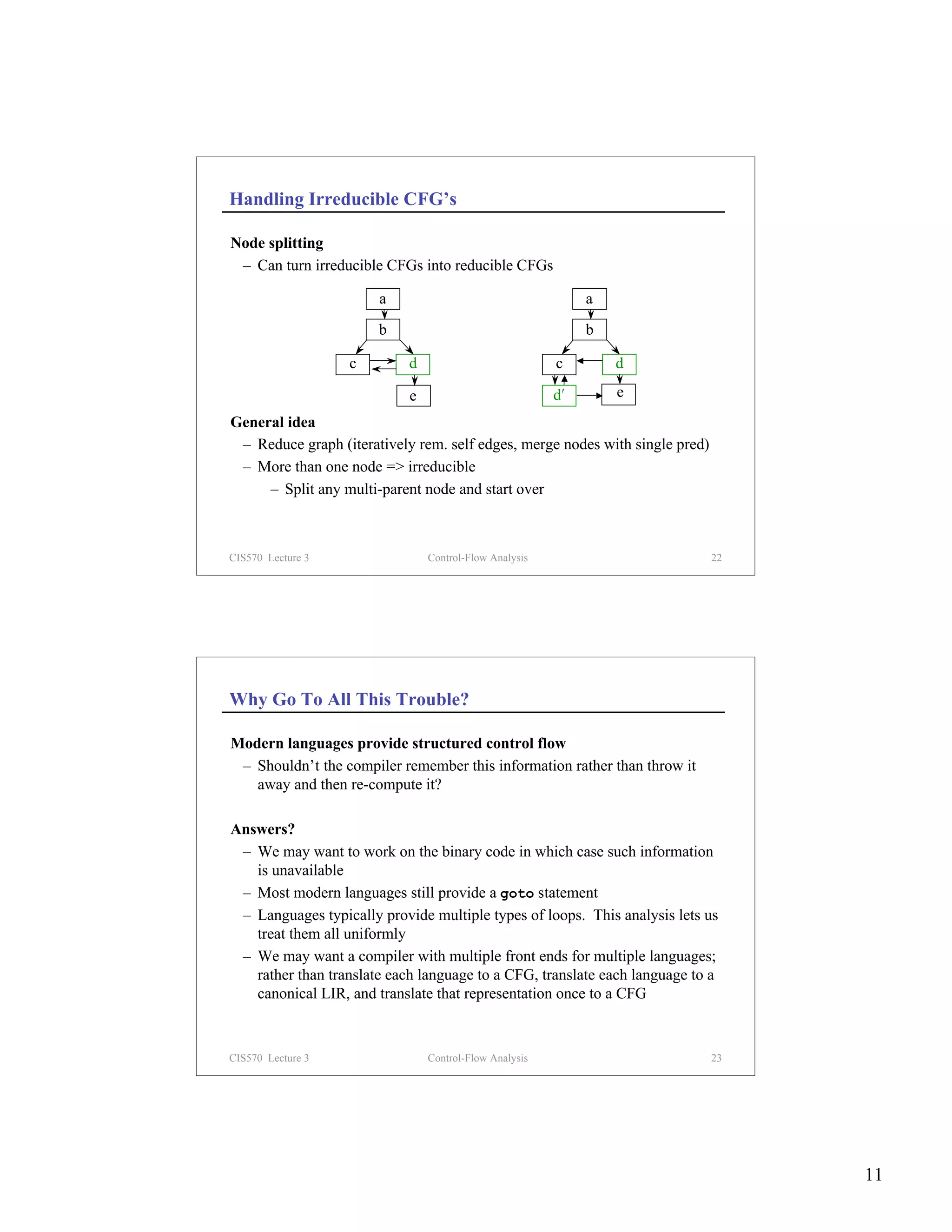
Handling Irreducible CFG’s

Node splitting
 – Can turn irreducible CFGs into reducible CFGs

                       a                                     a
                       b                                     b

                   c        d                           c        d

                            e                           d′       e
General idea
 – Reduce graph (iteratively rem. self edges, merge nodes with single pred)
 – More than one node => irreducible
     – Split any multi-parent node and start over


CIS570 Lecture 3                Control-Flow Analysis                         22


Why Go To All This Trouble?

Modern languages provide structured control flow
 – Shouldn’t the compiler remember this information rather than throw it
   away and then re-compute it?

Answers?
 – We may want to work on the binary code in which case such information
   is unavailable
 – Most modern languages still provide a goto statement
 – Languages typically provide multiple types of loops. This analysis lets us
   treat them all uniformly
 – We may want a compiler with multiple front ends for multiple languages;
   rather than translate each language to a CFG, translate each language to a
   canonical LIR, and translate that representation once to a CFG


CIS570 Lecture 3                Control-Flow Analysis                         23


                                                                                   11
Concepts

Control-flow analysis
Basic blocks
  – Computing basic blocks
  – Extended basic blocks
Control-flow graph (CFG)
Loop terminology
Identifying loops
Dominators
Reducibility


CIS570 Lecture 3               Control-Flow Analysis   24


Next Time

Discussion
 – “Binary Translation” by Sites et al.
 – Discussion questions online
 – Come prepared

After that: lecture
 – Introduction to data-flow analysis


CIS570 Lecture 3               Control-Flow Analysis   25


                                                            12

Lecture03

  • 1.
    Control-Flow Analysis Last time – Undergraduate compilers in a day Today – Control-flow analysis – Building basic blocks – Building control-flow graphs – Loops CIS570 Lecture 3 Control-Flow Analysis 2 Context Data-flow – Flow of data values from defs to uses Control-flow – Sequencing of operations e.g., Evaluation of then-code and else-code depends on if-test CIS570 Lecture 3 Control-Flow Analysis 3 1
  • 2.
    Representing Control-Flow High-level representation – Control flow is implicit in an AST Low-level representation: – Use a Control-flow graph (CFG) – Nodes represent statements (low-level linear IR) – Edges represent explicit flow of control Other options – Control dependences in program dependence graph (PDG) [Ferrante87] – Dependences on explicit state in value dependence graph (VDG) [Weise 94] CIS570 Lecture 3 Control-Flow Analysis 4 What Is Control-Flow Analysis? Control-flow analysis discovers the flow of control within a procedure (e.g., builds a CFG, identifies loops) 1 a := 0 Example b := a * b 1 a := 0 3 c := b/d 2 b := a * b c < x? 3 L1: c := b/d 4 if c < x goto L2 5 e := b / c 5 e := b / c f := e + 1 6 f := e + 1 7 L2: g := f 7 g := f 8 h := t - g h := t - g 9 if e > 0 goto L3 e > 0? 10 goto L1 No Yes 11 L3: return 10 goto 11 return CIS570 Lecture 3 Control-Flow Analysis 5 2
  • 3.
    Basic Blocks Definition –A basic block is a sequence of straight line code that can be entered only at the beginning and exited only at the end g := f h := t - g e > 0? No Yes Building basic blocks – Identify leaders – The first instruction in a procedure, or – The target of any branch, or – An instruction immediately following a branch (implicit target) – Gobble all subsequent instructions until the next leader CIS570 Lecture 3 Control-Flow Analysis 6 Algorithm for Building Basic Blocks Input: List of n instructions (instr[i] = ith instruction) Output: Set of leaders & list of basic blocks (block[x] is block with leader x) leaders = {1} // First instruction is a leader for i = 1 to n // Find all leaders if instr[i] is a branch leaders = leaders ∪ set of potential targets of instr[i] foreach x ∈ leaders block[x] = { x } i = x+1 // Fill out x’s basic block while i ≤ n and i ∉ leaders block[x] = block[x] ∪ { i } i=i+1 CIS570 Lecture 3 Control-Flow Analysis 7 3
  • 4.
    Building Basic BlocksExample Example Leaders? 1 a := 0 – {1, 3, 5, 7, 10, 11} 2 b := a * b 3 L1: c := b/d Blocks? 4 if c < x goto L2 – {1, 2} 5 e := b / c – {3, 4} 6 f := e + 1 – {5, 6} 7 L2: g := f – {7, 8, 9} 8 h := t - g – {10} 9 if e > 0 goto L3 – {11} 10 goto L1 11 L3: return CIS570 Lecture 3 Control-Flow Analysis 8 Extended Basic Blocks Extended basic blocks – A maximal sequence of instructions that has no merge points in it (except perhaps in the leader) – Single entry, multiple exits How are these useful? – Increases the scope of any local analysis or transformation that “flows forwards” (e.g., copy propagation, register renaming, instruction scheduling) Reverse extended basic blocks – Useful for “backward flow” problems CIS570 Lecture 3 Control-Flow Analysis 9 4
  • 5.
    Building a CFGfrom Basic Blocks Construction – Each CFG node represents a basic block – There is an edge from node i to j if – Last statement of block i branches to the first statement of j, or – Block i does not end with an unconditional branch and is immediately followed in program order by block j (fall through) Input: A list of m basic blocks (block) Output: A CFG where each node is a basic block1 1 goto L1: for i = 1 to m x = last instruction of block[i] 2 if instr x is a branch L1: 5 for each target (to block j) of instr x create an edge from block i to block j if instr x is not an unconditional branch create an edge from block i to block i+1 CIS570 Lecture 3 Control-Flow Analysis 10 Details Multiple edges between two nodes ... if (a<b) goto L2 L2: ... – Combine these edges into one edge Unreachable code ... – Perform DFS from entry node goto L1 – Mark each basic block as it is visited L0: a = 10 – Unmarked blocks are unreachable L1: ... CIS570 Lecture 3 Control-Flow Analysis 11 5
  • 6.
    Challenges When is CFGconstruction more challenging? Languages where jump targets may be unknown – e.g., Executable code ld $8, 104($7) jmp $8 Languages with user-defined control structures – e.g., Cecil if ( &{x = 3}, &{a := a + 1}, &{a := a - 1} ); CIS570 Lecture 3 Control-Flow Analysis 12 Loop Concepts Loop: Strongly connected component of CFG Loop entry edge: Source not in loop & target in loop Loop exit edge: Source in loop & target not in loop Loop header node: Target of loop entry edge Natural loop: Loop with only a single loop header Back edge: Target is loop header & source is in the loop Loop tail node: Source of back edge Loop preheader node: Single node that’s source of the loop entry edge Nested loop: Loop whose header is inside another loop Reducible flow graph: CFG whose loops are all natural loops CIS570 Lecture 3 Control-Flow Analysis 13 6
  • 7.
    Picturing Loop Terminology preheader back edge entry edge head loop (natural) tail exit edge CIS570 Lecture 3 Control-Flow Analysis 14 The Value of Preheader Nodes Not all loops have preheaders – Sometimes it is useful to create them h Without preheader node t – There can be multiple entry edges p pre-header With single preheader node – There is only one entry edge h Useful when moving code outside the loop t – Don’t have to replicate code for multiple entry edges CIS570 Lecture 3 Control-Flow Analysis 15 7
  • 8.
    Identifying Loops Why? –Most execution time spent in loops, so optimizing loops will often give most benefit Many approaches – Interval analysis – Exploit the natural hierarchical structure of programs – Decompose the program into nested regions called intervals – Structural analysis: a generalization of interval analysis – Identify dominators to discover loops We’ll look at the dominator-based approach CIS570 Lecture 3 Control-Flow Analysis 16 Dominator Terminology entry Dominators d dom i if all paths from entry to node i include d d d dom i Strict dominators d sdom i if d dom i and d ≠ i entry i Immediate dominators a idom b if a sdom b and there does not exist a node c a idom b a such that c ≠ a, c ≠ b, a dom c, and c dom b not ∃ c, a sdom c and c sdom b b Post dominators i p pdom i if every possible path from i to exit includes p (p dom i in the flow graph whose arcs are reversed and entry and exit are interchanged) p p pdom i exit CIS570 Lecture 3 Control-Flow Analysis 17 8
  • 9.
    Identifying Natural Loopswith Dominators Back edges t A back edge of a natural loop is one whose target back edge dominates its source s Natural loop The natural loop of a back edge (m→n), where n n dominates m, is the set of nodes x such that n natural dominates x and there is a path from x to m not loop containing n m a a The target, c, of the b Example edge (d→c) does not This loop has two b c dominate its source, d, entry points, so (d→c) does not c and d c d d define a natural loop e e CIS570 Lecture 3 Control-Flow Analysis 18 Computing Dominators Input: Set of nodes N (in CFG) and an entry node s Output: Dom[i] = set of all nodes that dominate node i Dom(s) = {s} Key Idea for each n ∈ N – {s} If a node dominates all Dom[n] = N predecessors of node n, then it repeat also dominates node n change = false for each n ∈ N – {s} p1 p2 p3 pred[n] D = {n} ∪ (∩p∈pred(n) Dom[p]) if D ≠ Dom[n] n change = true Dom[n] = D until !change x ∈ Dom(p ) ^ x ∈ Dom(p ) ^ x ∈ Dom(p ) ⇒ x ∈ Dom(n) 1 2 3 CIS570 Lecture 3 Control-Flow Analysis 19 9
  • 10.
    Computing Dominators (example) Input:Set of nodes N and an entry node s Output: Dom[i] = set of all nodes that dominate node i s {s} Dom(s) = {s} {n, p, q, r, s} q r {n, p, q, r, s} for each n ∈ N – {s} p {n, p, q, r, s} Dom[n] = N repeat n {n, p, q, r, s} change = false Initially for each n ∈ N – {s} Dom[s] = {s} D = {n} ∪ (∩p∈pred(n) Dom[p]) Dom[q] = {n, p, q, r, s}. . . if D ≠ Dom[n] Finally change = true Dom[q] = {q, s} Dom[n] = D Dom[r] = {r, s} until !change Dom[p] = {p, s} Dom[n] = {n, p, s} CIS570 Lecture 3 Control-Flow Analysis 20 Reducibility Definition – A CFG is reducible (well-structured) if we can partition its edges into two disjoint sets, the forward edges and the back edges, such that – The forward edges form an acyclic graph in which every node can be reached from the entry node – The back edges consist only of edges whose targets dominate their sources – Non-natural loops ⇔ irreducibility Structured control-flow constructs give rise to reducible CFGs Value of reducibility – Dominance useful in identifying loops – Simplifies code transformations (every loop has a single header) – Permits interval analysis CIS570 Lecture 3 Control-Flow Analysis 21 10
  • 11.
    Handling Irreducible CFG’s Nodesplitting – Can turn irreducible CFGs into reducible CFGs a a b b c d c d e d′ e General idea – Reduce graph (iteratively rem. self edges, merge nodes with single pred) – More than one node => irreducible – Split any multi-parent node and start over CIS570 Lecture 3 Control-Flow Analysis 22 Why Go To All This Trouble? Modern languages provide structured control flow – Shouldn’t the compiler remember this information rather than throw it away and then re-compute it? Answers? – We may want to work on the binary code in which case such information is unavailable – Most modern languages still provide a goto statement – Languages typically provide multiple types of loops. This analysis lets us treat them all uniformly – We may want a compiler with multiple front ends for multiple languages; rather than translate each language to a CFG, translate each language to a canonical LIR, and translate that representation once to a CFG CIS570 Lecture 3 Control-Flow Analysis 23 11
  • 12.
    Concepts Control-flow analysis Basic blocks – Computing basic blocks – Extended basic blocks Control-flow graph (CFG) Loop terminology Identifying loops Dominators Reducibility CIS570 Lecture 3 Control-Flow Analysis 24 Next Time Discussion – “Binary Translation” by Sites et al. – Discussion questions online – Come prepared After that: lecture – Introduction to data-flow analysis CIS570 Lecture 3 Control-Flow Analysis 25 12