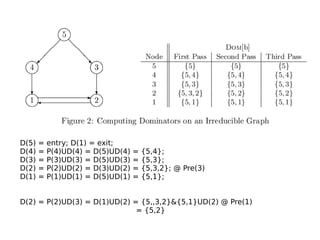
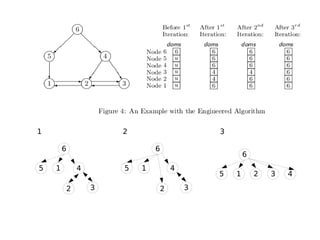
D(5) = entry; D(1) = exit; D(4) = P(4)UD(4) = D(5)UD(4) = {5,4}; D(3) = P(3)UD(3) = D(5)UD(3) = {5,3}; D(2) = P(2)UD(2) = D(3)UD(2) = {5,3,2}; @ Pre(3) D(1) = P(1)UD(1) = D(5)UD(1) = {5,1}; D(2) = P(2)UD(3) = D(1)UD(2) = {5,,3,2}&{5,1}UD(2) @ Pre(1) = {5,2}
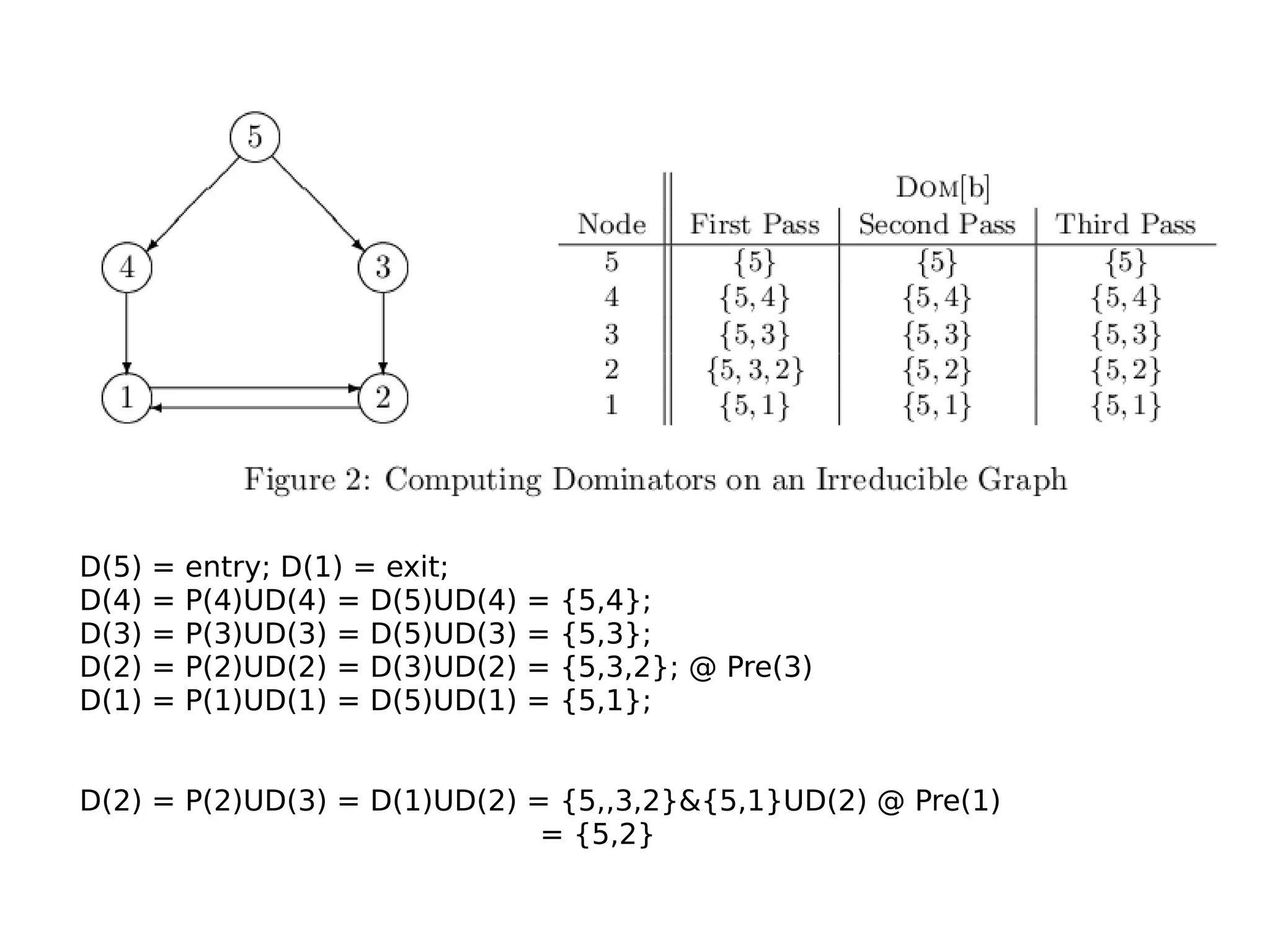
Post dominator tree pre order  {3,4,5,2,1} post_order  {1,4,5,2,3} Dominator tree pre order  {5,1,2,3,4}  post order {1,2,3,4,5} Feedback cut @ 1 5 1 3 2 4 5 1 3 3 2 4 2
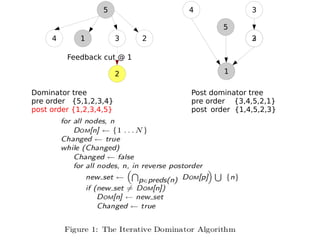
A Simple, Fast Dominance Algorithm
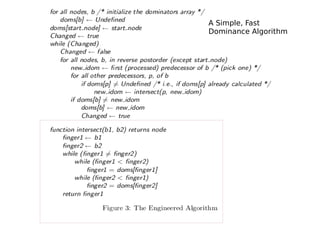
1 2 3 6 5 1 2 3 4 6 5 1 2 3 4 6 5 1 2 3 4
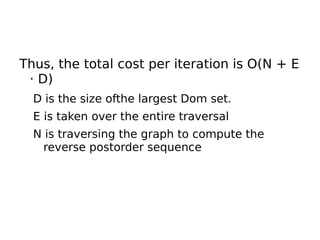
Thus, the total cost per iteration is O(N + E · D)  D is the size ofthe largest Dom set.

Dominator tree

  • 1.
    D(5) = entry;D(1) = exit; D(4) = P(4)UD(4) = D(5)UD(4) = {5,4}; D(3) = P(3)UD(3) = D(5)UD(3) = {5,3}; D(2) = P(2)UD(2) = D(3)UD(2) = {5,3,2}; @ Pre(3) D(1) = P(1)UD(1) = D(5)UD(1) = {5,1}; D(2) = P(2)UD(3) = D(1)UD(2) = {5,,3,2}&{5,1}UD(2) @ Pre(1) = {5,2}
  • 2.
    Post dominator treepre order {3,4,5,2,1} post_order {1,4,5,2,3} Dominator tree pre order {5,1,2,3,4} post order {1,2,3,4,5} Feedback cut @ 1 5 1 3 2 4 5 1 3 3 2 4 2
  • 3.
    A Simple, FastDominance Algorithm
  • 4.
    1 2 36 5 1 2 3 4 6 5 1 2 3 4 6 5 1 2 3 4
  • 5.
    Thus, the totalcost per iteration is O(N + E · D) D is the size ofthe largest Dom set.
  • 6.
    E is takenover the entire traversal
  • 7.
    N is traversingthe graph to compute the reverse postorder sequence