Code Optimization
Prepared By:
Prabhat Shukla
Basic Blocks
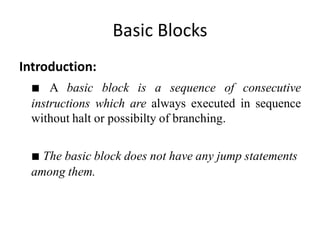
Introduction:
■ A basic block is a sequence of consecutive
instructions which are always executed in sequence
without halt or possibilty of branching.
■ The basic block does not have any jump statements
among them.
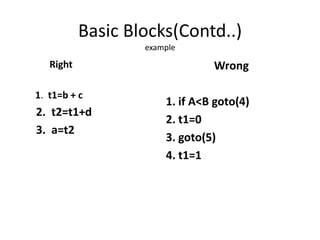
Basic Blocks(Contd..)
example
Wrong
1. if A<B goto(4)
2. t1=0
3. goto(5)
4. t1=1
Right
1. t1=b + c
2. t2=t1+d
3. a=t2
Algorithms
1. Determine the set of leaders,
a. The first statement is the leader.
b. Any statement that is the target of
a conditional or goto is a leader.
c. Any statement that immediately
follows conditional or goto is a
leader.
2. For each leader, its basic block
consist of the leader and all
statements up to but not including
the next leader or the end of the
program
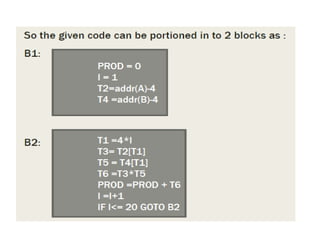
Consider the following three address
code statements .Compute the basic
blocks.
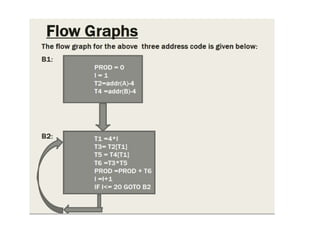
1) PROD = 0
2) I = 1
3) T2=addr(A)-4
4) T4 =addr(B)-4
5) T1 =4*I
6) T3= T2[T1]
7) T5 = T4[T1]
8) T6 =T3*T5
9) PROD =PROD + T6
10) I =I+1
11) IF I<= 20 GOTO (5)
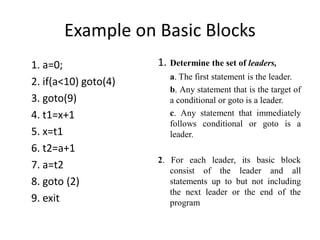
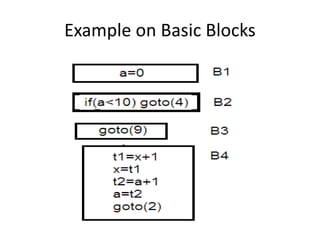
Example on Basic Blocks
1. a=0;
2. if(a<10) goto(4)
3. goto(9)
4. t1=x+1
5. x=t1
6. t2=a+1
7. a=t2
8. goto (2)
9. exit
1. Determine the set of leaders,
a. The first statement is the leader.
b. Any statement that is the target of
a conditional or goto is a leader.
c. Any statement that immediately
follows conditional or goto is a
leader.
2. For each leader, its basic block
consist of the leader and all
statements up to but not including
the next leader or the end of the
program
Example on Basic Blocks
Flow Graph
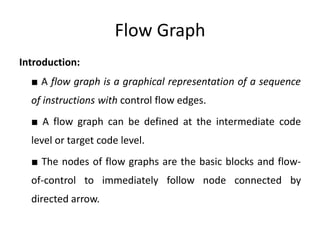
Introduction:
■ A flow graph is a graphical representation of a sequence
of instructions with control flow edges.
■ A flow graph can be defined at the intermediate code
level or target code level.
■ The nodes of flow graphs are the basic blocks and flow-
of-control to immediately follow node connected by
directed arrow.
Rules
■ The basic blocks are the nodes to the flow
graph .
■ The block whose leader is the first
statement is called initial block.
■ There is a directed edge from block B1 to B2
if B2 immediately follows B1 in the given
sequence
■ Then we say that B1 is the predecessor of
B2.
Directed Acyclic Graph(DAG)
Definition:-
In compiler design, a directed acyclic graph is
an abstract syntax tree with a unique node for
each value
Use of DAG for optimizing basic blocks
 DAG is a useful data structure for implementing
transformations on basic blocks.
 A basic block can be optimized by the
construction of DAG.
 A DAG can be constructed for a block and certain
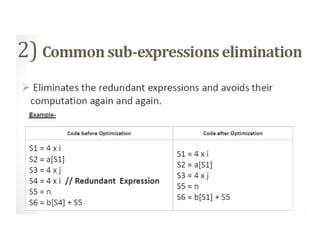
transformations such as common subexpression
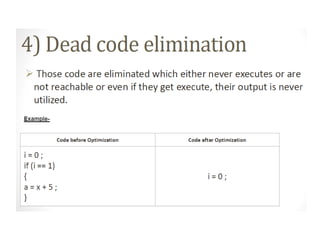
elimination and dead code elimination can be
applied for performing the local optimization
Application of DAG
 Determining common subexpression
 Determining which name are used in the block
and computed outside the block
 Determining which statements of the block
could have their computed value outside the
block
Rules for construction of DAG
1. In a DAG
a. Leaf nodes represent identifiers, name or constants.
b. Interior nodes represent operators
2. while constructing DAG, there is a check made to find if
there is an existing node with same children. A new node
is created only when such a node does not exist. This
action allows us to detect common sub-expression .
2. The assignment of the form x=y must not be performed
until and unless it is a must.
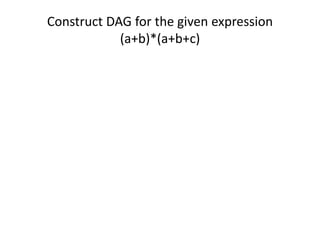
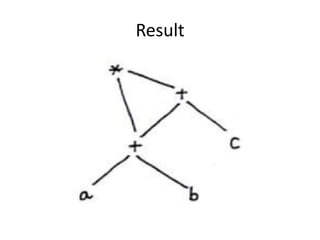
Construct DAG for the given expression
(a+b)*(a+b+c)
Result
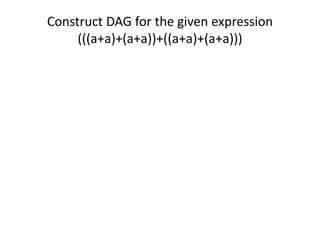
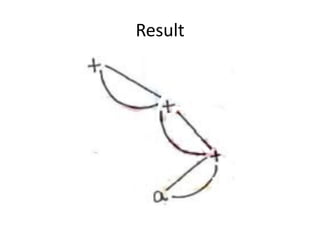
Construct DAG for the given expression
(((a+a)+(a+a))+((a+a)+(a+a)))
Result
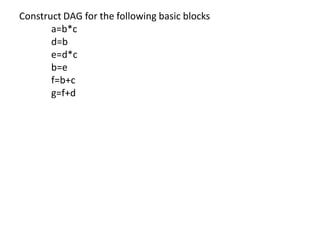
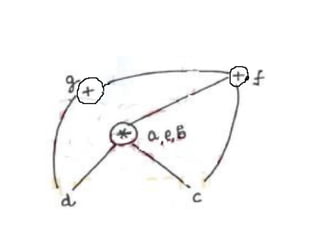
Construct DAG for the following basic blocks
a=b*c
d=b
e=d*c
b=e
f=b+c
g=f+d
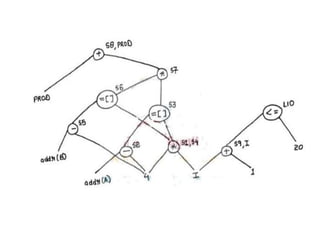
Draw the DAG representation of
following code
1. s1=4*I
2. s2=addr(A)-4
3. s3=s2[s1]
4. s4=4*I
5. s5=addr(B)-4
6. s6=s5[s4]
7. s7=s3*s6
8. s8= PROD+s7
9. PROD=s8
10. s9=I+1
11. I=s9
12. if I<=20 goto(1)
Code optimization lecture

Code optimization lecture

  • 1.
  • 11.
    Basic Blocks Introduction: ■ Abasic block is a sequence of consecutive instructions which are always executed in sequence without halt or possibilty of branching. ■ The basic block does not have any jump statements among them.
  • 12.
    Basic Blocks(Contd..) example Wrong 1. ifA<B goto(4) 2. t1=0 3. goto(5) 4. t1=1 Right 1. t1=b + c 2. t2=t1+d 3. a=t2
  • 13.
    Algorithms 1. Determine theset of leaders, a. The first statement is the leader. b. Any statement that is the target of a conditional or goto is a leader. c. Any statement that immediately follows conditional or goto is a leader. 2. For each leader, its basic block consist of the leader and all statements up to but not including the next leader or the end of the program Consider the following three address code statements .Compute the basic blocks. 1) PROD = 0 2) I = 1 3) T2=addr(A)-4 4) T4 =addr(B)-4 5) T1 =4*I 6) T3= T2[T1] 7) T5 = T4[T1] 8) T6 =T3*T5 9) PROD =PROD + T6 10) I =I+1 11) IF I<= 20 GOTO (5)
  • 15.
    Example on BasicBlocks 1. a=0; 2. if(a<10) goto(4) 3. goto(9) 4. t1=x+1 5. x=t1 6. t2=a+1 7. a=t2 8. goto (2) 9. exit 1. Determine the set of leaders, a. The first statement is the leader. b. Any statement that is the target of a conditional or goto is a leader. c. Any statement that immediately follows conditional or goto is a leader. 2. For each leader, its basic block consist of the leader and all statements up to but not including the next leader or the end of the program
  • 16.
  • 17.
    Flow Graph Introduction: ■ Aflow graph is a graphical representation of a sequence of instructions with control flow edges. ■ A flow graph can be defined at the intermediate code level or target code level. ■ The nodes of flow graphs are the basic blocks and flow- of-control to immediately follow node connected by directed arrow.
  • 18.
    Rules ■ The basicblocks are the nodes to the flow graph . ■ The block whose leader is the first statement is called initial block. ■ There is a directed edge from block B1 to B2 if B2 immediately follows B1 in the given sequence ■ Then we say that B1 is the predecessor of B2.
  • 20.
    Directed Acyclic Graph(DAG) Definition:- Incompiler design, a directed acyclic graph is an abstract syntax tree with a unique node for each value
  • 21.
    Use of DAGfor optimizing basic blocks  DAG is a useful data structure for implementing transformations on basic blocks.  A basic block can be optimized by the construction of DAG.  A DAG can be constructed for a block and certain transformations such as common subexpression elimination and dead code elimination can be applied for performing the local optimization
  • 22.
    Application of DAG Determining common subexpression  Determining which name are used in the block and computed outside the block  Determining which statements of the block could have their computed value outside the block
  • 23.
    Rules for constructionof DAG 1. In a DAG a. Leaf nodes represent identifiers, name or constants. b. Interior nodes represent operators 2. while constructing DAG, there is a check made to find if there is an existing node with same children. A new node is created only when such a node does not exist. This action allows us to detect common sub-expression . 2. The assignment of the form x=y must not be performed until and unless it is a must.
  • 24.
    Construct DAG forthe given expression (a+b)*(a+b+c)
  • 25.
  • 26.
    Construct DAG forthe given expression (((a+a)+(a+a))+((a+a)+(a+a)))
  • 27.
  • 28.
    Construct DAG forthe following basic blocks a=b*c d=b e=d*c b=e f=b+c g=f+d
  • 30.
    Draw the DAGrepresentation of following code 1. s1=4*I 2. s2=addr(A)-4 3. s3=s2[s1] 4. s4=4*I 5. s5=addr(B)-4 6. s6=s5[s4] 7. s7=s3*s6 8. s8= PROD+s7 9. PROD=s8 10. s9=I+1 11. I=s9 12. if I<=20 goto(1)