Statistics One
Lecture 14
Mediation
1
Two segments
•  Standard approach
•  Path analysis

2
Lecture 14 ~ Segment 1
Mediation: Standard approach

3
Mediation
•  Mediation and moderation may sounds alike
but they are quite different
–  Moderation (Lecture 13)
–  Mediation (Lecture 14)
–  Both demonstrated in R (Lab 7)

4
Mediation
Mediator	


5
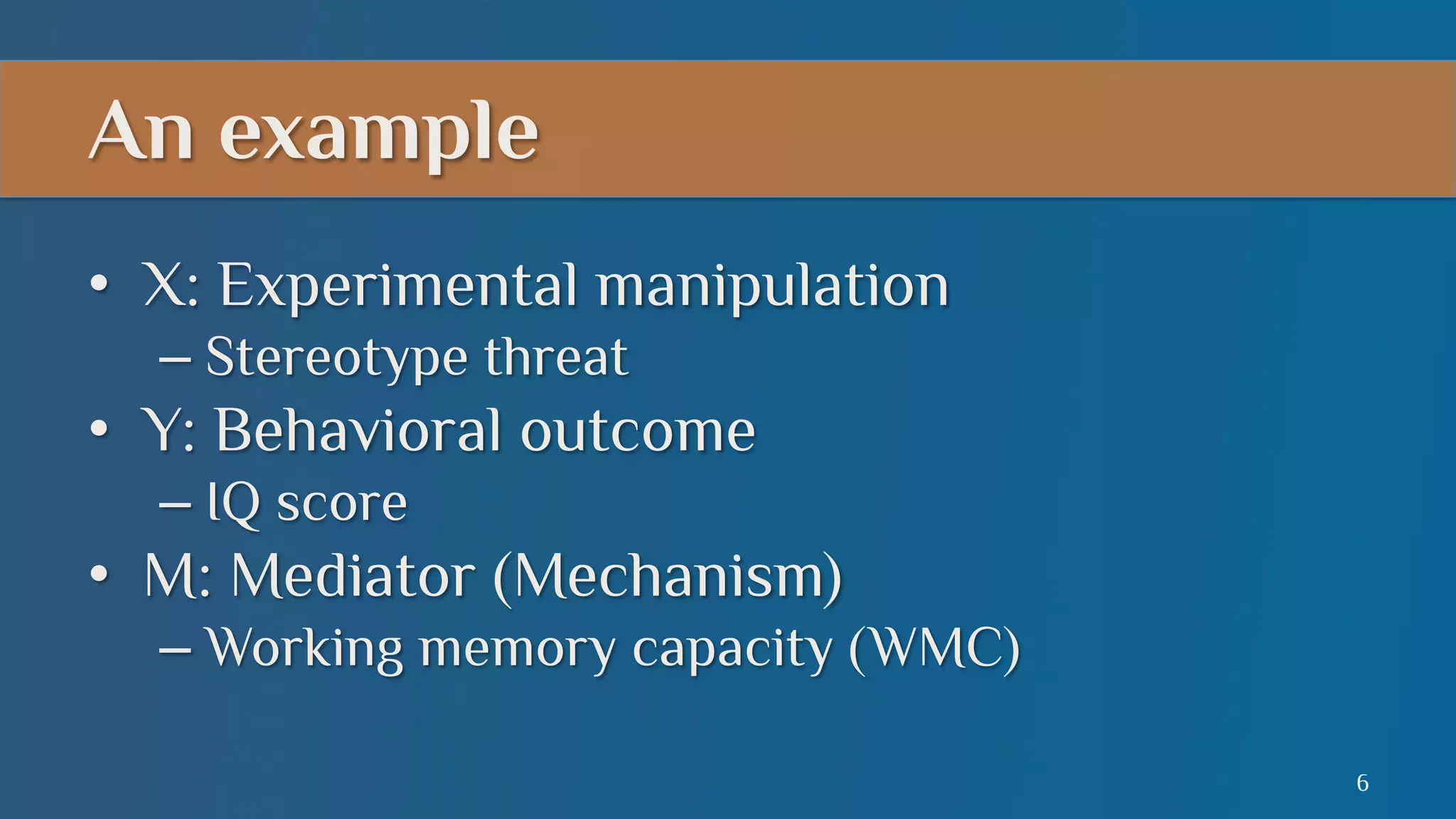
An example
•  X: Experimental manipulation
–  Stereotype threat

•  Y: Behavioral outcome
–  IQ score

•  M: Mediator (Mechanism)
–  Working memory capacity (WMC)
6
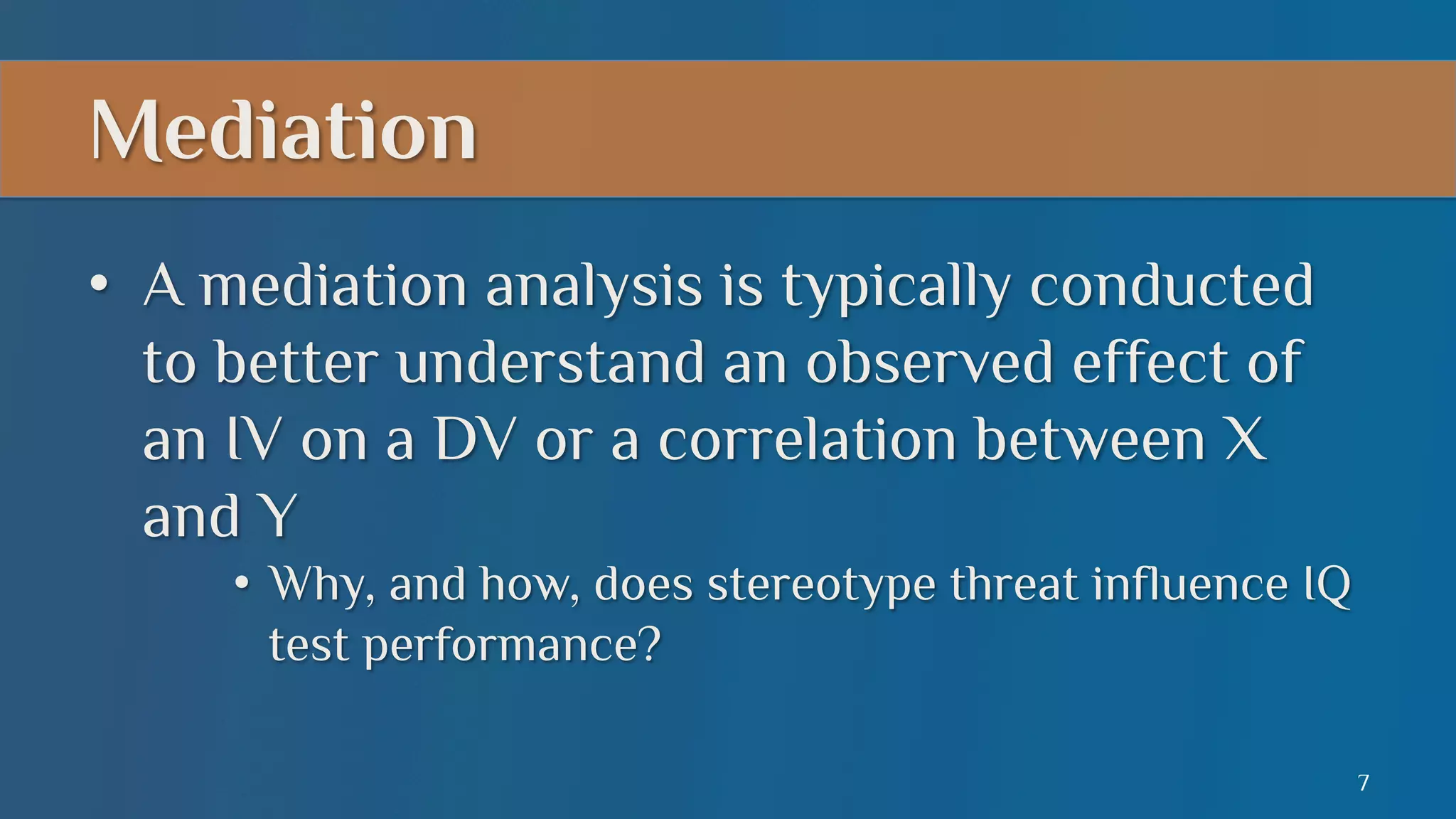
Mediation
•  A mediation analysis is typically conducted
to better understand an observed effect of
an IV on a DV or a correlation between X
and Y
•  Why, and how, does stereotype threat influence IQ
test performance?
7
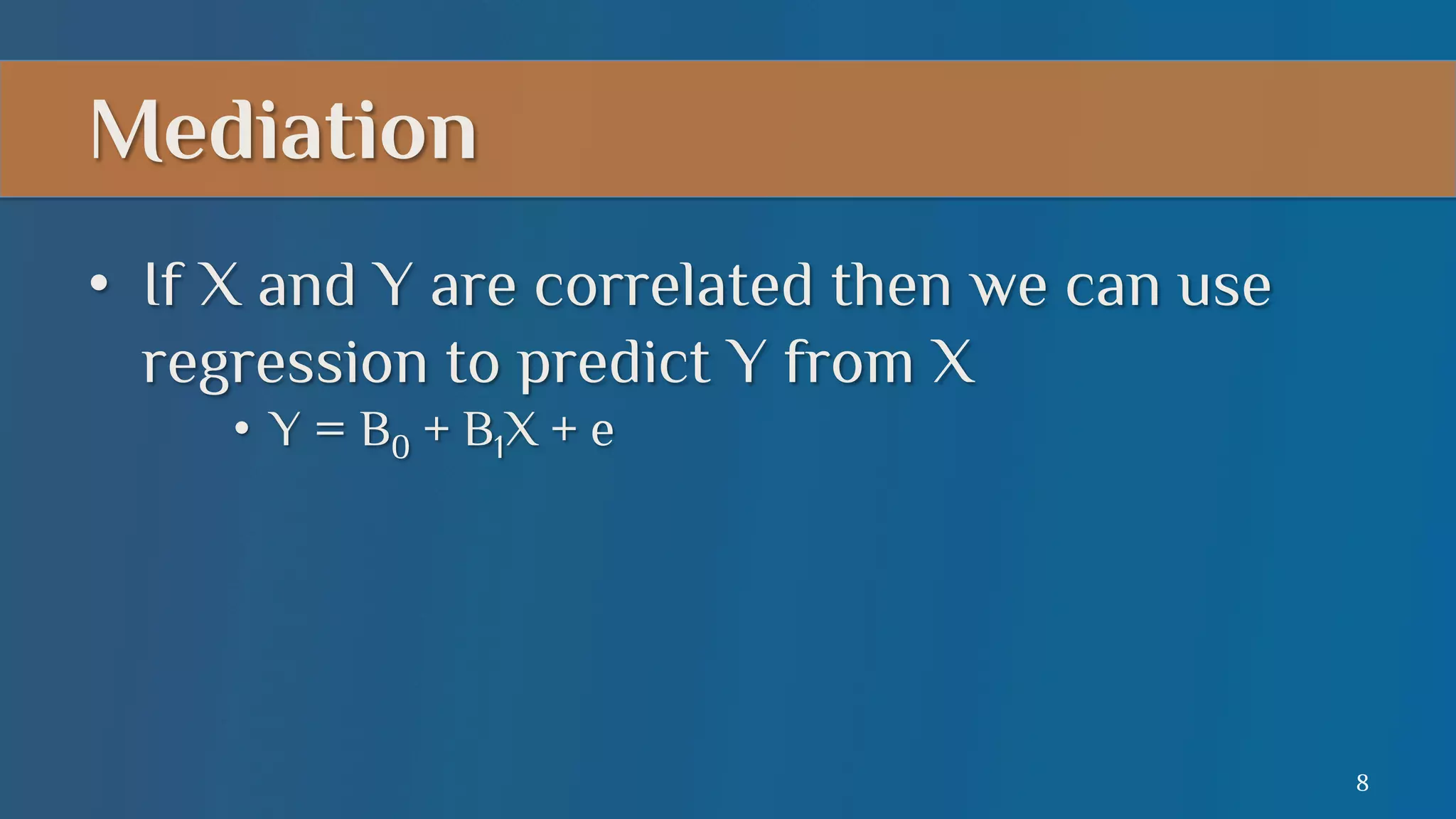
Mediation
•  If X and Y are correlated then we can use
regression to predict Y from X
•  Y = B0 + B1X + e

8
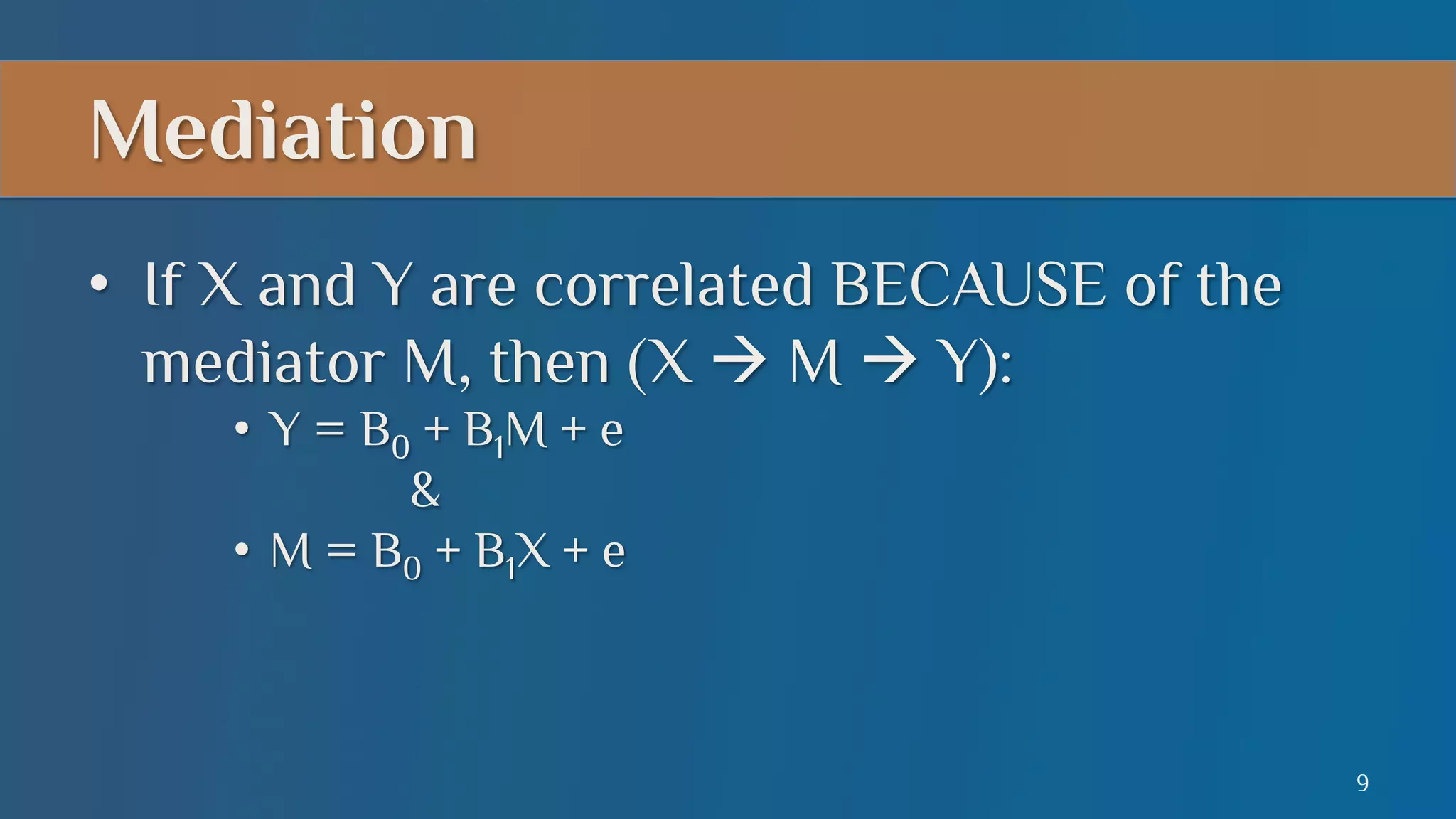
Mediation
•  If X and Y are correlated BECAUSE of the
mediator M, then (X à M à Y):
•  Y = B0 + B1M + e
&
•  M = B0 + B1X + e

9
Mediation
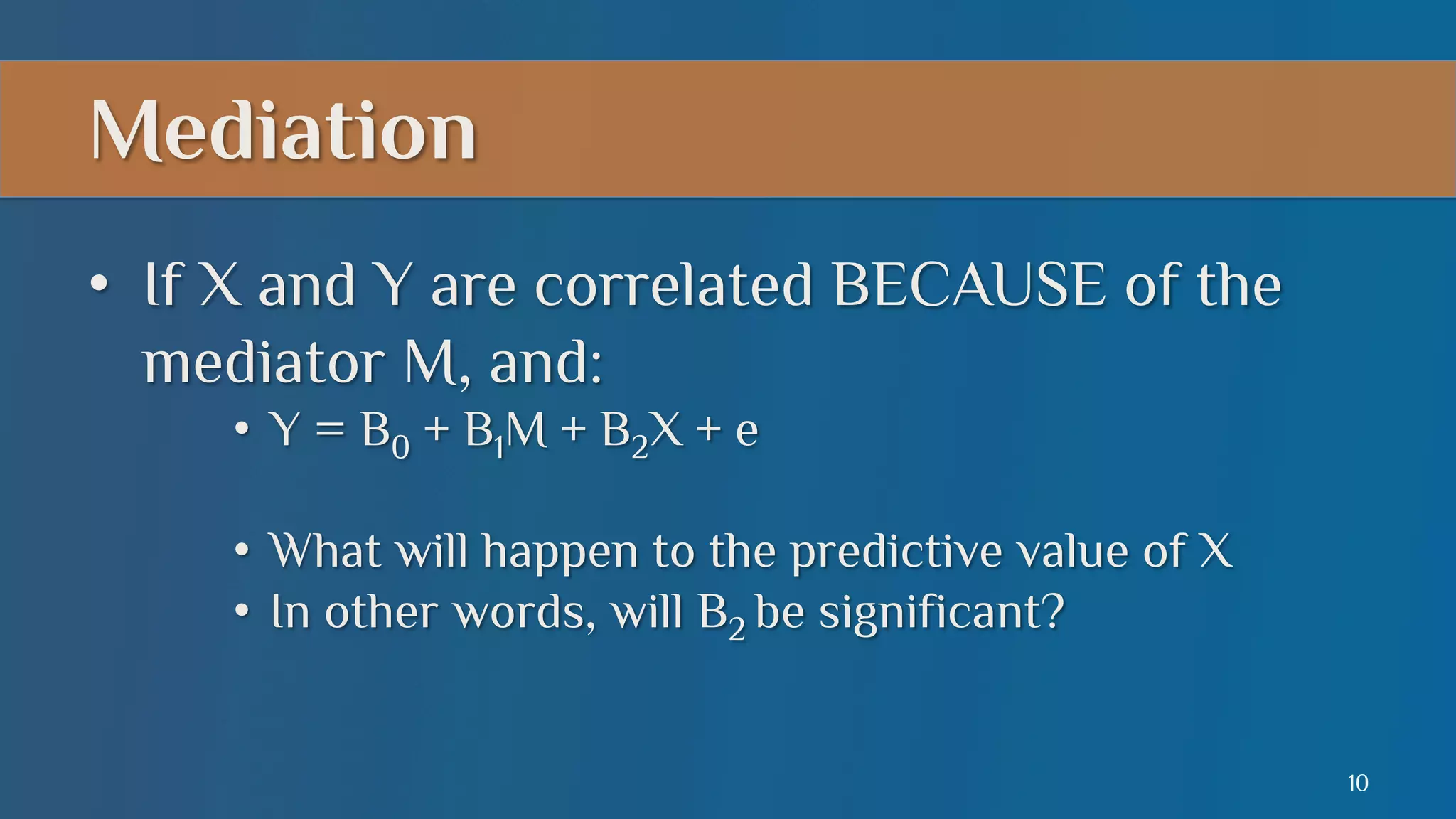
•  If X and Y are correlated BECAUSE of the
mediator M, and:
•  Y = B0 + B1M + B2X + e
•  What will happen to the predictive value of X
•  In other words, will B2 be significant?
10
Mediation
•  A mediator variable (M) accounts for some or
all of the relationship between X and Y
–  Some: Partial mediation
–  All: Full mediation

11
Mediation
•  CAUTION!

–  Correlation does not imply causation!
–  In other words, there is a BIG difference between
statistical mediation and true causal mediation

12
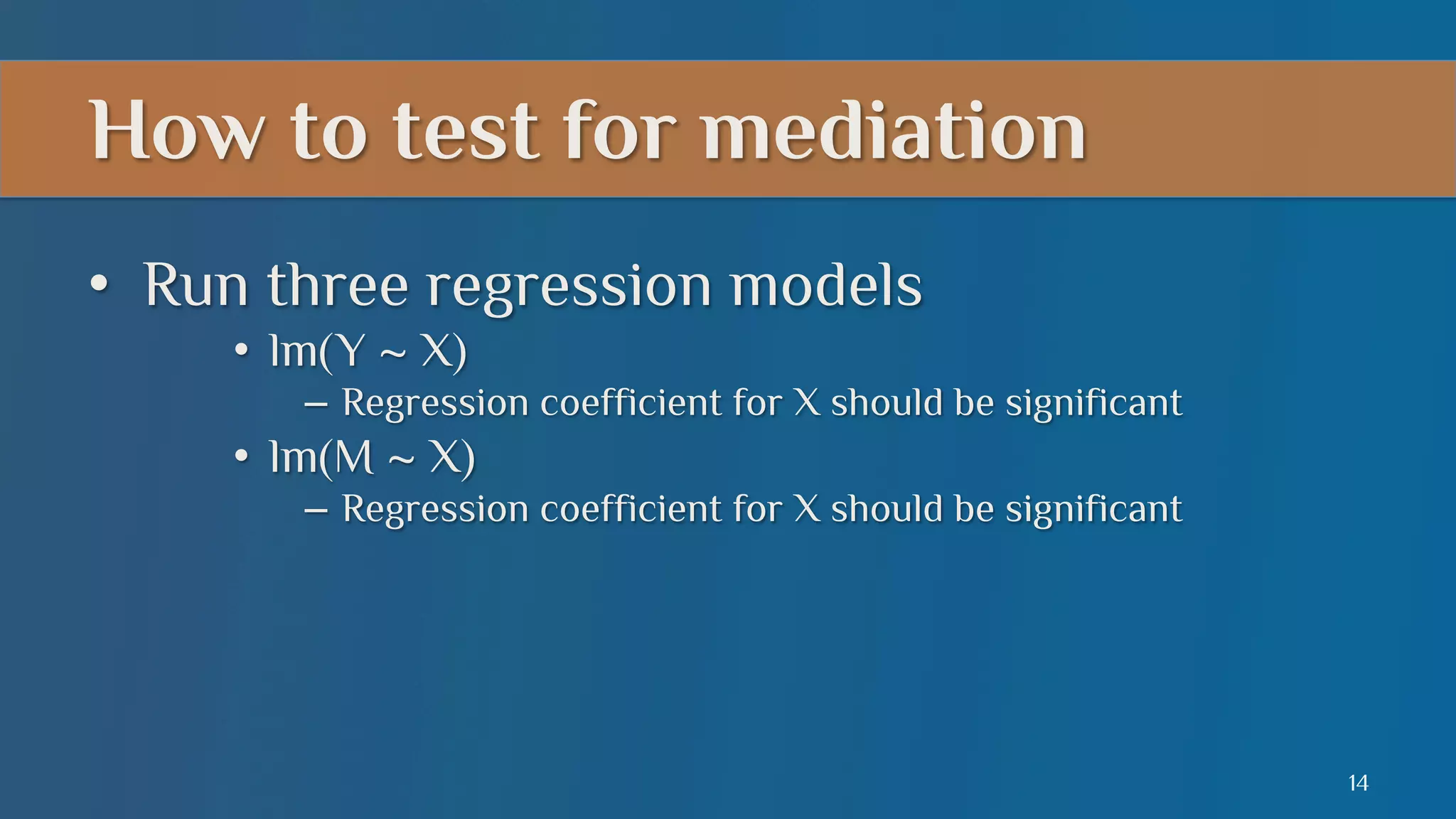
How to test for mediation
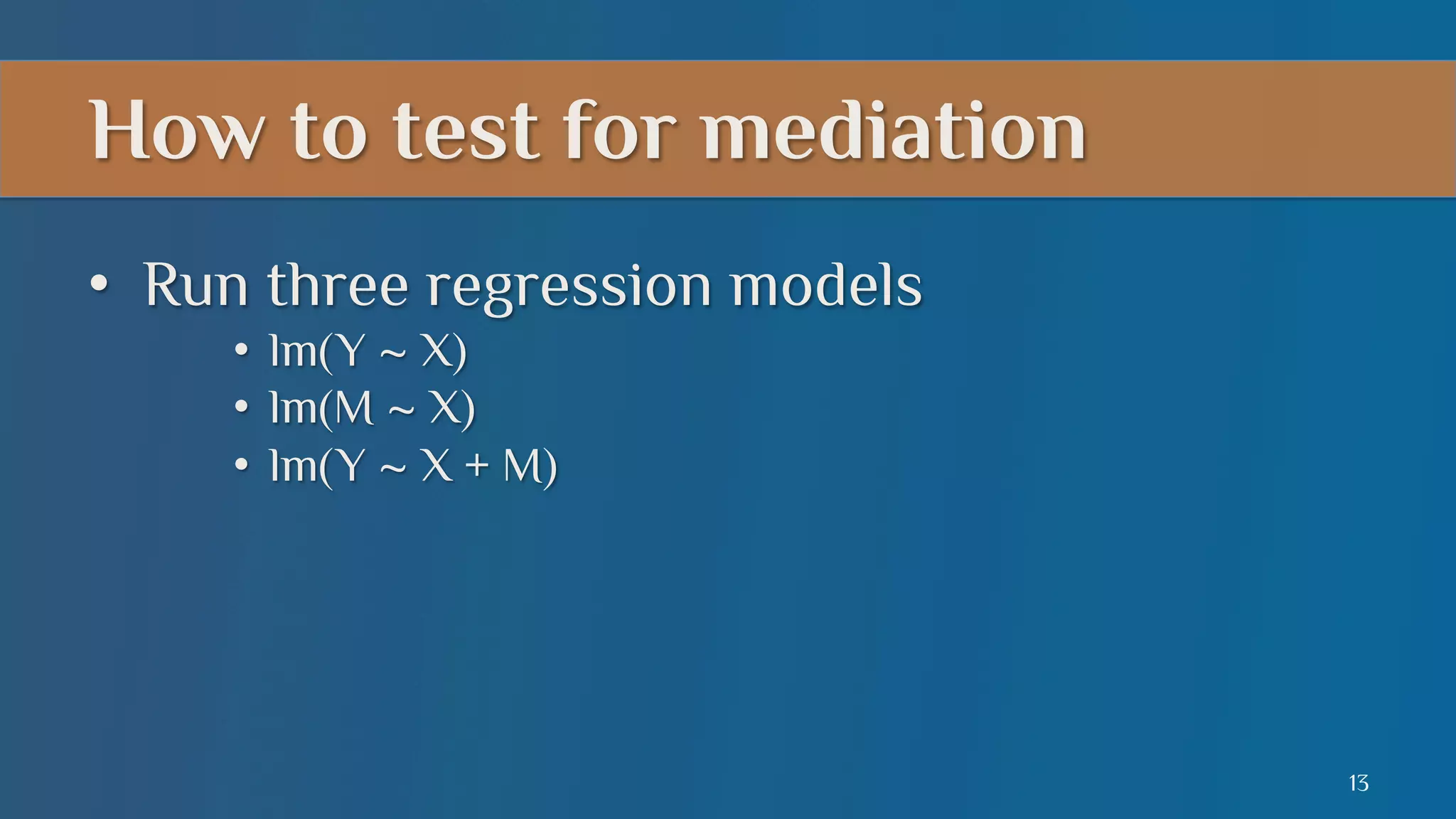
•  Run three regression models
•  lm(Y ~ X)
•  lm(M ~ X)
•  lm(Y ~ X + M)

13
How to test for mediation
•  Run three regression models
•  lm(Y ~ X)
–  Regression coefficient for X should be significant

•  lm(M ~ X)
–  Regression coefficient for X should be significant

14
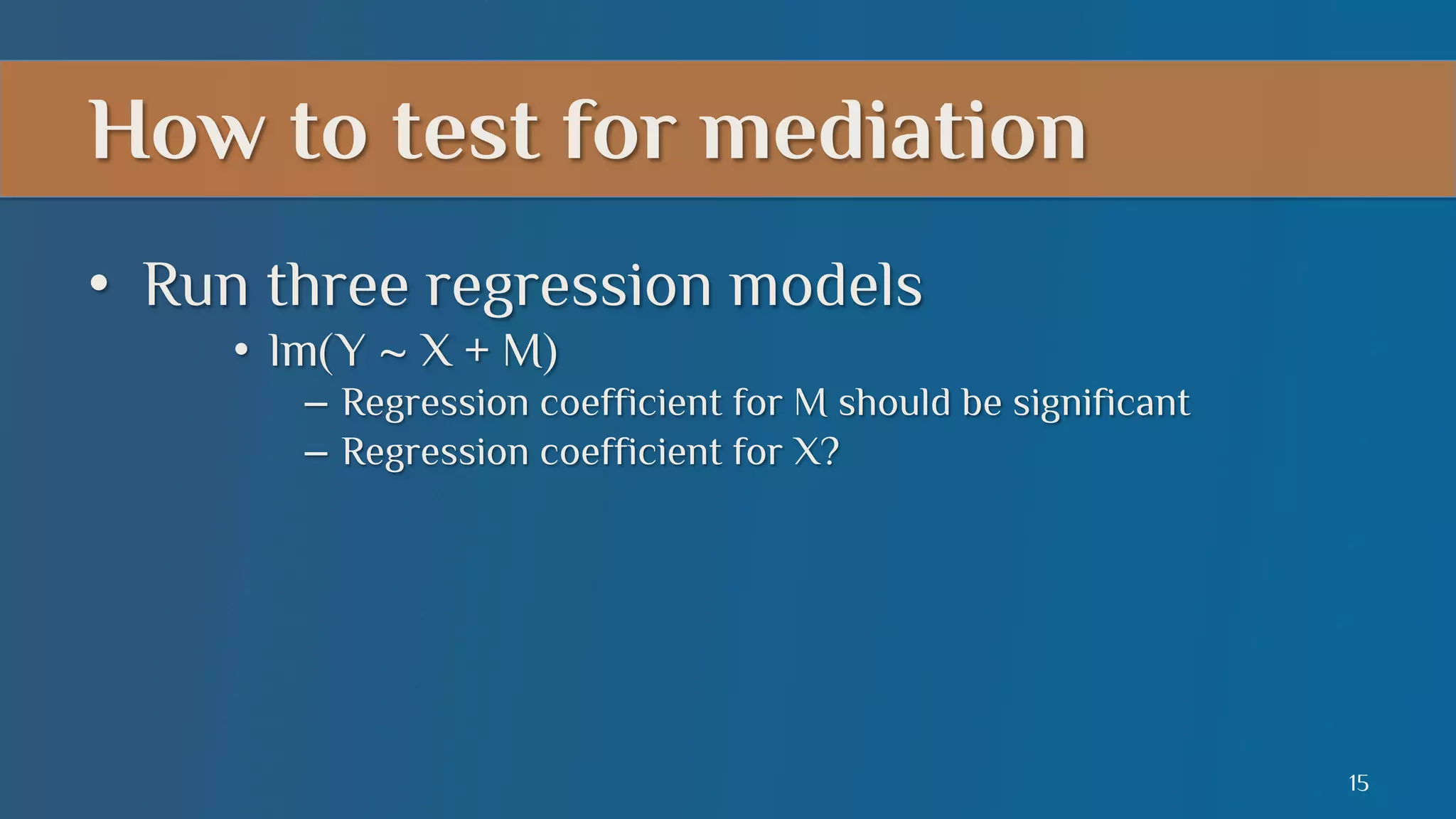
How to test for mediation
•  Run three regression models
•  lm(Y ~ X + M)
–  Regression coefficient for M should be significant
–  Regression coefficient for X?

15
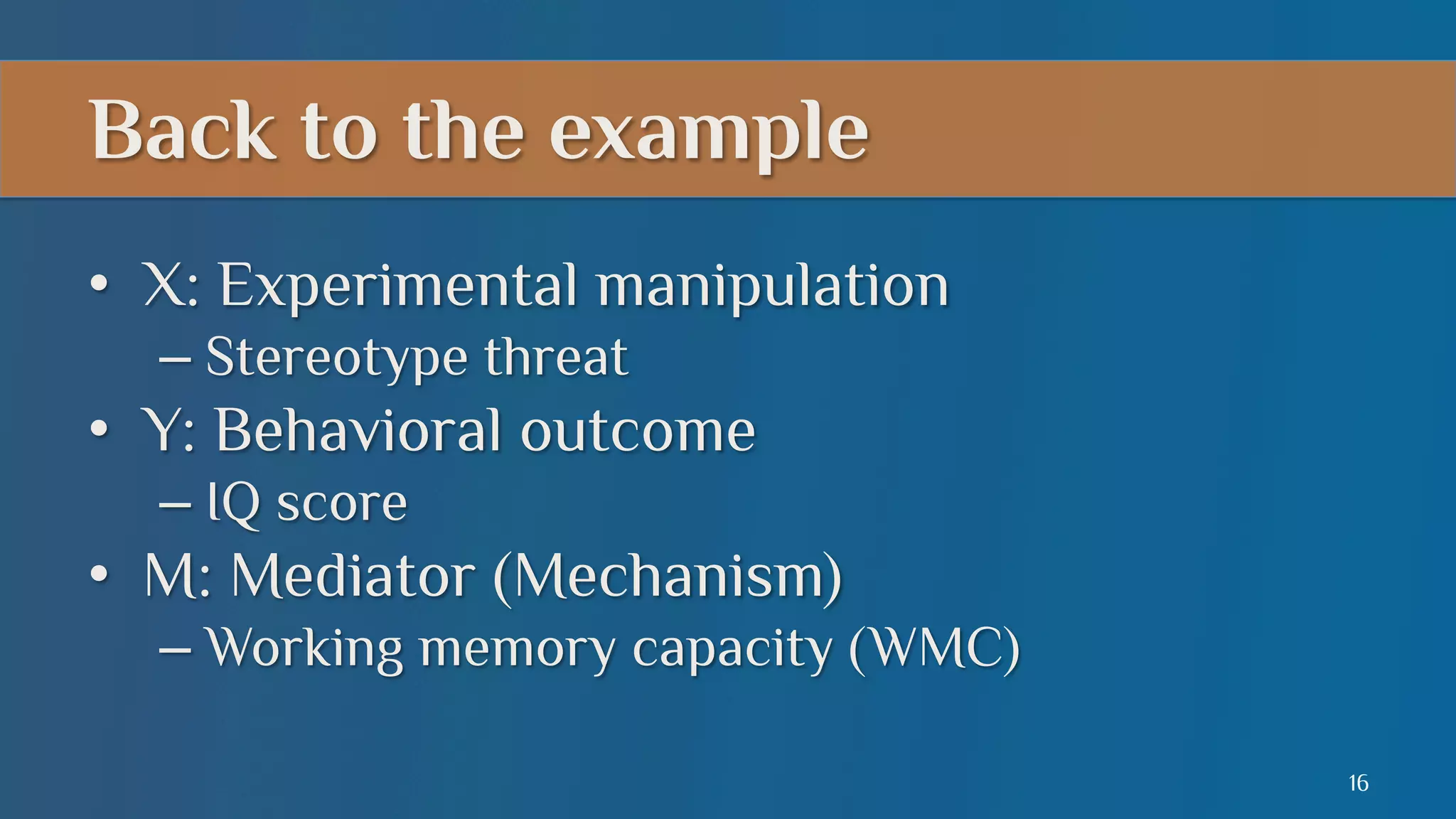
Back to the example
•  X: Experimental manipulation
–  Stereotype threat

•  Y: Behavioral outcome
–  IQ score

•  M: Mediator (Mechanism)
–  Working memory capacity (WMC)
16
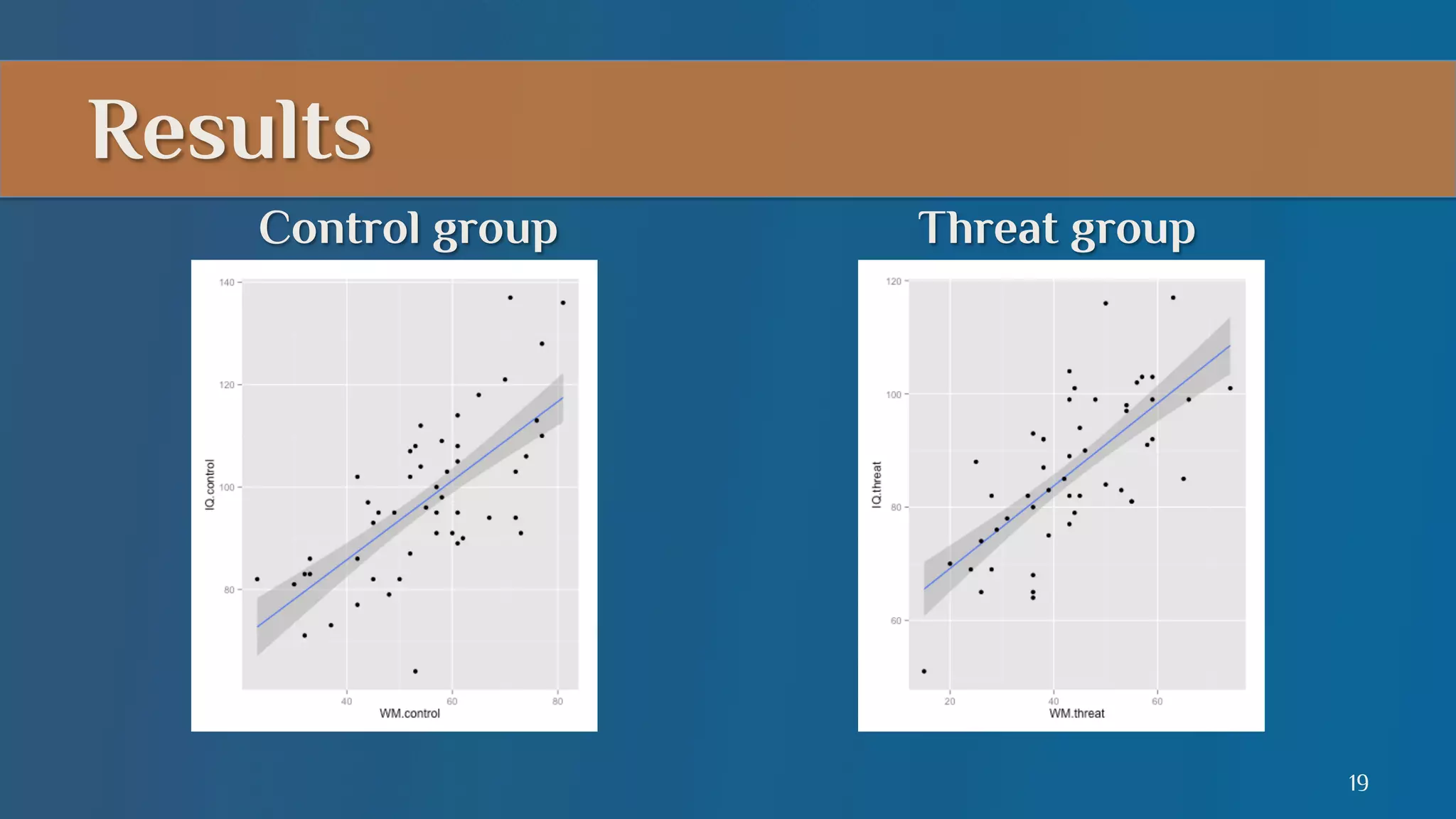
Simulated experiment & data
•  Students randomly assigned to one of two
experimental conditions
–  Threat
–  Control

•  Students completed a working memory task
•  Students completed an IQ test
17
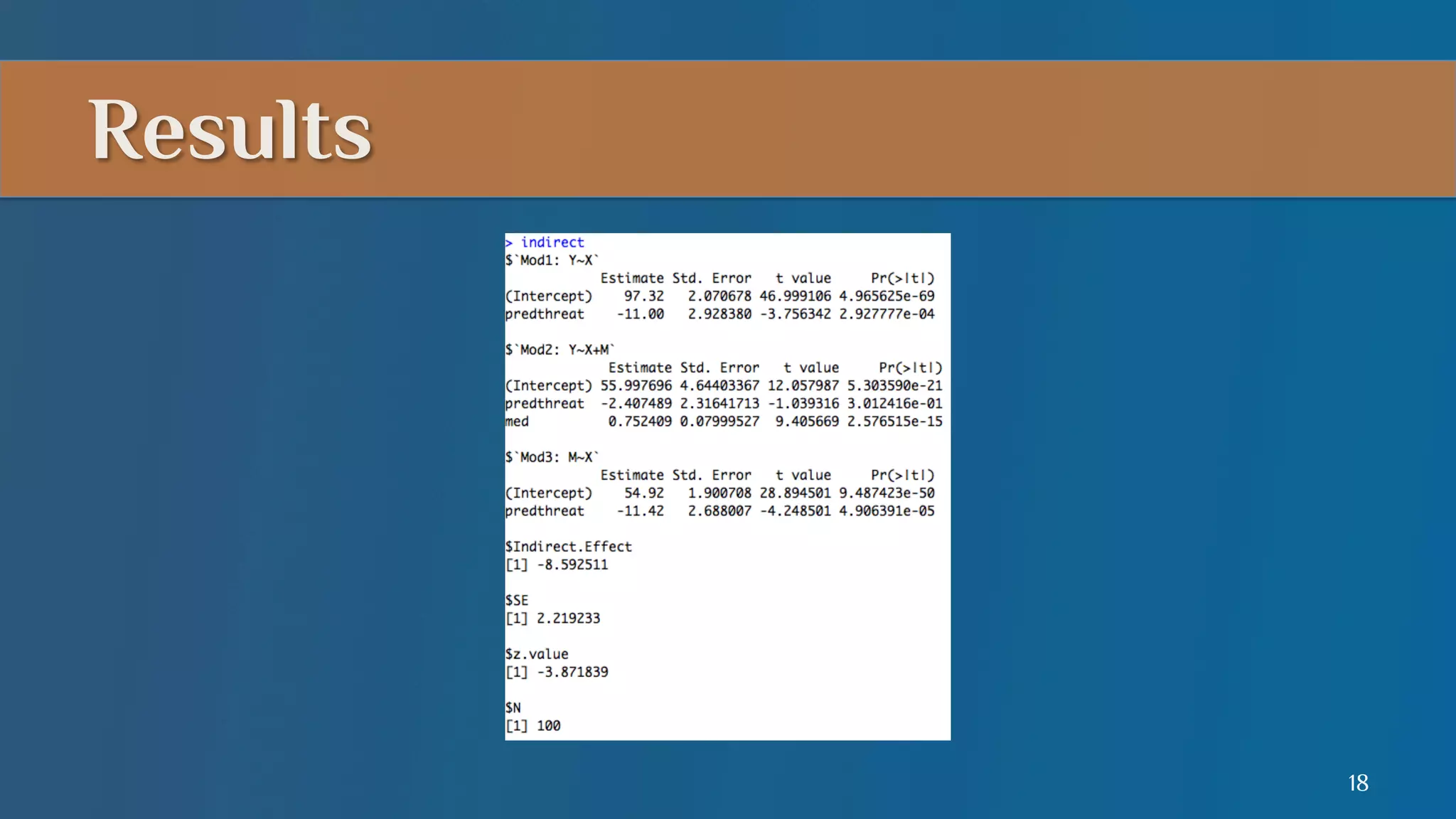
Results

18
Results
Control group

Threat group

19
Interpretation
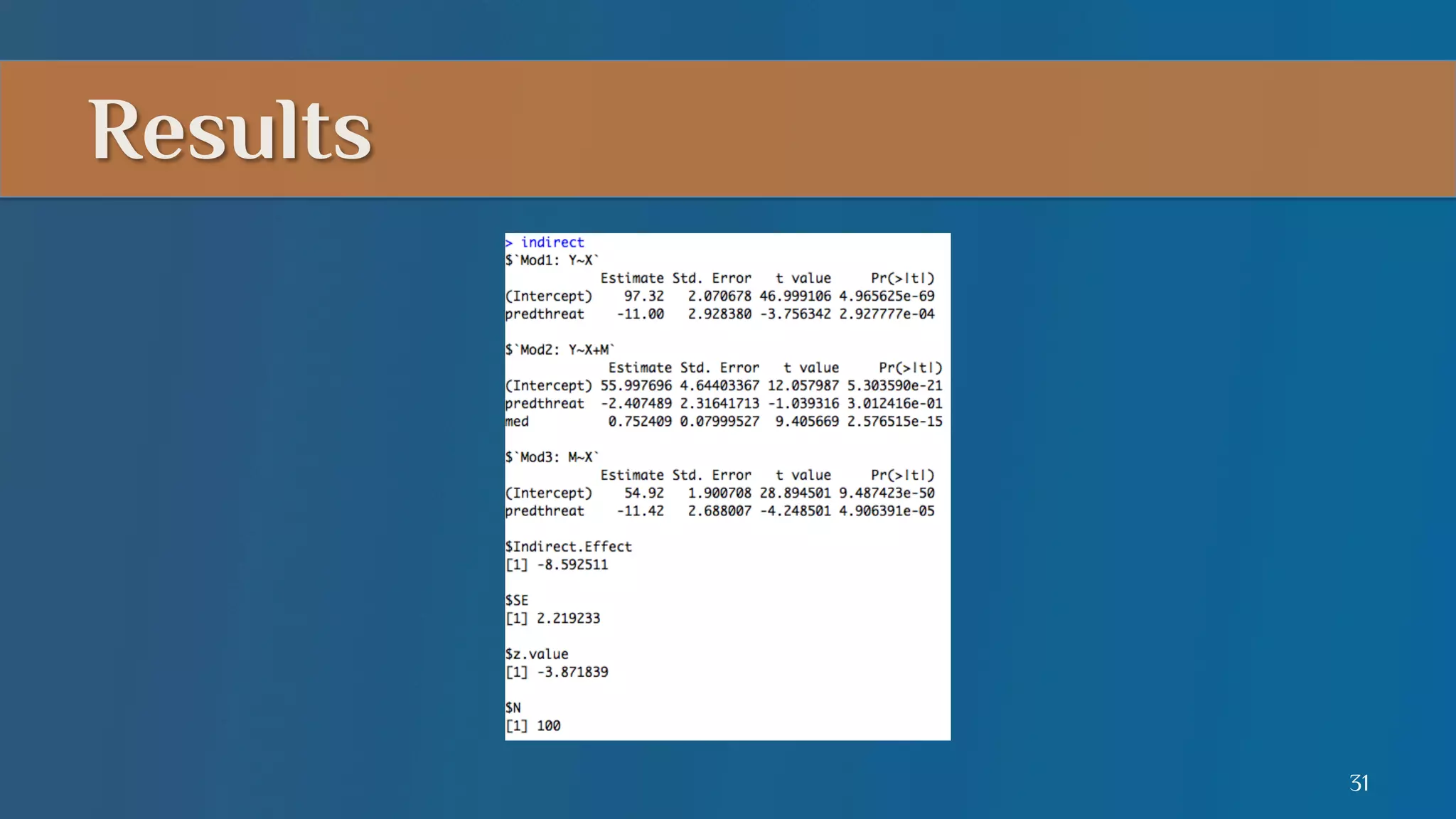
•  Full mediation
–  The direct effect is no longer significant after
adding the mediator into the regression
equation
–  The Sobel test is significant

20
END SEGMENT

21
Lecture 14 ~ Segment 2
Mediation: Path analysis approach

22
Mediation
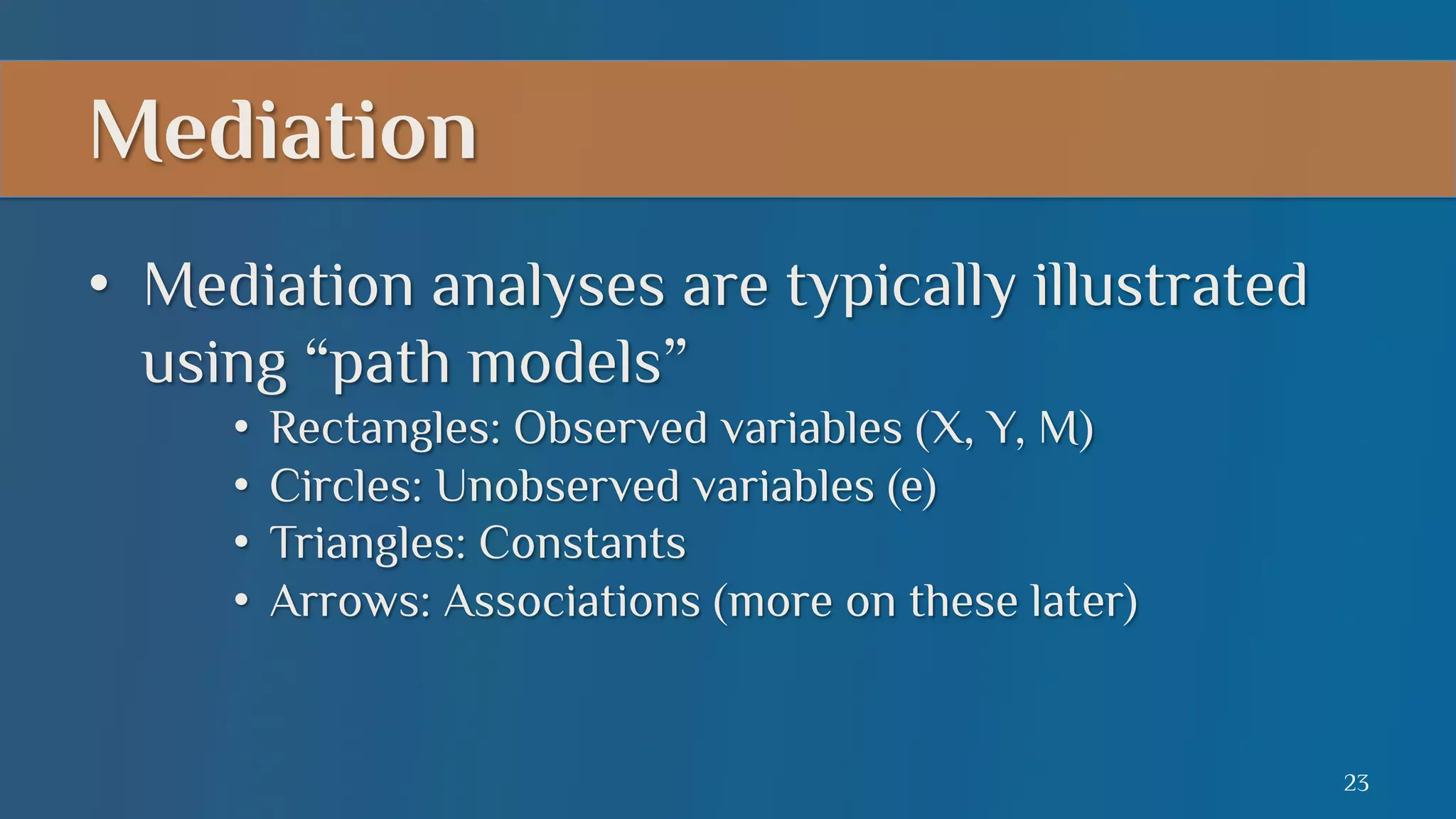
•  Mediation analyses are typically illustrated
using “path models”
•  Rectangles: Observed variables (X, Y, M)
•  Circles: Unobserved variables (e)
•  Triangles: Constants
•  Arrows: Associations (more on these later)

23
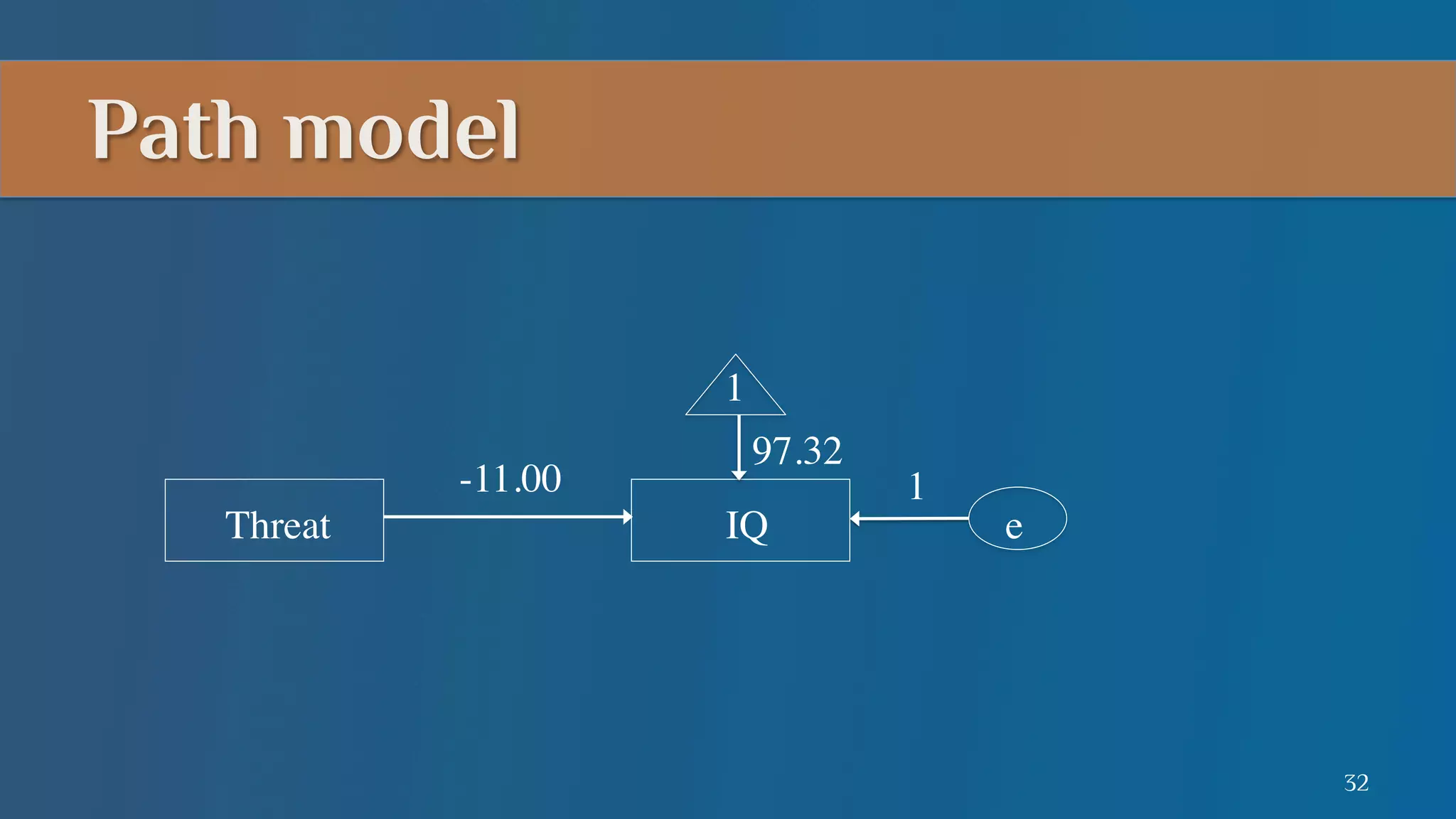
Path model
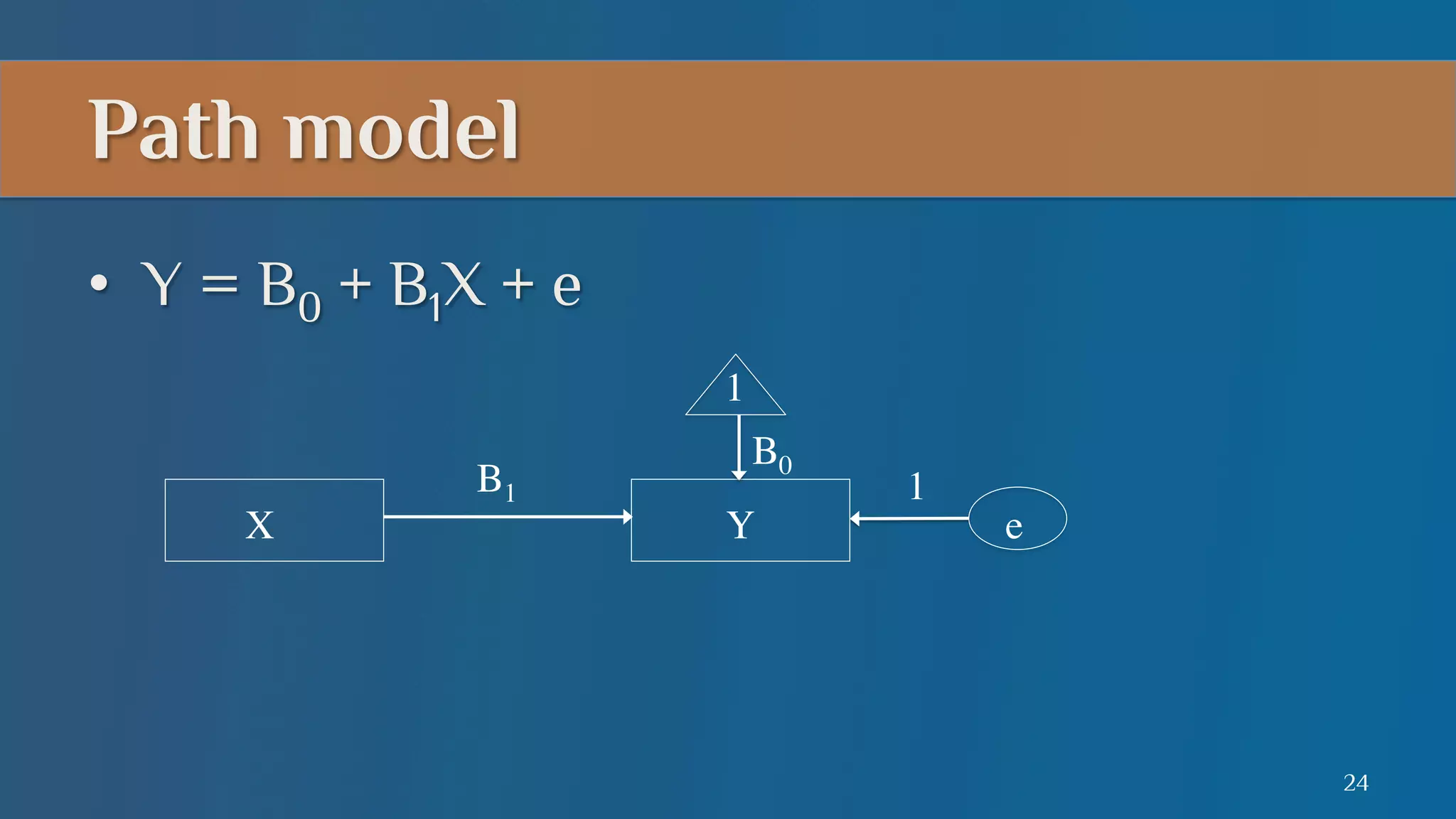
•  Y = B0 + B1X + e
1	

X	


B1	


B0	

Y	


1	


e	


24
Path model with a mediator
X	


1	

B0	


B1	


M	


Y	


1	


1	


e	


e	


25
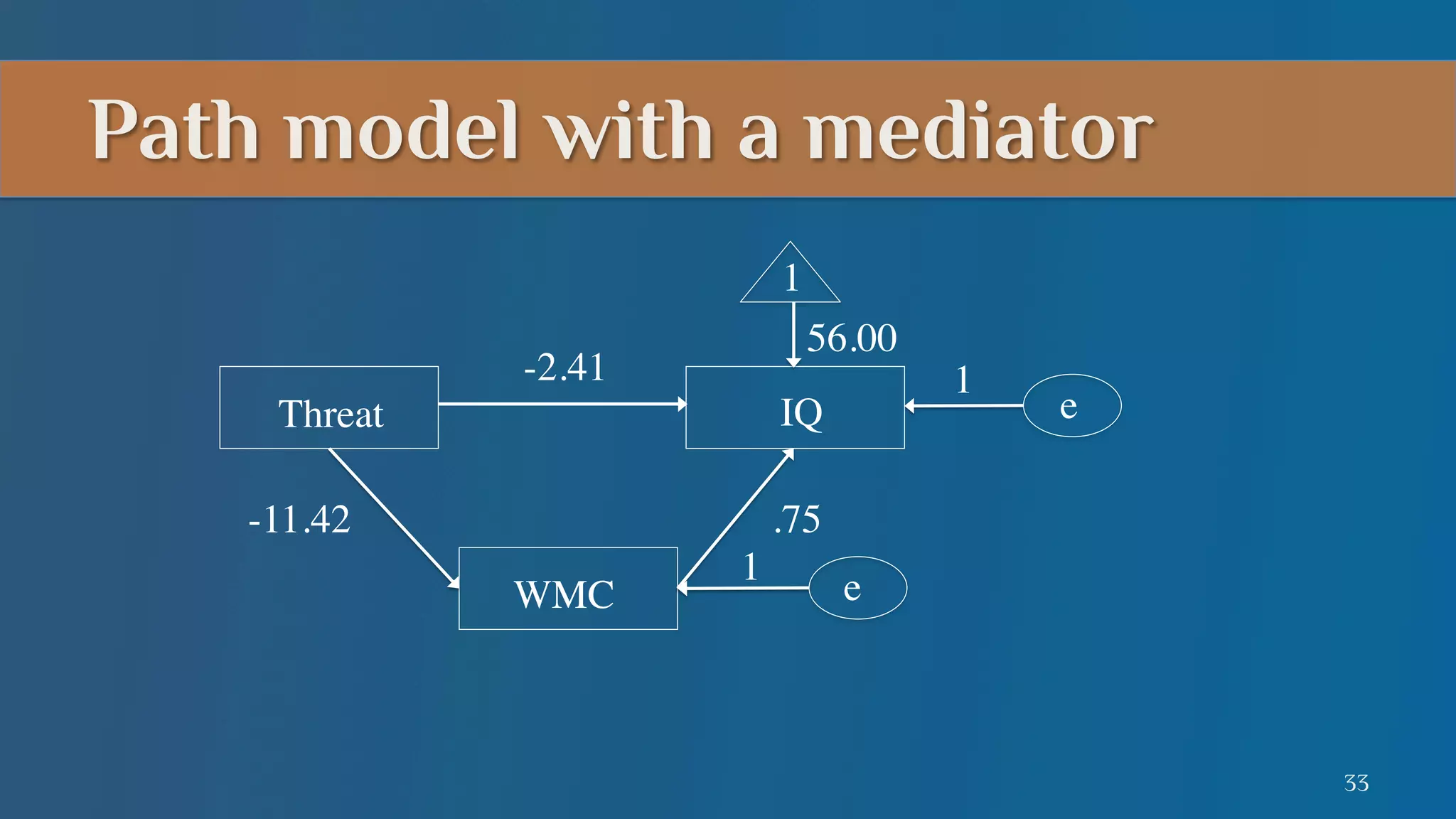
Path model with a mediator
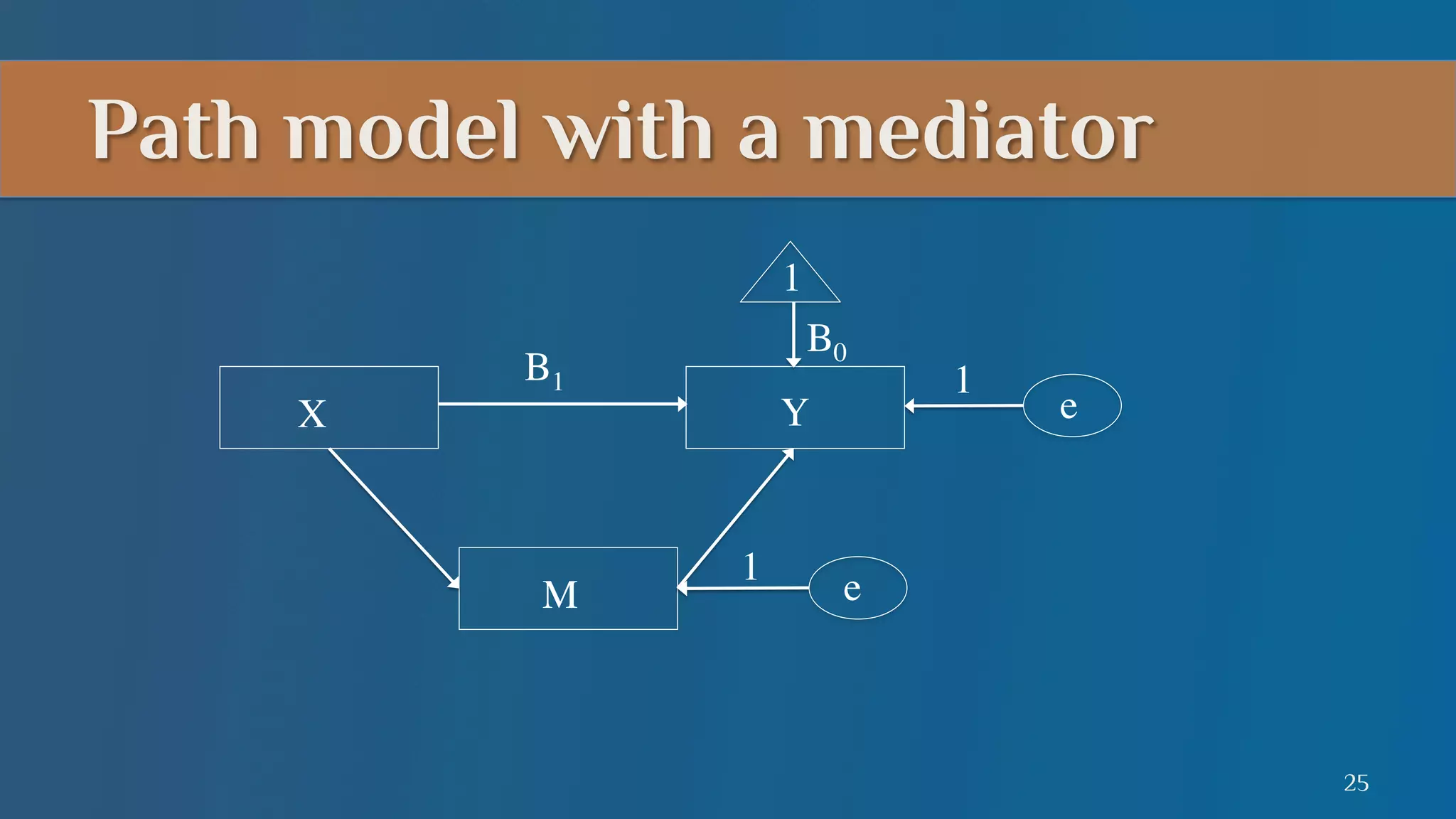
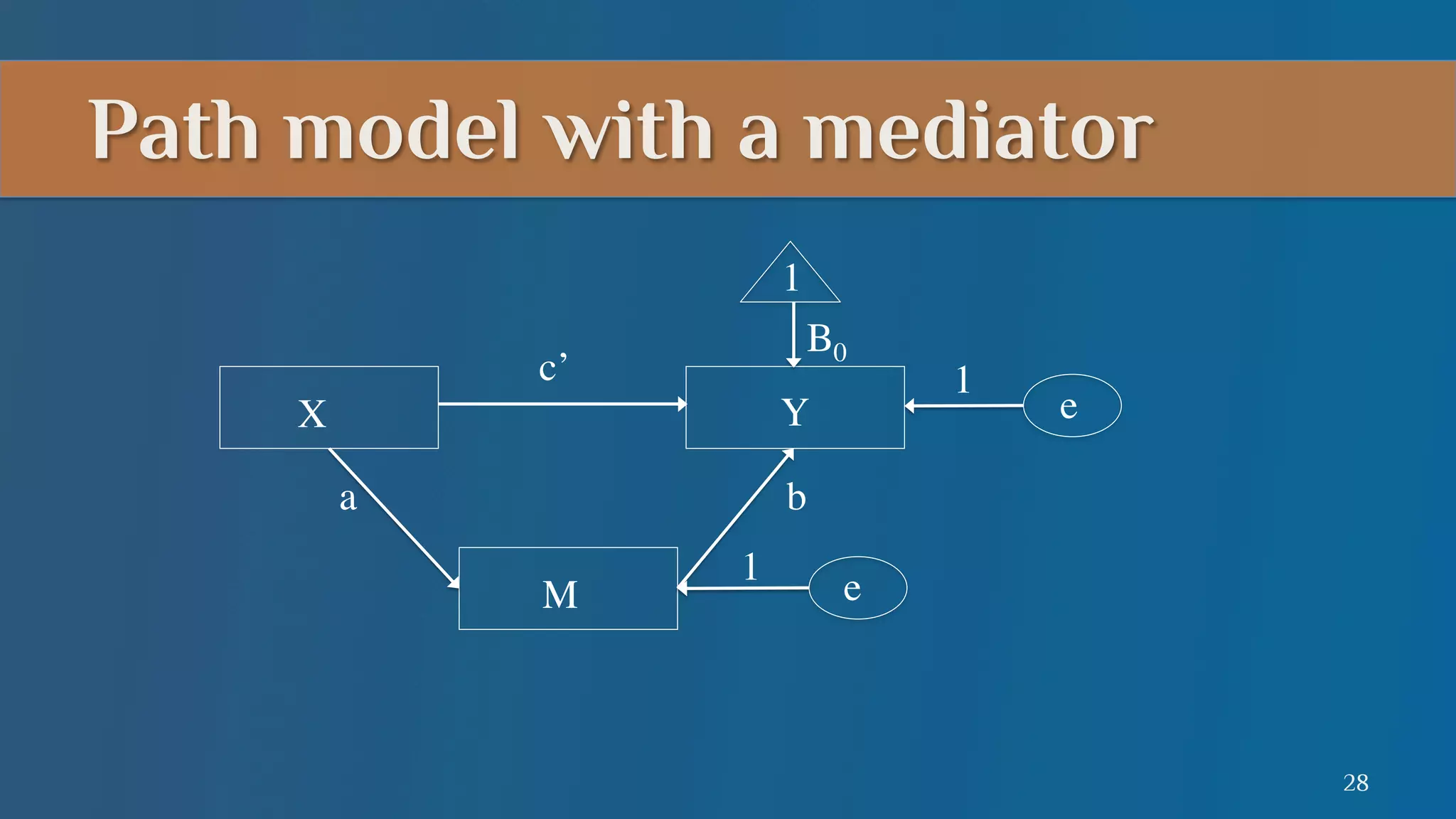
•  To avoid confusion, let’s label the paths
•  a: Path from X to M
•  b: Path from M to Y
•  c: Direct path from X to Y (before including M)
•  c’: Direct path from X to Y (after including M)
•  Note: (a*b) is known as the indirect path

26
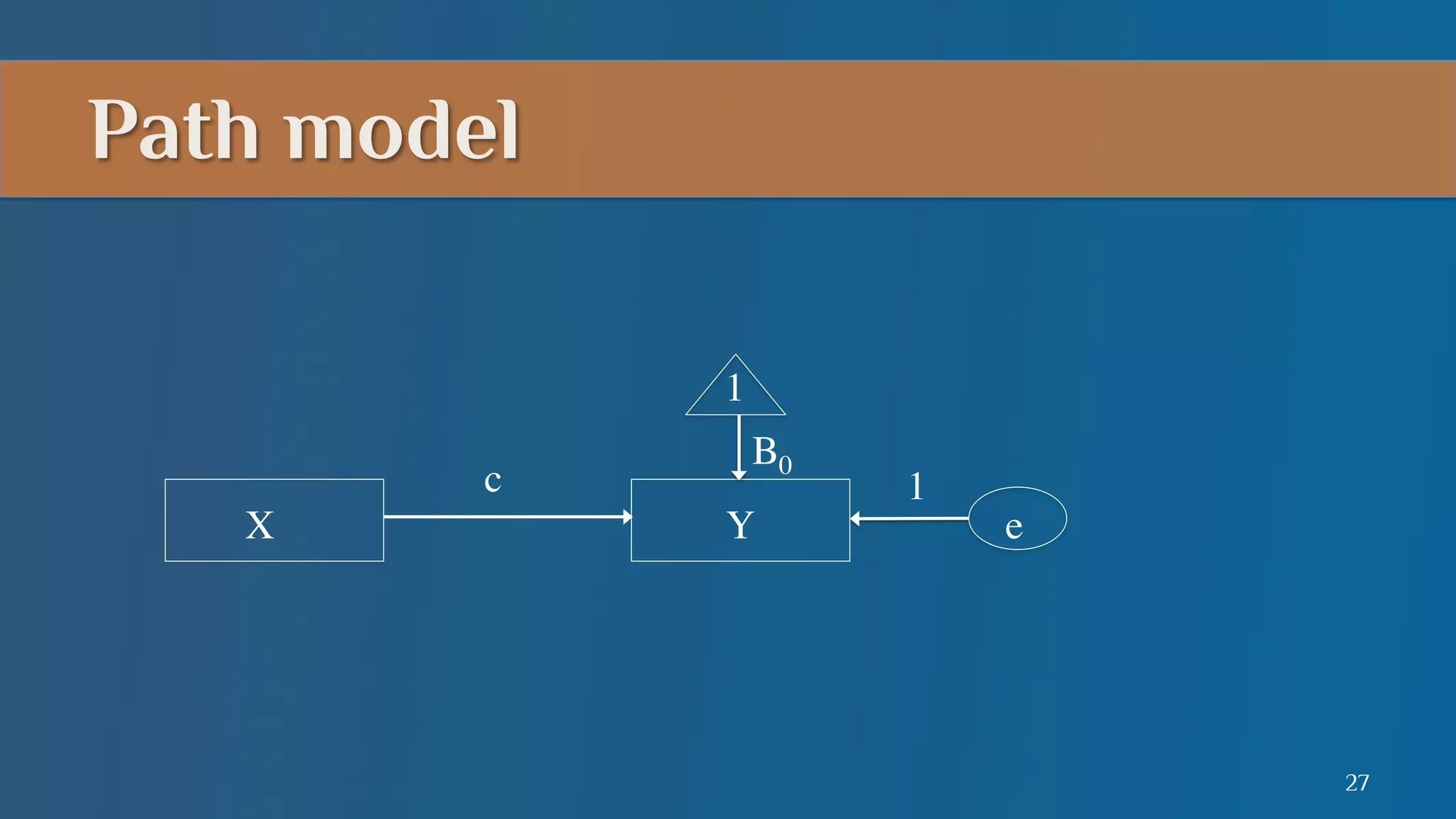
Path model
1	

X	


c	


B0	

Y	


1	


e	


27
Path model with a mediator
1	

B0	


c’	


X	


Y	


a	


1	


e	


b	

M	


1	


e	


28
How to test for mediation
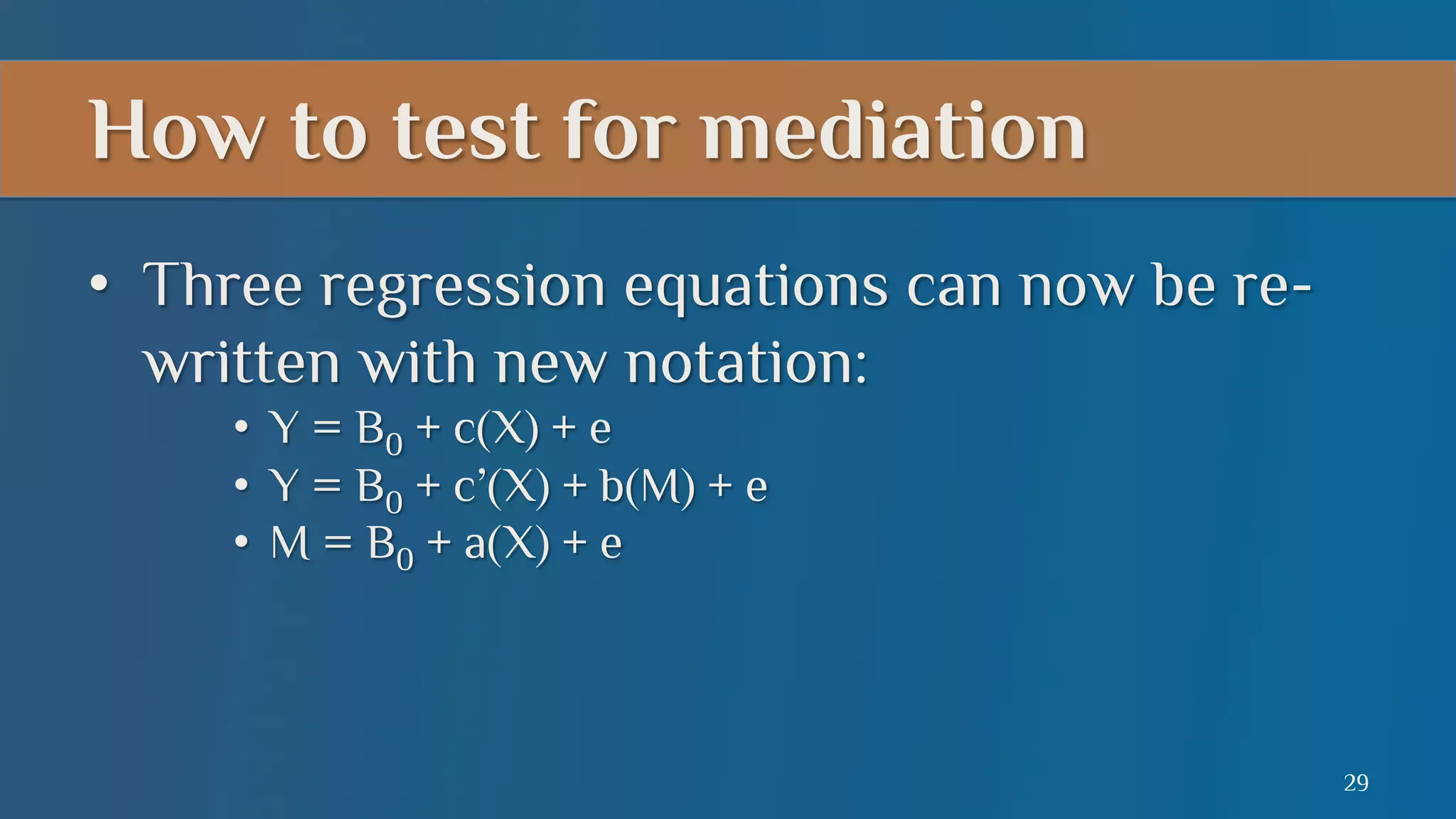
•  Three regression equations can now be rewritten with new notation:
•  Y = B0 + c(X) + e
•  Y = B0 + c’(X) + b(M) + e
•  M = B0 + a(X) + e

29
How to test for mediation
•  The Sobel test
z = (Ba* Bb) / SQRT[(Ba2 * SEb2) + (Bb2 * SEa2)]

–  The null hypothesis
•  The indirect effect is zero

•  (Ba*Bb) = 0
30
Results

31
Path model
1	

Threat	


-11.00	


97.32	

IQ	


1	


e	


32
Path model with a mediator
Threat	


1	

56.00	


-2.41	


IQ	


-11.42	


1	


e	


.75	

WMC	


1	


e	


33
Mediation: Final comments
•  Here we used path analysis to *illustrate*
the mediation analysis
•  It is also possible to test for mediation using
a statistical procedure called:
–  Structural Equation Modeling (SEM)

34
END SEGMENT

35
END LECTURE 14

36

Lecture slides stats1.13.l14.air

  • 1.
  • 2.
    Two segments •  Standardapproach •  Path analysis 2
  • 3.
    Lecture 14 ~Segment 1 Mediation: Standard approach 3
  • 4.
    Mediation •  Mediation andmoderation may sounds alike but they are quite different –  Moderation (Lecture 13) –  Mediation (Lecture 14) –  Both demonstrated in R (Lab 7) 4
  • 5.
  • 6.
    An example •  X:Experimental manipulation –  Stereotype threat •  Y: Behavioral outcome –  IQ score •  M: Mediator (Mechanism) –  Working memory capacity (WMC) 6
  • 7.
    Mediation •  A mediationanalysis is typically conducted to better understand an observed effect of an IV on a DV or a correlation between X and Y •  Why, and how, does stereotype threat influence IQ test performance? 7
  • 8.
    Mediation •  If Xand Y are correlated then we can use regression to predict Y from X •  Y = B0 + B1X + e 8
  • 9.
    Mediation •  If Xand Y are correlated BECAUSE of the mediator M, then (X à M à Y): •  Y = B0 + B1M + e & •  M = B0 + B1X + e 9
  • 10.
    Mediation •  If Xand Y are correlated BECAUSE of the mediator M, and: •  Y = B0 + B1M + B2X + e •  What will happen to the predictive value of X •  In other words, will B2 be significant? 10
  • 11.
    Mediation •  A mediatorvariable (M) accounts for some or all of the relationship between X and Y –  Some: Partial mediation –  All: Full mediation 11
  • 12.
    Mediation •  CAUTION! –  Correlationdoes not imply causation! –  In other words, there is a BIG difference between statistical mediation and true causal mediation 12
  • 13.
    How to testfor mediation •  Run three regression models •  lm(Y ~ X) •  lm(M ~ X) •  lm(Y ~ X + M) 13
  • 14.
    How to testfor mediation •  Run three regression models •  lm(Y ~ X) –  Regression coefficient for X should be significant •  lm(M ~ X) –  Regression coefficient for X should be significant 14
  • 15.
    How to testfor mediation •  Run three regression models •  lm(Y ~ X + M) –  Regression coefficient for M should be significant –  Regression coefficient for X? 15
  • 16.
    Back to theexample •  X: Experimental manipulation –  Stereotype threat •  Y: Behavioral outcome –  IQ score •  M: Mediator (Mechanism) –  Working memory capacity (WMC) 16
  • 17.
    Simulated experiment &data •  Students randomly assigned to one of two experimental conditions –  Threat –  Control •  Students completed a working memory task •  Students completed an IQ test 17
  • 18.
  • 19.
  • 20.
    Interpretation •  Full mediation – The direct effect is no longer significant after adding the mediator into the regression equation –  The Sobel test is significant 20
  • 21.
  • 22.
    Lecture 14 ~Segment 2 Mediation: Path analysis approach 22
  • 23.
    Mediation •  Mediation analysesare typically illustrated using “path models” •  Rectangles: Observed variables (X, Y, M) •  Circles: Unobserved variables (e) •  Triangles: Constants •  Arrows: Associations (more on these later) 23
  • 24.
    Path model •  Y= B0 + B1X + e 1 X B1 B0 Y 1 e 24
  • 25.
    Path model witha mediator X 1 B0 B1 M Y 1 1 e e 25
  • 26.
    Path model witha mediator •  To avoid confusion, let’s label the paths •  a: Path from X to M •  b: Path from M to Y •  c: Direct path from X to Y (before including M) •  c’: Direct path from X to Y (after including M) •  Note: (a*b) is known as the indirect path 26
  • 27.
  • 28.
    Path model witha mediator 1 B0 c’ X Y a 1 e b M 1 e 28
  • 29.
    How to testfor mediation •  Three regression equations can now be rewritten with new notation: •  Y = B0 + c(X) + e •  Y = B0 + c’(X) + b(M) + e •  M = B0 + a(X) + e 29
  • 30.
    How to testfor mediation •  The Sobel test z = (Ba* Bb) / SQRT[(Ba2 * SEb2) + (Bb2 * SEa2)] –  The null hypothesis •  The indirect effect is zero •  (Ba*Bb) = 0 30
  • 31.
  • 32.
  • 33.
    Path model witha mediator Threat 1 56.00 -2.41 IQ -11.42 1 e .75 WMC 1 e 33
  • 34.
    Mediation: Final comments • Here we used path analysis to *illustrate* the mediation analysis •  It is also possible to test for mediation using a statistical procedure called: –  Structural Equation Modeling (SEM) 34
  • 35.
  • 36.