THE SCIENTIFIC METHOD
CHAPTER 2
THE SCIENTIFIC METHOD
• Approach through which psychologists systematically
acquire knowledge and understanding about behavior and
other phenomenon of interest.
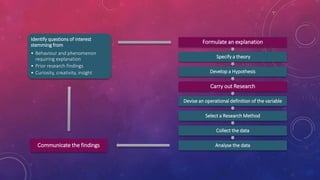
Formulate an explanation
Specify a theory
Develop a Hypothesis
Carry out Research
Devise an operational definition of the variable
Select a Research Method
Collect the data
Analyse the data
Communicate the findings
Identify questions of interest
stemming from
• Behaviour and phenomenon
requiring explanation
• Prior research findings
• Curiosity, creativity, insight
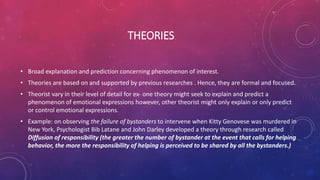
THEORIES
• Broad explanation and prediction concerning phenomenon of interest.
• Theories are based on and supported by previous researches . Hence, they are formal and focused.
• Theorist vary in their level of detail for ex- one theory might seek to explain and predict a
phenomenon of emotional expressions however, other theorist might only explain or only predict
or control emotional expressions.
• Example: on observing the failure of bystanders to intervene when Kitty Genovese was murdered in
New York, Psychologist Bib Latane and John Darley developed a theory through research called
Diffusion of responsibility (the greater the number of bystander at the event that calls for helping
behavior, the more the responsibility of helping is perceived to be shared by all the bystanders.)
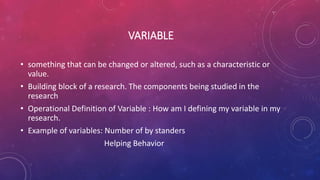
VARIABLE
• something that can be changed or altered, such as a characteristic or
value.
• Building block of a research. The components being studied in the
research
• Operational Definition of Variable : How am I defining my variable in my
research.
• Example of variables: Number of by standers
Helping Behavior
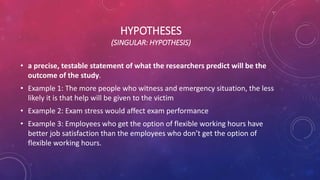
HYPOTHESES
(SINGULAR: HYPOTHESIS)
• a precise, testable statement of what the researchers predict will be the
outcome of the study.
• Example 1: The more people who witness and emergency situation, the less
likely it is that help will be given to the victim
• Example 2: Exam stress would affect exam performance
• Example 3: Employees who get the option of flexible working hours have
better job satisfaction than the employees who don’t get the option of
flexible working hours.
TYPES OF HYPOTHESIS
DIRECTIONAL
NON-DIRECTIONAL
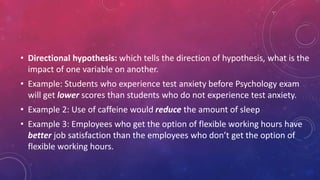
• Directional hypothesis: which tells the direction of hypothesis, what is the
impact of one variable on another.
• Example: Students who experience test anxiety before Psychology exam
will get lower scores than students who do not experience test anxiety.
• Example 2: Use of caffeine would reduce the amount of sleep
• Example 3: Employees who get the option of flexible working hours have
better job satisfaction than the employees who don’t get the option of
flexible working hours.
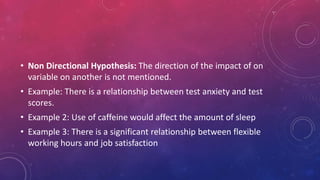
• Non Directional Hypothesis: The direction of the impact of on
variable on another is not mentioned.
• Example: There is a relationship between test anxiety and test
scores.
• Example 2: Use of caffeine would affect the amount of sleep
• Example 3: There is a significant relationship between flexible
working hours and job satisfaction
RESEARCH METHOD: WAYS TO CONDUCT RESEARCH
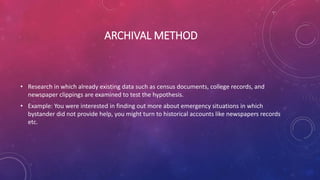
ARCHIVAL METHOD
• Research in which already existing data such as census documents, college records, and
newspaper clippings are examined to test the hypothesis.
• Example: You were interested in finding out more about emergency situations in which
bystander did not provide help, you might turn to historical accounts like newspapers records
etc.
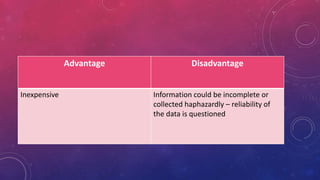
Advantage Disadvantage
Inexpensive Information could be incomplete or
collected haphazardly – reliability of
the data is questioned
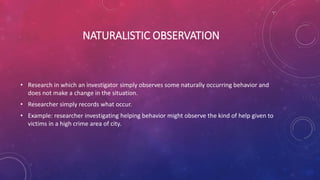
NATURALISTIC OBSERVATION
• Research in which an investigator simply observes some naturally occurring behavior and
does not make a change in the situation.
• Researcher simply records what occur.
• Example: researcher investigating helping behavior might observe the kind of help given to
victims in a high crime area of city.
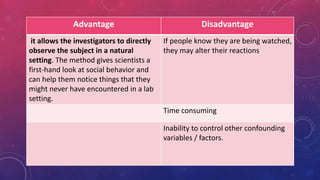
Advantage Disadvantage
it allows the investigators to directly
observe the subject in a natural
setting. The method gives scientists a
first-hand look at social behavior and
can help them notice things that they
might never have encountered in a lab
setting.
If people know they are being watched,
they may alter their reactions
Time consuming
Inability to control other confounding
variables / factors.
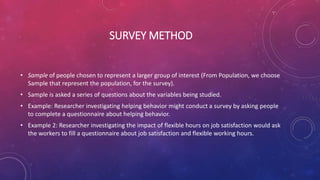
SURVEY METHOD
• Sample of people chosen to represent a larger group of interest (From Population, we choose
Sample that represent the population, for the survey).
• Sample is asked a series of questions about the variables being studied.
• Example: Researcher investigating helping behavior might conduct a survey by asking people
to complete a questionnaire about helping behavior.
• Example 2: Researcher investigating the impact of flexible hours on job satisfaction would ask
the workers to fill a questionnaire about job satisfaction and flexible working hours.
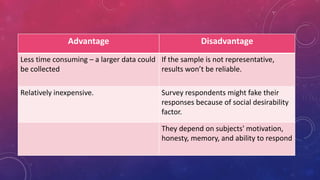
Advantage Disadvantage
Less time consuming – a larger data could
be collected
If the sample is not representative,
results won’t be reliable.
Relatively inexpensive. Survey respondents might fake their
responses because of social desirability
factor.
They depend on subjects' motivation,
honesty, memory, and ability to respond
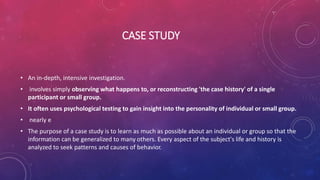
CASE STUDY
• An in-depth, intensive investigation.
• involves simply observing what happens to, or reconstructing 'the case history' of a single
participant or small group.
• It often uses psychological testing to gain insight into the personality of individual or small group.
• nearly e
• The purpose of a case study is to learn as much as possible about an individual or group so that the
information can be generalized to many others. Every aspect of the subject's life and history is
analyzed to seek patterns and causes of behavior.
EXAMPLE OF CASE STUDY
• Anna O: Anna O. was a pseudonym of a woman named Bertha Pappenheim, a
patient of a physician named Josef Breuer. While she was never a patient of
Freud's, Freud and Breuer discussed her case extensively. The woman was
experiencing symptoms of a condition that was then known as hysteria and
found that talking about her problems helped relieve her symptoms. Her case
played an important part in the development of talk therapy as an approach
to mental health treatment.
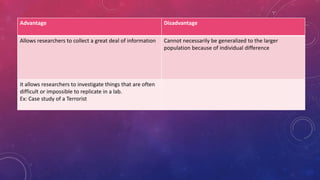
Advantage Disadvantage
Allows researchers to collect a great deal of information Cannot necessarily be generalized to the larger
population because of individual difference
it allows researchers to investigate things that are often
difficult or impossible to replicate in a lab.
Ex: Case study of a Terrorist
TYPES OF RESEARCH STUDY
• Correlational Study
• Experimental Study
CORRELATIONAL RESEARCH
• Relationship between two sets of variable is examined to determine the correlation.
• For Example: There is a significant relationship between exam stress and exam performance.
• The strength and direction of the relationship between the variables are represented by a
mathematical statistic known as Correlation, which can range from +1 to -1
TYPES OF CORRELATION
POSITIVE CORRELATION
NEGATIVE CORRELATION
POSITIVE CORRELATION
• if the value of one variable increase, the value of other variable also increase
• If the value of one variable decrease, the value of another also decreases,
• Both the values would go in the same direction.
• For Example: the more time students spend in studying the higher would be the grades, the less they
study, grades would be low.
• Example 2: Being in a good mood is positively correlated with the hours of sleep someone gets each
night.
• Example 3: The more number of flexible hours a worker gets, the higher the job satisfaction would be.
NEGATIVE CORRELATION
• if the value of one variable increase, the value of other variable decreases.
• Value of both variables would go in opposite direction
• Example: When the supply of a particular product decreases, the demand for it increases.
• Example 2: The more a person has negative thoughts about himself, the lesser the life satisfaction
would be.
• Example: more studying is associated with less partying.
• When two variables are strongly correlated, we assume that one variable causes the other.
• For example; more study time is associated with better grades, we might assume more
studying causes better results. Although, it is not a bad guess but it is still a guess. Because

finding that two variables are correlated does not mean that there is a causal relationship
between the two variables.
• For example, the actual cause would be the Interest in a particular subject which led to more
studying resulting into better grades.
• Correlation only predicts about the relationship between the variables but not the Causal
relationship.
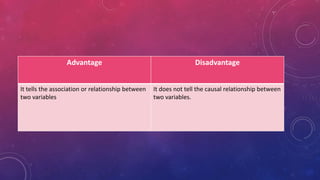
Advantage Disadvantage
It tells the association or relationship between
two variables
It does not tell the causal relationship between
two variables.
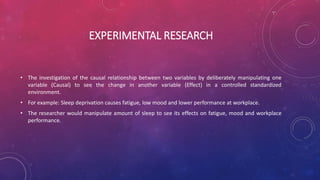
EXPERIMENTAL RESEARCH
• The investigation of the causal relationship between two variables by deliberately manipulating one
variable (Causal) to see the change in another variable (Effect) in a controlled standardized
environment.
• For example: Sleep deprivation causes fatigue, low mood and lower performance at workplace.
• The researcher would manipulate amount of sleep to see its effects on fatigue, mood and workplace
performance.
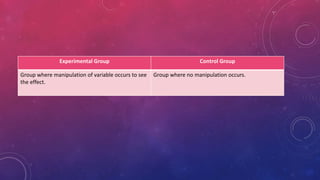
Experimental Group Control Group
Group where manipulation of variable occurs to see
the effect.
Group where no manipulation occurs.
TYPE OF VARIABLES IN AN EXPERIMENT
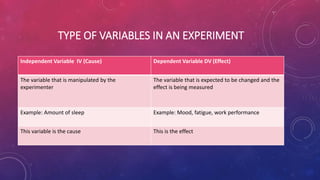
Independent Variable IV (Cause) Dependent Variable DV (Effect)
The variable that is manipulated by the
experimenter
The variable that is expected to be changed and the
effect is being measured
Example: Amount of sleep Example: Mood, fatigue, work performance
This variable is the cause This is the effect
RESEARCH ISSUES
ETHICS OF RESEARCH
• Informed consent
• Protection of participants from physical and mental harm
• Right to withdraw
• Protect participants anonymity and confidentiality
• Avoid using deceptive practices.
EXPLORING DIVERSITY
• Choose participants who represent the scope of human behavior. Giving
participants from different race, gender, ethnicity equal right to participate.
THREATS TO EXPERIMENTAL VALIDITY: AVOIDING
EXPERIMENTAL BIAS
• Experimental bias: factors that distort how the Independent Variable affects the dependent variable in
an experiment.
• Experimental Expectations Bias: experimenter unintentionally transmit cues to participant about the
ways the experiment expects them to behave. Example: researcher unintentionally convey that
watching a particular aggressive scene could trigger anger in them.
• Participant Expectations Bias: where participant guess about what is expected of them in an experiment
and they start behaving in a certain way. Example: someone may think that a drug will make them feel
sick and then experience nausea as a result.
THANK YOU!

2. The scientific method - Chap 2.pptx

  • 1.
  • 2.
    THE SCIENTIFIC METHOD •Approach through which psychologists systematically acquire knowledge and understanding about behavior and other phenomenon of interest.
  • 3.
    Formulate an explanation Specifya theory Develop a Hypothesis Carry out Research Devise an operational definition of the variable Select a Research Method Collect the data Analyse the data Communicate the findings Identify questions of interest stemming from • Behaviour and phenomenon requiring explanation • Prior research findings • Curiosity, creativity, insight
  • 4.
    THEORIES • Broad explanationand prediction concerning phenomenon of interest. • Theories are based on and supported by previous researches . Hence, they are formal and focused. • Theorist vary in their level of detail for ex- one theory might seek to explain and predict a phenomenon of emotional expressions however, other theorist might only explain or only predict or control emotional expressions. • Example: on observing the failure of bystanders to intervene when Kitty Genovese was murdered in New York, Psychologist Bib Latane and John Darley developed a theory through research called Diffusion of responsibility (the greater the number of bystander at the event that calls for helping behavior, the more the responsibility of helping is perceived to be shared by all the bystanders.)
  • 5.
    VARIABLE • something thatcan be changed or altered, such as a characteristic or value. • Building block of a research. The components being studied in the research • Operational Definition of Variable : How am I defining my variable in my research. • Example of variables: Number of by standers Helping Behavior
  • 6.
    HYPOTHESES (SINGULAR: HYPOTHESIS) • aprecise, testable statement of what the researchers predict will be the outcome of the study. • Example 1: The more people who witness and emergency situation, the less likely it is that help will be given to the victim • Example 2: Exam stress would affect exam performance • Example 3: Employees who get the option of flexible working hours have better job satisfaction than the employees who don’t get the option of flexible working hours.
  • 7.
  • 8.
    • Directional hypothesis:which tells the direction of hypothesis, what is the impact of one variable on another. • Example: Students who experience test anxiety before Psychology exam will get lower scores than students who do not experience test anxiety. • Example 2: Use of caffeine would reduce the amount of sleep • Example 3: Employees who get the option of flexible working hours have better job satisfaction than the employees who don’t get the option of flexible working hours.
  • 9.
    • Non DirectionalHypothesis: The direction of the impact of on variable on another is not mentioned. • Example: There is a relationship between test anxiety and test scores. • Example 2: Use of caffeine would affect the amount of sleep • Example 3: There is a significant relationship between flexible working hours and job satisfaction
  • 10.
    RESEARCH METHOD: WAYSTO CONDUCT RESEARCH
  • 11.
    ARCHIVAL METHOD • Researchin which already existing data such as census documents, college records, and newspaper clippings are examined to test the hypothesis. • Example: You were interested in finding out more about emergency situations in which bystander did not provide help, you might turn to historical accounts like newspapers records etc.
  • 12.
    Advantage Disadvantage Inexpensive Informationcould be incomplete or collected haphazardly – reliability of the data is questioned
  • 13.
    NATURALISTIC OBSERVATION • Researchin which an investigator simply observes some naturally occurring behavior and does not make a change in the situation. • Researcher simply records what occur. • Example: researcher investigating helping behavior might observe the kind of help given to victims in a high crime area of city.
  • 14.
    Advantage Disadvantage it allowsthe investigators to directly observe the subject in a natural setting. The method gives scientists a first-hand look at social behavior and can help them notice things that they might never have encountered in a lab setting. If people know they are being watched, they may alter their reactions Time consuming Inability to control other confounding variables / factors.
  • 15.
    SURVEY METHOD • Sampleof people chosen to represent a larger group of interest (From Population, we choose Sample that represent the population, for the survey). • Sample is asked a series of questions about the variables being studied. • Example: Researcher investigating helping behavior might conduct a survey by asking people to complete a questionnaire about helping behavior. • Example 2: Researcher investigating the impact of flexible hours on job satisfaction would ask the workers to fill a questionnaire about job satisfaction and flexible working hours.
  • 16.
    Advantage Disadvantage Less timeconsuming – a larger data could be collected If the sample is not representative, results won’t be reliable. Relatively inexpensive. Survey respondents might fake their responses because of social desirability factor. They depend on subjects' motivation, honesty, memory, and ability to respond
  • 17.
    CASE STUDY • Anin-depth, intensive investigation. • involves simply observing what happens to, or reconstructing 'the case history' of a single participant or small group. • It often uses psychological testing to gain insight into the personality of individual or small group. • nearly e • The purpose of a case study is to learn as much as possible about an individual or group so that the information can be generalized to many others. Every aspect of the subject's life and history is analyzed to seek patterns and causes of behavior.
  • 18.
    EXAMPLE OF CASESTUDY • Anna O: Anna O. was a pseudonym of a woman named Bertha Pappenheim, a patient of a physician named Josef Breuer. While she was never a patient of Freud's, Freud and Breuer discussed her case extensively. The woman was experiencing symptoms of a condition that was then known as hysteria and found that talking about her problems helped relieve her symptoms. Her case played an important part in the development of talk therapy as an approach to mental health treatment.
  • 19.
    Advantage Disadvantage Allows researchersto collect a great deal of information Cannot necessarily be generalized to the larger population because of individual difference it allows researchers to investigate things that are often difficult or impossible to replicate in a lab. Ex: Case study of a Terrorist
  • 20.
    TYPES OF RESEARCHSTUDY • Correlational Study • Experimental Study
  • 21.
    CORRELATIONAL RESEARCH • Relationshipbetween two sets of variable is examined to determine the correlation. • For Example: There is a significant relationship between exam stress and exam performance. • The strength and direction of the relationship between the variables are represented by a mathematical statistic known as Correlation, which can range from +1 to -1
  • 22.
    TYPES OF CORRELATION POSITIVECORRELATION NEGATIVE CORRELATION
  • 23.
    POSITIVE CORRELATION • ifthe value of one variable increase, the value of other variable also increase • If the value of one variable decrease, the value of another also decreases, • Both the values would go in the same direction. • For Example: the more time students spend in studying the higher would be the grades, the less they study, grades would be low. • Example 2: Being in a good mood is positively correlated with the hours of sleep someone gets each night. • Example 3: The more number of flexible hours a worker gets, the higher the job satisfaction would be.
  • 24.
    NEGATIVE CORRELATION • ifthe value of one variable increase, the value of other variable decreases. • Value of both variables would go in opposite direction • Example: When the supply of a particular product decreases, the demand for it increases. • Example 2: The more a person has negative thoughts about himself, the lesser the life satisfaction would be. • Example: more studying is associated with less partying.
  • 25.
    • When twovariables are strongly correlated, we assume that one variable causes the other. • For example; more study time is associated with better grades, we might assume more studying causes better results. Although, it is not a bad guess but it is still a guess. Because finding that two variables are correlated does not mean that there is a causal relationship between the two variables. • For example, the actual cause would be the Interest in a particular subject which led to more studying resulting into better grades. • Correlation only predicts about the relationship between the variables but not the Causal relationship.

  • 26.
    Advantage Disadvantage It tellsthe association or relationship between two variables It does not tell the causal relationship between two variables.
  • 27.
    EXPERIMENTAL RESEARCH • Theinvestigation of the causal relationship between two variables by deliberately manipulating one variable (Causal) to see the change in another variable (Effect) in a controlled standardized environment. • For example: Sleep deprivation causes fatigue, low mood and lower performance at workplace. • The researcher would manipulate amount of sleep to see its effects on fatigue, mood and workplace performance.
  • 28.
    Experimental Group ControlGroup Group where manipulation of variable occurs to see the effect. Group where no manipulation occurs.
  • 29.
    TYPE OF VARIABLESIN AN EXPERIMENT Independent Variable IV (Cause) Dependent Variable DV (Effect) The variable that is manipulated by the experimenter The variable that is expected to be changed and the effect is being measured Example: Amount of sleep Example: Mood, fatigue, work performance This variable is the cause This is the effect
  • 30.
  • 31.
    ETHICS OF RESEARCH •Informed consent • Protection of participants from physical and mental harm • Right to withdraw • Protect participants anonymity and confidentiality • Avoid using deceptive practices.
  • 32.
    EXPLORING DIVERSITY • Chooseparticipants who represent the scope of human behavior. Giving participants from different race, gender, ethnicity equal right to participate.
  • 33.
    THREATS TO EXPERIMENTALVALIDITY: AVOIDING EXPERIMENTAL BIAS • Experimental bias: factors that distort how the Independent Variable affects the dependent variable in an experiment. • Experimental Expectations Bias: experimenter unintentionally transmit cues to participant about the ways the experiment expects them to behave. Example: researcher unintentionally convey that watching a particular aggressive scene could trigger anger in them. • Participant Expectations Bias: where participant guess about what is expected of them in an experiment and they start behaving in a certain way. Example: someone may think that a drug will make them feel sick and then experience nausea as a result.
  • 34.