
Mediation models
Direct, Indirect & Total Effects
• OLS models yield direct effects of predictors
• Often, however, we are interested in indirect and
total effects as well as direct effects
• E.g. gaining a degree increases earnings
– Does it do this by increasing skills/productivity?
– Or is it just a ‘credential’?
2
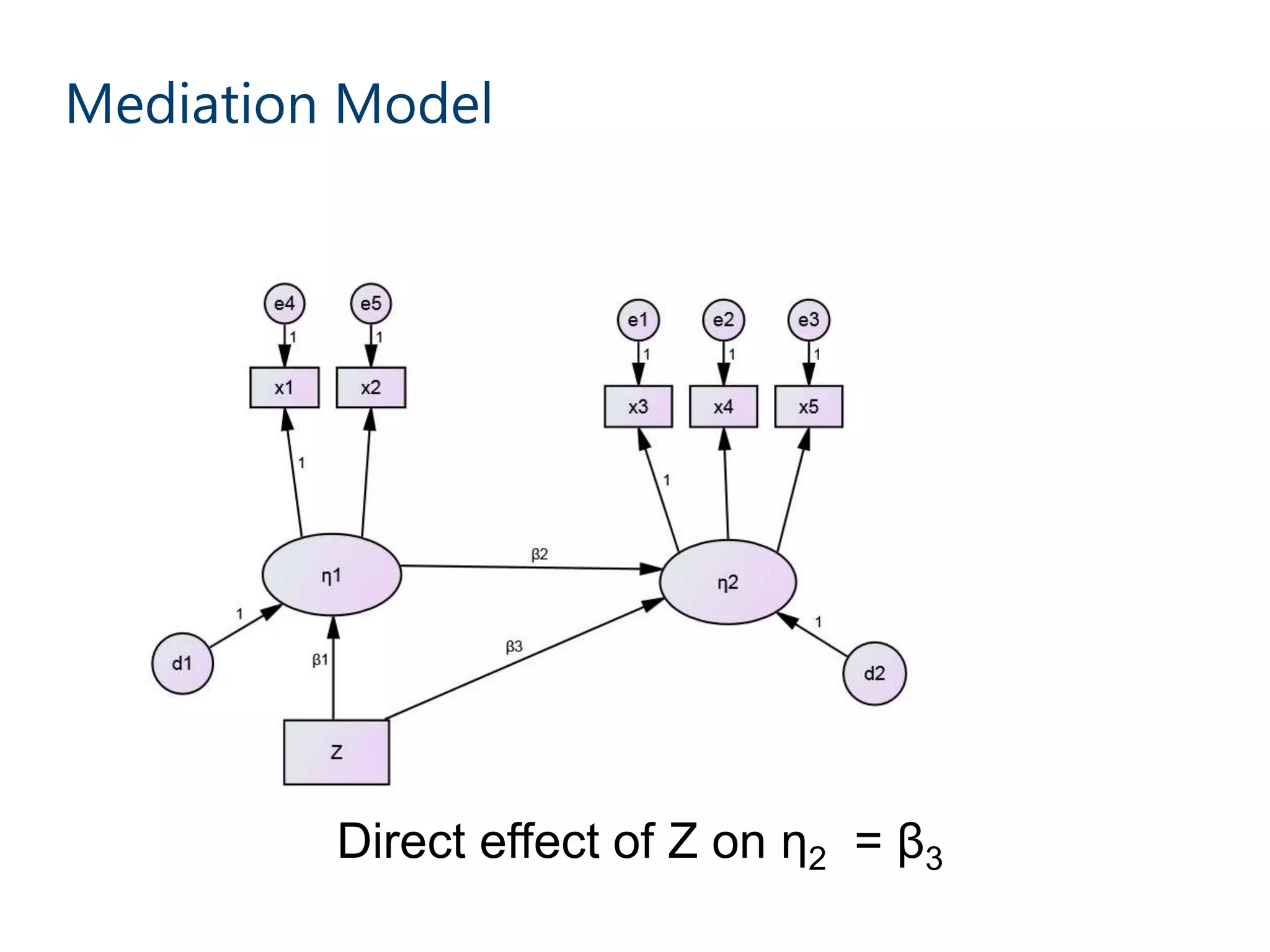
Mediation Model
Direct effect of Z on η2 = β3
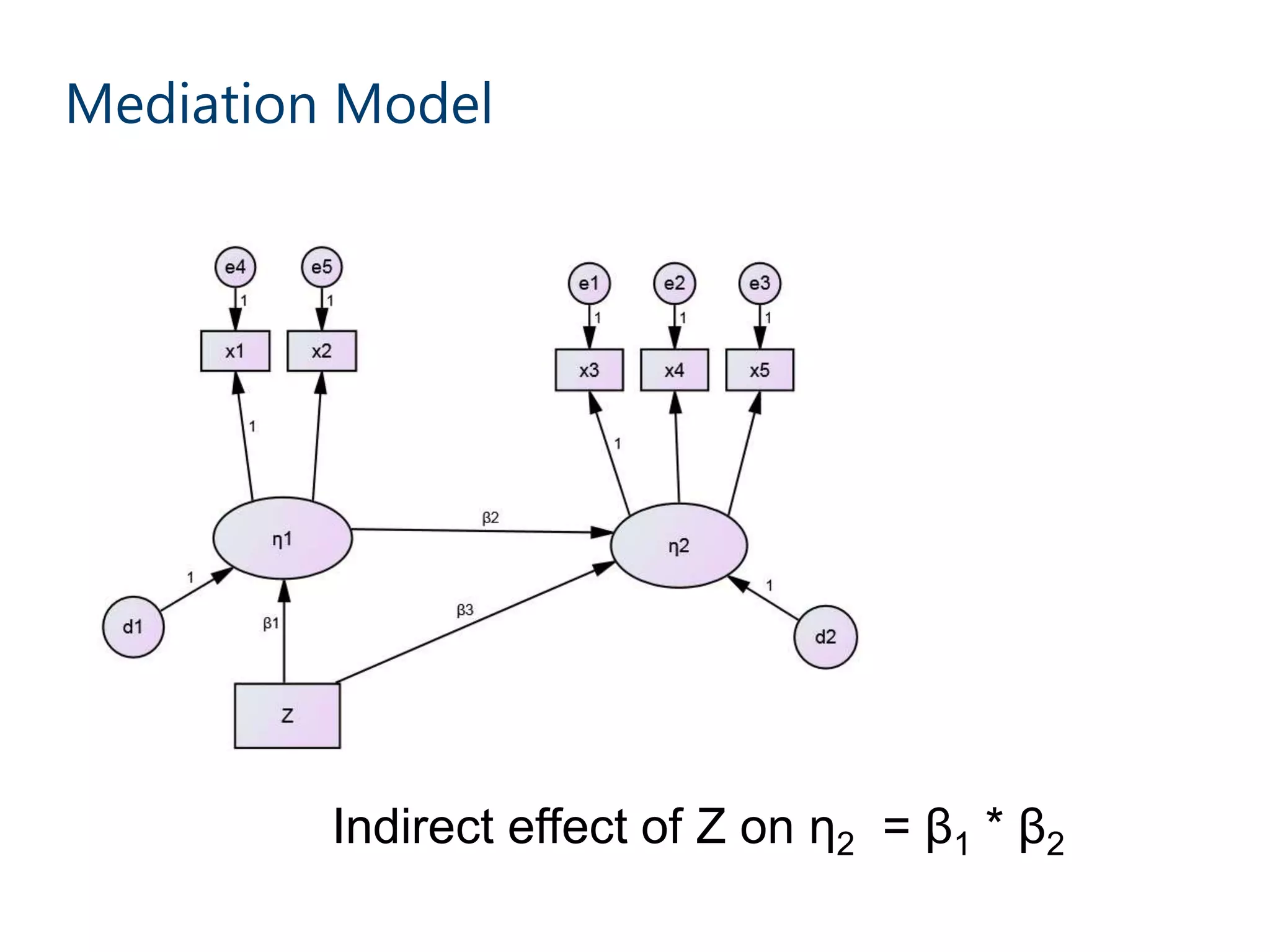
Mediation Model
Indirect effect of Z on η2 = β1 * β2
Mediation Model
Total effect of Z on η2 = β3 + (β1 * β2)
Perfect mediation when B3
non-significant after inclusion
of eta1
Partial mediation when B3
significantly lower after
Inclusion of eta1
standard errors for mediated paths
• Parametric approach is the ‘Delta method’
• Assumes normal coefficients
• Can also use non-parametric bootstrapping
• Resampling with replacement from sample data
generates empirical sampling distribution
• Need to use raw data, not covariance matrix
6
Example: Income, trust, happiness
7
Chi2=6; df=7; p=.571;
RMSEA=0; CFI=1
Data: European Social Survey 2004, GB only
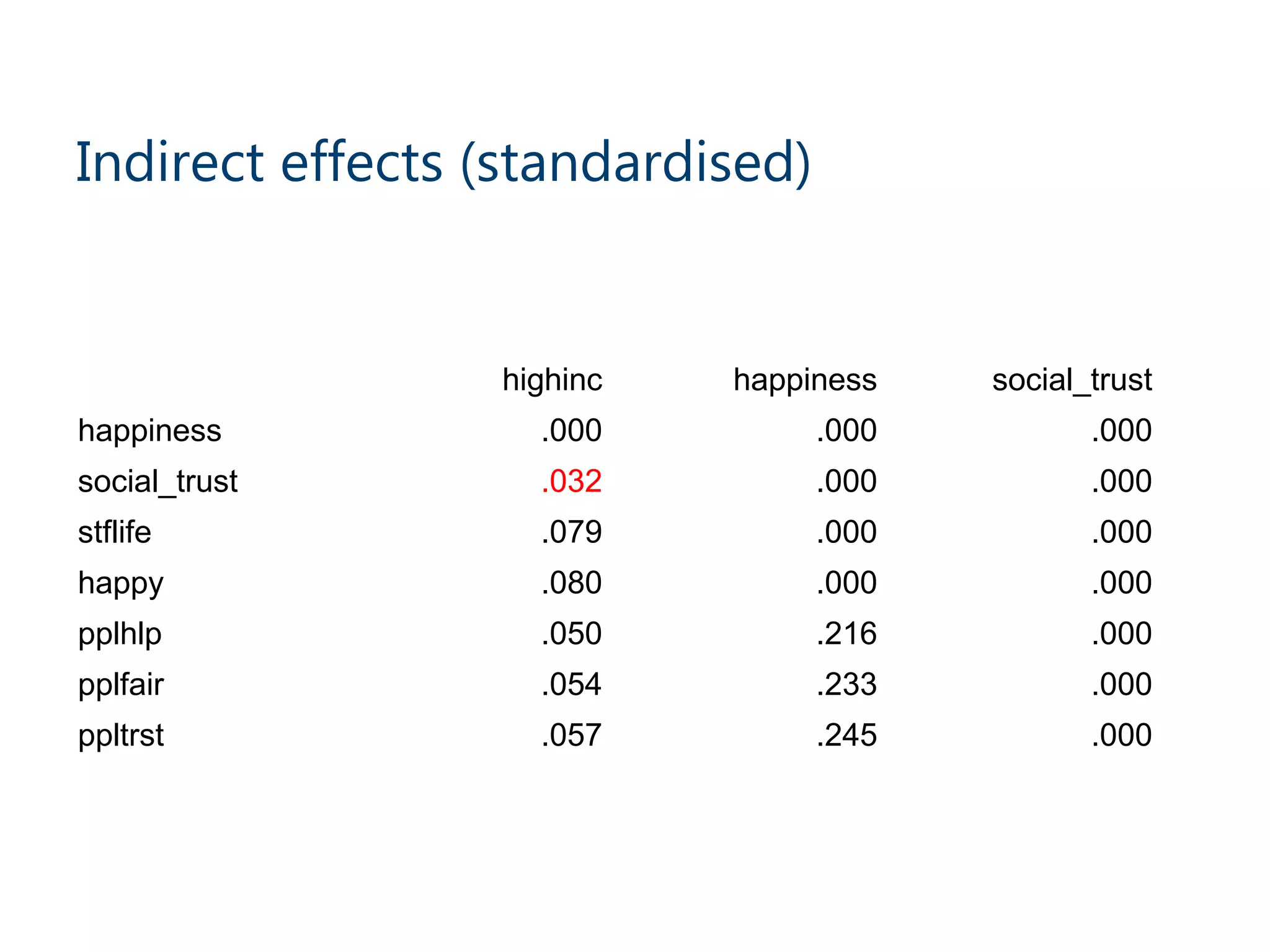
Indirect effects (standardised)
highinc happiness social_trust
happiness .000 .000 .000
social_trust .032 .000 .000
stflife .079 .000 .000
happy .080 .000 .000
pplhlp .050 .216 .000
pplfair .054 .233 .000
ppltrst .057 .245 .000
Indirect Effects - Two Tailed p values(BC)
highinc happiness social_trust
happiness ... ... ...
social_trust .004 ... ...
stflife .012 ... ...
happy .011 ... ...
pplhlp .019 .006 ...
pplfair .010 .010 ...
ppltrst .009 .005 ...
New Approaches to Mediation
• The approach considered here is limited to continuous
mediators
• Does not yield causal effect estimates, just decomposes
covariances
• More recent approaches based on counter-
factual/potential outcomes framework (Rubin 1978)
• G-computation (Muthen, 2011)
New Approaches to Mediation
• The approach considered here is limited to continuous
mediators
• Does not yield causal effect estimates, just decomposes
covariances
• More recent approaches based on counter-
factual/potential outcomes framework (Rubin 1978)
• G-computation (Muthen, 2011)

Mediation models

  • 1.
  • 2.
    Direct, Indirect &Total Effects • OLS models yield direct effects of predictors • Often, however, we are interested in indirect and total effects as well as direct effects • E.g. gaining a degree increases earnings – Does it do this by increasing skills/productivity? – Or is it just a ‘credential’? 2
  • 3.
  • 4.
    Mediation Model Indirect effectof Z on η2 = β1 * β2
  • 5.
    Mediation Model Total effectof Z on η2 = β3 + (β1 * β2) Perfect mediation when B3 non-significant after inclusion of eta1 Partial mediation when B3 significantly lower after Inclusion of eta1
  • 6.
    standard errors formediated paths • Parametric approach is the ‘Delta method’ • Assumes normal coefficients • Can also use non-parametric bootstrapping • Resampling with replacement from sample data generates empirical sampling distribution • Need to use raw data, not covariance matrix 6
  • 7.
    Example: Income, trust,happiness 7 Chi2=6; df=7; p=.571; RMSEA=0; CFI=1 Data: European Social Survey 2004, GB only
  • 8.
    Indirect effects (standardised) highinchappiness social_trust happiness .000 .000 .000 social_trust .032 .000 .000 stflife .079 .000 .000 happy .080 .000 .000 pplhlp .050 .216 .000 pplfair .054 .233 .000 ppltrst .057 .245 .000
  • 9.
    Indirect Effects -Two Tailed p values(BC) highinc happiness social_trust happiness ... ... ... social_trust .004 ... ... stflife .012 ... ... happy .011 ... ... pplhlp .019 .006 ... pplfair .010 .010 ... ppltrst .009 .005 ...
  • 10.
    New Approaches toMediation • The approach considered here is limited to continuous mediators • Does not yield causal effect estimates, just decomposes covariances • More recent approaches based on counter- factual/potential outcomes framework (Rubin 1978) • G-computation (Muthen, 2011)
  • 11.
    New Approaches toMediation • The approach considered here is limited to continuous mediators • Does not yield causal effect estimates, just decomposes covariances • More recent approaches based on counter- factual/potential outcomes framework (Rubin 1978) • G-computation (Muthen, 2011)