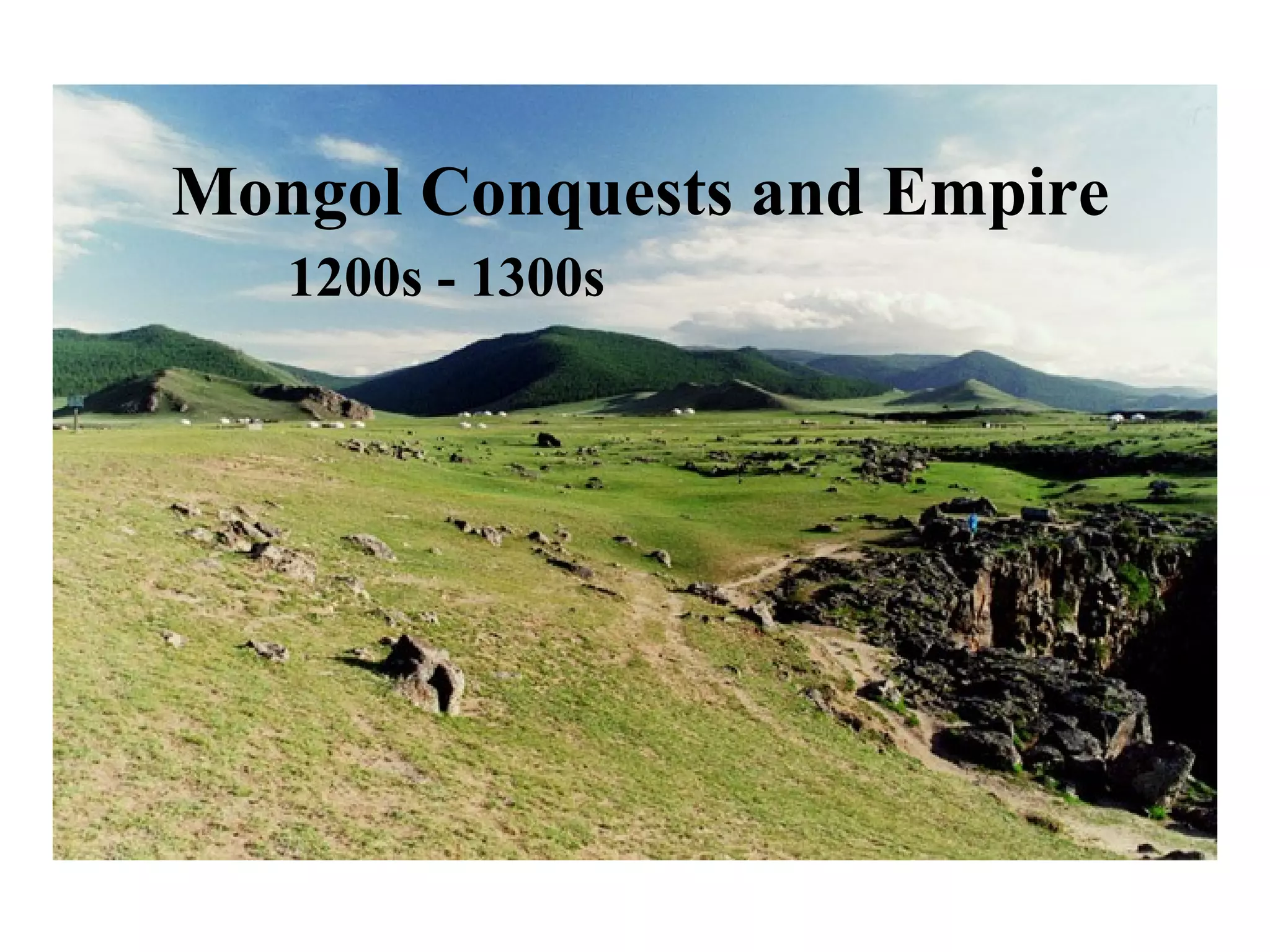
Mongol Conquests and Empire
1200s - 1300s

Mongol Conquests and Empire
1200s - 1300s
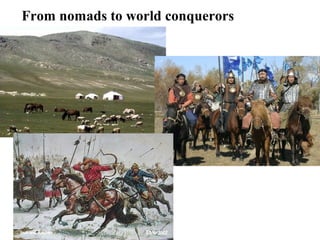
From nomads to world conquerors
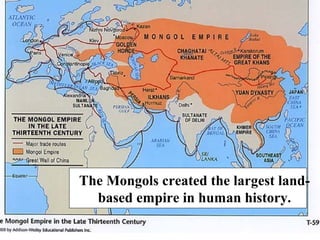
The Mongols created the largest landbased empire in human history.
Mongols and
other Central
Asian Nomads
characteristics

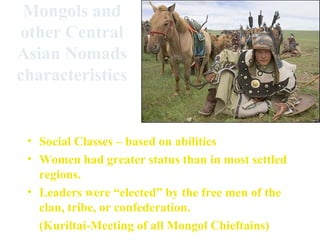
• Social Classes – based on abilities
• Women had greater status than in most settled
regions.
• Leaders were “elected” by the free men of the
clan, tribe, or confederation.
(Kuriltai-Meeting of all Mongol Chieftains)
Quote of the Day
“The greatest happiness is to scatter your
enemy, to see his cities reduced to ashes, to
see those who love him shrouded in tears,
and to carry off his wives and daughters.”
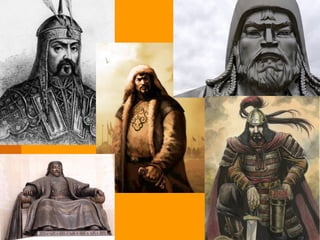
Temujin
(a.k.a. Chinggis Khan)
(a.k.a. Genghis Khan)
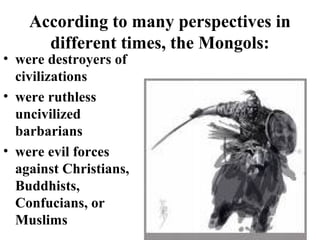
According to many perspectives in
different times, the Mongols:
• were destroyers of
civilizations
• were ruthless
uncivilized
barbarians
• were evil forces
against Christians,
Buddhists,
Confucians, or
Muslims
Generally speaking, the
Mongols:
•
•
•
•

Had few technological breakthroughs
Spread no new religions
Wrote few books and plays
Brought no new crops or agricultural
methods
• Left few artifacts and buildings
• Didn’t hold on to an empire very long
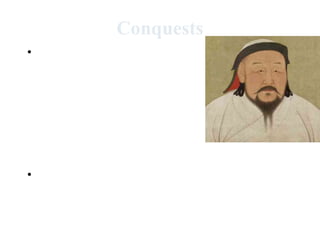
Conquests
• Under the leadership of
Chinggis Khan, the
combination of Mongol
discipline, technology,
strategy, and ruthlessness
helped the Mongols take
control of Central Asia, then
Northern China.
• By Chinggis Khan’s death in
1220s, Mongol armies had
moved west into the Islamic
lands and Central Europe.
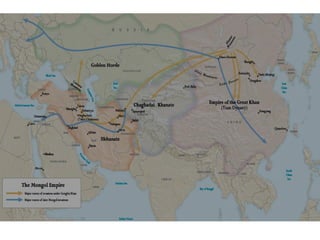
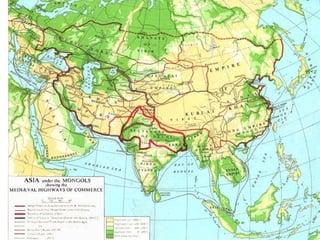
THE MONGOL EMPIREs
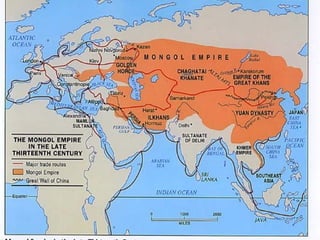
• Each KHANATE or kingdom then
worked to add territory and tributary
states to the empire which continued
under later Mongol leaders.
• Mongol control eventually spread into
Eastern Europe, the Middle East,
Central Asia, and all of China.
• The ruling class who survived often
continued to control aspects of their
territory under the “supervision” of
Mongol rulers.
Conquests
• After Chinggis Khan’s death, the
Mongol Empire was divided in four
parts controlled by 3 sons and a
grandson.
•
•
•
•

Khanate of the Golden Horde
Ilkanate
Djagatai (Chagtai)
Khanate of the Great Khan (and
Yuan dynasty)
IMPACT of the MONGOLS
• Death & Destruction!
–

•

Especially in Islamic Persia in Baghdad

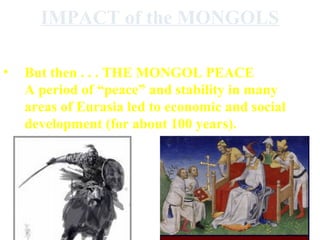
But then . . . THE MONGOL PEACE
A period of “peace” and stability in many
areas of Eurasia led to economic and social
development (for about 100 years).
Trade & Infrastructure
Mongol rulers . . .
• protected travel and trade routes in the
Empire
• People moved to new places for Mongol
government and military posts
• ordered construction of roads & BRIDGES,
and extended the Grand Canal in China
• set up post offices/trading posts
• Skilled workers and artisans disbursed
throughout the Empire
SILK ROADs REVIVED!
Mongol rule allowed an “exchange of food,
tools, goods, and ideas [that] was
unprecedented.”
• Chinese goods and ideas flowed westward(painting,
printing, gunpowder, compass, high temp furnaces,
& medical techniques)!
• East and West were more connected
• Plants and crops circulated
• Touched nearly all parts of the known world.
• Europeans gained more than most!
Those dirty Mongols!
•

Spread the use of gunpowder in military uses

•

Destroyed the Song dynasty, the Abbasid
Dynasty, the agriculture of some of the
Middle East

•

Spread the Bubonic Plague or Black Death
beginning in the 1330s and lasting for several
decades(labor shortage in Europe)!
(and Mongol culture didn’t have an impact on
the culture of settled civilizations)
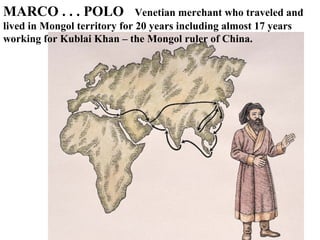
MARCO . . . POLO

Venetian merchant who traveled and
lived in Mongol territory for 20 years including almost 17 years
working for Kublai Khan – the Mongol ruler of China.
MARCO . . . POLO writes about the
Central Asia Nomads
• Write a SOAP analysis in your notebook for Marco
Polo.
– Speaker, Occasion, Audience, Purpose
– WHAT CAUSED Marco Polo to have the point of view he
had on the Mongols?

• Analyze similarities between the Mongols and other
civilizations and write them in your notebook.
For example: Both the Mongols and Arabs were nomadic.

• Write the most unusual characteristics of the Mongols as
reported by Marco Polo.
MARCO . . . POLO writes about the
Central Asia Nomads
• Marco Polo wrote this account many years after his
trip so his recollections may not be completely
accurate after years.
• The details that Marco Polo uses in his description
show that his point of view is based on a long period
of living with and interacting with the Mongols.
• Marco Polo’s purpose in telling his story was simply
to record the events he remembered for other
European elites. This probably caused him be as
accurate as possible. He may, however, have
focused on things that he thought might impress
Europeans who read the journal.

Lecture mongolconquests

  • 1.
    Mongol Conquests andEmpire 1200s - 1300s Mongol Conquests and Empire 1200s - 1300s
  • 2.
    From nomads toworld conquerors
  • 4.
    The Mongols createdthe largest landbased empire in human history.
  • 5.
    Mongols and other Central AsianNomads characteristics • Social Classes – based on abilities • Women had greater status than in most settled regions. • Leaders were “elected” by the free men of the clan, tribe, or confederation. (Kuriltai-Meeting of all Mongol Chieftains)
  • 6.
    Quote of theDay “The greatest happiness is to scatter your enemy, to see his cities reduced to ashes, to see those who love him shrouded in tears, and to carry off his wives and daughters.” Temujin (a.k.a. Chinggis Khan) (a.k.a. Genghis Khan)
  • 8.
    According to manyperspectives in different times, the Mongols: • were destroyers of civilizations • were ruthless uncivilized barbarians • were evil forces against Christians, Buddhists, Confucians, or Muslims
  • 9.
    Generally speaking, the Mongols: • • • • Hadfew technological breakthroughs Spread no new religions Wrote few books and plays Brought no new crops or agricultural methods • Left few artifacts and buildings • Didn’t hold on to an empire very long
  • 10.
    Conquests • Under theleadership of Chinggis Khan, the combination of Mongol discipline, technology, strategy, and ruthlessness helped the Mongols take control of Central Asia, then Northern China. • By Chinggis Khan’s death in 1220s, Mongol armies had moved west into the Islamic lands and Central Europe.
  • 11.
    THE MONGOL EMPIREs •Each KHANATE or kingdom then worked to add territory and tributary states to the empire which continued under later Mongol leaders. • Mongol control eventually spread into Eastern Europe, the Middle East, Central Asia, and all of China. • The ruling class who survived often continued to control aspects of their territory under the “supervision” of Mongol rulers.
  • 12.
    Conquests • After ChinggisKhan’s death, the Mongol Empire was divided in four parts controlled by 3 sons and a grandson. • • • • Khanate of the Golden Horde Ilkanate Djagatai (Chagtai) Khanate of the Great Khan (and Yuan dynasty)
  • 14.
    IMPACT of theMONGOLS • Death & Destruction! – • Especially in Islamic Persia in Baghdad But then . . . THE MONGOL PEACE A period of “peace” and stability in many areas of Eurasia led to economic and social development (for about 100 years).
  • 15.
    Trade & Infrastructure Mongolrulers . . . • protected travel and trade routes in the Empire • People moved to new places for Mongol government and military posts • ordered construction of roads & BRIDGES, and extended the Grand Canal in China • set up post offices/trading posts • Skilled workers and artisans disbursed throughout the Empire
  • 16.
    SILK ROADs REVIVED! Mongolrule allowed an “exchange of food, tools, goods, and ideas [that] was unprecedented.” • Chinese goods and ideas flowed westward(painting, printing, gunpowder, compass, high temp furnaces, & medical techniques)! • East and West were more connected • Plants and crops circulated • Touched nearly all parts of the known world. • Europeans gained more than most!
  • 18.
    Those dirty Mongols! • Spreadthe use of gunpowder in military uses • Destroyed the Song dynasty, the Abbasid Dynasty, the agriculture of some of the Middle East • Spread the Bubonic Plague or Black Death beginning in the 1330s and lasting for several decades(labor shortage in Europe)! (and Mongol culture didn’t have an impact on the culture of settled civilizations)
  • 19.
    MARCO . .. POLO Venetian merchant who traveled and lived in Mongol territory for 20 years including almost 17 years working for Kublai Khan – the Mongol ruler of China.
  • 20.
    MARCO . .. POLO writes about the Central Asia Nomads • Write a SOAP analysis in your notebook for Marco Polo. – Speaker, Occasion, Audience, Purpose – WHAT CAUSED Marco Polo to have the point of view he had on the Mongols? • Analyze similarities between the Mongols and other civilizations and write them in your notebook. For example: Both the Mongols and Arabs were nomadic. • Write the most unusual characteristics of the Mongols as reported by Marco Polo.
  • 21.
    MARCO . .. POLO writes about the Central Asia Nomads • Marco Polo wrote this account many years after his trip so his recollections may not be completely accurate after years. • The details that Marco Polo uses in his description show that his point of view is based on a long period of living with and interacting with the Mongols. • Marco Polo’s purpose in telling his story was simply to record the events he remembered for other European elites. This probably caused him be as accurate as possible. He may, however, have focused on things that he thought might impress Europeans who read the journal.