Longest Common
Subsequence
Krishma Parekh
5th -C.E.
140210107039
What is
Subsequences ?
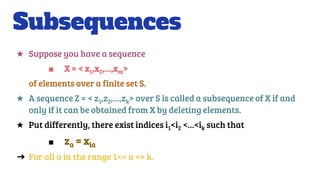
Subsequences
★ Suppose you have a sequence
■ X = < x1,x2,…,xm>
of elements over a finite set S.
★ A sequence Z = < z1,z2,…,zk> over S is called a subsequence of X if and
only if it can be obtained from X by deleting elements.
★ Put differently, there exist indices i1<i2 <…<ik such that
■ za = xia
➔ For all a in the range 1<= a <= k.
What is
Common
Subsequences ?
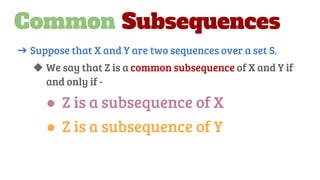
Common Subsequences
➔ Suppose that X and Y are two sequences over a set S.
◆ We say that Z is a common subsequence of X and Y if
and only if -
● Z is a subsequence of X
● Z is a subsequence of Y
What is
Longest Common
Subsequences ?
Longest Common
Subsequences
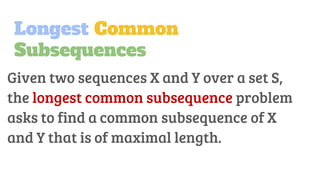
Given two sequences X and Y over a set S,
the longest common subsequence problem
asks to find a common subsequence of X
and Y that is of maximal length.
Naive Solution !!!
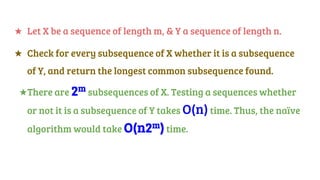
★ Let X be a sequence of length m, & Y a sequence of length n.
★ Check for every subsequence of X whether it is a subsequence
of Y, and return the longest common subsequence found.
★There are 2m subsequences of X. Testing a sequences whether
or not it is a subsequence of Y takes O(n)time. Thus, the naïve
algorithm would take O(n2m)time.
Optimal
Substructure
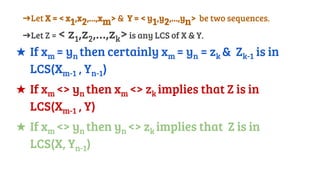
➔Let X = < x1,x2,…,xm> & Y = < y1,y2,…,yn> be two sequences.
➔Let Z = < z1,z2,…,zk>is any LCS of X & Y.
★ If xm = yn then certainly xm = yn = zk & Zk-1 is in
LCS(Xm-1 , Yn-1)
★ If xm <> yn then xm <> zk implies that Z is in
LCS(Xm-1 , Y)
★ If xm <> yn then yn <> zk implies that Z is in
LCS(X, Yn-1)
Recursive Solution
c[i,j] =
Dynamic
Programming
Solution
➔ To compute length of an element in LCS(X,Y) with
X of length m& Y of length n, we do the following:
1. Initialize first row and first column of the array c with 0.
2. Calculate c[1,j] for 1 <= j <= n,c[2,j] for 1 <= j <= n...
3. Return c[m,n]
4. Complexity O(mn)
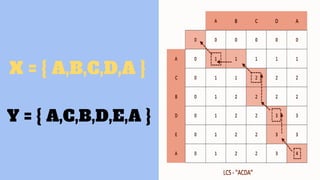
Example
X = { A,B,C,D,A }
Y = { A,C,B,D,E,A }
Algorithm
m  length[X]
n  length[Y]
for i  1 to m do
c[i,0]  0
for j  1 to n do
c[0,j]  0
for i  1 to m do
for j  1 to n do
if xi = yj
c[i, j]  c[i-1,j-1]+1
b[i, j]  “D”
else
if c[i-1, j] >= c[i, j-1]
c[i, j]  c[i-1, j]
b[i, j]  “U”
else
c[i, j]  c[i, j-1]
b[i, j]  “L”
return c and b
LCS(X,Y)
Longest Common Subsequence

Longest Common Subsequence

  • 1.
  • 2.
  • 3.
    Subsequences ★ Suppose youhave a sequence ■ X = < x1,x2,…,xm> of elements over a finite set S. ★ A sequence Z = < z1,z2,…,zk> over S is called a subsequence of X if and only if it can be obtained from X by deleting elements. ★ Put differently, there exist indices i1<i2 <…<ik such that ■ za = xia ➔ For all a in the range 1<= a <= k.
  • 4.
  • 5.
    Common Subsequences ➔ Supposethat X and Y are two sequences over a set S. ◆ We say that Z is a common subsequence of X and Y if and only if - ● Z is a subsequence of X ● Z is a subsequence of Y
  • 6.
  • 7.
    Longest Common Subsequences Given twosequences X and Y over a set S, the longest common subsequence problem asks to find a common subsequence of X and Y that is of maximal length.
  • 8.
  • 9.
    ★ Let Xbe a sequence of length m, & Y a sequence of length n. ★ Check for every subsequence of X whether it is a subsequence of Y, and return the longest common subsequence found. ★There are 2m subsequences of X. Testing a sequences whether or not it is a subsequence of Y takes O(n)time. Thus, the naïve algorithm would take O(n2m)time.
  • 10.
  • 11.
    ➔Let X =< x1,x2,…,xm> & Y = < y1,y2,…,yn> be two sequences. ➔Let Z = < z1,z2,…,zk>is any LCS of X & Y. ★ If xm = yn then certainly xm = yn = zk & Zk-1 is in LCS(Xm-1 , Yn-1) ★ If xm <> yn then xm <> zk implies that Z is in LCS(Xm-1 , Y) ★ If xm <> yn then yn <> zk implies that Z is in LCS(X, Yn-1)
  • 12.
  • 13.
  • 14.
    ➔ To computelength of an element in LCS(X,Y) with X of length m& Y of length n, we do the following: 1. Initialize first row and first column of the array c with 0. 2. Calculate c[1,j] for 1 <= j <= n,c[2,j] for 1 <= j <= n... 3. Return c[m,n] 4. Complexity O(mn)
  • 15.
  • 16.
    X = {A,B,C,D,A } Y = { A,C,B,D,E,A }
  • 17.
  • 18.
    m  length[X] n length[Y] for i  1 to m do c[i,0]  0 for j  1 to n do c[0,j]  0 for i  1 to m do for j  1 to n do if xi = yj c[i, j]  c[i-1,j-1]+1 b[i, j]  “D” else if c[i-1, j] >= c[i, j-1] c[i, j]  c[i-1, j] b[i, j]  “U” else c[i, j]  c[i, j-1] b[i, j]  “L” return c and b LCS(X,Y)