Longest Common Subsequence
Subsequences
• A subsequence is a sequence that appears in the same
relative order, but not necessarily contiguous.
• In LCS ,we have to find Longest Common
Subsequence that is in the same relative order.
• String of length n has 2^n different possible
subsequences.
• E.g.—
• Subsequences of “ABCDEFG”.
• “ABC”,”ABG”,”BDF”,”AEG”,’ACEFG”,…….
2
Common Subsequences
Suppose that X and Y are two sequences
over a set S.
X: ABCBDAB
Y: BDCABA
Z: BCBA
We say that Z is a common subsequence
of X and Y if and only if
• Z is a subsequence of X
• Z is a subsequence of Y 3
The Longest Common
Subsequence Problem
Given two sequences X and Y over a set S,
the longest common subsequence problem
asks to find a common subsequence of X
and Y that is of maximal length.
Z= (B,C,A) Length 3
Z= (B,C,A,B) Length 4
Z= (B,D,A,B) Length 4
4
Longest
LCS Notation
Let X and Y be sequences.
We denote by LCS(X, Y) the set of
longest common subsequences of X and
Y.
LCS(X,Y)
Functional notation,
but not a function
5
6
A Poor Approach to the LCS
Problem
• A Brute-force solution:
• Enumerate all subsequences of X
• Test which ones are also subsequences of Y
• Pick the longest one.
• Analysis:
• If X is of length n, then it has 2n
subsequences
• This is an exponential-time algorithm!
Dynamic Programming
Let us try to develop a dynamic
programming solution to the LCS problem.
7
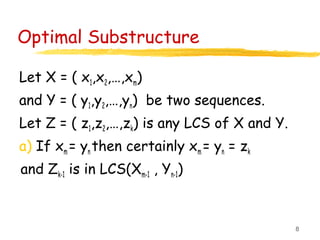
Optimal Substructure
Let X = ( x1,x2,…,xm)
and Y = ( y1,y2,…,yn) be two sequences.
Let Z = ( z1,z2,…,zk) is any LCS of X and Y.
a) If xm = yn then certainly xm = yn = zk
and Zk-1 is in LCS(Xm-1 , Yn-1)
8
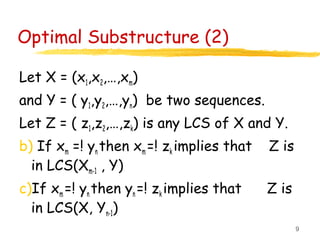
Optimal Substructure (2)
Let X = (x1,x2,…,xm)
and Y = ( y1,y2,…,yn) be two sequences.
Let Z = ( z1,z2,…,zk) is any LCS of X and Y.
b) If xm =! yn then xm =! zk implies that Z is
in LCS(Xm-1 , Y)
c)If xm =! yn then yn =! zk implies that Z is
in LCS(X, Yn-1)
9
Recursive Solution
Let X and Y be sequences.
Let c[i,j] be the length of an element in LCS(Xi, Yj).
c[i,j] =
10
Dynamic Programming Solution
• Define L[i,j] to be the length of the longest common
subsequence of X[0..i] and Y[0..j].
• L[i,j-1] = 0 and L[i-1,j]=0, to indicate that the null
part of X or Y has no match with the other.
• Then we can define L[i,j] in the general case as
follows:
1. If xi=yj, then L[i,j] = L[i-1,j-1] + 1 (we can add this
match)
2. If xi≠yj, then L[i,j] = max{L[i-1,j], L[i,j-1]} (we
have no match here)
X:ABCB
Y:BDCA LCS:BC 11
Dynamic Programming Solution (2)
How can we get an actual longest common
subsequence?
Store in addition to the array c an array
b pointing to the optimal subproblem
chosen when computing c[i,j].
12
13
Example
T yj B D C A
Xi 0 0 0 0 0
A 0 0 0 0 1
B 0 1 1 1 1
C 0 1 1 2 2
B 0 1 1 2 2
Start at b[m,n]. Follow the arrows. Each
diagonal array gives one element of the LCS.
14
ALGORITHM
LCS(X,Y)
m ← length[X]
n ← length[Y]
for i ← 1 to m do
c[i,0] ← 0
for j ← 1 to n do
c[0,j] ← 0
15
LCS(X,Y)
for i ← 1 to m do
for j ← 1 to n do
if xi
= yj
c[i, j] ← c[i-1, j-1]+1
b[i, j] ← “D”
else
if c[i-1, j] ≥ c[i, j-1]
c[i, j] ← c[i-1, j]
b[i, j] ← “U”
else
c[i, j] ← c[i, j-1]
b[i, j] ← “L”
return c and b
CONSTRUCTING AN LCS
• PRINT-LCS(b, X, i, j)
1. If i=0 or j=0
2. then return
3.If b[i, j]=“D”
4. then PRINT- LCS(b,X,i-1,j-1)
5. print xi
6.Else if b[i, j]=“U”
7. then PRINT-LCS(b,X,i-1,j)
8.Else PRINT-LCS(b,X,i,j-1) 16
Analysis of LCS Algorithm
• We have two nested loops
• The outer one iterates n times
• The inner one iterates m times
• A constant amount of work is done inside
each iteration of the inner loop
• Thus, the total running time is O(nm)
• Answer is contained in L[n,m] (and the
subsequence can be recovered from the
T table).
17
usage
• Biological applications often need to
compare the DNA of two (or more)
different organisms.
• We can say that two DNA strands are
similar if one is a substring of the
other.
18

Longest common subsequence(dynamic programming).

  • 1.
  • 2.
    Subsequences • A subsequenceis a sequence that appears in the same relative order, but not necessarily contiguous. • In LCS ,we have to find Longest Common Subsequence that is in the same relative order. • String of length n has 2^n different possible subsequences. • E.g.— • Subsequences of “ABCDEFG”. • “ABC”,”ABG”,”BDF”,”AEG”,’ACEFG”,……. 2
  • 3.
    Common Subsequences Suppose thatX and Y are two sequences over a set S. X: ABCBDAB Y: BDCABA Z: BCBA We say that Z is a common subsequence of X and Y if and only if • Z is a subsequence of X • Z is a subsequence of Y 3
  • 4.
    The Longest Common SubsequenceProblem Given two sequences X and Y over a set S, the longest common subsequence problem asks to find a common subsequence of X and Y that is of maximal length. Z= (B,C,A) Length 3 Z= (B,C,A,B) Length 4 Z= (B,D,A,B) Length 4 4 Longest
  • 5.
    LCS Notation Let Xand Y be sequences. We denote by LCS(X, Y) the set of longest common subsequences of X and Y. LCS(X,Y) Functional notation, but not a function 5
  • 6.
    6 A Poor Approachto the LCS Problem • A Brute-force solution: • Enumerate all subsequences of X • Test which ones are also subsequences of Y • Pick the longest one. • Analysis: • If X is of length n, then it has 2n subsequences • This is an exponential-time algorithm!
  • 7.
    Dynamic Programming Let ustry to develop a dynamic programming solution to the LCS problem. 7
  • 8.
    Optimal Substructure Let X= ( x1,x2,…,xm) and Y = ( y1,y2,…,yn) be two sequences. Let Z = ( z1,z2,…,zk) is any LCS of X and Y. a) If xm = yn then certainly xm = yn = zk and Zk-1 is in LCS(Xm-1 , Yn-1) 8
  • 9.
    Optimal Substructure (2) LetX = (x1,x2,…,xm) and Y = ( y1,y2,…,yn) be two sequences. Let Z = ( z1,z2,…,zk) is any LCS of X and Y. b) If xm =! yn then xm =! zk implies that Z is in LCS(Xm-1 , Y) c)If xm =! yn then yn =! zk implies that Z is in LCS(X, Yn-1) 9
  • 10.
    Recursive Solution Let Xand Y be sequences. Let c[i,j] be the length of an element in LCS(Xi, Yj). c[i,j] = 10
  • 11.
    Dynamic Programming Solution •Define L[i,j] to be the length of the longest common subsequence of X[0..i] and Y[0..j]. • L[i,j-1] = 0 and L[i-1,j]=0, to indicate that the null part of X or Y has no match with the other. • Then we can define L[i,j] in the general case as follows: 1. If xi=yj, then L[i,j] = L[i-1,j-1] + 1 (we can add this match) 2. If xi≠yj, then L[i,j] = max{L[i-1,j], L[i,j-1]} (we have no match here) X:ABCB Y:BDCA LCS:BC 11
  • 12.
    Dynamic Programming Solution(2) How can we get an actual longest common subsequence? Store in addition to the array c an array b pointing to the optimal subproblem chosen when computing c[i,j]. 12
  • 13.
    13 Example T yj BD C A Xi 0 0 0 0 0 A 0 0 0 0 1 B 0 1 1 1 1 C 0 1 1 2 2 B 0 1 1 2 2 Start at b[m,n]. Follow the arrows. Each diagonal array gives one element of the LCS.
  • 14.
    14 ALGORITHM LCS(X,Y) m ← length[X] n← length[Y] for i ← 1 to m do c[i,0] ← 0 for j ← 1 to n do c[0,j] ← 0
  • 15.
    15 LCS(X,Y) for i ←1 to m do for j ← 1 to n do if xi = yj c[i, j] ← c[i-1, j-1]+1 b[i, j] ← “D” else if c[i-1, j] ≥ c[i, j-1] c[i, j] ← c[i-1, j] b[i, j] ← “U” else c[i, j] ← c[i, j-1] b[i, j] ← “L” return c and b
  • 16.
    CONSTRUCTING AN LCS •PRINT-LCS(b, X, i, j) 1. If i=0 or j=0 2. then return 3.If b[i, j]=“D” 4. then PRINT- LCS(b,X,i-1,j-1) 5. print xi 6.Else if b[i, j]=“U” 7. then PRINT-LCS(b,X,i-1,j) 8.Else PRINT-LCS(b,X,i,j-1) 16
  • 17.
    Analysis of LCSAlgorithm • We have two nested loops • The outer one iterates n times • The inner one iterates m times • A constant amount of work is done inside each iteration of the inner loop • Thus, the total running time is O(nm) • Answer is contained in L[n,m] (and the subsequence can be recovered from the T table). 17
  • 18.
    usage • Biological applicationsoften need to compare the DNA of two (or more) different organisms. • We can say that two DNA strands are similar if one is a substring of the other. 18