Network Switching
Aung Thu Rha Hein (g5536871)
2nd March 2014
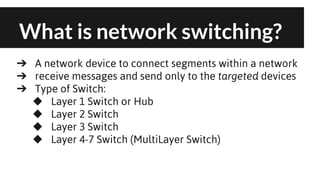
What is network switching?
➔ A network device to connect segments within a network
➔ receive messages and send only to the targeted devices
➔ Type of Switch:
◆ Layer 1 Switch or Hub
◆ Layer 2 Switch
◆ Layer 3 Switch
◆ Layer 4-7 Switch (MultiLayer Switch)
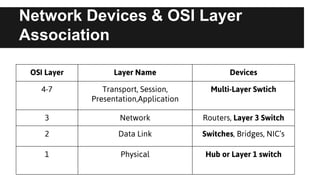
Network Devices & OSI Layer
Association
OSI Layer

Layer Name

Devices

4-7

Transport, Session,
Presentation,Application

Multi-Layer Swtich

3

Network

Routers, Layer 3 Switch

2

Data Link

Switches, Bridges, NIC’s

1

Physical

Hub or Layer 1 switch
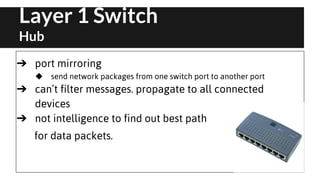
Layer 1 Switch
Hub
➔ port mirroring
◆

send network packages from one switch port to another port

➔ can’t filter messages. propagate to all connected
devices
➔ not intelligence to find out best path
for data packets.
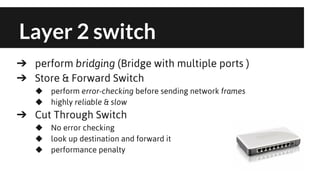
Layer 2 switch
➔ perform bridging (Bridge with multiple ports )
➔ Store & Forward Switch
◆
◆

perform error-checking before sending network frames
highly reliable & slow

➔ Cut Through Switch
◆
◆
◆

No error checking
look up destination and forward it
performance penalty
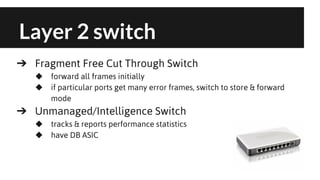
Layer 2 switch
➔ Fragment Free Cut Through Switch
◆
◆

forward all frames initially
if particular ports get many error frames, switch to store & forward
mode

➔ Unmanaged/Intelligence Switch
◆
◆

tracks & reports performance statistics
have DB ASIC
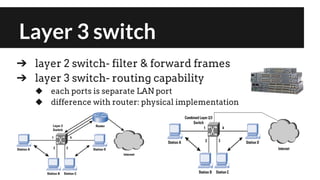
Layer 3 switch
➔ layer 2 switch- filter & forward frames
➔ layer 3 switch- routing capability
◆
◆

each ports is separate LAN port
difference with router: physical implementation
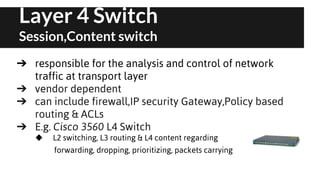
Layer 4 Switch
Session,Content switch
➔ responsible for the analysis and control of network
traffic at transport layer
➔ vendor dependent
➔ can include firewall,IP security Gateway,Policy based
routing & ACLs
➔ E.g. Cisco 3560 L4 Switch
◆

L2 switching, L3 routing & L4 content regarding
forwarding, dropping, prioritizing, packets carrying
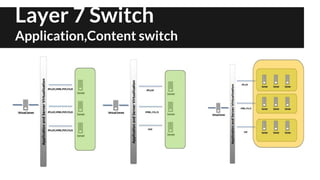
Layer 7 Switch
Application,Content switch
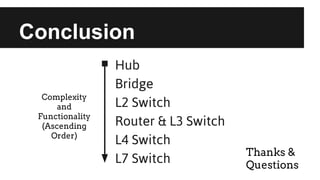
Conclusion
Complexity
and
Functionality
(Ascending
Order)

Hub
Bridge
L2 Switch
Router & L3 Switch
L4 Switch
L7 Switch

Thanks &
Questions

Network switching

  • 1.
    Network Switching Aung ThuRha Hein (g5536871) 2nd March 2014
  • 2.
    What is networkswitching? ➔ A network device to connect segments within a network ➔ receive messages and send only to the targeted devices ➔ Type of Switch: ◆ Layer 1 Switch or Hub ◆ Layer 2 Switch ◆ Layer 3 Switch ◆ Layer 4-7 Switch (MultiLayer Switch)
  • 3.
    Network Devices &OSI Layer Association OSI Layer Layer Name Devices 4-7 Transport, Session, Presentation,Application Multi-Layer Swtich 3 Network Routers, Layer 3 Switch 2 Data Link Switches, Bridges, NIC’s 1 Physical Hub or Layer 1 switch
  • 4.
    Layer 1 Switch Hub ➔port mirroring ◆ send network packages from one switch port to another port ➔ can’t filter messages. propagate to all connected devices ➔ not intelligence to find out best path for data packets.
  • 5.
    Layer 2 switch ➔perform bridging (Bridge with multiple ports ) ➔ Store & Forward Switch ◆ ◆ perform error-checking before sending network frames highly reliable & slow ➔ Cut Through Switch ◆ ◆ ◆ No error checking look up destination and forward it performance penalty
  • 6.
    Layer 2 switch ➔Fragment Free Cut Through Switch ◆ ◆ forward all frames initially if particular ports get many error frames, switch to store & forward mode ➔ Unmanaged/Intelligence Switch ◆ ◆ tracks & reports performance statistics have DB ASIC
  • 7.
    Layer 3 switch ➔layer 2 switch- filter & forward frames ➔ layer 3 switch- routing capability ◆ ◆ each ports is separate LAN port difference with router: physical implementation
  • 8.
    Layer 4 Switch Session,Contentswitch ➔ responsible for the analysis and control of network traffic at transport layer ➔ vendor dependent ➔ can include firewall,IP security Gateway,Policy based routing & ACLs ➔ E.g. Cisco 3560 L4 Switch ◆ L2 switching, L3 routing & L4 content regarding forwarding, dropping, prioritizing, packets carrying
  • 9.
  • 10.