Spanos

EE290H F05

CUSUM, MA and EWMA Control Charts

Increasing the sensitivity and getting ready for
automated control:
The Cumulative Sum chart, the Moving
Average and the Exponentially Weighted
Moving Average Charts.

Lecture 14: CUSUM and EWMA

1
Spanos

EE290H F05

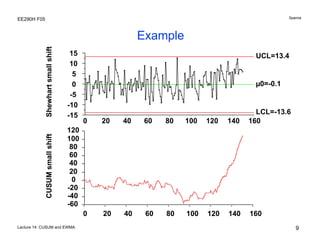
Shewhart Charts cannot detect small shifts
The charts discussed so far are variations of the Shewhart
chart: each new point depends only on one subgroup.
Shewhart charts are sensitive to large process shifts.
The probability of detecting small shifts fast is rather small:

Fig 6-13 pp 195 Montgomery.

Lecture 14: CUSUM and EWMA

2
Spanos

EE290H F05

Cumulative-Sum Chart

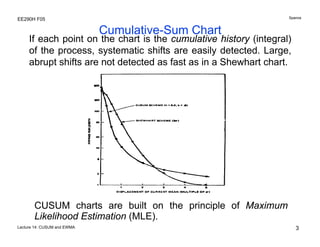
If each point on the chart is the cumulative history (integral)
of the process, systematic shifts are easily detected. Large,
abrupt shifts are not detected as fast as in a Shewhart chart.

CUSUM charts are built on the principle of Maximum
Likelihood Estimation (MLE).
Lecture 14: CUSUM and EWMA

3
Spanos

EE290H F05

Maximum Likelihood Estimation
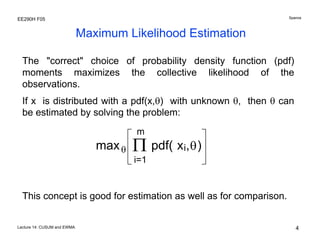
The "correct" choice of probability density function (pdf)
moments maximizes the collective likelihood of the
observations.
If x is distributed with a pdf(x,θ) with unknown θ, then θ can
be estimated by solving the problem:
m

max θ

Π pdf( xi,θ )
i=1

This concept is good for estimation as well as for comparison.

Lecture 14: CUSUM and EWMA

4
Spanos

EE290H F05

Maximum Likelihood Estimation Example
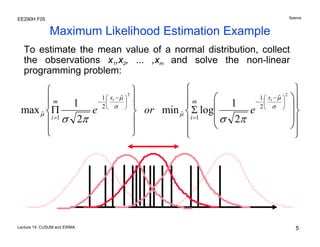
To estimate the mean value of a normal distribution, collect
the observations x1,x2, ... ,xm and solve the non-linear
programming problem:

⎧
⎫
⎧
2 ⎫
2
ˆ
ˆ
1 ⎛ x −μ ⎞
1 ⎛ x −μ ⎞ ⎞
⎛ 1
⎪m
⎪
m
− ⎜ i
− ⎜ i
⎟ ⎪
⎟
⎪
1
⎪
2⎝ σ ⎠
2 ⎝ σ ⎠ ⎟⎪
⎜
max μ ⎨Π
e
e
⎬ or min μ ⎨iΣ1 log⎜
ˆ
ˆ
⎟⎬
i =1 σ 2π
=
σ 2π
⎪
⎪
⎪
⎝
⎠⎪
⎪
⎪
⎩
⎭
⎩
⎭

Lecture 14: CUSUM and EWMA

5
Spanos

EE290H F05

MLE Control Schemes
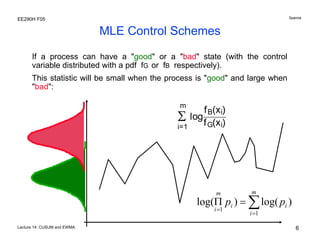
If a process can have a "good" or a "bad" state (with the control
variable distributed with a pdf fG or fB respectively).
This statistic will be small when the process is "good" and large when
"bad":
m

f B(x i)
Σ log f G(xi)
i=1

m

m

log(Π pi ) = ∑ log( pi )
i =1

Lecture 14: CUSUM and EWMA

i =1

6
Spanos

EE290H F05

MLE Control Schemes (cont.)
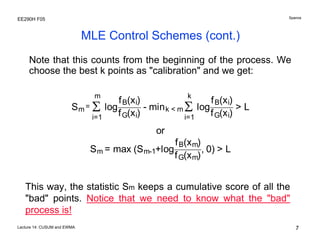
Note that this counts from the beginning of the process. We
choose the best k points as "calibration" and we get:
m

k

f B(x i)
f B(x i)
S m = Σ log
- min k < m Σ log
>L
f G(x i)
f G(x i)
i=1
i=1
or
f B(x m)
S m = max (S m-1+log
, 0) > L
f G(x m)
This way, the statistic Sm keeps a cumulative score of all the
"bad" points. Notice that we need to know what the "bad"
process is!
Lecture 14: CUSUM and EWMA

7
Spanos

EE290H F05

The Cumulative Sum chart
If θ is a mean value of a normal distribution, is simplified to:
m

S m = Σ (x i - µ 0)
i=1

where μ0 is the target mean of the process. This can be
monitored with V-shaped or tabular “limits”.
Advantages
The CUSUM chart is very effective for small shifts and
when the subgroup size n=1.
Disadvantages
The CUSUM is relatively slow to respond to large shifts.
Also, special patterns are hard to see and analyze.
Lecture 14: CUSUM and EWMA

8
Spanos

EE290H F05

Shewhart small shift

Example
15
10
5
0
-5
-10
-15

UCL=13.4

µ0=-0.1

20

40

60

80

100

120

140

0

CUSUM small shift

0

LCL=-13.6
160

20

40

60

80

100

120

140

160

120
100
80
60
40
20
0
-20
-40
-60

Lecture 14: CUSUM and EWMA

9
Spanos

EE290H F05

The V-Mask CUSUM design
for standardized observations yi=(xi-μo)/σ

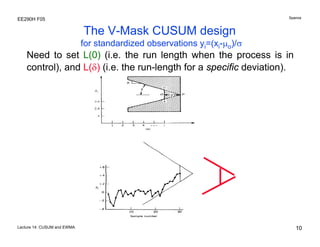
Need to set L(0) (i.e. the run length when the process is in
control), and L(δ) (i.e. the run-length for a specific deviation).

Figure 7-3 Montgomery pp 227

Lecture 14: CUSUM and EWMA

10
Spanos

EE290H F05

The V-Mask CUSUM design
for standardized observations yi=(xi-μo)/σ
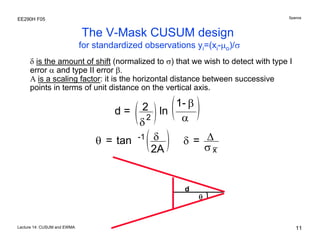
δ is the amount of shift (normalized to σ) that we wish to detect with type I
error α and type II error β.
Α is a scaling factor: it is the horizontal distance between successive
points in terms of unit distance on the vertical axis.

2 ln 1- β
d=
2
α
δ
δ= Δ
θ = tan -1 δ
σx
2A

d

Lecture 14: CUSUM and EWMA

θ

11
Spanos

EE290H F05

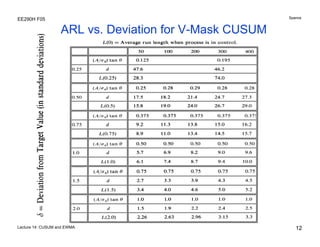
ARL vs. Deviation for V-Mask CUSUM

Lecture 14: CUSUM and EWMA

12
Spanos

EE290H F05

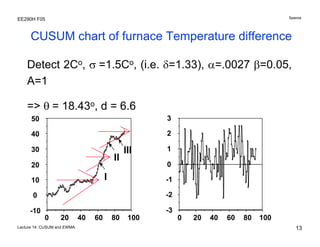
CUSUM chart of furnace Temperature difference
Detect 2Co, σ =1.5Co, (i.e. δ=1.33), α=.0027 β=0.05,
A=1
=> θ = 18.43o, d = 6.6
50

3

40

2

30

II

20

III

0

I

10

1

-1

0

-2

-10

-3
0

20

Lecture 14: CUSUM and EWMA

40

60

80

100

0

20

40

60

80

100
13
Spanos

EE290H F05

Tabular CUSUM
A tabular form is easier to implement in a CAM system
Ci+ = max [ 0, xi - ( μo + k ) + Ci-1+ ]
Ci-

= max [ 0, ( μo - k ) - xi +

h

Ci-1-

]

d

θ

C0+ = C0- = 0
k = (δ/2)/σ
h = dσxtan(θ)

Lecture 14: CUSUM and EWMA

14
Spanos

EE290H F05

Tabular CUSUM Example

Lecture 14: CUSUM and EWMA

15
Spanos

EE290H F05

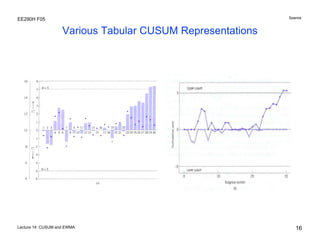
Various Tabular CUSUM Representations

Lecture 14: CUSUM and EWMA

16
Spanos

EE290H F05

CUSUM Enhancements
To speed up CUSUM response one can use "modified" V
masks:
15
10
5
0
-5
0

20

40

60

80

100

Other solutions include the application of Fast Initial
Response (FIR) CUSUM, or the use of combined CUSUMShewhart charts.
Lecture 14: CUSUM and EWMA

17
Spanos

EE290H F05

General MLE Control Schemes
Since the MLE principle is so general, control
schemes can be built to detect:
• single or multivariate deviation in means
• deviation in variances
• deviation in covariances
An important point to remember is that MLE
schemes need, implicitly or explicitly, a definition of
the "bad" process.
The calculation of the ARL is complex but possible.

Lecture 14: CUSUM and EWMA

18
Spanos

EE290H F05

Control Charts Based on Weighted Averages
Small shifts can be detected more easily when multiple
samples are combined.
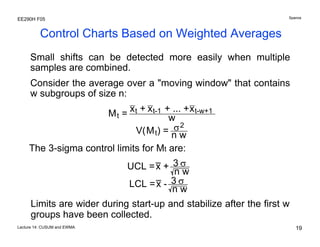
Consider the average over a "moving window" that contains
w subgroups of size n:
Mt =

x t + x t-1 + ... +x t-w+1
w
σ2
V(M t) = n w

The 3-sigma control limits for Mt are:
UCL = x + 3 σ
nw
LCL = x - 3 σ
nw

Limits are wider during start-up and stabilize after the first w
groups have been collected.
Lecture 14: CUSUM and EWMA

19
Spanos

EE290H F05

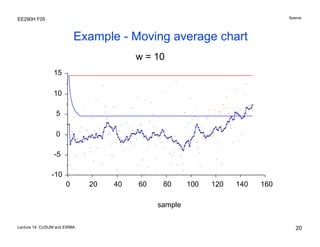
Example - Moving average chart
w = 10
15
10
5
0
-5
-10
0

20

40

60

80

100

120

140

160

sample
Lecture 14: CUSUM and EWMA

20
Spanos

EE290H F05

The Exponentially Weighted Moving Average
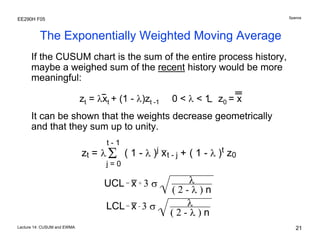
If the CUSUM chart is the sum of the entire process history,
maybe a weighed sum of the recent history would be more
meaningful:
zt = λxt + (1 - λ)zt -1

0 < λ < 1 z0 = x

It can be shown that the weights decrease geometrically
and that they sum up to unity.
t-1

z t = λ Σ ( 1 - λ )j x t - j + ( 1 - λ )t z 0
j=0

UCL = x + 3 σ
LCL = x - 3 σ
Lecture 14: CUSUM and EWMA

λ
(2-λ)n
λ
(2-λ)n
21
Spanos

EE290H F05

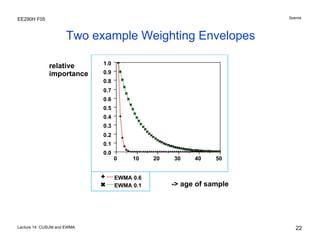
Two example Weighting Envelopes
relative
importance

1.0
0.9
0.8
0.7
0.6
0.5
0.4
0.3
0.2
0.1
0.0
0

10

EWMA 0.6
EWMA 0.1

Lecture 14: CUSUM and EWMA

20

30

40

50

-> age of sample

22
Spanos

EE290H F05

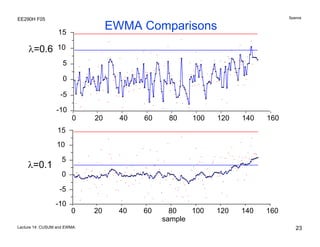
EWMA Comparisons

15

λ=0.6

10
5
0
-5
-10
0

20

40

60

0

20

40

60

80

100

120

140

160

80
100
sample

120

140

160

15
10

λ=0.1

5
0
-5
-10

Lecture 14: CUSUM and EWMA

23
Spanos

EE290H F05

Another View of the EWMA
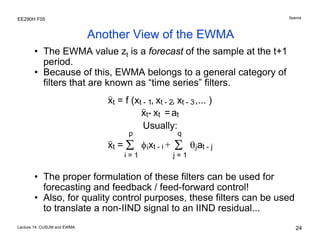
• The EWMA value zt is a forecast of the sample at the t+1
period.
• Because of this, EWMA belongs to a general category of
filters that are known as “time series” filters.
xt = f (xt - 1, xt - 2, xt - 3 ,... )
xt- xt = at
Usually:
p

xt = Σ φixt - i +
i=1

q

Σ

θjat - j

j=1

• The proper formulation of these filters can be used for
forecasting and feedback / feed-forward control!
• Also, for quality control purposes, these filters can be used
to translate a non-IIND signal to an IIND residual...
Lecture 14: CUSUM and EWMA

24
Spanos

EE290H F05

Summary so far…
While simple control charts are great tools for visualizing
the process,it is possible to look at them from another
perspective:
Control charts are useful “summaries” of the process
statistics.
Charts can be designed to increase sensitivity without
sacrificing type I error.
It is this type of advanced charts that can form the
foundation of the automation control of the (near) future.
Next stop before we get there: multivariate and modelbased SPC!
Lecture 14: CUSUM and EWMA

25

Lecture 14 cusum and ewma

  • 1.
    Spanos EE290H F05 CUSUM, MAand EWMA Control Charts Increasing the sensitivity and getting ready for automated control: The Cumulative Sum chart, the Moving Average and the Exponentially Weighted Moving Average Charts. Lecture 14: CUSUM and EWMA 1
  • 2.
    Spanos EE290H F05 Shewhart Chartscannot detect small shifts The charts discussed so far are variations of the Shewhart chart: each new point depends only on one subgroup. Shewhart charts are sensitive to large process shifts. The probability of detecting small shifts fast is rather small: Fig 6-13 pp 195 Montgomery. Lecture 14: CUSUM and EWMA 2
  • 3.
    Spanos EE290H F05 Cumulative-Sum Chart Ifeach point on the chart is the cumulative history (integral) of the process, systematic shifts are easily detected. Large, abrupt shifts are not detected as fast as in a Shewhart chart. CUSUM charts are built on the principle of Maximum Likelihood Estimation (MLE). Lecture 14: CUSUM and EWMA 3
  • 4.
    Spanos EE290H F05 Maximum LikelihoodEstimation The "correct" choice of probability density function (pdf) moments maximizes the collective likelihood of the observations. If x is distributed with a pdf(x,θ) with unknown θ, then θ can be estimated by solving the problem: m max θ Π pdf( xi,θ ) i=1 This concept is good for estimation as well as for comparison. Lecture 14: CUSUM and EWMA 4
  • 5.
    Spanos EE290H F05 Maximum LikelihoodEstimation Example To estimate the mean value of a normal distribution, collect the observations x1,x2, ... ,xm and solve the non-linear programming problem: ⎧ ⎫ ⎧ 2 ⎫ 2 ˆ ˆ 1 ⎛ x −μ ⎞ 1 ⎛ x −μ ⎞ ⎞ ⎛ 1 ⎪m ⎪ m − ⎜ i − ⎜ i ⎟ ⎪ ⎟ ⎪ 1 ⎪ 2⎝ σ ⎠ 2 ⎝ σ ⎠ ⎟⎪ ⎜ max μ ⎨Π e e ⎬ or min μ ⎨iΣ1 log⎜ ˆ ˆ ⎟⎬ i =1 σ 2π = σ 2π ⎪ ⎪ ⎪ ⎝ ⎠⎪ ⎪ ⎪ ⎩ ⎭ ⎩ ⎭ Lecture 14: CUSUM and EWMA 5
  • 6.
    Spanos EE290H F05 MLE ControlSchemes If a process can have a "good" or a "bad" state (with the control variable distributed with a pdf fG or fB respectively). This statistic will be small when the process is "good" and large when "bad": m f B(x i) Σ log f G(xi) i=1 m m log(Π pi ) = ∑ log( pi ) i =1 Lecture 14: CUSUM and EWMA i =1 6
  • 7.
    Spanos EE290H F05 MLE ControlSchemes (cont.) Note that this counts from the beginning of the process. We choose the best k points as "calibration" and we get: m k f B(x i) f B(x i) S m = Σ log - min k < m Σ log >L f G(x i) f G(x i) i=1 i=1 or f B(x m) S m = max (S m-1+log , 0) > L f G(x m) This way, the statistic Sm keeps a cumulative score of all the "bad" points. Notice that we need to know what the "bad" process is! Lecture 14: CUSUM and EWMA 7
  • 8.
    Spanos EE290H F05 The CumulativeSum chart If θ is a mean value of a normal distribution, is simplified to: m S m = Σ (x i - µ 0) i=1 where μ0 is the target mean of the process. This can be monitored with V-shaped or tabular “limits”. Advantages The CUSUM chart is very effective for small shifts and when the subgroup size n=1. Disadvantages The CUSUM is relatively slow to respond to large shifts. Also, special patterns are hard to see and analyze. Lecture 14: CUSUM and EWMA 8
  • 9.
    Spanos EE290H F05 Shewhart smallshift Example 15 10 5 0 -5 -10 -15 UCL=13.4 µ0=-0.1 20 40 60 80 100 120 140 0 CUSUM small shift 0 LCL=-13.6 160 20 40 60 80 100 120 140 160 120 100 80 60 40 20 0 -20 -40 -60 Lecture 14: CUSUM and EWMA 9
  • 10.
    Spanos EE290H F05 The V-MaskCUSUM design for standardized observations yi=(xi-μo)/σ Need to set L(0) (i.e. the run length when the process is in control), and L(δ) (i.e. the run-length for a specific deviation). Figure 7-3 Montgomery pp 227 Lecture 14: CUSUM and EWMA 10
  • 11.
    Spanos EE290H F05 The V-MaskCUSUM design for standardized observations yi=(xi-μo)/σ δ is the amount of shift (normalized to σ) that we wish to detect with type I error α and type II error β. Α is a scaling factor: it is the horizontal distance between successive points in terms of unit distance on the vertical axis. 2 ln 1- β d= 2 α δ δ= Δ θ = tan -1 δ σx 2A d Lecture 14: CUSUM and EWMA θ 11
  • 12.
    Spanos EE290H F05 ARL vs.Deviation for V-Mask CUSUM Lecture 14: CUSUM and EWMA 12
  • 13.
    Spanos EE290H F05 CUSUM chartof furnace Temperature difference Detect 2Co, σ =1.5Co, (i.e. δ=1.33), α=.0027 β=0.05, A=1 => θ = 18.43o, d = 6.6 50 3 40 2 30 II 20 III 0 I 10 1 -1 0 -2 -10 -3 0 20 Lecture 14: CUSUM and EWMA 40 60 80 100 0 20 40 60 80 100 13
  • 14.
    Spanos EE290H F05 Tabular CUSUM Atabular form is easier to implement in a CAM system Ci+ = max [ 0, xi - ( μo + k ) + Ci-1+ ] Ci- = max [ 0, ( μo - k ) - xi + h Ci-1- ] d θ C0+ = C0- = 0 k = (δ/2)/σ h = dσxtan(θ) Lecture 14: CUSUM and EWMA 14
  • 15.
    Spanos EE290H F05 Tabular CUSUMExample Lecture 14: CUSUM and EWMA 15
  • 16.
    Spanos EE290H F05 Various TabularCUSUM Representations Lecture 14: CUSUM and EWMA 16
  • 17.
    Spanos EE290H F05 CUSUM Enhancements Tospeed up CUSUM response one can use "modified" V masks: 15 10 5 0 -5 0 20 40 60 80 100 Other solutions include the application of Fast Initial Response (FIR) CUSUM, or the use of combined CUSUMShewhart charts. Lecture 14: CUSUM and EWMA 17
  • 18.
    Spanos EE290H F05 General MLEControl Schemes Since the MLE principle is so general, control schemes can be built to detect: • single or multivariate deviation in means • deviation in variances • deviation in covariances An important point to remember is that MLE schemes need, implicitly or explicitly, a definition of the "bad" process. The calculation of the ARL is complex but possible. Lecture 14: CUSUM and EWMA 18
  • 19.
    Spanos EE290H F05 Control ChartsBased on Weighted Averages Small shifts can be detected more easily when multiple samples are combined. Consider the average over a "moving window" that contains w subgroups of size n: Mt = x t + x t-1 + ... +x t-w+1 w σ2 V(M t) = n w The 3-sigma control limits for Mt are: UCL = x + 3 σ nw LCL = x - 3 σ nw Limits are wider during start-up and stabilize after the first w groups have been collected. Lecture 14: CUSUM and EWMA 19
  • 20.
    Spanos EE290H F05 Example -Moving average chart w = 10 15 10 5 0 -5 -10 0 20 40 60 80 100 120 140 160 sample Lecture 14: CUSUM and EWMA 20
  • 21.
    Spanos EE290H F05 The ExponentiallyWeighted Moving Average If the CUSUM chart is the sum of the entire process history, maybe a weighed sum of the recent history would be more meaningful: zt = λxt + (1 - λ)zt -1 0 < λ < 1 z0 = x It can be shown that the weights decrease geometrically and that they sum up to unity. t-1 z t = λ Σ ( 1 - λ )j x t - j + ( 1 - λ )t z 0 j=0 UCL = x + 3 σ LCL = x - 3 σ Lecture 14: CUSUM and EWMA λ (2-λ)n λ (2-λ)n 21
  • 22.
    Spanos EE290H F05 Two exampleWeighting Envelopes relative importance 1.0 0.9 0.8 0.7 0.6 0.5 0.4 0.3 0.2 0.1 0.0 0 10 EWMA 0.6 EWMA 0.1 Lecture 14: CUSUM and EWMA 20 30 40 50 -> age of sample 22
  • 23.
  • 24.
    Spanos EE290H F05 Another Viewof the EWMA • The EWMA value zt is a forecast of the sample at the t+1 period. • Because of this, EWMA belongs to a general category of filters that are known as “time series” filters. xt = f (xt - 1, xt - 2, xt - 3 ,... ) xt- xt = at Usually: p xt = Σ φixt - i + i=1 q Σ θjat - j j=1 • The proper formulation of these filters can be used for forecasting and feedback / feed-forward control! • Also, for quality control purposes, these filters can be used to translate a non-IIND signal to an IIND residual... Lecture 14: CUSUM and EWMA 24
  • 25.
    Spanos EE290H F05 Summary sofar… While simple control charts are great tools for visualizing the process,it is possible to look at them from another perspective: Control charts are useful “summaries” of the process statistics. Charts can be designed to increase sensitivity without sacrificing type I error. It is this type of advanced charts that can form the foundation of the automation control of the (near) future. Next stop before we get there: multivariate and modelbased SPC! Lecture 14: CUSUM and EWMA 25