Continuous Process ImprovementVariation and Mistake-Proofing
Variation & Mistake ProofingUpon completing this module, students should be able to:Understand common cause and special cause variation Understand how to interpret control charts Understand the Improvement HierarchyUnderstand the concept of Mistake Proofing Recognize error-proofing in a process2
Understanding Variation
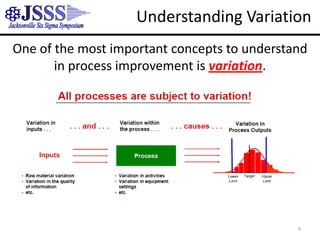
Understanding VariationOne of the most important concepts to understand in process improvement is variation.4
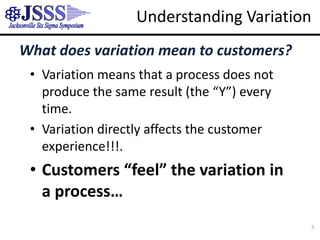
Understanding VariationWhat does variation mean to customers?Variation means that a process does not produce the same result (the “Y”) every time.Variation directly affects the customer experience!!!.Customers “feel” the variation in a process…5
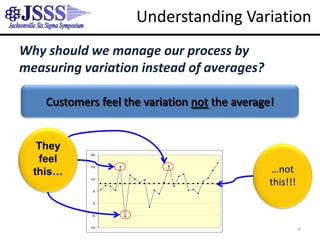
Understanding VariationWhy should we manage our process bymeasuring variation instead of averages?Customers feel the variation not the average!They feel this……not this!!!6
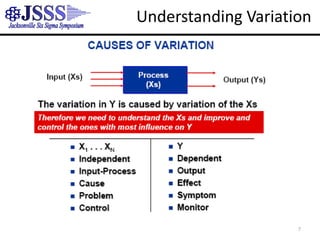
7Understanding Variation
8Types  of VariationTo successfully interpret variation, you mustknow the difference between:common cause variation&special cause variation."If I had to reduce my message to management to just a few words,  I'd say it all has to do with reducing variation.“ - W. Edwards Deming
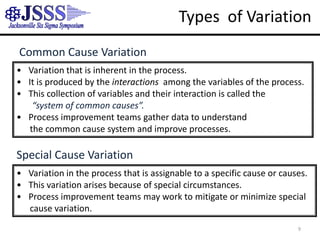
9Types  of VariationCommon Cause VariationVariation that is inherent in the process.
It is produced by the interactions  among the variables of the process.
This collection of variables and their interaction is called the       “system of common causes”.Process improvement teams gather data to understand      the common cause system and improve processes. Special Cause VariationVariation in the process that is assignable to a specific cause or causes.
This variation arises because of special circumstances.
Process improvement teams may work to mitigate or minimize special      cause variation.
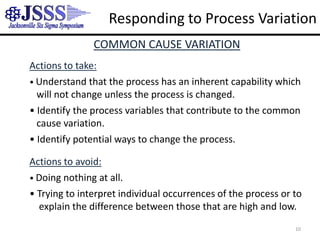
Responding to Process VariationCOMMON CAUSE VARIATIONActions to take:Understand that the process has an inherent capability which   will not change unless the process is changed. Identify the process variables that contribute to the commoncause variation. Identify potential ways to change the process.Actions to avoid:Doing nothing at all.
 Trying to interpret individual occurrences of the process or toexplain the difference between those that are high and low. 10
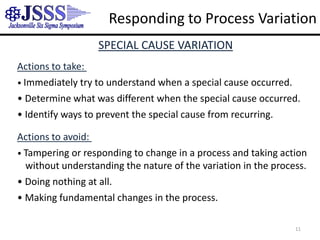
Responding to Process VariationSPECIAL CAUSE VARIATIONActions to take: Immediately try to understand when a special cause occurred.
 Determine what was different when the special cause occurred.
 Identify ways to prevent the special cause from recurring. Actions to avoid: Tampering or responding to change in a process and taking action	without understanding the nature of the variation in the process.   Doing nothing at all.
 Making fundamental changes in the process. 11
Visualizing Variation
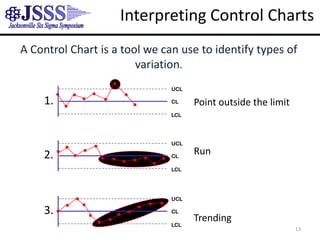
UCLCLLCLInterpreting Control ChartsA Control Chart is a tool we can use to identify types of variation.Point outside the limit1.RunUCL2.CLLCLUCLTrending3.CLLCL13
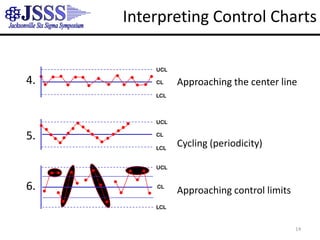
Interpreting Control ChartsApproaching the center lineUCL4.CLLCLUCLCycling (periodicity)5.CLLCLUCLApproaching control limits6.CLLCL14
Sources of VariationCommon Cause (Random) Variation
Seen as normal movement on the chart
Represent normal operation of the process (good or bad)
Improvement requires management action
Usually represents 85% of variability in a process
Special Cause (Assignable) Variation
Shown as “out of control” conditions
Represent abnormality in the process
Can be reduced or eliminated through local actions
Usually highly identifiable!!15
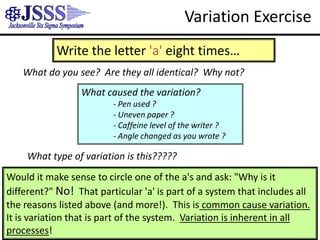
Variation Exercise Write the letter 'a' eight times… What do you see?  Are they all identical?  Why not? What caused the variation?	- Pen used ?	- Uneven paper ?	- Caffeine level of the writer ?	- Angle changed as you wrote ?What type of variation is this?????Would it make sense to circle one of the a's and ask: "Why is it different?" No!  That particular 'a' is part of a system that includes all the reasons listed above (and more!).  This is common cause variation. It is variation that is part of the system.  Variation is inherent in all processes!
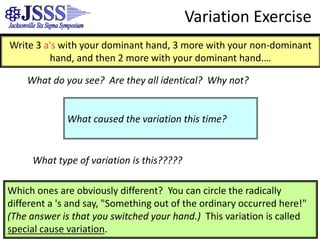
Variation ExerciseWrite 3 a's with your dominant hand, 3 more with your non-dominant hand, and then 2 more with your dominant hand.… What do you see?  Are they all identical?  Why not? What caused the variation this time?What type of variation is this?????Which ones are obviously different?  You can circle the radically different a 's and say, "Something out of the ordinary occurred here!"   (The answer is that you switched your hand.)  This variation is called special cause variation.
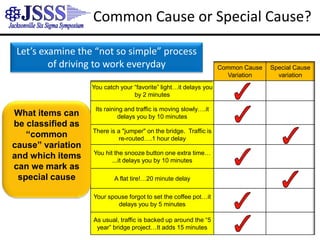
Common Cause or Special Cause?Let’s examine the “not so simple” process of driving to work everydayWhat items can be classified as “common cause” variation and which items can we mark as special cause
Mistake Proofing(Poka-Yoke)
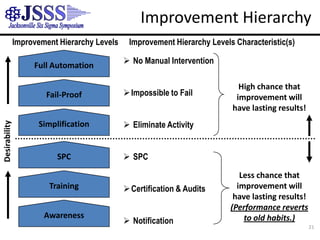
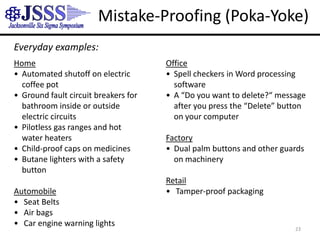
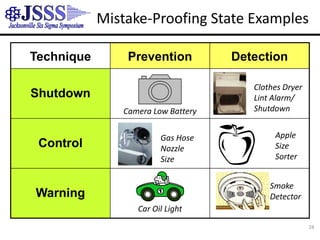
20Mistake-Proofing (Poka Yoke)Mistake-Proofing (Poka Yoke) in Everyday Life Although we often take it for granted, mistake-proofing is all around us.Things we use everyday have been mistake-proofed.

Variation and mistake proofing

  • 1.
  • 2.
    Variation & MistakeProofingUpon completing this module, students should be able to:Understand common cause and special cause variation Understand how to interpret control charts Understand the Improvement HierarchyUnderstand the concept of Mistake Proofing Recognize error-proofing in a process2
  • 3.
  • 4.
    Understanding VariationOne ofthe most important concepts to understand in process improvement is variation.4
  • 5.
    Understanding VariationWhat doesvariation mean to customers?Variation means that a process does not produce the same result (the “Y”) every time.Variation directly affects the customer experience!!!.Customers “feel” the variation in a process…5
  • 6.
    Understanding VariationWhy shouldwe manage our process bymeasuring variation instead of averages?Customers feel the variation not the average!They feel this……not this!!!6
  • 7.
  • 8.
    8Types ofVariationTo successfully interpret variation, you mustknow the difference between:common cause variation&special cause variation."If I had to reduce my message to management to just a few words, I'd say it all has to do with reducing variation.“ - W. Edwards Deming
  • 9.
    9Types ofVariationCommon Cause VariationVariation that is inherent in the process.
  • 10.
    It is producedby the interactions  among the variables of the process.
  • 11.
    This collection ofvariables and their interaction is called the “system of common causes”.Process improvement teams gather data to understand the common cause system and improve processes. Special Cause VariationVariation in the process that is assignable to a specific cause or causes.
  • 12.
    This variation arisesbecause of special circumstances.
  • 13.
    Process improvement teamsmay work to mitigate or minimize special cause variation.
  • 14.
    Responding to ProcessVariationCOMMON CAUSE VARIATIONActions to take:Understand that the process has an inherent capability which will not change unless the process is changed. Identify the process variables that contribute to the commoncause variation. Identify potential ways to change the process.Actions to avoid:Doing nothing at all.
  • 15.
    Trying tointerpret individual occurrences of the process or toexplain the difference between those that are high and low. 10
  • 16.
    Responding to ProcessVariationSPECIAL CAUSE VARIATIONActions to take: Immediately try to understand when a special cause occurred.
  • 17.
    Determine whatwas different when the special cause occurred.
  • 18.
    Identify waysto prevent the special cause from recurring. Actions to avoid: Tampering or responding to change in a process and taking action without understanding the nature of the variation in the process. Doing nothing at all.
  • 19.
    Making fundamentalchanges in the process. 11
  • 20.
  • 21.
    UCLCLLCLInterpreting Control ChartsAControl Chart is a tool we can use to identify types of variation.Point outside the limit1.RunUCL2.CLLCLUCLTrending3.CLLCL13
  • 22.
    Interpreting Control ChartsApproachingthe center lineUCL4.CLLCLUCLCycling (periodicity)5.CLLCLUCLApproaching control limits6.CLLCL14
  • 23.
    Sources of VariationCommonCause (Random) Variation
  • 24.
    Seen as normalmovement on the chart
  • 25.
    Represent normal operationof the process (good or bad)
  • 26.
  • 27.
    Usually represents 85%of variability in a process
  • 28.
  • 29.
    Shown as “outof control” conditions
  • 30.
  • 31.
    Can be reducedor eliminated through local actions
  • 32.
  • 33.
    Variation Exercise Writethe letter 'a' eight times… What do you see? Are they all identical? Why not? What caused the variation? - Pen used ? - Uneven paper ? - Caffeine level of the writer ? - Angle changed as you wrote ?What type of variation is this?????Would it make sense to circle one of the a's and ask: "Why is it different?" No! That particular 'a' is part of a system that includes all the reasons listed above (and more!). This is common cause variation. It is variation that is part of the system.  Variation is inherent in all processes!
  • 34.
    Variation ExerciseWrite 3a's with your dominant hand, 3 more with your non-dominant hand, and then 2 more with your dominant hand.… What do you see? Are they all identical? Why not? What caused the variation this time?What type of variation is this?????Which ones are obviously different? You can circle the radically different a 's and say, "Something out of the ordinary occurred here!" (The answer is that you switched your hand.) This variation is called special cause variation.
  • 35.
    Common Cause orSpecial Cause?Let’s examine the “not so simple” process of driving to work everydayWhat items can be classified as “common cause” variation and which items can we mark as special cause
  • 36.
  • 37.
    20Mistake-Proofing (Poka Yoke)Mistake-Proofing(Poka Yoke) in Everyday Life Although we often take it for granted, mistake-proofing is all around us.Things we use everyday have been mistake-proofed.