3.1
Extreme
Values of
Functions
Def: Absolute Extreme Values
Let f be a function with domain D. Then f(c)
is the…
a) Absolute (or global) maximum value on
D iff f(x) ≤ f(c) for all x in D.
b) Absolute (or global) minimum value on
D iff f(x) ≥ f(c) for all x in D.
* Note: The max or min VALUE refers to
the y value.
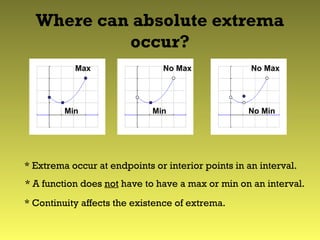
Where can absolute extrema
occur?
* Extrema occur at endpoints or interior points in an interval.
* A function does not have to have a max or min on an interval.
* Continuity affects the existence of extrema.
Min
Max
Min
No Max No Max
No Min
Thm 1: Extreme Value Theorem
If f is continuous on a closed interval [a,b],
then f has both a maximum value and a
minimum value on the interval.
* What is the “worst case scenario,”
and what happens then?
Def: Local Extreme Values
Let c be an interior point of the domain of f.
Then f(c) is a…
a) Local (or relative) maximum value at c iff
f(x) ≤ f(c) for all x in some open interval
containing c.
b) Local (or relative) minimum value at c iff
f(x) ≥ f(c) for all x in some open interval
containing c.
* A local extreme value is a max or min in a
“neighborhood” of points surrounding c
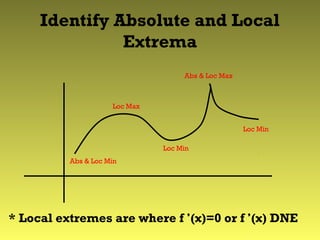
Identify Absolute and Local
Extrema
Abs & Loc Min
Abs & Loc Max
Loc Max
Loc Min
Loc Min
* Local extremes are where f ’(x)=0 or f ’(x) DNE
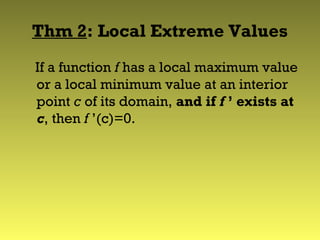
Thm 2: Local Extreme Values
If a function f has a local maximum value
or a local minimum value at an interior
point c of its domain, and if f ’ exists at
c, then f ’(c)=0.
Def: Critical Point
A critical point is a point in the interior
of the domain of f at which either…
1) f ’(x)= 0, or
2) f ’(x) does not exist
Finding Absolute
Extrema on [a,b]…
To find the absolute extrema of a
continuous function f on [a,b]…
1. Evaluate f at the endpoints a and b.
2. Find the critical numbers of f on [a,b].
3. Evaluate f at each critical number.
4. Compare values. The greatest is the
absolute max and the least is the
absolute min.
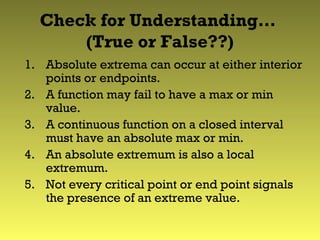
Check for Understanding…
(True or False??)
1. Absolute extrema can occur at either interior
points or endpoints.
2. A function may fail to have a max or min
value.
3. A continuous function on a closed interval
must have an absolute max or min.
4. An absolute extremum is also a local
extremum.
5. Not every critical point or end point signals
the presence of an extreme value.

Lecture 11(relative extrema)

  • 1.
  • 2.
    Def: Absolute ExtremeValues Let f be a function with domain D. Then f(c) is the… a) Absolute (or global) maximum value on D iff f(x) ≤ f(c) for all x in D. b) Absolute (or global) minimum value on D iff f(x) ≥ f(c) for all x in D. * Note: The max or min VALUE refers to the y value.
  • 3.
    Where can absoluteextrema occur? * Extrema occur at endpoints or interior points in an interval. * A function does not have to have a max or min on an interval. * Continuity affects the existence of extrema. Min Max Min No Max No Max No Min
  • 4.
    Thm 1: ExtremeValue Theorem If f is continuous on a closed interval [a,b], then f has both a maximum value and a minimum value on the interval. * What is the “worst case scenario,” and what happens then?
  • 5.
    Def: Local ExtremeValues Let c be an interior point of the domain of f. Then f(c) is a… a) Local (or relative) maximum value at c iff f(x) ≤ f(c) for all x in some open interval containing c. b) Local (or relative) minimum value at c iff f(x) ≥ f(c) for all x in some open interval containing c. * A local extreme value is a max or min in a “neighborhood” of points surrounding c
  • 6.
    Identify Absolute andLocal Extrema Abs & Loc Min Abs & Loc Max Loc Max Loc Min Loc Min * Local extremes are where f ’(x)=0 or f ’(x) DNE
  • 7.
    Thm 2: LocalExtreme Values If a function f has a local maximum value or a local minimum value at an interior point c of its domain, and if f ’ exists at c, then f ’(c)=0.
  • 8.
    Def: Critical Point Acritical point is a point in the interior of the domain of f at which either… 1) f ’(x)= 0, or 2) f ’(x) does not exist
  • 9.
    Finding Absolute Extrema on[a,b]… To find the absolute extrema of a continuous function f on [a,b]… 1. Evaluate f at the endpoints a and b. 2. Find the critical numbers of f on [a,b]. 3. Evaluate f at each critical number. 4. Compare values. The greatest is the absolute max and the least is the absolute min.
  • 10.
    Check for Understanding… (Trueor False??) 1. Absolute extrema can occur at either interior points or endpoints. 2. A function may fail to have a max or min value. 3. A continuous function on a closed interval must have an absolute max or min. 4. An absolute extremum is also a local extremum. 5. Not every critical point or end point signals the presence of an extreme value.