By the end of the lesson you will be able to:
• Use the derivative of a function to find 
    maximum and minimum points.
• Use the second derivative to test the nature of a 
stationary point and/or point of inflexion.
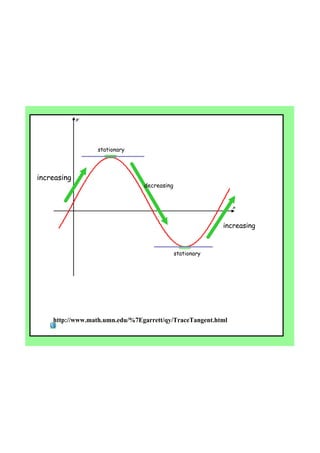
increasing
increasing
decreasing
stationary
stationary
http://www.math.umn.edu/%7Egarrett/qy/TraceTangent.html
•  
•  
•  
•  
A
B
P
Q
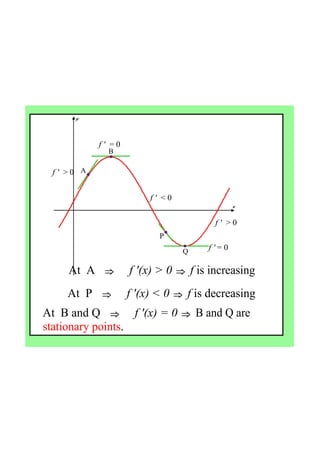
At  A   ⇒  f '(x) > 0 ⇒ f is increasing          
At  P   ⇒  f '(x) < 0 ⇒ f is decreasing          
At  B and Q   ⇒  f '(x) = 0 ⇒ B and Q are 
stationary points.         
f '  = 0
f '  < 0
f '  > 0
f '  > 0
f ' = 0
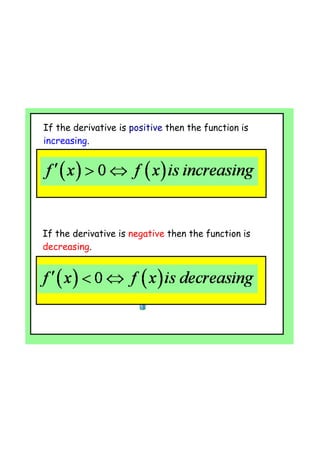
If the derivative is positive then the function is
increasing.
If the derivative is negative then the function is
decreasing.
 
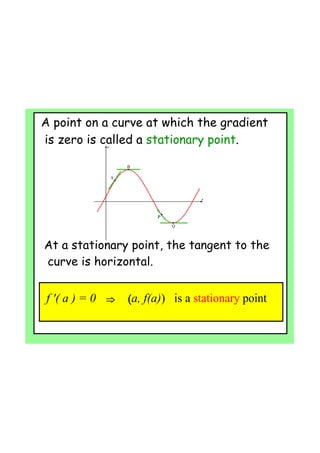
f '( a ) = 0   ⇒ (a, f(a))   is a stationary point
•  
•  
•  
•  
A
B
P
Q
A point on a curve at which the gradient
is zero is called a stationary point.
At a stationary point, the tangent to the
curve is horizontal.
•  
•  
•  
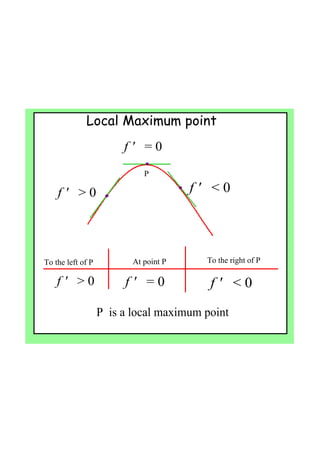
Local Maximum point
 f '   > 0
 f '   = 0
 f '   < 0
P
To the left of P At point P To the right of P
 f '   > 0  f '   < 0 f '   = 0
P  is a local maximum point
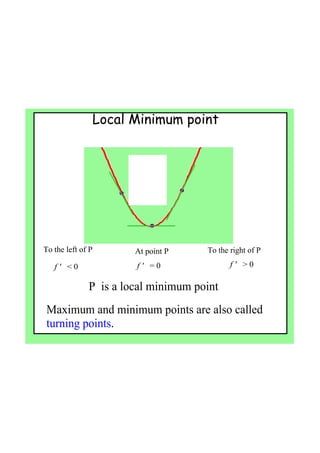
Local Minimum point
 f '   > 0
 f '   = 0
 f '   < 0
To the left of P At point P To the right of P
 f '   > 0 f '   < 0  f '   = 0
P  is a local minimum point
P
•  
•  •  
Maximum and minimum points are also called 
turning points.
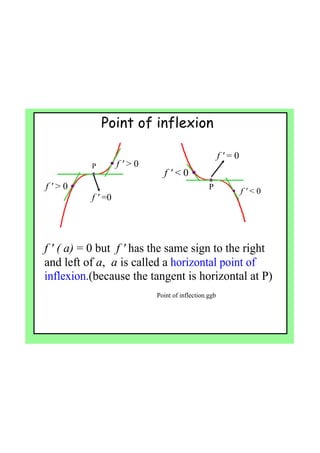
Point of inflexion
•  
•  
•  
f ' =0
f ' > 0
f ' > 0P
•  
•  
•  
f ' = 0
f ' < 0
f ' < 0
P
f ' ( a) = 0 but  f ' has the same sign to the right 
and left of a,  a is called a horizontal point of 
inflexion.(because the tangent is horizontal at P)
Point of inflection.ggb
•  
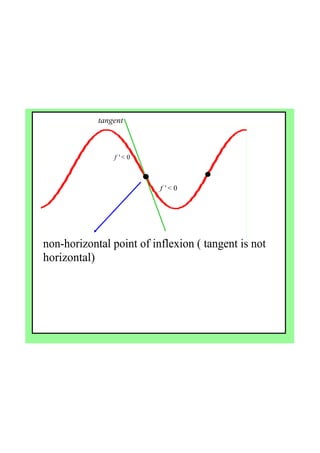
non­horizontal point of inflexion ( tangent is not 
horizontal)
f ' < 0
f ' < 0
tangent
•  
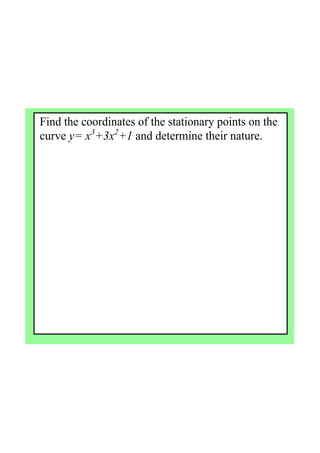
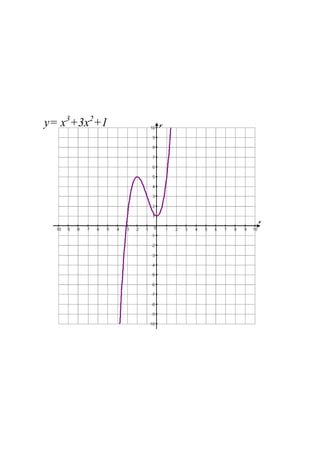
Find the coordinates of the stationary points on the 
curve y= x3
+3x2
+1 and determine their nature.
y= x3
+3x2
+1 
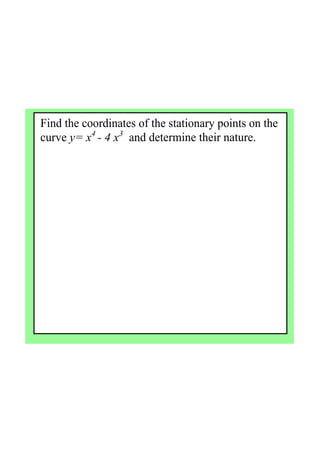
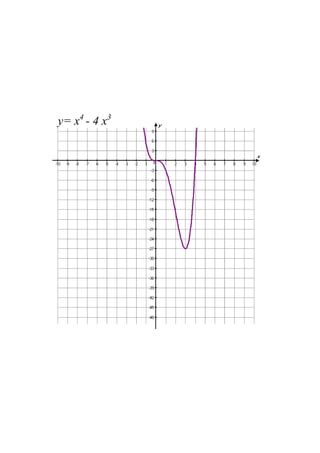
Find the coordinates of the stationary points on the 
curve y= x4 
­ 4 x3
  and determine their nature.
y= x4 
­ 4 x3
 
Attachments
Point of inflection.ggb

IB Maths. Turning points. First derivative test