















Analysing
Qualitative Data
Introduction to Qualitative Analysis
Writing as a Tool in Analysis
Thematic Coding and Categorising
Comparative Analysis
Analytic Quality and Ethics
Introduction to Qualitative Analysis
What is going on here?
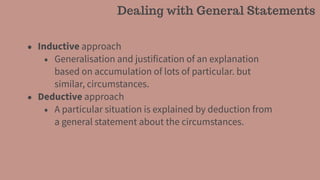
• Inductive approach
• Generalisation and justification of an explanation
based on accumulation of lots of particular. but
similar, circumstances.
• Deductive approach
• A particular situation is explained by deduction from
a general statement about the circumstances.
Dealing with General Statements
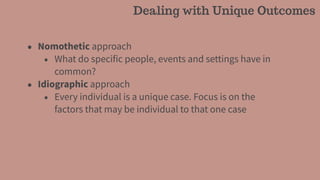
• Nomothetic approach
• What do specific people, events and settings have in
common?
• Idiographic approach
• Every individual is a unique case. Focus is on the
factors that may be individual to that one case
Dealing with Unique Outcomes
• Realism approach
• There is a world with objects and people that exist.
This can include aspects such as clowns, atoms,
learning styles…
• Idealism approach
• We can’t know anything about a real world and
instead experience it through constructs and ideas.
Dealing with World Reality
Basically…lots of people
think lots of things in lots
of different ways.
Writing as a Tool in Analysis
Write Early and Write Often!
• The more you write the easier it gets
• If you write a little bit every day, it becomes a habit
• Tiny bits of writing add up to a lot of writing
• The longer you leave it unwritten the worse the task
becomes.
Don’t get it right, get it written!
• Until it is on paper, no-one can help you get it right
• Drafting is a vital stage in clarifying thought
• Start writing the bit that is clearest in your head
• Drafting reveals the places where it isn’t right (yet!)
Research Diary
Can be an open document or a very personal
thing, really up to you.
• What you did, and where, how and why
you did it.
• What you have been reading
• Contact summaries about what people,
events or situations were involved
• What data you collected
• Particular achievements, dead ends and
surprises
• Thoughts that come into your mind
about what has been happening
Field Notes
Notes taken whilst in the research setting. Used a
lot in ethnographic work.
• Not planned or structured. Are normally
open ended, loose, and messy
• Can be used to represent an event, or to
give an account of it. Identify aspects
which are significant
• Descriptions of what people said and
did, but not a simple recording of facts
Memos
A way to theorise and comment on your ideas as
you carry out analysis and also in the lead up to
this
• Are notes to yourself or to others in the
research team
• Can be organised into different
categories to make it easy to
understand…
ON MN TN PN
Observational Notes
Methodological Notes
Personal Notes
Theoretical Notes
• A new idea for a code: Might be sparked
by something that a respondent says.
Keep all of these close for cross-
referencing
• A quick hunch: Support this with some
evidence in your data
• Integrative discussion: Brings together
one or more memos
• Dialogue among researchers: Sharing
ideas with others
• To question quality of data:
Respondent wasn’t entirely open or
were not qualified to talk about issue
• Question the original analytic
framework: Memo against an existing
code to raise questions about whether
they make sense
• Puzzling or surprising issues: Spot
what is surprising, harder than you
would think!
• Alternative to other memos: Internal
dialogue - what are the other options?
• No clear idea: Writing things down can
help to flesh out a bigger idea
• Raise a general theme: bring issues
together
The Final Report
Bringing everything together with all the writing
that has been completed so far.
• Layout and purpose is down to the
situation that it is being created for
• Have an organised structure to tell the
story of the data you have collected
• The first time you write it won’t be the
last time you read it. Be prepared to
redraft…
The Final Report
Redrafting • Read through and ask yourself:
• What am I trying to say?
• Who is the text for?
• What changes will make the text
clearer
• Big changes you might consider:
• Reordering parts of txt
• Adding examples
• Deleting parts that are confusing
• Minor changes include:
• Simpler wording
• Shorter sentences
• Shorter paragraphs
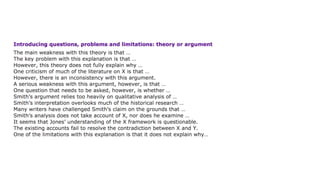
academic phrasebank
Thematic Coding and Categorising
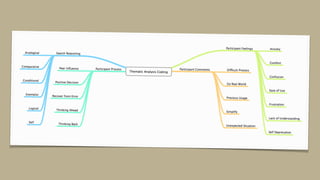
Coding is how you define what the data you are analysing
are about. It involves identifying and recording one ore
more passages of text or other data items that exemplify
the same theoretical or descriptive idea.
• Text can be retrieved that has been coded in the same
way to show examples of the same phenomenon, idea, or
activity. This lets you look at the data in a more
structured way
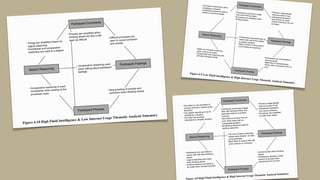
• Lists of codes, when developed into a hierarchy, can be
used to further examine questions and relationships
between ideas.
Defining Your Codes
Give your codes descriptive names, and define
how it should be applied. Keep this in a document
and include?
• Label or name of the code
• Who coded it
• Date of the code and if it has been
changed
• Definition of the code - description of
analytical idea
• Any other notes that you think may be
useful.
Mechanisms of Coding
• What is going on?
• What are people doing?
• What is the person saying?
What can be coded?
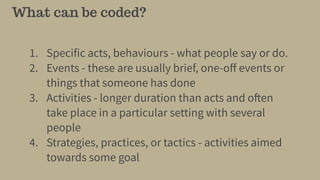
1. Specific acts, behaviours - what people say or do.
2. Events - these are usually brief, one-off events or
things that someone has done
3. Activities - longer duration than acts and often
take place in a particular setting with several
people
4. Strategies, practices, or tactics - activities aimed
towards some goal
What can be coded?
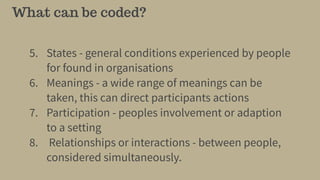
5. States - general conditions experienced by people
for found in organisations
6. Meanings - a wide range of meanings can be
taken, this can direct participants actions
7. Participation - peoples involvement or adaption
to a setting
8. Relationships or interactions - between people,
considered simultaneously.
What can be coded?
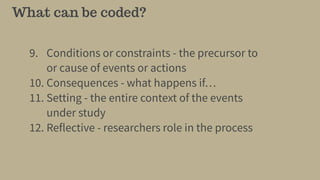
9. Conditions or constraints - the precursor to
or cause of events or actions
10. Consequences - what happens if…
11. Setting - the entire context of the events
under study
12. Reflective - researchers role in the process
Grounded Theory
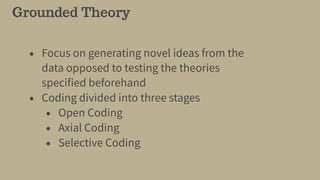
• Focus on generating novel ideas from the
data opposed to testing the theories
specified beforehand
• Coding divided into three stages
• Open Coding
• Axial Coding
• Selective Coding
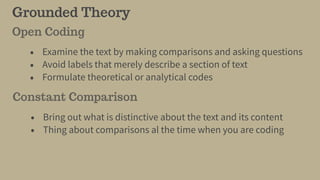
Grounded Theory
• Examine the text by making comparisons and asking questions
• Avoid labels that merely describe a section of text
• Formulate theoretical or analytical codes
Open Coding
• Bring out what is distinctive about the text and its content
• Thing about comparisons al the time when you are coding
Constant Comparison
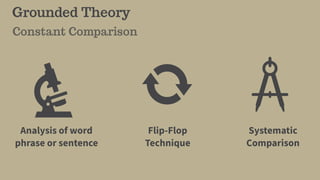
Grounded Theory
Constant Comparison
Analysis of word
phrase or sentence
Flip-Flop
Technique
Systematic
Comparison
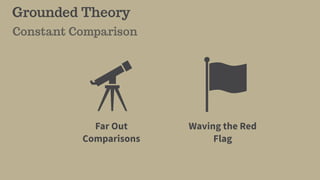
Grounded Theory
Constant Comparison
Far Out
Comparisons
Waving the Red
Flag
Comparative Analysis
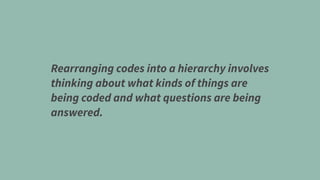
Rearranging codes into a hierarchy involves
thinking about what kinds of things are
being coded and what questions are being
answered.
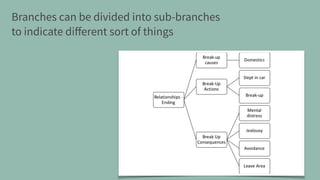
Branches can be divided into sub-branches
to indicate different sort of things
• Keeps Things Tidy
• As analysis proceeds you will develop a large number
of codes
• Long lists of repeating codes are not helpful
• Can constitute an analysis of the data itself
• Can understand respondents’ view of the world
• Prevents the duplication of codes
• Especially true when you have high numbers of
codes that you are working with
Functions of the Code Hierarchy
• Helps see the range of things
• Codes can have dimensions, this helps to uncover
what they can be
• Makes it easier to do some types of analytics
• When people do X do they also do Y
Functions of the Code Hierarchy
Coding provides the shorthand synthesis
for making comparisons between
1. Different people, objects, scenes, or
events
2. Data from the same people, scenes,
objects or events
3. Incidents with incidents
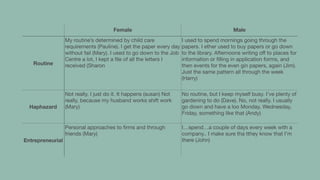
Female Male
Routine
My routine’s determined by child care
requirements (Pauline). I get the paper every day
without fail (Mary). I used to go down to the Job
Centre a lot, I kept a file of all the letters I
received (Sharon
I used to spend mornings going through the
papers. I ether used to buy papers or go down
to the library. Afternoons writing off to places for
information or filling in application forms, and
then events for the even gin papers, again (Jim).
Just the same pattern all through the week
(Harry)
Haphazard
Not really, I just do it. It happens (susan) Not
really, because my husband works shift work
(Mary)
No routine, but I keep myself busy. I’ve plenty of
gardening to do (Dave). No, not really. I usually
go down and have a loo Monday, Wednesday,
Friday, something like that (Andy)
Entrepreneurial
Personal approaches to firms and through
friends (Mary)
I…spend…a couple of days every week with a
company.. I make sure tha tthey know that I’m
there (John)
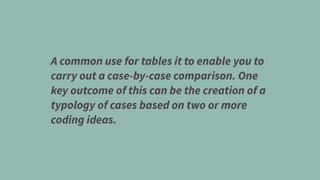
A common use for tables it to enable you to
carry out a case-by-case comparison. One
key outcome of this can be the creation of a
typology of cases based on two or more
coding ideas.
Using a Model to Describe a Phenomenon
A model is a framework that attempts to
explain what has been identified as key
aspects of a phenomenon being studied in
terms of a number of different aspects.
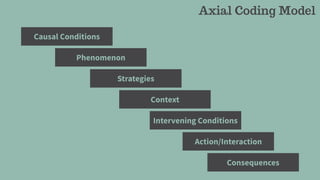
Axial Coding Model
Causal Conditions
Phenomenon
Strategies
Context
Intervening Conditions
Action/Interaction
Consequences
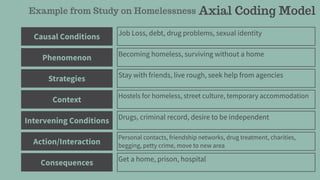
Axial Coding Model
Causal Conditions
Phenomenon
Strategies
Context
Intervening Conditions
Action/Interaction
Consequences Get a home, prison, hospital
Becoming homeless, surviving without a home
Stay with friends, live rough, seek help from agencies
Hostels for homeless, street culture, temporary accommodation
Drugs, criminal record, desire to be independent
Personal contacts, friendship networks, drug treatment, charities,
begging, petty crime, move to new area
Example from Study on Homelessness
Job Loss, debt, drug problems, sexual identity
Analytic Quality and Ethics
Traditional Approaches to Quality
• Valid
• If the explanations are really true or accurate and correctly
capture what is actually happening
• Reliable
• If the results are consistent across repeated investigations
in different circumstances with different investigators
• Generalsable
• True for a wide (but specified) range of circumstances
beyond those studied in the particular research
Reflexivity
We are encouraged to be reflexive in our
account of the research process, the
data collected and the way we write up.
Reflexivity shows the partial nature of
our representations of reality and the
multiplicity of competing versions of
reality
• Examine the wider relevance of your project and its setting, and
the grounds on which empirical generalisations are made.
• Discuss the features of your project and its setting that are left
un-researched. Why did you make these choices and what
implications for the research findings happen because of this?
• Be explicit about the theoretical framework you are operating
within, and the broader values and commitments you bring to
your work
Reflexive Good Practice
• Critically assess your integrity as a researcher by considering:
• the grounds on which knowledge claims are being justified
(length of the fieldwork, extent of trust and report
developed)
• your background and experiences in the setting and topic
• the strengths and weaknesses of your research design and
strategy
Reflexive Good Practice
• Critically assess the data by
• discussing the problems that arose during all stages of the
research
• outlining the grounds on which you developed the
categorisation system used to interpret the data, identifying
clearly whether this is one used by respondents them selves,
or an analyst constructed one
• discussing rival explanations and alternative ways of
organising the data
• providing sufficient data extracts in the text to allow readers
to evaluate the inferences dawn and the interpretations
made
Reflexive Good Practice
• Show the complexity of the data, avoiding the suggestion that
there is a simple fit between the situation and your
representation of it by:
• discussing negative cases that fall outside the general
patterns and categories employed to structure your analysis
• showing the multiple and often contradictory descriptions
given by the respondents themselves
• stressing the contextual nature of respondents accounts and
descriptions
Reflexive Good Practice
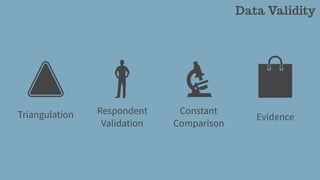
Data Validity
Triangulation Respondent
Validation
Constant
Comparison
Evidence
The key to ethics is to balance the harm
(even minimal) that research might do
against its benefits. Qualitative data is
so detailed, there is always a danger
that confidentiality may be breached, so
anonymous information is especially
important.
Introduction to Qualitative Analysis
Writing as a Tool in Analysis
Thematic Coding and Categorising
Comparative Analysis
Analytic Quality and Ethics
Information in this
presentation was
based on…

Analysing Qualitative Data

  • 1.
  • 2.
    Introduction to QualitativeAnalysis Writing as a Tool in Analysis Thematic Coding and Categorising Comparative Analysis Analytic Quality and Ethics
  • 3.
  • 4.
    What is goingon here?
  • 5.
    • Inductive approach •Generalisation and justification of an explanation based on accumulation of lots of particular. but similar, circumstances. • Deductive approach • A particular situation is explained by deduction from a general statement about the circumstances. Dealing with General Statements
  • 6.
    • Nomothetic approach •What do specific people, events and settings have in common? • Idiographic approach • Every individual is a unique case. Focus is on the factors that may be individual to that one case Dealing with Unique Outcomes
  • 7.
    • Realism approach •There is a world with objects and people that exist. This can include aspects such as clowns, atoms, learning styles… • Idealism approach • We can’t know anything about a real world and instead experience it through constructs and ideas. Dealing with World Reality
  • 8.
    Basically…lots of people thinklots of things in lots of different ways.
  • 9.
    Writing as aTool in Analysis
  • 10.
    Write Early andWrite Often! • The more you write the easier it gets • If you write a little bit every day, it becomes a habit • Tiny bits of writing add up to a lot of writing • The longer you leave it unwritten the worse the task becomes.
  • 11.
    Don’t get itright, get it written! • Until it is on paper, no-one can help you get it right • Drafting is a vital stage in clarifying thought • Start writing the bit that is clearest in your head • Drafting reveals the places where it isn’t right (yet!)
  • 12.
    Research Diary Can bean open document or a very personal thing, really up to you. • What you did, and where, how and why you did it. • What you have been reading • Contact summaries about what people, events or situations were involved • What data you collected • Particular achievements, dead ends and surprises • Thoughts that come into your mind about what has been happening
  • 13.
    Field Notes Notes takenwhilst in the research setting. Used a lot in ethnographic work. • Not planned or structured. Are normally open ended, loose, and messy • Can be used to represent an event, or to give an account of it. Identify aspects which are significant • Descriptions of what people said and did, but not a simple recording of facts
  • 14.
    Memos A way totheorise and comment on your ideas as you carry out analysis and also in the lead up to this • Are notes to yourself or to others in the research team • Can be organised into different categories to make it easy to understand…
  • 15.
    ON MN TNPN Observational Notes Methodological Notes Personal Notes Theoretical Notes
  • 16.
    • A newidea for a code: Might be sparked by something that a respondent says. Keep all of these close for cross- referencing • A quick hunch: Support this with some evidence in your data • Integrative discussion: Brings together one or more memos • Dialogue among researchers: Sharing ideas with others • To question quality of data: Respondent wasn’t entirely open or were not qualified to talk about issue
  • 17.
    • Question theoriginal analytic framework: Memo against an existing code to raise questions about whether they make sense • Puzzling or surprising issues: Spot what is surprising, harder than you would think! • Alternative to other memos: Internal dialogue - what are the other options? • No clear idea: Writing things down can help to flesh out a bigger idea • Raise a general theme: bring issues together
  • 18.
    The Final Report Bringingeverything together with all the writing that has been completed so far. • Layout and purpose is down to the situation that it is being created for • Have an organised structure to tell the story of the data you have collected • The first time you write it won’t be the last time you read it. Be prepared to redraft…
  • 19.
    The Final Report Redrafting• Read through and ask yourself: • What am I trying to say? • Who is the text for? • What changes will make the text clearer • Big changes you might consider: • Reordering parts of txt • Adding examples • Deleting parts that are confusing • Minor changes include: • Simpler wording • Shorter sentences • Shorter paragraphs
  • 20.
  • 22.
    Thematic Coding andCategorising
  • 23.
    Coding is howyou define what the data you are analysing are about. It involves identifying and recording one ore more passages of text or other data items that exemplify the same theoretical or descriptive idea.
  • 24.
    • Text canbe retrieved that has been coded in the same way to show examples of the same phenomenon, idea, or activity. This lets you look at the data in a more structured way • Lists of codes, when developed into a hierarchy, can be used to further examine questions and relationships between ideas.
  • 25.
    Defining Your Codes Giveyour codes descriptive names, and define how it should be applied. Keep this in a document and include? • Label or name of the code • Who coded it • Date of the code and if it has been changed • Definition of the code - description of analytical idea • Any other notes that you think may be useful.
  • 26.
    Mechanisms of Coding •What is going on? • What are people doing? • What is the person saying?
  • 27.
    What can becoded? 1. Specific acts, behaviours - what people say or do. 2. Events - these are usually brief, one-off events or things that someone has done 3. Activities - longer duration than acts and often take place in a particular setting with several people 4. Strategies, practices, or tactics - activities aimed towards some goal
  • 28.
    What can becoded? 5. States - general conditions experienced by people for found in organisations 6. Meanings - a wide range of meanings can be taken, this can direct participants actions 7. Participation - peoples involvement or adaption to a setting 8. Relationships or interactions - between people, considered simultaneously.
  • 29.
    What can becoded? 9. Conditions or constraints - the precursor to or cause of events or actions 10. Consequences - what happens if… 11. Setting - the entire context of the events under study 12. Reflective - researchers role in the process
  • 30.
    Grounded Theory • Focuson generating novel ideas from the data opposed to testing the theories specified beforehand • Coding divided into three stages • Open Coding • Axial Coding • Selective Coding
  • 31.
    Grounded Theory • Examinethe text by making comparisons and asking questions • Avoid labels that merely describe a section of text • Formulate theoretical or analytical codes Open Coding • Bring out what is distinctive about the text and its content • Thing about comparisons al the time when you are coding Constant Comparison
  • 32.
    Grounded Theory Constant Comparison Analysisof word phrase or sentence Flip-Flop Technique Systematic Comparison
  • 33.
    Grounded Theory Constant Comparison FarOut Comparisons Waving the Red Flag
  • 37.
  • 38.
    Rearranging codes intoa hierarchy involves thinking about what kinds of things are being coded and what questions are being answered.
  • 39.
    Branches can bedivided into sub-branches to indicate different sort of things
  • 40.
    • Keeps ThingsTidy • As analysis proceeds you will develop a large number of codes • Long lists of repeating codes are not helpful • Can constitute an analysis of the data itself • Can understand respondents’ view of the world • Prevents the duplication of codes • Especially true when you have high numbers of codes that you are working with Functions of the Code Hierarchy
  • 41.
    • Helps seethe range of things • Codes can have dimensions, this helps to uncover what they can be • Makes it easier to do some types of analytics • When people do X do they also do Y Functions of the Code Hierarchy
  • 42.
    Coding provides theshorthand synthesis for making comparisons between 1. Different people, objects, scenes, or events 2. Data from the same people, scenes, objects or events 3. Incidents with incidents
  • 43.
    Female Male Routine My routine’sdetermined by child care requirements (Pauline). I get the paper every day without fail (Mary). I used to go down to the Job Centre a lot, I kept a file of all the letters I received (Sharon I used to spend mornings going through the papers. I ether used to buy papers or go down to the library. Afternoons writing off to places for information or filling in application forms, and then events for the even gin papers, again (Jim). Just the same pattern all through the week (Harry) Haphazard Not really, I just do it. It happens (susan) Not really, because my husband works shift work (Mary) No routine, but I keep myself busy. I’ve plenty of gardening to do (Dave). No, not really. I usually go down and have a loo Monday, Wednesday, Friday, something like that (Andy) Entrepreneurial Personal approaches to firms and through friends (Mary) I…spend…a couple of days every week with a company.. I make sure tha tthey know that I’m there (John)
  • 44.
    A common usefor tables it to enable you to carry out a case-by-case comparison. One key outcome of this can be the creation of a typology of cases based on two or more coding ideas.
  • 45.
    Using a Modelto Describe a Phenomenon A model is a framework that attempts to explain what has been identified as key aspects of a phenomenon being studied in terms of a number of different aspects.
  • 46.
    Axial Coding Model CausalConditions Phenomenon Strategies Context Intervening Conditions Action/Interaction Consequences
  • 47.
    Axial Coding Model CausalConditions Phenomenon Strategies Context Intervening Conditions Action/Interaction Consequences Get a home, prison, hospital Becoming homeless, surviving without a home Stay with friends, live rough, seek help from agencies Hostels for homeless, street culture, temporary accommodation Drugs, criminal record, desire to be independent Personal contacts, friendship networks, drug treatment, charities, begging, petty crime, move to new area Example from Study on Homelessness Job Loss, debt, drug problems, sexual identity
  • 48.
  • 49.
    Traditional Approaches toQuality • Valid • If the explanations are really true or accurate and correctly capture what is actually happening • Reliable • If the results are consistent across repeated investigations in different circumstances with different investigators • Generalsable • True for a wide (but specified) range of circumstances beyond those studied in the particular research
  • 50.
  • 51.
    We are encouragedto be reflexive in our account of the research process, the data collected and the way we write up. Reflexivity shows the partial nature of our representations of reality and the multiplicity of competing versions of reality
  • 52.
    • Examine thewider relevance of your project and its setting, and the grounds on which empirical generalisations are made. • Discuss the features of your project and its setting that are left un-researched. Why did you make these choices and what implications for the research findings happen because of this? • Be explicit about the theoretical framework you are operating within, and the broader values and commitments you bring to your work Reflexive Good Practice
  • 53.
    • Critically assessyour integrity as a researcher by considering: • the grounds on which knowledge claims are being justified (length of the fieldwork, extent of trust and report developed) • your background and experiences in the setting and topic • the strengths and weaknesses of your research design and strategy Reflexive Good Practice
  • 54.
    • Critically assessthe data by • discussing the problems that arose during all stages of the research • outlining the grounds on which you developed the categorisation system used to interpret the data, identifying clearly whether this is one used by respondents them selves, or an analyst constructed one • discussing rival explanations and alternative ways of organising the data • providing sufficient data extracts in the text to allow readers to evaluate the inferences dawn and the interpretations made Reflexive Good Practice
  • 55.
    • Show thecomplexity of the data, avoiding the suggestion that there is a simple fit between the situation and your representation of it by: • discussing negative cases that fall outside the general patterns and categories employed to structure your analysis • showing the multiple and often contradictory descriptions given by the respondents themselves • stressing the contextual nature of respondents accounts and descriptions Reflexive Good Practice
  • 56.
  • 57.
    The key toethics is to balance the harm (even minimal) that research might do against its benefits. Qualitative data is so detailed, there is always a danger that confidentiality may be breached, so anonymous information is especially important.
  • 58.
    Introduction to QualitativeAnalysis Writing as a Tool in Analysis Thematic Coding and Categorising Comparative Analysis Analytic Quality and Ethics
  • 59.