CHOOSING A RESEARCH
PROJECT
© LOUIS COHEN, LAWRENCE
MANION, KEITH MORRISON
• What gives rise to the research project?
(Choosing a research project)
• The importance of the research
• The purposes of the research
• Is the research practicable?
• Research questions
• The scope of the literature review
STRUCTURE OF THE CHAPTER
• A problem encountered in everyday work or outside
everyday work;
• An issue that the researcher has read about or seen;
• A problem that has arisen in the locality, e.g. in
response to government policy or practices or to local
developments;
• An area of the researcher’s own interest;
• An area of the researcher’s own experience;
• A perceived area of importance;
• An interesting question;
• A testable guess or hunch;
• A topical matter;
• Disquiet with a particular research finding that one
has met in the literature or a piece of policy;
CHOOSING A RESEARCH PROJECT
• An awareness that a particular issue or area has
been incompletely studied, and a wish to plug the
gap;
• A wish to apply a piece of conceptual research to
actual practice, or to test a theory in practice;
• A wish to rework the conceptual or theoretical
frameworks that are often used in a specific area;
• A wish to revise or replace the methodologies that
are often used in researching a specific area;
• A desire to improve practice in a particular area;
• A desire to involve participants in research and
development;
CHOOSING A RESEARCH PROJECT
• A desire to test out a particular methodology in
research;
• An interest in seeing if reported practice holds
true for the researcher’s own context (e.g. a
comparative study);
• An interest in investigating the causes of a
phenomenon or the effects of a particular
intervention in the area of the phenomenon;
• A priority identified by funding agencies;
• An issue identified by the researcher’s
supervisor or a project team of which the
researcher is a member.
CHOOSING A RESEARCH PROJECT
• Is the research significant?
• What difference will the research make?
• Does the originality of the research render it
significant?
• How and where does the research move forward
the field?
• Where do originality and significance lie in the
research:
– Conceptually
– Theoretically
– Methodologically
– Substantively
THE IMPORTANCE OF THE RESEARCH
• What is the likely impact of the research?
• What is the use of the research – what will it
‘deliver’?
• What benefit will the research bring, and to
whom?
• Is the research worth doing?
THE IMPORTANCE OF THE RESEARCH
• What are the ‘deliverables’ in the research?
• What does the research seek to do?
• What do you wish to come from the research?
THE PURPOSES OF THE RESEARCH
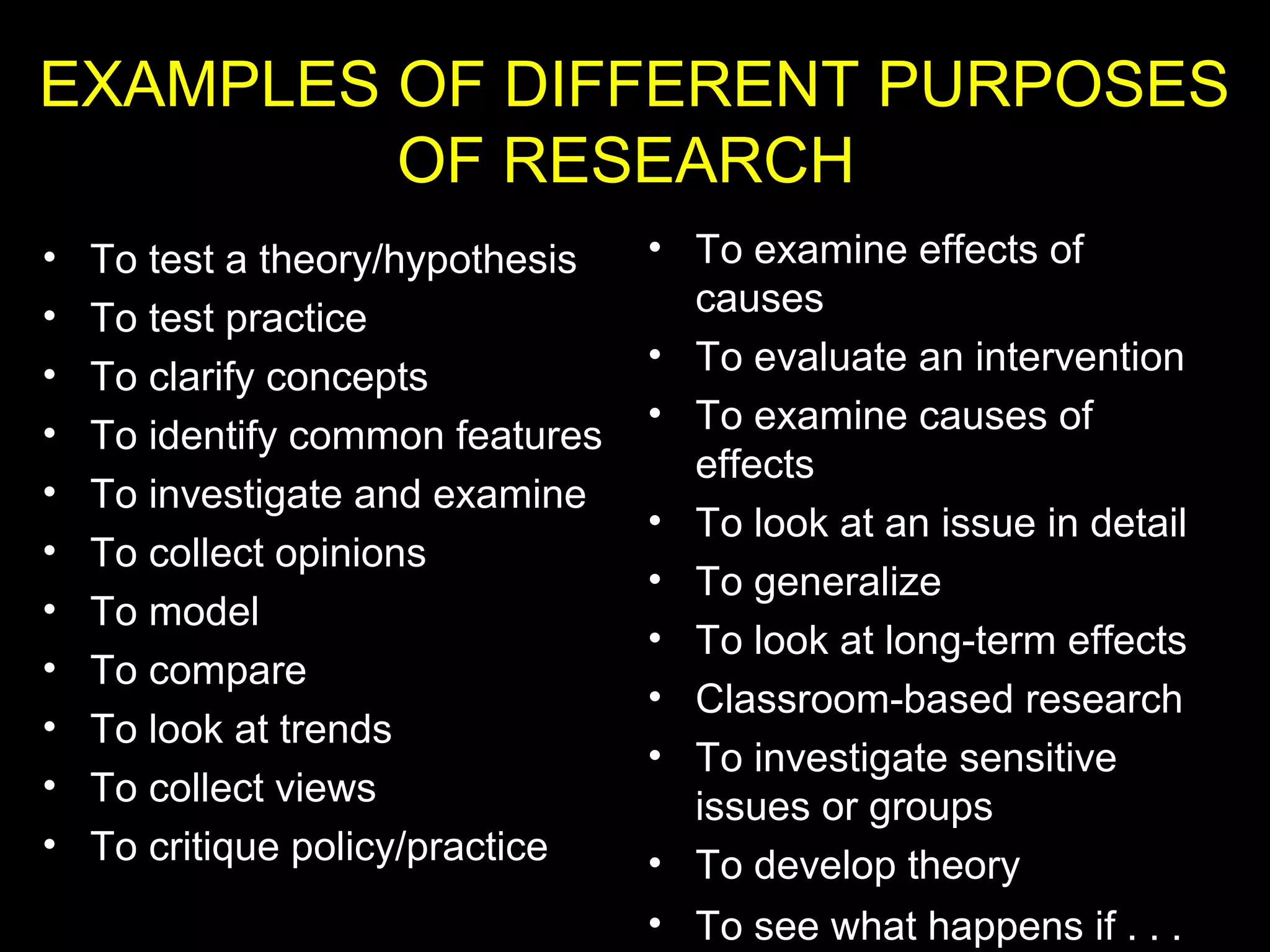
• To test a theory/hypothesis
• To test practice
• To clarify concepts
• To identify common features
• To investigate and examine
• To collect opinions
• To model
• To compare
• To look at trends
• To collect views
• To critique policy/practice
• To examine effects of
causes
• To evaluate an intervention
• To examine causes of
effects
• To look at an issue in detail
• To generalize
• To look at long-term effects
• Classroom-based research
• To investigate sensitive
issues or groups
• To develop theory
• To see what happens if . . .
EXAMPLES OF DIFFERENT PURPOSES
OF RESEARCH
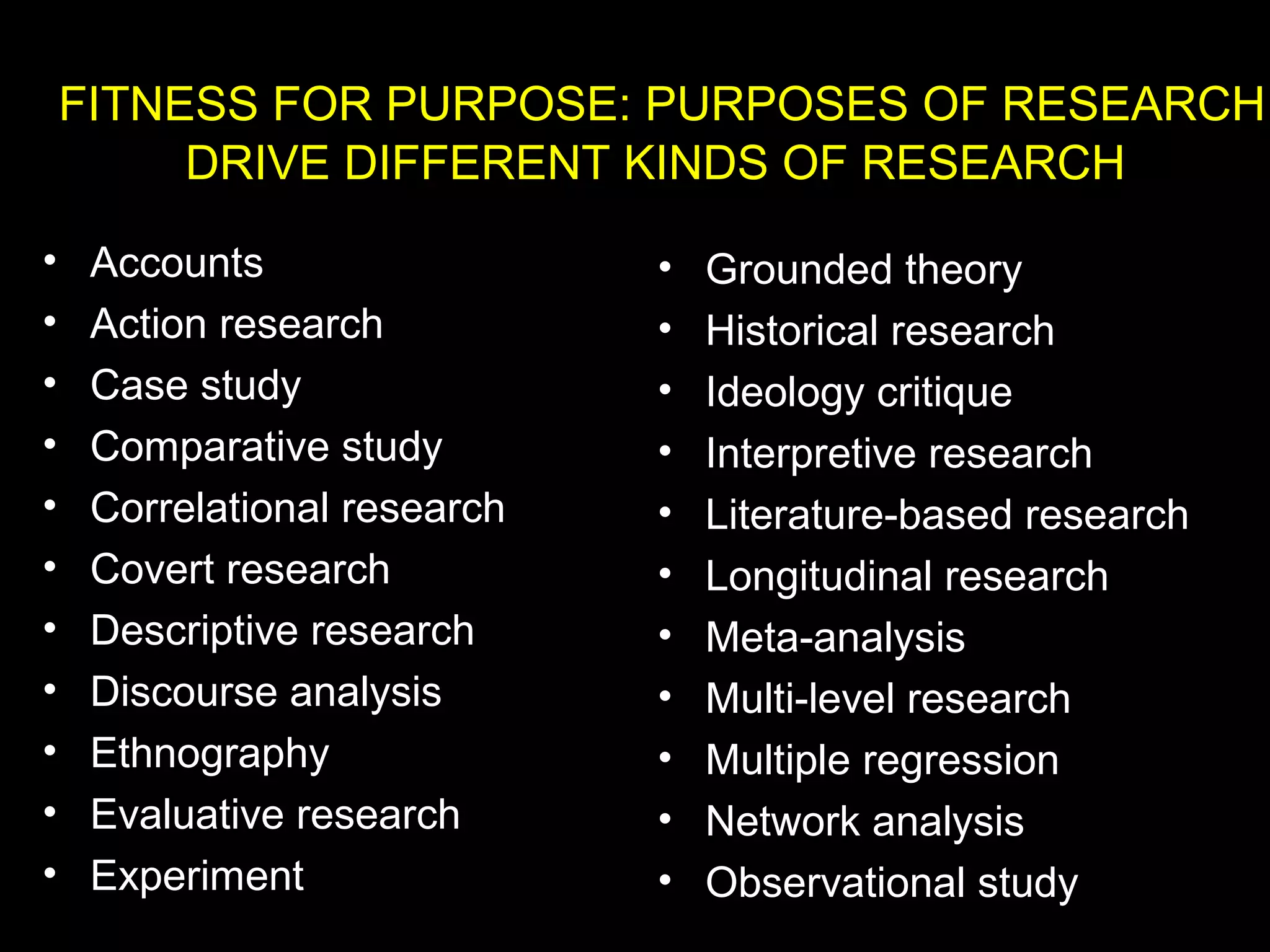
• Accounts
• Action research
• Case study
• Comparative study
• Correlational research
• Covert research
• Descriptive research
• Discourse analysis
• Ethnography
• Evaluative research
• Experiment
• Grounded theory
• Historical research
• Ideology critique
• Interpretive research
• Literature-based research
• Longitudinal research
• Meta-analysis
• Multi-level research
• Multiple regression
• Network analysis
• Observational study
FITNESS FOR PURPOSE: PURPOSES OF RESEARCH
DRIVE DIFFERENT KINDS OF RESEARCH
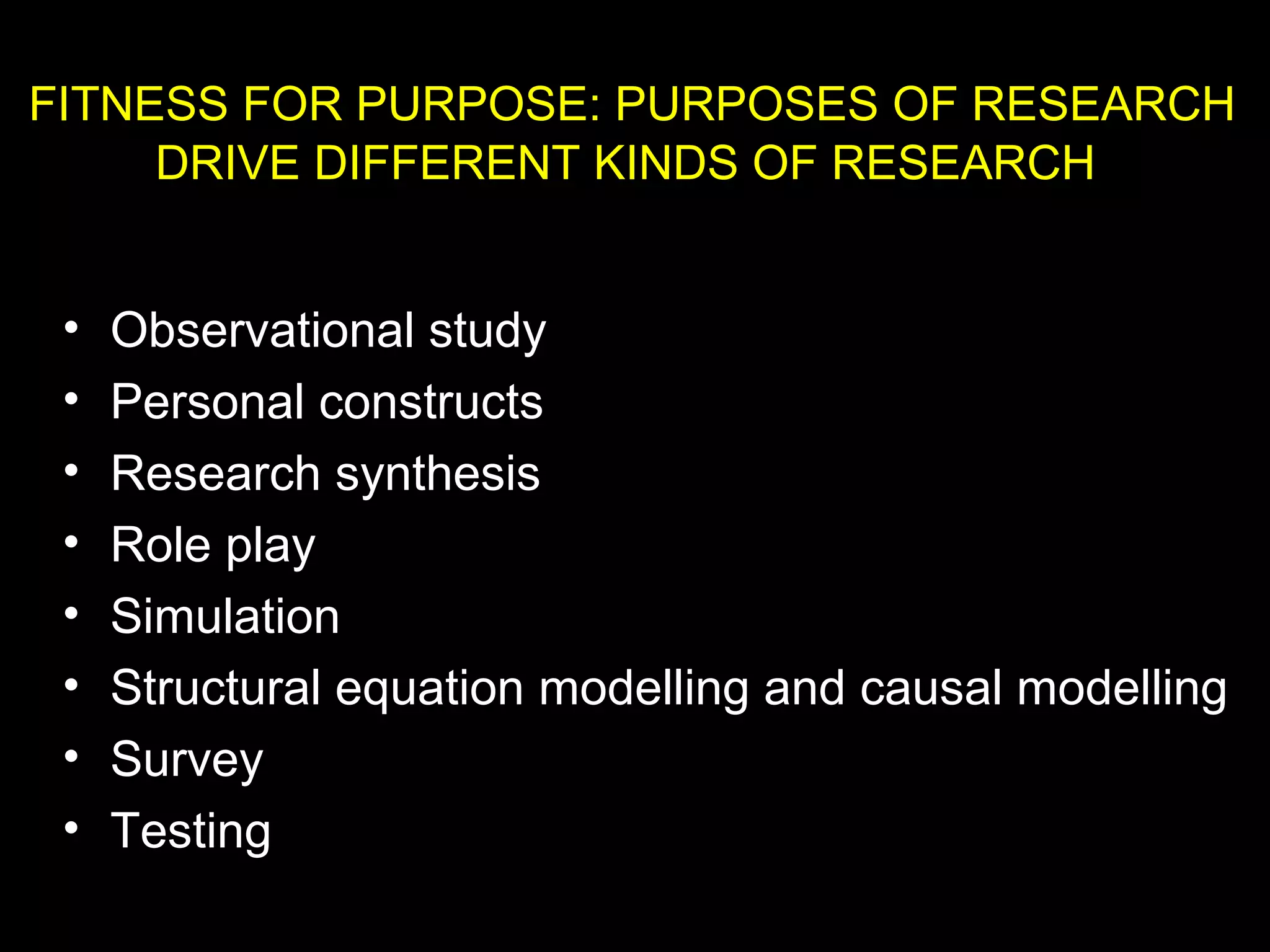
• Observational study
• Personal constructs
• Research synthesis
• Role play
• Simulation
• Structural equation modelling and causal modelling
• Survey
• Testing
FITNESS FOR PURPOSE: PURPOSES OF RESEARCH
DRIVE DIFFERENT KINDS OF RESEARCH
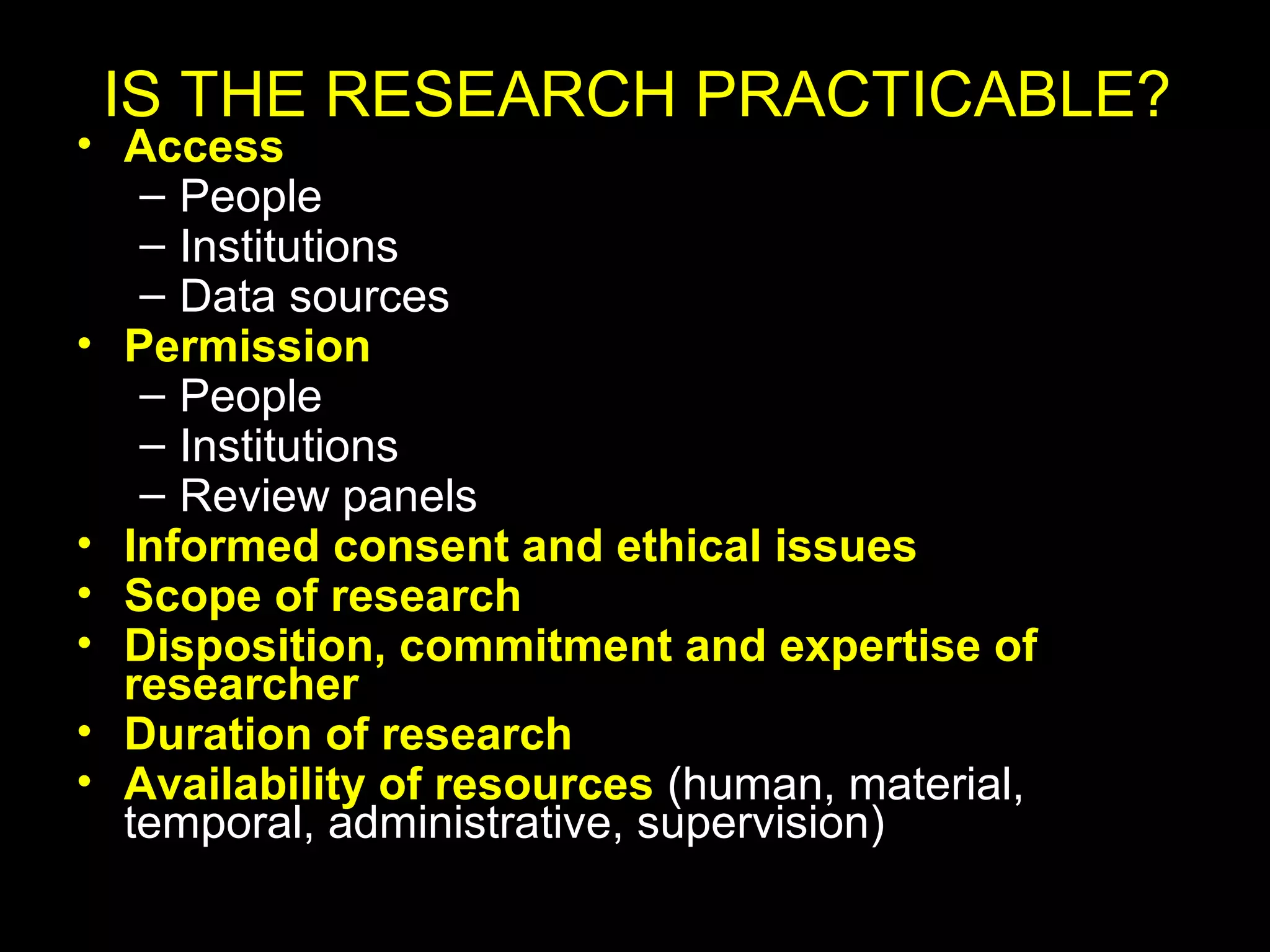
• Access
– People
– Institutions
– Data sources
• Permission
– People
– Institutions
– Review panels
• Informed consent and ethical issues
• Scope of research
• Disposition, commitment and expertise of
researcher
• Duration of research
• Availability of resources (human, material,
temporal, administrative, supervision)
IS THE RESEARCH PRACTICABLE?
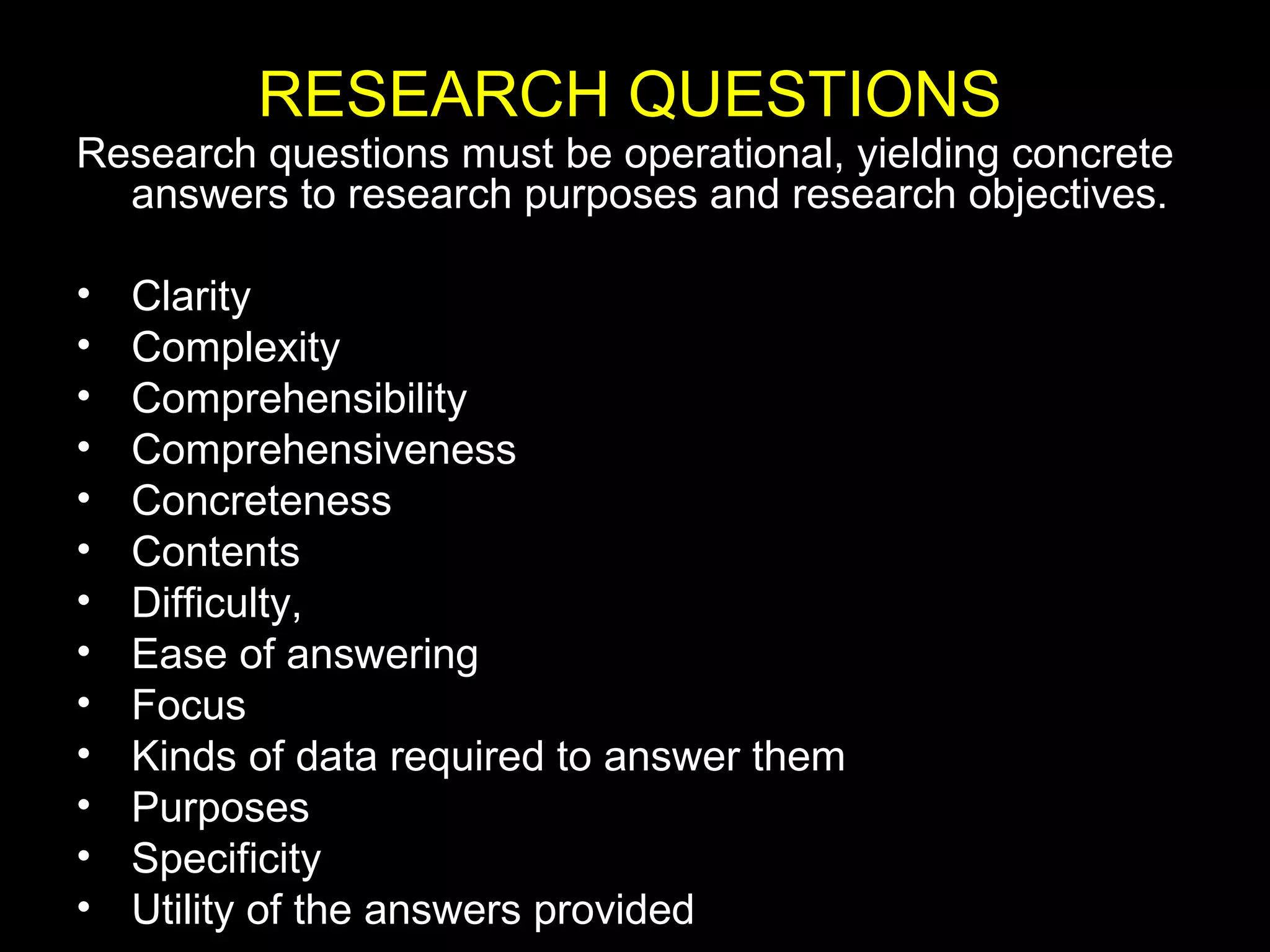
Research questions must be operational, yielding concrete
answers to research purposes and research objectives.
• Clarity
• Complexity
• Comprehensibility
• Comprehensiveness
• Concreteness
• Contents
• Difficulty,
• Ease of answering
• Focus
• Kinds of data required to answer them
• Purposes
• Specificity
• Utility of the answers provided
RESEARCH QUESTIONS
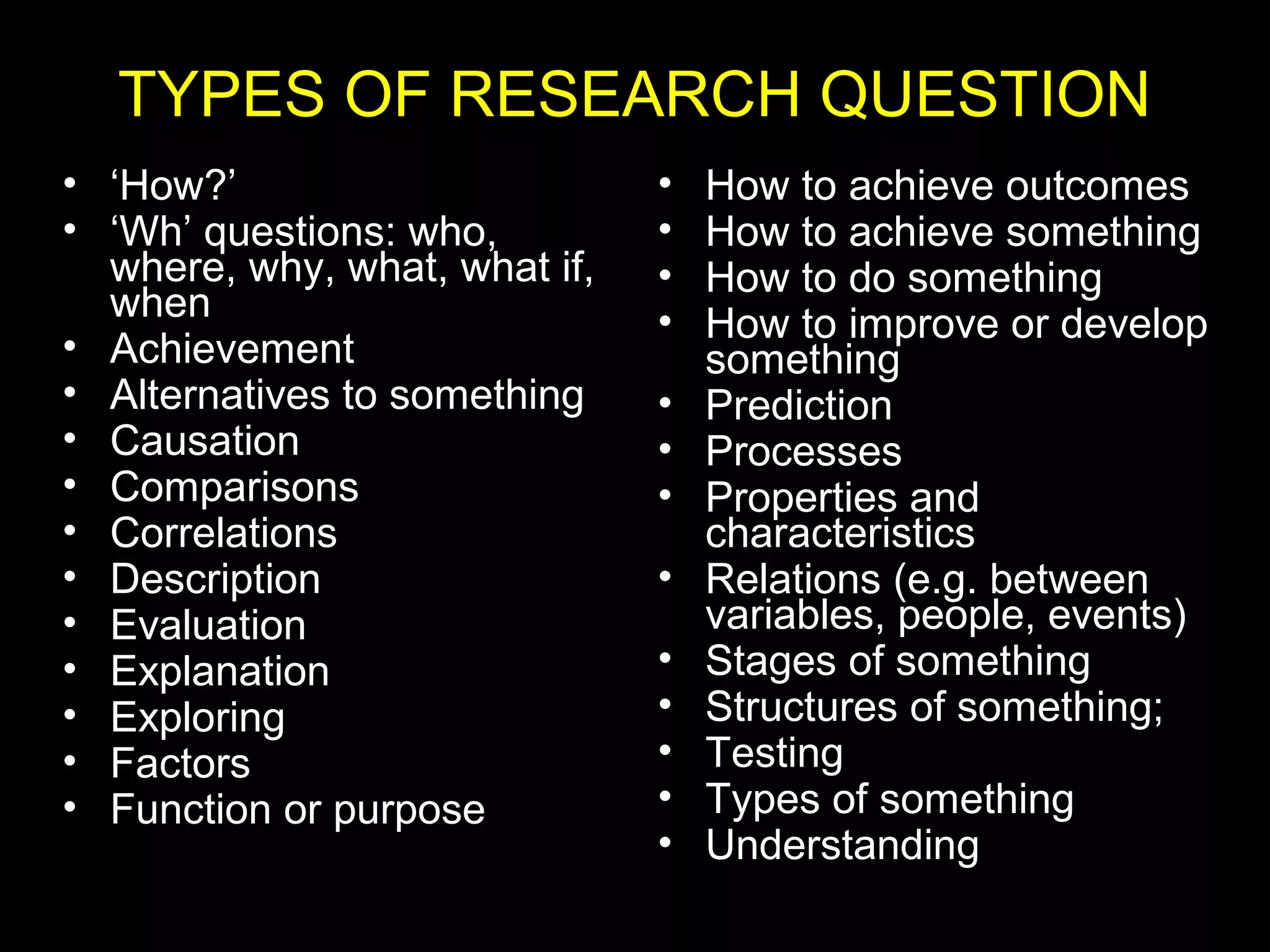
• ‘How?’
• ‘Wh’ questions: who,
where, why, what, what if,
when
• Achievement
• Alternatives to something
• Causation
• Comparisons
• Correlations
• Description
• Evaluation
• Explanation
• Exploring
• Factors
• Function or purpose
• How to achieve outcomes
• How to achieve something
• How to do something
• How to improve or develop
something
• Prediction
• Processes
• Properties and
characteristics
• Relations (e.g. between
variables, people, events)
• Stages of something
• Structures of something;
• Testing
• Types of something
• Understanding
TYPES OF RESEARCH QUESTION
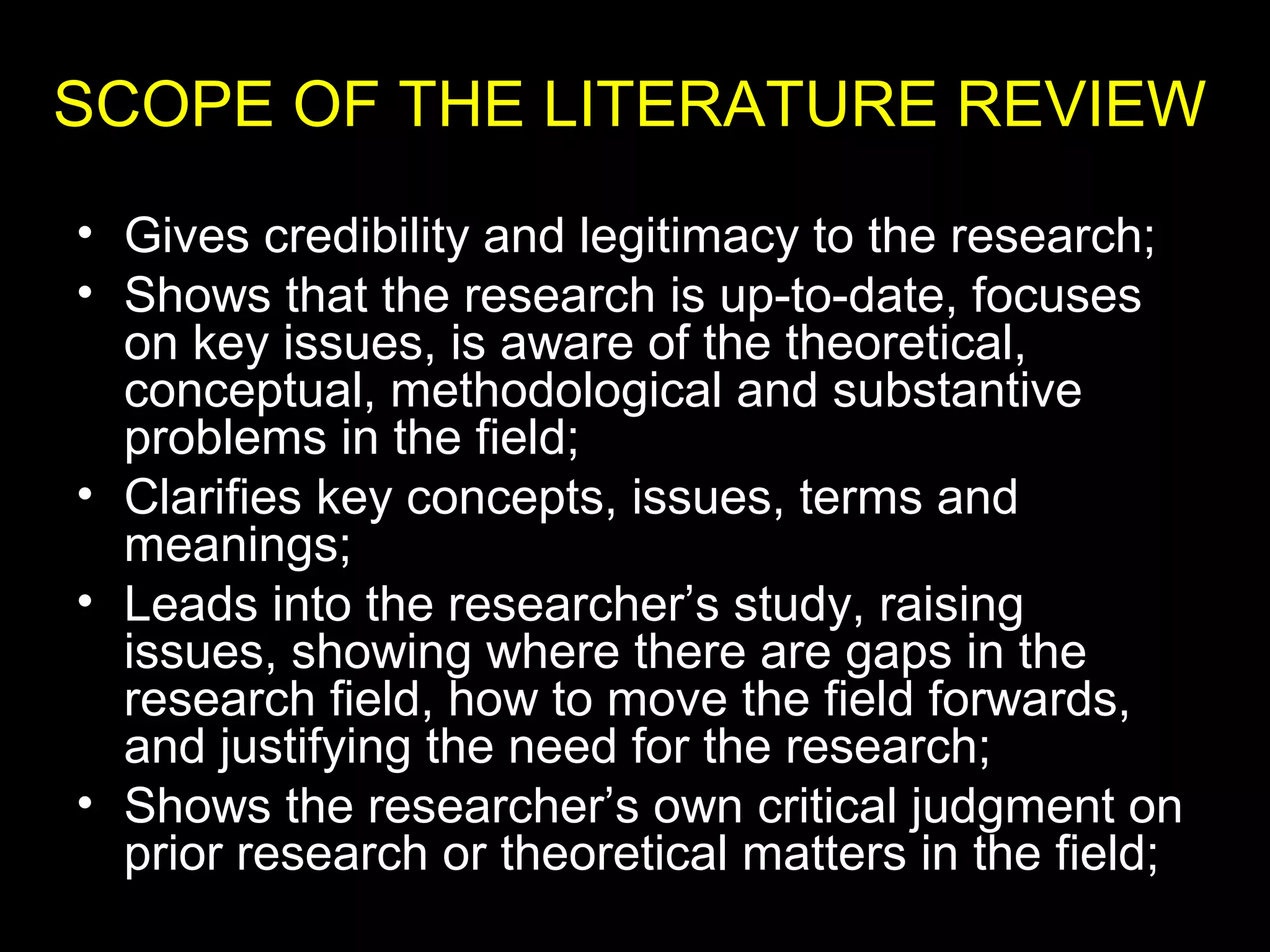
• Gives credibility and legitimacy to the research;
• Shows that the research is up-to-date, focuses
on key issues, is aware of the theoretical,
conceptual, methodological and substantive
problems in the field;
• Clarifies key concepts, issues, terms and
meanings;
• Leads into the researcher’s study, raising
issues, showing where there are gaps in the
research field, how to move the field forwards,
and justifying the need for the research;
• Shows the researcher’s own critical judgment on
prior research or theoretical matters in the field;
SCOPE OF THE LITERATURE REVIEW
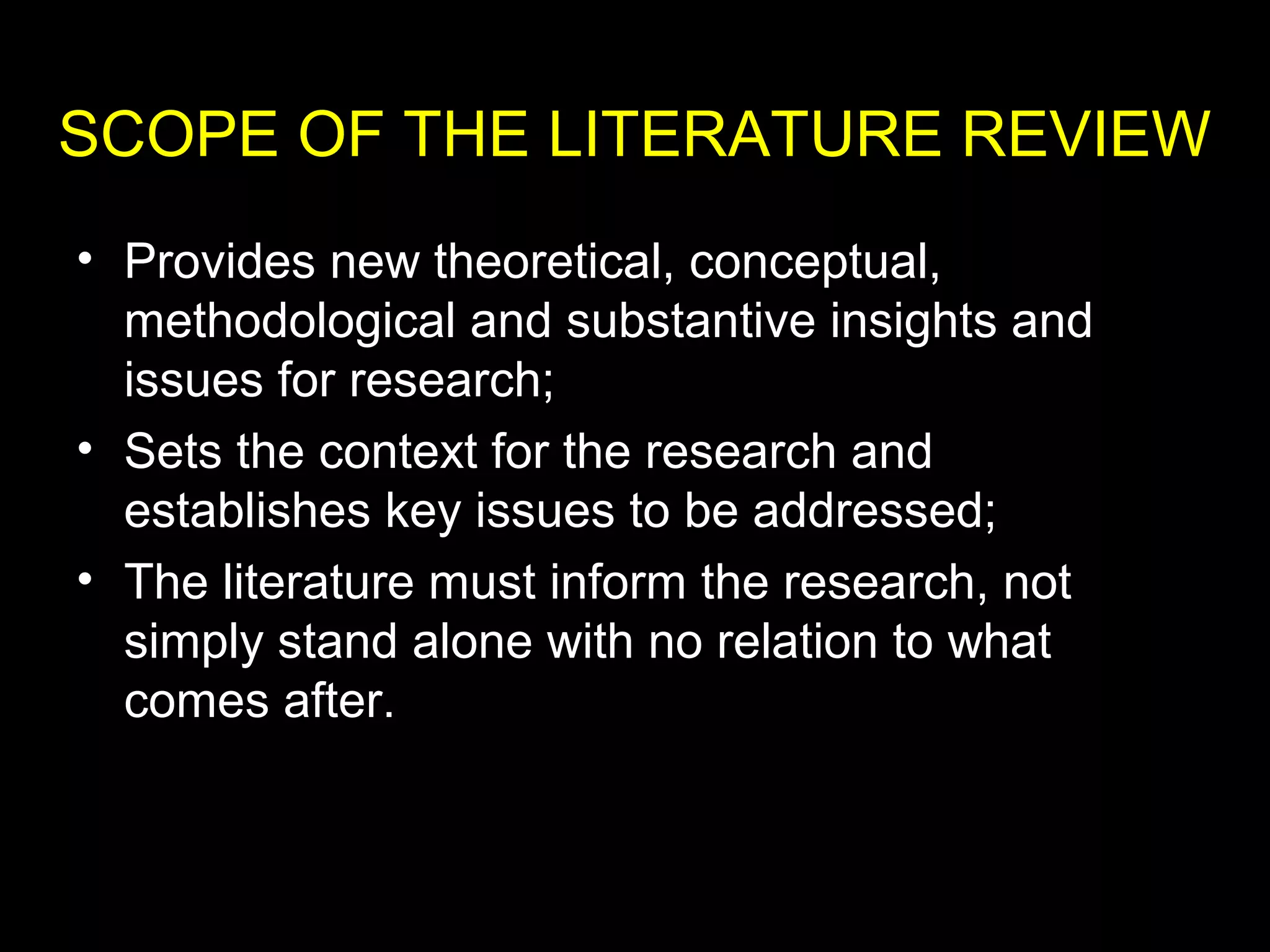
• Provides new theoretical, conceptual,
methodological and substantive insights and
issues for research;
• Sets the context for the research and
establishes key issues to be addressed;
• The literature must inform the research, not
simply stand alone with no relation to what
comes after.
SCOPE OF THE LITERATURE REVIEW

Chapter6

  • 1.
    CHOOSING A RESEARCH PROJECT ©LOUIS COHEN, LAWRENCE MANION, KEITH MORRISON
  • 2.
    • What givesrise to the research project? (Choosing a research project) • The importance of the research • The purposes of the research • Is the research practicable? • Research questions • The scope of the literature review STRUCTURE OF THE CHAPTER
  • 3.
    • A problemencountered in everyday work or outside everyday work; • An issue that the researcher has read about or seen; • A problem that has arisen in the locality, e.g. in response to government policy or practices or to local developments; • An area of the researcher’s own interest; • An area of the researcher’s own experience; • A perceived area of importance; • An interesting question; • A testable guess or hunch; • A topical matter; • Disquiet with a particular research finding that one has met in the literature or a piece of policy; CHOOSING A RESEARCH PROJECT
  • 4.
    • An awarenessthat a particular issue or area has been incompletely studied, and a wish to plug the gap; • A wish to apply a piece of conceptual research to actual practice, or to test a theory in practice; • A wish to rework the conceptual or theoretical frameworks that are often used in a specific area; • A wish to revise or replace the methodologies that are often used in researching a specific area; • A desire to improve practice in a particular area; • A desire to involve participants in research and development; CHOOSING A RESEARCH PROJECT
  • 5.
    • A desireto test out a particular methodology in research; • An interest in seeing if reported practice holds true for the researcher’s own context (e.g. a comparative study); • An interest in investigating the causes of a phenomenon or the effects of a particular intervention in the area of the phenomenon; • A priority identified by funding agencies; • An issue identified by the researcher’s supervisor or a project team of which the researcher is a member. CHOOSING A RESEARCH PROJECT
  • 6.
    • Is theresearch significant? • What difference will the research make? • Does the originality of the research render it significant? • How and where does the research move forward the field? • Where do originality and significance lie in the research: – Conceptually – Theoretically – Methodologically – Substantively THE IMPORTANCE OF THE RESEARCH
  • 7.
    • What isthe likely impact of the research? • What is the use of the research – what will it ‘deliver’? • What benefit will the research bring, and to whom? • Is the research worth doing? THE IMPORTANCE OF THE RESEARCH
  • 8.
    • What arethe ‘deliverables’ in the research? • What does the research seek to do? • What do you wish to come from the research? THE PURPOSES OF THE RESEARCH
  • 9.
    • To testa theory/hypothesis • To test practice • To clarify concepts • To identify common features • To investigate and examine • To collect opinions • To model • To compare • To look at trends • To collect views • To critique policy/practice • To examine effects of causes • To evaluate an intervention • To examine causes of effects • To look at an issue in detail • To generalize • To look at long-term effects • Classroom-based research • To investigate sensitive issues or groups • To develop theory • To see what happens if . . . EXAMPLES OF DIFFERENT PURPOSES OF RESEARCH
  • 10.
    • Accounts • Actionresearch • Case study • Comparative study • Correlational research • Covert research • Descriptive research • Discourse analysis • Ethnography • Evaluative research • Experiment • Grounded theory • Historical research • Ideology critique • Interpretive research • Literature-based research • Longitudinal research • Meta-analysis • Multi-level research • Multiple regression • Network analysis • Observational study FITNESS FOR PURPOSE: PURPOSES OF RESEARCH DRIVE DIFFERENT KINDS OF RESEARCH
  • 11.
    • Observational study •Personal constructs • Research synthesis • Role play • Simulation • Structural equation modelling and causal modelling • Survey • Testing FITNESS FOR PURPOSE: PURPOSES OF RESEARCH DRIVE DIFFERENT KINDS OF RESEARCH
  • 12.
    • Access – People –Institutions – Data sources • Permission – People – Institutions – Review panels • Informed consent and ethical issues • Scope of research • Disposition, commitment and expertise of researcher • Duration of research • Availability of resources (human, material, temporal, administrative, supervision) IS THE RESEARCH PRACTICABLE?
  • 13.
    Research questions mustbe operational, yielding concrete answers to research purposes and research objectives. • Clarity • Complexity • Comprehensibility • Comprehensiveness • Concreteness • Contents • Difficulty, • Ease of answering • Focus • Kinds of data required to answer them • Purposes • Specificity • Utility of the answers provided RESEARCH QUESTIONS
  • 14.
    • ‘How?’ • ‘Wh’questions: who, where, why, what, what if, when • Achievement • Alternatives to something • Causation • Comparisons • Correlations • Description • Evaluation • Explanation • Exploring • Factors • Function or purpose • How to achieve outcomes • How to achieve something • How to do something • How to improve or develop something • Prediction • Processes • Properties and characteristics • Relations (e.g. between variables, people, events) • Stages of something • Structures of something; • Testing • Types of something • Understanding TYPES OF RESEARCH QUESTION
  • 15.
    • Gives credibilityand legitimacy to the research; • Shows that the research is up-to-date, focuses on key issues, is aware of the theoretical, conceptual, methodological and substantive problems in the field; • Clarifies key concepts, issues, terms and meanings; • Leads into the researcher’s study, raising issues, showing where there are gaps in the research field, how to move the field forwards, and justifying the need for the research; • Shows the researcher’s own critical judgment on prior research or theoretical matters in the field; SCOPE OF THE LITERATURE REVIEW
  • 16.
    • Provides newtheoretical, conceptual, methodological and substantive insights and issues for research; • Sets the context for the research and establishes key issues to be addressed; • The literature must inform the research, not simply stand alone with no relation to what comes after. SCOPE OF THE LITERATURE REVIEW