SectionSection 1: Fabric Inspection1: Fabric Inspection
44 Point SystemPoint System44--Point SystemPoint System
44 Point SystemPoint System
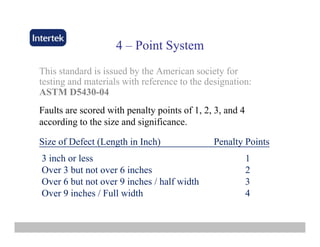
This standard is issued by the American society for
44 –– Point SystemPoint System
testing and materials with reference to the designation:
ASTM D5430-04
F lt d ith lt i t f 1 2 3 d 4Faults are scored with penalty points of 1, 2, 3, and 4
according to the size and significance.
Si f D f (L h i I h) P l P iSize of Defect (Length in Inch) Penalty Points
3 inch or less 1
Over 3 but not over 6 inches 2Over 3 but not over 6 inches 2
Over 6 but not over 9 inches / half width 3
Over 9 inches / Full width 4
44 P i tP i t S tS t44 -- PointPoint SystemSystem
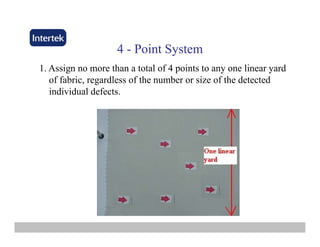
1. Assign no more than a total of 4 points to any one linear yard
f f b i dl f h b i f h d dof fabric, regardless of the number or size of the detected
individual defects.
44 -- PointPoint SystemSystem
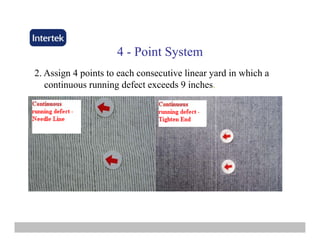
2. Assign 4 points to each consecutive linear yard in which ag p y
continuous running defect exceeds 9 inches.
44 -- PointPoint SystemSystem
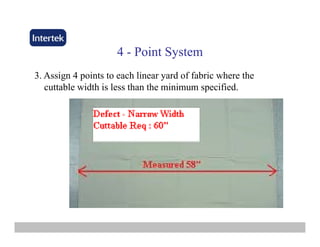
3 Assign 4 points to each linear yard of fabric where the3. Assign 4 points to each linear yard of fabric where the
cuttable width is less than the minimum specified.
44 -- PointPoint SystemSystem
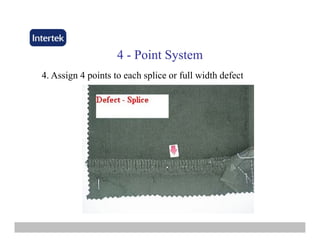
4 Assign 4 points to each splice or full width defect4. Assign 4 points to each splice or full width defect
44 PointPoint SystemSystem
A roll is graded as “PASSEDPASSED” if the total penalty points
44 -- PointPoint SystemSystem
A roll is graded as PASSEDPASSED if the total penalty points
do not exceed the advised point count per 100 square yards.
A roll is graded as “FAILEDFAILED” if the total penalty points
exceed the advised point count per 100 square yards.
The entire lot shall be ““REJECTED”REJECTED” if the average penalty
points exceed the average shipment point count per 100points exceed the average shipment point count per 100
square yards.
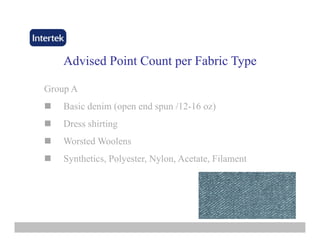
Advised Point CountAdvised Point Count per Fabric Typeper Fabric Type
Group A
Basic denim (open end spun /12-16 oz)Basic denim (open end spun /12 16 oz)
Dress shirting
W t d W lWorsted Woolens
Synthetics, Polyester, Nylon, Acetate, Filament
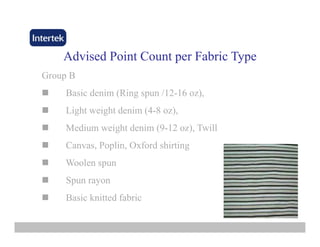
Advised Point CountAdvised Point Count per Fabric Typeper Fabric Type
Group BGroup B
Basic denim (Ring spun /12-16 oz),
Li ht i ht d i (4 8 )Light weight denim (4-8 oz),
Medium weight denim (9-12 oz), Twill
Canvas, Poplin, Oxford shirting
Woolen spun
Spun rayon
Basic knitted fabric
Advised PointAdvised Point Count per Fabric TypeCount per Fabric Type
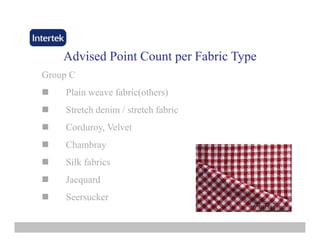
Group CGroup C
Plain weave fabric(others)
St t h d i / t t h f b iStretch denim / stretch fabric
Corduroy, Velvet
Chambray
Silk fabrics
Jacquard
Seersucker
Advised PointAdvised Point Count per Fabric TypeCount per Fabric Type
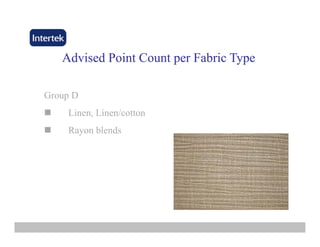
Group D
Linen, Linen/cotton
Rayon blends
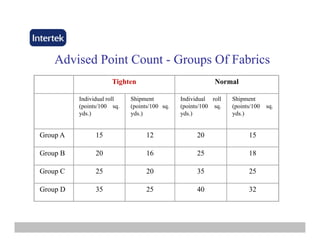
Advised PointAdvised Point CountCount -- GroupsGroups Of FabricsOf Fabrics
Tighten Normal
Individual roll
(points/100 sq.
Shipment
(points/100 sq.
Individual roll
(points/100 sq.
Shipment
(points/100 sq.(points/100 sq.
yds.)
(points/100 sq.
yds.)
(points/100 sq.
yds.)
(points/100 sq.
yds.)
Group A 15 12 20 15
Group B 20 16 25 18
G C 25 20 35 25Group C 25 20 35 25
Group D 35 25 40 32
SectionSection 2:2:
Random SamplingRandom Sampling
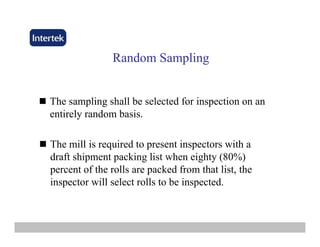
The sampling shall be selected for inspection on an
entirely random basis.
The mill is required to present inspectors with a
draft shipment packing list when eighty (80%)
percent of the rolls are packed from that list thepercent of the rolls are packed from that list, the
inspector will select rolls to be inspected.
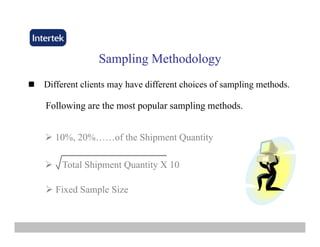
Sampling MSampling Methodologyethodology
Different clients may have different choices of sampling methods.
Following are the most popular sampling methods.Following are the most popular sampling methods.
10% 20% of the Shipment Quantity10%, 20%……of the Shipment Quantity
Total Shipment Quantity X 10
Fixed Sample Size
SectionSection 3:3:
OnOn--Site Fabric Inspection ProcessSite Fabric Inspection Process
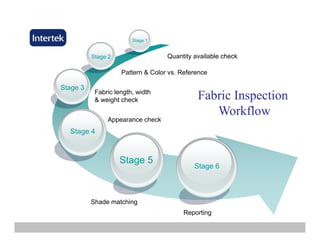
Stage 1
Stage 2 Quantity available check
Pattern & Color vs. Reference
FabricFabric InspectionInspection
W kflW kfl
Stage 3
Fabric length, width
& weight check
WorkflowWorkflow
Stage 4
Appearance check
Stage 6
Stage 5
Shade matchingShade matching
Reporting
SectionSection 4:4:
Inspection ArrangementInspection Arrangement
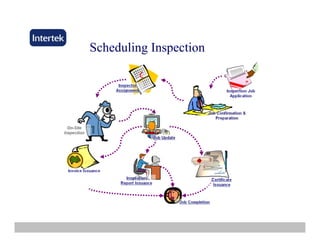
S h d li I tiScheduling Inspection
Inspection ConditionsInspection Conditionsspec o Co d o sspec o Co d o s
A suitable environment is very important for inspection. In
order to speed up the inspection, fabric manufacturer
should provide inspectors with necessary support in loading
and unloading fabric rolls.
All fabrics are to be inspected on an inspection frame with
a variable speed motor and proper lighting.
The fabric will be inspected at a speed that is compatible
with the fabric quality, but should never exceed:
25 yards/meter per minute for solid colors;25 yards/meter per minute for solid colors;
15 yards/meter per minute for printed/ pattern fabrics;.
The fabric inspection quantity depends on the fabric types:The fabric inspection quantity depends on the fabric types:
about 1,500 to 2,000 yards per day;
SectionSection 5:5:
FabricFabric Inspection HighlightsInspection Highlights
InspectionInspection ProcedureProcedure –– Fabric WidthFabric Width
Cuttable width will be checked at minimum three
ti d i th i ti f ll (10 d ftimes during the inspection of a roll (10 yards from
beginning, middle and 10 yards from end of the roll).
Assign 4 point (4-point system only) to each linear
yard of fabric where the cuttable width is less than they
minimum specified.
InspectionInspection ProcedureProcedure –– Fabric LengthFabric Length
Fabric length can be measured by a meter which is set
up on the fabric inspection machine. Otherwise, the
lt t b t if th f b i l th iresult may not be accurate if the fabric length is
measured manually on a table, particularly for knit
fabrics.
If a fabric roll length is 2% shorter from the ordered
ticket it may be rejected. Penalty points will not be
i d f ll l th i ti b t it h ll bassigned for roll length variation, but it shall be
included in the inspection report.
Common Fabric Defects
• Abrasion Mark
• Bow
• Hole
• Mispick
• Skew
• Crease
• Oil Stain
• Double Pick
• Misprint
• Slub• Oil Stain
• Dye Stain
• Slub
• Contamination/Color fly
24
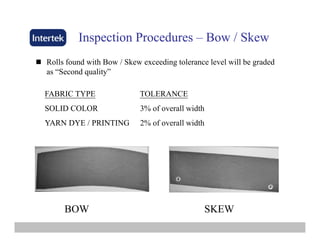
Inspection ProceduresInspection Procedures –– Bow / SkewBow / Skew
Rolls found with Bow / Skew exceeding tolerance level will be graded
as “Second quality”
FABRIC TYPE TOLERANCE
SOLID COLOR 3% of overall widthSOLID COLOR 3% of overall width
YARN DYE / PRINTING 2% of overall width
BOW SKEW
InspectionInspection ProcedureProcedure –– Shade MatchingShade Matching
Color shade evaluation consists of the following points:
Color shade comparison against reference sample
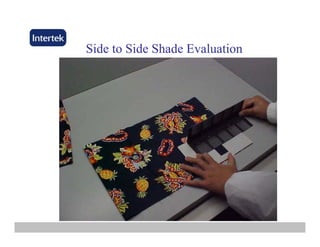
Side to Side / Side to Center
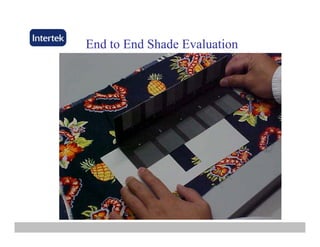
End to End
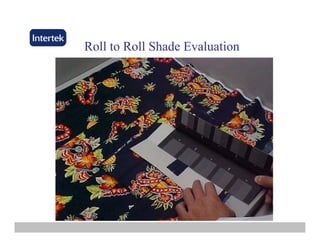
Roll to Roll
Note: Common use light source: D65 daylight
Sid t SidSid t Sid Sh d E l tiSh d E l tiSide to SideSide to Side Shade EvaluationShade Evaluation
End to EndEnd to End Shade EvaluationShade EvaluationEnd to EndEnd to End Shade EvaluationShade Evaluation
Roll to RollRoll to Roll Shade EvaluationShade EvaluationRoll to RollRoll to Roll Shade EvaluationShade Evaluation
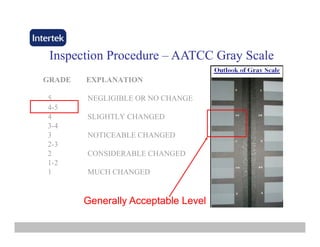
InspectionInspection ProcedureProcedure –– AATCC Gray ScaleAATCC Gray Scale
GRADE EXPLANATION
5 NEGLIGIBLE OR NO CHANGE
4 54-5
4 SLIGHTLY CHANGED
3-4
3 NOTICEABLE CHANGED
2-3
2 CONSIDERABLE CHANGED
1-2
1 MUCH CHANGED1 MUCH CHANGED
GenerallyGenerally Acceptable LevelAcceptable LevelGenerallyGenerally Acceptable LevelAcceptable Level
InspectionInspection ProcedureProcedure –– Fabric WeightFabric Weight
At least two samples in different rolls should be weighed.At least two samples in different rolls should be weighed.
General tolerance:
+/-5% of fabric weighing < 10 oz./sq.yd
+/-3% of fabric weighing ≥ 10 oz./sq.yd+/ 3% of fabric weighing ≥ 10 oz./sq.yd
For example:
Order request: 6.0 oz/sq.yd. (Requirement: +/-5%)
If the finding is 6.15 oz/sq.yd. Accepted
If the finding is 6.40 oz/sq.yd. Rejected
STEPS:STEPS:
The fabric swatch should be drawn at least 1 yard from the beginning/end.
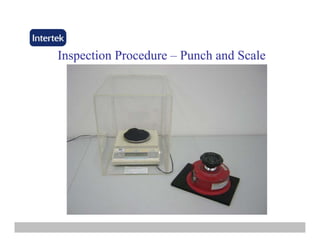
Cut the sampled fabric with punch.
For accuracy, use electronic balance to weight fabric.
InspectionInspection ProcedureProcedure –– Punch and ScalePunch and Scale
InspectionInspection ProcedureProcedure –– PackagingPackaging
Fabric shall be rolled onto a tube with the necessary
wall thickness and strength to ensure the fabric reaches
its destination in good condition.
Tube diameter shall be at least 1.5” in diameter, but not
more than 2” in diameter.more than 2 in diameter.
InspectionInspection ProcedureProcedure –– PackagingPackaging
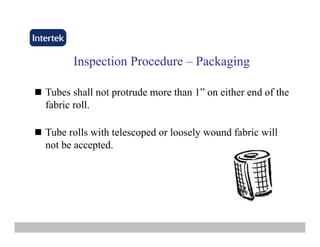
Tubes shall not protrude more than 1” on either end of the
fabric roll.fabric roll.
Tube rolls with telescoped or loosely wound fabric will
not be accepted.

4-Point-Fabric-Inspection

  • 1.
    SectionSection 1: FabricInspection1: Fabric Inspection 44 Point SystemPoint System44--Point SystemPoint System
  • 2.
    44 Point SystemPointSystem This standard is issued by the American society for 44 –– Point SystemPoint System testing and materials with reference to the designation: ASTM D5430-04 F lt d ith lt i t f 1 2 3 d 4Faults are scored with penalty points of 1, 2, 3, and 4 according to the size and significance. Si f D f (L h i I h) P l P iSize of Defect (Length in Inch) Penalty Points 3 inch or less 1 Over 3 but not over 6 inches 2Over 3 but not over 6 inches 2 Over 6 but not over 9 inches / half width 3 Over 9 inches / Full width 4
  • 3.
    44 P itP i t S tS t44 -- PointPoint SystemSystem 1. Assign no more than a total of 4 points to any one linear yard f f b i dl f h b i f h d dof fabric, regardless of the number or size of the detected individual defects.
  • 4.
    44 -- PointPointSystemSystem 2. Assign 4 points to each consecutive linear yard in which ag p y continuous running defect exceeds 9 inches.
  • 5.
    44 -- PointPointSystemSystem 3 Assign 4 points to each linear yard of fabric where the3. Assign 4 points to each linear yard of fabric where the cuttable width is less than the minimum specified.
  • 6.
    44 -- PointPointSystemSystem 4 Assign 4 points to each splice or full width defect4. Assign 4 points to each splice or full width defect
  • 7.
    44 PointPoint SystemSystem Aroll is graded as “PASSEDPASSED” if the total penalty points 44 -- PointPoint SystemSystem A roll is graded as PASSEDPASSED if the total penalty points do not exceed the advised point count per 100 square yards. A roll is graded as “FAILEDFAILED” if the total penalty points exceed the advised point count per 100 square yards. The entire lot shall be ““REJECTED”REJECTED” if the average penalty points exceed the average shipment point count per 100points exceed the average shipment point count per 100 square yards.
  • 8.
    Advised Point CountAdvisedPoint Count per Fabric Typeper Fabric Type Group A Basic denim (open end spun /12-16 oz)Basic denim (open end spun /12 16 oz) Dress shirting W t d W lWorsted Woolens Synthetics, Polyester, Nylon, Acetate, Filament
  • 9.
    Advised Point CountAdvisedPoint Count per Fabric Typeper Fabric Type Group BGroup B Basic denim (Ring spun /12-16 oz), Li ht i ht d i (4 8 )Light weight denim (4-8 oz), Medium weight denim (9-12 oz), Twill Canvas, Poplin, Oxford shirting Woolen spun Spun rayon Basic knitted fabric
  • 10.
    Advised PointAdvised PointCount per Fabric TypeCount per Fabric Type Group CGroup C Plain weave fabric(others) St t h d i / t t h f b iStretch denim / stretch fabric Corduroy, Velvet Chambray Silk fabrics Jacquard Seersucker
  • 11.
    Advised PointAdvised PointCount per Fabric TypeCount per Fabric Type Group D Linen, Linen/cotton Rayon blends
  • 12.
    Advised PointAdvised PointCountCount -- GroupsGroups Of FabricsOf Fabrics Tighten Normal Individual roll (points/100 sq. Shipment (points/100 sq. Individual roll (points/100 sq. Shipment (points/100 sq.(points/100 sq. yds.) (points/100 sq. yds.) (points/100 sq. yds.) (points/100 sq. yds.) Group A 15 12 20 15 Group B 20 16 25 18 G C 25 20 35 25Group C 25 20 35 25 Group D 35 25 40 32
  • 13.
  • 14.
    Random SamplingRandom Sampling Thesampling shall be selected for inspection on an entirely random basis. The mill is required to present inspectors with a draft shipment packing list when eighty (80%) percent of the rolls are packed from that list thepercent of the rolls are packed from that list, the inspector will select rolls to be inspected.
  • 15.
    Sampling MSampling Methodologyethodology Differentclients may have different choices of sampling methods. Following are the most popular sampling methods.Following are the most popular sampling methods. 10% 20% of the Shipment Quantity10%, 20%……of the Shipment Quantity Total Shipment Quantity X 10 Fixed Sample Size
  • 16.
    SectionSection 3:3: OnOn--Site FabricInspection ProcessSite Fabric Inspection Process
  • 17.
    Stage 1 Stage 2Quantity available check Pattern & Color vs. Reference FabricFabric InspectionInspection W kflW kfl Stage 3 Fabric length, width & weight check WorkflowWorkflow Stage 4 Appearance check Stage 6 Stage 5 Shade matchingShade matching Reporting
  • 18.
  • 19.
    S h dli I tiScheduling Inspection
  • 20.
    Inspection ConditionsInspection Conditionsspeco Co d o sspec o Co d o s A suitable environment is very important for inspection. In order to speed up the inspection, fabric manufacturer should provide inspectors with necessary support in loading and unloading fabric rolls. All fabrics are to be inspected on an inspection frame with a variable speed motor and proper lighting. The fabric will be inspected at a speed that is compatible with the fabric quality, but should never exceed: 25 yards/meter per minute for solid colors;25 yards/meter per minute for solid colors; 15 yards/meter per minute for printed/ pattern fabrics;. The fabric inspection quantity depends on the fabric types:The fabric inspection quantity depends on the fabric types: about 1,500 to 2,000 yards per day;
  • 21.
    SectionSection 5:5: FabricFabric InspectionHighlightsInspection Highlights
  • 22.
    InspectionInspection ProcedureProcedure ––Fabric WidthFabric Width Cuttable width will be checked at minimum three ti d i th i ti f ll (10 d ftimes during the inspection of a roll (10 yards from beginning, middle and 10 yards from end of the roll). Assign 4 point (4-point system only) to each linear yard of fabric where the cuttable width is less than they minimum specified.
  • 23.
    InspectionInspection ProcedureProcedure ––Fabric LengthFabric Length Fabric length can be measured by a meter which is set up on the fabric inspection machine. Otherwise, the lt t b t if th f b i l th iresult may not be accurate if the fabric length is measured manually on a table, particularly for knit fabrics. If a fabric roll length is 2% shorter from the ordered ticket it may be rejected. Penalty points will not be i d f ll l th i ti b t it h ll bassigned for roll length variation, but it shall be included in the inspection report.
  • 24.
    Common Fabric Defects •Abrasion Mark • Bow • Hole • Mispick • Skew • Crease • Oil Stain • Double Pick • Misprint • Slub• Oil Stain • Dye Stain • Slub • Contamination/Color fly 24
  • 25.
    Inspection ProceduresInspection Procedures–– Bow / SkewBow / Skew Rolls found with Bow / Skew exceeding tolerance level will be graded as “Second quality” FABRIC TYPE TOLERANCE SOLID COLOR 3% of overall widthSOLID COLOR 3% of overall width YARN DYE / PRINTING 2% of overall width BOW SKEW
  • 26.
    InspectionInspection ProcedureProcedure ––Shade MatchingShade Matching Color shade evaluation consists of the following points: Color shade comparison against reference sample Side to Side / Side to Center End to End Roll to Roll Note: Common use light source: D65 daylight
  • 27.
    Sid t SidSidt Sid Sh d E l tiSh d E l tiSide to SideSide to Side Shade EvaluationShade Evaluation
  • 28.
    End to EndEndto End Shade EvaluationShade EvaluationEnd to EndEnd to End Shade EvaluationShade Evaluation
  • 29.
    Roll to RollRollto Roll Shade EvaluationShade EvaluationRoll to RollRoll to Roll Shade EvaluationShade Evaluation
  • 30.
    InspectionInspection ProcedureProcedure ––AATCC Gray ScaleAATCC Gray Scale GRADE EXPLANATION 5 NEGLIGIBLE OR NO CHANGE 4 54-5 4 SLIGHTLY CHANGED 3-4 3 NOTICEABLE CHANGED 2-3 2 CONSIDERABLE CHANGED 1-2 1 MUCH CHANGED1 MUCH CHANGED GenerallyGenerally Acceptable LevelAcceptable LevelGenerallyGenerally Acceptable LevelAcceptable Level
  • 31.
    InspectionInspection ProcedureProcedure ––Fabric WeightFabric Weight At least two samples in different rolls should be weighed.At least two samples in different rolls should be weighed. General tolerance: +/-5% of fabric weighing < 10 oz./sq.yd +/-3% of fabric weighing ≥ 10 oz./sq.yd+/ 3% of fabric weighing ≥ 10 oz./sq.yd For example: Order request: 6.0 oz/sq.yd. (Requirement: +/-5%) If the finding is 6.15 oz/sq.yd. Accepted If the finding is 6.40 oz/sq.yd. Rejected STEPS:STEPS: The fabric swatch should be drawn at least 1 yard from the beginning/end. Cut the sampled fabric with punch. For accuracy, use electronic balance to weight fabric.
  • 32.
    InspectionInspection ProcedureProcedure ––Punch and ScalePunch and Scale
  • 33.
    InspectionInspection ProcedureProcedure ––PackagingPackaging Fabric shall be rolled onto a tube with the necessary wall thickness and strength to ensure the fabric reaches its destination in good condition. Tube diameter shall be at least 1.5” in diameter, but not more than 2” in diameter.more than 2 in diameter.
  • 34.
    InspectionInspection ProcedureProcedure ––PackagingPackaging Tubes shall not protrude more than 1” on either end of the fabric roll.fabric roll. Tube rolls with telescoped or loosely wound fabric will not be accepted.