Kapok
Structure &Fibre Properties
Miss Eryna Binti Nasir
GROUP MEMBER:
NOR FARAH ASYIKIN
BINTI MOHD TALIB
NOR NADIAH BINTI
SARBU
OBJECTIVES
To identify the potential natural fibers
(Kapok).
To study the suitable method on processing
the Kapok fibers.
To do fiber identification test to determine
the Kapok fiber properties.
To identify the end-use of the Kapok fiber.
INTRODUCTION
Kapok tree does not grow wild in Malaysia and it comes
from the tropical America's.
Kapok fibres on their own are not suitable for spinning into
yarn. (as they are too smooth, slippery and brittle)
Kapok fiber's essential attributes are many: buoyant,
resilient, moisture resistant, vermin resistant and smooth,
kapok possess powerful performance in a lightweight
package.
When kapok fibers are put under tension they completely
return to their original length when the tension is removed.
The conventional end uses of kapok include mattress/pillow
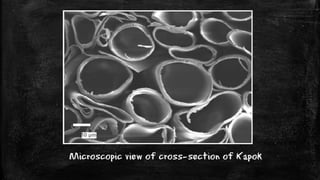
Microscopic view of cross-section of Kapok
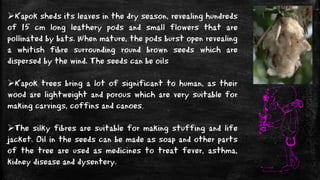
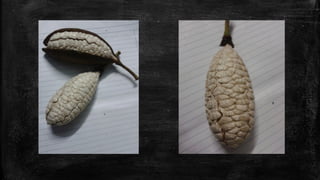
Kapok sheds its leaves in the dry season, revealing hundreds
of 15 cm long leathery pods and small flowers that are
pollinated by bats. When mature, the pods burst open revealing
a whitish fibre surrounding round brown seeds which are
dispersed by the wind. The seeds can be oils
Kapok trees bring a lot of significant to human, as their
wood are lightweight and porous which are very suitable for
making carvings, coffins and canoes.
The silky fibres are suitable for making stuffing and life
jacket. Oil in the seeds can be made as soap and other parts
of the tree are used as medicines to treat fever, asthma,
kidney disease and dysentery.
METHOD OF
PROCESSING
KAPOK
Kapok harvesting process requires a lot of manpower,
as each step is done mostly by hand. The process
starts with:
Harversting
The ripe unopened
pods are normally
harvested by
knocking them off
the tree, but they
can also be cut
from the tree or
harvested when
they fall to the
ground.
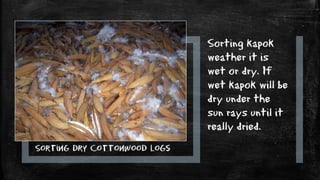
Sorting dry cottonwood logs
Sorting kapok
weather it is
wet or dry. If
wet kapok will be
dry under the
sun rays until it
really dried.
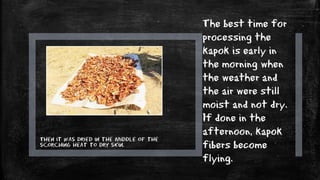
Then it was dried in the middle of the
scorching heat to dry skin.
The best time for
processing the
kapok is early in
the morning when
the weather and
the air were still
moist and not dry.
If done in the
afternoon, kapok
fibers become
flying.
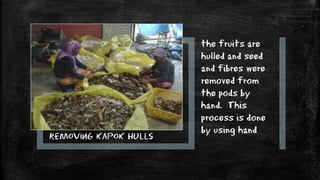
removing Kapok hulls
the fruits are
hulled and seed
and fibres were
removed from
the pods by
hand. This
process is done
by using hand
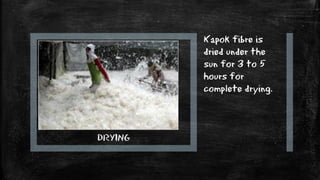
DRYING
Kapok fibre is
dried under the
sun for 3 to 5
hours for
complete drying.
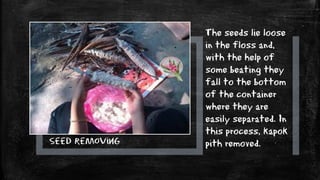
Seed removing
The seeds lie loose
in the floss and,
with the help of
some beating they
fall to the bottom
of the container
where they are
easily separated. In
this process, kapok
pith removed.
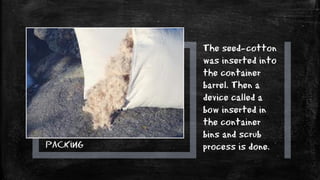
Packing
The seed-cotton
was inserted into
the container
barrel. Then a
device called a
bow inserted in
the container
bins and scrub
process is done.
Fiber
Identification
Your text here
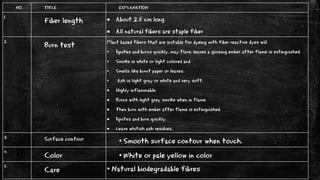
NO. TITLE EXPLANATION
1.
Fiber length  About 2.5 cm long
 All natural fibers are staple fiber
2.
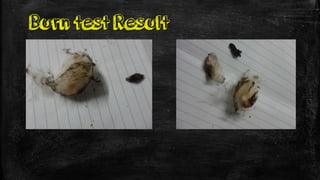
Burn test Plant based fibers that are suitable for dyeing with fiber reactive dyes will
• Ignites and burns quickly, may flare, leaves a glowing ember after flame is extinguished.
• Smoke is white or light colored and
• Smells like burnt paper or leaves.
• Ash is light gray or white and very soft.
 Highly inflammable.
 Burns with light grey smoke when in flame.
 Then burn with ember after flame is extinguished.
 Ignites and burn quickly.
 Leave whitish ash residues.
3. Surface contour • Smooth surface contour when touch.
4.
Color • White or pale yellow in color
5.
Care • Natural biodegradable fibres
Burn test Result
End use
▪ Life Jackets
▪ pillow
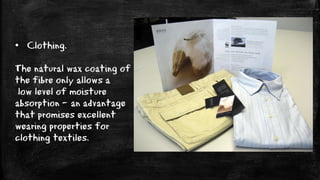
• Clothing.
The natural wax coating of
the fibre only allows a
low level of moisture
absorption – an advantage
that promises excellent
wearing properties for
clothing textiles.
Conclusion
The conventional end uses of kapok include mattress/pillow stuffing,
upholstery and thermal insulation. The market for kapok in these traditional
uses has declined considerably over the past 30 years, due to the
developments in synthetic materials, such as foamed plastics, which have
almost replaced kapok in most of its traditional end uses. Attempts to use
kapok fibre for producing textile yarn were not successful due to the
slippery nature of the fibres and its brittleness. The fibre yarn resulting
from blending kapok with cotton is potentially suitable for producing woven
textile fabrics. In addition to its potential use as clothing material, the
fabric is being considered for suitability as reinforcement to thermosetting
polymeric materials such as polyester and phenolic resins
Thank You
ANY QUESTION

Kapok

  • 1.
  • 2.
    GROUP MEMBER: NOR FARAHASYIKIN BINTI MOHD TALIB NOR NADIAH BINTI SARBU
  • 3.
    OBJECTIVES To identify thepotential natural fibers (Kapok). To study the suitable method on processing the Kapok fibers. To do fiber identification test to determine the Kapok fiber properties. To identify the end-use of the Kapok fiber.
  • 4.
    INTRODUCTION Kapok tree doesnot grow wild in Malaysia and it comes from the tropical America's. Kapok fibres on their own are not suitable for spinning into yarn. (as they are too smooth, slippery and brittle) Kapok fiber's essential attributes are many: buoyant, resilient, moisture resistant, vermin resistant and smooth, kapok possess powerful performance in a lightweight package. When kapok fibers are put under tension they completely return to their original length when the tension is removed. The conventional end uses of kapok include mattress/pillow
  • 5.
    Microscopic view ofcross-section of Kapok
  • 6.
    Kapok sheds itsleaves in the dry season, revealing hundreds of 15 cm long leathery pods and small flowers that are pollinated by bats. When mature, the pods burst open revealing a whitish fibre surrounding round brown seeds which are dispersed by the wind. The seeds can be oils Kapok trees bring a lot of significant to human, as their wood are lightweight and porous which are very suitable for making carvings, coffins and canoes. The silky fibres are suitable for making stuffing and life jacket. Oil in the seeds can be made as soap and other parts of the tree are used as medicines to treat fever, asthma, kidney disease and dysentery.
  • 8.
  • 9.
    Kapok harvesting processrequires a lot of manpower, as each step is done mostly by hand. The process starts with: Harversting The ripe unopened pods are normally harvested by knocking them off the tree, but they can also be cut from the tree or harvested when they fall to the ground.
  • 10.
    Sorting dry cottonwoodlogs Sorting kapok weather it is wet or dry. If wet kapok will be dry under the sun rays until it really dried.
  • 11.
    Then it wasdried in the middle of the scorching heat to dry skin. The best time for processing the kapok is early in the morning when the weather and the air were still moist and not dry. If done in the afternoon, kapok fibers become flying.
  • 12.
    removing Kapok hulls thefruits are hulled and seed and fibres were removed from the pods by hand. This process is done by using hand
  • 13.
    DRYING Kapok fibre is driedunder the sun for 3 to 5 hours for complete drying.
  • 14.
    Seed removing The seedslie loose in the floss and, with the help of some beating they fall to the bottom of the container where they are easily separated. In this process, kapok pith removed.
  • 15.
    Packing The seed-cotton was insertedinto the container barrel. Then a device called a bow inserted in the container bins and scrub process is done.
  • 16.
  • 17.
    NO. TITLE EXPLANATION 1. Fiberlength  About 2.5 cm long  All natural fibers are staple fiber 2. Burn test Plant based fibers that are suitable for dyeing with fiber reactive dyes will • Ignites and burns quickly, may flare, leaves a glowing ember after flame is extinguished. • Smoke is white or light colored and • Smells like burnt paper or leaves. • Ash is light gray or white and very soft.  Highly inflammable.  Burns with light grey smoke when in flame.  Then burn with ember after flame is extinguished.  Ignites and burn quickly.  Leave whitish ash residues. 3. Surface contour • Smooth surface contour when touch. 4. Color • White or pale yellow in color 5. Care • Natural biodegradable fibres
  • 18.
  • 19.
    End use ▪ LifeJackets ▪ pillow
  • 20.
    • Clothing. The naturalwax coating of the fibre only allows a low level of moisture absorption – an advantage that promises excellent wearing properties for clothing textiles.
  • 21.
    Conclusion The conventional enduses of kapok include mattress/pillow stuffing, upholstery and thermal insulation. The market for kapok in these traditional uses has declined considerably over the past 30 years, due to the developments in synthetic materials, such as foamed plastics, which have almost replaced kapok in most of its traditional end uses. Attempts to use kapok fibre for producing textile yarn were not successful due to the slippery nature of the fibres and its brittleness. The fibre yarn resulting from blending kapok with cotton is potentially suitable for producing woven textile fabrics. In addition to its potential use as clothing material, the fabric is being considered for suitability as reinforcement to thermosetting polymeric materials such as polyester and phenolic resins
  • 22.