-An informative presentation by Pranjal Garg
World of numbers!
• There are so many different types of numbers around
us! Starting from simple natural numbers like 1,2,3.etc
to very complex numbers such as 23+5i, 23i+687,etc.
• All of them play a vital role in carrying out various
sophisticated mathematical calculations which help
our lives become simpler and even better.
• How are these numbers classified into different types,
what are the numerous properties associated with
these numbers and where all these numbers actually
come into use, are some of the questions we will be
finding the answers for.
Types of numbers
• These infinite set of numbers are broadly classified into
two groups- Real Numbers and Imaginary numbers.
• These classifications help us better understand
these numbers by organizing them into different groups.
• We will try to understand each of them in detail with ample
of examples.
• At last, beautiful games would help us to test our
knowledge of these numbers we would have learnt so far.
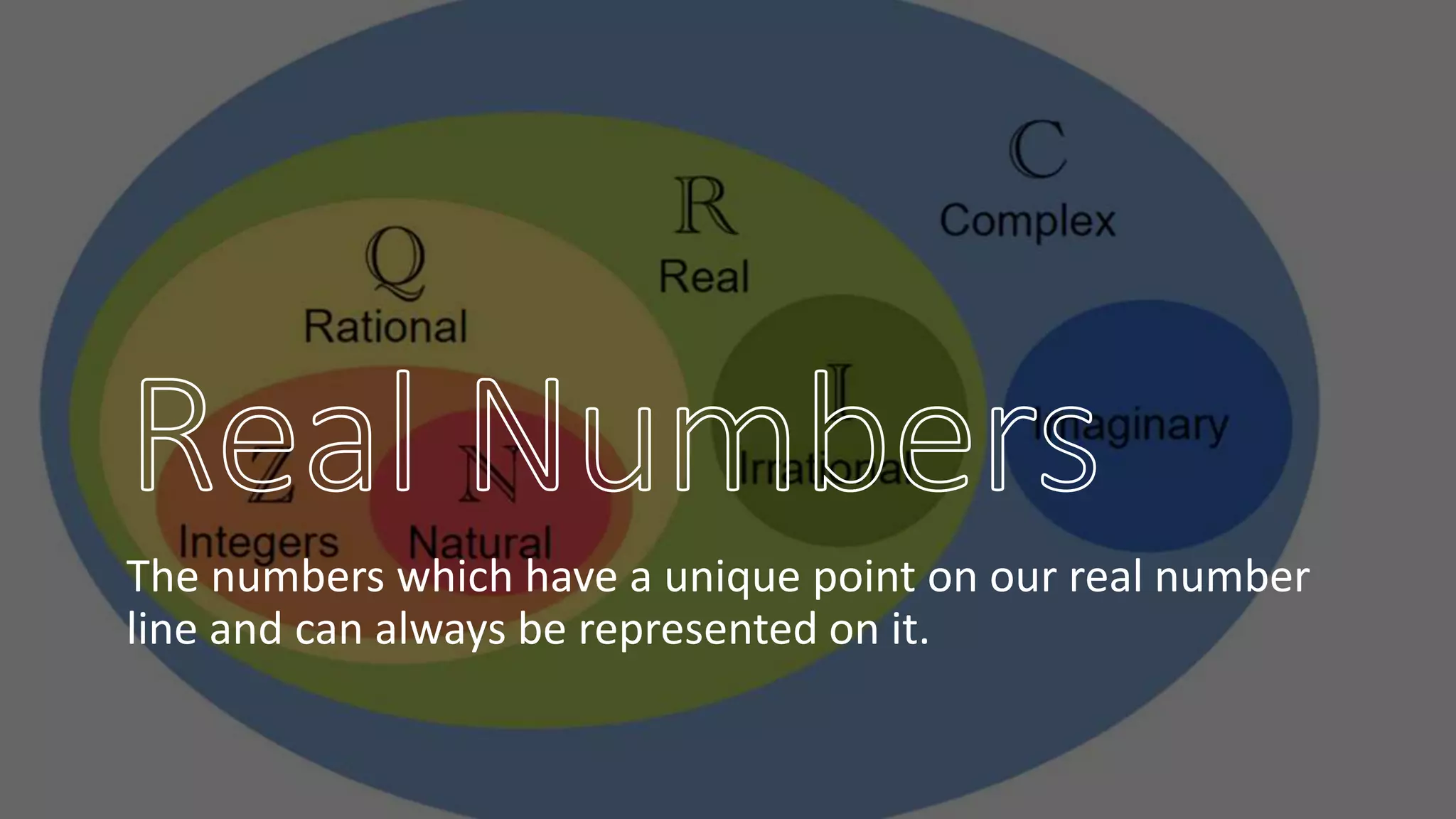
The numbers which have a unique point on our real number
line and can always be represented on it.
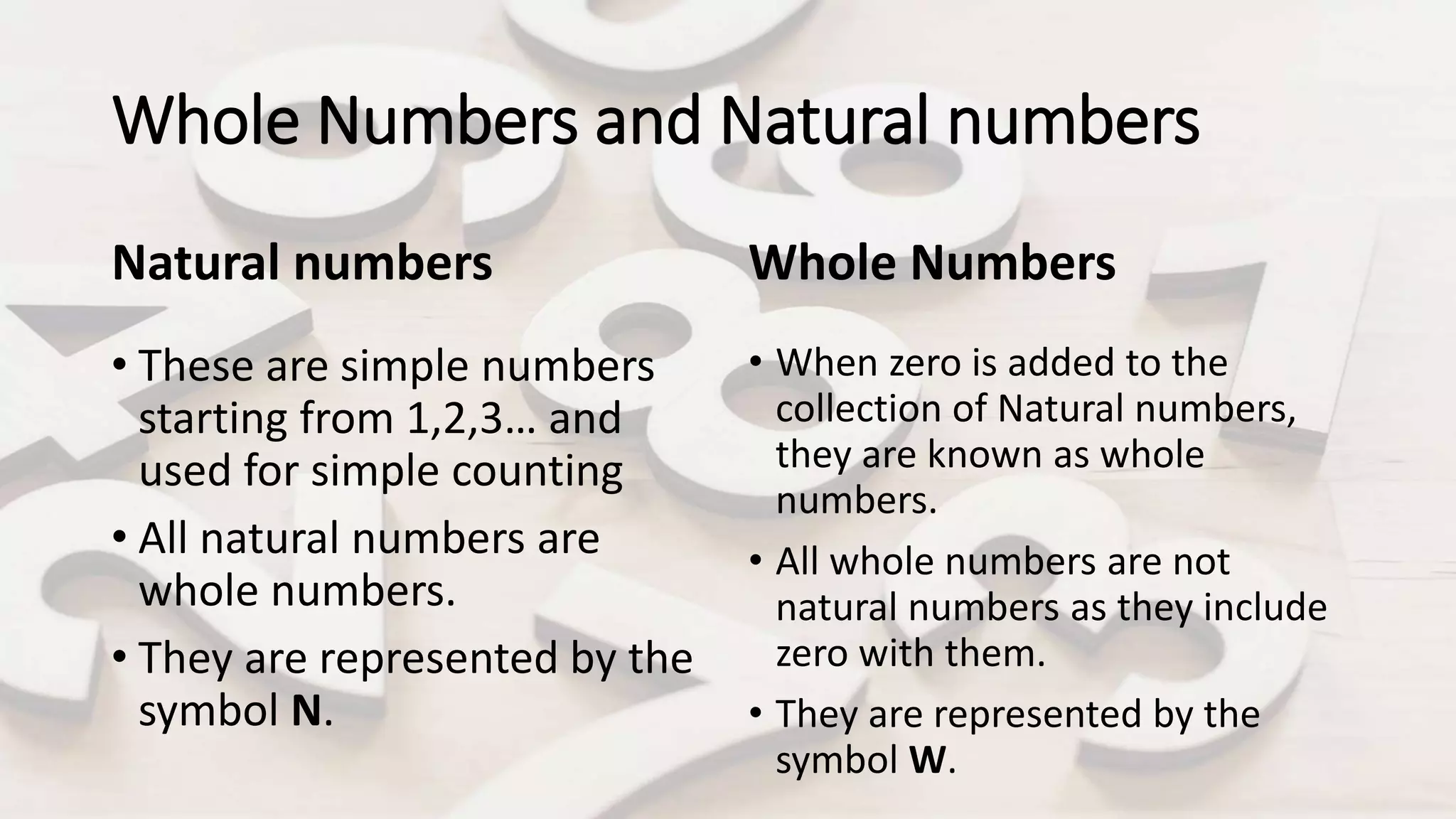
Whole Numbers and Natural numbers
Natural numbers
• These are simple numbers
starting from 1,2,3… and
used for simple counting
• All natural numbers are
whole numbers.
• They are represented by the
symbol N.
Whole Numbers
• When zero is added to the
collection of Natural numbers,
they are known as whole
numbers.
• All whole numbers are not
natural numbers as they include
zero with them.
• They are represented by the
symbol W.
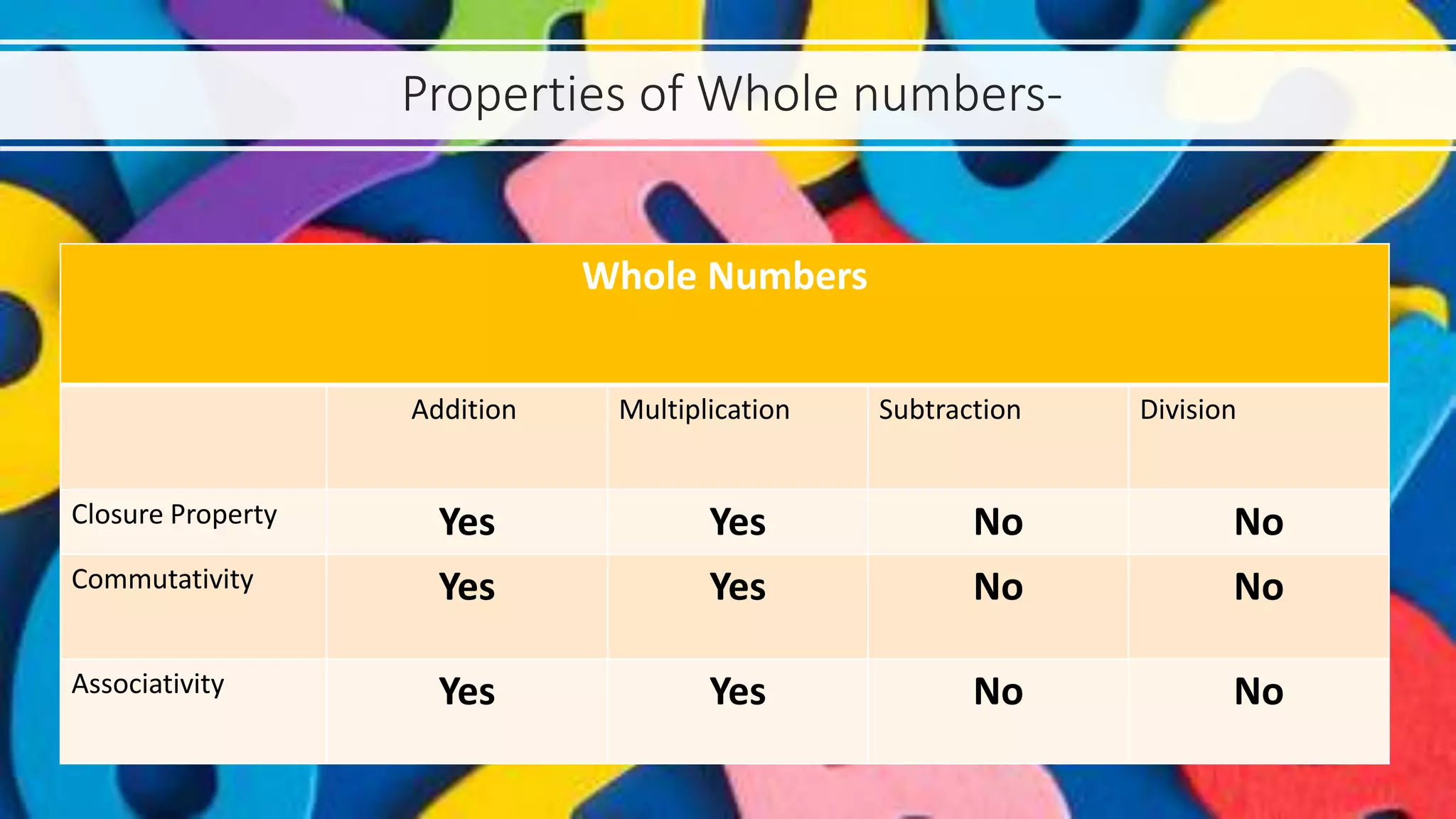
Properties of Whole numbers-
Whole Numbers​​
Addition Multiplication Subtraction​​ Division​​
Closure Property​​ Yes Yes No No
Commutativity​​ Yes Yes No No
Associativity Yes Yes No No
Integers
The collection of whole
numbers was not
enough to maintain
debts, loans, etc.
Thus, negative numbers
along with whole
numbers formed the
collection of integers.
These include -1,-2,-
3,1,4,7,8,etc.
All whole numbers are
integers while all
integers are not whole
numbers.
They are represented
by the symbol Z.
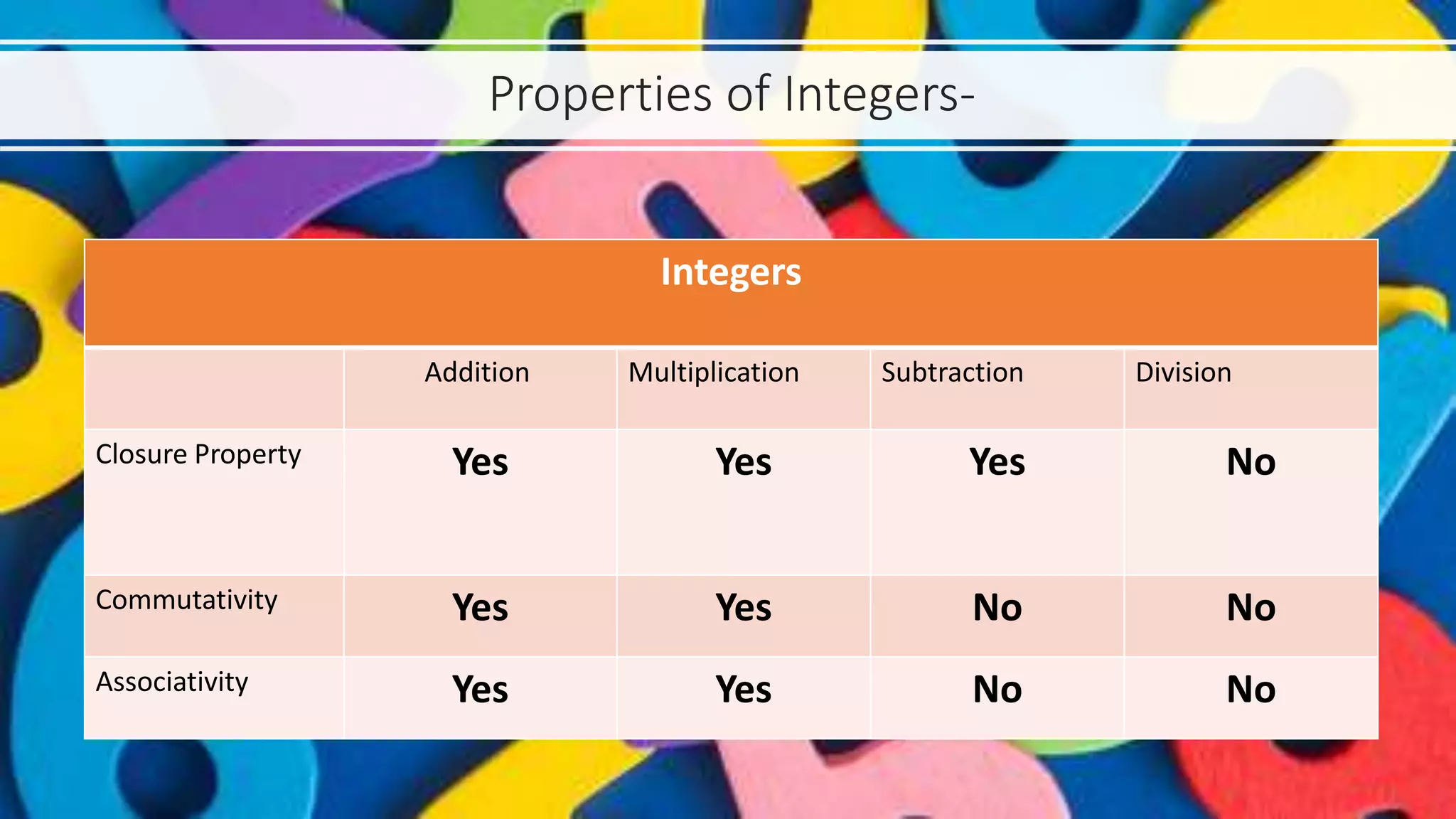
Properties of Integers-
Integers
Addition Multiplication Subtraction​ Division​
Closure Property​ ​Yes Yes Yes No
Commutativity​ ​Yes Yes No No
Associativity Yes Yes No No
Rational Numbers
• These are the numbers between any two
integers. They help us denote both
positive and negative fractional values.
• Any number that can be written in the
form of p/q and q ≠ 0.
• There are infinitely many Rational
numbers between any two given integers.
• They are represented by the symbol Q.
• For example-
36
100
,
3
17
, etc.
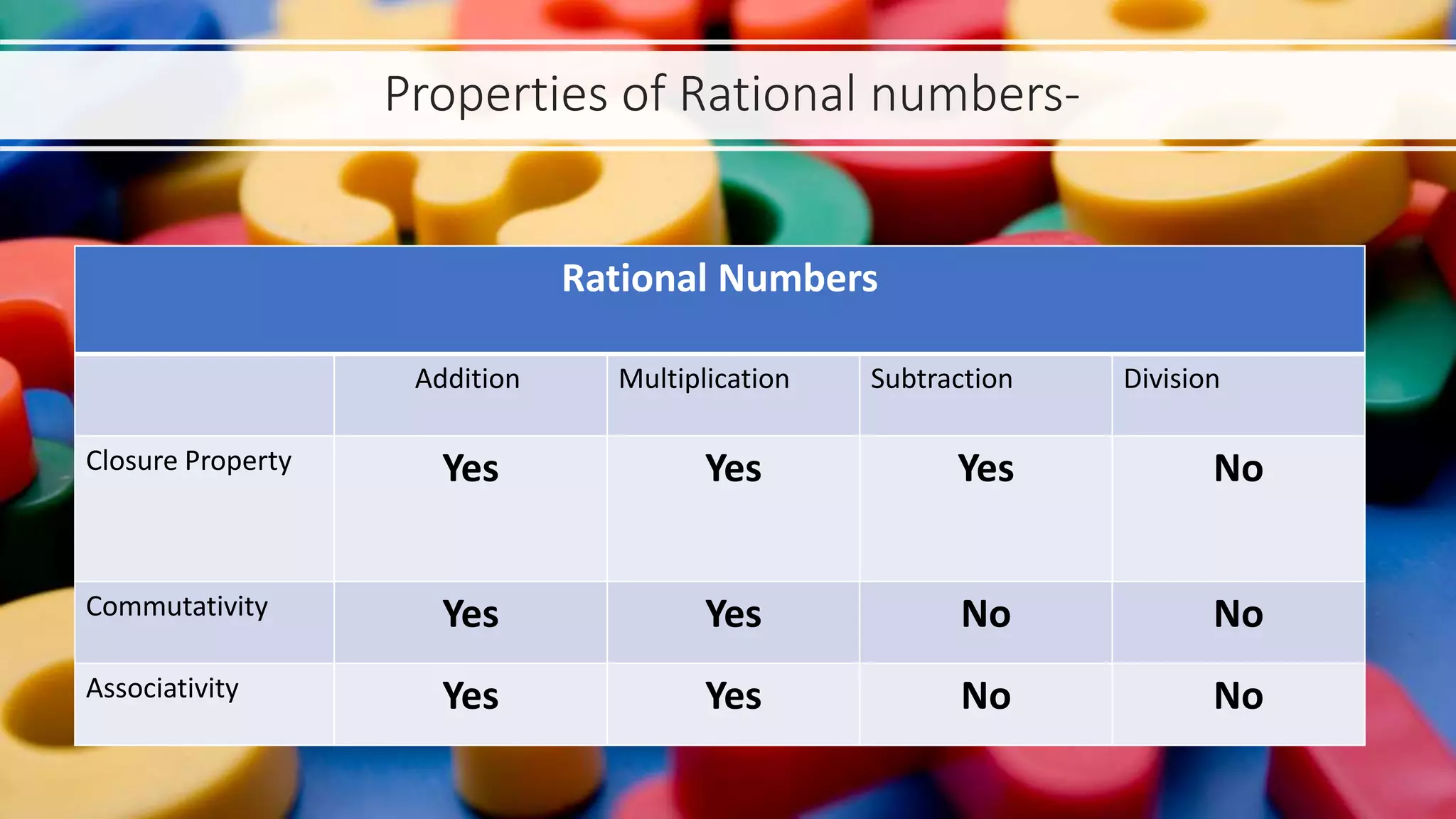
Properties of Rational numbers-
Rational Numbers​​
Addition Multiplication Subtraction​​ Division​​
Closure Property​​ Yes Yes Yes No
Commutativity​​ Yes Yes No No
Associativity ​​Yes Yes ​​No No
Irrational Numbers
• Any number that cannot be written in the form
of p/q and q ≠0 is an irrational number.
• These are present on the number line but an
exact location of these cannot be determined
as they never fit on the demarcations or
divisions present on the number line.
• Thus, their decimal expansion go on forever
without showing any specific pattern.
Therefore, they cannot be represented in the
form of p/q and q ≠0.
• For example- 23.468466545…. ,
644.10100100011000001……
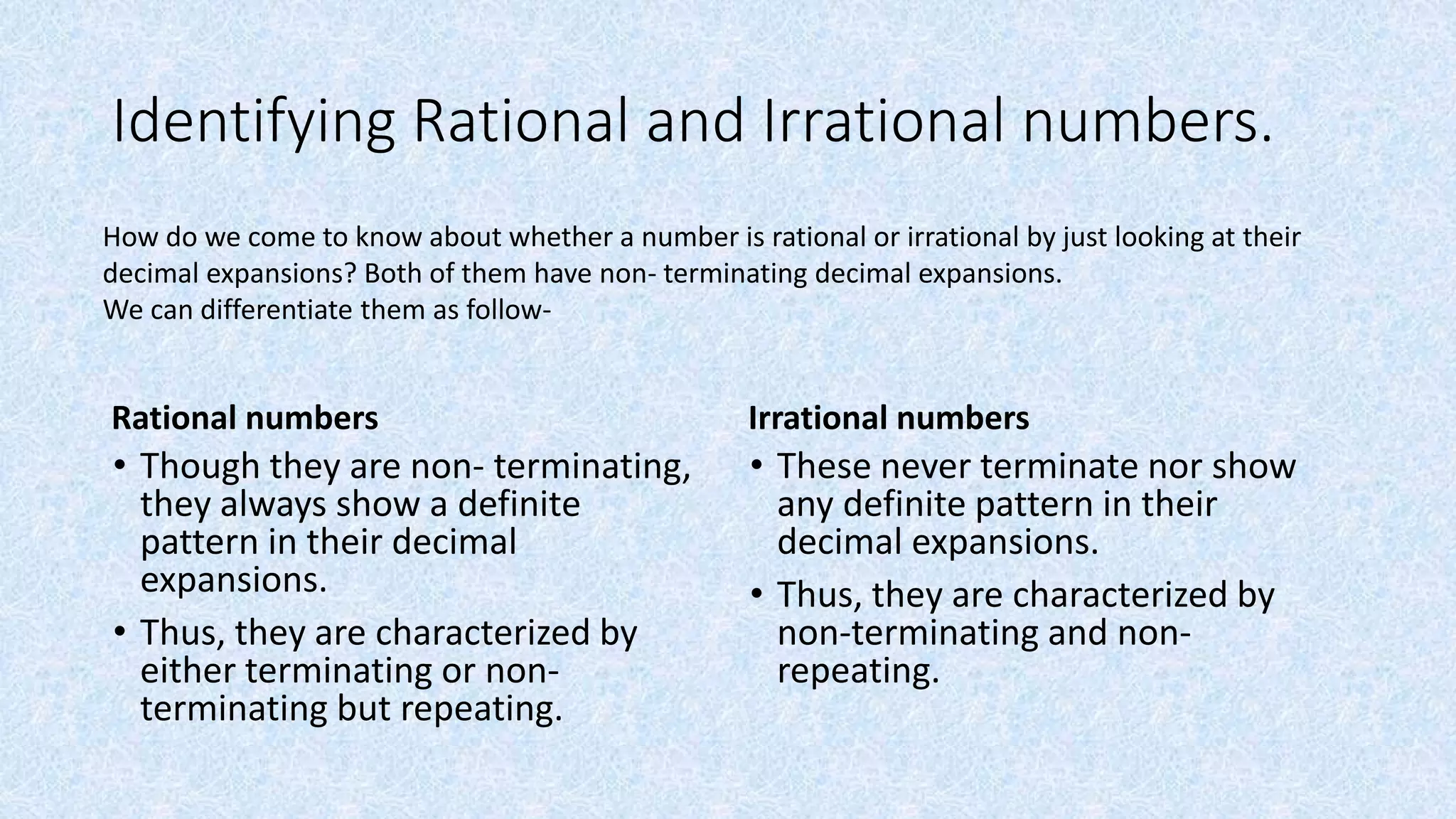
Identifying Rational and Irrational numbers.
Rational numbers
• Though they are non- terminating,
they always show a definite
pattern in their decimal
expansions.
• Thus, they are characterized by
either terminating or non-
terminating but repeating.
Irrational numbers
• These never terminate nor show
any definite pattern in their
decimal expansions.
• Thus, they are characterized by
non-terminating and non-
repeating.
How do we come to know about whether a number is rational or irrational by just looking at their
decimal expansions? Both of them have non- terminating decimal expansions.
We can differentiate them as follow-
Games on Types
of Numbers
Game-1 Race
your car
Question- 1
3,55,767,0
Give the type of numbers.
Solution - 1
Whole Numbers
Question- 2
3/5 , 3.55, 56,
7.888, -56.66
Give the type of numbers.
Solution - 2
Rational Numbers
Question- 3
5/3,34.67828…. , 0,
12.343434…., -4.66
,etc.
Give the type of numbers.
Solution - 3
Real Numbers
Question- 4
-435, 5 , -45,
-2, 67 ,etc.
Give the type of numbers.
Solution - 4
Integers
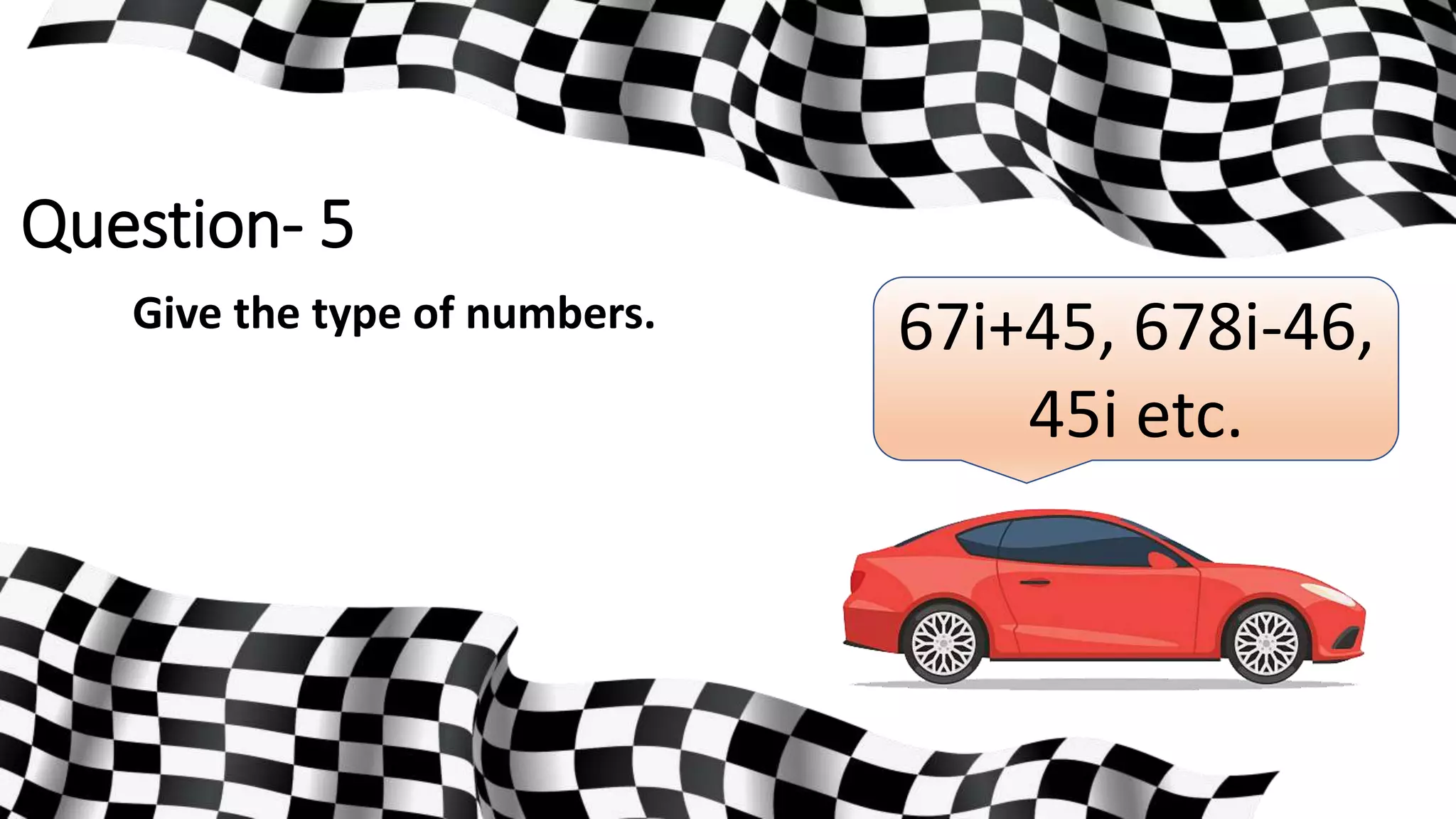
Question- 5
67i+45, 678i-46,
45i etc.
Give the type of numbers.
Solution - 5
Complex Numbers
Question- 6
3.505005000….,
3.67235466…. etc.
Give the type of numbers.
Solution - 6
Irrational Numbers
Types of numbers.pptx

Types of numbers.pptx

  • 1.
  • 2.
    World of numbers! •There are so many different types of numbers around us! Starting from simple natural numbers like 1,2,3.etc to very complex numbers such as 23+5i, 23i+687,etc. • All of them play a vital role in carrying out various sophisticated mathematical calculations which help our lives become simpler and even better. • How are these numbers classified into different types, what are the numerous properties associated with these numbers and where all these numbers actually come into use, are some of the questions we will be finding the answers for.
  • 3.
    Types of numbers •These infinite set of numbers are broadly classified into two groups- Real Numbers and Imaginary numbers. • These classifications help us better understand these numbers by organizing them into different groups. • We will try to understand each of them in detail with ample of examples. • At last, beautiful games would help us to test our knowledge of these numbers we would have learnt so far.
  • 4.
    The numbers whichhave a unique point on our real number line and can always be represented on it.
  • 5.
    Whole Numbers andNatural numbers Natural numbers • These are simple numbers starting from 1,2,3… and used for simple counting • All natural numbers are whole numbers. • They are represented by the symbol N. Whole Numbers • When zero is added to the collection of Natural numbers, they are known as whole numbers. • All whole numbers are not natural numbers as they include zero with them. • They are represented by the symbol W.
  • 6.
    Properties of Wholenumbers- Whole Numbers​​ Addition Multiplication Subtraction​​ Division​​ Closure Property​​ Yes Yes No No Commutativity​​ Yes Yes No No Associativity Yes Yes No No
  • 7.
    Integers The collection ofwhole numbers was not enough to maintain debts, loans, etc. Thus, negative numbers along with whole numbers formed the collection of integers. These include -1,-2,- 3,1,4,7,8,etc. All whole numbers are integers while all integers are not whole numbers. They are represented by the symbol Z.
  • 8.
    Properties of Integers- Integers AdditionMultiplication Subtraction​ Division​ Closure Property​ ​Yes Yes Yes No Commutativity​ ​Yes Yes No No Associativity Yes Yes No No
  • 9.
    Rational Numbers • Theseare the numbers between any two integers. They help us denote both positive and negative fractional values. • Any number that can be written in the form of p/q and q ≠ 0. • There are infinitely many Rational numbers between any two given integers. • They are represented by the symbol Q. • For example- 36 100 , 3 17 , etc.
  • 10.
    Properties of Rationalnumbers- Rational Numbers​​ Addition Multiplication Subtraction​​ Division​​ Closure Property​​ Yes Yes Yes No Commutativity​​ Yes Yes No No Associativity ​​Yes Yes ​​No No
  • 11.
    Irrational Numbers • Anynumber that cannot be written in the form of p/q and q ≠0 is an irrational number. • These are present on the number line but an exact location of these cannot be determined as they never fit on the demarcations or divisions present on the number line. • Thus, their decimal expansion go on forever without showing any specific pattern. Therefore, they cannot be represented in the form of p/q and q ≠0. • For example- 23.468466545…. , 644.10100100011000001……
  • 12.
    Identifying Rational andIrrational numbers. Rational numbers • Though they are non- terminating, they always show a definite pattern in their decimal expansions. • Thus, they are characterized by either terminating or non- terminating but repeating. Irrational numbers • These never terminate nor show any definite pattern in their decimal expansions. • Thus, they are characterized by non-terminating and non- repeating. How do we come to know about whether a number is rational or irrational by just looking at their decimal expansions? Both of them have non- terminating decimal expansions. We can differentiate them as follow-
  • 13.
    Games on Types ofNumbers Game-1 Race your car
  • 14.
  • 15.
  • 16.
    Question- 2 3/5 ,3.55, 56, 7.888, -56.66 Give the type of numbers.
  • 17.
  • 18.
    Question- 3 5/3,34.67828…. ,0, 12.343434…., -4.66 ,etc. Give the type of numbers.
  • 19.
  • 20.
    Question- 4 -435, 5, -45, -2, 67 ,etc. Give the type of numbers.
  • 21.
  • 22.
    Question- 5 67i+45, 678i-46, 45ietc. Give the type of numbers.
  • 23.
  • 24.
  • 25.