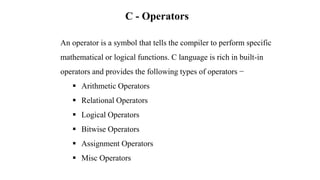
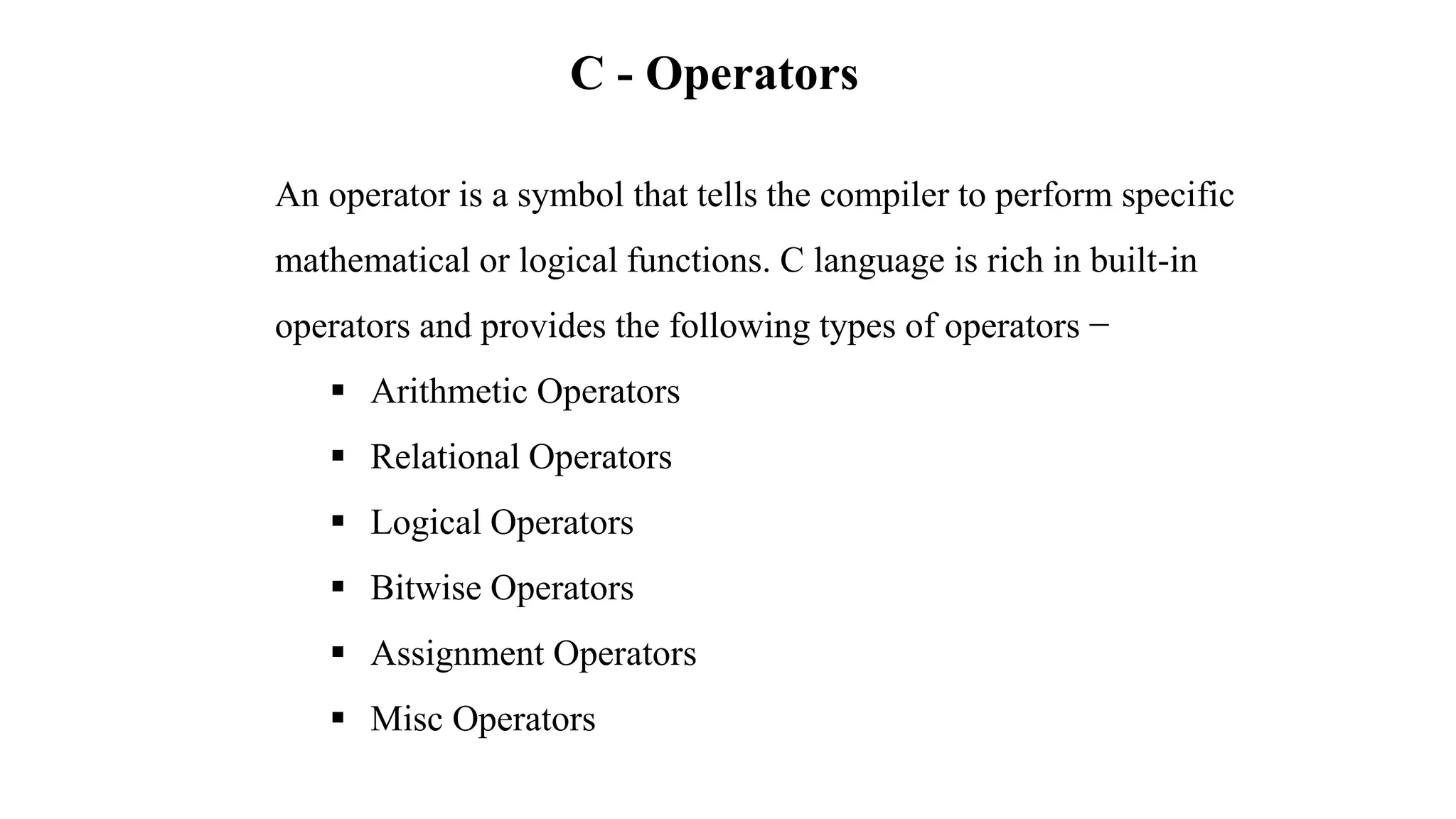
An operator is a symbol that tells the compiler to perform specific
mathematical or logical functions. C language is rich in built-in
operators and provides the following types of operators −
 Arithmetic Operators
 Relational Operators
 Logical Operators
 Bitwise Operators
 Assignment Operators
 Misc Operators
C - Operators
Arithmetic Operators
Operator Description Example
+ Adds two operands. A + B = 30
− Subtracts second operand from the
first.
A − B = -10
* Multiplies both operands. A * B = 200
/ Divides numerator by de-numerator. B / A = 2
% Modulus Operator and remainder of
after an integer division.
B % A = 0
++ Increment operator increases the
integer value by one.
A++ = 11
-- Decrement operator decreases the
integer value by one.
A-- = 9
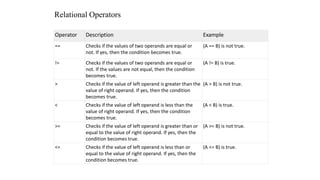
Relational Operators
Operator Description Example
== Checks if the values of two operands are equal or
not. If yes, then the condition becomes true.
(A == B) is not true.
!= Checks if the values of two operands are equal or
not. If the values are not equal, then the condition
becomes true.
(A != B) is true.
> Checks if the value of left operand is greater than the
value of right operand. If yes, then the condition
becomes true.
(A > B) is not true.
< Checks if the value of left operand is less than the
value of right operand. If yes, then the condition
becomes true.
(A < B) is true.
>= Checks if the value of left operand is greater than or
equal to the value of right operand. If yes, then the
condition becomes true.
(A >= B) is not true.
<= Checks if the value of left operand is less than or
equal to the value of right operand. If yes, then the
condition becomes true.
(A <= B) is true.
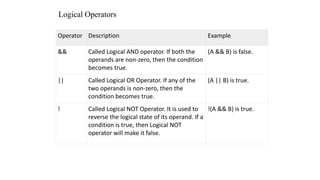
Logical Operators
Operator Description Example
&& Called Logical AND operator. If both the
operands are non-zero, then the condition
becomes true.
(A && B) is false.
|| Called Logical OR Operator. If any of the
two operands is non-zero, then the
condition becomes true.
(A || B) is true.
! Called Logical NOT Operator. It is used to
reverse the logical state of its operand. If a
condition is true, then Logical NOT
operator will make it false.
!(A && B) is true.
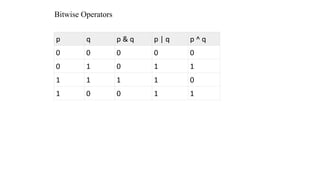
Bitwise Operators
p q p & q p | q p ^ q
0 0 0 0 0
0 1 0 1 1
1 1 1 1 0
1 0 0 1 1
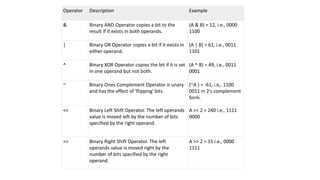
Operator Description Example
& Binary AND Operator copies a bit to the
result if it exists in both operands.
(A & B) = 12, i.e., 0000
1100
| Binary OR Operator copies a bit if it exists in
either operand.
(A | B) = 61, i.e., 0011
1101
^ Binary XOR Operator copies the bit if it is set
in one operand but not both.
(A ^ B) = 49, i.e., 0011
0001
~ Binary Ones Complement Operator is unary
and has the effect of 'flipping' bits.
(~A ) = -61, i.e,. 1100
0011 in 2's complement
form.
<< Binary Left Shift Operator. The left operands
value is moved left by the number of bits
specified by the right operand.
A << 2 = 240 i.e., 1111
0000
>> Binary Right Shift Operator. The left
operands value is moved right by the
number of bits specified by the right
operand.
A >> 2 = 15 i.e., 0000
1111
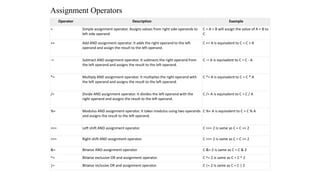
Assignment Operators
Operator Description Example
= Simple assignment operator. Assigns values from right side operands to
left side operand
C = A + B will assign the value of A + B to
C
+= Add AND assignment operator. It adds the right operand to the left
operand and assign the result to the left operand.
C += A is equivalent to C = C + A
-= Subtract AND assignment operator. It subtracts the right operand from
the left operand and assigns the result to the left operand.
C -= A is equivalent to C = C - A
*= Multiply AND assignment operator. It multiplies the right operand with
the left operand and assigns the result to the left operand.
C *= A is equivalent to C = C * A
/= Divide AND assignment operator. It divides the left operand with the
right operand and assigns the result to the left operand.
C /= A is equivalent to C = C / A
%= Modulus AND assignment operator. It takes modulus using two operands
and assigns the result to the left operand.
C %= A is equivalent to C = C % A
<<= Left shift AND assignment operator. C <<= 2 is same as C = C << 2
>>= Right shift AND assignment operator. C >>= 2 is same as C = C >> 2
&= Bitwise AND assignment operator. C &= 2 is same as C = C & 2
^= Bitwise exclusive OR and assignment operator. C ^= 2 is same as C = C ^ 2
|= Bitwise inclusive OR and assignment operator. C |= 2 is same as C = C | 2
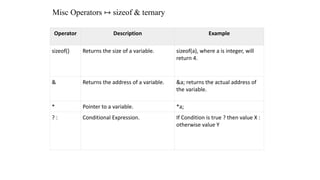
Misc Operators ↦ sizeof & ternary
Operator Description Example
sizeof() Returns the size of a variable. sizeof(a), where a is integer, will
return 4.
& Returns the address of a variable. &a; returns the actual address of
the variable.
* Pointer to a variable. *a;
? : Conditional Expression. If Condition is true ? then value X :
otherwise value Y

Session03 operators

  • 1.
    An operator isa symbol that tells the compiler to perform specific mathematical or logical functions. C language is rich in built-in operators and provides the following types of operators −  Arithmetic Operators  Relational Operators  Logical Operators  Bitwise Operators  Assignment Operators  Misc Operators C - Operators
  • 2.
    Arithmetic Operators Operator DescriptionExample + Adds two operands. A + B = 30 − Subtracts second operand from the first. A − B = -10 * Multiplies both operands. A * B = 200 / Divides numerator by de-numerator. B / A = 2 % Modulus Operator and remainder of after an integer division. B % A = 0 ++ Increment operator increases the integer value by one. A++ = 11 -- Decrement operator decreases the integer value by one. A-- = 9
  • 3.
    Relational Operators Operator DescriptionExample == Checks if the values of two operands are equal or not. If yes, then the condition becomes true. (A == B) is not true. != Checks if the values of two operands are equal or not. If the values are not equal, then the condition becomes true. (A != B) is true. > Checks if the value of left operand is greater than the value of right operand. If yes, then the condition becomes true. (A > B) is not true. < Checks if the value of left operand is less than the value of right operand. If yes, then the condition becomes true. (A < B) is true. >= Checks if the value of left operand is greater than or equal to the value of right operand. If yes, then the condition becomes true. (A >= B) is not true. <= Checks if the value of left operand is less than or equal to the value of right operand. If yes, then the condition becomes true. (A <= B) is true.
  • 4.
    Logical Operators Operator DescriptionExample && Called Logical AND operator. If both the operands are non-zero, then the condition becomes true. (A && B) is false. || Called Logical OR Operator. If any of the two operands is non-zero, then the condition becomes true. (A || B) is true. ! Called Logical NOT Operator. It is used to reverse the logical state of its operand. If a condition is true, then Logical NOT operator will make it false. !(A && B) is true.
  • 5.
    Bitwise Operators p qp & q p | q p ^ q 0 0 0 0 0 0 1 0 1 1 1 1 1 1 0 1 0 0 1 1
  • 6.
    Operator Description Example &Binary AND Operator copies a bit to the result if it exists in both operands. (A & B) = 12, i.e., 0000 1100 | Binary OR Operator copies a bit if it exists in either operand. (A | B) = 61, i.e., 0011 1101 ^ Binary XOR Operator copies the bit if it is set in one operand but not both. (A ^ B) = 49, i.e., 0011 0001 ~ Binary Ones Complement Operator is unary and has the effect of 'flipping' bits. (~A ) = -61, i.e,. 1100 0011 in 2's complement form. << Binary Left Shift Operator. The left operands value is moved left by the number of bits specified by the right operand. A << 2 = 240 i.e., 1111 0000 >> Binary Right Shift Operator. The left operands value is moved right by the number of bits specified by the right operand. A >> 2 = 15 i.e., 0000 1111
  • 7.
    Assignment Operators Operator DescriptionExample = Simple assignment operator. Assigns values from right side operands to left side operand C = A + B will assign the value of A + B to C += Add AND assignment operator. It adds the right operand to the left operand and assign the result to the left operand. C += A is equivalent to C = C + A -= Subtract AND assignment operator. It subtracts the right operand from the left operand and assigns the result to the left operand. C -= A is equivalent to C = C - A *= Multiply AND assignment operator. It multiplies the right operand with the left operand and assigns the result to the left operand. C *= A is equivalent to C = C * A /= Divide AND assignment operator. It divides the left operand with the right operand and assigns the result to the left operand. C /= A is equivalent to C = C / A %= Modulus AND assignment operator. It takes modulus using two operands and assigns the result to the left operand. C %= A is equivalent to C = C % A <<= Left shift AND assignment operator. C <<= 2 is same as C = C << 2 >>= Right shift AND assignment operator. C >>= 2 is same as C = C >> 2 &= Bitwise AND assignment operator. C &= 2 is same as C = C & 2 ^= Bitwise exclusive OR and assignment operator. C ^= 2 is same as C = C ^ 2 |= Bitwise inclusive OR and assignment operator. C |= 2 is same as C = C | 2
  • 8.
    Misc Operators ↦sizeof & ternary Operator Description Example sizeof() Returns the size of a variable. sizeof(a), where a is integer, will return 4. & Returns the address of a variable. &a; returns the actual address of the variable. * Pointer to a variable. *a; ? : Conditional Expression. If Condition is true ? then value X : otherwise value Y