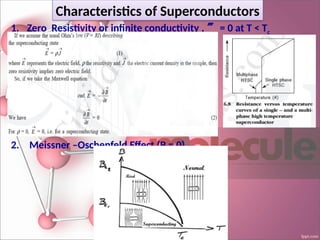
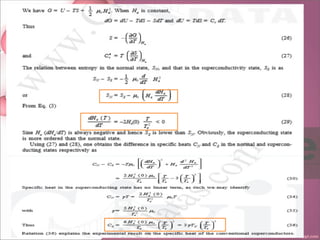
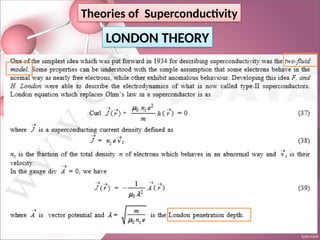
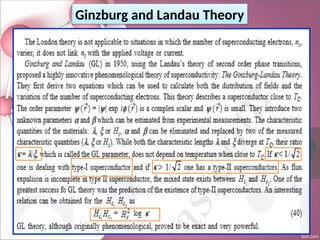
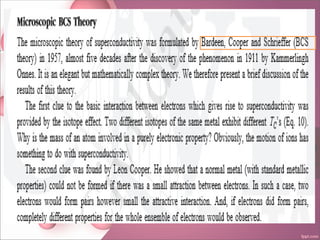
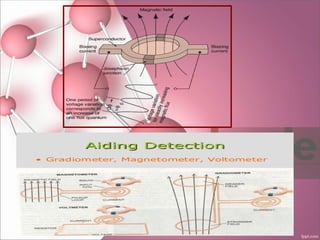
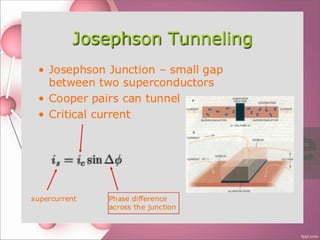
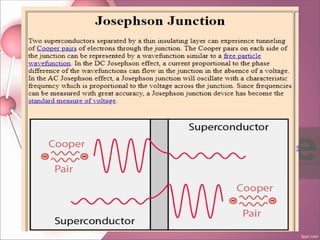
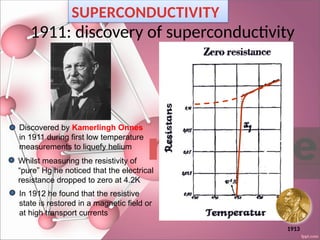
1911: discovery ofsuperconductivity
Whilst measuring the resistivity of
“pure” Hg he noticed that the electrical
resistance dropped to zero at 4.2K
Discovered by Kamerlingh Onnes
in 1911 during first low temperature
measurements to liquefy helium
In 1912 he found that the resistive
state is restored in a magnetic field or
at high transport currents
1913
SUPERCONDUCTIVITY
3.
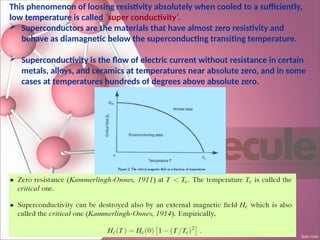
This phenomenon ofloosing resistivity absolutely when cooled to a sufficiently,
low temperature is called `super conductivity’.
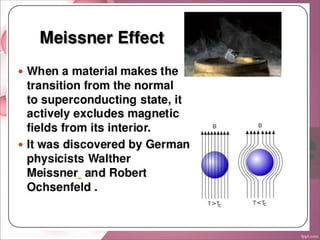
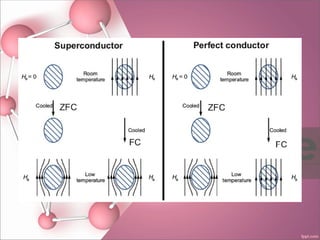
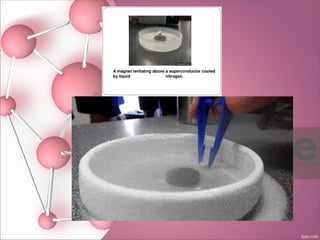
Superconductors are the materials that have almost zero resistivity and
behave as diamagnetic below the superconducting transiting temperature.
Superconductivity is the flow of electric current without resistance in certain
metals, alloys, and ceramics at temperatures near absolute zero, and in some
cases at temperatures hundreds of degrees above absolute zero.
4.
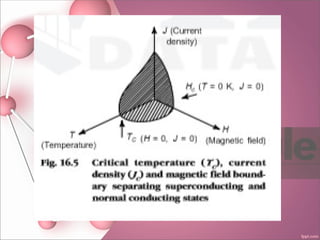
Transition Temperature (or)Critical
Temperature
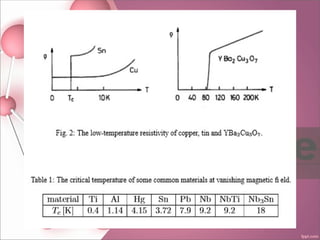
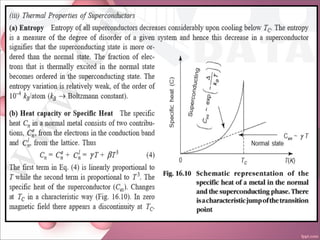
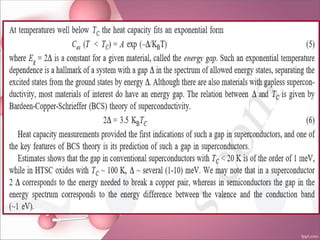
The temperature at which the transition of a normal
conductor into a superconductor occurs is called as the `Transition
temperature or critical temperature [Tc].
Above Tc- the substance is in the normal state, but
Below Tc-The substance is in the super conducting state.
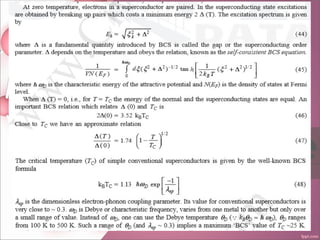
For semiconductors -Tc varies from, 0.3K to 1.25K
For metals -Tc varies from 0.35K to 9.22K and
For alloys -Tc varies from 18.1K to 22.65K.
6.
I. On thebasis of their critical temperature, Tc
Low-temperature superconductors, or LTS: those whose critical temperature is
below 30 K.
High-temperature superconductors, or HTS: those whose critical temperature is
above 30 K.
Classification of Superconductors
II. By their magnetic properties
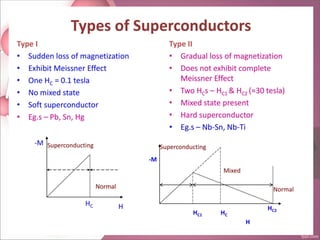
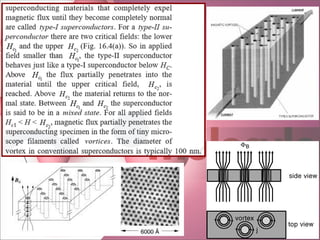
• Type I superconductors: those having just one critical field, Hc, and changing abruptly
from one state to the other when it is reached.
• Type II superconductors: having two critical fields, Hc1 and Hc2, being a perfect
superconductor under the lower critical field (Hc1) and leaving completely the
superconducting state to a normal conducting state above the upper critical field (Hc2),
being in a mixed state when between the critical fields.
7.
Low Temperature Superconductors(LTSC)
Superconducting Materials:
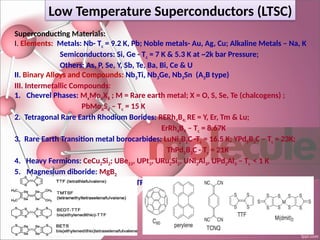
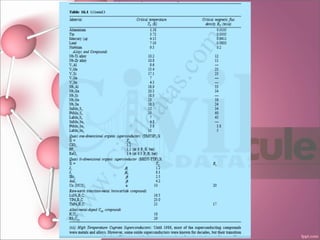
I. Elements: Metals: Nb- Tc = 9.2 K, Pb; Noble metals- Au, Ag, Cu; Alkaline Metals – Na, K
Semiconductors: Si, Ge - Tc = 7 K & 5.3 K at ~2k bar Pressure;
Others: As, P, Se, Y, Sb, Te, Ba, Bi, Ce & U
II. Binary Alloys and Compounds: Nb3Ti, Nb3Ge, Nb3Sn (A3B type)
III. Intermetallic Compounds:
1. Chevrel Phases: MxMo6X8 ; M = Rare earth metal; X = O, S, Se, Te (chalcogens) ;
PbMo6S8 – Tc = 15 K
2. Tetragonal Rare Earth Rhodium Borides: RERh4B4; RE = Y, Er, Tm & Lu;
ErRh4B4 – Tc = 8.67K
3. Rare Earth Transition metal borocarbides: LuNi2B2C -Tc = 16.5 K; YPd5B3C – Tc = 23K;
ThPd3B3C - Tc = 21K
4. Heavy Fermions: CeCu2Si2; UBe13, UPt3, URu2Si2, UNi2Al3, UPd2Al3 – Tc < 1 K
5. Magnesium diboride: MgB2
IV. Organic Superconductors: BEDT-TTF-Tc = 11.2 K
9.
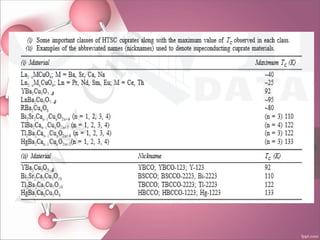
High Temperature Superconductors(HTSC)
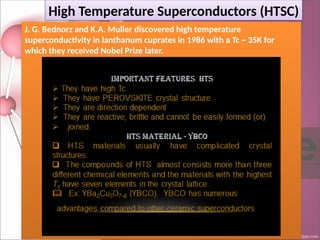
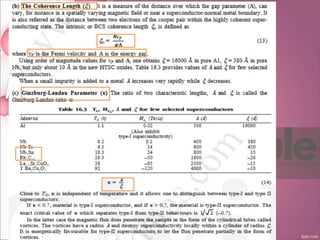
J. G. Bednorz and K.A. Muller discovered high temperature
superconductivity in lanthanum cuprates in 1986 with a Tc ~ 35K for
which they received Nobel Prize later.
11.
High Temperature Superconductors(HTSC)
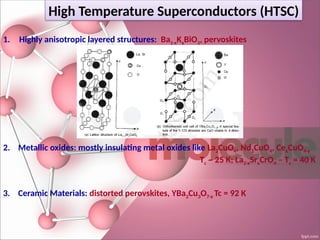
1. Highly anisotropic layered structures: Ba1-xKxBiO3, pervoskites
2. Metallic oxides: mostly insulating metal oxides like La2CuO4, Nd2CuO4, CexCuO4-y
Tc ~ 25 K; La2-xSrxCrO4 – Tc = 40 K
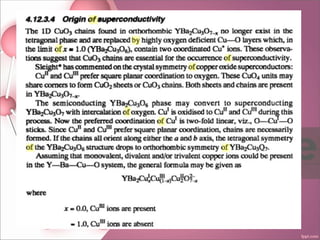
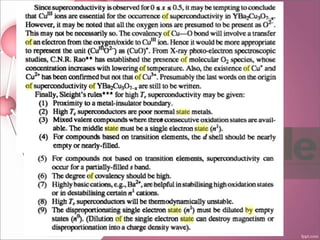
3. Ceramic Materials: distorted perovskites, YBa2Cu3O7-x Tc = 92 K
14.
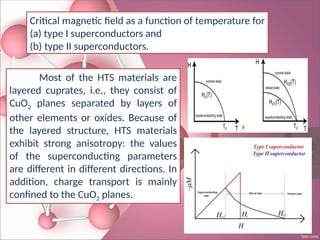
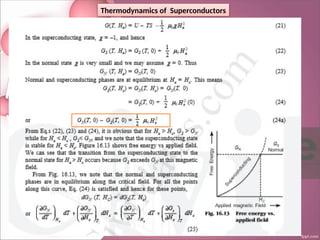
Critical magnetic fieldas a function of temperature for
(a) type I superconductors and
(b) type II superconductors.
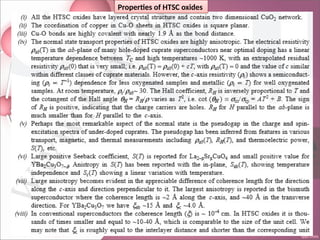
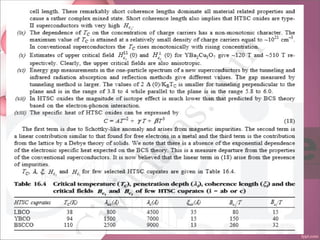
Most of the HTS materials are
layered cuprates, i.e., they consist of
CuO2 planes separated by layers of
other elements or oxides. Because of
the layered structure, HTS materials
exhibit strong anisotropy: the values
of the superconducting parameters
are different in different directions. In
addition, charge transport is mainly
confined to the CuO2 planes.
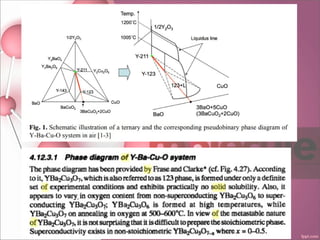
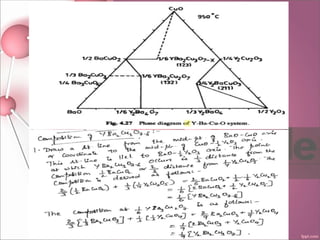
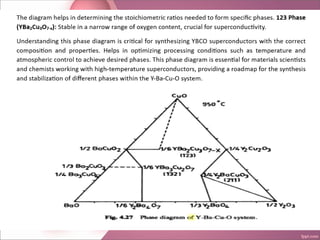
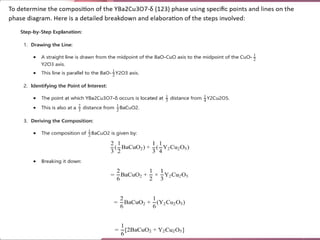
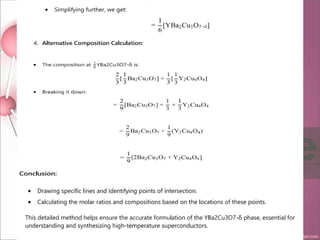
YBa2Cu3O7−x
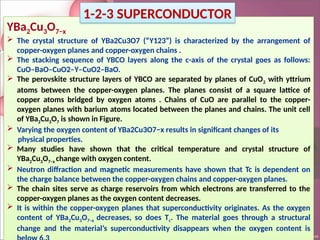
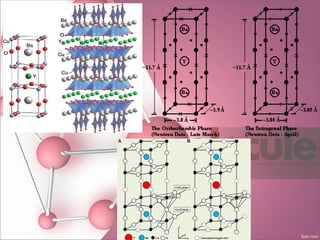
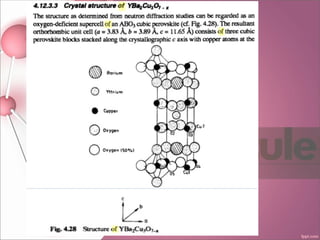
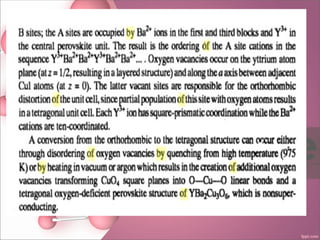
The crystalstructure of YBa2Cu3O7 (“Y123”) is characterized by the arrangement of
copper-oxygen planes and copper-oxygen chains .
The stacking sequence of YBCO layers along the c-axis of the crystal goes as follows:
CuO–BaO–CuO2–Y–CuO2–BaO.
The perovskite structure layers of YBCO are separated by planes of CuO2 with yttrium
atoms between the copper-oxygen planes. The planes consist of a square lattice of
copper atoms bridged by oxygen atoms . Chains of CuO are parallel to the copper-
oxygen planes with barium atoms located between the planes and chains. The unit cell
of YBa2Cu3O7 is shown in Figure.
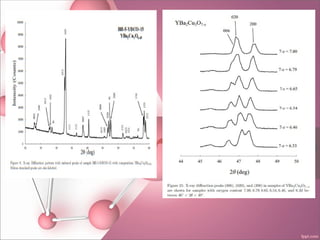
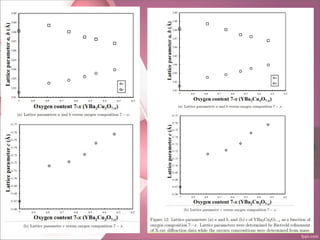
Varying the oxygen content of YBa2Cu3O7−x results in significant changes of its
physical properties.
Many studies have shown that the critical temperature and crystal structure of
YBa2Cu3O7−x change with oxygen content.
Neutron diffraction and magnetic measurements have shown that Tc is dependent on
the charge balance between the copper-oxygen chains and copper-oxygen planes.
The chain sites serve as charge reservoirs from which electrons are transferred to the
copper-oxygen planes as the oxygen content decreases.
It is within the copper-oxygen planes that superconductivity originates. As the oxygen
content of YBa2Cu3O7−x decreases, so does Tc. The material goes through a structural
change and the material’s superconductivity disappears when the oxygen content is
1-2-3 SUPERCONDUCTOR
42.
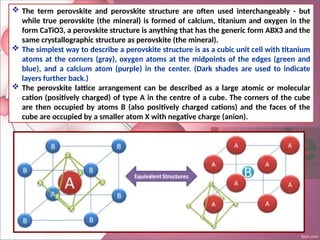
The termperovskite and perovskite structure are often used interchangeably - but
while true perovskite (the mineral) is formed of calcium, titanium and oxygen in the
form CaTiO3, a perovskite structure is anything that has the generic form ABX3 and the
same crystallographic structure as perovskite (the mineral).
The simplest way to describe a perovskite structure is as a cubic unit cell with titanium
atoms at the corners (gray), oxygen atoms at the midpoints of the edges (green and
blue), and a calcium atom (purple) in the center. (Dark shades are used to indicate
layers further back.)
The perovskite lattice arrangement can be described as a large atomic or molecular
cation (positively charged) of type A in the centre of a cube. The corners of the cube
are then occupied by atoms B (also positively charged cations) and the faces of the
cube are occupied by a smaller atom X with negative charge (anion).
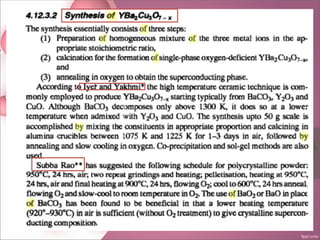
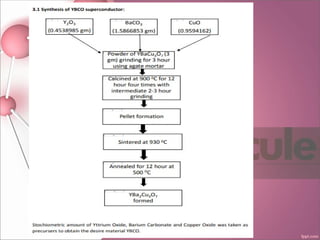
52.
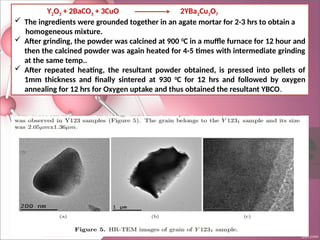
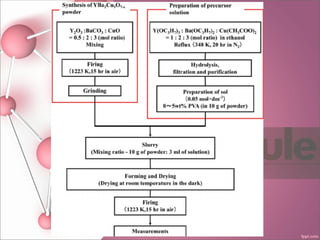
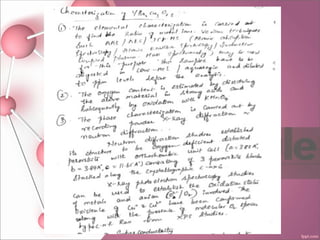
Y2O3 + 2BaCO3+ 3CuO 2YBa2Cu3O7
The ingredients were grounded together in an agate mortar for 2-3 hrs to obtain a
homogeneous mixture.
After grinding, the powder was calcined at 900 0
C in a muffle furnace for 12 hour and
then the calcined powder was again heated for 4-5 times with intermediate grinding
at the same temp..
After repeated heating, the resultant powder obtained, is pressed into pellets of
1mm thickness and finally sintered at 930 0
C for 12 hrs and followed by oxygen
annealing for 12 hrs for Oxygen uptake and thus obtained the resultant YBCO.
62.
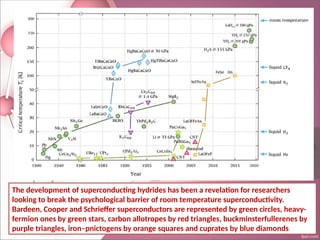
The development ofsuperconducting hydrides has been a revelation for researchers
looking to break the psychological barrier of room temperature superconductivity.
Bardeen, Cooper and Schrieffer superconductors are represented by green circles, heavy-
fermion ones by green stars, carbon allotropes by red triangles, buckminsterfullerenes by
purple triangles, iron–pnictogens by orange squares and cuprates by blue diamonds
76.
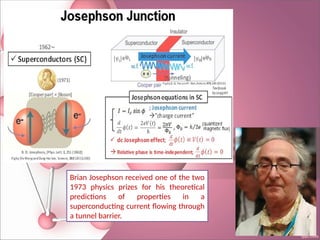
Brian Josephson receivedone of the two
1973 physics prizes for his theoretical
predictions of properties in a
superconducting current flowing through
a tunnel barrier.

![Transition Temperature (or) Critical
Temperature
The temperature at which the transition of a normal
conductor into a superconductor occurs is called as the `Transition
temperature or critical temperature [Tc].
Above Tc- the substance is in the normal state, but
Below Tc-The substance is in the super conducting state.
For semiconductors -Tc varies from, 0.3K to 1.25K
For metals -Tc varies from 0.35K to 9.22K and
For alloys -Tc varies from 18.1K to 22.65K.](https://image.slidesharecdn.com/solidstatechemistry-ii-260102145826-4e620715/85/Solid-state-chemistry-osmania-university-II-pptx-4-320.jpg)