Drug Store and Business Management
D Pharm 2nd year
Part-I
COMMERCE
Diksha Choudhary(Assistant Prof.)
M Pharmacy (Pharmaceutical Chemistry)
Abhilashi University , Mandi
Topic
1. Introduction
 Trade, Industry and Commerce
 Functions and subdivisions of commerce
Business
 Remains busy in the economic activities
 To get financial gain and not that person who remains busy in non-economic
activities
 Involves regular production and/or exchange of goods and services
 Main purpose of earning profits
 Through the satisfaction of human wants
Scope of business
 Not be confused with trade
 „Trade‟ simply denotes purchase and sale of goods
 „Business‟ includes all activities from production to distribution of goods and
services
 It embraces industry, trade and other activities like
 Banking, transport, insurance and warehousing
 Facilitate production and distribution of goods and services
Classification of business activities
 Classified into two groups
A. Industry
B. Commerce
Cont……
A. Industry
 Activities which relates to growing, extraction, production, conversion,
processing or fabrication of goods
 Industry produce different kinds of products for different purpose which may
be classified as follows:
Cont……
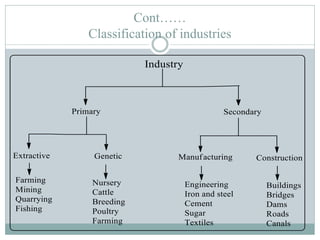
Classification of industries
Cont…..
 Primary industry:
 Include all the products or raw materials obtained from
 Agriculture, forests, mines, animal husbandry and fisheries etc
 Examples: wheat, rice, cotton, sugarcane, cereals, wood, metal ores, milk, fish, raw
silk etc
● Secondary industry:
 Produced by one industry
 But cannot be consumed as such unless it is passed through another industry
 to undergo further manufacturing processes to obtain a finished product
 Example: capsule shells are manufactured in one kind of industry but filling is
done in another kind of industry
 Iron, cotton, pulp
Cont…..
1. Extractive industries:
 Extract or draw out products from natural sources such as earth, sea or air
 Products generally used by manufacturing and construction industries
 For producing finished goods
 examples: farming, mining, fishing
2. Genetic industries:
 Means heredity
 Engaged in breeding plants and animals
 Their use in further reproduction
 Example: cattle, breeding, farming
Cont…
3. Manufacturing industry:
 Engaged in producing goods through the creation of utility
 Engaged in conversion or transformation of raw materials or semi-finished
products into finished products
 Goods supplied by the extractive industries are used as a raw material for
manufacturing industry
 Example: textile, jute, sugar, cement
 Further sub-divided as follows:
a) Analytical industries
b) Synthetic industries
c) Processing industries
d) Assembling industries
Cont……
a) Analytical industries:
 Analysis of one kind of basic material and after separating a number of products
are obtained from the same material
 Example: crude oil is extracted from beneath the earth and is processed and
separated into petrol, kerosene, gasoline, lubricating oil, etc.
b) Synthetic industries:
 Two or more materials are mixed together in the manufacturing operations to
obtain some new products
 Example: soap, cement, paints, fertilizers and cosmetics
c) Processing industries:
 Raw materials are processed through a series of manufacturing operations making
use of analytical and synthetic methods.
 Example: textiles, sugar and steel
Cont….
d) Assembling industries:
 Finished products can be produced only after various components have been
made
 Brought together for final assembly
 Example: automobiles, watches, televisions, bicycles, railway wagons, etc.
4. Construction industries:
 Making or construction of buildings, bridges, dams, roads, canals, etc.
 Use the products of manufacturing industries such as iron and steel, cement,
lime, mortar, etc.
 Products are not sold in the sense of being taken to the markets.
 Constructed and fabricated at fixed sites
Commerce
 An organized system for the exchange of commodities
 Distribution of finished products
 Evelyn Thomas “Commercial occupation deal with the buying and selling of
goods, the exchange of commodities and the distribution of the finished
products.”
 James Stephenson “Commerce embraces all those processes which help to break
the barrier between products and consumers.”
 Engaged in the removal of hindrances of person (trade), place (transport and
insurance) and time (warehousing)
 In the exchange (banking) of commodities.
Components/subdivisions of commerce
1. Trade
2. Aids to trade
1. Trade:
 Buying and selling of goods
 Purchase goods to be sold to other trades or consumers at a profit
 Intermediaries between producers and consumers
 Buys those goods which are in demand
 Likely to find response in the market
 Hold them in the store and sell at appropriate time
 Able to get good margin of profit
Classification of trade
A. Internal trade
B. International trade
A. Internal trade:
 Also known as home trade
 Buying and selling done within the boundaries of the country which may be
a) Local trade (goods are purchased and sold at particular place)
b) State trade ( goods are traded only in a particular state)
c) Interstate trade (goods are bought and sold from one state to another state)
 Payments involved in trading are made in nation‟s own currency directly or
through the banking system
Cont…….
 Internal trade may be further sub-classified as follow:
i. Wholesale trade
ii. Retail trade
i. Wholesale trade:
 Buy the goods in large quantities
 Directly from the manufacturers
 Sell them in smaller quantities to retailers
 Direct contact with the consumers
 Link between manufacturers and retailers
ii. Retail trade:
 Goods are distributed in small quantities
 Final stage in distribution of goods
 Involves direct selling to the ultimate consumers
 Who deal in retail sale of goods are known as retailers
 Conducted through shops, department stores, multiple shops, co-operative stores, super
bazars, vendors etc.
 Direct link between manufacturer and/or wholesaler and consumer
Cont……
B. International trade:
 Foreign trade and external trade
 Goods or services are exchanged between two or more then two countries
 Making payments in the currency of the country concerned called foreign
exchange
 Movement of goods is done through international system of transport
 Vital role in the economic development
Cont…..
 Classification of foreign trade:
i. Import trade
ii. Export trade
iii. Entrepot trade
i. Import trade:
 Brings goods from foreign countries to his own country
 Example: India brings goods from Japan, USA, or any other country
ii. Export trade:
 Goods of one country are sold to other countries
 Exchange: India sells goods like drugs, cloth, readymade garments, tea, coffee, etc.
iii. Entrepot trade:
 Re-export trade
 Import of foreign goods of one country with the idea of exporting the same to other
countries and making profit in the process
 Example: India imports goods from Singapore, Japan and China
 Sells the same to any other country with a margin of profit
Cont…..
2. Aids to trade
i. Transport
ii. Warehousing
iii. Banking
iv. Insurance
v. Packing
vi. Advertising and publicity
Cont……
i. Transport:
 removes obstacle of place
 Carrying goods and persons from one place to another
 Increasing the mobility of goods, workers and capital
 Help in stabilizing the prices
 Modes of transport available which include road, rail, air, water, pipeline
transport etc
 Railways are most effective means of mvement of goods because:
a. Cheaper for bulky goods for long distance
b. Goods are more safe
c. Government controlled so the freights are less
Cont……..
ii. Warehousing (storage)
 removes the hindrance of time
 Place where goods are stored
 Proper conditions and to ensure continuous and unrestricted supply of goods
 Keeping, holding and preserving used at a later stage
 Process is done at a large scale and in a specialized manner
Need and importance of storage:
 Goods are not immediately sold so unsold goods will stored
 to ensure uninterrupted production
 Advantage of bulk buying
 Anticipation of demand
 For wholesalers as well as retailer for regular supply
Cont….
iii. Banking:
 Removing the hindrance of finance
 Life blood of any business
 Without finance it is not possible to run market activity
 Need for the purchase of machinery, raw materials, carrying production
operations, meeting transportation, storage and insurance expenses
 Raised from own sources, commercial bank, shares, debentures, financial
institution, trade creditors etc.
 Facilities of overdraft, cash credits, discounting of the bills of exchange
Cont…..
iv. Insurance:
 Removes the hindrance of risks
 Examples: fire, accidents, theft, storm, floods, earthquake, price reduction,
changes in demand and supply conditions, non-recovery of credit sales, etc.
 Risks due to natural calamities like pests, rain, hailstorm, lightning, fire,
floods, drought etc.
 Losses due to dishonesty, strikes, lockouts
 pilferage can be minimized by developing cordial relations and understanding
between employers and employees
Cont…..
v. Packaging:
 Removes the risk of spoilage
 Retain their therapeutic effectiveness from the time of their packaging
 Art and science
 Preparing the articles for transport, storage, display and use
Cont…..
vi. Advertising and publicity:
 Removes the hindrance of knowledge or information gap
 About the availability and uses of goods between trades and consumers
 Create demand and to increase the sales
 Methods are: T.V., radio, newspapers, magazines, wall posters, pamphlets, free
samples, trade fairs, exhibitions, balloons and window display, etc.

D Pharmacy

  • 1.
    Drug Store andBusiness Management D Pharm 2nd year Part-I COMMERCE Diksha Choudhary(Assistant Prof.) M Pharmacy (Pharmaceutical Chemistry) Abhilashi University , Mandi
  • 2.
    Topic 1. Introduction  Trade,Industry and Commerce  Functions and subdivisions of commerce
  • 3.
    Business  Remains busyin the economic activities  To get financial gain and not that person who remains busy in non-economic activities  Involves regular production and/or exchange of goods and services  Main purpose of earning profits  Through the satisfaction of human wants
  • 4.
    Scope of business Not be confused with trade  „Trade‟ simply denotes purchase and sale of goods  „Business‟ includes all activities from production to distribution of goods and services  It embraces industry, trade and other activities like  Banking, transport, insurance and warehousing  Facilitate production and distribution of goods and services
  • 5.
    Classification of businessactivities  Classified into two groups A. Industry B. Commerce
  • 6.
    Cont…… A. Industry  Activitieswhich relates to growing, extraction, production, conversion, processing or fabrication of goods  Industry produce different kinds of products for different purpose which may be classified as follows:
  • 7.
  • 8.
    Cont…..  Primary industry: Include all the products or raw materials obtained from  Agriculture, forests, mines, animal husbandry and fisheries etc  Examples: wheat, rice, cotton, sugarcane, cereals, wood, metal ores, milk, fish, raw silk etc ● Secondary industry:  Produced by one industry  But cannot be consumed as such unless it is passed through another industry  to undergo further manufacturing processes to obtain a finished product  Example: capsule shells are manufactured in one kind of industry but filling is done in another kind of industry  Iron, cotton, pulp
  • 9.
    Cont….. 1. Extractive industries: Extract or draw out products from natural sources such as earth, sea or air  Products generally used by manufacturing and construction industries  For producing finished goods  examples: farming, mining, fishing 2. Genetic industries:  Means heredity  Engaged in breeding plants and animals  Their use in further reproduction  Example: cattle, breeding, farming
  • 10.
    Cont… 3. Manufacturing industry: Engaged in producing goods through the creation of utility  Engaged in conversion or transformation of raw materials or semi-finished products into finished products  Goods supplied by the extractive industries are used as a raw material for manufacturing industry  Example: textile, jute, sugar, cement  Further sub-divided as follows: a) Analytical industries b) Synthetic industries c) Processing industries d) Assembling industries
  • 11.
    Cont…… a) Analytical industries: Analysis of one kind of basic material and after separating a number of products are obtained from the same material  Example: crude oil is extracted from beneath the earth and is processed and separated into petrol, kerosene, gasoline, lubricating oil, etc. b) Synthetic industries:  Two or more materials are mixed together in the manufacturing operations to obtain some new products  Example: soap, cement, paints, fertilizers and cosmetics c) Processing industries:  Raw materials are processed through a series of manufacturing operations making use of analytical and synthetic methods.  Example: textiles, sugar and steel
  • 12.
    Cont…. d) Assembling industries: Finished products can be produced only after various components have been made  Brought together for final assembly  Example: automobiles, watches, televisions, bicycles, railway wagons, etc. 4. Construction industries:  Making or construction of buildings, bridges, dams, roads, canals, etc.  Use the products of manufacturing industries such as iron and steel, cement, lime, mortar, etc.  Products are not sold in the sense of being taken to the markets.  Constructed and fabricated at fixed sites
  • 13.
    Commerce  An organizedsystem for the exchange of commodities  Distribution of finished products  Evelyn Thomas “Commercial occupation deal with the buying and selling of goods, the exchange of commodities and the distribution of the finished products.”  James Stephenson “Commerce embraces all those processes which help to break the barrier between products and consumers.”  Engaged in the removal of hindrances of person (trade), place (transport and insurance) and time (warehousing)  In the exchange (banking) of commodities.
  • 14.
    Components/subdivisions of commerce 1.Trade 2. Aids to trade 1. Trade:  Buying and selling of goods  Purchase goods to be sold to other trades or consumers at a profit  Intermediaries between producers and consumers  Buys those goods which are in demand  Likely to find response in the market  Hold them in the store and sell at appropriate time  Able to get good margin of profit
  • 15.
    Classification of trade A.Internal trade B. International trade A. Internal trade:  Also known as home trade  Buying and selling done within the boundaries of the country which may be a) Local trade (goods are purchased and sold at particular place) b) State trade ( goods are traded only in a particular state) c) Interstate trade (goods are bought and sold from one state to another state)  Payments involved in trading are made in nation‟s own currency directly or through the banking system
  • 16.
    Cont…….  Internal trademay be further sub-classified as follow: i. Wholesale trade ii. Retail trade i. Wholesale trade:  Buy the goods in large quantities  Directly from the manufacturers  Sell them in smaller quantities to retailers  Direct contact with the consumers  Link between manufacturers and retailers ii. Retail trade:  Goods are distributed in small quantities  Final stage in distribution of goods  Involves direct selling to the ultimate consumers  Who deal in retail sale of goods are known as retailers  Conducted through shops, department stores, multiple shops, co-operative stores, super bazars, vendors etc.  Direct link between manufacturer and/or wholesaler and consumer
  • 17.
    Cont…… B. International trade: Foreign trade and external trade  Goods or services are exchanged between two or more then two countries  Making payments in the currency of the country concerned called foreign exchange  Movement of goods is done through international system of transport  Vital role in the economic development
  • 18.
    Cont…..  Classification offoreign trade: i. Import trade ii. Export trade iii. Entrepot trade i. Import trade:  Brings goods from foreign countries to his own country  Example: India brings goods from Japan, USA, or any other country ii. Export trade:  Goods of one country are sold to other countries  Exchange: India sells goods like drugs, cloth, readymade garments, tea, coffee, etc. iii. Entrepot trade:  Re-export trade  Import of foreign goods of one country with the idea of exporting the same to other countries and making profit in the process  Example: India imports goods from Singapore, Japan and China  Sells the same to any other country with a margin of profit
  • 19.
    Cont….. 2. Aids totrade i. Transport ii. Warehousing iii. Banking iv. Insurance v. Packing vi. Advertising and publicity
  • 20.
    Cont…… i. Transport:  removesobstacle of place  Carrying goods and persons from one place to another  Increasing the mobility of goods, workers and capital  Help in stabilizing the prices  Modes of transport available which include road, rail, air, water, pipeline transport etc  Railways are most effective means of mvement of goods because: a. Cheaper for bulky goods for long distance b. Goods are more safe c. Government controlled so the freights are less
  • 21.
    Cont…….. ii. Warehousing (storage) removes the hindrance of time  Place where goods are stored  Proper conditions and to ensure continuous and unrestricted supply of goods  Keeping, holding and preserving used at a later stage  Process is done at a large scale and in a specialized manner Need and importance of storage:  Goods are not immediately sold so unsold goods will stored  to ensure uninterrupted production  Advantage of bulk buying  Anticipation of demand  For wholesalers as well as retailer for regular supply
  • 22.
    Cont…. iii. Banking:  Removingthe hindrance of finance  Life blood of any business  Without finance it is not possible to run market activity  Need for the purchase of machinery, raw materials, carrying production operations, meeting transportation, storage and insurance expenses  Raised from own sources, commercial bank, shares, debentures, financial institution, trade creditors etc.  Facilities of overdraft, cash credits, discounting of the bills of exchange
  • 23.
    Cont….. iv. Insurance:  Removesthe hindrance of risks  Examples: fire, accidents, theft, storm, floods, earthquake, price reduction, changes in demand and supply conditions, non-recovery of credit sales, etc.  Risks due to natural calamities like pests, rain, hailstorm, lightning, fire, floods, drought etc.  Losses due to dishonesty, strikes, lockouts  pilferage can be minimized by developing cordial relations and understanding between employers and employees
  • 24.
    Cont….. v. Packaging:  Removesthe risk of spoilage  Retain their therapeutic effectiveness from the time of their packaging  Art and science  Preparing the articles for transport, storage, display and use
  • 25.
    Cont….. vi. Advertising andpublicity:  Removes the hindrance of knowledge or information gap  About the availability and uses of goods between trades and consumers  Create demand and to increase the sales  Methods are: T.V., radio, newspapers, magazines, wall posters, pamphlets, free samples, trade fairs, exhibitions, balloons and window display, etc.