*
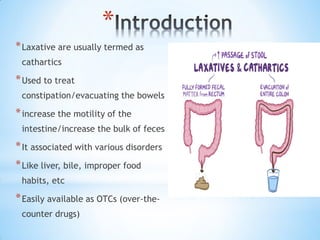
*Laxative are usuallytermed as
cathartics
*Used to treat
constipation/evacuating the bowels
*increase the motility of the
intestine/increase the bulk of feces
*It associated with various disorders
*Like liver, bile, improper food
habits, etc
*Easily available as OTCs (over-the-
counter drugs)
3.
*
*To treat acuteconstipation
*To remove solid material from intestine prior to certain X-rays
studies
*To avoid hazardous in blood pressure during defecation in patients
with cardiovascular and cerebral disorder
Note: cathartics are not intended for long-term therapy as the
patient may lose the normal rhythm of defecate
*
1. Stimulant cathartics:
*Actby local irritation on the intestinal tract
*Increase peristaltic activity (movements of the longitudinal &
circular muscles)
*Examples: Phenolphthalein, Aloe, Cascara, Senna extract,
Castor oil, etc.
2. Emollient (Lubricant):
*Provide lubricant effect for easy passage through rectum
*Termed as stool softeners
*Examples: Mineral oil, D-octyl sodium sulfosuccinate, etc.
3. Bulk forming:
*These agents swell in the intestine and increase the bulk
*Stimulates peristaltic movements
*Examples: Isabgol, Methyl cellulose, Agar, Karaya gum
6.
*
4. Saline cathartics:
*Increasethe osmotic load of the GIT
*Highly water soluble & consumed with large amount of water
*Examples:
a) Sodium-containing compounds: Sodium Biphosphate, Sodium
Phosphate, Dried Sodium Phosphate, Potassium Sodium Tartrate,
etc.
b) Magnesium containing compounds: Magnesium hydroxide,
Magnesium citrate, Magnesium sulphate
c) Sulfur
*
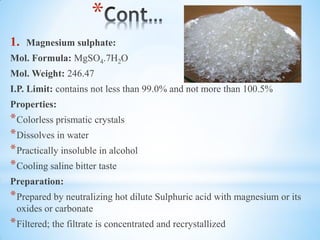
1. Magnesium sulphate:
Mol.Formula: MgSO4.7H2O
Mol. Weight: 246.47
I.P. Limit: contains not less than 99.0% and not more than 100.5%
Properties:
*Colorless prismatic crystals
*Dissolves in water
*Practically insoluble in alcohol
*Cooling saline bitter taste
Preparation:
*Prepared by neutralizing hot dilute Sulphuric acid with magnesium or its
oxides or carbonate
*Filtered; the filtrate is concentrated and recrystallized
9.
*
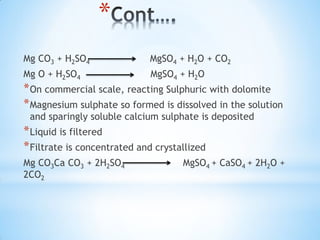
Mg CO3 +H2SO4 MgSO4 + H2O + CO2
Mg O + H2SO4 MgSO4 + H2O
*On commercial scale, reacting Sulphuric with dolomite
*Magnesium sulphate so formed is dissolved in the solution
and sparingly soluble calcium sulphate is deposited
*Liquid is filtered
*Filtrate is concentrated and crystallized
Mg CO3Ca CO3 + 2H2SO4 MgSO4 + CaSO4 + 2H2O +
2CO2
10.
*
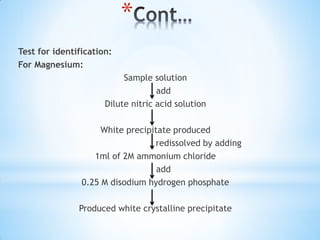
Test for identification:
ForMagnesium:
Sample solution
add
Dilute nitric acid solution
White precipitate produced
redissolved by adding
1ml of 2M ammonium chloride
add
0.25 M disodium hydrogen phosphate
Produced white crystalline precipitate
11.
*
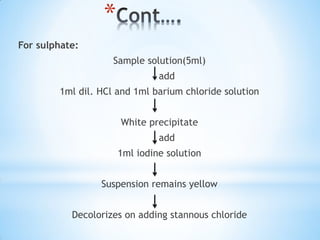
For sulphate:
Sample solution(5ml)
add
1mldil. HCl and 1ml barium chloride solution
White precipitate
add
1ml iodine solution
Suspension remains yellow
Decolorizes on adding stannous chloride
12.
*
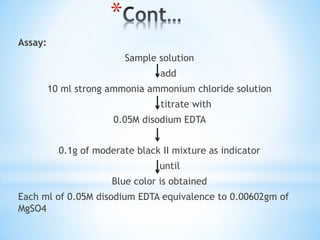
Assay:
Sample solution
add
10 mlstrong ammonia ammonium chloride solution
titrate with
0.05M disodium EDTA
0.1g of moderate black II mixture as indicator
until
Blue color is obtained
Each ml of 0.05M disodium EDTA equivalence to 0.00602gm of
MgSO4
13.
*
Uses:
1. Osmotic laxative
2.Treatment of electrolyte deficiency
3. Wet dressing in boils
4. Treatment of cholecystitis(inflammation of the gallbladder)
5. Sea sickness
6. Hypertension
14.
*
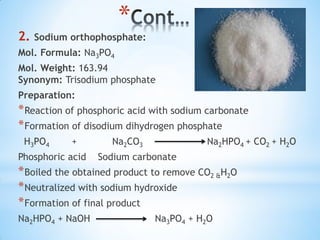
2. Sodium orthophosphate:
Mol.Formula: Na3PO4
Mol. Weight: 163.94
Synonym: Trisodium phosphate
Preparation:
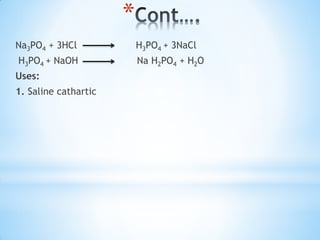
*Reaction of phosphoric acid with sodium carbonate
*Formation of disodium dihydrogen phosphate
H3PO4 + Na2CO3 Na2HPO4 + CO2 + H2O
Phosphoric acid Sodium carbonate
*Boiled the obtained product to remove CO2 &H2O
*Neutralized with sodium hydroxide
*Formation of final product
Na2HPO4 + NaOH Na3PO4 + H2O
15.
*
Properties:
*White crystalline powder
*Odorless
*Stronglyefflorescent
*Soluble in water
*Practically insoluble in alcohol
Standards:
*Occur as dodecahydrate of disodium orthophosphate
*Contains not less than 98.5% and not more than 101% with
reference to dried substance
16.
*
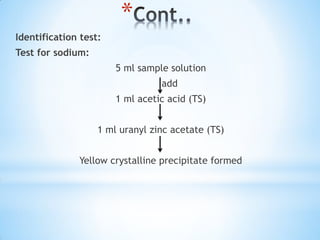
Identification test:
Test forsodium:
5 ml sample solution
add
1 ml acetic acid (TS)
1 ml uranyl zinc acetate (TS)
Yellow crystalline precipitate formed
17.
*
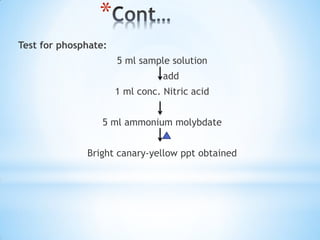
Test for phosphate:
5ml sample solution
add
1 ml conc. Nitric acid
5 ml ammonium molybdate
Bright canary-yellow ppt obtained
*
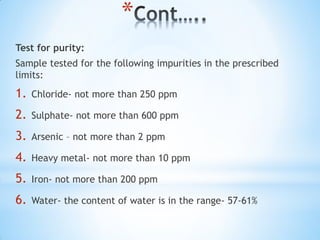
Test for purity:
Sampletested for the following impurities in the prescribed
limits:
1. Chloride- not more than 250 ppm
2. Sulphate- not more than 600 ppm
3. Arsenic – not more than 2 ppm
4. Heavy metal- not more than 10 ppm
5. Iron- not more than 200 ppm
6. Water- the content of water is in the range- 57-61%
20.
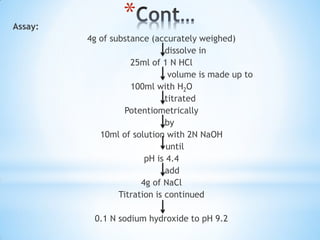
*Assay:
4g of substance(accurately weighed)
dissolve in
25ml of 1 N HCl
volume is made up to
100ml with H2O
titrated
Potentiometrically
by
10ml of solution with 2N NaOH
until
pH is 4.4
add
4g of NaCl
Titration is continued
0.1 N sodium hydroxide to pH 9.2
*
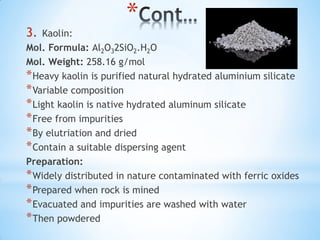
3. Kaolin:
Mol. Formula:Al2O32SiO2.H2O
Mol. Weight: 258.16 g/mol
*Heavy kaolin is purified natural hydrated aluminium silicate
*Variable composition
*Light kaolin is native hydrated aluminum silicate
*Free from impurities
*By elutriation and dried
*Contain a suitable dispersing agent
Preparation:
*Widely distributed in nature contaminated with ferric oxides
*Prepared when rock is mined
*Evacuated and impurities are washed with water
*Then powdered
23.
*
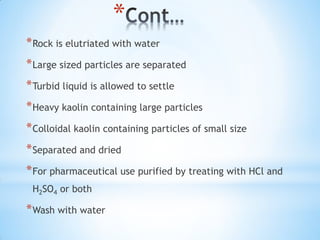
*Rock is elutriatedwith water
*Large sized particles are separated
*Turbid liquid is allowed to settle
*Heavy kaolin containing large particles
*Colloidal kaolin containing particles of small size
*Separated and dried
*For pharmaceutical use purified by treating with HCl and
H2SO4 or both
*Wash with water
24.
*
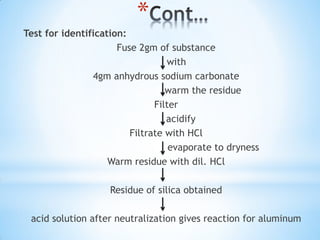
Test for identification:
Fuse2gm of substance
with
4gm anhydrous sodium carbonate
warm the residue
Filter
acidify
Filtrate with HCl
evaporate to dryness
Warm residue with dil. HCl
Residue of silica obtained
acid solution after neutralization gives reaction for aluminum
25.
*
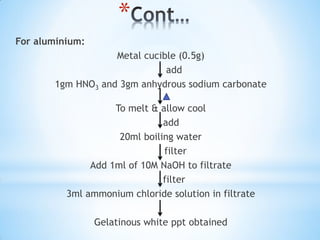
For aluminium:
Metal cucible(0.5g)
add
1gm HNO3 and 3gm anhydrous sodium carbonate
To melt & allow cool
add
20ml boiling water
filter
Add 1ml of 10M NaOH to filtrate
filter
3ml ammonium chloride solution in filtrate
Gelatinous white ppt obtained
26.
*
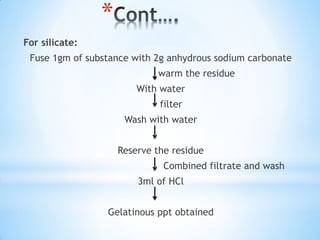
For silicate:
Fuse 1gmof substance with 2g anhydrous sodium carbonate
warm the residue
With water
filter
Wash with water
Reserve the residue
Combined filtrate and wash
3ml of HCl
Gelatinous ppt obtained
27.
*
Uses:
1. Adsorbent indiarrhea (due to food poisoning)
2. Chronic ulcerative colitis
3. As poultice, dusting powder, clarifying and decolorizing
medium
4. As filtering medium, as tablet diluent
28.
*
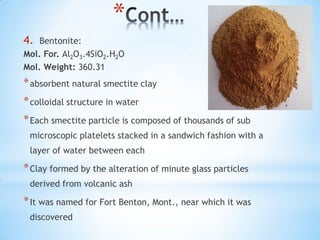
4. Bentonite:
Mol. For.Al2O3.4SiO2.H2O
Mol. Weight: 360.31
*absorbent natural smectite clay
*colloidal structure in water
*Each smectite particle is composed of thousands of sub
microscopic platelets stacked in a sandwich fashion with a
layer of water between each
*Clay formed by the alteration of minute glass particles
derived from volcanic ash
*It was named for Fort Benton, Mont., near which it was
discovered
29.
*
Types:
1. Sodium bentonite
2.Calcium bentonite
3. Potassium bentonite
Sodium bentonite:
*Absorb large quantities of water
*Welling to many times their original volume
*Give rise to permanent suspensions of gel like masses
*Used to seal dams; in bonding foundry sands, asbestos, and
mineral wool; as drilling muds; in portland cements and
concrete, ceramics, emulsions, insecticides, soaps,
pharmaceuticals, and paints; in the manufacture of paper; for
clarifying water, juices, and liquors; and as a water sortener to
remove calcium from hard water
30.
*
2. Calcium bentonite:
*Sometimescalled fuller’s earth
*Nonswelling and break down to a finely granular aggregate
*Widely used as an absorbent clay
3. Potassium bentonite:
*Also known as potash bentonite or K-bentonite
*Potassium bentonite is a potassium-rich illitic clay formed from
alteration of volcanic ash
Uses:
*Used for decolorizing various mineral, vegetable, and animal oils
*Also used for clarifying wine, liquor, cider, beer, mead, and
vinegar
*Main uses of bentonite are as drilling mud, binder (e.g. foundry-
sand bond, iron ore pelletizer), purifier, absorbent (e.g. pet
litter), and as a groundwater barrier
31.
*
*Used as abase for many dermatologic formulas
*Used as a desiccant due to its adsorption properties
*Used to protect pharmaceutical, nutraceutical, and diagnostic
products from moisture degradation
*Used in industry and emergency response as a chemical
absorbent and container sealant




![CTEV [ clubfoot] DR ARUN LAL ,DR MOHAMED ASHRAF travancore medical college k...](https://cdn.slidesharecdn.com/ss_thumbnails/ctevclubfootdrarunlaldrmohamedashraftravancoremedicalcollegekollamkeralaindia-260208063247-18fc466c-thumbnail.jpg?width=640&height=640&fit=bounds)
