Topic 1
IMPORTANT DEFINITIONS
1. BUSINESS - DEFINITION:
Businessorganizationscanbe definedinseveral ways.Givenbelow are few definitions of business.
“An organization engaged in producing or trading goods and services to the society under
the incentive of private gain.”
OR
“Business organizations are those, producing / manufacturing or trading goods and / or
services in order to make profit”
OR
“An institution organized and operated to provide goods and services to the society under
the incentive of private gain”
EXPLANATION:
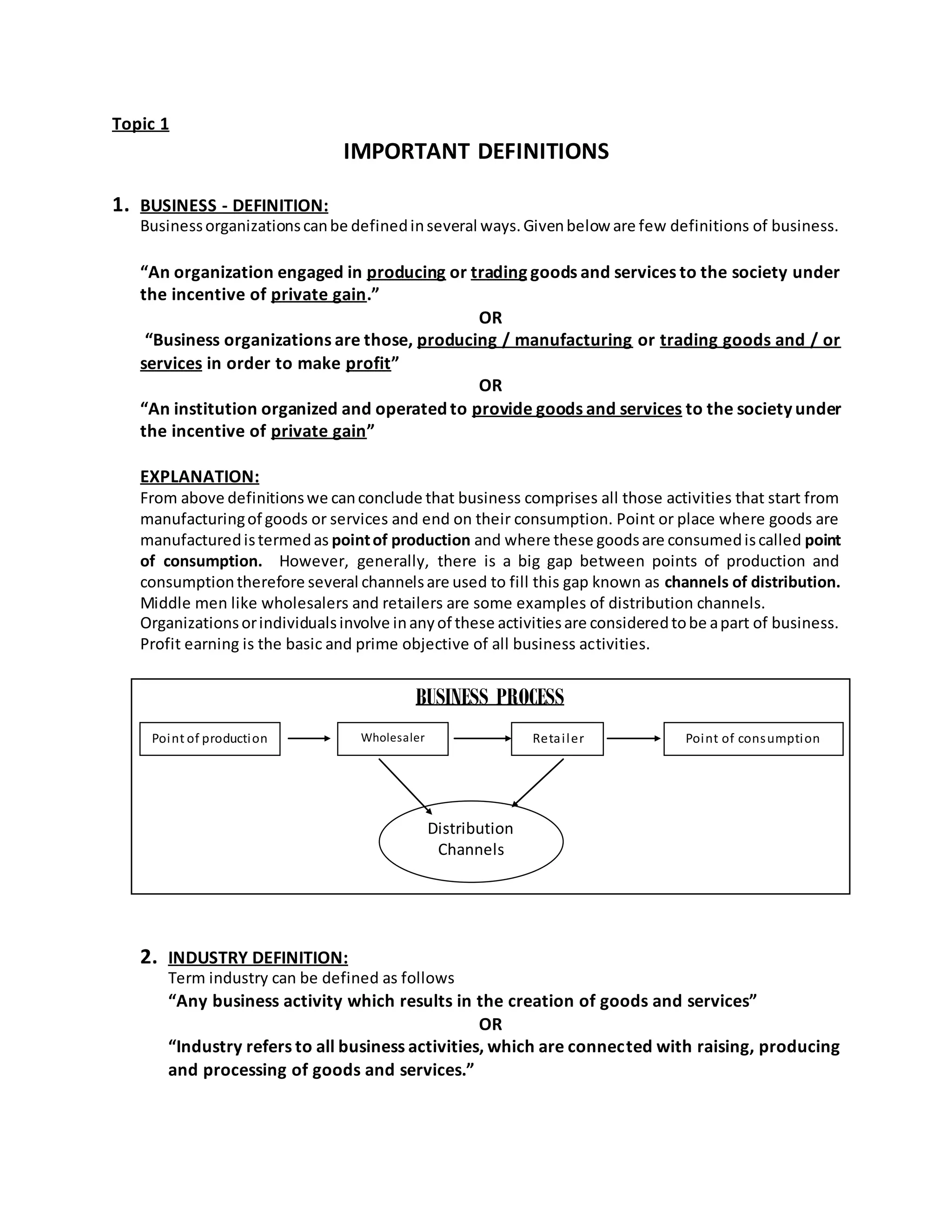
From above definitionswe canconclude that business comprises all those activities that start from
manufacturingof goods or services and end on their consumption. Point or place where goods are
manufacturedistermedas pointof production and where these goodsare consumediscalled point
of consumption. However, generally, there is a big gap between points of production and
consumptiontherefore several channelsare used to fill this gap known as channels of distribution.
Middle men like wholesalers and retailers are some examples of distribution channels.
Organizationsorindividualsinvolve inanyof these activitiesare consideredtobe apart of business.
Profit earning is the basic and prime objective of all business activities.
BUSINESS PROCESS
2. INDUSTRY DEFINITION:
Term industry can be defined as follows
“Any business activity which results in the creation of goods and services”
OR
“Industry refers to all business activities, which are connected with raising, producing
and processing of goods and services.”
Point of production Wholesaler Retailer Point of consumption
Distribution
Channels
EXPLANATION:
From above definitionswe cansaythat industriesare manufacturingunits. They produce goods
and services.Industries,throughmanufacturingprocess,change shapesandqualitiesof existing
productsto modifiedform.Some industriesconvert raw material into semi-finished goods like
cotton (rawmaterial) isusedtoproduce cloth(semi- finished good). However, some industries
convertsemi- finishedgoodsintofinished goods as Shirt (finished good) is manufactured from
cloth (semi- finished good).
3. COMMERCE DEFINITON:
Commerce can be defined as follows:
“Commerce includes all those activities which facilitate transfer of goods and services
from one place to an-other."
OR
“It is the sum of total activities involving the removal of hindrances in the process of
exchange of goods and services and facilitates the availability for consumption or
use.”
EXPLANATION:
Goods are produced or manufactured for consumption or use. Goods or services are
manufacturedbyindustriesbutthese are of nouse until theyreach to their target customers or
consumers.Commerce,therefore,coversall activitiesof makingthese goodsavailable foruse to
their consumers.
a) TRADE: It is the exchange of goods or services of some worth between two persons or
organizations.
b) AUXILIARIES TO TRADE: These are differentmodes,means or channels that facilitate the
processof trade.Transportation, Warehousing, Insurance and Banking are main auxiliaries
to trade.
4. TRADE DEFINITION:
Trade can be defined as:
“Trade is the exchange of goods or services of some worth between two persons or
organizations”.
OR
“Trade is the exchange i.e. buying and selling of goods or services”.
EXPLANATION:
Trade means buying and selling of goods or services, usually on regular basis. The person or
organizationthatpurchasesgoodsor services for further sale in order to make profit is termed
as trader. Presence of boththe activities i.e. buying and selling is compulsory in order to make
trade possible. Trade can be further divided into following two types:
1. Home Trade.
2. ForeignTrade.
a) HOME TRADE:
Trade withinthe countryis termedas home trade. This process involves exchange (buying
and selling)of goodsandservices within one city or even from one city to another of same
country. It is very often, that goods are directly supplied from producer to consumer, but
several medium are involved in this process. As producers sale their products to
wholesalers,fromwhole sellers products are purchased by retailers and finally consumers
buy these products from retailers.
When wholesalers purchased goods from producers, trade is termed as whole sale trade
and retailers purchase goods from wholesalers it is called retail trade.
b) FOREIGN TRADE:
Trade betweentwocountriesistermedasforeigntrade. We can say that in a foreign trade,
buyer belongs to one country while seller to another. Buyer, in foreign trade is called
importer while seller is termed as exporter. Foreign trade can be of following types:
(i) IMPORT TRADE: When goods are purchased from a foreign country for selling in our
own country, trade will be import trade.
(ii) EXPORT TRADE: When goods are sold to a foreign country, it is called export trade.
(iii) ENTREPOT TRADE: Sometimesgoodsare importedintoone countryforthe purpose of
exporting them to another country with or without making any change. Such type of
foreign trade is termed as entrepot trade.
5. AUXILIARIES / AIDS TO TRADE
INTRODUCTION:
Trade is not a simple process. Usually there is a big gap between producer and customer. In
many cases goods are produced in one city and their wholesaler belongs to another city.
Similarly if a retailer wants to carry goods from wholesaler’s outlet to his shop he must need
transportin orderto fulfillthisobjective.Therefore,there are manyactivitiesthat help, support
and facilitate the trade process. All such activities are termed as auxiliaries or aids to trade.
Given below are some important auxiliaries to trade:
(a) TRANSPORTATION:
Transport is considered as a backbone for trade success. Transport is required to move
goods from one place to another for example producer to wholesaler or retailer to
consumer.Forhome trade,tradersuse trucks, huge trawlers,vans,pickupsortrains inorder
to move products within the city or even from one city to another. Similarly, in foreign
trade, these are ships and aero-planes that move goods from one country to another.
(b) BANKING:
Banking sector helps the trade process in many ways. Not only they sanction loans to
traders in order to give their financial support but banks are also safe, easy and fast
channels of funds transfer from bank to bank, city to city or even from one country to
another. Banks also facilitate foreign traders with the services like discounting bill of
exchange, opening of L/Cs, and issuance of E-forms etc.
(c) INSURANCE:
Not any business or trade is free from risks. Whether it is production, transporting or
storage of goods,chancesof loss,damages,theftandfire etc. are present with them. Every
trader, of-course, wants to minimize these risks. Insurance companies play an important
role in this regard as they come forward to bear such risks. They commit to compensate
trader in case of loss or damage of his goods in return of receiving premium from traders.
(d) WARE HOUSING:
Warehouses solve the storage problem of traders. Especially those traders, importers or
exporters who do not have sufficient space to store their products, can store with such
warehouses by paying them some rent. These warehouses contain almost all facilities in
order to keep product secure like safety from sun, wind or rain, cold storage facility and
security etc.
(e) COMMUNICATION / INFORMATION:
Informationisthe keytosuccess.A traderneedsdifferentsortof informationfromboth the
suppliersaswell hiscustomers.Informationfromsuppliers’side, relates to enquiries about
products,prices,delivery time, new models etc. Whereas from customers, a trader always
seeksfeedbacks about his products, sometimes he may also receive some complaints and
he has to quote prices to his customers. All such information can be received and sent
throughvariouscommunicationmeanslike telephone, faxes, telegrams, letters and emails
etc.
6. SCOPE OF BUSINESS
INTRODUCTION:
Business is a broader term and it covers all activities done for the sake of profit. Following
activities or functions fall under the scope of business:
1. PRODUCTION:
Businessprocessstartswithplanningforproduction.Productionisconvertingraw materials
into semi- finished or finished products. Business organizations involve in production are
termed as industries. Industries can be divided into various types depending upon the
nature of work. Every manufacturing business strives to maintain quality, standard and
grades of its products so that it can get maximum profits.
2. TRADE:
Trade isexchange (buyingandsellingof goods orservices).Productionisof-course done for
consumption.We cansay that withoutconsumptionof anyproductorservice itsproduction
is useless. Trade is the process of moving goods or services from point of production to
point of consumption either directly or gradually.
From direct trade, it means, when consumer of product directly purchase the goods from
manufacturer. However direct trade is very often, because goods, gradually reach to
consumer or end-user from producer. As wholesaler purchases goods from producer,
retailer fromwhole sellerandfromretailergoodsare purchased byconsumer.Trade can be
withinthe country,termedashome trade and trade betweentwocountriesiscalledforeign
trade.
3. AUXILIARIES TO TRADE: (Concern previous topic)
CONCLUSION:
“Every production needs consumption”. All channels or activities making this idea
possible under the incentive of private gain come under the scope of business.
Topic 2
PROBLEMS IN ESTABLISHING A BUSINESS HOUSE
INTRODUCTION:
Establishing and running any business, in this competitive era, is not an easy task. It requires lot of
researchwork,surveysandanalysisinordertoestablishabusiness.Givenbeloware some major points
an organization must deal with while starting its operation.
1. SELECTION OF TYPE OF THE BUSINESS:
First of all, a businessman has to decide the type of his business. We can say that, he should
selectamongstmanufacturing,tradingorservice businesses. This selection would be based on
his knowledge, interest and experience. At this stage, the businessman must also analyze the
demand of his product(s) or service(s). Further, he should do a proper working about the
profitability of his business. In short, proper research and feasibilities must be made while
starting a new business.
2. FORM OF BUSINESS:
There are several choices available as far as form of business organization is concerned. A
businessman can go in for Sole Proprietorship, Partnership of Joint Stock Company. The
selectionisbasedoncertainelementslike sizeof businessorganization(small, medium or large
scale), financial needs, management and controlling issues and future expansion plans of
business etc. For example, a small retail shop can be opened and run by an individual but
multinational or national level businesses are usually in form of corporations.
3. FINANCING:
Finance is the life blood of every business. No business activity can be started without
arrangement of funds. For example, while starting a business businessman has to purchase
building, land, furniture, machinery and equipment etc. Further finance is needed in order to
meetday-to–daybusiness issues as making payments to suppliers, paying salaries to staff and
purchasing merchandise or other assets etc. Funds can be arranged either by owner(s)
themselves in the form of capital or businesses can also borrow the required amount from
financial institutionslike banksoncertainrate of interest.Financial resources depend upon the
size of the business.
4. LOCATION:
Location of the business is also an issue that should be carefully handled by a business man.
Suitable businesslocationisalwayseasytoapproachbyall means.Locationdependsuponmany
factors like availabilityof rawmaterial andotheraccessories,transport,manpower, nearness to
marketand basic necessities like water, power and gas etc. Selection of a suitable location for
business always increases profitability and decreases cost of doing.
5. SUITABLE MANPOWER:
Employeesare the resourcesof business,businesssuccessorfailure is heavily dependent upon
its employees. Selection of a right person for a right job is another issue a businessman has to
deal with. Specially at the time of starting a business, the businessman has not only to find
suitable candidates but also has to motivate them for joining the setup. He must analyze the
number of staff (labors, semi-skilled and skilled) his business is required. Further salary and
remunerationpackage mustbe inaccordance withjobassignments,knowledge,andexperience
and market trends.
6. MACHINES AND EQUIPMENT:
The choice of machineriesandequipmentsisalsoanotherdelicate problemwhile startinganew
business. Although, this issue is of great concern for manufacturing businesses but trading
enterprises also have to purchase certain machines or equipments like Photostat, Generators
and AirConditioners etc. Availability of funds and size of business are major considerations in
thisregard,however,repairandmaintenance facilities,availabilityof spare partsand after sales
service are also important factors while purchasing a machine or equipment.
7. COMPETITION:
A businessman has to keep an eye on his competitors. Specially, while establishing a new
businesshe mustanalyze the numberof competitors already working in the market. Important
factors inthisregardwouldbe theirproductsqualityandstandards, prices, discounts and other
benefitstheyoffertocustomers.The analysiswill helpinsetting-up the right prices and quality
of product(s). Further, it will also help the businessman to know whether his products can
compete with the market or not.
8. FUTURE SCOPE:
Good businesses always work for future. In this competitive era, it is almost impossible for a
business to survive without having a vision for growth. A businessman, therefore, must also
analyze the future prospects of his business. He must choose such products and services that
not only have a continuous but also increasing demand in market.
9. GOVERNMENT POLICIES:
Every business in bounded by the laws and policies of the government. A businessman must
thoroughly read and understand the laws, policies and rules and regulations defined by the
government. Main factors would be taxes, import and export duties, policies related to
advances and rebates and different quotas etc.
Topic 3
SOLE PROPRIETORSHIP
DEFINITION:
Sole proprietorship business can be defined as follows:
“The business owned by a single owner, who is referred as sole proprietor”
OR
“A business structure in which an individual and his/her company are considered a single
entity for tax and liability purposes”
EXPLANATION:
Sole proprietorship business is owned by single person called “owner” or “proprietor.” The owner, in
sole proprietorship,doesnot pay income tax separately for the company, but he/she reports business
income or losses on his/her individual income tax return. As owner is inseparable from the sole
proprietorship,sohe/she solelyenjoys all the profits of his business. On the other hand owner in such
type of businesses is solely liable for all the losses and debts as well.
Sole proprietorshipbusinessesare veryeasytoform anddo not require much legal formalities. Same is
the reason that huge number of businesses are running under this form of organization not only in
Pakistan but throughout the world.
MERITS OF SOLE PROPRIETORSHIP
Following are the advantages of a sole proprietorship business.
1. OWNERSHIP OF ALL PROFITS:
Businessisownedbyasingle persontherefore the profits whether big or small are enjoyed by
the proprietor. As the only owner, he is not required to share any of his profits amount with
others.
2. EASY FORMATION:
The formationof sole proprietorship business is very easy and simple. No legal formalities are
involved for setting up the business excepting a license or permission in certain cases. The
entrepreneur with initiative and certain amount of capital can set up such form of business.
3. PROMPTNESS IN DECISION-MAKING:
Whenthe decisionistobe takenbyone person,itis sure to be quick.Thus,the entrepreneur as
sole proprietor can arrive at quick decisions concerning the business by which he can take the
advantage of any better opportunities.
4. SECRECY:
Each and everyaspectof the businessislookedafterbythe proprietorand the business secrets
are known to him only. He has no legal obligation to publish his accounts or share the
information with others. Thus, the maintenance of adequate secrecy leaves no scope to his
competitors to be aware of the business secrets.
5. FLEXIBILITY IN OPERATIONS:
The sole proprietorship business is undertaken on a small scale. If any change is required in
business operations, it is easy and quick to bring the changes.
6. INEXPENSIVE FORMATION AND MANAGEMENT:
The managementof the businessisalsoinexpensive asnospecialists are normally appointed in
various functional areas of the business which is an added advantage.
7. FREE FROM GOVERNMENT CONTROL:
Sole proprietorshipisthe leastregulatedformof business.Regulatedlawsare almost negligible
in its formation, day-to-day operation and dissolution as well.
8. EASY DISSOLUTION:
Like that of formation, the dissolution of the sole proprietorship is also very easy. Since the
proprietoristhe supreme authorityandnoregulationsare applicable forclosure of the business
he can dissolve his business any time he likes.
DE-MERITS OF SOLE PROPRIETORSHIP
Following are the disadvantages of a sole proprietorship business.
1. LIMITED RESOURCES:
The financial resources of any small entrepreneur as an individual are limited. He mainly
financesfromhisownsavingsorborrowsfrom financial institutions,friendsandrelatives as per
his capacity. Thus, limited resource is the major drawback of this form of business.
2. LIMITED MANAGERIAL CAPABILITY:
Modern business requires updated managerial skills in each and every sphere of activity. We
cannot hope a single individual to possess all the managerial talents necessary to carry on a
business efficiently.
3. UNLIMITED LIABILITY:
Since the liabilityof the sole proprietorisunlimited,the private properties of the proprietor are
also at risk. Because if business fails, owner himself is required to pay-off his business debts
even by utilizing his private properties. Thus, the entrepreneur must have to look this aspect
carefully.
4. UNCERTAINTY OF CONTINUITY:
The continuity of the businessisuncertainbecausethe businessmaycome to an end due to the
incapacityor deathof the proprietor.Evenif at all the business passes on to the successor(s) of
the proprietor, it is unlikely that they may possess same abilities like that of the proprietor.
5. NOT SUITABLE FOR LARGE SCALE BUSINESS:
The limited financial resources, limited managerial capability of the proprietor, risk to the
private propertyetc.make the sole proprietorshipbusinessunsuitable for large-scale business.
This system of business is not affordable for large-scale operation.
6. LIMITIED OPPORTUINITIES FOR EMPLOYEES:
Sole proprietorshipbusinessdoesnotoffercareeropportunitiestoitsemployees because of its
limitationof size.Mostlyemployeesinsuchtype of businessesworkatlowerlevel management.
Topic 4
PARTNERSHIP
DEFINITION:
Partnership business can be defined as follows:
“An association of two or more persons to carry on as co-owners a business for profit.”
OR
“A relation between persons who have agreed to share the profits of a business carried out
by all or any of them acting for all.”
EXPLANATION:
Partnershipisbasicallyarelationshipbetween two or more persons who join hands to form a business
organizationwiththe objective of earningprofit.These personsare individuallyknownas ‘Partners’ and
their business is collectively known as ‘Firm’.
The partners provide necessary capital, run the business jointly and share the responsibility. A
‘partnershipagreement’or‘partnershipdeed’ismade withmutual understanding of all the partners at
the time of start of the business clearly explaining clauses like:
(i) Amount of capital to be contributed by each partner
(ii) Profit and loss sharing ratio of each partner and
(iii) Management issues in partnership business etc.
MERITS OF PARTNERSHIP
Following are the advantages of a partnership business.
1. EASY FORMATION:
Like sole proprietorship,the partnershipbusinesscanbe formedeasilywithoutanylegal formalities.
It is not necessary to get the firm registered. A simple agreement, either oral or in writing, is
sufficient to create a partnership firm.
2. AVAILABILITY OF LARGE RESOURCES:
Since two or more partners join hand to start partnership business it may be possible to pool more
resourcesascomparedto sole proprietorship.The partnerscancontribute more capital, more effort
and also more time for the business.
3. BETTER DECISION:
The partners are the owners of the business. Each of them has equal right to participate in the
managementof the business.Incase of any conflicttheycansit togethertosolve the problems.Since
all partners participate in decision-making, there is less scope for reckless and hasty decisions.
4. FLEXIBILITY IN OPERATIONS:
The partnershipfirmisa flexible organization.Atanytime the partnerscandecide to change the size
and nature of the business or area of its operation. There is no need to follow any legal procedure.
Only the consent of all the partners is required.
5. RISK SHARING:
In a partnership firm risk of loss, damages or any uncertain situation is always shared by all the
partnersas pertheiragreement.Therefore,apartnershipbusinessdoesnotgive complete burden of
risk on an individual as in sole proprietorship business.
6. PROTECTION OF INTEREST OF EACH PARTNER:
In a partnershipfirmeverypartner has an equal say in decision making. If any decision goes against
the interest of any partner he can prevent the decision from being taken. In extreme cases a
dissenting partner may withdraw himself from the business and can dissolve it.
7. BENEFITS OF SPECIALIZATION:
Since all the partners are owners of the business they can actively participate in every aspect of
business as per their specialization and knowledge. For example two or more doctors may start a
clinicinpartnership.Similarlyinalegal consultancy(partnership)firmone partnermaydeal withcivil
cases, one in criminal cases, and another in labor cases and so on as per their specialization.
DE-MERITS OF PARTNERSHIP
Following are the disadvantages of a partnership business.
1. UN-LIMITED LIABILITIES:
All the partnersare jointlyaswell asseparatelyliable for the debt of the firm to an unlimited extent.
Thus,theycan share the liabilityamongthemselvesorany one can be asked to pay all the debts even
from his personal properties.
2. UNCERTAIN LIFE:
The partnershipfirmhasno legal entityseparate fromitspartners.Itcomesto an end with the death,
insolvency,incapacityorthe retirementof anypartner.Further, any dissenting member can also give
notice at any time for dissolution of partnership.
3. LACK OF HARMONY:
In partnership firm every partner has an equal right to participate in the management. Also every
partnercan place his or heropinionor viewpointbeforethe managementregardinganymatter at any
time. Because of this sometimes there is a possibility of conflict among the partners. Difference of
opinion may lead to closure of the business on many occasions.
4. LIMITED CAPITAL:
Since the total number of partners cannot exceed by 20, the capital to be raised is always limited. It
may not be possible to start a very large business in partnership form.
5. NO TRANSFERABILTY OF SHARES:
Anypartneris notallowedtotransferhisor hershare of interesttooutsiderswithout mutual consent
of otherpartners.Thiscreatesinconvenience for the partner who wants to leave the firm or sell part
of his share to others.
RIGHTS AND DUTIES OF PARTNERS
RIGHTS:
Partnershave certainrightsovertheirbusinesses.Mainrightsare givenbelow.
1. Right of the partner to take part inthe day-to-daymanagementof the firm.
2. Right to be consultedandheardwhile takinganydecisionregardingthe business.
3. Right of access to booksof accounts andcall forthe copyof the same.
4. Right to share the profitsequallyorasagreeduponby the partners.
5. Right to getinterestoncapital contributedbyhimtothe firm.
6. Right to avail interestonadvancespaidbythe partnersforbusinesspurpose.
7. Right to the use of partnershippropertyexclusivelyforpartnershipbusinessonlynothimself.
8. Right as agentof the firmandimpliedauthoritytobindthe firmforanyact done incarryingthe
business.
9. Right to preventadmissionof newpartners.
10.Right to retire withthe consentof otherpartnersandaccordingto the terms-andconditionsof deed.
DUTIES / RESPONSIBILITIES:
On otherhanda partnerisalsoliable orresponsibletowardshisfirm.Maindutiesorresponsibilitiesof a
partneras follows:
1. TO CARRY ON THE BUSINESS TO THE GREATEST COMMON ADVANTAGE:
Every partner is bound to carry on the business of the firm to the greatest common advantage. In
other words, the partner must use his knowledge and skill in the conduct of business to secure
maximum benefits for the firm.
2. TO RENDER TRUE ACCOUNTS:
Everypartnermust rendertrue andproperaccounts to hisco-partners.Each andeveryentryinthe
booksmustbe supportedbyvouchersandexplanationsif demandedbyotherpartners.
3. TO PERFORM HIS DUTIES:
Everypartneris boundto attenddiligentlytodutiesinthe conductof the businessof the firm.
4. TO HOLD AND USE PARTNERSHIP PROPERTY EXCLUSIVELY FOR THE FIRM:
The partnersmust holdanduse the partnershippropertyexclusivelyforthe purpose of businessand
not fortheirpersonal benefit.
5. NOT TO CARRY ON ANY COMPETING BUSINESS:
A partnermustnot carry oncompetingbusinesstothatof the firm.If he carrieson andearns any
profitthen he mustaccount forthe profitmade and pay itto the firm.
6. TO SHARE LOSSES:
It is the duty of the partners to bear the losses of the firm. Partners share the losses equally when
there is no agreement otherwise, as per their profit share ratio.
7. TO ACT WITHIN AUTHORITY:
Every partner is bound to act within the scope of his authority. If he exceeds his authority and the
firm suffers from any loss, he will have to compensate the same.
DISSOLUTION OF PARTNERSHIP
Under the following conditions a partnership firm stands dissolved:
1. ADMISSION OF A NEW PARTNER:
In case of admission of new partner(s), the old partnership has to be dissolved and a new
agreement is required to be made.
2. RETIREMENT OF AN EXISTING PARTNER:
In case of retirementof anexistingpartner the old partnership stands dissolved. However, the
firm may continue its operations in case of mutual agreement of other existing partners.
3. DEATH OF A PARTNER:
Deathof a partneralso bringsthe partnershipto an end. If other partners want to continue the
business, they make a new agreement for their partnership.
4. INSOLVENCY OR BANKRUPTCY OF AN EXISTING PARNTER:
If partner isdeclaredbankrupt,the partnershipwill turn dissolved. Remaining partners have to
make a new agreement in order to continue their partnership business.
5. CRIME CONVICTION BY AN EXISTING PARTNER:
If a partner is convicted of crime or declared guilty by the court of law, he cannot enter in any
kind of agreement or run any business, therefore conviction in any kind of crime will
automatically dissolved the partnership business.
6. EXPIRY OF PARTNERSHIP PERIOD:
In some cases partnership agreement is made for a definite period. Such partnerships
automaticallydissolveattheirperiodof expiry.However,atthe will of partners, the agreement
can be renewed for future.
Topic 5
JOINT STOCK COMPANIES
DFINITION:
Joint Stock Company can be defined as follows:
“An artificial being, intangible, invisible but existing in contemplation by law.”
OR
“A company is an artificial person created by law, having a separate legal entity with
perpetual succession and a common seal.”
EXPLANATION:
A company form of business organization is known as a Joint Stock Company. It is a voluntary
associationof personswhogenerallycontribute capital tocarryon a particulartype of business,whichis
establishedbylawand can be dissolvedonlyby law. Personswho contribute capital become members
of the company. This form of business has a legal existence separate from its members, which means
membersmaycome and go butthe companyremainsinexistence. This form of business organizations
generallyrequireshuge capital investment, which is contributed by its members. The total capital of a
joint stock company is called share capital and it is divided into a number of units called shares. Thus,
every member has some shares in the business depending upon the amount of capital contributed by
him. Hence, members are also called shareholders.
FEATURES OF COMPANY
Following are the main features of a Joint Stock Company:
1. LEGAL FORMATION:
A joint stock company is formed only by completing several legal formalities. It always comes into
existence when it has been registered after completion of all formalities required by the country’s
law. As in Pakistan companies are formed and governed under companies’ ordinance of 1984.
2. ARTIFICIAL PERSON:
A company is always considered as an artificial person as it establishes with its own entity and can
enter in any agreement like any individual. However, it is called an artificial person as its birth,
existence and death are regulated by law and it does not possess physical attributes like that of a
normal person.
3. SEPERATE LEGAL ENTITY:
Being an artificial person, a joint stock company has its own separate existence independent of its
members. It means that a joint stock company can own property, enter into contracts and conduct
any lawful business in its own name. It can sue and can be sued by others in the court of law.
4. COMMON SEAL:
A jointstock company has a seal, which is used while dealing with others or entering into contracts
with outsiders. It is called a common seal as it can be used by any officer at any level of the
organizationworkingon behalf of the company. Any document, on which the company's seal is put
and is duly signed by any official of the company, become binding on the company.
5. PERPETUAL EXISTENCE:
A jointstockcompanycontinuestoexistaslongas it fulfillsthe requirementsof law.Itisnot affected
by the death, insolvency or retirement of any of its members. Members may come in and go out
throughbuyingandsellingof shares(usuallytermedastransferof shares) without affecting working
of the company.
6. LIMITED LIABILITY:
In a jointstockcompany,the liabilityof amemberislimitedtothe extentof the value of shares held
by him. While repaying debts, for example, if a person owns 1000 shares of Rs. 10 each, then he is
liable only upto Rs 10,000 towards payment of debts. Therefore, even if there is liquidation of the
company, the personal property of the shareholder cannot be attached and he will lose only his
shares worth Rs. 10,000.
MEMORANDUM OF ASSOCIATION
INTRODUCTION:
Memorandum of association is the fundamental charter which defines the aims and objectives of a
company.It contains fundamental rule regarding the constitution and the activities of a company. It is
the most significant document on which the super-structure of the company is raised. It sets out the
limits with in which the company may function and defines the relations of the company with the
outside world. Any action beyond the scope of the memorandum of association is void. The following
are the main clauses of the memorandum of association:
1. NAME CLAUSE:
Thisclause containsthe name of the company. The word limited is used after the name of a public
limitedcompanyandprivate limited is used after the name of a private company. The name of the
company should not be identical to the name of an existing company. The words like Royal, King,
Emperor and Federal may not be used without prior permission of the government.
2. OBJECT CLAUSE:
Thisis an importantclause of the memorandum of association which states the objects with which
the companyhas beenestablished.Anyactionbeyondthe statedobjective isillegal therefore great
care has to be taken in drawing up this clause. It is better to keep broad objective of a company
along with subsidiary objectives.
3. DOMICILE CLAUSE:
Thisclause statesthe place at whichthe registeredofficewillbe situated. It is advisable to mention
the name of province or state in order to avoid legal formalities in shifting the registered office of
the company.Domicile clause isvital fordeterminationof jurisdictionof the court for legal matters.
4. CAPITAL CLAUSE:
Thisclause statesthe amountof authorizedcapital withwhichacompanyisregistered.The division
of share capital intodifferentsharesmustbe statedinthe capital clause.The face value of the share
will be stated in this clause. This clause gives an idea of exact capital structure of the company.
5. LIABILITY CLAUSE:
This clause states that the liability of the shareholders is limited to the extent of the face value of
shares purchased by them. Further, it also means that the liability of the company to pay-off its
debts is limited to its capital. This clause protects personal properties and belongings of
shareholders from settling the debts of company.
ARTICLES OF ASSOCIATION
INTRODUCTION:
It isa documentinwhichrulesandregulationsare written which govern the internal administration of
the company.It definesthe powersandrightsof the directors, officers and shareholders. The article of
association are framed and registered to settle the daily affairs of the company. It is subsidiary of
Memorandum of Association. No any rule can be framed which against the Memorandum of
Association.
CONTENTS OF ARTICLE OF ASSOCIATION
Following are the main clauses of article of association.
1. Amount of capital and its division into various shares.
2. Rights regarding the different shareholders.
3. Rules regarding transfer of shares.
4. Rules regarding issue of shares and debentures.
5. Calls on shares.
6. Appointment of directors powers and duties.
7. Alteration of capital.
8. The functions and powers of managing agent.
9. Proceeding of disposing of resolution.
10. Accounts and audit.
11. Stamp of a company.
12. Voting rights of shareholders.
13. Winding up procedure of company.
14. Rules regarding the forfeiture and surrender of shares.
15. Proceeding of shareholders meeting.
16. Proceeding of Board of Directors meetings.
17. Change of shares into stock and stock into shares.
FORMATION OF A COMPANY
INTRODUCTION:
Incorporation of a company is a complicated and time consuming procedure. Following are the main
steps in order to form a company.
1. GETTING PROMOTERS:
Promotersare the foundersof a company.Therefore they must get together in order to design the
work plan, objective and skeleton of the company. A public limited company may have at-least
seven promoters while the minimum number of promoters required to form a private limited
company is two.
2. APPOINTMENT OF ADVISORS:
In secondstep a legal advisor is hired by the promoters. The advisor helps them in preparing legal
documentslike article andmemorandumof association, prospectus or statement in its lieu etc. He
further deals with the office of the registrar for company registration.
3. PREPRATION OF COMPANY’S DOCUMENTS:
According to the companies’ ordinance 1984, certain documents are required to be prepared in
order to get a legal status of the company. Important documents in this regard are
i. Memorandum of Association
ii. Article of Association
iii. Prospectus of the company
4. SUBMITTING APPLICATION TO THE REGISTRAR:
After completion of all necessary documents an application is submitted to the registrar office in
orderto get registrationof the company.The application(along-with the documents mentioned in
step3) alsocontainsdetailslike name andaddressesof company’s directors and name and address
of the registered office of the company etc.
5. PAYMENT OF REGISTRATION FEE:
A registration fee is also required to be paid along-with application form. The fee amount is not
fixed and always depends upon the share capital of the company. Greater the amount of capital
higher will be the registration fee.
6. PRINTING SHARE CERTIFICATE:
Duringthe processof registrationthe promoterstrytogetshare certificates of their company to be
printed. These certificates are issued to the shareholders as a token of their ownership in the
company.
7. ISSUANCE OF REGISTRATION CERTIFICATE:
Aftera thoroughexaminationandanalysis a registration certificate is issued by the registrar of the
company, after the issuance of which the company gets a legal status. We can also say that before
getting a registration certificate no any company can start its business operation.
It isalso importanttonote that a private limitedcompanycanimmediately start its business affairs
after getting the registration certificate, however a public limited company cannot commence its
operation at this stage unless it gets another certificate known as commencement certificate.
8. PUBLICATION OF PROSPECTUS: ( Only for Public Limited Companies)
On receipt of registration certificate the company issues prospectus to general public (through
advertisement). The prospectus helps the company in raising the desired capital amount from the
public.
9. APPLICATION FOR COMMENCEMENT CERTIFICATE: (only for Public Limited Companies)
After raising capital through prospectus the company applies for commencement certificate. The
commencement certificate allows the company to begin its actual operations.
PROSPECTUS
A prospectus is an invitation or advertisement of a public limited company to general public asking
themto investinthe share capital of the company.Prospectusis required to be circulated (through
advertisement) bypubliclimitedcompanies. Without its publication a company is unable to gather
its desired share capital hence, cannot get the commencement certificate to start its business
affairs.
It isimportantto note that prospectusisnotcompulsoryfora private limitedcompanyas it does not
raise its capital from general public. Similarly, public limited companies arranging their share capital
privately are not required to publish their prospectus.
VALIDITY / ESSENTIALS OF PROSPECTUS:
A legally valid prospectus must fulfill the following conditions.
i. Invites general public to buy shares.
ii. Its copy must be submitted to registrar office before its publication.
iii. It must be properly dated.
iv. It must be signed by all or at-least two directors of the company.
FEATURES OF PROSPECTUS:
Following are the salient features of a prospectus.
i. It contains the content of memorandum of association
ii. It contains the total number of shares and promoters of the company.
iii. Number of redeemable shares.
iv. Qualifications shares of directors
v. The name of underwriters of shares.
vi. Description of companies’ directors.
vii. Allotment, installments and forfeiture of shares.
viii. Preliminary Expenses
ix. Promoters’ Fees
x. Name and address of auditors.
xi. Minimum subscription of shares
xii. Nature of debentures and their underwriters
xiii. Name and date of contract relating to company’s property.
STATEMENT IN LIEU OF PROSPECTUS
Private limited companies and Public limited companies (arranging their share capital from private
sources and not from general public) are not required to publish company’s prospectus. Therefore, in
accordance withcompanies’lawtheyare onlyrequiredto submit to the registrar a statement in lieu of
prospectus. This statement should include same information as of prospectus and is required to be
submitted at-least three days prior to the issuance of shares or bonds.
Topic 6
SOCIALISM
DEFINITION:
“An economic system or theory underwhich means of production and distribution work for
community as a whole.”
OR
“Economic system under which means of production and distribution are held under
collective ownership in public interest.”
EXPLANATION:
Socialismisalsotermedasbusiness under public ownership. Under socialism production of goods and
servicesare organized in order to fulfill human needs and not to earn profits. Socialist economies are
state ownedwhere all factorsof productionsare owned,controlledandmanagedby state government.
Socialist states are not profit oriented but these are welfare states. Hence socialism encourages state
control, dependence, spending and bureaucracy while discourages private ownership, profit and
individual responsibilities.
SOCIALISM – CHARACTERISTICS
Following are the main characteristics of socialism:
1. GOVERNMENT CONTROL:
All factors of production related to goods and services are controlled by government. Heavy
industries,utilitiesservices(water,powerandgasetc.),financial institutionsandeducationalsectors
etc.are completelycontrolledbygovernment.Government,asperstate requirementsutilize factors
of production in the manner it finds best.
2. INTEREST FREE ECONOMY:
Socialismisbasedonpublicwelfare,therefore,socialisteconomiesare interest free. Resources and
wealthare supposedtobe distributed on the basis of equality in general public and interest is the
factor that results in wealth concentration in hands of some people, hence it is discouraged in
socialism.
3. CLASSLESS SOCIETY:
The concept of socialism,atlarge, eliminates differences of rich and poor from the society. Mostly
goods and services are produced or manufactured on the basis of analysis about their number of
consumers. We can say that in a socialist economy, almost all goods and services are within the
range of everyone.
4. CONTROLLED ECONOMY:
Besides having control over factors of production, government in a broader aspect also controls
trade and auxiliaries to trade of the country because of which government has complete control
overentire country’seconomy.Inasocialisteconomyitisthe governmentthatdecidesaboutprices
of commodities, rates of services and even salaries of employees.
5. EMPLOYMENT FOR ALL:
Beinga welfare state, a socialist economy guarantees compulsory employment to every citizen of
state. All men and women get employment in state run organizations based on their capabilities,
skillsandknowledge.Hence we cansaythat ina complete socialisteconomy,un-employment does
not exist at all.
6. SERVICE ORIENTED FOR PEOPLE:
As businesses are run by government for welfare of its citizens, socialist economies themselves
become service oriented. Government offers services and goods to consumers at moderate and
affordable prices. Same is the reason, that government sometimes runs few of its organizations
even at losses but does not windup such businesses in public interest.
SOCIALISM – ADVANTAGES
Following are the main advantages of socialism:
1. WELFARE STATE:
A socialist state is also termed as welfare state. Factors of production, resources of country and
other business affairs are utilized for general public welfare and not to earn profits. Government
offers,goodstoconsumersat moderate andaffordable prices.Further,service providingsectorslike
education, utilities, hospitals, rail and air ways etc. are also under government control, which
sometimes runs few of its organizations even at losses but does not windup such businesses for
welfare of its public.
2. INTEREST FREE ECONOMY:
Due to interest factor wealth and other resources start going into the hands of few people of the
state. Further interest is one of the major causes of inflation in the society. A socialist economic
system is based on the concept of public welfare through equal distribution of wealth and
resources, hence it completely discourages interest.
3. CLASS LESS SOCIETY:
The concept of socialism,atlarge, eliminates differences of rich and poor from the society. Mostly
goods and services are produced or manufactured on the basis of analysis about their number of
consumers.Thisfactoris beneficial as all goods and services are within the range of everyone, life
style people isalmostsame,chancesof robberyandtheftare minimizedanddiscriminating factor is
eliminated from the society.
4. CONTROLLED PRICES:
Due to complete governmentcontrol overthe economy,pricesof goodsandservicesremainstable.
Thus profitmakingisnotthe objective of businessesinasocialist state the government fixes prices
in favor of consumers by which they purchase commodities and avail services at low rates.
5. LESS WASTAGE OF RESOURCES:
Factors of production and resources of a socialist state are used, controlled and managed by the
governmentwhich doesnotuse these resourcesforprofitmaking.Allocation of all the resources in
productive mannerisbasedongovernmentanalysisand research. Same is the reason that wastage
or misuse is supposed to be at its minimum level in a socialist economy.
6. EMPLOYMENT FOR ALL:
Beinga welfare state,asocialisteconomyguarantees compulsory employment to every its citizen.
All menandwomengetemploymentinstate runorganizationsbasedontheircapabilities,skills and
knowledge.Hence we cansaythat in a complete socialisteconomy, un-employment does not exist
at all.
SOCIALISM – DISADVANTAGES
A socialist economy has following major disadvantages:
1. ABSENCE OF PRIVATE OWNERSHIP:
Everyindividualmusthave righttouse hispersonal resourcesasperhischoice.Private ownership is
basedon profitandrevenue generation. In a socialist state concept of private ownership does-not
exist. All resources are owned by government. Every individual has to surrender his resources (if
any) to government and has no right to use it as per his choice. Absence of private ownership
eliminates the profit generation factor from the society by which individual’s interest in business
affairs go down.
2. NO CONSUMER CHOICES:
Consumers in a socialist state are not supposed to demand but they have to accept. Production of
goodsand servicesare controlled by government. Further it is the government that decides about
prices, rates, standards and qualities of goods and services. Not any individual or organization is
allowed to enter in any sort of business. Same is the reasons that consumers do-not have much
choice of products or services.
3. LESS CHOICES OF PROFESSION:
Due to complete control of government over all business activities, people get fewer professional
choices. As there is no private sector, people can only apply for jobs in industries run by
government.Itisthe government that decides about matters like job assignments, salaries, fringe
benefits,promotionsandincrementsetc.Therefore employees, mostly, have no right to negotiate
on their salaries and other matters.
4. LOW MORALEOF PEOPLE:
It isthe responsibilityof state to provide employment to every citizen. Government usually has its
own criteria of salary fixation, promotion and increment. Usually increments and promotions are
given on seniority basis instead of performance or worth abilities. The factors bring morale of
employeesatverylowside.Onthe otherhand, compulsory employment and permanent nature of
job usually decrease job interest and increase factors like absenteeism and late comings in
employees.
5. BUREAUCRATIC CULTURE:
Management, in a socialist economy is based on rule and not on objective. Every matter goes
throughprocessdesignedbythe government.Further top management of organizations is directly
transferred or appointed by government hence sometimes is un-experienced about organization
matters.It isusuallyobservedthatmostlygovernmentemployeestake least interest in betterment
of corporation same is the reason that several government owned organizations show losses of
millions of rupees every year.
6. CORRUPTION:
Socialist economies lead to increase corruption in their country. Most government employees
indulge in corruption, inefficiency and fudged accounts.
7. SLOW ECONOMIC GROWTH:
Absence of factorslike private ownership,competition,profitmakingandinterest of employees to-
wards their job assignments slow down the economic growth of the country. Organizations in
socialist economies hardly move towards updating themselves with new technologies and other
changes.
Topic 7
CAPITALISM
DEFINITION:
“An economic system or theory in which all means of production and distribution work under
private ownership with incentive of private gain or profit.”
OR
“An economic system in which means of production and distribution are privately or
corporately owned and development is proportionate to the accumulation and reinvestment
of profits in a free market.”
EXPLANATION:
In a capitalistic economy, businesses are run under private owner with the incentive of private gains.
There isno or verylittle involvementof state governmentinbusinessaffairs,usuallyup-tothe extent of
policy making. Factors of production and resources remain under private ownership. Profit earning is
the key factor of economical growth in a capitalist economy. More profits lead to more investment
which ultimately results in economic growth of the country.
CAPITALISM – CHARACTERISTICS
Following are the main characteristics of capitalism:
1. PRIVATE OWNERSHIP:
In a capitalisteconomyfactorsof productionsare owned,managedandcontrolledbyprivate sector.
Individualsororganizations are free to run their businesses and use their resources in the manner
they like. Government does not interfere in any legal use of resources like land, capital or labor.
Similarly, the fourth factor i.e. entrepreneur is also free to start, own and run any legitimate
business in a capitalist economy.
2. PROFIT ORIENTED ECONOMY:
Profitisthe mainmotivating factorof a capitalisteconomy.Businessesunderprivate ownership are
establishedandrunforprofits.Everybusinessman,afterpayingall taxes,dutiesandliabilitiesisfree
to use hisprofitinthe mannerhe likes.We can say that, entrepreneurs are free to use their profits
either for their personal use, savings or reinvesting in their businesses.
3. INTERST BASED ECONOMY:
Interestisone of the strong pillarsof capitalism.Itisreferredasreturnoninvestmentanownergets
on his capital. Investor is free to use his capital in any sector to get maximum rate of return. The
return on investment can be, again, freely use by the owner.
4. ECONOMY OF CLASSES:
Due to minimum government control and freedom of private sector capitalist economy generates
classes of rich and poor. More capital investment brings more return, good quality products and
servicesgenerate more profit,experiencedandskilledemployees get more salaries and benefits as
compared to in-experienced and unskilled staff. All such factors divide the community in upper,
middle and lower classes.
5. FREEDOM TO CHOOSE:
In a capitalist economy, variety of products and services are available for consumers. Hence,
consumers are not only free to choose any of the available products or services but they can also
negotiate ontheirprices. Further, consumers also have right either to accept or reject any product
on basis of its price, quality or standards.
6. FREEDOM OF PROFESSION:
A capitalist economy provides open opportunities of professions to the whole community.
Employers are free in selection for suitable candidates. Similarly employees and workers can also
searchjobsof theirowninterest.Furtheremployeesare alsofree to negotiate on their salaries and
other fringe benefits with their employers.
CAPITALISM – ADVANTAGES
Following are the main advantages of capitalism:
1. PROFIT OREINTED ECONOMY:
Profitisthe basic objective of privateownership. Businessmen invest more and work hard in order
to earnmore profits.Thisfactorresultsinbusiness expansion and growth which is not only fruitful
for businessmen but also creates employment opportunities and faster the economic growth as
well.
2. CONSUMER FREEDOM:
In capitalisteconomy, consumers have lot of choices of goods and services. They have freedom to
choose amongthe available goods and services in the market. They can negotiate on price, quality
and standard of products and services and have right to reject or accept any product or service on
such grounds.Insimple wordswe can say that ina capitalisteconomyconsumeristhe king. Same is
the reasonthat businesseswork hard for maintain good quality and standard of their products and
services in order to satisfy their consumers
3. FREEDOM OF PROFESSIONS:
Capitalism also gives individuals, freedom to choose professions of their own interest. They can
applyfor any job in any industry or sector they like, further have right to negotiate on salaries and
otherbenefitswiththeiremployers.It is obvious that employees work whole heartedly if they get
jobs of their interest which ultimately results in business and so economic growth. Similarly,
employers also have right to search and select candidates according to their requirements.
4. COMPETITION:
Capitalismprovidesequalopportunitiestoall businessmen.Businessesthatworkhard and maintain
good standards will earn more profits. This makes the business environment competitive and
consumers get better quality products at good price levels.
5. USE OF TECHNOLOGY:
Producers in order to satisfy their customers and get more market share keep themselves busy in
introducing new products in the market which needs a lot of research and analysis. Same is the
reason that science and technology is used in the best possible way in a capitalist economy.
6. FASTER ECONOMIC GROWTH:
In a capitalisteconomy,privateownershipandprofitabilityincreases interest of individuals in their
businesses. Further investors try to invest their capital as they have chance to get return on their
investments.Similarlyemployeesandworkersworkwithfull devotion as their professional growth
isdependentupontheirperformance.Due tosuchfactors capitalisteconomies bring fast economic
growth in country.
CAPITALISM – DISADVANTAGES
Following are the disadvantages of capitalism:
1. ECONOMY OF CLASSES:
Due to minimum government control and freedom of private sector capitalist economy generates
classesof rich andpoor. Same factor creates class conflicts of rich and poor. Rich people can afford
luxurious goodsandservicesbutpoor cannot. Same is the reason that complexity and jealousy are
common elements in a capitalistic society.
2. INTEREST FACTOR:
Interestisone of the strong pillars of capitalism. Due to interest factor wealth and other resources
start goingintothe handsof fewpeople of the state. Further interest is one of the major causes of
inflationinthe society.Due tointerestfactor rich become richer and poor become poorer. Interest
is also ‘Haram’ from Islamic point of view.
3. RISK FACTOR:
Business activities are always full of risk. The risks may be in form of loss, fire, theft, natural
calamities,competitionetc.Individual orbusinessorganizationsare notstrongenoughtoabsorb big
risksand losses.Asaresultof whichsometimesentrepreneurshave towinduptheirbusinesses due
to losses and other risks.
4. MISUSE OF RESOURCES:
In a capitalisteconomy,individualsare free to use their resources. Same is the reason that chances
of misuse increase inacapitalism.People investonlyinthose sectorsthatprovide maximum profits
and returns. Further funds and resources are used freely in order to get maximum customers e.g.
businessmenuse huge amount for advertising and other marketing strategies in order to compete
with their rivals.
5. LACK OF SOCIAL ETHICS AND NORMS:
Businesses in capitalist economy do not care about social ethics and norms. In order to generate
profit unethical business practices are usually observed in capitalist economy like casinos and
lotteries etc.
Topic 8
MIXED ECONOMY
DEFINITION:
“It is an economy with co-existence of both private sector and a degree of state monopoly in
some sectors”
OR
“Mixed economies are those where means of production are shared between private and
public sector”
EXPLANATION:
Mixed economy, also termed as dual economy, is a moderate system consisting characteristics of two
other economic systems viz. capitalism and socialism.
Pure capitalismhasitsdemeritslikecomplete holdof private sectoroverfactors of production, thirst of
maximizing profits and un-controllable prices etc. Socialism, on other hand gives no choices to
consumersandemployees,observesslow economic growth and increases chances of corruption in the
country. Mixed economy therefore is a moderate way to run country’s economy. It is an economic
systemthatcontainsadvantageouscharacteristicsof bothcapitalismandsocialismwhile ignoresall such
factors thatcan be harmful toeconomy.Due to itsmoderate nature,manycountrieshave implemented
mixed economy as their economic system. Pakistan is one of the countries where mixed economic
system has been followed.
MIXED ECONOMY- CHARACTERISITCS
Following are the characteristics of mixed economy:
1. DUAL OWNERSHIP:
Ownership of business resources, in a mixed economy, is held in both sectors.
(i) Public Sector (Ownership of Government)
(ii) Private Sector
(i) OWNER SHIP OF PUBLIC SECTOR
Industriesof basicnecessitiesof goodsandservicesare ownedbygovernment,further government
usuallydoes-notpermitprivatesectortoenterinsuchbusinesses. These industries usually include
infrastructure andutilitiesserviceslike water,gasandpoweretc.Due to complete control oversuch
industries,governmentdirectlycontrolsprices or rates of such products and services to keep them
within the range of general public. Sui-Southern, Sui- Northern gas corporations and Water and
Power Development Authority (WAPDA) are examples of government owned sectors in Pakistan.
(ii) OWNER SHIP OF PUBLIC SECTOR
Howeverindividualsandprivate organizationsare alsoallowedforbusinessactivitiesinall other
permissible sectors. Private sector has right to enter in any permissible business under the
prime objective of profit. Further individuals are also allowed to invest their capital in any
sectorin orderto getmaximumreturn.Justlike capitalism, businesses can decide the prices of
theirproductsand services,however inorder to keep prices stable, government can also enter
inany businessalongwith private sector.Forexample inPakistan,UtilityStoresare government
owned departmental stores that offer products at low prices than market. Similarly there are
several private organizationsproducingsteel productsin our country but Pakistan Steel Mills (a
government owned organization) is also working in Pakistan in steel sector.
2. DUAL OBJECTIVE:
In a mixedeconomicsystem,publicsectororganizationswork for welfare of general public and not
to earn profit. Same is the reason that government runs some of its enterprises even at loss but
does not wind them up for benefits of general public. Pakistan International Airlines, Pakistan
Railways and Pakistan Steel Mills are the biggest examples of such enterprises in our country.
On other hand, private sector of mixed economic system works with the prime objective of
maximizing its profit. Goods and services are produced, as per consumers’ demands. Good quality
products and services observe more sales hence generate more profit for the business.
3. GOVERNMENT CONTROL OVER PRIVATE SECTOR:
In orderto deal withissueslikegoodqualityandstable pricesof productsandservicesgovernment,
inmixedeconomy system, also keeps a check and balance in business affairs of private sector and
several regulatoryauthoritiesworktoachieve thisobjective.PakistanStandardsandQualityControl
Authority (PSQCA), Oil and Gas Regulatory Authority (OGRA) and Pakistan Electronic Media
Regulatory Authority (PEMRA) are some examples of such organizations in Pakistan. Defining and
implementing policies and rules about standards and quality of products and services is the prime
objective of suchorganizations.Furthergovernmenthasrightto take legal actionto businesses that
do not follow government policies.
4. PLANNED ECONOMY:
Like socialism, mixed economies are also based on long run. Usually countries make their policies
and regulations in order to achieve long run objectives. The long run planning may be for ten to
twentyyearsbutgovernment,usuallyineverycountry,iselectedforfiveyears,therefore five years
plan is common in this regard.
5. CONSUMER FREEDOM:
Having involvement of private sector in business, consumers in mixed economy get variety of
products and services available in the market. Further, they have right to negotiate on prices and
have rightto accept or rejectany productor service due toitsprice,qualityorstandards. The added
advantage ina mixedeconomyisthatconsumer can also launch complaints (if any) about products
and services to government authorities for legal action.
6. FREEDOM OF PROFESSION:
Mixedeconomy does not guarantee confirm employment however various fields and professions
are available inbothpublicandprivate sectorswhere people are free toapply.Publicsectorsjobare
usually of permanent nature where salary package, bonus, increment and other benefits are
decided and announced by government. Further promotions in government owned organizations
are generally given on seniority basis.
On other hand, people may search jobs in private sector as well where they have freedom to
negotiate their salaries, bonuses and other benefits. Jobs in private sectors are performance
orientedandemployees’promotions,increments and even job continuity is heavily dependent on
their performance.
Topic 9
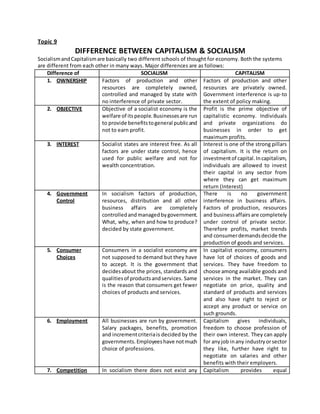
DIFFERENCE BETWEEN CAPITALISM & SOCIALISM
SocialismandCapitalismare basically two different schools of thought for economy. Both the systems
are different from each other in many ways. Major differences are as follows:
Difference of SOCIALISM CAPITALISM
1. OWNERSHIP Factors of production and other
resources are completely owned,
controlled and managed by state with
no interference of private sector.
Factors of production and other
resources are privately owned.
Government interference is up-to
the extent of policy making.
2. OBJECTIVE Objective of a socialist economy is the
welfare of itspeople.Businessesare run
to provide benefitstogeneral publicand
not to earn profit.
Profit is the prime objective of
capitalistic economy. Individuals
and private organizations do
businesses in order to get
maximum profits.
3. INTEREST Socialist states are interest free. As all
factors are under state control, hence
used for public welfare and not for
wealth concentration.
Interest is one of the strong pillars
of capitalism. It is the return on
investmentof capital.Incapitalism,
individuals are allowed to invest
their capital in any sector from
where they can get maximum
return (Interest)
4. Government
Control
In socialism factors of production,
resources, distribution and all other
business affairs are completely
controlledandmanagedbygovernment.
What, why, when and how to produce?
decided by state government.
There is no government
interference in business affairs.
Factors of production, resources
and businessaffairsare completely
under control of private sector.
Therefore profits, market trends
and consumerdemandsdecide the
production of goods and services.
5. Consumer
Choices
Consumers in a socialist economy are
not supposed to demand but they have
to accept. It is the government that
decidesabout the prices, standards and
qualitiesof productsandservices. Same
is the reason that consumers get fewer
choices of products and services.
In capitalist economy, consumers
have lot of choices of goods and
services. They have freedom to
choose among available goods and
services in the market. They can
negotiate on price, quality and
standard of products and services
and also have right to reject or
accept any product or service on
such grounds.
6. Employment All businesses are run by government.
Salary packages, benefits, promotion
and incrementcriteriais decided by the
governments.Employeeshave notmuch
choice of professions.
Capitalism gives individuals,
freedom to choose profession of
their own interest. They can apply
for anyjob inany industryorsector
they like, further have right to
negotiate on salaries and other
benefits with their employers.
7. Competition In socialism there does not exist any Capitalism provides equal
competition, as the only producer of all
goods and services is government. We
can also say that government enjoys
monopoly in a socialist state.
opportunities to all businesses.
Right to produce and right to
purchase make a capitalist
economy competitive.
8. CLASSES The concept of socialism, at large,
eliminates differences of rich and poor
from the society. Mostly goods and
services are produced or manufactured
on the basis of analysis about their
number of consumers. We can say that
almostall goods and services are within
the range of everyone. Similarly, salary
packages of workers at same level in
different organizations are equal.
Due to minimum government
control and freedom of private
sector capitalist economy
generates classes of rich and poor.
More capital investment brings
more return,goodquality products
and services generate more profit,
skilled employees paid more than
un-skilled staff. All such factors
divide the community in upper,
middle and lower classes.
Topic 10
BUSINESS COMBINATION
INTRODUCTION:
From businesscombination we mean combining of two or more business organizations to form a new
business. Such combinations are done due to various reasons, some of them are given below:
1. Organizations want to expand their business resources
2. Organizations want to expand their market
3. National level organizations want to become multi-national organizations
4. Organizationswith small resources or less capabilities want to have shelter of big organizations in
order for their survival.
KINDS OF COMBINATIONS:
Business combination may be of different kinds some of them are given below.
1. Merger
2. Amalgamation
3. Holding companies
4. Subsidiary companies
5. Trust
6. Pool
7. Cartel
8. Syndicates
9. Licensing
1. MERGER:
Merger refers to combination where a firm takes over one or more independent firms in such a
manner that firms taken over lose their separate identity. This can easily be understandable from
following:
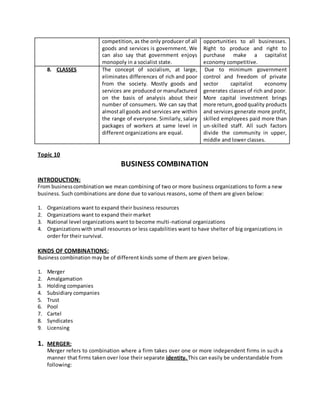
A + b + c = A’
From above equation we can understand that two small companies (b & c) are taken over by a big
company (A). After their combination both small companies lose their existence but company A’s
existence remain the same.
2. AMALGAMATION:
This type of combination takes place where two or more companies combine with each other in
such a manner that all of them loose their entities and form another company with a new name.
Amalgamation can be represented as follows:
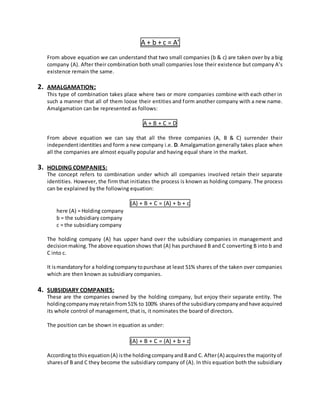
A + B + C = D
From above equation we can say that all the three companies (A, B & C) surrender their
independentidentities and form a new company i.e. D. Amalgamation generally takes place when
all the companies are almost equally popular and having equal share in the market.
3. HOLDING COMPANIES:
The concept refers to combination under which all companies involved retain their separate
identities. However, the firm that initiates the process is known as holding company. The process
can be explained by the following equation:
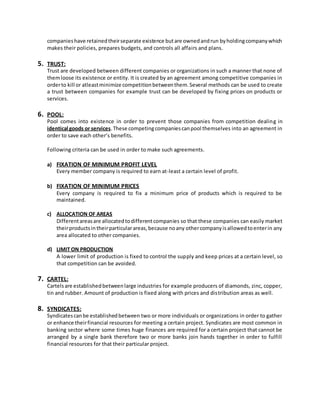
(A) + B + C = (A) + b + c
here (A) = Holding company
b = the subsidiary company
c = the subsidiary company
The holding company (A) has upper hand over the subsidiary companies in management and
decisionmaking.The above equationshows that (A) has purchased B and C converting B into b and
C into c.
It ismandatoryfor a holdingcompanytopurchase at least 51% shares of the taken over companies
which are then known as subsidiary companies.
4. SUBSIDIARY COMPANIES:
These are the companies owned by the holding company, but enjoy their separate entity. The
holdingcompanymayretainfrom51% to 100% sharesof the subsidiarycompanyandhave acquired
its whole control of management, that is, it nominates the board of directors.
The position can be shown in equation as under:
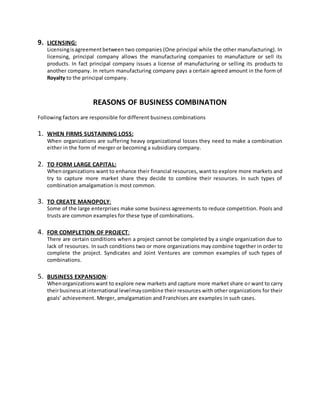
(A) + B + C = (A) + b + c
Accordingto thisequation(A) isthe holdingcompanyandBand C. After(A) acquiresthe majorityof
sharesof B and C they become the subsidiary company of (A). In this equation both the subsidiary
companieshave retainedtheirseparate existence butare ownedandrun byholdingcompanywhich
makes their policies, prepares budgets, and controls all affairs and plans.
5. TRUST:
Trust are developed between different companies or organizations in such a manner that none of
themloose its existence or entity. It is created by an agreement among competitive companies in
orderto kill or atleastminimize competitionbetweenthem.Several methods can be used to create
a trust between companies for example trust can be developed by fixing prices on products or
services.
6. POOL:
Pool comes into existence in order to prevent those companies from competition dealing in
identical goods or services.These competingcompaniescanpool themselves into an agreement in
order to save each other’s benefits.
Following criteria can be used in order to make such agreements.
a) FIXATION OF MINIMUM PROFIT LEVEL
Every member company is required to earn at-least a certain level of profit.
b) FIXATION OF MINIMUM PRICES
Every company is required to fix a minimum price of products which is required to be
maintained.
c) ALLOCATION OF AREAS
Differentareasare allocatedtodifferentcompanies so that these companies can easily market
theirproductsintheirparticularareas,because noany othercompanyisallowedtoenterin any
area allocated to other companies.
d) LIMIT ON PRODUCTION
A lower limit of production is fixed to control the supply and keep prices at a certain level, so
that competition can be avoided.
7. CARTEL:
Cartelsare establishedbetweenlarge industries for example producers of diamonds, zinc, copper,
tin and rubber. Amount of production is fixed along with prices and distribution areas as well.
8. SYNDICATES:
Syndicatescanbe establishedbetween two or more individuals or organizations in order to gather
or enhance theirfinancial resources for meeting a certain project. Syndicates are most common in
banking sector where some times huge finances are required for a certain project that cannot be
arranged by a single bank therefore two or more banks join hands together in order to fulfill
financial resources for that their particular project.
9. LICENSING:
Licensingisagreementbetween two companies (One principal while the other manufacturing). In
licensing, principal company allows the manufacturing companies to manufacture or sell its
products. In fact principal company issues a license of manufacturing or selling its products to
another company. In return manufacturing company pays a certain agreed amount in the form of
Royalty to the principal company.
REASONS OF BUSINESS COMBINATION
Following factors are responsible for different business combinations
1. WHEN FIRMS SUSTAINING LOSS:
When organizations are suffering heavy organizational losses they need to make a combination
either in the form of merger or becoming a subsidiary company.
2. TO FORM LARGE CAPITAL:
Whenorganizations want to enhance their financial resources, want to explore more markets and
try to capture more market share they decide to combine their resources. In such types of
combination amalgamation is most common.
3. TO CREATE MANOPOLY:
Some of the large enterprises make some business agreements to reduce competition. Pools and
trusts are common examples for these type of combinations.
4. FOR COMPLETION OF PROJECT:
There are certain conditions when a project cannot be completed by a single organization due to
lack of resources. In such conditions two or more organizations may combine together in order to
complete the project. Syndicates and Joint Ventures are common examples of such types of
combinations.
5. BUSINESS EXPANSION:
Whenorganizationswant to explore new markets and capture more market share or want to carry
theirbusinessatinternational levelmaycombine their resources with other organizations for their
goals’ achievement. Merger, amalgamation and Franchises are examples in such cases.
Topic 11
MARKETING
DEFINITION:
The term marketing can be defined as follows:
“Marketing is process by which goods and services move from point of production topoint of
consumption.”
OR
“Marketing is a social & managerial process by which individuals & groups obtain what they
need & want through creating, offering, & exchanging products of value with others.”
EXPLANATION:
Marketing is a very important aspect in business since it contributes greatly to the success of the
organization. Production and distribution depend largely on marketing. Marketing is a research based
concept the scope of starts from the idea generation and ends at where product or service reaches to
the end user consumer.
The present era is “Marketing Era.” The marketing concept gives priority to the customer. All the
activities of marketing revolve around one concept i.e. “customer or consumer satisfaction.” Same is
the reason that now it is said that “customer is the king.”
MARKET SEGMENTATION
INTRODUCTION:
It refers to dividing market into various segments or sectors. Segmentation plays an important role in
targeting the right customer and right market even at right time. It is not easy and feasible for any
companyto capture each and everyindividualof acity or country. Every human has his own behaviour,
purchasingpower,testandpreferences. Same as the reason that every organization realizes not try to
make every person its customers because ofcourse it is impossible.
Market segmentationhereplaysanimportantrole asitdividesthe entire market into small sectors and
helps the organizations to make strategies only for their targeted sectors or market.
A market can be segmentised into following categories.
1. GEOGRAPHICAL SEGMENTATION
It refers to dividing the market according to location of the customers. Following can be the main
markets resulting due to this segmentation.
a) Rural: people living in villages.
b) Urban: people living in cities
c) National: people of one country
d) Foreign: people of two or more countries
2. CUSTOMER SEGMENTATION
Here market is divided on the basis of behaviours, ages and purchasing power of customers.
Customers can be segmentised into following main categories.
a) Segmentation by age
b) Segmentation by gender
c) Segmentation by income
3. CULTURAL SEGMENTATION
It refersto dividing the market on the basis of culture of a country, state or province following are
the main types in this segmentation.
a) Segmentation by religion
b) Segmentation by fashion
c) Segmentation by culture
MARKETING MIX
Marketing Mix isa combinationof marketingtoolsthatacompanyusesto satisfytheirtargetcustomers
and achieving organizational goals. Following four are the main components of marketing mix
1. Product
2. Price
3. Place
4. Promotion
These four elements are collectively called 4 P’s of marketing. All these elements are variable i.e.
controllable. Marketers,withthe helpof marketing mix can target different group of customers having
different needs. Some detail of 4 P’s is given below:
PRODUCT:
Product is the actual offeringbythe companyto itstargetedcustomerswhichalso includesvalue added
stuff.Productmaybe tangible (goods)orintangible(services).While formulatingthe marketingstrategy
about a particular product, following questions must be sort out by the organization.
1. What Productto offer?
2. What wouldbe the brand name?
3. What wouldthe Packagingstyle?
4. What wouldbe the Quality?
5. What additional accessoriesare orcan be provided?(Valueadded)
6. What will be the conditionsof aftersale servicesandwarranties?
PRICE:
Price includesthe pricingstrategy of the company for its products. How much customer should pay for
a product? Pricing strategy not only related to the profit margins but also helps in finding target
customers. Pricing decision also influence the choice of marketing channels. Price decisions include:
1. List Price
2. Payment period
3. Discounts
4. Financing
5. Credit terms
PLACE (PLACEMENT):
It not only includes the place where the product is placed, all those activities performed by the
companyto ensure the availabilityof the productto the targetedcustomers. Availability of the product
at the right place, at the right time and in the right quantity are crucial in placement decisions.
Placement decisions include:
1. Distribution channels
2. Logistics (modes of transportations)
3. Inventory
4. Order processing
5. Market coverage
6. Selection of channel members
PROMOTION
Promotion includes all communication and selling activities to persuade future prospects to buy the
product. Promotion decisions include:
1. Advertising
2. MediaTypes
3. Message
4. Salespromotion
5. Personal selling
6. Publicrelations
7. Directmarketing
CONCLUSION:
It always takes time and requires market research to develop a successful marketing mix. Companies
should not depend on one mix but always try new mixes.
PRODUCT LIFE CYCLE
INTRODUCTION
Businessesshouldmanage their products carefully over time to ensure that they deliver products that
continue to meet customer wants. The stages through which individual products develop over the
period of time is commonly known as the "Product Life Cycle".
The classic product life cycle has four stages
1. Introduction
2. Growth;
3. Maturity
4. Decline
1. INTRODUCTION STAGE
At the Introduction(ordevelopment) Stage marketsize and growth is slight. In addition, marketing
costs may be high in order to test the market, undergo launch promotion and set up distribution
channels.Itisdifficultfor companies to make profits at introduction stage of products. Products at
this stage have to be carefully monitored to ensure that they start to grow.
2. GROWTH STAGE
At thisstage the product enjoysrapidgrowthinsalesand profits. Profits arise due to an increase in
output and possibly. At growth stage customers become familiar with the product’s price and
qualitytherefore,companiescanenjoymore profitandoverall marketgrowthatthisstage.Further,
companies invest more on promotional activities in order for more growth of their product at this
stage.
3. MATURITY STAGE
The Maturity Stage is,most commonstage for all markets.Inthisstage competitionismostintensed
as companies fight to maintain their market share. Here, both marketing and finance become key
activities.Marketingstrategieshave tobe monitoredcarefully,since anysignificantmovesare likely
to be copied by competitors.
4. DECLINE STAGE
In the Decline Stage, the market starts shrinking, reducing the overall amount of profit that can be
sharedamongstthe remainingcompetitors.At this stage, great care has to be taken to manage the
productcarefully.Care shouldbe taken to control the amount of stocks of the product. Ultimately,
dependingonwhetherthe product remains profitable, a company may decide to end the product.
Topic 12
CHANNELS OF DISTRIBUTION
1. WHOLESALERS
DEFINITION:
“A marketing or business activity by which goods in bulk quantities are sold to retailers”
OR
“A distributor or middleman who sells usually to retailers or institutions, rather than
consumers”
OR
“A person or firm that buys large quantity of goods from various producers or vendors and
resells to retailers.”
EXPLANATION:
Wholesalersare those middlemen whopurchase goodsinbulkquantityfromproducersandsell themto
retailers after adding some profit. Wholesalers do-not have direct link to end user or final consumer.
These middlemen usually have enough space to stock products same is the reason that they purchase
directlyfromproducersinbulkquantities. Due to bulk purchases producers offer, to them, products at
quiet low prices so that wholesalers add their profit on such products and sell them to retailers.
TYPES OF WHOLESALERS
Following are the main types of wholesalers.
1. MERCHANT WHOLESALERS OR JOBBERS:
These are the wholesalers who buy goods in bulk quantity from producers on their own account.
Therefore, ownership of goods is transferred from producers to such wholesalers. These have
sufficientspace tostore and enoughfundstoinvestinpurchasingof differentproducts.Usuallythey
do nothave expertise inanyone productbuttheysimplypurchase productsandstock them at their
storage houses or warehouses from where they sell them to different retailers.
2. BROKERS:
Brokersare such wholesalers who do-not buy or sell on their own names. They simply bring seller
and buyerat one platformandhelpthemtostrike a deal for whichtheyreceive commissiontermed
as brokerage.The feature that distinctthemfrommerchantwholesalersisthatbrokersdo-notclaim
ownership of the products.
3. REPRESENTATIVE OF MANUFACTURERS:
Such wholesalers do-not work for every producer, but they make contacts with retailers and sell
them products only for their principal company.
4. SPECIALIZED WHOLESALERS:
These wholesalers work for one or some products in bulk quantities, they may be merchant
wholesalers or broker but their field of business is specific such as livestock, petroleum products,
fisheries etc.
SERVICES OF WHOLESALERS- TO PRODUCERS
Wholesalers provide valuable services to producers, some of them are given below.
1. APPROACH TO RETAILERS:
Production itself is a complicated and full time job therefore it is not possible and feasible for
producers to have a direct link with retailers. If they try to do so, it would almost be impossible to
complete the small orders of retailers. Further, producers’ factories are usually not easily
approachable to retailers. Wholesalers help producers as they sit in the market and have a direct
contact to the retailers whether big or small.
2. STORAGE PROBLEM :
Many producers have orders and working capability to produce huge quantity but they restrict
themselvesto small production due to small storage capacity. Wholesalers also prove themselves
helpful for producers, as they have huge space to stock the products.
3. FINANCIAL SUPPORT :
Production is heavily dependent on availability of funds. Production often stops due to funds
shortage. Wholesalers can assist the producers by making advance payments of their orders by
which production cycle do-not stop.
4. SHIFTING OF CREDIT BURDEN:
Trade of any kind is usually done on credit terms. Specially retailers purchase products on credit.
Wholesalers as middlemen take this burden hence provide relief to producers from credits and
recoveries.
5. MARKET INFORMATION:
There is a gap between producers and final consumer because consumers only interact with the
retailers.Therefore,producerscannoteasilyunderstand their consumers’ issues like demands and
complaintsaboutproducts.Wholesalershave directinteractionwiththe retailersinsucha way they
play an important role of giving market feedback to the producers.
SERVICES OF WHOLESALERS- TO RETAILERS
Main advantages retailers can get from wholesale services are given below:
1. CONVENIENT BUYING:
Retailersalwaystrytokeepvarietyof productsat theirstores.Insteadof purchasingbulkquantityof
single product, their inventory stock contains small quantities (usually a dozen or two) of almost
everyorat-leastpopularproductsandbrands.By purchasingfromwholesalers, they can get almost
all varietiesunderone roof. Otherwiseitisimpossible topurchase fromall producersone byone all
overthe country or world.Furthereverymanufacturerpreferstosale hisproductsinbulkquantities
which is not feasible for retailers.
2. ON-TIME DELIVERY :
Wholesalershave readystockof productsintheirwarehouses.Therefore,they can manage on time
deliveryissue of retailers.Evenretailerscanthemselvesapproachthe wholesalersto bring products
at their door.
3. CREDIT FACILTY :
Retailers are small investors and do not have huge amount to run their business. Usually they
purchase productson creditandpay back the amountafter sellingthem to customers. Wholesalers
as big investors understand retailers’ problem and allow them credit purchases for a sufficient
period of time.
4. STORAGE FACILITY:
Retailers do not have sufficient space to store bulk quantities. Their storage problem is solved by
wholesalers as retailers only make purchases when they know their stock is near to be finished.
2. RETAILERS
DEFINITION:
“A person or business that sells goods to consumer under the incentive of profit”
OR
“Retailers are those businessmen that purchase goods in small quantities usually from
wholesalers and sell them to consumers after adding certain amount of profit. ”
EXPLANATION:
Retailers are the middlemen having direct link with consumers. They are usually small investors than
manufacturersorwholesalers.Retailerspurchase small quantitiesof goodsfrom wholesalers or agents,
though sometimes they directly purchase from manufacturers too. Retailers are the last channel to
bridge the gap between producer and consumer.
TYPES OF RETAILERS
Retail businesses can be divided into several kinds some of them are given below:
1. DEPARTMENTAL STORES:
A departmental store is a setup which offers a wide range of products to consumers / end users
under one roof and same is the biggest advantage for consumers. Departmental stores contain
almost every product such as electronic items, garments, toys, books, jewelry, foot-wears, CD’s /
DVD’s etc.
2. SUPER-MARKETS:
Super markets have resemblance in their nature with departmental stores, the distinct feature is
that super markets have wide range of variety related to daily items e.g. food, grocery and other
kitchen items like Flour, Sugar, Cooking Oils, Bakery items, Soaps etc. Concept of super market is
observing a fast growth in Pakistan.
3. DISCOUNT STORES:
These are retail houses that offer products at discount prices to their customers. These may be
departmental stores, super markets or retail stores in any residential area. They usually purchase
large quantitiesof productsforwhichtheygetspecial discountsfromwholesalers or manufacturers
and pass this benefit to their customers.
4. SPECIALITY OR SINGLE PRODUCTS STORES:
Single product stores are those that are specialized in a particular product or brand. Same is the
reason that such stores do-not deal in any other product or brand.
5. COMMON RETAILING SHOPS:
These are the small stores usually run by individuals in nearby locality in order to cater needs of
consumersstayinginthe locality. This is the most common form of retail stores all over the world.
SERVICES OF RETAILERS - TO WHOLESALERS AND PRODUCERS
Retailers provide valuable services to producers and wholesalers, some of them are given below.
1. WIDE DISTRIBUTION:
Retailersare scatteredthroughoutthe city. Without retailers it is impossible for a manufacturer to
distribute andmange salesof itsproductsthroughoutthe cityor country.Similarly,wholesalers can
enjoy more profit by selling the products to large number of retailers.
2. ADVERTISMENT :
Retailersplayanimportantrole in making products popular with consumers. Therefore, producers
enjoy a benefit of free advertisement by making available their products at retail stores.
3. FEED BACK :
Retailershave directlinkwithend-users/consumers,therefore theyplayanimportantrole of giving
feedbackto producersaboutproduct quality, consumer behavior, product complaints etc. Further
they are also helpful in managing the sales promotion activities of different producers like lucky
draws, gifts etc.
SERVICES OF RETAILERS – TO CONSUMERS
Main advantages consumer can get from retail services are given below:
1. EASY APPROACH :
Retailersformtheirbusinessesinornearresidential areassotheseare easilyaccessibletoconsumers.
2. EXCHANGE OF GOODS :
In case of inferior quality or damage products, consumer can easily approach the retailers to
exchange the products with other one.
3. CREDIT FACILTY :
Retailersusuallybelong to same locality of their customers therefore they personally know them.
Same is the reason that customers can avail credit facility from retailers.
4. HOME DELIVERY:
Most retailers offer a free home delivery service to their customers. This service is most common
specially in case of grocery items.
3. TRANSPORTATION
INTRODUCTION:
Transportation isthe backbone of all business activities. It is the source of transferring goods from one
place to another. Therefore, every business whether manufacturing, trading or even service provider
totally depends on transportation. It is transportation that make possible of transferring goods from
pointof productiontopointof consumptioninbothForeignandHome Trades. Business revolution was
impossible without availability of transport.
CHANNELS OF TRANSPORTATION
As there are three routesavailable to travel, same are also the channels of transportation for business
and trade.
1. AIR ROUTES:
With the help of air routes goods are transferred through aero-planes and helicopters. This is the
quickest channel for goods’ transfer and commonly used in foreign trade. However due to quick
service air companies charge high freight rates from businessmen. Therefore it is the most
expensive channel of transportationavailable.Usually it is adopted in case of time issues or export
of perishable items such as fruits, vegetables etc.
2. SEA ROUTES:
Secondchannel istransferringthe goodsisthroughsea.Like air routes, this channel is also used for
foreigntrade.Usingthischannel ismore time consuming as compared to air routes, but the freight
ratesof shippingcompaniesare comparativelyatlow side ascomparedto air freights.Further,ships
have more capacity to carry goods at one time. Same is the reason that most of the exporters
choose sea routes to send their products towards destination.
3. LAND ROUTES:
Land routes are generally used to transfer goods from one place to another within the city or
between two cities. However many companies use this channel for foreign trade, with their
neighborcountries.Thisisthe cheapestamongall the channels. Goods are carried with the help of
trains,trucks,mini trucks,pickupsandbussesfromproducerto consumerwhetherwithinoroutside
the city or evencountry.Anotherchannel of thiscategoryisPipelines as through them utilities like
petroleum, water, gas etc. are transferred from point production to point of consumption.
ADVANTAGES OF TRANSPORTATION
Transportation plays a major role in the economy. It increases the production efficiency and it links to
the logistics system. Vehicle should have some characteristics which are used for easy transport of
goods and services.
Every transport mode has its advantages along with some disadvantages. A business has to choose
amongthe bestavailable optionsconsideringthe elements like time and rates of transportation. Some
advantages and disadvantages of each transportation mode are given below:
1. RAIL:
Advantages:
 Abilityof loadingandunloadinggoodsandservicesismore.
 Frequencyof deliveringthe goodsoverlongdistancesismore.
 Climaticconditionshave noeffect
 No trafficor congestioneasymovementof the vehicle.
Disadvantages:
 Capital andinitial investmentsare more.
 Highmaterial usage forthe constructionandeventhe fuel consumption
 The above are some of the advantagesanddisadvantagesof usingthe rail.
2. ROADS (BUSES & TRAINS):
Advantages:
 Highflexibilityandabilitytomove the vehiclesfast.
 Uses differentroutestoreachthe destinationquickly.
 Doesdoor to doorservice
 Highsafetyfor the cargo.
 Chance to selectthe carrierwhichis suitable forcarryingthe goods.
Disadvantages:
 It mostlydependsonclimaticconditions.
 Highcost for longdistances.
 Productivityislow.
3. AIR:
Advantages:
 Highestspeed
 Evendeliversgoodstoremote places.
 Highreliability
Disadvantages:
 Highestcostof transportation.
 Evenadverse weatherconditionseffectthe transportation.
 Material and fuel consumptioniscostly.
4. WATER (SHIPS):
Advantages:
 It iseconomical mode fortransportingheavyloadsandevencargo.
 It isthe safestmode whichprovidesconvenience tothe peoplewithoutaccidents.
 Cost of constructionandmaintenance isverylow.
 It evenprovidesinternationaltransport
Disadvantages:
 It ishighlyaffectedbythe weatherconditions.
 It requireslarge initial investment
 It isa slowprocess.
Topic 13
RISKS
INTRODUCTION:
Like everywalkoflife,businessesalsofacevariousrisks.Nomatter,whatisthenatureofbusiness, whether
the businessissmallorrunningonlargescaleitalwaysfacesdifferenttypesof risks right from its start day.
In-fact,more risks are involved while establishing a new business as compared to running businesses.
Riskreferstothe chancesof loss,damage or injury.Everybusinesstriestomake full efforts to survive it
from all risk factors through minimizing the chances of loss or damages of any kind.
TYPES OF BUSINESS RISKS
Business risks can mainly be divided into following two types:
1. Insurable risks.
2. Un- Insurable Risks.
3. Other Business Risks
1. INSURABLE RISKS:
Insurable risksare those which can be transferred from one person or group (business) to another
group(usuallyinsurance companies).The process of shifting the risk in such a manner is termed as
insurance of a risk. Insurance does not mean that chance of loss or damage has been totally
controlledoreliminated.However,incase of lossthe insurance companiesacceptthe responsibility
to compensate the same for which they charge some premium usually on annual basis. Loss or
damage of Life,Property,Vehicles, Goods, Goods in transit are some examples of risks that can be
insured.
2. UN-INSURABLE RISKS:
There are several risks a business faces, that cannot be insured. Such risks are un-insurable risks.
Change in market prices and trends, government policies, competition, introduction of new
products, new innovations are some risks that cannot be insured.
3. OTHER BUSINESS RISKS:
Businessriskscanbe of differenttypesandcategories.These maybe insurable or un-insurable. It is
verydifficulttokeep all businessrisksinone category.Thereforebusinessrisksare sub-divided into
several categories. Some important risks are:
i. Marketing Risks
ii. Credit Risks
iii. Equipment Risks
iv. Inventory Risks
v. Government Risks
vi. Fire, Theft and accidental Risks.
(I) MARKETING RISKS:
These risks are involved in marketing for a new product. Even after a product has been
successfully introduced to the market, risks of decline sales and product failure continue to
move with it.
(ii) CREDIT RISKS
Each time a company extended credit to its customer, there is always a danger that the
customer will not pay his bill. On the other hand if a credit manager becomes too careful too
short list his customers who ever made late payments, the company sales will fall down. We
therefore, can say that these risks have to be faced and can’t be avoided.
(iii) EQUIPMENT RISKS
The purchase of special facilities and equipments involve great risks. Risks of theft and fire are
ofcorse butbesidesthese risksthereare some more thatnot onlyun-insurable butalso can’t be
avoided.Forexample the expensiveequipment purchased to produce some new products may
prove use-lessoreventhe sale of productmay notaccording to the company’sexpectationsetc.
(iv) INVENTORY RISKS
Inventoriesare alsoanotherfactordue to which a company faces risks all the time. Shortage or
substandard stock are examples of such risks. Further risks of theft, fire and expiry are always
along with the stored stock.
(v) GOVERNMENT RISKS
Changesinlawsby federal orprovincial governmentsalwayscreate conflictsbetweenthem and
businessmen. Risks like changes in duties, restriction on imports and sometimes exports and
other tax laws have to faced by a businessman.
METHODS OF HANDLING BUSINESS RISKS
INTRODUCTION:
Risks are inherent in business. Some risks have to be assumed while some can be minimized with the
help of different managerial techniques. Important techniques for risks handling are given below:
1. RISKS AVOIDANCE:
Although it is an impractical techniques but sometimes it is helpful to avoid risks by stopping the
workwhichbears a risk.Ofcourse,itisimpossible fora business to stop its business operations but
it may be done when chances of damages or losses become more due to particular condition. For
example,openingabusinessinstrike,lockoutsoranyuncertainsituation of the city can cause great
harm to business property.
2. RISKS REDUCTION:
Unavoidable risks can be minimized or reduced by taking safety measures. This technique is used
mainly in areas like establishment of employees’ safety programme, Use of proper safety for
equipments, fire fighting systems and security guards etc.
3. SELF INSURANCE :
It referstosettingupa separate fundbycompaniesasa back up tocompensate anybusinesslossor
damage.Self insurance doesnoteliminate risks,itsonlyprovidesameanof covering losses. Further
it is only affordable by large business organizations.
4. BUSINESS FLEXIBILITY:
Many risks face by a business are due to changes coming in technology, education and production
methods. Organizations can reduce such risks by keeping them flexible with the changes
circumstances through adaptation of new production methods and technologies.
5. SHIFITNG REDUCTION:
The most commonly used method is to transfer the risk to a professional risk taker i.e. “insurance
company.” Anorganizationcanshiftitsbusiness risks to such companies against payment of a pre-
agreedfee termed as premium either lump-sum or in installments. In case of loss or damage or at
expiry of policy, insurance companies are bounded to compensate / return pre-agreed amount to
the person who purchased insurance policy.
INSURANCE COMPANIES
INSURANCE COMPANIES:
These companies can bear the risks of loss or damage of any kind on life and other assets. A common
man can shift his life and / or business risks to such companies against payment of a pre-agreed fee
termedas premium eitherlump-sumorininstallments.In case of loss or damage or at expiry of policy,
insurance companies are bounded to compensate / return pre-agreed amount to the person who
purchased insurance policy.
Personwhopurchase insurance policyof anykind is known as insured. Whereas the company to which
risk is shifted i.e. insurance company is termed as insurer.
TYPES OF INSURABLE RISKS / INSURANCE
Insurance are of following types:
1. Life Insurance
2. Accident Insurance
3. PropertyInsurance.
4. Marine or Goodsintransit Insurance
1. LIFE INSURANCE:
Every person cares about future of his family- children and relatives after his death. Several
insurance companies insured lives of people against premium. As in Pakistan we have State Life
Insurance Corporationthatpurelyworksfor lives insurance. Business of such insurance companies
reliesonthe lawof averages.Insurance companiesworkoutthe premiumonthe basisof numberof
insured persons and their respective ages. The premium demand by insurance company is
dependentonthe agesof the people.Insuredwithlowerage isaskedfor small amount of premium
or vice versa. Life insurance is again divided into three main categories:
(a) TERM LIFE INSURANCE:
It isinsurance fora certainperiodof time. It can be from 3 years to 20 years. The insured has to
pay amount of premium up-to the agreed time period. After completing the time period the
total (pre-agreed) amount of policy is paid to the insured by insurance company. However, if
insuredexpires,duringthe periodthe amountof policywillbe paidbyinsurance companyto his
nominees (usually family members) without asking any additional premium from them.
(b) ORDINARY LIFE INSURANCE:
Thisinsurance isnot limiteduptocertainperiod.Rather,insuredhastopay amountof premium
throughout his life. Amount of premium varies from person to person and is decided on the
basis of ages of the insured persons. Other terms and conditions in ordinary life insurance are
same as in term life insurance.
(c) LIMITED PAYMENT LIFE INSURANCE:
In limited life insurance, premium is paid by the insured up-to a certain (pre-agreed) time
period.The amountof policy,however,ispaidbythe insurance company after the death of the
insured whether he dies during the period when he is paying the premium or after.
2. PERSONAL ACCIDENT INSURANCE:
Accident cannot be prevented. No one has idea about the loss or damage he suffers due to any
accident. Loss may be in the form of death, partial or complete disablement. Further no one has
ideathat disabilitywill be of permanentortemporarynature.Accidentriskscanalsobe insuredwith
insurance companies.A premiumisdecidedtobe paidbythe insured,amount of which varies from
policytopolicy.The insurance company,inreturn, commits to pay policy amount, depending upon
the loss caused due to accident.
3. PROPERTY INSURANCE:
Property/FixedAssetscanbe damaged either completely or partially. Hence same can be insured
on basisof premium payment to the insurance companies. Property insurance can be of following
types:
(a) FIRE INSURANCE:
All typesof buildingse.g.houses,factories,mills,showroomsetc.carryfire risks with them. Fire
riskof buildingscanbe transferred to insurance companies for a period of time usually 2 years
to 5 years. A certain amount of premium is to be paid to insurance companies the amount of
which depends upon the age and construction of the building.
(b) CASUALTY INSURANCE:
Risks of theft, loss, damages or robbery are always present with properties like equipments,
machineries and vehicles etc. Such risks are also transferrable to insurance companies for an
agreed period usually 3 years to 5 years.
4. MARINE INSURANCE:
Riskslike accident, theftandfire etc.are alwayspresent,whiletransferringgoodsfrom one place to
another.Suchrisksare insuredbyofferingmarine insurance policies to insured. A premium is paid
to insurance companies for the period when goods remain in transit. In case of any loss during
transitionof goods,insurance companycompensatesthe same otherwiseagreement,automatically,
finished if goods safely reach at their destination. Marine insurance are sub-divided into two
categories.
(a) OCEAN MARINE INSURANCE:
This is the insurance commonly used in foreign trade i.e. when goods are moving from one
country to another through sea.
(b) INLAND MARINE INSURANCE:
Thisis the insurance when goods are moving within the cities of same country by roads, trains
or even rivers.
Topic 14
HUMAN RESOURCES MANAGEMENT
INTRODUCTION:
Staffing is the process that starts from hiring of staff and ends at finishing of service tenure. However
there are several more activities between these two for example salary disbursement, promotions,
increments,transferand postingsetc.Same is the reason that staffing process has taken an important
place inevery organizationandnowitis consideredasone of the important jobs of a manager. Almost
every organization is now managing a separate Human Resources Department for this purpose, same
department is responsible to perform activities related to the staff or employees.
Some important staffing activities are:
(i) Determinationof needs
(ii) SelectionandRecruitment
(iii) OrientationandTraining
(iv) Performance Appraisal
(v) Compensation
(vi) Promotion
(vii) Seperation
(i) DETERMINATION OF NEEDS:
Effective managementfirstdeterminesthe needof staff before it makes decision to hire. Once
needsare determined it becomes easy for management to select candidates that are suitable
for jobs.Furtherthis steps also saves time and over staffing in any organization. Needs can be
determined through various methods some of these are given below.
a) CAMPARISON METHOD
Jobis determinedthroughcomparisonfromotherorganizationsserving the same industry.
b) JOB FACTOR METHOD
Jobis determinedbyanalysingthe importance anddifficulties to be faced by an employee.
c) TIME SPAN METHOD
Job is determined through analysing total required time for its completion.
d) ORGANIZATON CHART METHOD
This method is most common in formal organizations, here jobs are determined through
organizational chart. We can also say that jobs at top level in any organizational hierarchy
are considered as more crucial than jobs at middle or low level.
(ii) SELECTION AND RECRUITMENT:
Once the needsare determined,recruitingstarts.Recruitingreferstoinviting applications from
prospective candidates. Further, once the application has been received they are screened
(selected) accordingtothe company’srequirements.Interviewsandtestsof eligible candidates
are also a part of these steps.
(iii) ORIENTATION AND TRAINING:
One of the important activity in this regard is orientation and training of selected staff.
Orientationreferstogivinganintroductionof organizationtoselectedcandidates. It covers the
history, present situation and future plans of any organizations. Orientation also provides an
idea to selected staff about their future scope in that organization along with chances of
growth, promotions and increments on good performance.
Training,however,isanon goingprocess required to make staff compatible with the changing
circumstancesandtechnologiesinanyorganizations.Same isthe reasonthatorganizationswith
broadervisionalwaysconsidertrainingas a source of success not only for their employees but
the whole organization.
(iv) PERFORMANCE APPRAISAL:
It refersto measuring the performance of managers as well as other staff members. The main
objective of thisstepistomake workerstorealize theirfaults andalsotokeepthemonthe way
of objectives. Further performance appraisal work as a tool to reward the eligible candidates
hence works as a tool for positive competition.
(v) COMPENSATION:
It refers to the reward for the service one has to perform. People should be paid according to
theirperformance.A salaryincrease,bonusesandotherfringe benefitsare the partof this step.
(vi) PROMOTION:
Promotionisupwardtransferof bringingthe suitable candidate.Itnotonlyresultsinincrease in
salary but also in the status of selected candidates.
(vii) SEPARATION:
It referstoendingof service tenure of anycandidate fromthe organization.Separationnotonly
meant as firing of the employee but it can be in different forms. Some common methods of
separation are as follows:
a) RESIGNATION:
It refers to employee’s separation on his own discretion.
b) LAY OFF:
It isthe processwhenorganizationstemporarilydiscontinue the servicesof theiremployees
due to reasons like economic condition or end of service contract etc.
c) RETIREMENT:
Here employee isseparatedashe reachedat a certainlevel of age.Differentorganizationsmayhave
different age standards for retirement. In Pakistan however, retirement age is sixty years for
men and fifty eight years for women.
d) TERMINATION:
It refers to employee’s separation due to his act against organizational procedures and
rules. It is involuntary permanent separation from the organization for any reason.
WAGES AND WAGE PLANS
INTRODUCTION:
Wages are the payment made to person(s) against work done or duties performed by them. It is the
rewardof productive work.Wagescanbe in differentformse.g.salary,bonuses,commissionsandother
fringe benefits.
METHODS OF PAYMENT:
Following are the most common methods of wages payment.
1. StraightSalary
2. Time Wages
3. Piece – Rate payment
4. ShiftPremium
5. Bonus
6. ProfitSharingplan
7. DearnessAllowance
8. Overtime
9. Commission.
1. STRAIGHT SALARY:
It isusuallya pre- decidedfixedamountpaidonapre-determinedperiodi.e onmonthly,weaklyand
fortnightly basis. In Pakistan salaries are usually paid on monthly basis whereas in UK and USA
weakly payment of salaries is in general practice.
2. TIME WAGES:
Thismethodisusedto make paymentasper agreedrate of a periodof time e.g.hourlyordailyrate.
Usually this method of payment is used for labors. For example if a person works for a total 10
hoursand itspay rate isRs. 20/- per hourthen total amount of payment would be (10X20=Rs. 200).
3. PIECE – RATE METHOD:
This method is also common in manufacturing companies where usually payment is made on the
basis of per unit produced by the staff. For example a person produced total 30 pieces of any
product with a pay rate of Rs. 10/- per piece then amount of payment would be (10 X 30= 300).
4. SHIFT PREMIUM:
It isan additional amountpaidonlyto employees working in odd timings or shifts. There are many
companies working 24 hours a day. Such companies pay additional amount in the form of shift
premium to their employees working in night shifts.
5. BONUS :
These are the extra or additional amount paid to the workers on certain occassions. For example
several companies in muslim countries like Pakistan pay bonuses on Eid occassions. Further large
organizations announce may also bonuses on annual or half basis to their employees as well.
6. PROFIT SHARING:
In order to maintain better employer- employee relations some companies may also offer some
share of profit to their employees. This may enhance the working of workers. Sometimes public
limited companies offer shares to those employees who performed well throughout the year.
7. DEARNESS ALLOWANCE:
It refers to the temporary adjustment in the pay of employee. It is often done by government
organizations as they grant this allowance for a short period instead of permanent increas in the
pay.
8. COMMISSION :
It iscommon speciallyforsalespersons.Inordertoenhance theirsales,companies often announce
commissiononpiece sale of eachproduct.Sometimes companies also announce extra commission
to staff who made sale above their targets.

ITB Handout B.Com-I

  • 1.
    Topic 1 IMPORTANT DEFINITIONS 1.BUSINESS - DEFINITION: Businessorganizationscanbe definedinseveral ways.Givenbelow are few definitions of business. “An organization engaged in producing or trading goods and services to the society under the incentive of private gain.” OR “Business organizations are those, producing / manufacturing or trading goods and / or services in order to make profit” OR “An institution organized and operated to provide goods and services to the society under the incentive of private gain” EXPLANATION: From above definitionswe canconclude that business comprises all those activities that start from manufacturingof goods or services and end on their consumption. Point or place where goods are manufacturedistermedas pointof production and where these goodsare consumediscalled point of consumption. However, generally, there is a big gap between points of production and consumptiontherefore several channelsare used to fill this gap known as channels of distribution. Middle men like wholesalers and retailers are some examples of distribution channels. Organizationsorindividualsinvolve inanyof these activitiesare consideredtobe apart of business. Profit earning is the basic and prime objective of all business activities. BUSINESS PROCESS 2. INDUSTRY DEFINITION: Term industry can be defined as follows “Any business activity which results in the creation of goods and services” OR “Industry refers to all business activities, which are connected with raising, producing and processing of goods and services.” Point of production Wholesaler Retailer Point of consumption Distribution Channels
  • 2.
    EXPLANATION: From above definitionswecansaythat industriesare manufacturingunits. They produce goods and services.Industries,throughmanufacturingprocess,change shapesandqualitiesof existing productsto modifiedform.Some industriesconvert raw material into semi-finished goods like cotton (rawmaterial) isusedtoproduce cloth(semi- finished good). However, some industries convertsemi- finishedgoodsintofinished goods as Shirt (finished good) is manufactured from cloth (semi- finished good). 3. COMMERCE DEFINITON: Commerce can be defined as follows: “Commerce includes all those activities which facilitate transfer of goods and services from one place to an-other." OR “It is the sum of total activities involving the removal of hindrances in the process of exchange of goods and services and facilitates the availability for consumption or use.” EXPLANATION: Goods are produced or manufactured for consumption or use. Goods or services are manufacturedbyindustriesbutthese are of nouse until theyreach to their target customers or consumers.Commerce,therefore,coversall activitiesof makingthese goodsavailable foruse to their consumers. a) TRADE: It is the exchange of goods or services of some worth between two persons or organizations. b) AUXILIARIES TO TRADE: These are differentmodes,means or channels that facilitate the processof trade.Transportation, Warehousing, Insurance and Banking are main auxiliaries to trade. 4. TRADE DEFINITION: Trade can be defined as: “Trade is the exchange of goods or services of some worth between two persons or organizations”. OR “Trade is the exchange i.e. buying and selling of goods or services”. EXPLANATION: Trade means buying and selling of goods or services, usually on regular basis. The person or organizationthatpurchasesgoodsor services for further sale in order to make profit is termed as trader. Presence of boththe activities i.e. buying and selling is compulsory in order to make trade possible. Trade can be further divided into following two types: 1. Home Trade. 2. ForeignTrade.
  • 3.
    a) HOME TRADE: Tradewithinthe countryis termedas home trade. This process involves exchange (buying and selling)of goodsandservices within one city or even from one city to another of same country. It is very often, that goods are directly supplied from producer to consumer, but several medium are involved in this process. As producers sale their products to wholesalers,fromwhole sellers products are purchased by retailers and finally consumers buy these products from retailers. When wholesalers purchased goods from producers, trade is termed as whole sale trade and retailers purchase goods from wholesalers it is called retail trade. b) FOREIGN TRADE: Trade betweentwocountriesistermedasforeigntrade. We can say that in a foreign trade, buyer belongs to one country while seller to another. Buyer, in foreign trade is called importer while seller is termed as exporter. Foreign trade can be of following types: (i) IMPORT TRADE: When goods are purchased from a foreign country for selling in our own country, trade will be import trade. (ii) EXPORT TRADE: When goods are sold to a foreign country, it is called export trade. (iii) ENTREPOT TRADE: Sometimesgoodsare importedintoone countryforthe purpose of exporting them to another country with or without making any change. Such type of foreign trade is termed as entrepot trade. 5. AUXILIARIES / AIDS TO TRADE INTRODUCTION: Trade is not a simple process. Usually there is a big gap between producer and customer. In many cases goods are produced in one city and their wholesaler belongs to another city. Similarly if a retailer wants to carry goods from wholesaler’s outlet to his shop he must need transportin orderto fulfillthisobjective.Therefore,there are manyactivitiesthat help, support and facilitate the trade process. All such activities are termed as auxiliaries or aids to trade. Given below are some important auxiliaries to trade: (a) TRANSPORTATION: Transport is considered as a backbone for trade success. Transport is required to move goods from one place to another for example producer to wholesaler or retailer to consumer.Forhome trade,tradersuse trucks, huge trawlers,vans,pickupsortrains inorder to move products within the city or even from one city to another. Similarly, in foreign trade, these are ships and aero-planes that move goods from one country to another. (b) BANKING: Banking sector helps the trade process in many ways. Not only they sanction loans to traders in order to give their financial support but banks are also safe, easy and fast channels of funds transfer from bank to bank, city to city or even from one country to another. Banks also facilitate foreign traders with the services like discounting bill of exchange, opening of L/Cs, and issuance of E-forms etc.
  • 4.
    (c) INSURANCE: Not anybusiness or trade is free from risks. Whether it is production, transporting or storage of goods,chancesof loss,damages,theftandfire etc. are present with them. Every trader, of-course, wants to minimize these risks. Insurance companies play an important role in this regard as they come forward to bear such risks. They commit to compensate trader in case of loss or damage of his goods in return of receiving premium from traders. (d) WARE HOUSING: Warehouses solve the storage problem of traders. Especially those traders, importers or exporters who do not have sufficient space to store their products, can store with such warehouses by paying them some rent. These warehouses contain almost all facilities in order to keep product secure like safety from sun, wind or rain, cold storage facility and security etc. (e) COMMUNICATION / INFORMATION: Informationisthe keytosuccess.A traderneedsdifferentsortof informationfromboth the suppliersaswell hiscustomers.Informationfromsuppliers’side, relates to enquiries about products,prices,delivery time, new models etc. Whereas from customers, a trader always seeksfeedbacks about his products, sometimes he may also receive some complaints and he has to quote prices to his customers. All such information can be received and sent throughvariouscommunicationmeanslike telephone, faxes, telegrams, letters and emails etc. 6. SCOPE OF BUSINESS INTRODUCTION: Business is a broader term and it covers all activities done for the sake of profit. Following activities or functions fall under the scope of business: 1. PRODUCTION: Businessprocessstartswithplanningforproduction.Productionisconvertingraw materials into semi- finished or finished products. Business organizations involve in production are termed as industries. Industries can be divided into various types depending upon the nature of work. Every manufacturing business strives to maintain quality, standard and grades of its products so that it can get maximum profits. 2. TRADE: Trade isexchange (buyingandsellingof goods orservices).Productionisof-course done for consumption.We cansay that withoutconsumptionof anyproductorservice itsproduction is useless. Trade is the process of moving goods or services from point of production to point of consumption either directly or gradually.
  • 5.
    From direct trade,it means, when consumer of product directly purchase the goods from manufacturer. However direct trade is very often, because goods, gradually reach to consumer or end-user from producer. As wholesaler purchases goods from producer, retailer fromwhole sellerandfromretailergoodsare purchased byconsumer.Trade can be withinthe country,termedashome trade and trade betweentwocountriesiscalledforeign trade. 3. AUXILIARIES TO TRADE: (Concern previous topic) CONCLUSION: “Every production needs consumption”. All channels or activities making this idea possible under the incentive of private gain come under the scope of business. Topic 2 PROBLEMS IN ESTABLISHING A BUSINESS HOUSE INTRODUCTION: Establishing and running any business, in this competitive era, is not an easy task. It requires lot of researchwork,surveysandanalysisinordertoestablishabusiness.Givenbeloware some major points an organization must deal with while starting its operation. 1. SELECTION OF TYPE OF THE BUSINESS: First of all, a businessman has to decide the type of his business. We can say that, he should selectamongstmanufacturing,tradingorservice businesses. This selection would be based on his knowledge, interest and experience. At this stage, the businessman must also analyze the demand of his product(s) or service(s). Further, he should do a proper working about the profitability of his business. In short, proper research and feasibilities must be made while starting a new business. 2. FORM OF BUSINESS: There are several choices available as far as form of business organization is concerned. A businessman can go in for Sole Proprietorship, Partnership of Joint Stock Company. The selectionisbasedoncertainelementslike sizeof businessorganization(small, medium or large scale), financial needs, management and controlling issues and future expansion plans of business etc. For example, a small retail shop can be opened and run by an individual but multinational or national level businesses are usually in form of corporations. 3. FINANCING: Finance is the life blood of every business. No business activity can be started without arrangement of funds. For example, while starting a business businessman has to purchase building, land, furniture, machinery and equipment etc. Further finance is needed in order to meetday-to–daybusiness issues as making payments to suppliers, paying salaries to staff and purchasing merchandise or other assets etc. Funds can be arranged either by owner(s) themselves in the form of capital or businesses can also borrow the required amount from financial institutionslike banksoncertainrate of interest.Financial resources depend upon the size of the business.
  • 6.
    4. LOCATION: Location ofthe business is also an issue that should be carefully handled by a business man. Suitable businesslocationisalwayseasytoapproachbyall means.Locationdependsuponmany factors like availabilityof rawmaterial andotheraccessories,transport,manpower, nearness to marketand basic necessities like water, power and gas etc. Selection of a suitable location for business always increases profitability and decreases cost of doing. 5. SUITABLE MANPOWER: Employeesare the resourcesof business,businesssuccessorfailure is heavily dependent upon its employees. Selection of a right person for a right job is another issue a businessman has to deal with. Specially at the time of starting a business, the businessman has not only to find suitable candidates but also has to motivate them for joining the setup. He must analyze the number of staff (labors, semi-skilled and skilled) his business is required. Further salary and remunerationpackage mustbe inaccordance withjobassignments,knowledge,andexperience and market trends. 6. MACHINES AND EQUIPMENT: The choice of machineriesandequipmentsisalsoanotherdelicate problemwhile startinganew business. Although, this issue is of great concern for manufacturing businesses but trading enterprises also have to purchase certain machines or equipments like Photostat, Generators and AirConditioners etc. Availability of funds and size of business are major considerations in thisregard,however,repairandmaintenance facilities,availabilityof spare partsand after sales service are also important factors while purchasing a machine or equipment. 7. COMPETITION: A businessman has to keep an eye on his competitors. Specially, while establishing a new businesshe mustanalyze the numberof competitors already working in the market. Important factors inthisregardwouldbe theirproductsqualityandstandards, prices, discounts and other benefitstheyoffertocustomers.The analysiswill helpinsetting-up the right prices and quality of product(s). Further, it will also help the businessman to know whether his products can compete with the market or not. 8. FUTURE SCOPE: Good businesses always work for future. In this competitive era, it is almost impossible for a business to survive without having a vision for growth. A businessman, therefore, must also analyze the future prospects of his business. He must choose such products and services that not only have a continuous but also increasing demand in market. 9. GOVERNMENT POLICIES: Every business in bounded by the laws and policies of the government. A businessman must thoroughly read and understand the laws, policies and rules and regulations defined by the government. Main factors would be taxes, import and export duties, policies related to advances and rebates and different quotas etc.
  • 7.
    Topic 3 SOLE PROPRIETORSHIP DEFINITION: Soleproprietorship business can be defined as follows: “The business owned by a single owner, who is referred as sole proprietor” OR “A business structure in which an individual and his/her company are considered a single entity for tax and liability purposes” EXPLANATION: Sole proprietorship business is owned by single person called “owner” or “proprietor.” The owner, in sole proprietorship,doesnot pay income tax separately for the company, but he/she reports business income or losses on his/her individual income tax return. As owner is inseparable from the sole proprietorship,sohe/she solelyenjoys all the profits of his business. On the other hand owner in such type of businesses is solely liable for all the losses and debts as well. Sole proprietorshipbusinessesare veryeasytoform anddo not require much legal formalities. Same is the reason that huge number of businesses are running under this form of organization not only in Pakistan but throughout the world. MERITS OF SOLE PROPRIETORSHIP Following are the advantages of a sole proprietorship business. 1. OWNERSHIP OF ALL PROFITS: Businessisownedbyasingle persontherefore the profits whether big or small are enjoyed by the proprietor. As the only owner, he is not required to share any of his profits amount with others. 2. EASY FORMATION: The formationof sole proprietorship business is very easy and simple. No legal formalities are involved for setting up the business excepting a license or permission in certain cases. The entrepreneur with initiative and certain amount of capital can set up such form of business. 3. PROMPTNESS IN DECISION-MAKING: Whenthe decisionistobe takenbyone person,itis sure to be quick.Thus,the entrepreneur as sole proprietor can arrive at quick decisions concerning the business by which he can take the advantage of any better opportunities.
  • 8.
    4. SECRECY: Each andeveryaspectof the businessislookedafterbythe proprietorand the business secrets are known to him only. He has no legal obligation to publish his accounts or share the information with others. Thus, the maintenance of adequate secrecy leaves no scope to his competitors to be aware of the business secrets. 5. FLEXIBILITY IN OPERATIONS: The sole proprietorship business is undertaken on a small scale. If any change is required in business operations, it is easy and quick to bring the changes. 6. INEXPENSIVE FORMATION AND MANAGEMENT: The managementof the businessisalsoinexpensive asnospecialists are normally appointed in various functional areas of the business which is an added advantage. 7. FREE FROM GOVERNMENT CONTROL: Sole proprietorshipisthe leastregulatedformof business.Regulatedlawsare almost negligible in its formation, day-to-day operation and dissolution as well. 8. EASY DISSOLUTION: Like that of formation, the dissolution of the sole proprietorship is also very easy. Since the proprietoristhe supreme authorityandnoregulationsare applicable forclosure of the business he can dissolve his business any time he likes. DE-MERITS OF SOLE PROPRIETORSHIP Following are the disadvantages of a sole proprietorship business. 1. LIMITED RESOURCES: The financial resources of any small entrepreneur as an individual are limited. He mainly financesfromhisownsavingsorborrowsfrom financial institutions,friendsandrelatives as per his capacity. Thus, limited resource is the major drawback of this form of business. 2. LIMITED MANAGERIAL CAPABILITY: Modern business requires updated managerial skills in each and every sphere of activity. We cannot hope a single individual to possess all the managerial talents necessary to carry on a business efficiently. 3. UNLIMITED LIABILITY: Since the liabilityof the sole proprietorisunlimited,the private properties of the proprietor are also at risk. Because if business fails, owner himself is required to pay-off his business debts even by utilizing his private properties. Thus, the entrepreneur must have to look this aspect carefully.
  • 9.
    4. UNCERTAINTY OFCONTINUITY: The continuity of the businessisuncertainbecausethe businessmaycome to an end due to the incapacityor deathof the proprietor.Evenif at all the business passes on to the successor(s) of the proprietor, it is unlikely that they may possess same abilities like that of the proprietor. 5. NOT SUITABLE FOR LARGE SCALE BUSINESS: The limited financial resources, limited managerial capability of the proprietor, risk to the private propertyetc.make the sole proprietorshipbusinessunsuitable for large-scale business. This system of business is not affordable for large-scale operation. 6. LIMITIED OPPORTUINITIES FOR EMPLOYEES: Sole proprietorshipbusinessdoesnotoffercareeropportunitiestoitsemployees because of its limitationof size.Mostlyemployeesinsuchtype of businessesworkatlowerlevel management. Topic 4 PARTNERSHIP DEFINITION: Partnership business can be defined as follows: “An association of two or more persons to carry on as co-owners a business for profit.” OR “A relation between persons who have agreed to share the profits of a business carried out by all or any of them acting for all.” EXPLANATION: Partnershipisbasicallyarelationshipbetween two or more persons who join hands to form a business organizationwiththe objective of earningprofit.These personsare individuallyknownas ‘Partners’ and their business is collectively known as ‘Firm’. The partners provide necessary capital, run the business jointly and share the responsibility. A ‘partnershipagreement’or‘partnershipdeed’ismade withmutual understanding of all the partners at the time of start of the business clearly explaining clauses like: (i) Amount of capital to be contributed by each partner (ii) Profit and loss sharing ratio of each partner and (iii) Management issues in partnership business etc.
  • 10.
    MERITS OF PARTNERSHIP Followingare the advantages of a partnership business. 1. EASY FORMATION: Like sole proprietorship,the partnershipbusinesscanbe formedeasilywithoutanylegal formalities. It is not necessary to get the firm registered. A simple agreement, either oral or in writing, is sufficient to create a partnership firm. 2. AVAILABILITY OF LARGE RESOURCES: Since two or more partners join hand to start partnership business it may be possible to pool more resourcesascomparedto sole proprietorship.The partnerscancontribute more capital, more effort and also more time for the business. 3. BETTER DECISION: The partners are the owners of the business. Each of them has equal right to participate in the managementof the business.Incase of any conflicttheycansit togethertosolve the problems.Since all partners participate in decision-making, there is less scope for reckless and hasty decisions. 4. FLEXIBILITY IN OPERATIONS: The partnershipfirmisa flexible organization.Atanytime the partnerscandecide to change the size and nature of the business or area of its operation. There is no need to follow any legal procedure. Only the consent of all the partners is required. 5. RISK SHARING: In a partnership firm risk of loss, damages or any uncertain situation is always shared by all the partnersas pertheiragreement.Therefore,apartnershipbusinessdoesnotgive complete burden of risk on an individual as in sole proprietorship business. 6. PROTECTION OF INTEREST OF EACH PARTNER: In a partnershipfirmeverypartner has an equal say in decision making. If any decision goes against the interest of any partner he can prevent the decision from being taken. In extreme cases a dissenting partner may withdraw himself from the business and can dissolve it. 7. BENEFITS OF SPECIALIZATION: Since all the partners are owners of the business they can actively participate in every aspect of business as per their specialization and knowledge. For example two or more doctors may start a clinicinpartnership.Similarlyinalegal consultancy(partnership)firmone partnermaydeal withcivil cases, one in criminal cases, and another in labor cases and so on as per their specialization.
  • 11.
    DE-MERITS OF PARTNERSHIP Followingare the disadvantages of a partnership business. 1. UN-LIMITED LIABILITIES: All the partnersare jointlyaswell asseparatelyliable for the debt of the firm to an unlimited extent. Thus,theycan share the liabilityamongthemselvesorany one can be asked to pay all the debts even from his personal properties. 2. UNCERTAIN LIFE: The partnershipfirmhasno legal entityseparate fromitspartners.Itcomesto an end with the death, insolvency,incapacityorthe retirementof anypartner.Further, any dissenting member can also give notice at any time for dissolution of partnership. 3. LACK OF HARMONY: In partnership firm every partner has an equal right to participate in the management. Also every partnercan place his or heropinionor viewpointbeforethe managementregardinganymatter at any time. Because of this sometimes there is a possibility of conflict among the partners. Difference of opinion may lead to closure of the business on many occasions. 4. LIMITED CAPITAL: Since the total number of partners cannot exceed by 20, the capital to be raised is always limited. It may not be possible to start a very large business in partnership form. 5. NO TRANSFERABILTY OF SHARES: Anypartneris notallowedtotransferhisor hershare of interesttooutsiderswithout mutual consent of otherpartners.Thiscreatesinconvenience for the partner who wants to leave the firm or sell part of his share to others. RIGHTS AND DUTIES OF PARTNERS RIGHTS: Partnershave certainrightsovertheirbusinesses.Mainrightsare givenbelow. 1. Right of the partner to take part inthe day-to-daymanagementof the firm. 2. Right to be consultedandheardwhile takinganydecisionregardingthe business. 3. Right of access to booksof accounts andcall forthe copyof the same. 4. Right to share the profitsequallyorasagreeduponby the partners. 5. Right to getinterestoncapital contributedbyhimtothe firm. 6. Right to avail interestonadvancespaidbythe partnersforbusinesspurpose. 7. Right to the use of partnershippropertyexclusivelyforpartnershipbusinessonlynothimself. 8. Right as agentof the firmandimpliedauthoritytobindthe firmforanyact done incarryingthe business. 9. Right to preventadmissionof newpartners. 10.Right to retire withthe consentof otherpartnersandaccordingto the terms-andconditionsof deed.
  • 12.
    DUTIES / RESPONSIBILITIES: Onotherhanda partnerisalsoliable orresponsibletowardshisfirm.Maindutiesorresponsibilitiesof a partneras follows: 1. TO CARRY ON THE BUSINESS TO THE GREATEST COMMON ADVANTAGE: Every partner is bound to carry on the business of the firm to the greatest common advantage. In other words, the partner must use his knowledge and skill in the conduct of business to secure maximum benefits for the firm. 2. TO RENDER TRUE ACCOUNTS: Everypartnermust rendertrue andproperaccounts to hisco-partners.Each andeveryentryinthe booksmustbe supportedbyvouchersandexplanationsif demandedbyotherpartners. 3. TO PERFORM HIS DUTIES: Everypartneris boundto attenddiligentlytodutiesinthe conductof the businessof the firm. 4. TO HOLD AND USE PARTNERSHIP PROPERTY EXCLUSIVELY FOR THE FIRM: The partnersmust holdanduse the partnershippropertyexclusivelyforthe purpose of businessand not fortheirpersonal benefit. 5. NOT TO CARRY ON ANY COMPETING BUSINESS: A partnermustnot carry oncompetingbusinesstothatof the firm.If he carrieson andearns any profitthen he mustaccount forthe profitmade and pay itto the firm. 6. TO SHARE LOSSES: It is the duty of the partners to bear the losses of the firm. Partners share the losses equally when there is no agreement otherwise, as per their profit share ratio. 7. TO ACT WITHIN AUTHORITY: Every partner is bound to act within the scope of his authority. If he exceeds his authority and the firm suffers from any loss, he will have to compensate the same. DISSOLUTION OF PARTNERSHIP Under the following conditions a partnership firm stands dissolved: 1. ADMISSION OF A NEW PARTNER: In case of admission of new partner(s), the old partnership has to be dissolved and a new agreement is required to be made. 2. RETIREMENT OF AN EXISTING PARTNER: In case of retirementof anexistingpartner the old partnership stands dissolved. However, the firm may continue its operations in case of mutual agreement of other existing partners.
  • 13.
    3. DEATH OFA PARTNER: Deathof a partneralso bringsthe partnershipto an end. If other partners want to continue the business, they make a new agreement for their partnership. 4. INSOLVENCY OR BANKRUPTCY OF AN EXISTING PARNTER: If partner isdeclaredbankrupt,the partnershipwill turn dissolved. Remaining partners have to make a new agreement in order to continue their partnership business. 5. CRIME CONVICTION BY AN EXISTING PARTNER: If a partner is convicted of crime or declared guilty by the court of law, he cannot enter in any kind of agreement or run any business, therefore conviction in any kind of crime will automatically dissolved the partnership business. 6. EXPIRY OF PARTNERSHIP PERIOD: In some cases partnership agreement is made for a definite period. Such partnerships automaticallydissolveattheirperiodof expiry.However,atthe will of partners, the agreement can be renewed for future. Topic 5 JOINT STOCK COMPANIES DFINITION: Joint Stock Company can be defined as follows: “An artificial being, intangible, invisible but existing in contemplation by law.” OR “A company is an artificial person created by law, having a separate legal entity with perpetual succession and a common seal.” EXPLANATION: A company form of business organization is known as a Joint Stock Company. It is a voluntary associationof personswhogenerallycontribute capital tocarryon a particulartype of business,whichis establishedbylawand can be dissolvedonlyby law. Personswho contribute capital become members of the company. This form of business has a legal existence separate from its members, which means membersmaycome and go butthe companyremainsinexistence. This form of business organizations generallyrequireshuge capital investment, which is contributed by its members. The total capital of a joint stock company is called share capital and it is divided into a number of units called shares. Thus, every member has some shares in the business depending upon the amount of capital contributed by him. Hence, members are also called shareholders.
  • 14.
    FEATURES OF COMPANY Followingare the main features of a Joint Stock Company: 1. LEGAL FORMATION: A joint stock company is formed only by completing several legal formalities. It always comes into existence when it has been registered after completion of all formalities required by the country’s law. As in Pakistan companies are formed and governed under companies’ ordinance of 1984. 2. ARTIFICIAL PERSON: A company is always considered as an artificial person as it establishes with its own entity and can enter in any agreement like any individual. However, it is called an artificial person as its birth, existence and death are regulated by law and it does not possess physical attributes like that of a normal person. 3. SEPERATE LEGAL ENTITY: Being an artificial person, a joint stock company has its own separate existence independent of its members. It means that a joint stock company can own property, enter into contracts and conduct any lawful business in its own name. It can sue and can be sued by others in the court of law. 4. COMMON SEAL: A jointstock company has a seal, which is used while dealing with others or entering into contracts with outsiders. It is called a common seal as it can be used by any officer at any level of the organizationworkingon behalf of the company. Any document, on which the company's seal is put and is duly signed by any official of the company, become binding on the company. 5. PERPETUAL EXISTENCE: A jointstockcompanycontinuestoexistaslongas it fulfillsthe requirementsof law.Itisnot affected by the death, insolvency or retirement of any of its members. Members may come in and go out throughbuyingandsellingof shares(usuallytermedastransferof shares) without affecting working of the company. 6. LIMITED LIABILITY: In a jointstockcompany,the liabilityof amemberislimitedtothe extentof the value of shares held by him. While repaying debts, for example, if a person owns 1000 shares of Rs. 10 each, then he is liable only upto Rs 10,000 towards payment of debts. Therefore, even if there is liquidation of the company, the personal property of the shareholder cannot be attached and he will lose only his shares worth Rs. 10,000.
  • 15.
    MEMORANDUM OF ASSOCIATION INTRODUCTION: Memorandumof association is the fundamental charter which defines the aims and objectives of a company.It contains fundamental rule regarding the constitution and the activities of a company. It is the most significant document on which the super-structure of the company is raised. It sets out the limits with in which the company may function and defines the relations of the company with the outside world. Any action beyond the scope of the memorandum of association is void. The following are the main clauses of the memorandum of association: 1. NAME CLAUSE: Thisclause containsthe name of the company. The word limited is used after the name of a public limitedcompanyandprivate limited is used after the name of a private company. The name of the company should not be identical to the name of an existing company. The words like Royal, King, Emperor and Federal may not be used without prior permission of the government. 2. OBJECT CLAUSE: Thisis an importantclause of the memorandum of association which states the objects with which the companyhas beenestablished.Anyactionbeyondthe statedobjective isillegal therefore great care has to be taken in drawing up this clause. It is better to keep broad objective of a company along with subsidiary objectives. 3. DOMICILE CLAUSE: Thisclause statesthe place at whichthe registeredofficewillbe situated. It is advisable to mention the name of province or state in order to avoid legal formalities in shifting the registered office of the company.Domicile clause isvital fordeterminationof jurisdictionof the court for legal matters. 4. CAPITAL CLAUSE: Thisclause statesthe amountof authorizedcapital withwhichacompanyisregistered.The division of share capital intodifferentsharesmustbe statedinthe capital clause.The face value of the share will be stated in this clause. This clause gives an idea of exact capital structure of the company. 5. LIABILITY CLAUSE: This clause states that the liability of the shareholders is limited to the extent of the face value of shares purchased by them. Further, it also means that the liability of the company to pay-off its debts is limited to its capital. This clause protects personal properties and belongings of shareholders from settling the debts of company.
  • 16.
    ARTICLES OF ASSOCIATION INTRODUCTION: Itisa documentinwhichrulesandregulationsare written which govern the internal administration of the company.It definesthe powersandrightsof the directors, officers and shareholders. The article of association are framed and registered to settle the daily affairs of the company. It is subsidiary of Memorandum of Association. No any rule can be framed which against the Memorandum of Association. CONTENTS OF ARTICLE OF ASSOCIATION Following are the main clauses of article of association. 1. Amount of capital and its division into various shares. 2. Rights regarding the different shareholders. 3. Rules regarding transfer of shares. 4. Rules regarding issue of shares and debentures. 5. Calls on shares. 6. Appointment of directors powers and duties. 7. Alteration of capital. 8. The functions and powers of managing agent. 9. Proceeding of disposing of resolution. 10. Accounts and audit. 11. Stamp of a company. 12. Voting rights of shareholders. 13. Winding up procedure of company. 14. Rules regarding the forfeiture and surrender of shares. 15. Proceeding of shareholders meeting. 16. Proceeding of Board of Directors meetings. 17. Change of shares into stock and stock into shares. FORMATION OF A COMPANY INTRODUCTION: Incorporation of a company is a complicated and time consuming procedure. Following are the main steps in order to form a company. 1. GETTING PROMOTERS: Promotersare the foundersof a company.Therefore they must get together in order to design the work plan, objective and skeleton of the company. A public limited company may have at-least seven promoters while the minimum number of promoters required to form a private limited company is two. 2. APPOINTMENT OF ADVISORS: In secondstep a legal advisor is hired by the promoters. The advisor helps them in preparing legal documentslike article andmemorandumof association, prospectus or statement in its lieu etc. He further deals with the office of the registrar for company registration.
  • 17.
    3. PREPRATION OFCOMPANY’S DOCUMENTS: According to the companies’ ordinance 1984, certain documents are required to be prepared in order to get a legal status of the company. Important documents in this regard are i. Memorandum of Association ii. Article of Association iii. Prospectus of the company 4. SUBMITTING APPLICATION TO THE REGISTRAR: After completion of all necessary documents an application is submitted to the registrar office in orderto get registrationof the company.The application(along-with the documents mentioned in step3) alsocontainsdetailslike name andaddressesof company’s directors and name and address of the registered office of the company etc. 5. PAYMENT OF REGISTRATION FEE: A registration fee is also required to be paid along-with application form. The fee amount is not fixed and always depends upon the share capital of the company. Greater the amount of capital higher will be the registration fee. 6. PRINTING SHARE CERTIFICATE: Duringthe processof registrationthe promoterstrytogetshare certificates of their company to be printed. These certificates are issued to the shareholders as a token of their ownership in the company. 7. ISSUANCE OF REGISTRATION CERTIFICATE: Aftera thoroughexaminationandanalysis a registration certificate is issued by the registrar of the company, after the issuance of which the company gets a legal status. We can also say that before getting a registration certificate no any company can start its business operation. It isalso importanttonote that a private limitedcompanycanimmediately start its business affairs after getting the registration certificate, however a public limited company cannot commence its operation at this stage unless it gets another certificate known as commencement certificate. 8. PUBLICATION OF PROSPECTUS: ( Only for Public Limited Companies) On receipt of registration certificate the company issues prospectus to general public (through advertisement). The prospectus helps the company in raising the desired capital amount from the public. 9. APPLICATION FOR COMMENCEMENT CERTIFICATE: (only for Public Limited Companies) After raising capital through prospectus the company applies for commencement certificate. The commencement certificate allows the company to begin its actual operations.
  • 18.
    PROSPECTUS A prospectus isan invitation or advertisement of a public limited company to general public asking themto investinthe share capital of the company.Prospectusis required to be circulated (through advertisement) bypubliclimitedcompanies. Without its publication a company is unable to gather its desired share capital hence, cannot get the commencement certificate to start its business affairs. It isimportantto note that prospectusisnotcompulsoryfora private limitedcompanyas it does not raise its capital from general public. Similarly, public limited companies arranging their share capital privately are not required to publish their prospectus. VALIDITY / ESSENTIALS OF PROSPECTUS: A legally valid prospectus must fulfill the following conditions. i. Invites general public to buy shares. ii. Its copy must be submitted to registrar office before its publication. iii. It must be properly dated. iv. It must be signed by all or at-least two directors of the company. FEATURES OF PROSPECTUS: Following are the salient features of a prospectus. i. It contains the content of memorandum of association ii. It contains the total number of shares and promoters of the company. iii. Number of redeemable shares. iv. Qualifications shares of directors v. The name of underwriters of shares. vi. Description of companies’ directors. vii. Allotment, installments and forfeiture of shares. viii. Preliminary Expenses ix. Promoters’ Fees x. Name and address of auditors. xi. Minimum subscription of shares xii. Nature of debentures and their underwriters xiii. Name and date of contract relating to company’s property. STATEMENT IN LIEU OF PROSPECTUS Private limited companies and Public limited companies (arranging their share capital from private sources and not from general public) are not required to publish company’s prospectus. Therefore, in accordance withcompanies’lawtheyare onlyrequiredto submit to the registrar a statement in lieu of prospectus. This statement should include same information as of prospectus and is required to be submitted at-least three days prior to the issuance of shares or bonds.
  • 19.
    Topic 6 SOCIALISM DEFINITION: “An economicsystem or theory underwhich means of production and distribution work for community as a whole.” OR “Economic system under which means of production and distribution are held under collective ownership in public interest.” EXPLANATION: Socialismisalsotermedasbusiness under public ownership. Under socialism production of goods and servicesare organized in order to fulfill human needs and not to earn profits. Socialist economies are state ownedwhere all factorsof productionsare owned,controlledandmanagedby state government. Socialist states are not profit oriented but these are welfare states. Hence socialism encourages state control, dependence, spending and bureaucracy while discourages private ownership, profit and individual responsibilities. SOCIALISM – CHARACTERISTICS Following are the main characteristics of socialism: 1. GOVERNMENT CONTROL: All factors of production related to goods and services are controlled by government. Heavy industries,utilitiesservices(water,powerandgasetc.),financial institutionsandeducationalsectors etc.are completelycontrolledbygovernment.Government,asperstate requirementsutilize factors of production in the manner it finds best. 2. INTEREST FREE ECONOMY: Socialismisbasedonpublicwelfare,therefore,socialisteconomiesare interest free. Resources and wealthare supposedtobe distributed on the basis of equality in general public and interest is the factor that results in wealth concentration in hands of some people, hence it is discouraged in socialism. 3. CLASSLESS SOCIETY: The concept of socialism,atlarge, eliminates differences of rich and poor from the society. Mostly goods and services are produced or manufactured on the basis of analysis about their number of consumers. We can say that in a socialist economy, almost all goods and services are within the range of everyone. 4. CONTROLLED ECONOMY: Besides having control over factors of production, government in a broader aspect also controls trade and auxiliaries to trade of the country because of which government has complete control overentire country’seconomy.Inasocialisteconomyitisthe governmentthatdecidesaboutprices of commodities, rates of services and even salaries of employees.
  • 20.
    5. EMPLOYMENT FORALL: Beinga welfare state, a socialist economy guarantees compulsory employment to every citizen of state. All men and women get employment in state run organizations based on their capabilities, skillsandknowledge.Hence we cansaythat ina complete socialisteconomy,un-employment does not exist at all. 6. SERVICE ORIENTED FOR PEOPLE: As businesses are run by government for welfare of its citizens, socialist economies themselves become service oriented. Government offers services and goods to consumers at moderate and affordable prices. Same is the reason, that government sometimes runs few of its organizations even at losses but does not windup such businesses in public interest. SOCIALISM – ADVANTAGES Following are the main advantages of socialism: 1. WELFARE STATE: A socialist state is also termed as welfare state. Factors of production, resources of country and other business affairs are utilized for general public welfare and not to earn profits. Government offers,goodstoconsumersat moderate andaffordable prices.Further,service providingsectorslike education, utilities, hospitals, rail and air ways etc. are also under government control, which sometimes runs few of its organizations even at losses but does not windup such businesses for welfare of its public. 2. INTEREST FREE ECONOMY: Due to interest factor wealth and other resources start going into the hands of few people of the state. Further interest is one of the major causes of inflation in the society. A socialist economic system is based on the concept of public welfare through equal distribution of wealth and resources, hence it completely discourages interest. 3. CLASS LESS SOCIETY: The concept of socialism,atlarge, eliminates differences of rich and poor from the society. Mostly goods and services are produced or manufactured on the basis of analysis about their number of consumers.Thisfactoris beneficial as all goods and services are within the range of everyone, life style people isalmostsame,chancesof robberyandtheftare minimizedanddiscriminating factor is eliminated from the society. 4. CONTROLLED PRICES: Due to complete governmentcontrol overthe economy,pricesof goodsandservicesremainstable. Thus profitmakingisnotthe objective of businessesinasocialist state the government fixes prices in favor of consumers by which they purchase commodities and avail services at low rates.
  • 21.
    5. LESS WASTAGEOF RESOURCES: Factors of production and resources of a socialist state are used, controlled and managed by the governmentwhich doesnotuse these resourcesforprofitmaking.Allocation of all the resources in productive mannerisbasedongovernmentanalysisand research. Same is the reason that wastage or misuse is supposed to be at its minimum level in a socialist economy. 6. EMPLOYMENT FOR ALL: Beinga welfare state,asocialisteconomyguarantees compulsory employment to every its citizen. All menandwomengetemploymentinstate runorganizationsbasedontheircapabilities,skills and knowledge.Hence we cansaythat in a complete socialisteconomy, un-employment does not exist at all. SOCIALISM – DISADVANTAGES A socialist economy has following major disadvantages: 1. ABSENCE OF PRIVATE OWNERSHIP: Everyindividualmusthave righttouse hispersonal resourcesasperhischoice.Private ownership is basedon profitandrevenue generation. In a socialist state concept of private ownership does-not exist. All resources are owned by government. Every individual has to surrender his resources (if any) to government and has no right to use it as per his choice. Absence of private ownership eliminates the profit generation factor from the society by which individual’s interest in business affairs go down. 2. NO CONSUMER CHOICES: Consumers in a socialist state are not supposed to demand but they have to accept. Production of goodsand servicesare controlled by government. Further it is the government that decides about prices, rates, standards and qualities of goods and services. Not any individual or organization is allowed to enter in any sort of business. Same is the reasons that consumers do-not have much choice of products or services. 3. LESS CHOICES OF PROFESSION: Due to complete control of government over all business activities, people get fewer professional choices. As there is no private sector, people can only apply for jobs in industries run by government.Itisthe government that decides about matters like job assignments, salaries, fringe benefits,promotionsandincrementsetc.Therefore employees, mostly, have no right to negotiate on their salaries and other matters. 4. LOW MORALEOF PEOPLE: It isthe responsibilityof state to provide employment to every citizen. Government usually has its own criteria of salary fixation, promotion and increment. Usually increments and promotions are given on seniority basis instead of performance or worth abilities. The factors bring morale of employeesatverylowside.Onthe otherhand, compulsory employment and permanent nature of job usually decrease job interest and increase factors like absenteeism and late comings in employees.
  • 22.
    5. BUREAUCRATIC CULTURE: Management,in a socialist economy is based on rule and not on objective. Every matter goes throughprocessdesignedbythe government.Further top management of organizations is directly transferred or appointed by government hence sometimes is un-experienced about organization matters.It isusuallyobservedthatmostlygovernmentemployeestake least interest in betterment of corporation same is the reason that several government owned organizations show losses of millions of rupees every year. 6. CORRUPTION: Socialist economies lead to increase corruption in their country. Most government employees indulge in corruption, inefficiency and fudged accounts. 7. SLOW ECONOMIC GROWTH: Absence of factorslike private ownership,competition,profitmakingandinterest of employees to- wards their job assignments slow down the economic growth of the country. Organizations in socialist economies hardly move towards updating themselves with new technologies and other changes. Topic 7 CAPITALISM DEFINITION: “An economic system or theory in which all means of production and distribution work under private ownership with incentive of private gain or profit.” OR “An economic system in which means of production and distribution are privately or corporately owned and development is proportionate to the accumulation and reinvestment of profits in a free market.” EXPLANATION: In a capitalistic economy, businesses are run under private owner with the incentive of private gains. There isno or verylittle involvementof state governmentinbusinessaffairs,usuallyup-tothe extent of policy making. Factors of production and resources remain under private ownership. Profit earning is the key factor of economical growth in a capitalist economy. More profits lead to more investment which ultimately results in economic growth of the country.
  • 23.
    CAPITALISM – CHARACTERISTICS Followingare the main characteristics of capitalism: 1. PRIVATE OWNERSHIP: In a capitalisteconomyfactorsof productionsare owned,managedandcontrolledbyprivate sector. Individualsororganizations are free to run their businesses and use their resources in the manner they like. Government does not interfere in any legal use of resources like land, capital or labor. Similarly, the fourth factor i.e. entrepreneur is also free to start, own and run any legitimate business in a capitalist economy. 2. PROFIT ORIENTED ECONOMY: Profitisthe mainmotivating factorof a capitalisteconomy.Businessesunderprivate ownership are establishedandrunforprofits.Everybusinessman,afterpayingall taxes,dutiesandliabilitiesisfree to use hisprofitinthe mannerhe likes.We can say that, entrepreneurs are free to use their profits either for their personal use, savings or reinvesting in their businesses. 3. INTERST BASED ECONOMY: Interestisone of the strong pillarsof capitalism.Itisreferredasreturnoninvestmentanownergets on his capital. Investor is free to use his capital in any sector to get maximum rate of return. The return on investment can be, again, freely use by the owner. 4. ECONOMY OF CLASSES: Due to minimum government control and freedom of private sector capitalist economy generates classes of rich and poor. More capital investment brings more return, good quality products and servicesgenerate more profit,experiencedandskilledemployees get more salaries and benefits as compared to in-experienced and unskilled staff. All such factors divide the community in upper, middle and lower classes. 5. FREEDOM TO CHOOSE: In a capitalist economy, variety of products and services are available for consumers. Hence, consumers are not only free to choose any of the available products or services but they can also negotiate ontheirprices. Further, consumers also have right either to accept or reject any product on basis of its price, quality or standards. 6. FREEDOM OF PROFESSION: A capitalist economy provides open opportunities of professions to the whole community. Employers are free in selection for suitable candidates. Similarly employees and workers can also searchjobsof theirowninterest.Furtheremployeesare alsofree to negotiate on their salaries and other fringe benefits with their employers.
  • 24.
    CAPITALISM – ADVANTAGES Followingare the main advantages of capitalism: 1. PROFIT OREINTED ECONOMY: Profitisthe basic objective of privateownership. Businessmen invest more and work hard in order to earnmore profits.Thisfactorresultsinbusiness expansion and growth which is not only fruitful for businessmen but also creates employment opportunities and faster the economic growth as well. 2. CONSUMER FREEDOM: In capitalisteconomy, consumers have lot of choices of goods and services. They have freedom to choose amongthe available goods and services in the market. They can negotiate on price, quality and standard of products and services and have right to reject or accept any product or service on such grounds.Insimple wordswe can say that ina capitalisteconomyconsumeristhe king. Same is the reasonthat businesseswork hard for maintain good quality and standard of their products and services in order to satisfy their consumers 3. FREEDOM OF PROFESSIONS: Capitalism also gives individuals, freedom to choose professions of their own interest. They can applyfor any job in any industry or sector they like, further have right to negotiate on salaries and otherbenefitswiththeiremployers.It is obvious that employees work whole heartedly if they get jobs of their interest which ultimately results in business and so economic growth. Similarly, employers also have right to search and select candidates according to their requirements. 4. COMPETITION: Capitalismprovidesequalopportunitiestoall businessmen.Businessesthatworkhard and maintain good standards will earn more profits. This makes the business environment competitive and consumers get better quality products at good price levels. 5. USE OF TECHNOLOGY: Producers in order to satisfy their customers and get more market share keep themselves busy in introducing new products in the market which needs a lot of research and analysis. Same is the reason that science and technology is used in the best possible way in a capitalist economy. 6. FASTER ECONOMIC GROWTH: In a capitalisteconomy,privateownershipandprofitabilityincreases interest of individuals in their businesses. Further investors try to invest their capital as they have chance to get return on their investments.Similarlyemployeesandworkersworkwithfull devotion as their professional growth isdependentupontheirperformance.Due tosuchfactors capitalisteconomies bring fast economic growth in country.
  • 25.
    CAPITALISM – DISADVANTAGES Followingare the disadvantages of capitalism: 1. ECONOMY OF CLASSES: Due to minimum government control and freedom of private sector capitalist economy generates classesof rich andpoor. Same factor creates class conflicts of rich and poor. Rich people can afford luxurious goodsandservicesbutpoor cannot. Same is the reason that complexity and jealousy are common elements in a capitalistic society. 2. INTEREST FACTOR: Interestisone of the strong pillars of capitalism. Due to interest factor wealth and other resources start goingintothe handsof fewpeople of the state. Further interest is one of the major causes of inflationinthe society.Due tointerestfactor rich become richer and poor become poorer. Interest is also ‘Haram’ from Islamic point of view. 3. RISK FACTOR: Business activities are always full of risk. The risks may be in form of loss, fire, theft, natural calamities,competitionetc.Individual orbusinessorganizationsare notstrongenoughtoabsorb big risksand losses.Asaresultof whichsometimesentrepreneurshave towinduptheirbusinesses due to losses and other risks. 4. MISUSE OF RESOURCES: In a capitalisteconomy,individualsare free to use their resources. Same is the reason that chances of misuse increase inacapitalism.People investonlyinthose sectorsthatprovide maximum profits and returns. Further funds and resources are used freely in order to get maximum customers e.g. businessmenuse huge amount for advertising and other marketing strategies in order to compete with their rivals. 5. LACK OF SOCIAL ETHICS AND NORMS: Businesses in capitalist economy do not care about social ethics and norms. In order to generate profit unethical business practices are usually observed in capitalist economy like casinos and lotteries etc. Topic 8 MIXED ECONOMY DEFINITION: “It is an economy with co-existence of both private sector and a degree of state monopoly in some sectors” OR “Mixed economies are those where means of production are shared between private and public sector”
  • 26.
    EXPLANATION: Mixed economy, alsotermed as dual economy, is a moderate system consisting characteristics of two other economic systems viz. capitalism and socialism. Pure capitalismhasitsdemeritslikecomplete holdof private sectoroverfactors of production, thirst of maximizing profits and un-controllable prices etc. Socialism, on other hand gives no choices to consumersandemployees,observesslow economic growth and increases chances of corruption in the country. Mixed economy therefore is a moderate way to run country’s economy. It is an economic systemthatcontainsadvantageouscharacteristicsof bothcapitalismandsocialismwhile ignoresall such factors thatcan be harmful toeconomy.Due to itsmoderate nature,manycountrieshave implemented mixed economy as their economic system. Pakistan is one of the countries where mixed economic system has been followed. MIXED ECONOMY- CHARACTERISITCS Following are the characteristics of mixed economy: 1. DUAL OWNERSHIP: Ownership of business resources, in a mixed economy, is held in both sectors. (i) Public Sector (Ownership of Government) (ii) Private Sector (i) OWNER SHIP OF PUBLIC SECTOR Industriesof basicnecessitiesof goodsandservicesare ownedbygovernment,further government usuallydoes-notpermitprivatesectortoenterinsuchbusinesses. These industries usually include infrastructure andutilitiesserviceslike water,gasandpoweretc.Due to complete control oversuch industries,governmentdirectlycontrolsprices or rates of such products and services to keep them within the range of general public. Sui-Southern, Sui- Northern gas corporations and Water and Power Development Authority (WAPDA) are examples of government owned sectors in Pakistan. (ii) OWNER SHIP OF PUBLIC SECTOR Howeverindividualsandprivate organizationsare alsoallowedforbusinessactivitiesinall other permissible sectors. Private sector has right to enter in any permissible business under the prime objective of profit. Further individuals are also allowed to invest their capital in any sectorin orderto getmaximumreturn.Justlike capitalism, businesses can decide the prices of theirproductsand services,however inorder to keep prices stable, government can also enter inany businessalongwith private sector.Forexample inPakistan,UtilityStoresare government owned departmental stores that offer products at low prices than market. Similarly there are several private organizationsproducingsteel productsin our country but Pakistan Steel Mills (a government owned organization) is also working in Pakistan in steel sector. 2. DUAL OBJECTIVE: In a mixedeconomicsystem,publicsectororganizationswork for welfare of general public and not to earn profit. Same is the reason that government runs some of its enterprises even at loss but does not wind them up for benefits of general public. Pakistan International Airlines, Pakistan Railways and Pakistan Steel Mills are the biggest examples of such enterprises in our country.
  • 27.
    On other hand,private sector of mixed economic system works with the prime objective of maximizing its profit. Goods and services are produced, as per consumers’ demands. Good quality products and services observe more sales hence generate more profit for the business. 3. GOVERNMENT CONTROL OVER PRIVATE SECTOR: In orderto deal withissueslikegoodqualityandstable pricesof productsandservicesgovernment, inmixedeconomy system, also keeps a check and balance in business affairs of private sector and several regulatoryauthoritiesworktoachieve thisobjective.PakistanStandardsandQualityControl Authority (PSQCA), Oil and Gas Regulatory Authority (OGRA) and Pakistan Electronic Media Regulatory Authority (PEMRA) are some examples of such organizations in Pakistan. Defining and implementing policies and rules about standards and quality of products and services is the prime objective of suchorganizations.Furthergovernmenthasrightto take legal actionto businesses that do not follow government policies. 4. PLANNED ECONOMY: Like socialism, mixed economies are also based on long run. Usually countries make their policies and regulations in order to achieve long run objectives. The long run planning may be for ten to twentyyearsbutgovernment,usuallyineverycountry,iselectedforfiveyears,therefore five years plan is common in this regard. 5. CONSUMER FREEDOM: Having involvement of private sector in business, consumers in mixed economy get variety of products and services available in the market. Further, they have right to negotiate on prices and have rightto accept or rejectany productor service due toitsprice,qualityorstandards. The added advantage ina mixedeconomyisthatconsumer can also launch complaints (if any) about products and services to government authorities for legal action. 6. FREEDOM OF PROFESSION: Mixedeconomy does not guarantee confirm employment however various fields and professions are available inbothpublicandprivate sectorswhere people are free toapply.Publicsectorsjobare usually of permanent nature where salary package, bonus, increment and other benefits are decided and announced by government. Further promotions in government owned organizations are generally given on seniority basis. On other hand, people may search jobs in private sector as well where they have freedom to negotiate their salaries, bonuses and other benefits. Jobs in private sectors are performance orientedandemployees’promotions,increments and even job continuity is heavily dependent on their performance.
  • 28.
    Topic 9 DIFFERENCE BETWEENCAPITALISM & SOCIALISM SocialismandCapitalismare basically two different schools of thought for economy. Both the systems are different from each other in many ways. Major differences are as follows: Difference of SOCIALISM CAPITALISM 1. OWNERSHIP Factors of production and other resources are completely owned, controlled and managed by state with no interference of private sector. Factors of production and other resources are privately owned. Government interference is up-to the extent of policy making. 2. OBJECTIVE Objective of a socialist economy is the welfare of itspeople.Businessesare run to provide benefitstogeneral publicand not to earn profit. Profit is the prime objective of capitalistic economy. Individuals and private organizations do businesses in order to get maximum profits. 3. INTEREST Socialist states are interest free. As all factors are under state control, hence used for public welfare and not for wealth concentration. Interest is one of the strong pillars of capitalism. It is the return on investmentof capital.Incapitalism, individuals are allowed to invest their capital in any sector from where they can get maximum return (Interest) 4. Government Control In socialism factors of production, resources, distribution and all other business affairs are completely controlledandmanagedbygovernment. What, why, when and how to produce? decided by state government. There is no government interference in business affairs. Factors of production, resources and businessaffairsare completely under control of private sector. Therefore profits, market trends and consumerdemandsdecide the production of goods and services. 5. Consumer Choices Consumers in a socialist economy are not supposed to demand but they have to accept. It is the government that decidesabout the prices, standards and qualitiesof productsandservices. Same is the reason that consumers get fewer choices of products and services. In capitalist economy, consumers have lot of choices of goods and services. They have freedom to choose among available goods and services in the market. They can negotiate on price, quality and standard of products and services and also have right to reject or accept any product or service on such grounds. 6. Employment All businesses are run by government. Salary packages, benefits, promotion and incrementcriteriais decided by the governments.Employeeshave notmuch choice of professions. Capitalism gives individuals, freedom to choose profession of their own interest. They can apply for anyjob inany industryorsector they like, further have right to negotiate on salaries and other benefits with their employers. 7. Competition In socialism there does not exist any Capitalism provides equal
  • 29.
    competition, as theonly producer of all goods and services is government. We can also say that government enjoys monopoly in a socialist state. opportunities to all businesses. Right to produce and right to purchase make a capitalist economy competitive. 8. CLASSES The concept of socialism, at large, eliminates differences of rich and poor from the society. Mostly goods and services are produced or manufactured on the basis of analysis about their number of consumers. We can say that almostall goods and services are within the range of everyone. Similarly, salary packages of workers at same level in different organizations are equal. Due to minimum government control and freedom of private sector capitalist economy generates classes of rich and poor. More capital investment brings more return,goodquality products and services generate more profit, skilled employees paid more than un-skilled staff. All such factors divide the community in upper, middle and lower classes. Topic 10 BUSINESS COMBINATION INTRODUCTION: From businesscombination we mean combining of two or more business organizations to form a new business. Such combinations are done due to various reasons, some of them are given below: 1. Organizations want to expand their business resources 2. Organizations want to expand their market 3. National level organizations want to become multi-national organizations 4. Organizationswith small resources or less capabilities want to have shelter of big organizations in order for their survival. KINDS OF COMBINATIONS: Business combination may be of different kinds some of them are given below. 1. Merger 2. Amalgamation 3. Holding companies 4. Subsidiary companies 5. Trust 6. Pool 7. Cartel 8. Syndicates 9. Licensing 1. MERGER: Merger refers to combination where a firm takes over one or more independent firms in such a manner that firms taken over lose their separate identity. This can easily be understandable from following:
  • 30.
    A + b+ c = A’ From above equation we can understand that two small companies (b & c) are taken over by a big company (A). After their combination both small companies lose their existence but company A’s existence remain the same. 2. AMALGAMATION: This type of combination takes place where two or more companies combine with each other in such a manner that all of them loose their entities and form another company with a new name. Amalgamation can be represented as follows: A + B + C = D From above equation we can say that all the three companies (A, B & C) surrender their independentidentities and form a new company i.e. D. Amalgamation generally takes place when all the companies are almost equally popular and having equal share in the market. 3. HOLDING COMPANIES: The concept refers to combination under which all companies involved retain their separate identities. However, the firm that initiates the process is known as holding company. The process can be explained by the following equation: (A) + B + C = (A) + b + c here (A) = Holding company b = the subsidiary company c = the subsidiary company The holding company (A) has upper hand over the subsidiary companies in management and decisionmaking.The above equationshows that (A) has purchased B and C converting B into b and C into c. It ismandatoryfor a holdingcompanytopurchase at least 51% shares of the taken over companies which are then known as subsidiary companies. 4. SUBSIDIARY COMPANIES: These are the companies owned by the holding company, but enjoy their separate entity. The holdingcompanymayretainfrom51% to 100% sharesof the subsidiarycompanyandhave acquired its whole control of management, that is, it nominates the board of directors. The position can be shown in equation as under: (A) + B + C = (A) + b + c Accordingto thisequation(A) isthe holdingcompanyandBand C. After(A) acquiresthe majorityof sharesof B and C they become the subsidiary company of (A). In this equation both the subsidiary
  • 31.
    companieshave retainedtheirseparate existencebutare ownedandrun byholdingcompanywhich makes their policies, prepares budgets, and controls all affairs and plans. 5. TRUST: Trust are developed between different companies or organizations in such a manner that none of themloose its existence or entity. It is created by an agreement among competitive companies in orderto kill or atleastminimize competitionbetweenthem.Several methods can be used to create a trust between companies for example trust can be developed by fixing prices on products or services. 6. POOL: Pool comes into existence in order to prevent those companies from competition dealing in identical goods or services.These competingcompaniescanpool themselves into an agreement in order to save each other’s benefits. Following criteria can be used in order to make such agreements. a) FIXATION OF MINIMUM PROFIT LEVEL Every member company is required to earn at-least a certain level of profit. b) FIXATION OF MINIMUM PRICES Every company is required to fix a minimum price of products which is required to be maintained. c) ALLOCATION OF AREAS Differentareasare allocatedtodifferentcompanies so that these companies can easily market theirproductsintheirparticularareas,because noany othercompanyisallowedtoenterin any area allocated to other companies. d) LIMIT ON PRODUCTION A lower limit of production is fixed to control the supply and keep prices at a certain level, so that competition can be avoided. 7. CARTEL: Cartelsare establishedbetweenlarge industries for example producers of diamonds, zinc, copper, tin and rubber. Amount of production is fixed along with prices and distribution areas as well. 8. SYNDICATES: Syndicatescanbe establishedbetween two or more individuals or organizations in order to gather or enhance theirfinancial resources for meeting a certain project. Syndicates are most common in banking sector where some times huge finances are required for a certain project that cannot be arranged by a single bank therefore two or more banks join hands together in order to fulfill financial resources for that their particular project.
  • 32.
    9. LICENSING: Licensingisagreementbetween twocompanies (One principal while the other manufacturing). In licensing, principal company allows the manufacturing companies to manufacture or sell its products. In fact principal company issues a license of manufacturing or selling its products to another company. In return manufacturing company pays a certain agreed amount in the form of Royalty to the principal company. REASONS OF BUSINESS COMBINATION Following factors are responsible for different business combinations 1. WHEN FIRMS SUSTAINING LOSS: When organizations are suffering heavy organizational losses they need to make a combination either in the form of merger or becoming a subsidiary company. 2. TO FORM LARGE CAPITAL: Whenorganizations want to enhance their financial resources, want to explore more markets and try to capture more market share they decide to combine their resources. In such types of combination amalgamation is most common. 3. TO CREATE MANOPOLY: Some of the large enterprises make some business agreements to reduce competition. Pools and trusts are common examples for these type of combinations. 4. FOR COMPLETION OF PROJECT: There are certain conditions when a project cannot be completed by a single organization due to lack of resources. In such conditions two or more organizations may combine together in order to complete the project. Syndicates and Joint Ventures are common examples of such types of combinations. 5. BUSINESS EXPANSION: Whenorganizationswant to explore new markets and capture more market share or want to carry theirbusinessatinternational levelmaycombine their resources with other organizations for their goals’ achievement. Merger, amalgamation and Franchises are examples in such cases.
  • 33.
    Topic 11 MARKETING DEFINITION: The termmarketing can be defined as follows: “Marketing is process by which goods and services move from point of production topoint of consumption.” OR “Marketing is a social & managerial process by which individuals & groups obtain what they need & want through creating, offering, & exchanging products of value with others.” EXPLANATION: Marketing is a very important aspect in business since it contributes greatly to the success of the organization. Production and distribution depend largely on marketing. Marketing is a research based concept the scope of starts from the idea generation and ends at where product or service reaches to the end user consumer. The present era is “Marketing Era.” The marketing concept gives priority to the customer. All the activities of marketing revolve around one concept i.e. “customer or consumer satisfaction.” Same is the reason that now it is said that “customer is the king.” MARKET SEGMENTATION INTRODUCTION: It refers to dividing market into various segments or sectors. Segmentation plays an important role in targeting the right customer and right market even at right time. It is not easy and feasible for any companyto capture each and everyindividualof acity or country. Every human has his own behaviour, purchasingpower,testandpreferences. Same as the reason that every organization realizes not try to make every person its customers because ofcourse it is impossible. Market segmentationhereplaysanimportantrole asitdividesthe entire market into small sectors and helps the organizations to make strategies only for their targeted sectors or market. A market can be segmentised into following categories. 1. GEOGRAPHICAL SEGMENTATION It refers to dividing the market according to location of the customers. Following can be the main markets resulting due to this segmentation. a) Rural: people living in villages. b) Urban: people living in cities c) National: people of one country d) Foreign: people of two or more countries
  • 34.
    2. CUSTOMER SEGMENTATION Heremarket is divided on the basis of behaviours, ages and purchasing power of customers. Customers can be segmentised into following main categories. a) Segmentation by age b) Segmentation by gender c) Segmentation by income 3. CULTURAL SEGMENTATION It refersto dividing the market on the basis of culture of a country, state or province following are the main types in this segmentation. a) Segmentation by religion b) Segmentation by fashion c) Segmentation by culture MARKETING MIX Marketing Mix isa combinationof marketingtoolsthatacompanyusesto satisfytheirtargetcustomers and achieving organizational goals. Following four are the main components of marketing mix 1. Product 2. Price 3. Place 4. Promotion These four elements are collectively called 4 P’s of marketing. All these elements are variable i.e. controllable. Marketers,withthe helpof marketing mix can target different group of customers having different needs. Some detail of 4 P’s is given below: PRODUCT: Product is the actual offeringbythe companyto itstargetedcustomerswhichalso includesvalue added stuff.Productmaybe tangible (goods)orintangible(services).While formulatingthe marketingstrategy about a particular product, following questions must be sort out by the organization. 1. What Productto offer? 2. What wouldbe the brand name? 3. What wouldthe Packagingstyle? 4. What wouldbe the Quality? 5. What additional accessoriesare orcan be provided?(Valueadded) 6. What will be the conditionsof aftersale servicesandwarranties?
  • 35.
    PRICE: Price includesthe pricingstrategyof the company for its products. How much customer should pay for a product? Pricing strategy not only related to the profit margins but also helps in finding target customers. Pricing decision also influence the choice of marketing channels. Price decisions include: 1. List Price 2. Payment period 3. Discounts 4. Financing 5. Credit terms PLACE (PLACEMENT): It not only includes the place where the product is placed, all those activities performed by the companyto ensure the availabilityof the productto the targetedcustomers. Availability of the product at the right place, at the right time and in the right quantity are crucial in placement decisions. Placement decisions include: 1. Distribution channels 2. Logistics (modes of transportations) 3. Inventory 4. Order processing 5. Market coverage 6. Selection of channel members PROMOTION Promotion includes all communication and selling activities to persuade future prospects to buy the product. Promotion decisions include: 1. Advertising 2. MediaTypes 3. Message 4. Salespromotion 5. Personal selling 6. Publicrelations 7. Directmarketing CONCLUSION: It always takes time and requires market research to develop a successful marketing mix. Companies should not depend on one mix but always try new mixes. PRODUCT LIFE CYCLE INTRODUCTION Businessesshouldmanage their products carefully over time to ensure that they deliver products that continue to meet customer wants. The stages through which individual products develop over the period of time is commonly known as the "Product Life Cycle". The classic product life cycle has four stages 1. Introduction 2. Growth;
  • 36.
    3. Maturity 4. Decline 1.INTRODUCTION STAGE At the Introduction(ordevelopment) Stage marketsize and growth is slight. In addition, marketing costs may be high in order to test the market, undergo launch promotion and set up distribution channels.Itisdifficultfor companies to make profits at introduction stage of products. Products at this stage have to be carefully monitored to ensure that they start to grow. 2. GROWTH STAGE At thisstage the product enjoysrapidgrowthinsalesand profits. Profits arise due to an increase in output and possibly. At growth stage customers become familiar with the product’s price and qualitytherefore,companiescanenjoymore profitandoverall marketgrowthatthisstage.Further, companies invest more on promotional activities in order for more growth of their product at this stage. 3. MATURITY STAGE The Maturity Stage is,most commonstage for all markets.Inthisstage competitionismostintensed as companies fight to maintain their market share. Here, both marketing and finance become key activities.Marketingstrategieshave tobe monitoredcarefully,since anysignificantmovesare likely to be copied by competitors. 4. DECLINE STAGE In the Decline Stage, the market starts shrinking, reducing the overall amount of profit that can be sharedamongstthe remainingcompetitors.At this stage, great care has to be taken to manage the productcarefully.Care shouldbe taken to control the amount of stocks of the product. Ultimately, dependingonwhetherthe product remains profitable, a company may decide to end the product. Topic 12 CHANNELS OF DISTRIBUTION 1. WHOLESALERS DEFINITION: “A marketing or business activity by which goods in bulk quantities are sold to retailers” OR “A distributor or middleman who sells usually to retailers or institutions, rather than consumers” OR “A person or firm that buys large quantity of goods from various producers or vendors and resells to retailers.” EXPLANATION: Wholesalersare those middlemen whopurchase goodsinbulkquantityfromproducersandsell themto retailers after adding some profit. Wholesalers do-not have direct link to end user or final consumer.
  • 37.
    These middlemen usuallyhave enough space to stock products same is the reason that they purchase directlyfromproducersinbulkquantities. Due to bulk purchases producers offer, to them, products at quiet low prices so that wholesalers add their profit on such products and sell them to retailers. TYPES OF WHOLESALERS Following are the main types of wholesalers. 1. MERCHANT WHOLESALERS OR JOBBERS: These are the wholesalers who buy goods in bulk quantity from producers on their own account. Therefore, ownership of goods is transferred from producers to such wholesalers. These have sufficientspace tostore and enoughfundstoinvestinpurchasingof differentproducts.Usuallythey do nothave expertise inanyone productbuttheysimplypurchase productsandstock them at their storage houses or warehouses from where they sell them to different retailers. 2. BROKERS: Brokersare such wholesalers who do-not buy or sell on their own names. They simply bring seller and buyerat one platformandhelpthemtostrike a deal for whichtheyreceive commissiontermed as brokerage.The feature that distinctthemfrommerchantwholesalersisthatbrokersdo-notclaim ownership of the products. 3. REPRESENTATIVE OF MANUFACTURERS: Such wholesalers do-not work for every producer, but they make contacts with retailers and sell them products only for their principal company. 4. SPECIALIZED WHOLESALERS: These wholesalers work for one or some products in bulk quantities, they may be merchant wholesalers or broker but their field of business is specific such as livestock, petroleum products, fisheries etc. SERVICES OF WHOLESALERS- TO PRODUCERS Wholesalers provide valuable services to producers, some of them are given below. 1. APPROACH TO RETAILERS: Production itself is a complicated and full time job therefore it is not possible and feasible for producers to have a direct link with retailers. If they try to do so, it would almost be impossible to complete the small orders of retailers. Further, producers’ factories are usually not easily approachable to retailers. Wholesalers help producers as they sit in the market and have a direct contact to the retailers whether big or small. 2. STORAGE PROBLEM : Many producers have orders and working capability to produce huge quantity but they restrict themselvesto small production due to small storage capacity. Wholesalers also prove themselves helpful for producers, as they have huge space to stock the products.
  • 38.
    3. FINANCIAL SUPPORT: Production is heavily dependent on availability of funds. Production often stops due to funds shortage. Wholesalers can assist the producers by making advance payments of their orders by which production cycle do-not stop. 4. SHIFTING OF CREDIT BURDEN: Trade of any kind is usually done on credit terms. Specially retailers purchase products on credit. Wholesalers as middlemen take this burden hence provide relief to producers from credits and recoveries. 5. MARKET INFORMATION: There is a gap between producers and final consumer because consumers only interact with the retailers.Therefore,producerscannoteasilyunderstand their consumers’ issues like demands and complaintsaboutproducts.Wholesalershave directinteractionwiththe retailersinsucha way they play an important role of giving market feedback to the producers. SERVICES OF WHOLESALERS- TO RETAILERS Main advantages retailers can get from wholesale services are given below: 1. CONVENIENT BUYING: Retailersalwaystrytokeepvarietyof productsat theirstores.Insteadof purchasingbulkquantityof single product, their inventory stock contains small quantities (usually a dozen or two) of almost everyorat-leastpopularproductsandbrands.By purchasingfromwholesalers, they can get almost all varietiesunderone roof. Otherwiseitisimpossible topurchase fromall producersone byone all overthe country or world.Furthereverymanufacturerpreferstosale hisproductsinbulkquantities which is not feasible for retailers. 2. ON-TIME DELIVERY : Wholesalershave readystockof productsintheirwarehouses.Therefore,they can manage on time deliveryissue of retailers.Evenretailerscanthemselvesapproachthe wholesalersto bring products at their door. 3. CREDIT FACILTY : Retailers are small investors and do not have huge amount to run their business. Usually they purchase productson creditandpay back the amountafter sellingthem to customers. Wholesalers as big investors understand retailers’ problem and allow them credit purchases for a sufficient period of time. 4. STORAGE FACILITY: Retailers do not have sufficient space to store bulk quantities. Their storage problem is solved by wholesalers as retailers only make purchases when they know their stock is near to be finished.
  • 39.
    2. RETAILERS DEFINITION: “A personor business that sells goods to consumer under the incentive of profit” OR “Retailers are those businessmen that purchase goods in small quantities usually from wholesalers and sell them to consumers after adding certain amount of profit. ” EXPLANATION: Retailers are the middlemen having direct link with consumers. They are usually small investors than manufacturersorwholesalers.Retailerspurchase small quantitiesof goodsfrom wholesalers or agents, though sometimes they directly purchase from manufacturers too. Retailers are the last channel to bridge the gap between producer and consumer. TYPES OF RETAILERS Retail businesses can be divided into several kinds some of them are given below: 1. DEPARTMENTAL STORES: A departmental store is a setup which offers a wide range of products to consumers / end users under one roof and same is the biggest advantage for consumers. Departmental stores contain almost every product such as electronic items, garments, toys, books, jewelry, foot-wears, CD’s / DVD’s etc. 2. SUPER-MARKETS: Super markets have resemblance in their nature with departmental stores, the distinct feature is that super markets have wide range of variety related to daily items e.g. food, grocery and other kitchen items like Flour, Sugar, Cooking Oils, Bakery items, Soaps etc. Concept of super market is observing a fast growth in Pakistan. 3. DISCOUNT STORES: These are retail houses that offer products at discount prices to their customers. These may be departmental stores, super markets or retail stores in any residential area. They usually purchase large quantitiesof productsforwhichtheygetspecial discountsfromwholesalers or manufacturers and pass this benefit to their customers. 4. SPECIALITY OR SINGLE PRODUCTS STORES: Single product stores are those that are specialized in a particular product or brand. Same is the reason that such stores do-not deal in any other product or brand. 5. COMMON RETAILING SHOPS: These are the small stores usually run by individuals in nearby locality in order to cater needs of consumersstayinginthe locality. This is the most common form of retail stores all over the world.
  • 40.
    SERVICES OF RETAILERS- TO WHOLESALERS AND PRODUCERS Retailers provide valuable services to producers and wholesalers, some of them are given below. 1. WIDE DISTRIBUTION: Retailersare scatteredthroughoutthe city. Without retailers it is impossible for a manufacturer to distribute andmange salesof itsproductsthroughoutthe cityor country.Similarly,wholesalers can enjoy more profit by selling the products to large number of retailers. 2. ADVERTISMENT : Retailersplayanimportantrole in making products popular with consumers. Therefore, producers enjoy a benefit of free advertisement by making available their products at retail stores. 3. FEED BACK : Retailershave directlinkwithend-users/consumers,therefore theyplayanimportantrole of giving feedbackto producersaboutproduct quality, consumer behavior, product complaints etc. Further they are also helpful in managing the sales promotion activities of different producers like lucky draws, gifts etc. SERVICES OF RETAILERS – TO CONSUMERS Main advantages consumer can get from retail services are given below: 1. EASY APPROACH : Retailersformtheirbusinessesinornearresidential areassotheseare easilyaccessibletoconsumers. 2. EXCHANGE OF GOODS : In case of inferior quality or damage products, consumer can easily approach the retailers to exchange the products with other one. 3. CREDIT FACILTY : Retailersusuallybelong to same locality of their customers therefore they personally know them. Same is the reason that customers can avail credit facility from retailers. 4. HOME DELIVERY: Most retailers offer a free home delivery service to their customers. This service is most common specially in case of grocery items.
  • 41.
    3. TRANSPORTATION INTRODUCTION: Transportation isthebackbone of all business activities. It is the source of transferring goods from one place to another. Therefore, every business whether manufacturing, trading or even service provider totally depends on transportation. It is transportation that make possible of transferring goods from pointof productiontopointof consumptioninbothForeignandHome Trades. Business revolution was impossible without availability of transport. CHANNELS OF TRANSPORTATION As there are three routesavailable to travel, same are also the channels of transportation for business and trade. 1. AIR ROUTES: With the help of air routes goods are transferred through aero-planes and helicopters. This is the quickest channel for goods’ transfer and commonly used in foreign trade. However due to quick service air companies charge high freight rates from businessmen. Therefore it is the most expensive channel of transportationavailable.Usually it is adopted in case of time issues or export of perishable items such as fruits, vegetables etc. 2. SEA ROUTES: Secondchannel istransferringthe goodsisthroughsea.Like air routes, this channel is also used for foreigntrade.Usingthischannel ismore time consuming as compared to air routes, but the freight ratesof shippingcompaniesare comparativelyatlow side ascomparedto air freights.Further,ships have more capacity to carry goods at one time. Same is the reason that most of the exporters choose sea routes to send their products towards destination. 3. LAND ROUTES: Land routes are generally used to transfer goods from one place to another within the city or between two cities. However many companies use this channel for foreign trade, with their neighborcountries.Thisisthe cheapestamongall the channels. Goods are carried with the help of
  • 42.
    trains,trucks,mini trucks,pickupsandbussesfromproducerto consumerwhetherwithinoroutside thecity or evencountry.Anotherchannel of thiscategoryisPipelines as through them utilities like petroleum, water, gas etc. are transferred from point production to point of consumption. ADVANTAGES OF TRANSPORTATION Transportation plays a major role in the economy. It increases the production efficiency and it links to the logistics system. Vehicle should have some characteristics which are used for easy transport of goods and services. Every transport mode has its advantages along with some disadvantages. A business has to choose amongthe bestavailable optionsconsideringthe elements like time and rates of transportation. Some advantages and disadvantages of each transportation mode are given below: 1. RAIL: Advantages:  Abilityof loadingandunloadinggoodsandservicesismore.  Frequencyof deliveringthe goodsoverlongdistancesismore.  Climaticconditionshave noeffect  No trafficor congestioneasymovementof the vehicle. Disadvantages:  Capital andinitial investmentsare more.  Highmaterial usage forthe constructionandeventhe fuel consumption  The above are some of the advantagesanddisadvantagesof usingthe rail. 2. ROADS (BUSES & TRAINS): Advantages:  Highflexibilityandabilitytomove the vehiclesfast.  Uses differentroutestoreachthe destinationquickly.  Doesdoor to doorservice  Highsafetyfor the cargo.  Chance to selectthe carrierwhichis suitable forcarryingthe goods. Disadvantages:  It mostlydependsonclimaticconditions.  Highcost for longdistances.  Productivityislow. 3. AIR: Advantages:  Highestspeed  Evendeliversgoodstoremote places.  Highreliability Disadvantages:  Highestcostof transportation.
  • 43.
     Evenadverse weatherconditionseffectthetransportation.  Material and fuel consumptioniscostly. 4. WATER (SHIPS): Advantages:  It iseconomical mode fortransportingheavyloadsandevencargo.  It isthe safestmode whichprovidesconvenience tothe peoplewithoutaccidents.  Cost of constructionandmaintenance isverylow.  It evenprovidesinternationaltransport Disadvantages:  It ishighlyaffectedbythe weatherconditions.  It requireslarge initial investment  It isa slowprocess. Topic 13 RISKS INTRODUCTION: Like everywalkoflife,businessesalsofacevariousrisks.Nomatter,whatisthenatureofbusiness, whether the businessissmallorrunningonlargescaleitalwaysfacesdifferenttypesof risks right from its start day. In-fact,more risks are involved while establishing a new business as compared to running businesses. Riskreferstothe chancesof loss,damage or injury.Everybusinesstriestomake full efforts to survive it from all risk factors through minimizing the chances of loss or damages of any kind. TYPES OF BUSINESS RISKS Business risks can mainly be divided into following two types: 1. Insurable risks. 2. Un- Insurable Risks. 3. Other Business Risks 1. INSURABLE RISKS: Insurable risksare those which can be transferred from one person or group (business) to another group(usuallyinsurance companies).The process of shifting the risk in such a manner is termed as insurance of a risk. Insurance does not mean that chance of loss or damage has been totally controlledoreliminated.However,incase of lossthe insurance companiesacceptthe responsibility to compensate the same for which they charge some premium usually on annual basis. Loss or damage of Life,Property,Vehicles, Goods, Goods in transit are some examples of risks that can be insured. 2. UN-INSURABLE RISKS: There are several risks a business faces, that cannot be insured. Such risks are un-insurable risks. Change in market prices and trends, government policies, competition, introduction of new products, new innovations are some risks that cannot be insured.
  • 44.
    3. OTHER BUSINESSRISKS: Businessriskscanbe of differenttypesandcategories.These maybe insurable or un-insurable. It is verydifficulttokeep all businessrisksinone category.Thereforebusinessrisksare sub-divided into several categories. Some important risks are: i. Marketing Risks ii. Credit Risks iii. Equipment Risks iv. Inventory Risks v. Government Risks vi. Fire, Theft and accidental Risks. (I) MARKETING RISKS: These risks are involved in marketing for a new product. Even after a product has been successfully introduced to the market, risks of decline sales and product failure continue to move with it. (ii) CREDIT RISKS Each time a company extended credit to its customer, there is always a danger that the customer will not pay his bill. On the other hand if a credit manager becomes too careful too short list his customers who ever made late payments, the company sales will fall down. We therefore, can say that these risks have to be faced and can’t be avoided. (iii) EQUIPMENT RISKS The purchase of special facilities and equipments involve great risks. Risks of theft and fire are ofcorse butbesidesthese risksthereare some more thatnot onlyun-insurable butalso can’t be avoided.Forexample the expensiveequipment purchased to produce some new products may prove use-lessoreventhe sale of productmay notaccording to the company’sexpectationsetc. (iv) INVENTORY RISKS Inventoriesare alsoanotherfactordue to which a company faces risks all the time. Shortage or substandard stock are examples of such risks. Further risks of theft, fire and expiry are always along with the stored stock. (v) GOVERNMENT RISKS Changesinlawsby federal orprovincial governmentsalwayscreate conflictsbetweenthem and businessmen. Risks like changes in duties, restriction on imports and sometimes exports and other tax laws have to faced by a businessman. METHODS OF HANDLING BUSINESS RISKS INTRODUCTION: Risks are inherent in business. Some risks have to be assumed while some can be minimized with the help of different managerial techniques. Important techniques for risks handling are given below:
  • 45.
    1. RISKS AVOIDANCE: Althoughit is an impractical techniques but sometimes it is helpful to avoid risks by stopping the workwhichbears a risk.Ofcourse,itisimpossible fora business to stop its business operations but it may be done when chances of damages or losses become more due to particular condition. For example,openingabusinessinstrike,lockoutsoranyuncertainsituation of the city can cause great harm to business property. 2. RISKS REDUCTION: Unavoidable risks can be minimized or reduced by taking safety measures. This technique is used mainly in areas like establishment of employees’ safety programme, Use of proper safety for equipments, fire fighting systems and security guards etc. 3. SELF INSURANCE : It referstosettingupa separate fundbycompaniesasa back up tocompensate anybusinesslossor damage.Self insurance doesnoteliminate risks,itsonlyprovidesameanof covering losses. Further it is only affordable by large business organizations. 4. BUSINESS FLEXIBILITY: Many risks face by a business are due to changes coming in technology, education and production methods. Organizations can reduce such risks by keeping them flexible with the changes circumstances through adaptation of new production methods and technologies. 5. SHIFITNG REDUCTION: The most commonly used method is to transfer the risk to a professional risk taker i.e. “insurance company.” Anorganizationcanshiftitsbusiness risks to such companies against payment of a pre- agreedfee termed as premium either lump-sum or in installments. In case of loss or damage or at expiry of policy, insurance companies are bounded to compensate / return pre-agreed amount to the person who purchased insurance policy. INSURANCE COMPANIES INSURANCE COMPANIES: These companies can bear the risks of loss or damage of any kind on life and other assets. A common man can shift his life and / or business risks to such companies against payment of a pre-agreed fee termedas premium eitherlump-sumorininstallments.In case of loss or damage or at expiry of policy, insurance companies are bounded to compensate / return pre-agreed amount to the person who purchased insurance policy. Personwhopurchase insurance policyof anykind is known as insured. Whereas the company to which risk is shifted i.e. insurance company is termed as insurer.
  • 46.
    TYPES OF INSURABLERISKS / INSURANCE Insurance are of following types: 1. Life Insurance 2. Accident Insurance 3. PropertyInsurance. 4. Marine or Goodsintransit Insurance 1. LIFE INSURANCE: Every person cares about future of his family- children and relatives after his death. Several insurance companies insured lives of people against premium. As in Pakistan we have State Life Insurance Corporationthatpurelyworksfor lives insurance. Business of such insurance companies reliesonthe lawof averages.Insurance companiesworkoutthe premiumonthe basisof numberof insured persons and their respective ages. The premium demand by insurance company is dependentonthe agesof the people.Insuredwithlowerage isaskedfor small amount of premium or vice versa. Life insurance is again divided into three main categories: (a) TERM LIFE INSURANCE: It isinsurance fora certainperiodof time. It can be from 3 years to 20 years. The insured has to pay amount of premium up-to the agreed time period. After completing the time period the total (pre-agreed) amount of policy is paid to the insured by insurance company. However, if insuredexpires,duringthe periodthe amountof policywillbe paidbyinsurance companyto his nominees (usually family members) without asking any additional premium from them. (b) ORDINARY LIFE INSURANCE: Thisinsurance isnot limiteduptocertainperiod.Rather,insuredhastopay amountof premium throughout his life. Amount of premium varies from person to person and is decided on the basis of ages of the insured persons. Other terms and conditions in ordinary life insurance are same as in term life insurance. (c) LIMITED PAYMENT LIFE INSURANCE: In limited life insurance, premium is paid by the insured up-to a certain (pre-agreed) time period.The amountof policy,however,ispaidbythe insurance company after the death of the insured whether he dies during the period when he is paying the premium or after. 2. PERSONAL ACCIDENT INSURANCE: Accident cannot be prevented. No one has idea about the loss or damage he suffers due to any accident. Loss may be in the form of death, partial or complete disablement. Further no one has ideathat disabilitywill be of permanentortemporarynature.Accidentriskscanalsobe insuredwith insurance companies.A premiumisdecidedtobe paidbythe insured,amount of which varies from policytopolicy.The insurance company,inreturn, commits to pay policy amount, depending upon the loss caused due to accident.
  • 47.
    3. PROPERTY INSURANCE: Property/FixedAssetscanbedamaged either completely or partially. Hence same can be insured on basisof premium payment to the insurance companies. Property insurance can be of following types: (a) FIRE INSURANCE: All typesof buildingse.g.houses,factories,mills,showroomsetc.carryfire risks with them. Fire riskof buildingscanbe transferred to insurance companies for a period of time usually 2 years to 5 years. A certain amount of premium is to be paid to insurance companies the amount of which depends upon the age and construction of the building. (b) CASUALTY INSURANCE: Risks of theft, loss, damages or robbery are always present with properties like equipments, machineries and vehicles etc. Such risks are also transferrable to insurance companies for an agreed period usually 3 years to 5 years. 4. MARINE INSURANCE: Riskslike accident, theftandfire etc.are alwayspresent,whiletransferringgoodsfrom one place to another.Suchrisksare insuredbyofferingmarine insurance policies to insured. A premium is paid to insurance companies for the period when goods remain in transit. In case of any loss during transitionof goods,insurance companycompensatesthe same otherwiseagreement,automatically, finished if goods safely reach at their destination. Marine insurance are sub-divided into two categories. (a) OCEAN MARINE INSURANCE: This is the insurance commonly used in foreign trade i.e. when goods are moving from one country to another through sea. (b) INLAND MARINE INSURANCE: Thisis the insurance when goods are moving within the cities of same country by roads, trains or even rivers. Topic 14 HUMAN RESOURCES MANAGEMENT INTRODUCTION: Staffing is the process that starts from hiring of staff and ends at finishing of service tenure. However there are several more activities between these two for example salary disbursement, promotions, increments,transferand postingsetc.Same is the reason that staffing process has taken an important place inevery organizationandnowitis consideredasone of the important jobs of a manager. Almost every organization is now managing a separate Human Resources Department for this purpose, same department is responsible to perform activities related to the staff or employees. Some important staffing activities are: (i) Determinationof needs (ii) SelectionandRecruitment
  • 48.
    (iii) OrientationandTraining (iv) PerformanceAppraisal (v) Compensation (vi) Promotion (vii) Seperation (i) DETERMINATION OF NEEDS: Effective managementfirstdeterminesthe needof staff before it makes decision to hire. Once needsare determined it becomes easy for management to select candidates that are suitable for jobs.Furtherthis steps also saves time and over staffing in any organization. Needs can be determined through various methods some of these are given below. a) CAMPARISON METHOD Jobis determinedthroughcomparisonfromotherorganizationsserving the same industry. b) JOB FACTOR METHOD Jobis determinedbyanalysingthe importance anddifficulties to be faced by an employee. c) TIME SPAN METHOD Job is determined through analysing total required time for its completion. d) ORGANIZATON CHART METHOD This method is most common in formal organizations, here jobs are determined through organizational chart. We can also say that jobs at top level in any organizational hierarchy are considered as more crucial than jobs at middle or low level. (ii) SELECTION AND RECRUITMENT: Once the needsare determined,recruitingstarts.Recruitingreferstoinviting applications from prospective candidates. Further, once the application has been received they are screened (selected) accordingtothe company’srequirements.Interviewsandtestsof eligible candidates are also a part of these steps. (iii) ORIENTATION AND TRAINING: One of the important activity in this regard is orientation and training of selected staff. Orientationreferstogivinganintroductionof organizationtoselectedcandidates. It covers the history, present situation and future plans of any organizations. Orientation also provides an idea to selected staff about their future scope in that organization along with chances of growth, promotions and increments on good performance. Training,however,isanon goingprocess required to make staff compatible with the changing circumstancesandtechnologiesinanyorganizations.Same isthe reasonthatorganizationswith broadervisionalwaysconsidertrainingas a source of success not only for their employees but the whole organization. (iv) PERFORMANCE APPRAISAL: It refersto measuring the performance of managers as well as other staff members. The main objective of thisstepistomake workerstorealize theirfaults andalsotokeepthemonthe way of objectives. Further performance appraisal work as a tool to reward the eligible candidates hence works as a tool for positive competition.
  • 49.
    (v) COMPENSATION: It refersto the reward for the service one has to perform. People should be paid according to theirperformance.A salaryincrease,bonusesandotherfringe benefitsare the partof this step. (vi) PROMOTION: Promotionisupwardtransferof bringingthe suitable candidate.Itnotonlyresultsinincrease in salary but also in the status of selected candidates. (vii) SEPARATION: It referstoendingof service tenure of anycandidate fromthe organization.Separationnotonly meant as firing of the employee but it can be in different forms. Some common methods of separation are as follows: a) RESIGNATION: It refers to employee’s separation on his own discretion. b) LAY OFF: It isthe processwhenorganizationstemporarilydiscontinue the servicesof theiremployees due to reasons like economic condition or end of service contract etc. c) RETIREMENT: Here employee isseparatedashe reachedat a certainlevel of age.Differentorganizationsmayhave different age standards for retirement. In Pakistan however, retirement age is sixty years for men and fifty eight years for women. d) TERMINATION: It refers to employee’s separation due to his act against organizational procedures and rules. It is involuntary permanent separation from the organization for any reason. WAGES AND WAGE PLANS INTRODUCTION: Wages are the payment made to person(s) against work done or duties performed by them. It is the rewardof productive work.Wagescanbe in differentformse.g.salary,bonuses,commissionsandother fringe benefits. METHODS OF PAYMENT: Following are the most common methods of wages payment. 1. StraightSalary 2. Time Wages 3. Piece – Rate payment 4. ShiftPremium 5. Bonus 6. ProfitSharingplan 7. DearnessAllowance 8. Overtime 9. Commission.
  • 50.
    1. STRAIGHT SALARY: Itisusuallya pre- decidedfixedamountpaidonapre-determinedperiodi.e onmonthly,weaklyand fortnightly basis. In Pakistan salaries are usually paid on monthly basis whereas in UK and USA weakly payment of salaries is in general practice. 2. TIME WAGES: Thismethodisusedto make paymentasper agreedrate of a periodof time e.g.hourlyordailyrate. Usually this method of payment is used for labors. For example if a person works for a total 10 hoursand itspay rate isRs. 20/- per hourthen total amount of payment would be (10X20=Rs. 200). 3. PIECE – RATE METHOD: This method is also common in manufacturing companies where usually payment is made on the basis of per unit produced by the staff. For example a person produced total 30 pieces of any product with a pay rate of Rs. 10/- per piece then amount of payment would be (10 X 30= 300). 4. SHIFT PREMIUM: It isan additional amountpaidonlyto employees working in odd timings or shifts. There are many companies working 24 hours a day. Such companies pay additional amount in the form of shift premium to their employees working in night shifts. 5. BONUS : These are the extra or additional amount paid to the workers on certain occassions. For example several companies in muslim countries like Pakistan pay bonuses on Eid occassions. Further large organizations announce may also bonuses on annual or half basis to their employees as well. 6. PROFIT SHARING: In order to maintain better employer- employee relations some companies may also offer some share of profit to their employees. This may enhance the working of workers. Sometimes public limited companies offer shares to those employees who performed well throughout the year. 7. DEARNESS ALLOWANCE: It refers to the temporary adjustment in the pay of employee. It is often done by government organizations as they grant this allowance for a short period instead of permanent increas in the pay. 8. COMMISSION : It iscommon speciallyforsalespersons.Inordertoenhance theirsales,companies often announce commissiononpiece sale of eachproduct.Sometimes companies also announce extra commission to staff who made sale above their targets.