PREPARED
BY
SOWNDARYA SHREE A.S
Introduction to Commerce
Content
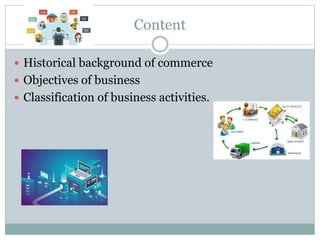
 Historical background of commerce
 Objectives of business
 Classification of business activities.
1. Historical background of commerce
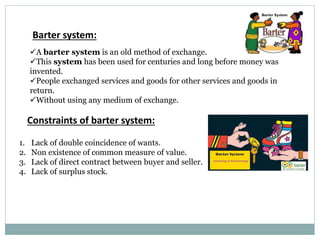
Barter system:
A barter system is an old method of exchange.
This system has been used for centuries and long before money was
invented.
People exchanged services and goods for other services and goods in
return.
Without using any medium of exchange.
Constraints of barter system:
1. Lack of double coincidence of wants.
2. Non existence of common measure of value.
3. Lack of direct contract between buyer and seller.
4. Lack of surplus stock.
Hindrance of commerce:
1. Hindrance of person (wholesalers to consumers)
2. Hindrance of place (Transport types)
3. Hindrance of time (willingness to buy)
4. Hindrance of risk of loss (Calamities)
5. Hindrance of knowledge (Communication + Innovation)
6. Hindrance of finance (Banks or financial institution)
7. Hindrance of exchange (Medium of exchange)
Hindrance meaning: delay,
obstruction.
2. Objectives of business
Introduction:
Human activities:
Human activity is an activity performed by a human being to
meet his/her needs and wants or may be for personal
satisfaction.
Human activities can be categorized into :
(A)Economic
(B) Non-economic activities.
Economic activity:
Activities undertaken with the object of earning
money are called economic activities.
Service are rendered by profit motive.
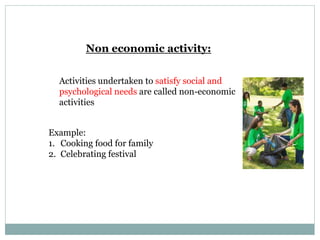
Non economic activity:
Activities undertaken to satisfy social and
psychological needs are called non-economic
activities
Example:
1. Cooking food for family
2. Celebrating festival
Types of economic activities:
Occupations may be classified into three categories based on the
following:-
A. Employment
B. Profession
C. Business
Employment:
It refers to the occupation in which people work for others
and get remuneration in the form of wages or salaries.
 The one who is employed by others are called employees .
The one who employs others is called employer.
Profession:
Professions are those occupations which involve rendering of personal
services of a special and expert nature.
 A profession is something which is more than a job.
Those engaged in a profession are called professionals and they earn
income by charging professional fee.
Business:
Business refers to any human activity undertaken on
a regular basis with the object to earn profit through
production, distribution, purchase and sale of goods
and services.
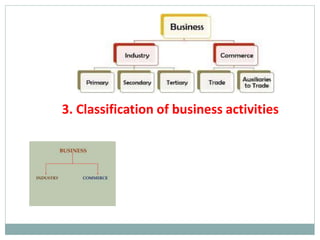
Classification of business activities:
1. Activities based on size.
2. Activities based on ownership.
3. Activities based on function.
1. Activities based on size:
On the basis of size, business activities may be broadly grouped into
two categories.
Small scale:
Small scale units require less capital.
They employ small number of workers and produce the goods on
small scale.
Large scale:
Large scale units require huge capital.
 They employ large number of workers and produce the goods
on large scale.
Activities based on ownership:
1. Private enterprises:
An enterprise is said to be a private enterprise where it is owned,
managed and controlled by persons other than Government.
An enterprise is said to be a public enterprise where it is owned,
managed and controlled by Government or any of its agencies or
both.
2. Public enterprises:
3. Joint enterprises:
An enterprise is said to be a joint enterprise where it is owned,
managed and controlled by Government and private
entrepreneurs.
Example - Maruti Suzuki
Activities based on function:
Industry:
Industry includes all those business activities which are connected with
raising, producing or processing of consumer goods.
Commerce:
It establishes a link between the producers and consumers of goods and
maintains a smooth and uninterrupted flow of goods from producers to
consumers.
Characteristics of business:
1. Profit motive
2. Element of risk
3. Production of goods
4. Dealing in goods and service.
5. Long lasting impact
6. Creation of utilities
Objectives of business:
Economic objective
Social objective
Organizational objective
National objective
Human objective
3. Classification of business activities
Industry
Meaning:
Industry is used for activities in which mechanical appliances and
technical skills are involved.
The manufacturers produces the goods for the consumers at one point of
location.
They distribute the goods to final consumer through intermediaries like
wholesaler, retailers, distributors , customer.
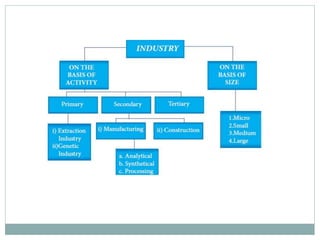
Kinds of industries:
On the basis of activities:
1. Primary activity -- (nature oriented history ) Agriculture, farming, fishing
etc…
Genetic industry:Extractive industry:
Transformed to many useful things
Ex: mining, oil drilling, farming. Breeding plants and animals
Ex: Diary, piggery, nursery
Secondary industries:
Produce goods for final consumption.
Ex: Manufacturing steel.
A. Manufacturing industry:
1. Analytical industry
2. Synthetic industry
3. Processing industry
4. Assembling industry
B. Construction industry
a. Analytical Industry which analyses and separates different
elements from the same materials, as in the case of oil refinery.
b. Synthetic Industry which combines various ingredients into a new
product, as in the case of cement.
c. Processing Industry which involves successive stages for
manufacturing finished products, as in the case of sugar and paper.
d. Assembling Industry which assembles different component parts
to make a new product, as in the case of television, car, computer, etc.
Territory industry:
1. Territory industry does not produce an goods.
2. Provides service and sells at profit.
3. Help in industry, trade, transportation , commerce etc…
Classification of territory industry:
i. Personalised service: Individuals and private institutions selling their
services to others. E.g. plumber, servant maid, etc.
ii. Public Service: Government hospitals, schools, police, Government offices, etc.
provide services to the people on behalf of the Government without profit motive.
iii. Distributive Service: Transportation, warehousing, logistics,
salesmanship, etc. come under this type of service.
iv. Financial Service: Banking, factoring, accounting, and insurance, etc.
are grouped under this type of service.
v. Quaternary Service: Professional or specialised skills and high
technology are used to provide this type of service.
On the basis of size:
1. Micro industries
2. Medium industries
3. Small industries
4. Large industries
Auxiliaries to trade and commerce:
Commerce refers to all those activities which are necessary for bringing
goods from the place of production to the place of their consumption.
1. Trade is used to denote buying and selling. It helps in making the goods
produced available to ultimate consumers or users.
2. Transportation (one place to another)
3. Warehouse (storage of goods)
4. Financial institution (Banking)
5. Insurance (Loss or damage)
Introduction to commerce

Introduction to commerce

  • 1.
  • 2.
    Content  Historical backgroundof commerce  Objectives of business  Classification of business activities.
  • 3.
  • 4.
    Barter system: A bartersystem is an old method of exchange. This system has been used for centuries and long before money was invented. People exchanged services and goods for other services and goods in return. Without using any medium of exchange. Constraints of barter system: 1. Lack of double coincidence of wants. 2. Non existence of common measure of value. 3. Lack of direct contract between buyer and seller. 4. Lack of surplus stock.
  • 5.
    Hindrance of commerce: 1.Hindrance of person (wholesalers to consumers) 2. Hindrance of place (Transport types) 3. Hindrance of time (willingness to buy) 4. Hindrance of risk of loss (Calamities) 5. Hindrance of knowledge (Communication + Innovation) 6. Hindrance of finance (Banks or financial institution) 7. Hindrance of exchange (Medium of exchange) Hindrance meaning: delay, obstruction.
  • 6.
  • 7.
    Introduction: Human activities: Human activityis an activity performed by a human being to meet his/her needs and wants or may be for personal satisfaction. Human activities can be categorized into : (A)Economic (B) Non-economic activities.
  • 8.
    Economic activity: Activities undertakenwith the object of earning money are called economic activities. Service are rendered by profit motive.
  • 9.
    Non economic activity: Activitiesundertaken to satisfy social and psychological needs are called non-economic activities Example: 1. Cooking food for family 2. Celebrating festival
  • 10.
    Types of economicactivities: Occupations may be classified into three categories based on the following:- A. Employment B. Profession C. Business
  • 11.
    Employment: It refers tothe occupation in which people work for others and get remuneration in the form of wages or salaries.  The one who is employed by others are called employees . The one who employs others is called employer.
  • 12.
    Profession: Professions are thoseoccupations which involve rendering of personal services of a special and expert nature.  A profession is something which is more than a job. Those engaged in a profession are called professionals and they earn income by charging professional fee.
  • 13.
    Business: Business refers toany human activity undertaken on a regular basis with the object to earn profit through production, distribution, purchase and sale of goods and services.
  • 14.
    Classification of businessactivities: 1. Activities based on size. 2. Activities based on ownership. 3. Activities based on function.
  • 15.
    1. Activities basedon size: On the basis of size, business activities may be broadly grouped into two categories. Small scale: Small scale units require less capital. They employ small number of workers and produce the goods on small scale. Large scale: Large scale units require huge capital.  They employ large number of workers and produce the goods on large scale.
  • 16.
    Activities based onownership: 1. Private enterprises: An enterprise is said to be a private enterprise where it is owned, managed and controlled by persons other than Government. An enterprise is said to be a public enterprise where it is owned, managed and controlled by Government or any of its agencies or both. 2. Public enterprises:
  • 17.
    3. Joint enterprises: Anenterprise is said to be a joint enterprise where it is owned, managed and controlled by Government and private entrepreneurs. Example - Maruti Suzuki
  • 18.
    Activities based onfunction: Industry: Industry includes all those business activities which are connected with raising, producing or processing of consumer goods. Commerce: It establishes a link between the producers and consumers of goods and maintains a smooth and uninterrupted flow of goods from producers to consumers.
  • 19.
    Characteristics of business: 1.Profit motive 2. Element of risk 3. Production of goods 4. Dealing in goods and service. 5. Long lasting impact 6. Creation of utilities
  • 20.
    Objectives of business: Economicobjective Social objective Organizational objective National objective Human objective
  • 21.
    3. Classification ofbusiness activities
  • 22.
    Industry Meaning: Industry is usedfor activities in which mechanical appliances and technical skills are involved. The manufacturers produces the goods for the consumers at one point of location. They distribute the goods to final consumer through intermediaries like wholesaler, retailers, distributors , customer.
  • 23.
  • 25.
    On the basisof activities: 1. Primary activity -- (nature oriented history ) Agriculture, farming, fishing etc… Genetic industry:Extractive industry: Transformed to many useful things Ex: mining, oil drilling, farming. Breeding plants and animals Ex: Diary, piggery, nursery
  • 26.
    Secondary industries: Produce goodsfor final consumption. Ex: Manufacturing steel. A. Manufacturing industry: 1. Analytical industry 2. Synthetic industry 3. Processing industry 4. Assembling industry B. Construction industry
  • 27.
    a. Analytical Industrywhich analyses and separates different elements from the same materials, as in the case of oil refinery. b. Synthetic Industry which combines various ingredients into a new product, as in the case of cement. c. Processing Industry which involves successive stages for manufacturing finished products, as in the case of sugar and paper. d. Assembling Industry which assembles different component parts to make a new product, as in the case of television, car, computer, etc.
  • 28.
    Territory industry: 1. Territoryindustry does not produce an goods. 2. Provides service and sells at profit. 3. Help in industry, trade, transportation , commerce etc…
  • 29.
    Classification of territoryindustry: i. Personalised service: Individuals and private institutions selling their services to others. E.g. plumber, servant maid, etc. ii. Public Service: Government hospitals, schools, police, Government offices, etc. provide services to the people on behalf of the Government without profit motive. iii. Distributive Service: Transportation, warehousing, logistics, salesmanship, etc. come under this type of service. iv. Financial Service: Banking, factoring, accounting, and insurance, etc. are grouped under this type of service. v. Quaternary Service: Professional or specialised skills and high technology are used to provide this type of service.
  • 30.
    On the basisof size: 1. Micro industries 2. Medium industries 3. Small industries 4. Large industries
  • 31.
    Auxiliaries to tradeand commerce: Commerce refers to all those activities which are necessary for bringing goods from the place of production to the place of their consumption. 1. Trade is used to denote buying and selling. It helps in making the goods produced available to ultimate consumers or users. 2. Transportation (one place to another) 3. Warehouse (storage of goods) 4. Financial institution (Banking) 5. Insurance (Loss or damage)