CHAPTER 1
EVOLUUTION AND FUNDAMENTALS OF
BUSINESS
1.CONCEPT OF BUSINESS
2. CHARACTERISTICS OF BUSINESS ACTIVITIES
3. COMPARISON OF BUSINESS, PROFESSION AND EMPLOYMENT
4.CLASSIFICATION OF BUSINESS ACTIVITIES
5. OBJECTIVES OF BUSINESS, MULTIPLE OBJECTIVES OF BUSINESS
6. BUSINESS RISKS- TYPE, NATURE AND CAUSES
CONCEPT OF
BUSINESS
• THE TERM BUSINESS MEANS BEING BUSY.
• HOW EVER IN SPECIFIC SENSE, BUSINESS REFERS TO AN OCCUPATION IN
WHICH PEOPLE REGULARLY ENGAGE IN ACTIVITIES RELATED TO PURCHASE,
PRODUCTION AND /OR SALE OF GOODS AND SERVICES WITH A VIEW OF
EARNING PROFITS.
• THE ACTIVITY MAY CONSIST OF PRODUCTION OR PURCHASE OF GOODS
FOR SALE OR EXCHANGE OF GOODS OR SUPPLY OF SERVICES TO SATISFY
THE NEEDS OF OTHER PEOPLE.
• THESE ACTIVITIES MAY BE CLASSIFIED INTO TWO GROUPS
• ECONOMIC ACTIVITIES AND NON ECONOMIC ACTIVITIES.
• ECONOMIC ACTIVITIES ARE THOSE BY WHICH WE EARN OUR LIVELIHOOD.
• EXAMPLES:1. RETAIL SHOPS 2. CAR MANUFACTURING 3.
• NON – ECONOMIC ACTIVITIES ARE THOSE PERFORMED OUT OF LOVE,
SYMPATHY, SENTIMENTS, PATRIOTISM ETC.
• EXAMPLES:1. 2. 3.
• CHARACTERISICS OF BUSINESS ACTIVITIES
• 1. AN ECONOMIC ACTIVITY
BUSINESS IS CONSIDERED TO BE AN ECONOMIC ACTIVITY BECAUSE IT IS UNDERTAKEN WITH
AN OBJECT OF EARNING PROFIT.
ANY ACTIVITY DONE OUT OF LOVE, SYMPATHY, AFFECTION OR ANY SENTIMENTAL REASON
CANNOT BE CALLED BUSINESS.
• 2. PRODUCTION OR PROCUREMENT OF GOODS AND SERVICES
BEFORE GOODS ARE SUPPLIED TO CUSTOMERS , GOODS MUST BE PRODUCED OR PROCURED.
GOODS MAY BE CONSUMABLE ITEMS LIKE MILK, SUGAR ETC OR CAPITAL GOODS LIKE
MACHINERY, FURNITURE, LAND ETC.
IT ALSO INCLUDES SERVICES LIKE TRANSPORTATION, BANKING, ELECTRICITY ETC.
• 3. SALE OR EXCHANGE OF GOODS AND SERVICES
BUSINESS INVOLVES EXCHANGE OR TRANSFER OF GOODS SERVICES FOR VALUE.
IF GOODS ARE PRODUCED FOR PERSONAL CONSUMPTION IT CANNOT BE CALLED BUSINESS.
• 4. DEALINGS IN GOODS AND SERVICES ON REGULAR BASIS
BUSINESS INVOLVES REGULAR DEALINGS IN GOODS AND SERVICES. ONE SINGLE TRANSACTION
OF SALE OR PURCHASE CANNOT BE CALLED BUSINESS.
• 5. PROFIT EARNING
MAIN PURPOSE IS TO EARN INCOME BY WAY OF PROFITS.
BUSINESS CANNOT SURVIVE WITHOUT PROFITS. SO EVERY BUSINESS MAN MAKES
ALL EFFORTS TO MAXIMISE PROFITS BY INCREASING SALES AND REDUCING COSTS.
• 6. UNCERTAINITY OF RETURN
IT MAINLY REFERS TO LACK OF KNOWLEDGE RELATING TO AMOUNT OF MONEY
THE BUSINESS WILL EARN IN A GIVEN PERIOD.
• 7. ELEMENT OF RISK
ALWAYS THERE IS AN ELEMENT OF RISK. IT IS NOTHING BUT UNCERTAINITY
ASSOCIATED WITH AN EXPOSURE TO LOSS.
RISKS CAN BE DUE TO MANY REASONS
• ECONOMIC ACTIVITIES ARE DIVIDED INTO 3 TYPES
• 1. BUSINESS:
BUSINESS REFERS TO THOSE ECONOMIC ACTIVITIES, WHICH ARE CONNECTED
WITH PRODUCTION OR PURCHASE AND SALE OF GOODS OR SUPPLY OF SERVICES WITH THE
MAIN OBJECTIVE OF EARNING PROFIT.
PEOPLE ENGAGED IN BUSINESS EARN INCOME IN THE FORM OF PROFIT.
2. PROFESSION:
PROFESSION INCLUDES THOSE ACTIVITIES WHICH REQUIRE SPECIAL KNOWLEDGE AND
SKILL TO BE APPLIED BY INDIVIDUALS IN THEIR OCCUPATION.
SUCH ACTIVITIES ARE SUBJECT TO GUIDELINES OR CODES OF CONDUCT LAID BY
PROFESSIONAL BODIES.
THOSE ENGAGED IN PROFESSION ARE CALLED PROFESSIONALS.
3. EMPLOYMENT :
IT REFERS TO THE OCCUPATION IN WHICH PEOPLE WORK FOR OTHERS AND GET
REMUNERATION IN RETURN.
THOSE WHO ARE EMPLOYED BY OTHERS ARE KNOWN AS EMPLOYEES.
PEOPLE WHO EMPLOY THEM ARE CALLED EMPLOYERS.
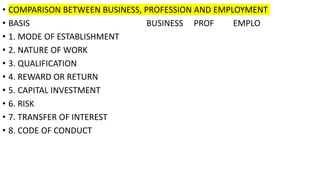
• COMPARISON BETWEEN BUSINESS, PROFESSION AND EMPLOYMENT
• BASIS BUSINESS PROF EMPLO
• 1. MODE OF ESTABLISHMENT
• 2. NATURE OF WORK
• 3. QUALIFICATION
• 4. REWARD OR RETURN
• 5. CAPITAL INVESTMENT
• 6. RISK
• 7. TRANSFER OF INTEREST
• 8. CODE OF CONDUCT
• Industry refers to economic activities, which are connected with conversion of
resources into useful goods. Generally, the term industry is used for activities in which
mechanical appliances and technical skills are involved
• Industries may be divided into three broad categories namely primary, secondary and
tertiary
• (i) Primary industries: These include all those activities which are concerned with the
extraction and production of natural resources and reproduction and development of
living organisms, plants, etc. These are divided as follows. (a) Extractive industries:
• These industries extract or draw products from natural sources. Extractive industries
supply some basic raw materials that are mostly products of geographical or natural
environment. Products of these industries are usually transformed into many other
useful goods by manufacturing industries. Important extractive industries include
farming, mining, lumbering, hunting and fishing operations.
• (b) Genetic industries: These industries are engaged in breeding plants and animals for
their use in further reproduction. Seeds and nursery companies are typical examples of
genetic industries. In additional, activities of cattle breeding farms, poultry farms, and
fish hatchery come under genetic industries
• ii) Secondary industries: These are concerned with using materials, which have
already been extracted at the primary state. These industries process such
materials to produce goods for final consumption or for further processing by
other industrial units. For example, mining of iron ore is a primary industry, but
manufacturing of steel by way of further processing of raw irons is a secondary
industry.
• Secondary industries may be further divided as follows: (a) Manufacturing
industrieshese: T industries are engaged in producing goods through processing
of raw materials and, thus, creating form utilities. They bring out diverse
finished products, that we consume, or use through the conversion of raw
materials or partly finished materials
• Manufacturing industries: These industries are engaged in producing goods
through processing of raw materials and, thus, creating form utilities. They bring
out diverse finished products, that we consume, or use through the conversion
of raw materials or partly finished material
• in their manufacturing operations. Manufacturing industries may be further divided into four categories on the
basis of method of operation for production.
• • Analytical industry
• which analyses and separates different elements from the same materials, as in the case of oil refinery.
• In analytical industry, the raw material is broken down into several useful materials. For example, an oil
refinery separates crude oil into kerosene, gasoline, diesel oil, and petrol, etc.
• • Synthetical industry
• which combines various ingredients into a new product, as in the case of cement.
• These industries put together two or more materials to form a new product such as plastics, concrete,
gypsum and coals are mixed up to produce cement.
• • Processing industry which involves successive stages for manfucturing finished products, as in the case of sugar
and paper. Textiles, steel, etc
• • Assembling industry which assembles different component parts to make a new product, as in the case of
television, car, computer, etc.
• (b) Construction industries: These industries are involved in the construction of buildings, dams, bridges, roads as
well as tunnels and canals. Engineering and architectural skills are an important part in construction industries.
• (iii) Tertiary industries: These are concerned with providing support services to primary and secondary industries
as well as activities relating to trade. These industries provide service facilities. As business activities, these may
be considered part of commerce because as auxiliaries to trade these activities assist trade. Included in this
category are transport, banking, insurance, warehousing, communication, packaging and advertising.
• Commerce includes two types of activities,
• (i) trade and (ii) auxiliaries to trade.
• TRADE:
• Buying and selling of goods is termed as trade.
• AUXILIARIES TO TRADE
• But there are a lot of activities that are required to facilitate the purchase
and sale of goods. These are called services or auxiliaries to trade .
• AUXILIARIES include transport, banking, insurance, communication,
advertisement, packaging and warehousing.
• Commerce, therefore, includes both, buying and selling of goods i.e., trade,
as well as, auxiliaries, such as transport, banking, etc.
• Commerce provides the necessary link between producers and consumers.
It embraces all those activities, which are necessary for maintaining a free
flow of goods and services. Thus, all activities involving the removal of
hindrances in the process of exchange are included in commerce. The
hindrances may be in respect of persons, place, time, risk, finance, etc
• Auxiliaries to Trade
• Activities which are meant for assisting trade are known as auxiliaries to trade.
These activities are generally referred to as services because these are in the
nature of facilitating the activities relating to industry and trade.
• Transport, banking, insurance, warehousing, and advertising are regarded as
auxiliaries to trade, i.e., activities playing a supportive role.
1. Transport and Communication:
• Production of goods generally takes place in particular locations.
• But these goods are required for consumption in different parts of the country.
The obstacle of place is removed by transport through road, rail or coastal
shipping. Transport facilitates movement of raw materials . But these goods are
required for consumption in different parts of the country. The obstacle of place
is removed by transport through road, rail or coastal shipping. Transport
facilitates movement of raw
• material, to the place of production and the finished products from factories to
the place of consumption. Along with transport facility, there is also a need for
communication facilities so that producers, traders and consumers may exchange
information with one another. Thus, postal services and telephone facilities may
also be regarded as auxiliaries to business activities.
• Banking and Finance:
• Business activities cannot be undertaken unless funds are available for acquiring
assets, purchasing raw materials and meeting other expenses. Necessary funds
can be obtained by businessmen from a bank. Thus, banking helps business
activities to overcome the problem of finance. Commercial banks, generally lend
money by providing overdraft and cash credit facilities, loans and advances.
Banks also undertake collection of cheques, remittance of funds to different
places, and discounting of bills on behalf of traders. In foreign trade, commercial
banks help exporters in collecting money from importers. Commercial banks also
help promoters of companies to raise capital from the public.
• Insurance: Business involves various types of risks. Factory building, machinery,
furniture, etc., must be protected against fire, theft and other risks.
• Material and goods help in stock or in transit are subject to the risk of loss or
damage.
• Employees are also required to be protected against the risks of accident and
occupational hazards. Insurance provides protection in all such cases.
• On payment of a nominal premium, the amount of loss or damage and
compensation for injury, if any, can be recovered from the insurance company.
• (iv) Warehousing: Usually, goods are not sold or consumed immediately after
production. They are held in stock to make them available as and when
required.
• Special arrangement must be made for the storage of goods to prevent loss or
damage.
• Warehousing helps business firms to overcome the problem of storage and
facilitates the availability of goods when needed.
• Prices are, thereby, maintained at a reasonable level through continuous supply
of goods.
• (v) Advertising:
• Advertising is one of the most important methods of promoting the sale of
products, particularly, consumer goods, like electronic and automobile goods,
soaps, detergents, etc.
• Most of these goods are manufactured and supplied in the market by numerous
firms — big or small. It is practically impossible for producers and traders to
contact each and every customer.
• Thus, for promoting sales, information about the goods and services available,
their features, price, etc., must reach potential buyers.
Also, there is a need to persuade potential buyers about the uses, quality, prices,
competitive information about the goods and services etc.
Advertising helps in providing information about available goods and services and
inducing customers to buy particular items.
• 1 Nature of Business Risks
• Nature of business risks can be understood in terms of their peculiar characteristics:
• (i) Business risks arise due to uncertainties:
• Uncertainty refers to the lack of knowledge about what is going to happen in future.
Natural calamities, change in demand and prices, changes in government policies and
prices, improvement in technology, etc., are some of the examples of uncertainty which
create risks for business because the outcomes of these future events are not known.
(ii) Risk is an essential part of every business:
• Every business has some risk. No business can avoid risk, although the amount of risk
may vary from business to business. Risk can be minimised, but cannot be eliminated.
(iii) Degree of risk depends mainly upon the nature and size of business:
• Nature of business (i.e., type of goods and services produced and sold) and size of
business (i.e., volume of production and sale) are the main factors which determine the
amount of risk in a business. For example, a business dealing in fashionable items has a
high degree of risk. Similarly, a large-scale business generally has a higher risk than
what a small scale has.
• (iv) Profit is the reward for risk taking:
• ‘No risk, no gain’ is an ageold principle which applies to all types of business. Greater
the risk involved in a business, higher is the chance of profit. An entrepreneur
undertakes risks under the expectation of higher profit. Profit is thus the reward for risk
taking.
• Cause of Business Risks
• Business risks arise due to a variety of causes, which are classified as follows: (i)
Natural causes: Human beings have little control over natural calamities, like
flood, earthquake, lightning, heavy rains, famine, etc. property and income in
business. (ii) Human causes: Human causes include such unexpected events, like
dishonesty, carelessness or negligence of employees, stoppage of work due to
power failure, strikes, riots, management inefficiency, etc. (iii) Economic causes:
These include uncertainties relating to demand for goods, competition, price,
collection of dues from customers, change of technology or method of
production, etc. Financial problems, like rise in interest rate for borrowing, levy of
higher taxes, etc., also come under these type of causes as they result in higher
unexpected cost of operation or business. (iv) Other causes: These are
unforeseen events, like political disturbances, mechanical failures, such as the
bursting of boiler, fluctuations in exchange rates, etc., which lead to the
possibility of business risks.

CHAPTER 1.pptx

  • 1.
    CHAPTER 1 EVOLUUTION ANDFUNDAMENTALS OF BUSINESS 1.CONCEPT OF BUSINESS 2. CHARACTERISTICS OF BUSINESS ACTIVITIES 3. COMPARISON OF BUSINESS, PROFESSION AND EMPLOYMENT 4.CLASSIFICATION OF BUSINESS ACTIVITIES 5. OBJECTIVES OF BUSINESS, MULTIPLE OBJECTIVES OF BUSINESS 6. BUSINESS RISKS- TYPE, NATURE AND CAUSES
  • 2.
    CONCEPT OF BUSINESS • THETERM BUSINESS MEANS BEING BUSY. • HOW EVER IN SPECIFIC SENSE, BUSINESS REFERS TO AN OCCUPATION IN WHICH PEOPLE REGULARLY ENGAGE IN ACTIVITIES RELATED TO PURCHASE, PRODUCTION AND /OR SALE OF GOODS AND SERVICES WITH A VIEW OF EARNING PROFITS. • THE ACTIVITY MAY CONSIST OF PRODUCTION OR PURCHASE OF GOODS FOR SALE OR EXCHANGE OF GOODS OR SUPPLY OF SERVICES TO SATISFY THE NEEDS OF OTHER PEOPLE. • THESE ACTIVITIES MAY BE CLASSIFIED INTO TWO GROUPS • ECONOMIC ACTIVITIES AND NON ECONOMIC ACTIVITIES. • ECONOMIC ACTIVITIES ARE THOSE BY WHICH WE EARN OUR LIVELIHOOD. • EXAMPLES:1. RETAIL SHOPS 2. CAR MANUFACTURING 3. • NON – ECONOMIC ACTIVITIES ARE THOSE PERFORMED OUT OF LOVE, SYMPATHY, SENTIMENTS, PATRIOTISM ETC. • EXAMPLES:1. 2. 3.
  • 3.
    • CHARACTERISICS OFBUSINESS ACTIVITIES • 1. AN ECONOMIC ACTIVITY BUSINESS IS CONSIDERED TO BE AN ECONOMIC ACTIVITY BECAUSE IT IS UNDERTAKEN WITH AN OBJECT OF EARNING PROFIT. ANY ACTIVITY DONE OUT OF LOVE, SYMPATHY, AFFECTION OR ANY SENTIMENTAL REASON CANNOT BE CALLED BUSINESS. • 2. PRODUCTION OR PROCUREMENT OF GOODS AND SERVICES BEFORE GOODS ARE SUPPLIED TO CUSTOMERS , GOODS MUST BE PRODUCED OR PROCURED. GOODS MAY BE CONSUMABLE ITEMS LIKE MILK, SUGAR ETC OR CAPITAL GOODS LIKE MACHINERY, FURNITURE, LAND ETC. IT ALSO INCLUDES SERVICES LIKE TRANSPORTATION, BANKING, ELECTRICITY ETC. • 3. SALE OR EXCHANGE OF GOODS AND SERVICES BUSINESS INVOLVES EXCHANGE OR TRANSFER OF GOODS SERVICES FOR VALUE. IF GOODS ARE PRODUCED FOR PERSONAL CONSUMPTION IT CANNOT BE CALLED BUSINESS. • 4. DEALINGS IN GOODS AND SERVICES ON REGULAR BASIS BUSINESS INVOLVES REGULAR DEALINGS IN GOODS AND SERVICES. ONE SINGLE TRANSACTION OF SALE OR PURCHASE CANNOT BE CALLED BUSINESS.
  • 4.
    • 5. PROFITEARNING MAIN PURPOSE IS TO EARN INCOME BY WAY OF PROFITS. BUSINESS CANNOT SURVIVE WITHOUT PROFITS. SO EVERY BUSINESS MAN MAKES ALL EFFORTS TO MAXIMISE PROFITS BY INCREASING SALES AND REDUCING COSTS. • 6. UNCERTAINITY OF RETURN IT MAINLY REFERS TO LACK OF KNOWLEDGE RELATING TO AMOUNT OF MONEY THE BUSINESS WILL EARN IN A GIVEN PERIOD. • 7. ELEMENT OF RISK ALWAYS THERE IS AN ELEMENT OF RISK. IT IS NOTHING BUT UNCERTAINITY ASSOCIATED WITH AN EXPOSURE TO LOSS. RISKS CAN BE DUE TO MANY REASONS
  • 5.
    • ECONOMIC ACTIVITIESARE DIVIDED INTO 3 TYPES • 1. BUSINESS: BUSINESS REFERS TO THOSE ECONOMIC ACTIVITIES, WHICH ARE CONNECTED WITH PRODUCTION OR PURCHASE AND SALE OF GOODS OR SUPPLY OF SERVICES WITH THE MAIN OBJECTIVE OF EARNING PROFIT. PEOPLE ENGAGED IN BUSINESS EARN INCOME IN THE FORM OF PROFIT. 2. PROFESSION: PROFESSION INCLUDES THOSE ACTIVITIES WHICH REQUIRE SPECIAL KNOWLEDGE AND SKILL TO BE APPLIED BY INDIVIDUALS IN THEIR OCCUPATION. SUCH ACTIVITIES ARE SUBJECT TO GUIDELINES OR CODES OF CONDUCT LAID BY PROFESSIONAL BODIES. THOSE ENGAGED IN PROFESSION ARE CALLED PROFESSIONALS. 3. EMPLOYMENT : IT REFERS TO THE OCCUPATION IN WHICH PEOPLE WORK FOR OTHERS AND GET REMUNERATION IN RETURN. THOSE WHO ARE EMPLOYED BY OTHERS ARE KNOWN AS EMPLOYEES. PEOPLE WHO EMPLOY THEM ARE CALLED EMPLOYERS.
  • 6.
    • COMPARISON BETWEENBUSINESS, PROFESSION AND EMPLOYMENT • BASIS BUSINESS PROF EMPLO • 1. MODE OF ESTABLISHMENT • 2. NATURE OF WORK • 3. QUALIFICATION • 4. REWARD OR RETURN • 5. CAPITAL INVESTMENT • 6. RISK • 7. TRANSFER OF INTEREST • 8. CODE OF CONDUCT
  • 7.
    • Industry refersto economic activities, which are connected with conversion of resources into useful goods. Generally, the term industry is used for activities in which mechanical appliances and technical skills are involved • Industries may be divided into three broad categories namely primary, secondary and tertiary • (i) Primary industries: These include all those activities which are concerned with the extraction and production of natural resources and reproduction and development of living organisms, plants, etc. These are divided as follows. (a) Extractive industries: • These industries extract or draw products from natural sources. Extractive industries supply some basic raw materials that are mostly products of geographical or natural environment. Products of these industries are usually transformed into many other useful goods by manufacturing industries. Important extractive industries include farming, mining, lumbering, hunting and fishing operations. • (b) Genetic industries: These industries are engaged in breeding plants and animals for their use in further reproduction. Seeds and nursery companies are typical examples of genetic industries. In additional, activities of cattle breeding farms, poultry farms, and fish hatchery come under genetic industries
  • 8.
    • ii) Secondaryindustries: These are concerned with using materials, which have already been extracted at the primary state. These industries process such materials to produce goods for final consumption or for further processing by other industrial units. For example, mining of iron ore is a primary industry, but manufacturing of steel by way of further processing of raw irons is a secondary industry. • Secondary industries may be further divided as follows: (a) Manufacturing industrieshese: T industries are engaged in producing goods through processing of raw materials and, thus, creating form utilities. They bring out diverse finished products, that we consume, or use through the conversion of raw materials or partly finished materials • Manufacturing industries: These industries are engaged in producing goods through processing of raw materials and, thus, creating form utilities. They bring out diverse finished products, that we consume, or use through the conversion of raw materials or partly finished material
  • 9.
    • in theirmanufacturing operations. Manufacturing industries may be further divided into four categories on the basis of method of operation for production. • • Analytical industry • which analyses and separates different elements from the same materials, as in the case of oil refinery. • In analytical industry, the raw material is broken down into several useful materials. For example, an oil refinery separates crude oil into kerosene, gasoline, diesel oil, and petrol, etc. • • Synthetical industry • which combines various ingredients into a new product, as in the case of cement. • These industries put together two or more materials to form a new product such as plastics, concrete, gypsum and coals are mixed up to produce cement. • • Processing industry which involves successive stages for manfucturing finished products, as in the case of sugar and paper. Textiles, steel, etc • • Assembling industry which assembles different component parts to make a new product, as in the case of television, car, computer, etc. • (b) Construction industries: These industries are involved in the construction of buildings, dams, bridges, roads as well as tunnels and canals. Engineering and architectural skills are an important part in construction industries. • (iii) Tertiary industries: These are concerned with providing support services to primary and secondary industries as well as activities relating to trade. These industries provide service facilities. As business activities, these may be considered part of commerce because as auxiliaries to trade these activities assist trade. Included in this category are transport, banking, insurance, warehousing, communication, packaging and advertising.
  • 10.
    • Commerce includestwo types of activities, • (i) trade and (ii) auxiliaries to trade. • TRADE: • Buying and selling of goods is termed as trade. • AUXILIARIES TO TRADE • But there are a lot of activities that are required to facilitate the purchase and sale of goods. These are called services or auxiliaries to trade . • AUXILIARIES include transport, banking, insurance, communication, advertisement, packaging and warehousing. • Commerce, therefore, includes both, buying and selling of goods i.e., trade, as well as, auxiliaries, such as transport, banking, etc. • Commerce provides the necessary link between producers and consumers. It embraces all those activities, which are necessary for maintaining a free flow of goods and services. Thus, all activities involving the removal of hindrances in the process of exchange are included in commerce. The hindrances may be in respect of persons, place, time, risk, finance, etc
  • 11.
    • Auxiliaries toTrade • Activities which are meant for assisting trade are known as auxiliaries to trade. These activities are generally referred to as services because these are in the nature of facilitating the activities relating to industry and trade. • Transport, banking, insurance, warehousing, and advertising are regarded as auxiliaries to trade, i.e., activities playing a supportive role. 1. Transport and Communication: • Production of goods generally takes place in particular locations. • But these goods are required for consumption in different parts of the country. The obstacle of place is removed by transport through road, rail or coastal shipping. Transport facilitates movement of raw materials . But these goods are required for consumption in different parts of the country. The obstacle of place is removed by transport through road, rail or coastal shipping. Transport facilitates movement of raw
  • 12.
    • material, tothe place of production and the finished products from factories to the place of consumption. Along with transport facility, there is also a need for communication facilities so that producers, traders and consumers may exchange information with one another. Thus, postal services and telephone facilities may also be regarded as auxiliaries to business activities. • Banking and Finance: • Business activities cannot be undertaken unless funds are available for acquiring assets, purchasing raw materials and meeting other expenses. Necessary funds can be obtained by businessmen from a bank. Thus, banking helps business activities to overcome the problem of finance. Commercial banks, generally lend money by providing overdraft and cash credit facilities, loans and advances. Banks also undertake collection of cheques, remittance of funds to different places, and discounting of bills on behalf of traders. In foreign trade, commercial banks help exporters in collecting money from importers. Commercial banks also help promoters of companies to raise capital from the public.
  • 13.
    • Insurance: Businessinvolves various types of risks. Factory building, machinery, furniture, etc., must be protected against fire, theft and other risks. • Material and goods help in stock or in transit are subject to the risk of loss or damage. • Employees are also required to be protected against the risks of accident and occupational hazards. Insurance provides protection in all such cases. • On payment of a nominal premium, the amount of loss or damage and compensation for injury, if any, can be recovered from the insurance company. • (iv) Warehousing: Usually, goods are not sold or consumed immediately after production. They are held in stock to make them available as and when required. • Special arrangement must be made for the storage of goods to prevent loss or damage. • Warehousing helps business firms to overcome the problem of storage and facilitates the availability of goods when needed. • Prices are, thereby, maintained at a reasonable level through continuous supply of goods.
  • 14.
    • (v) Advertising: •Advertising is one of the most important methods of promoting the sale of products, particularly, consumer goods, like electronic and automobile goods, soaps, detergents, etc. • Most of these goods are manufactured and supplied in the market by numerous firms — big or small. It is practically impossible for producers and traders to contact each and every customer. • Thus, for promoting sales, information about the goods and services available, their features, price, etc., must reach potential buyers. Also, there is a need to persuade potential buyers about the uses, quality, prices, competitive information about the goods and services etc. Advertising helps in providing information about available goods and services and inducing customers to buy particular items.
  • 15.
    • 1 Natureof Business Risks • Nature of business risks can be understood in terms of their peculiar characteristics: • (i) Business risks arise due to uncertainties: • Uncertainty refers to the lack of knowledge about what is going to happen in future. Natural calamities, change in demand and prices, changes in government policies and prices, improvement in technology, etc., are some of the examples of uncertainty which create risks for business because the outcomes of these future events are not known. (ii) Risk is an essential part of every business: • Every business has some risk. No business can avoid risk, although the amount of risk may vary from business to business. Risk can be minimised, but cannot be eliminated. (iii) Degree of risk depends mainly upon the nature and size of business: • Nature of business (i.e., type of goods and services produced and sold) and size of business (i.e., volume of production and sale) are the main factors which determine the amount of risk in a business. For example, a business dealing in fashionable items has a high degree of risk. Similarly, a large-scale business generally has a higher risk than what a small scale has. • (iv) Profit is the reward for risk taking: • ‘No risk, no gain’ is an ageold principle which applies to all types of business. Greater the risk involved in a business, higher is the chance of profit. An entrepreneur undertakes risks under the expectation of higher profit. Profit is thus the reward for risk taking.
  • 16.
    • Cause ofBusiness Risks • Business risks arise due to a variety of causes, which are classified as follows: (i) Natural causes: Human beings have little control over natural calamities, like flood, earthquake, lightning, heavy rains, famine, etc. property and income in business. (ii) Human causes: Human causes include such unexpected events, like dishonesty, carelessness or negligence of employees, stoppage of work due to power failure, strikes, riots, management inefficiency, etc. (iii) Economic causes: These include uncertainties relating to demand for goods, competition, price, collection of dues from customers, change of technology or method of production, etc. Financial problems, like rise in interest rate for borrowing, levy of higher taxes, etc., also come under these type of causes as they result in higher unexpected cost of operation or business. (iv) Other causes: These are unforeseen events, like political disturbances, mechanical failures, such as the bursting of boiler, fluctuations in exchange rates, etc., which lead to the possibility of business risks.