Lecture 350 – Parallel DACs, Improved Resolution DACs and Serial DACs (3/28/10) Page 350-1 
LECTURE 350 – PARALLEL DACS, IMPROVED DAC 
RESOLUTION AND SERIAL DACS 
LECTURE ORGANIZATION 
Outline 
• Voltage scaling DACs 
• Charge scaling DACs 
• Extending the resolution of parallel DACs 
• Serial DACs 
• Summary 
CMOS Analog Circuit Design, 2nd Edition Reference 
Pages 626-652 
CMOS Analog Circuit Design © P.E. Allen - 2010 
Lecture 350 – Parallel DACs, Improved Resolution DACs and Serial DACs (3/28/10) Page 350-2 
VOLTAGE SCALING DIGITAL-ANALOG CONVERTERS 
General Voltage Scaling Digital Analog Converter 
vOUT 
Voltage 
Scaling 
Network 
Digital Input Word 
VREF 
Decoder 
Logic 
V1 
V2 
V3 
V2N 
Fig. 10.2-6 
Operation: 
Creates all possible values of the analog output then uses a decoding network to 
determine which voltage to select based on the digital input word. 
CMOS Analog Circuit Design © P.E. Allen - 2010
Lecture 350 – Parallel DACs, Improved Resolution DACs and Serial DACs (3/28/10) Page 350-3 
3-Bit Voltage Scaling Digital-Analog Converter 
The voltage at any tap can be expressed as: vOUT = 
VREF 
8 (n  0.5) = 
VREF 
16 (2n  1) 
Attributes: 
• Guaranteed 
monotonic 
• Compatible with 
CMOS 
technology 
• Large area if N is 
large 
• Sensitive to 
parasitics 
• Requires a buffer 
• Large current can 
flow through the 
resistor string. 
VREF 
Input = 101 
b2 b2 b1 b1 b0 b0 
R/2 
8 
7 
6 
5 
4 
3 
2 
1 
R 
R 
R 
R 
R 
R 
R 
R/2 
vOUT 
000 001 010 011 100 101 110 111 
VREF 
7VREF 
8 
6VREF 
8 
5VREF 
8 
4VREF 
8 
3VREF 
8 
2VREF 
8 
VREF 
8 
0 
Digital Input Code 
vOUT 
(a.) (b.) 
Figure 10.2-7 - (a.) Implementation of a 3-bit voltage scaling DAC. (b.) Input-output 
characteristics of Fig. 10.2-7(a.) 
11 
16VREF 
CMOS Analog Circuit Design © P.E. Allen - 2010 
Lecture 350 – Parallel DACs, Improved Resolution DACs and Serial DACs (3/28/10) Page 350-4 
Alternate Realization of the 3-Bit Voltage Scaling DAC 
b2 b1 b0 
VREF 
R/2 
8 
7 
6 
5 
4 
3 
2 
1 
R 
R 
R 
R 
R 
R 
R 
R/2 
vOUT 
3-to-8 Decoder 
Fig. 10.2-8 
CMOS Analog Circuit Design © P.E. Allen - 2010
Lecture 350 – Parallel DACs, Improved Resolution DACs and Serial DACs (3/28/10) Page 350-5 
INL and DNL of the Voltage Scaling DAC 
Find an expression for the INL and DNL of the voltage scaling DAC using a worst-case 
approach. For an n-bit DAC, assume there are 2n resistors between VREF and ground 
and that the resistors are numbered from 1 to 2n beginning with the resistor connected to 
VREF and ending with the resistor connected to ground. 
Integral Nonlinearity 
The voltage at the i-th resistor from the top is, 
vi = 
(2n-i)R 
(2n-i)R+iR VREF 
where there are i resistors above vi and 2n-i below. 
For worst case, assume that i = 2n-1 (midpoint). 
Define Rmax = R + R and Rmin = R - R. 
The worst case INL is 
INL = v2n-1(actual) - v2n-1(ideal) 
Therefore, 
INL = 
2n-1(R+R)VREF 
2n-1(R+R)+2n-1(R-R) - 
VREF 
2 = 
R 
2R VREF 
R 
2R VREF=2n-1 
2n 
2n 
INL= 
 
R 
R  
 
VREF 
2n =2n-1 
 
R 
R LSBs 
 
Differential Nonlinearity 
The worst case DNL is 
DNL = vstep(act) - vstep(ideal) 
Substituting the actual and 
ideal steps gives, 
(R±R)VREF 
= 
2nR - 
RVREF 
2nR 
=  
RR 
 
R±R 
R - 
VREF 
2n 
= 
±R 
R 
VREF 
2n 
Therefore, 
±R 
R LSBs 
DNL= 
VREF 
R1 
1 
R2 
2 
R3 
3 
i-2 
Ri-1 
i-1 
Ri 
i 
Ri+1 
i+1 
2n-2 
R2n-1 
2n-1 
R2n 
2n 
Vi 
Fig. 10.2-085 
CMOS Analog Circuit Design © P.E. Allen - 2010 
Lecture 350 – Parallel DACs, Improved Resolution DACs and Serial DACs (3/28/10) Page 350-6 
Example 350-1 - Accuracy Requirements of a Voltage-Scaling Digital-Analog 
Converter 
If the resistor string of a voltage scaling digital-analog converter is a 5 μm wide 
polysilicon strip having a relative accuracy of ±1%, what is the largest number of bits that 
can be resolved and keep the worst case INL within ±0.5 LSB? For this number of bits 
what is the worst case DNL? 
Solution 
From the previous page, we can write that 
2n-1  
R 
R = 2n-1 
 
 
1 
100  
12 
This inequality can be simplified 
2n  100 
which has a solution of n = 6. 
The value of the DNL for n = 6 is found from the previous page as 
DNL = 
±1 
100 LSBs = ±0.01LSBs 
(This is the reason the resistor string is monotonic.) 
CMOS Analog Circuit Design © P.E. Allen - 2010
Lecture 350 – Parallel DACs, Improved Resolution DACs and Serial DACs (3/28/10) Page 350-7 
CHARGE SCALING DIGITAL-ANALOG CONVERTERS 
General Charge Scaling Digital-Analog Converter 
vOUT 
Digital Input Word 
Charge 
Scaling 
Network 
VREF 
Fig. 10.2-9 
General principle is to capacitively attenuate the reference 
voltage. Capacitive attenuation is simply: 
Calculate as if the capacitors were resistors. For example, 
Vout = 
1 
C2 
1 
C1+ 
1 
C2 
VREF = 
C1 
C1+C2 VREF 
C1 
VREF C2 
+ 
Vout 
- 
Fig. 10.2-9b 
CMOS Analog Circuit Design © P.E. Allen - 2010 
Lecture 350 – Parallel DACs, Improved Resolution DACs and Serial DACs (3/28/10) Page 350-8 
Binary-Weighted, Charge Scaling DAC 
Circuit: 
Operation: 
1.) All switches 
connected to ground 
during 1. 
2.) Switch Si 
φ1 
VREF 
C 
C 
4 C 
C C 
2 2N-2 2N-1 
S0 
φ2 
S1 S2 SN-2 SN-1 
φ2 φ2 φ2 φ2 
closes to VREF if bi = 1 or to ground if bi = 0. 
Equating the charge in the capacitors gives, 
VREFCeq = VREF  
+ 
- 
C 
2N-1 
Terminating 
Capacitor 
Fig. 10.2-10 
bN-1C 
2N1 = Ctot vOUT = 2C vOUT 
 
b1C 
2 + 
b0C+ 
b2C 
22 +...+ 
which gives 
vOUT = [b02-1 + b12-2 + b22-3 + ... + bN-12-N]VREF 
Equivalent circuit of the binary-weighted, charge 
scaling DAC is: 
Attributes: 
VREF 
• Accurate 
• Sensitive to parasitics 
• Not monotonic 
• Charge feedthrough occurs at turn on of switches 
vOUT 
+ 
2C - Ceq. vOUT 
- 
Ceq. 
Fig. 10.2-11 
CMOS Analog Circuit Design © P.E. Allen - 2010
Lecture 350 – Parallel DACs, Improved Resolution DACs and Serial DACs (3/28/10) Page 350-9 
Integral Nonlinearity of the Charge Scaling DAC 
Again, we use a worst case approach. Assume an n-bit charge scaling DAC with the 
MSB capacitor of C and the LSB capacitor of C/2n-1 and the capacitors have a tolerance 
of C/C. 
The ideal output when the i-th capacitor only is connected to VREF is 
vOUT (ideal) = 
C/2i-1 
2C VREF = 
VREF 
2i  
2n 
2n = 
 
2n 
2i LSBs 
The maximum and minimum capacitance is Cmax = C + C and Cmin = C - C. 
Therefore, the actual worst case output for the i-th capacitor is 
vOUT(actual) = 
(C±C)/2i-1 
2C VREF = 
VREF 
2i ± 
C·VREF 
2iC = 
2n 
2i ± 
2nC 
2iC LSBs 
Now, the INL for the i-th bit is given as 
INL(i) = vOUT(actual) - vOUT(ideal) = 
±2nC 
2iC = 
2n-iC 
C LSBs 
Typically, the worst case value of i occurs for i = 1. Therefore, the worst case INL is 
C 
C LSBs 
INL=±2n-1 
CMOS Analog Circuit Design © P.E. Allen - 2010 
Lecture 350 – Parallel DACs, Improved Resolution DACs and Serial DACs (3/28/10) Page 350-10 
Differential Nonlinearity of the Charge Scaling DAC 
The worst case DNL for the binary weighted capacitor array is found when the MSB 
changes. The output voltage of the binary weighted capacitor array can be written as 
vOUT = 
Ceq. 
(2C-Ceq.)+Ceq. 
VREF 
where Ceq are capacitors whose bits are 1 and (2C - Ceq) are capacitors whose bits are 0. 
The worst case DNL can be expressed as 
DNL = 
vstep(worstcase) 
vstep(ideal) - 1 = 
vOUT(1000....)-vOUT(0111....) 
LSB - 1 LSBs 
The worst case choice for the capacitors is to choose C1 larger by C and the remaining 
capacitors smaller by C giving, 
C1=C+C, C2 = 
12 
(C-C),...,Cn-1= 
1 
2n-2(C-C), Cn= 
1 
2n-1(C-C), and Cterm= 
1 
2n-1(C-C) 
Note that 
n 
Ci 
i=2 
+ Cterm = C2+ C3+···+ Cn-1+ Cn+ Cterm = C-C 
CMOS Analog Circuit Design © P.E. Allen - 2010
Lecture 350 – Parallel DACs, Improved Resolution DACs and Serial DACs (3/28/10) Page 350-11 
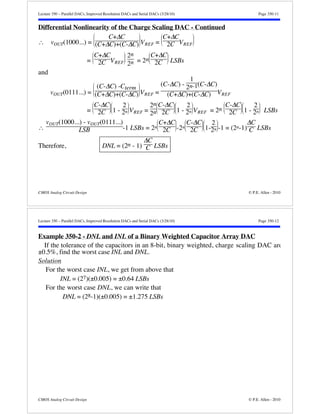
Differential Nonlinearity of the Charge Scaling DAC - Continued 
 vOUT(1000...) =  
 
C+C 
(C+C)+(C-C) VREF =  
C+C 
2C VREF 
 
=  
C+C 
2C VREF 
 
2n 
2n = 2n 
C+C 
2C LSBs 
 
and 
vOUT(0111...) =  
(C-C)-Cterm 
(C+C)+(C-C) VREF = 
 
1 
2n-1(C-C) 
(C-C)- 
(C+C)+(C-C) VREF 
=  
C-C 
2C  
 
2 
2n VREF = 
 
1- 
2n 
2n 
C-C 
2C  
 
2 
2n VREF = 2n  
 
1- 
C-C 
2C  
 
2 
2n LSBs 
 
1- 
 
vOUT(1000...)-vOUT(0111...) 
 
LSB -1 LSBs = 2n 
C+C 
2C -2n 
 
 
C-C 
2C  
 
C 
C LSBs 
2 
2n -1 = (2n-1) 
 
1- 
C 
C LSBs 
Therefore, DNL=(2n-1) 
CMOS Analog Circuit Design © P.E. Allen - 2010 
Lecture 350 – Parallel DACs, Improved Resolution DACs and Serial DACs (3/28/10) Page 350-12 
Example 350-2 - DNL and INL of a Binary Weighted Capacitor Array DAC 
If the tolerance of the capacitors in an 8-bit, binary weighted, charge scaling DAC are 
±0.5%, find the worst case INL and DNL. 
Solution 
For the worst case INL, we get from above that 
INL = (27)(±0.005) = ±0.64 LSBs 
For the worst case DNL, we can write that 
DNL = (28-1)(±0.005) = ±1.275 LSBs 
CMOS Analog Circuit Design © P.E. Allen - 2010
Lecture 350 – Parallel DACs, Improved Resolution DACs and Serial DACs (3/28/10) Page 350-13 
Example 350-3 - Influence of Capacitor Ratio Accuracy on Number of Bits 
Use the data shown to estimate the number of 
bits possible for a charge scaling DAC assuming a 
worst case approach for INL and that the worst 
conditions occur at the midscale (1 MSB). 
Solution 
Assuming an INL of ±0.5 LSB, we can write that 
INL = ±2N-1 C 
C  ± 
1 
2 
  
C 
C 
 
= 
1 
2N 
Let us assume a unit capacitor of 50 μm by 50 
μm and a relative accuracy of approximately 
±0.1%. Solving for N in the above equation gives 
approximately 10 bits. However, the ±0.1% figure 
corresponds to ratios of 16:1 or 4 bits. In order to 
get a solution, we estimate the relative accuracy of 
capacitor ratios as 
C 
C  0.001 + 0.0001N 
Using this approximate relationship, a 9-bit digital-analog converter should be 
realizable. 
CMOS Analog Circuit Design © P.E. Allen - 2010 
Lecture 350 – Parallel DACs, Improved Resolution DACs and Serial DACs (3/28/10) Page 350-14 
Binary Weighted, Charge Amplifier DAC 
φ1 
CF = 2NC/K 
- 
+ 
b0 
VREF 
φ1 
b0 φ1 b1 b1 φ1 b2 b2 φ1 bN-2 bN-2 
φ1 bN-1 bN-1 
2N-2C 2N-3C 
C 2C 
+ 
- 
2N-1 
+ 
vOUT 
- 
Fig. 10.2-12 
C 
Attributes: 
• No floating nodes which implies insensitive to parasitics and fast 
• No terminating capacitor required 
• With the above configuration, charge feedthrough will be Verror  -(COL/2CN)V 
• Can totally eliminate parasitics with parasitic-insensitive switched capacitor circuitry 
but not the charge feedthrough 
CMOS Analog Circuit Design © P.E. Allen - 2010
Lecture 350 – Parallel DACs, Improved Resolution DACs and Serial DACs (3/28/10) Page 350-15 
EXTENDING THE RESOLUTION OF PARALLEL DIGITAL-ANALOG 
CONVERTERS 
Background 
Technique: 
Divide the total resolution N into k smaller sub-DACs each with a resolution of 
Nk 
. 
Result: 
Smaller total area. 
More resolution because of reduced largest to smallest component spread. 
Approaches: 
• Combination of similarly scaled subDACs 
Divider approach (scale the analog output of the subDACs) 
Subranging approach (scale the reference voltage of the subDACs) 
• Combination of differently scaled subDACs 
CMOS Analog Circuit Design © P.E. Allen - 2010 
Lecture 350 – Parallel DACs, Improved Resolution DACs and Serial DACs (3/28/10) Page 350-16 
COMBINATION OF SIMILARLY SCALED SUBDACs 
Analog Scaling - Divider Approach 
Example of combining a m-bit 
and k-bit subDAC to form a 
m+k-bit DAC. 
vOUT =  
m-MSB 
bits 
k-LSB 
bits 
bm-1 
2m VREF + 
 
b0 
2 + 
b1 
4 +···+ 
 
1 
2m  
 
÷ 2m 
Σ + 
+ 
vOUT 
Fig. 10.3-1 
bm+k-1 
2k VREF 
 
bm 
2 + 
VREF 
m-bit 
MSB 
DAC 
VREF 
k-bit 
LSB 
DAC 
bm+1 
4 +···+ 
vOUT =  
bm+k-1 
2m+k VREF 
 
b0 
2 + 
b1 
4 +···+ 
bm-1 
2m + 
bm 
2m+1+ 
bm+1 
2m+2+···+ 
CMOS Analog Circuit Design © P.E. Allen - 2010
Lecture 350 – Parallel DACs, Improved Resolution DACs and Serial DACs (3/28/10) Page 350-17 
Example 350-4 - Illustration of the Influence of the Scaling Factor 
Assume that m = 2 and k = 2 in Fig. 10.3-1 and find the transfer characteristic of this 
DAC if the scaling factor for the LSB DAC is 3/8 instead of 1/4. Assume that VREF = 1V 
What is the ±INL and ±DNL for this DAC? Is this DAC monotonic or not? 
Solution 
The ideal DAC output is given as 
vOUT = 
b0 
2 + 
b1 
4 + 
14 
 
b3 
4 = 
 
b2 
2 + 
b0 
2 + 
b1 
4 + 
b2 
8 + 
b3 
16 . 
The actual DAC output can be written as 
vOUT(act.) = 
b0 
2 + 
b1 
4 + 
3b2 
16 + 
3b3 
32 = 
16b0 
32 + 
8b1 
32 + 
6b2 
32 + 
3b3 
32 
The results are tabulated in the following table for this example. 
CMOS Analog Circuit Design © P.E. Allen - 2010 
Lecture 350 – Parallel DACs, Improved Resolution DACs and Serial DACs (3/28/10) Page 350-18 
Example 350-4 - Continued 
Ideal and Actual Analog Output for the DAC in Ex. 350-4, 
The table contains all the 
information we are seeking 
An LSB for this example is 
1/16 or 2/32. The fourth 
column gives the +INL as 
1.5LSB and the -INL as 
0LSB. The fifth column 
gives the +DNL as -0.5LSB 
and the -DNL as -1.5LSB 
Because the -DNL is greater 
than -1LSB, this DAC is not 
monotonic. 
Input 
Digital 
Word 
vOUT(act.) vOUT vOUT(act.) 
- vOUT 
Change in 
vOUT(act) - 
2/32 
0000 0/32 0/32 0/32 - 
0001 3/32 2/32 1/32 1/32 
0010 6/32 4/32 2/32 1/32 
0011 9/32 6/32 3/32 1/32 
0100 8/32 8/32 0/32 -3/32 
0101 11/32 10/32 1/32 1/32 
0110 14/32 12/32 2/32 1/32 
0111 17/32 14/32 3/32 1/32 
1000 16/32 16/32 0/32 -3/32 
1001 19/32 18/32 1/32 1/32 
1010 22/32 20/32 2/32 1/32 
1011 25/32 22/32 3/32 1/32 
1100 24/32 24/32 0/32 -3/32 
1101 27/32 26/32 1/32 1/32 
1110 30/32 28/32 2/32 1/32 
1111 33/32 30/32 3/32 1/32 
CMOS Analog Circuit Design © P.E. Allen - 2010
Lecture 350 – Parallel DACs, Improved Resolution DACs and Serial DACs (3/28/10) Page 350-19 
Reference Scaling - Subranging Approach 
Example of combining a m-bit and k-bit subDAC to form a m+k-bit DAC. 
m-MSB 
bits 
k-LSB 
bits 
VREF 
m-bit 
MSB 
DAC 
VREF/2m 
k-bit 
LSB 
DAC 
Σ + 
+ 
vOUT 
Fig. 10.3-2 
vOUT =  
bm-1 
2m VREF +  
 
b0 
2 + 
b1 
4 +···+ 
bm+k-1 
2k  
 
bm 
2 + 
bm+1 
4 +···+ 
 
VREF 
2m 
vOUT =  
bm+k-1 
2m+k VREF 
 
b0 
2 + 
b1 
4 +···+ 
bm-1 
2m + 
bm 
2m+1+ 
bm+1 
2m+2+···+ 
Accuracy considerations of this method are similar to the analog scaling approach. 
Advantage: There are no dynamic limitations associated with the scaling factor of 1/2m. 
CMOS Analog Circuit Design © P.E. Allen - 2010 
Lecture 350 – Parallel DACs, Improved Resolution DACs and Serial DACs (3/28/10) Page 350-20 
Current Scaling Dac Using Two SubDACs 
Implementation: 
- 
+ 
i1 i2 io 
b7 b6 b5 b4 b3 b2 b1 b0 
LSB MSB 
I 
16 
I 
8 
I 
4 
I 
2 
I 
16 
I 
8 
I 
4 
I 
2 
15R 
R 
RF vOUT 
Current 
Divider 
LSB subDAC MSB subDAC 
Fig. 10.3-3 
vOUT = RFI
b3 
16 + 
 
b0 
2 + 
b1 
4 + 
b2 
8 + 
1 
16		 
b7 
16 
 
b4 
2 + 
b5 
4 + 
b6 
8 + 
CMOS Analog Circuit Design © P.E. Allen - 2010
Lecture 350 – Parallel DACs, Improved Resolution DACs and Serial DACs (3/28/10) Page 350-21 
Charge Scaling DAC Using Two SubDACs 
Implementation: 
+ 
- 
Terminating LSB Array MSB Array 
Capacitor 
φ1 
VREF 
C 2 C 
4 C 
C8 
b7 
φ2 
C 2 C 
4 C 
C8 
Cs 
Scaling 
Capacitor 
b6 b5 b4 
b3 
b2 
b1 b0 
φ2 φ2 φ2 φ2 
vOUT 
C 
φ2 
8 
φ2 
φ2 
070515-01 Circuit for LSB Thevenin Eq. Circuit for MSB Thevenin Eq. 
Design of the scaling capacitor, Cs: 
The series combination of Cs and the LSB array must terminate the MSB array or 
equal C/8. Therefore, we can write 
C8 
= 
1 
1 
Cs 
1 
2C 
+ 
or 
1 
Cs = 
8C 
- 
1 
2C = 
16 
2C - 
1 
2C = 
15 
2C 
CMOS Analog Circuit Design © P.E. Allen - 2010 
Lecture 350 – Parallel DACs, Improved Resolution DACs and Serial DACs (3/28/10) Page 350-22 
Equivalent Circuit of the Charge Scaling Dac Using Two SubDACs 
Simplified equivalent circuit: 
where the Thevenin equivalent voltage 
of the MSB array is 
V1 =  
Cs = 2C/15 
C + 7C/8 
= 15C/8 
2C 
V2 V1 
1/8 
15/8 b3 VREF = 


1 
15/8 b0+
1/2 
15/8 b1+
1/4 
15/8 b2+

Lect2 up350 (100328)

  • 1.
    Lecture 350 –Parallel DACs, Improved Resolution DACs and Serial DACs (3/28/10) Page 350-1 LECTURE 350 – PARALLEL DACS, IMPROVED DAC RESOLUTION AND SERIAL DACS LECTURE ORGANIZATION Outline • Voltage scaling DACs • Charge scaling DACs • Extending the resolution of parallel DACs • Serial DACs • Summary CMOS Analog Circuit Design, 2nd Edition Reference Pages 626-652 CMOS Analog Circuit Design © P.E. Allen - 2010 Lecture 350 – Parallel DACs, Improved Resolution DACs and Serial DACs (3/28/10) Page 350-2 VOLTAGE SCALING DIGITAL-ANALOG CONVERTERS General Voltage Scaling Digital Analog Converter vOUT Voltage Scaling Network Digital Input Word VREF Decoder Logic V1 V2 V3 V2N Fig. 10.2-6 Operation: Creates all possible values of the analog output then uses a decoding network to determine which voltage to select based on the digital input word. CMOS Analog Circuit Design © P.E. Allen - 2010
  • 2.
    Lecture 350 –Parallel DACs, Improved Resolution DACs and Serial DACs (3/28/10) Page 350-3 3-Bit Voltage Scaling Digital-Analog Converter The voltage at any tap can be expressed as: vOUT = VREF 8 (n 0.5) = VREF 16 (2n 1) Attributes: • Guaranteed monotonic • Compatible with CMOS technology • Large area if N is large • Sensitive to parasitics • Requires a buffer • Large current can flow through the resistor string. VREF Input = 101 b2 b2 b1 b1 b0 b0 R/2 8 7 6 5 4 3 2 1 R R R R R R R R/2 vOUT 000 001 010 011 100 101 110 111 VREF 7VREF 8 6VREF 8 5VREF 8 4VREF 8 3VREF 8 2VREF 8 VREF 8 0 Digital Input Code vOUT (a.) (b.) Figure 10.2-7 - (a.) Implementation of a 3-bit voltage scaling DAC. (b.) Input-output characteristics of Fig. 10.2-7(a.) 11 16VREF CMOS Analog Circuit Design © P.E. Allen - 2010 Lecture 350 – Parallel DACs, Improved Resolution DACs and Serial DACs (3/28/10) Page 350-4 Alternate Realization of the 3-Bit Voltage Scaling DAC b2 b1 b0 VREF R/2 8 7 6 5 4 3 2 1 R R R R R R R R/2 vOUT 3-to-8 Decoder Fig. 10.2-8 CMOS Analog Circuit Design © P.E. Allen - 2010
  • 3.
    Lecture 350 –Parallel DACs, Improved Resolution DACs and Serial DACs (3/28/10) Page 350-5 INL and DNL of the Voltage Scaling DAC Find an expression for the INL and DNL of the voltage scaling DAC using a worst-case approach. For an n-bit DAC, assume there are 2n resistors between VREF and ground and that the resistors are numbered from 1 to 2n beginning with the resistor connected to VREF and ending with the resistor connected to ground. Integral Nonlinearity The voltage at the i-th resistor from the top is, vi = (2n-i)R (2n-i)R+iR VREF where there are i resistors above vi and 2n-i below. For worst case, assume that i = 2n-1 (midpoint). Define Rmax = R + R and Rmin = R - R. The worst case INL is INL = v2n-1(actual) - v2n-1(ideal) Therefore, INL = 2n-1(R+R)VREF 2n-1(R+R)+2n-1(R-R) - VREF 2 = R 2R VREF R 2R VREF=2n-1 2n 2n INL= R R VREF 2n =2n-1 R R LSBs Differential Nonlinearity The worst case DNL is DNL = vstep(act) - vstep(ideal) Substituting the actual and ideal steps gives, (R±R)VREF = 2nR - RVREF 2nR = RR R±R R - VREF 2n = ±R R VREF 2n Therefore, ±R R LSBs DNL= VREF R1 1 R2 2 R3 3 i-2 Ri-1 i-1 Ri i Ri+1 i+1 2n-2 R2n-1 2n-1 R2n 2n Vi Fig. 10.2-085 CMOS Analog Circuit Design © P.E. Allen - 2010 Lecture 350 – Parallel DACs, Improved Resolution DACs and Serial DACs (3/28/10) Page 350-6 Example 350-1 - Accuracy Requirements of a Voltage-Scaling Digital-Analog Converter If the resistor string of a voltage scaling digital-analog converter is a 5 μm wide polysilicon strip having a relative accuracy of ±1%, what is the largest number of bits that can be resolved and keep the worst case INL within ±0.5 LSB? For this number of bits what is the worst case DNL? Solution From the previous page, we can write that 2n-1 R R = 2n-1 1 100 12 This inequality can be simplified 2n 100 which has a solution of n = 6. The value of the DNL for n = 6 is found from the previous page as DNL = ±1 100 LSBs = ±0.01LSBs (This is the reason the resistor string is monotonic.) CMOS Analog Circuit Design © P.E. Allen - 2010
  • 4.
    Lecture 350 –Parallel DACs, Improved Resolution DACs and Serial DACs (3/28/10) Page 350-7 CHARGE SCALING DIGITAL-ANALOG CONVERTERS General Charge Scaling Digital-Analog Converter vOUT Digital Input Word Charge Scaling Network VREF Fig. 10.2-9 General principle is to capacitively attenuate the reference voltage. Capacitive attenuation is simply: Calculate as if the capacitors were resistors. For example, Vout = 1 C2 1 C1+ 1 C2 VREF = C1 C1+C2 VREF C1 VREF C2 + Vout - Fig. 10.2-9b CMOS Analog Circuit Design © P.E. Allen - 2010 Lecture 350 – Parallel DACs, Improved Resolution DACs and Serial DACs (3/28/10) Page 350-8 Binary-Weighted, Charge Scaling DAC Circuit: Operation: 1.) All switches connected to ground during 1. 2.) Switch Si φ1 VREF C C 4 C C C 2 2N-2 2N-1 S0 φ2 S1 S2 SN-2 SN-1 φ2 φ2 φ2 φ2 closes to VREF if bi = 1 or to ground if bi = 0. Equating the charge in the capacitors gives, VREFCeq = VREF + - C 2N-1 Terminating Capacitor Fig. 10.2-10 bN-1C 2N1 = Ctot vOUT = 2C vOUT b1C 2 + b0C+ b2C 22 +...+ which gives vOUT = [b02-1 + b12-2 + b22-3 + ... + bN-12-N]VREF Equivalent circuit of the binary-weighted, charge scaling DAC is: Attributes: VREF • Accurate • Sensitive to parasitics • Not monotonic • Charge feedthrough occurs at turn on of switches vOUT + 2C - Ceq. vOUT - Ceq. Fig. 10.2-11 CMOS Analog Circuit Design © P.E. Allen - 2010
  • 5.
    Lecture 350 –Parallel DACs, Improved Resolution DACs and Serial DACs (3/28/10) Page 350-9 Integral Nonlinearity of the Charge Scaling DAC Again, we use a worst case approach. Assume an n-bit charge scaling DAC with the MSB capacitor of C and the LSB capacitor of C/2n-1 and the capacitors have a tolerance of C/C. The ideal output when the i-th capacitor only is connected to VREF is vOUT (ideal) = C/2i-1 2C VREF = VREF 2i 2n 2n = 2n 2i LSBs The maximum and minimum capacitance is Cmax = C + C and Cmin = C - C. Therefore, the actual worst case output for the i-th capacitor is vOUT(actual) = (C±C)/2i-1 2C VREF = VREF 2i ± C·VREF 2iC = 2n 2i ± 2nC 2iC LSBs Now, the INL for the i-th bit is given as INL(i) = vOUT(actual) - vOUT(ideal) = ±2nC 2iC = 2n-iC C LSBs Typically, the worst case value of i occurs for i = 1. Therefore, the worst case INL is C C LSBs INL=±2n-1 CMOS Analog Circuit Design © P.E. Allen - 2010 Lecture 350 – Parallel DACs, Improved Resolution DACs and Serial DACs (3/28/10) Page 350-10 Differential Nonlinearity of the Charge Scaling DAC The worst case DNL for the binary weighted capacitor array is found when the MSB changes. The output voltage of the binary weighted capacitor array can be written as vOUT = Ceq. (2C-Ceq.)+Ceq. VREF where Ceq are capacitors whose bits are 1 and (2C - Ceq) are capacitors whose bits are 0. The worst case DNL can be expressed as DNL = vstep(worstcase) vstep(ideal) - 1 = vOUT(1000....)-vOUT(0111....) LSB - 1 LSBs The worst case choice for the capacitors is to choose C1 larger by C and the remaining capacitors smaller by C giving, C1=C+C, C2 = 12 (C-C),...,Cn-1= 1 2n-2(C-C), Cn= 1 2n-1(C-C), and Cterm= 1 2n-1(C-C) Note that n Ci i=2 + Cterm = C2+ C3+···+ Cn-1+ Cn+ Cterm = C-C CMOS Analog Circuit Design © P.E. Allen - 2010
  • 6.
    Lecture 350 –Parallel DACs, Improved Resolution DACs and Serial DACs (3/28/10) Page 350-11 Differential Nonlinearity of the Charge Scaling DAC - Continued vOUT(1000...) = C+C (C+C)+(C-C) VREF = C+C 2C VREF = C+C 2C VREF 2n 2n = 2n C+C 2C LSBs and vOUT(0111...) = (C-C)-Cterm (C+C)+(C-C) VREF = 1 2n-1(C-C) (C-C)- (C+C)+(C-C) VREF = C-C 2C 2 2n VREF = 1- 2n 2n C-C 2C 2 2n VREF = 2n 1- C-C 2C 2 2n LSBs 1- vOUT(1000...)-vOUT(0111...) LSB -1 LSBs = 2n C+C 2C -2n C-C 2C C C LSBs 2 2n -1 = (2n-1) 1- C C LSBs Therefore, DNL=(2n-1) CMOS Analog Circuit Design © P.E. Allen - 2010 Lecture 350 – Parallel DACs, Improved Resolution DACs and Serial DACs (3/28/10) Page 350-12 Example 350-2 - DNL and INL of a Binary Weighted Capacitor Array DAC If the tolerance of the capacitors in an 8-bit, binary weighted, charge scaling DAC are ±0.5%, find the worst case INL and DNL. Solution For the worst case INL, we get from above that INL = (27)(±0.005) = ±0.64 LSBs For the worst case DNL, we can write that DNL = (28-1)(±0.005) = ±1.275 LSBs CMOS Analog Circuit Design © P.E. Allen - 2010
  • 7.
    Lecture 350 –Parallel DACs, Improved Resolution DACs and Serial DACs (3/28/10) Page 350-13 Example 350-3 - Influence of Capacitor Ratio Accuracy on Number of Bits Use the data shown to estimate the number of bits possible for a charge scaling DAC assuming a worst case approach for INL and that the worst conditions occur at the midscale (1 MSB). Solution Assuming an INL of ±0.5 LSB, we can write that INL = ±2N-1 C C ± 1 2 C C = 1 2N Let us assume a unit capacitor of 50 μm by 50 μm and a relative accuracy of approximately ±0.1%. Solving for N in the above equation gives approximately 10 bits. However, the ±0.1% figure corresponds to ratios of 16:1 or 4 bits. In order to get a solution, we estimate the relative accuracy of capacitor ratios as C C 0.001 + 0.0001N Using this approximate relationship, a 9-bit digital-analog converter should be realizable. CMOS Analog Circuit Design © P.E. Allen - 2010 Lecture 350 – Parallel DACs, Improved Resolution DACs and Serial DACs (3/28/10) Page 350-14 Binary Weighted, Charge Amplifier DAC φ1 CF = 2NC/K - + b0 VREF φ1 b0 φ1 b1 b1 φ1 b2 b2 φ1 bN-2 bN-2 φ1 bN-1 bN-1 2N-2C 2N-3C C 2C + - 2N-1 + vOUT - Fig. 10.2-12 C Attributes: • No floating nodes which implies insensitive to parasitics and fast • No terminating capacitor required • With the above configuration, charge feedthrough will be Verror -(COL/2CN)V • Can totally eliminate parasitics with parasitic-insensitive switched capacitor circuitry but not the charge feedthrough CMOS Analog Circuit Design © P.E. Allen - 2010
  • 8.
    Lecture 350 –Parallel DACs, Improved Resolution DACs and Serial DACs (3/28/10) Page 350-15 EXTENDING THE RESOLUTION OF PARALLEL DIGITAL-ANALOG CONVERTERS Background Technique: Divide the total resolution N into k smaller sub-DACs each with a resolution of Nk . Result: Smaller total area. More resolution because of reduced largest to smallest component spread. Approaches: • Combination of similarly scaled subDACs Divider approach (scale the analog output of the subDACs) Subranging approach (scale the reference voltage of the subDACs) • Combination of differently scaled subDACs CMOS Analog Circuit Design © P.E. Allen - 2010 Lecture 350 – Parallel DACs, Improved Resolution DACs and Serial DACs (3/28/10) Page 350-16 COMBINATION OF SIMILARLY SCALED SUBDACs Analog Scaling - Divider Approach Example of combining a m-bit and k-bit subDAC to form a m+k-bit DAC. vOUT = m-MSB bits k-LSB bits bm-1 2m VREF + b0 2 + b1 4 +···+ 1 2m ÷ 2m Σ + + vOUT Fig. 10.3-1 bm+k-1 2k VREF bm 2 + VREF m-bit MSB DAC VREF k-bit LSB DAC bm+1 4 +···+ vOUT = bm+k-1 2m+k VREF b0 2 + b1 4 +···+ bm-1 2m + bm 2m+1+ bm+1 2m+2+···+ CMOS Analog Circuit Design © P.E. Allen - 2010
  • 9.
    Lecture 350 –Parallel DACs, Improved Resolution DACs and Serial DACs (3/28/10) Page 350-17 Example 350-4 - Illustration of the Influence of the Scaling Factor Assume that m = 2 and k = 2 in Fig. 10.3-1 and find the transfer characteristic of this DAC if the scaling factor for the LSB DAC is 3/8 instead of 1/4. Assume that VREF = 1V What is the ±INL and ±DNL for this DAC? Is this DAC monotonic or not? Solution The ideal DAC output is given as vOUT = b0 2 + b1 4 + 14 b3 4 = b2 2 + b0 2 + b1 4 + b2 8 + b3 16 . The actual DAC output can be written as vOUT(act.) = b0 2 + b1 4 + 3b2 16 + 3b3 32 = 16b0 32 + 8b1 32 + 6b2 32 + 3b3 32 The results are tabulated in the following table for this example. CMOS Analog Circuit Design © P.E. Allen - 2010 Lecture 350 – Parallel DACs, Improved Resolution DACs and Serial DACs (3/28/10) Page 350-18 Example 350-4 - Continued Ideal and Actual Analog Output for the DAC in Ex. 350-4, The table contains all the information we are seeking An LSB for this example is 1/16 or 2/32. The fourth column gives the +INL as 1.5LSB and the -INL as 0LSB. The fifth column gives the +DNL as -0.5LSB and the -DNL as -1.5LSB Because the -DNL is greater than -1LSB, this DAC is not monotonic. Input Digital Word vOUT(act.) vOUT vOUT(act.) - vOUT Change in vOUT(act) - 2/32 0000 0/32 0/32 0/32 - 0001 3/32 2/32 1/32 1/32 0010 6/32 4/32 2/32 1/32 0011 9/32 6/32 3/32 1/32 0100 8/32 8/32 0/32 -3/32 0101 11/32 10/32 1/32 1/32 0110 14/32 12/32 2/32 1/32 0111 17/32 14/32 3/32 1/32 1000 16/32 16/32 0/32 -3/32 1001 19/32 18/32 1/32 1/32 1010 22/32 20/32 2/32 1/32 1011 25/32 22/32 3/32 1/32 1100 24/32 24/32 0/32 -3/32 1101 27/32 26/32 1/32 1/32 1110 30/32 28/32 2/32 1/32 1111 33/32 30/32 3/32 1/32 CMOS Analog Circuit Design © P.E. Allen - 2010
  • 10.
    Lecture 350 –Parallel DACs, Improved Resolution DACs and Serial DACs (3/28/10) Page 350-19 Reference Scaling - Subranging Approach Example of combining a m-bit and k-bit subDAC to form a m+k-bit DAC. m-MSB bits k-LSB bits VREF m-bit MSB DAC VREF/2m k-bit LSB DAC Σ + + vOUT Fig. 10.3-2 vOUT = bm-1 2m VREF + b0 2 + b1 4 +···+ bm+k-1 2k bm 2 + bm+1 4 +···+ VREF 2m vOUT = bm+k-1 2m+k VREF b0 2 + b1 4 +···+ bm-1 2m + bm 2m+1+ bm+1 2m+2+···+ Accuracy considerations of this method are similar to the analog scaling approach. Advantage: There are no dynamic limitations associated with the scaling factor of 1/2m. CMOS Analog Circuit Design © P.E. Allen - 2010 Lecture 350 – Parallel DACs, Improved Resolution DACs and Serial DACs (3/28/10) Page 350-20 Current Scaling Dac Using Two SubDACs Implementation: - + i1 i2 io b7 b6 b5 b4 b3 b2 b1 b0 LSB MSB I 16 I 8 I 4 I 2 I 16 I 8 I 4 I 2 15R R RF vOUT Current Divider LSB subDAC MSB subDAC Fig. 10.3-3 vOUT = RFI
  • 12.
    b3 16 + b0 2 + b1 4 + b2 8 + 1 16 b7 16 b4 2 + b5 4 + b6 8 + CMOS Analog Circuit Design © P.E. Allen - 2010
  • 13.
    Lecture 350 –Parallel DACs, Improved Resolution DACs and Serial DACs (3/28/10) Page 350-21 Charge Scaling DAC Using Two SubDACs Implementation: + - Terminating LSB Array MSB Array Capacitor φ1 VREF C 2 C 4 C C8 b7 φ2 C 2 C 4 C C8 Cs Scaling Capacitor b6 b5 b4 b3 b2 b1 b0 φ2 φ2 φ2 φ2 vOUT C φ2 8 φ2 φ2 070515-01 Circuit for LSB Thevenin Eq. Circuit for MSB Thevenin Eq. Design of the scaling capacitor, Cs: The series combination of Cs and the LSB array must terminate the MSB array or equal C/8. Therefore, we can write C8 = 1 1 Cs 1 2C + or 1 Cs = 8C - 1 2C = 16 2C - 1 2C = 15 2C CMOS Analog Circuit Design © P.E. Allen - 2010 Lecture 350 – Parallel DACs, Improved Resolution DACs and Serial DACs (3/28/10) Page 350-22 Equivalent Circuit of the Charge Scaling Dac Using Two SubDACs Simplified equivalent circuit: where the Thevenin equivalent voltage of the MSB array is V1 = Cs = 2C/15 C + 7C/8 = 15C/8 2C V2 V1 1/8 15/8 b3 VREF = 1 15/8 b0+
  • 15.
  • 17.