SURYA GROUP OF INSTITUTIONS
DEPARTMENT OF CAD/CAM ENGINEERING
FINAL YEAR PROJECT WORK
PHASE – II
DESIGN AND ANALYSIS OF WING RIB USING FINITE
ELEMENT METHOD
Presented by,
J.Muthuraman
(REG:NO:422217402006)
Guide Name: Project Co-ordinator:
Dr. M.Shankar M.E,Ph.D., Mr.M.Vivekanandhan M.E, (Ph.D)
Abstract
• Composite materials have received considerable attention as alternatives to other
structural materials in the construction of aerospace industries due to a high
strength-to-weight ratio, a high stiffness-to-weight ratio, corrosion and fatigue
resistance, ease of handling, and ease of fabrication.
• This research paper deals with the design and analysis of aircraft structural wing-
rib using composite materials. The optimum design parameters for an aircraft
structural wing-rib are suitably selected based on the classical approach.
• The three dimensional structural wing-rib is designed based on the design
parameters using Computer Aided Design (CAD) software.
• Wing-ribs are exported to the CAE tool and Finite Element Modeling is prepared
based on the design parameters. Composite Material properties and boundary
conditions are executed with suitable conditions in CAE tool.
• A complete set of finite element analysis were conducted on different fiber
oriented composite systems. Critical displacement and Stress tensor were
obtained from Finite Element Tool and the results are compared based on the
fiber orientation.
• Key words: Wing-Rib, Composites, fatigue resistance, Finite Element Method.
Introduction
• Widespread use of composite materials in industry is due to the good
characteristics of its strength to density and hardness to density. The
possibility of increase in these characteristics using the latest
technology and various manufacturing methods has raised application
range of these materials.
• Modern materials engineering, the term usually refers to a “matrix”
material that is reinforced with fibers. For instance, the term “FRP"
(Fiber Reinforced Plastic) usually indicates a thermosetting polyester
matrix containing glass fibres.
• Ribs are forming elements of the structure of a wing, especially the ribs
attach to the main spar, and by being repeated at frequent intervals,
form a skeletal shape for the wing.
• Usually ribs incorporate the airfoil shape of the wing, and the skin
adopts this shape when stretched over the ribs. ribs which must absorb
and transmit large concentrated applied loads such as those from
landing gear reactions, power plant reactions and fuselage reactions.
Literature Review
Title Author Year Project detail
Wing Rib Stress
Analysis And Design
Optimization
Ramin
Sedaghati
2006
This paper explains the improvement of the
available structural analysis modules and
performs a structural design optimization
of the wing box by adding an optimization
loop around the analysis code.
Design And Analysis
Of A Typical Wing
Rib For Passenger
Aircraft
Bindu H.C,
Muhammed
Mushin Ali.H
2013
This paper explains about the usage of
composite materials to reduce the weight.
In order to increase the buckling strength of
the plate, the number of holes has to be
increased. Meanwhile stress in the
component keeps on increased as the
number of holes increased
Finite Element
Analysis Of Aircraft
Wing Using
Composite
Structure
Dr. R.Rajappan
,V.Pugazhenthi
2013
A monocoque aircraft wing is made of
laminated composite with fiber angles in
each ply aligned in different direction.
Various airfoil thickness and ply angles
were considered to study the effect of
bending-torsion decoupling.
Literature Review
Title Author Year Project detail
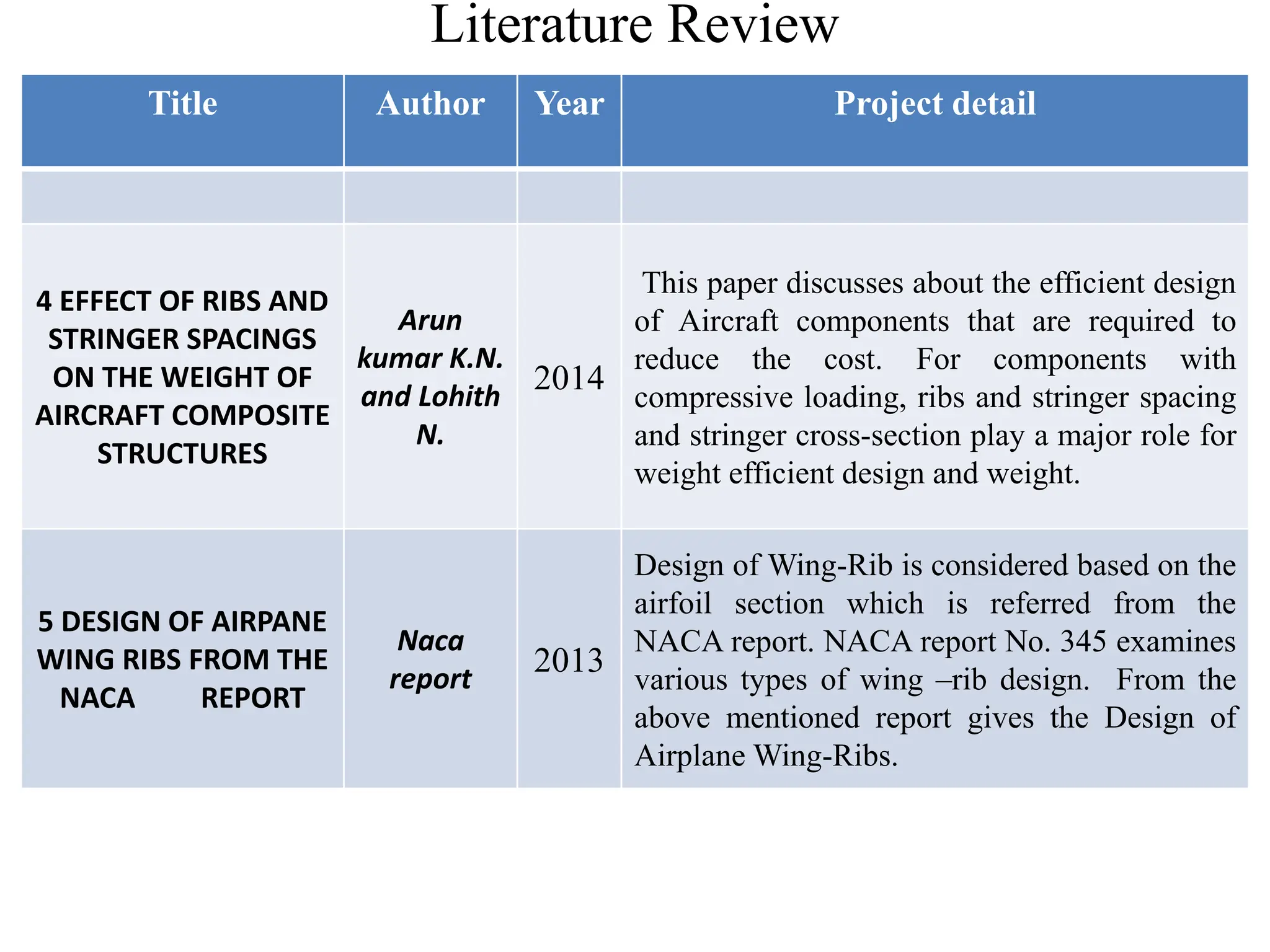
4 EFFECT OF RIBS AND
STRINGER SPACINGS
ON THE WEIGHT OF
AIRCRAFT COMPOSITE
STRUCTURES
Arun
kumar K.N.
and Lohith
N.
2014
This paper discusses about the efficient design
of Aircraft components that are required to
reduce the cost. For components with
compressive loading, ribs and stringer spacing
and stringer cross-section play a major role for
weight efficient design and weight.
5 DESIGN OF AIRPANE
WING RIBS FROM THE
NACA REPORT
Naca
report
2013
Design of Wing-Rib is considered based on the
airfoil section which is referred from the
NACA report. NACA report No. 345 examines
various types of wing –rib design. From the
above mentioned report gives the Design of
Airplane Wing-Ribs.
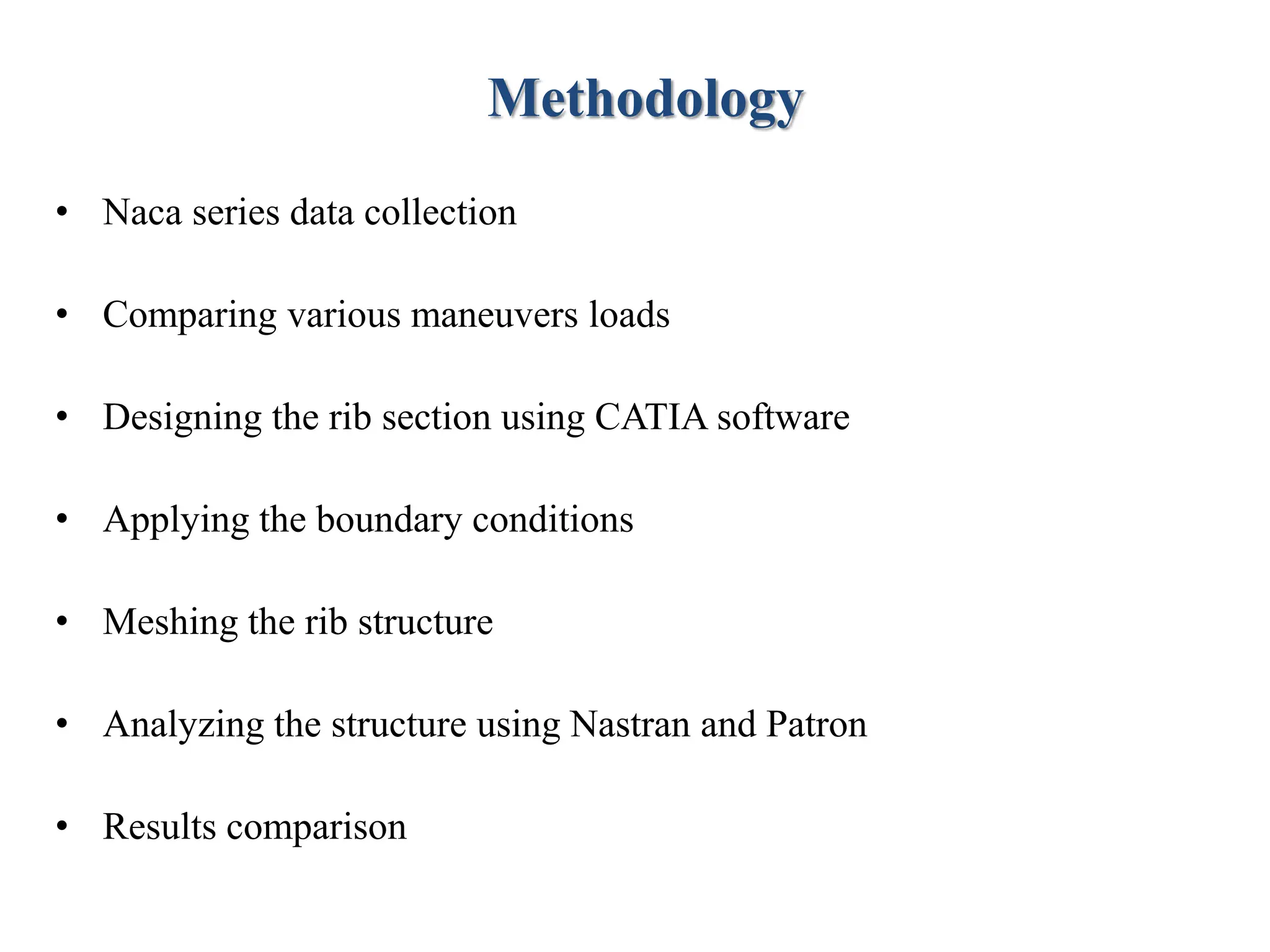
Methodology
• Naca series data collection
• Comparing various maneuvers loads
• Designing the rib section using CATIA software
• Applying the boundary conditions
• Meshing the rib structure
• Analyzing the structure using Nastran and Patron
• Results comparison
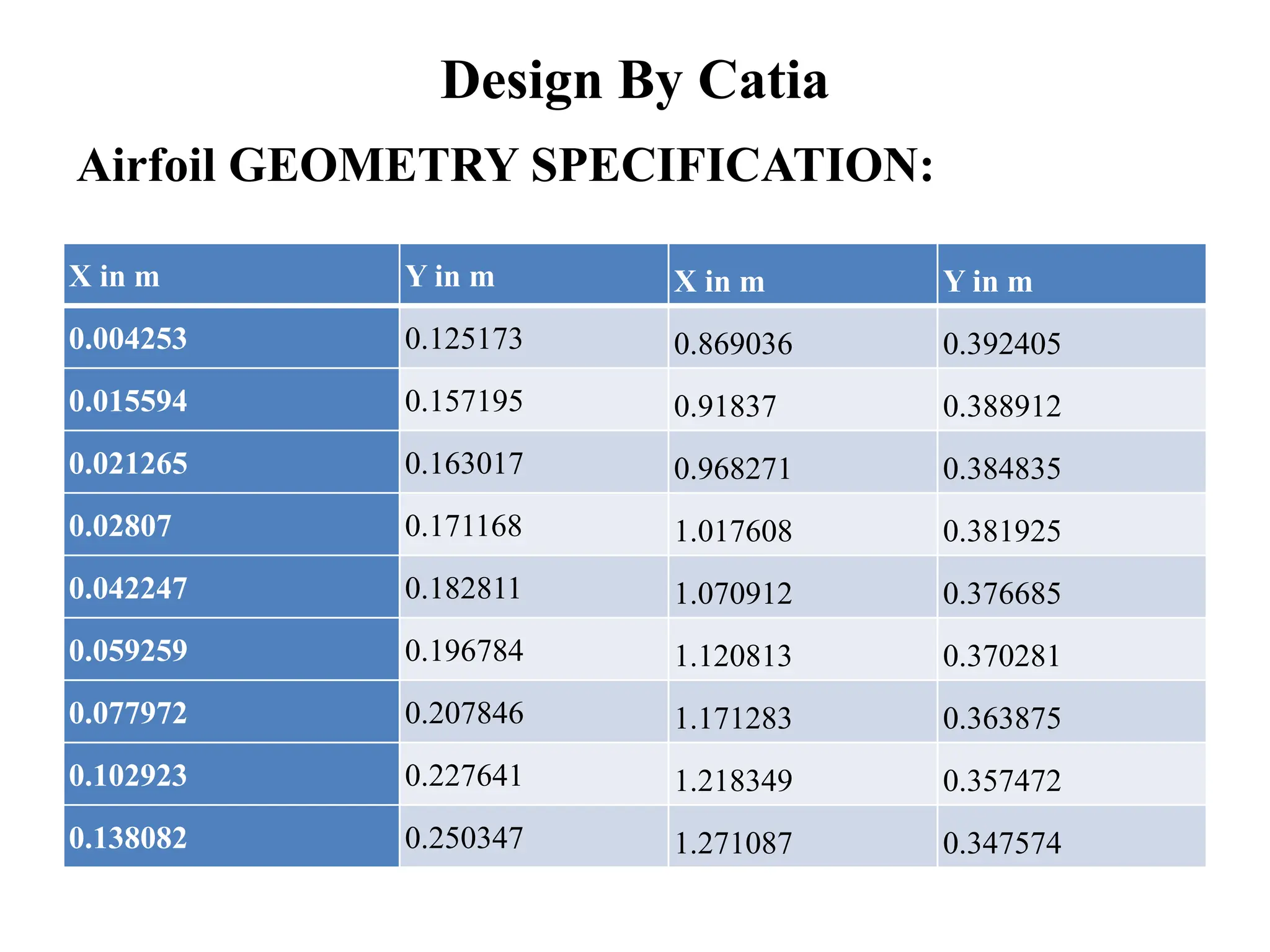
Design By Catia
Airfoil GEOMETRY SPECIFICATION:
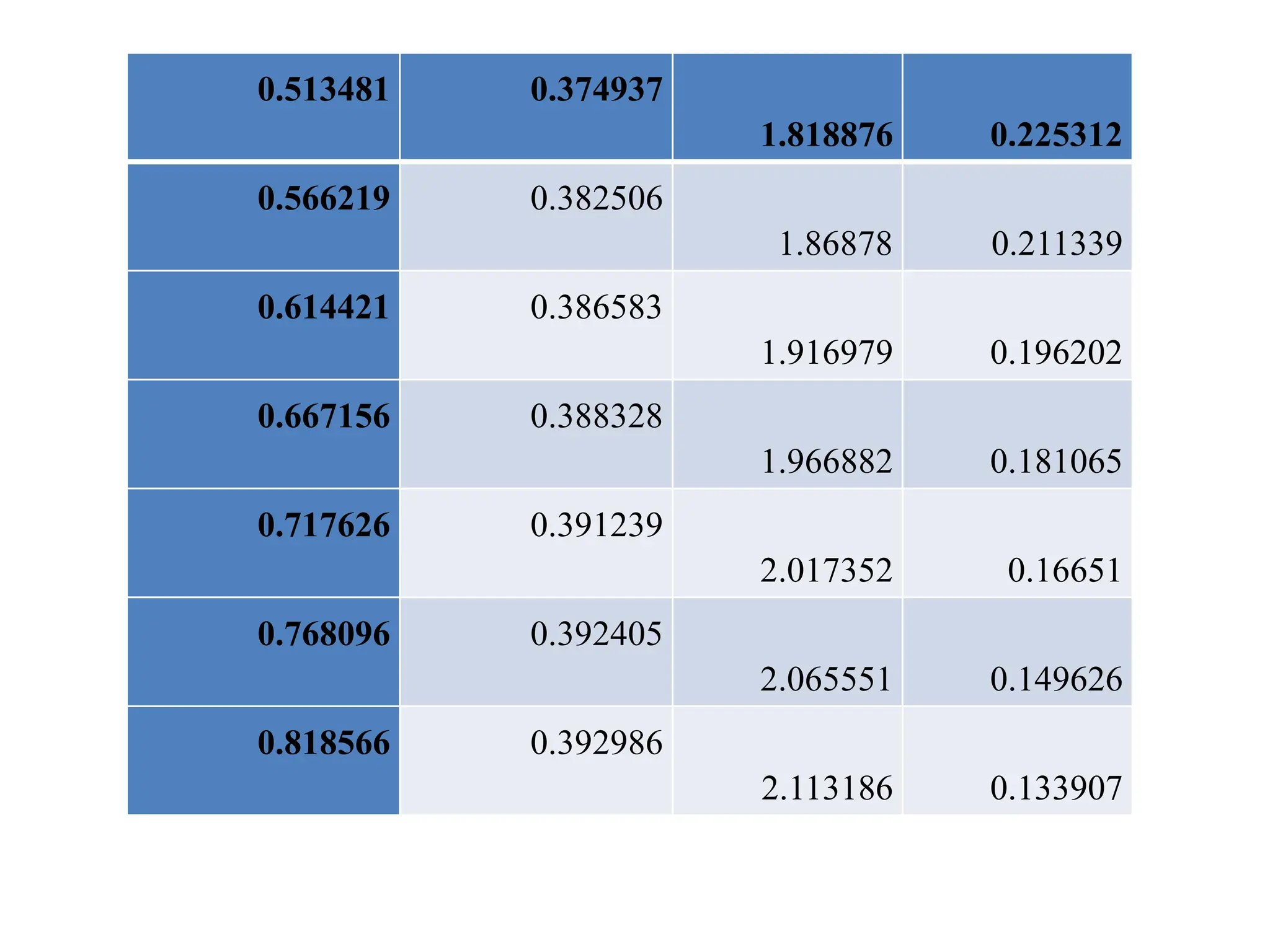
X in m Y in m X in m Y in m
0.004253 0.125173 0.869036 0.392405
0.015594 0.157195 0.91837 0.388912
0.021265 0.163017 0.968271 0.384835
0.02807 0.171168 1.017608 0.381925
0.042247 0.182811 1.070912 0.376685
0.059259 0.196784 1.120813 0.370281
0.077972 0.207846 1.171283 0.363875
0.102923 0.227641 1.218349 0.357472
0.138082 0.250347 1.271087 0.347574
0.171539 0.271305 1.320422 0.337678
0.203862 0.289936
1.370891 0.328361
0.233916 0.302163
1.426464 0.318465
0.257734 0.314389
1.497914 0.304493
0.283251 0.323705
1.576738 0.285862
0.30877 0.333019
1.625506 0.2748
0.357538 0.346992
1.674274 0.261991
0.418214 0.361549
1.720774 0.249765
0.465849 0.367952
1.768975 0.236956
0.513481 0.374937
1.818876 0.225312
0.566219 0.382506
1.86878 0.211339
0.614421 0.386583
1.916979 0.196202
0.667156 0.388328
1.966882 0.181065
0.717626 0.391239
2.017352 0.16651
0.768096 0.392405
2.065551 0.149626
0.818566 0.392986
2.113186 0.133907
2.16252 0.11644
1.375428 0.002911
2.211288 0.099557
1.278458 0.002329
2.260623 0.079762
1.147465 0.004658
2.307123 0.064624
1.045393 0.006404
2.359294 0.044829
0.972241 0.006986
2.381976 0.035514
0.92234 0.007569
2.401824 0.029692
0.874138 0.008151
2.383112 0.028528
0.768096 0.008733
2.357026 0.024453
0.619524 0.01048
2.323 0.020959
0.42275 0.008733
2.295215 0.020377
0.304234 0.013391
2.254954 0.015719
0.260568 0.015137
2.20108 0.012808
0.23505 0.016302
2.152312 0.01048
0.203862 0.021541
2.101845 0.008733
0.166435 0.026199
2.055345 0.006404
0.137514 0.032021
2.028124 0.002911
0.108027 0.039008
1.989564 0.002329
0.088746 0.045994
1.931723 0.002911
0.05699 0.057638
1.867078 0.002911
0.034308 0.071029
1.804132 0.001747
0.020698 0.083255
1.747992 0.002911
0.012759 0.091406
1.676542 0.002329
0.008223 0.100139
1.580139 0.002911
0.005954 0.109454
1.48147 0.002329
0.004253 0.119352
Airfoil diagram (WING RIB )
0
0.1
0.2
0.3
0.4
0.5
0 0.5 1 1.5 2 2.5 3
AIRFOIL
AIRFOIL
Length(m) X 2.401824
Height(m) Y 0.392986
Drafting model of airfoil
0.4m 0.35m 0.35m 0.35m 0.95m
• Number of spars = 2
• Number of web = 2
• Panels = 3
• Thickness of skin = 0.02m
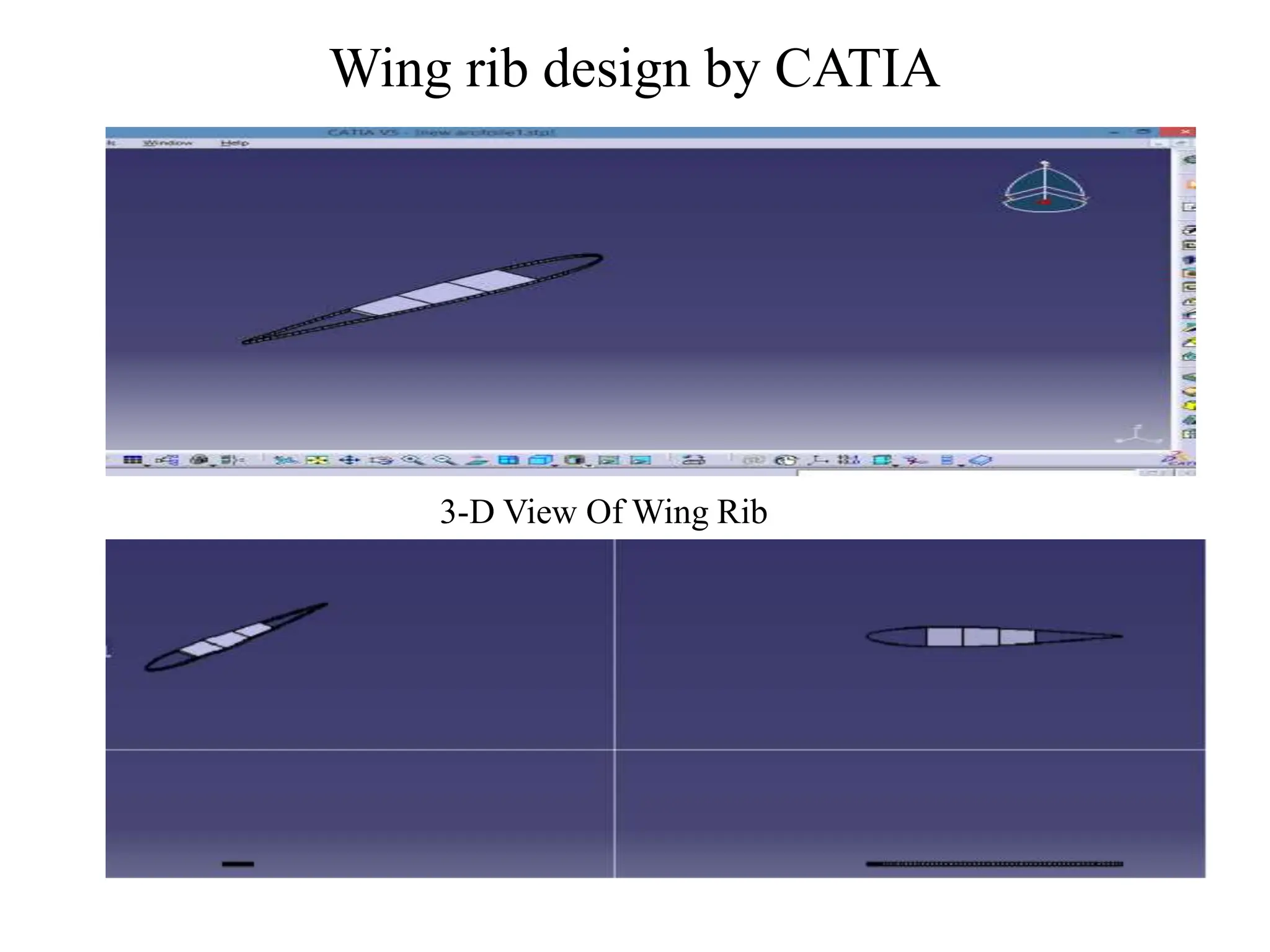
Wing rib design by CATIA
3-D View Of Wing Rib
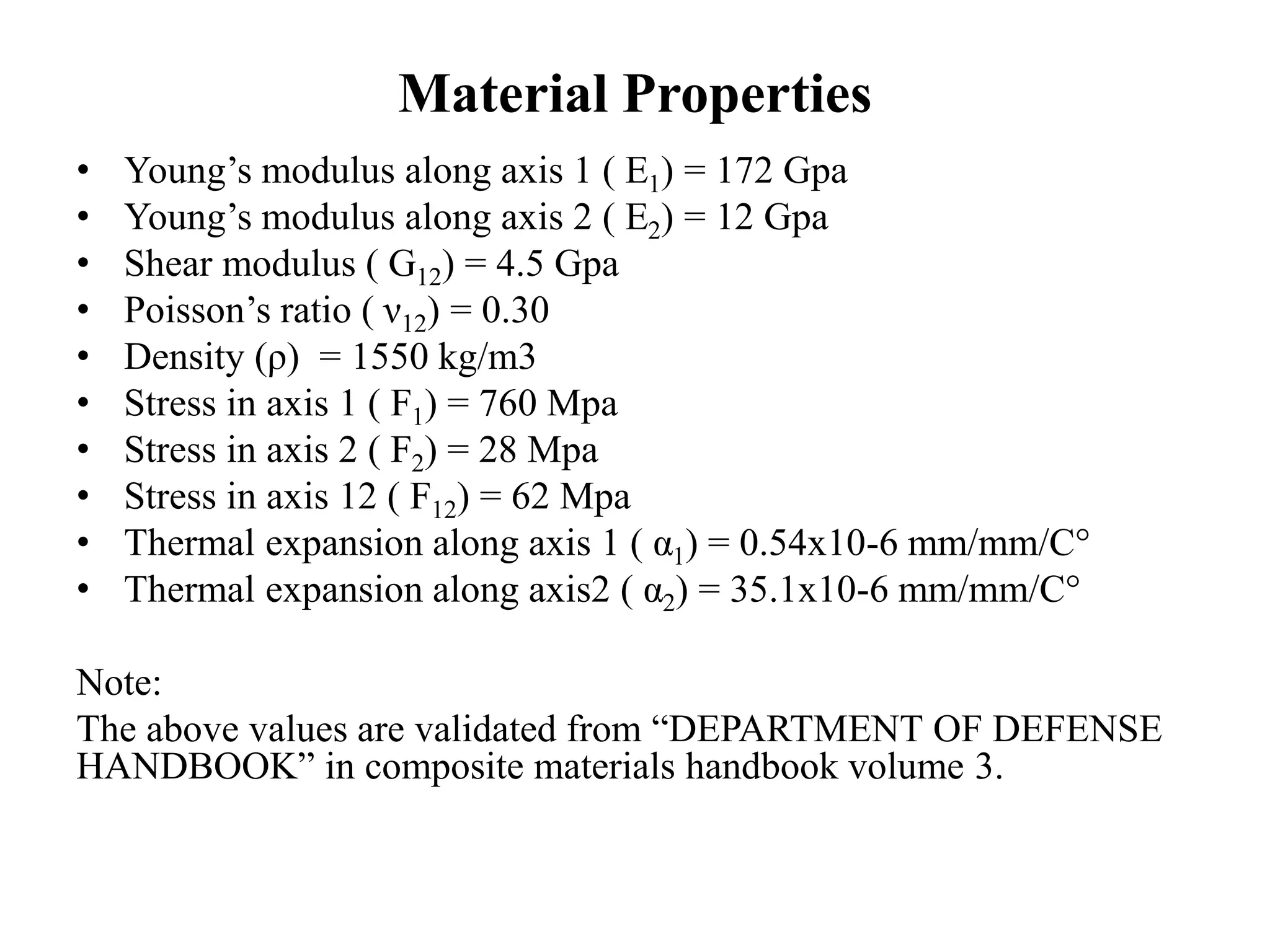
Material Properties
• Young’s modulus along axis 1 ( E1) = 172 Gpa
• Young’s modulus along axis 2 ( E2) = 12 Gpa
• Shear modulus ( G12) = 4.5 Gpa
• Poisson’s ratio ( ν12) = 0.30
• Density (ρ) = 1550 kg/m3
• Stress in axis 1 ( F1) = 760 Mpa
• Stress in axis 2 ( F2) = 28 Mpa
• Stress in axis 12 ( F12) = 62 Mpa
• Thermal expansion along axis 1 ( α1) = 0.54x10⁻⁶ mm/mm/C°
• Thermal expansion along axis2 ( α2) = 35.1x10⁻⁶ mm/mm/C°
Note:
The above values are validated from “DEPARTMENT OF DEFENSE
HANDBOOK” in composite materials handbook volume 3.
Final Load For Analysis
Fastener Fx in N Fy in N Fz in N
1 -3545 2490 1257
2 -2605 2519 1131
3 -1731 1746 1341
4 -1358 871 1597
5 -1289 746 1513
6 1156 -13 1080
7 1328 -546 668
8 -1898 -1428 514
9 -1353 -917 904
10 1568 621 1312
11 308 -98 1788
12 1881 1400 1718
13 1218 3141 747
14 2984 2554 484
15 2051 4943 1128
16 2032 4876 1146
17 1899 1378 1699
18 3229 3151 746
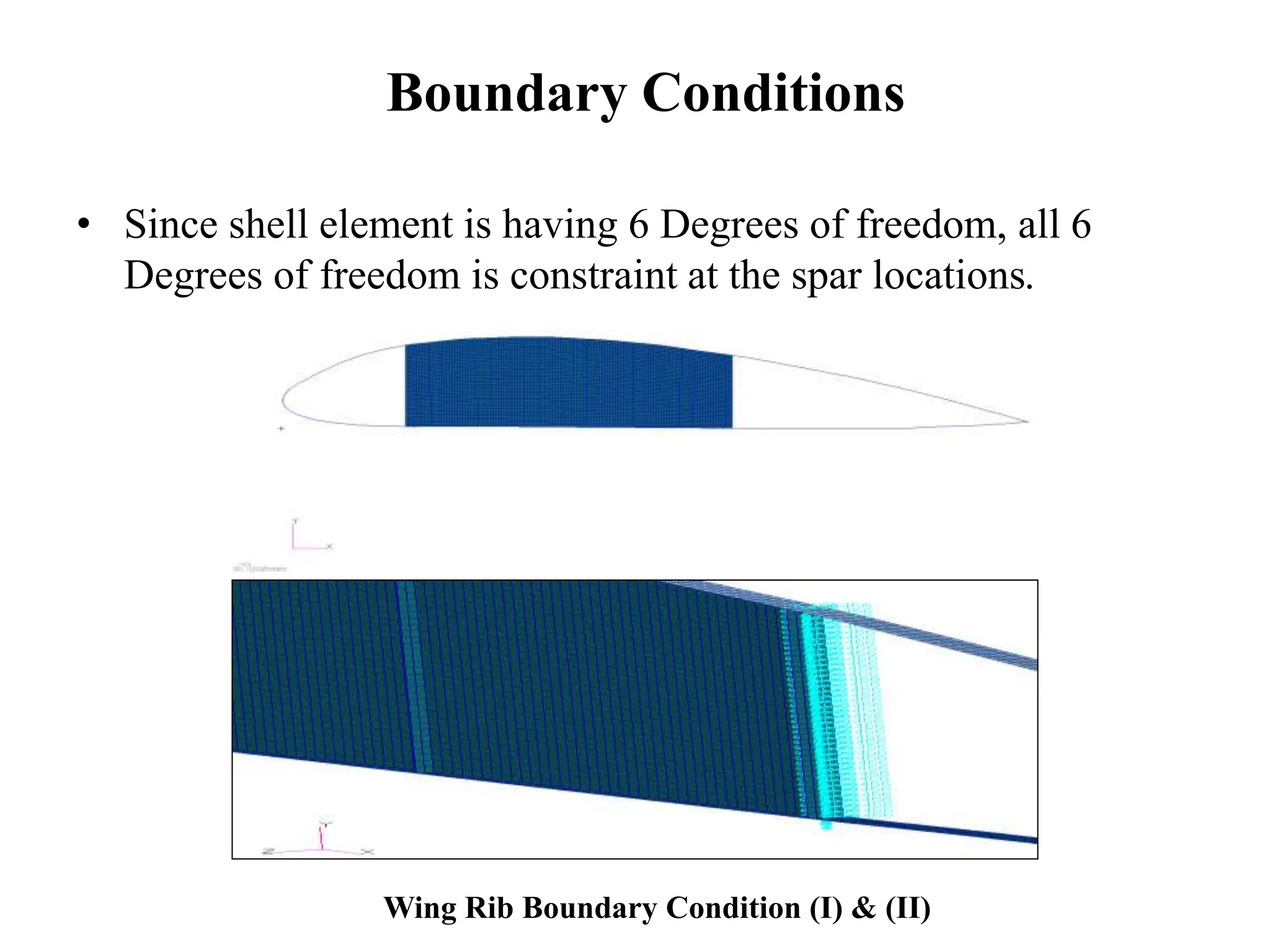
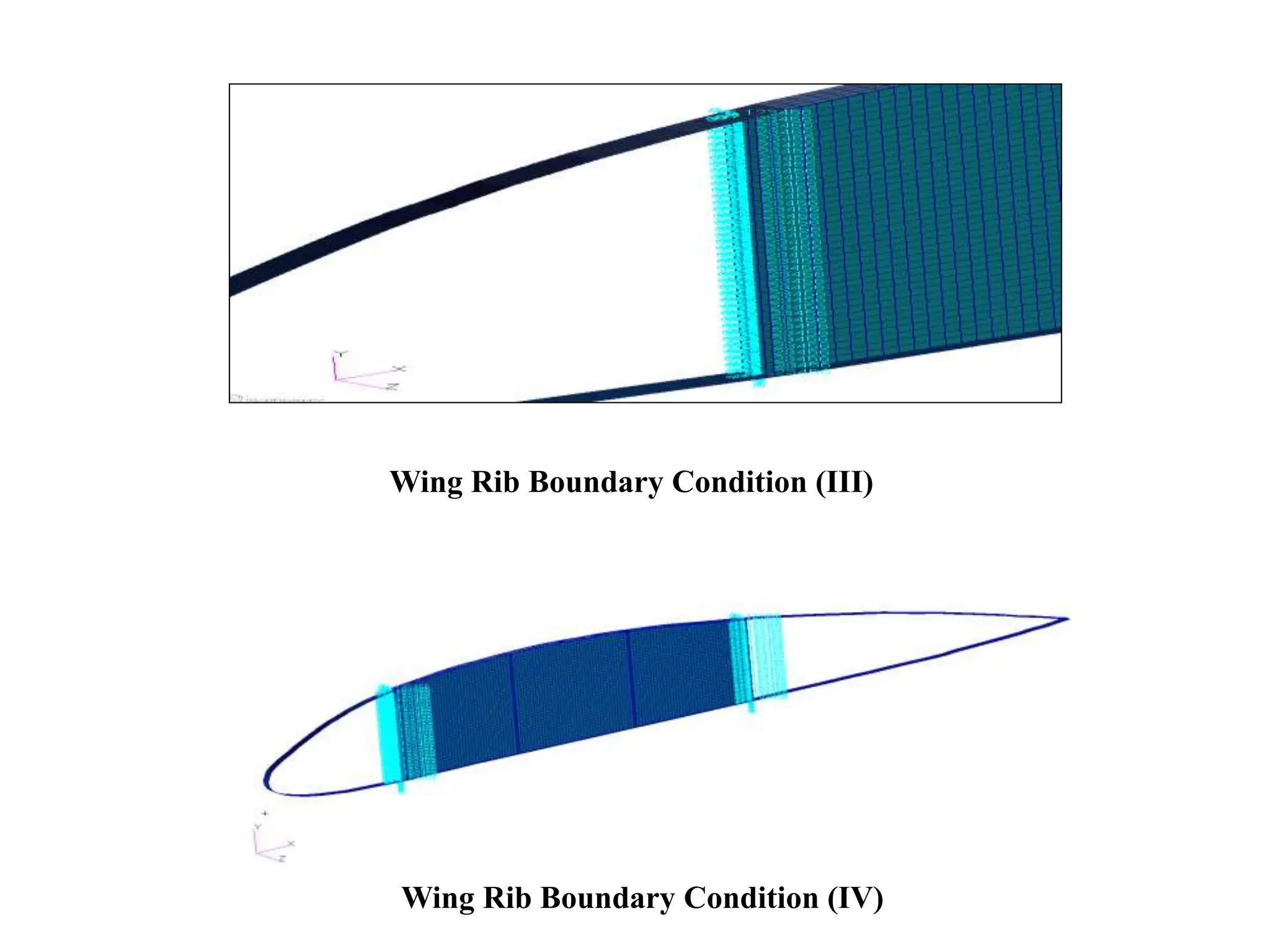
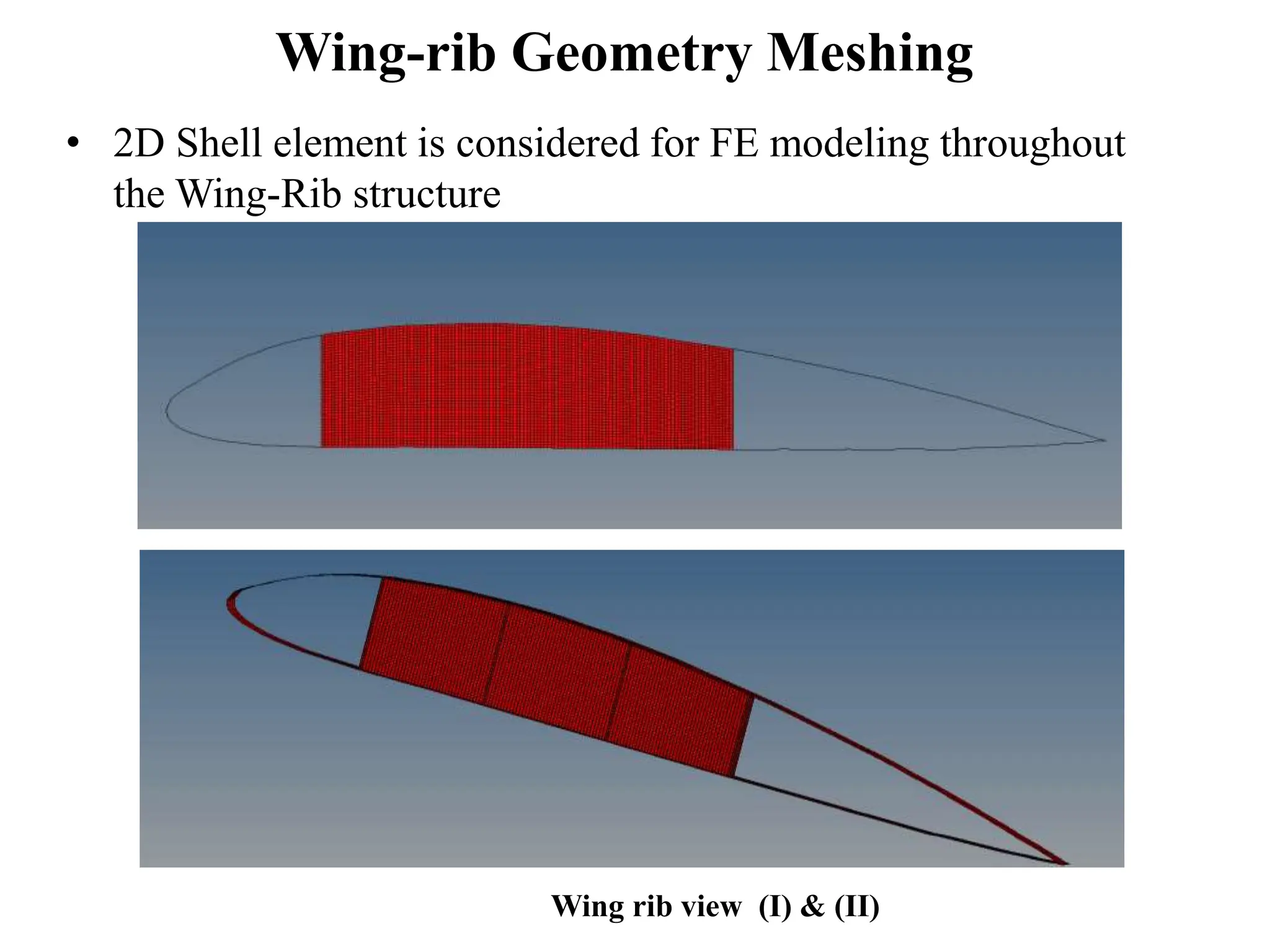
Boundary Conditions
• Since shell element is having 6 Degrees of freedom, all 6
Degrees of freedom is constraint at the spar locations.
Wing Rib Boundary Condition (I)
Wing Rib Boundary Condition (I) & (II)
Wing Rib Boundary Condition (III)
Wing Rib Boundary Condition (IV)
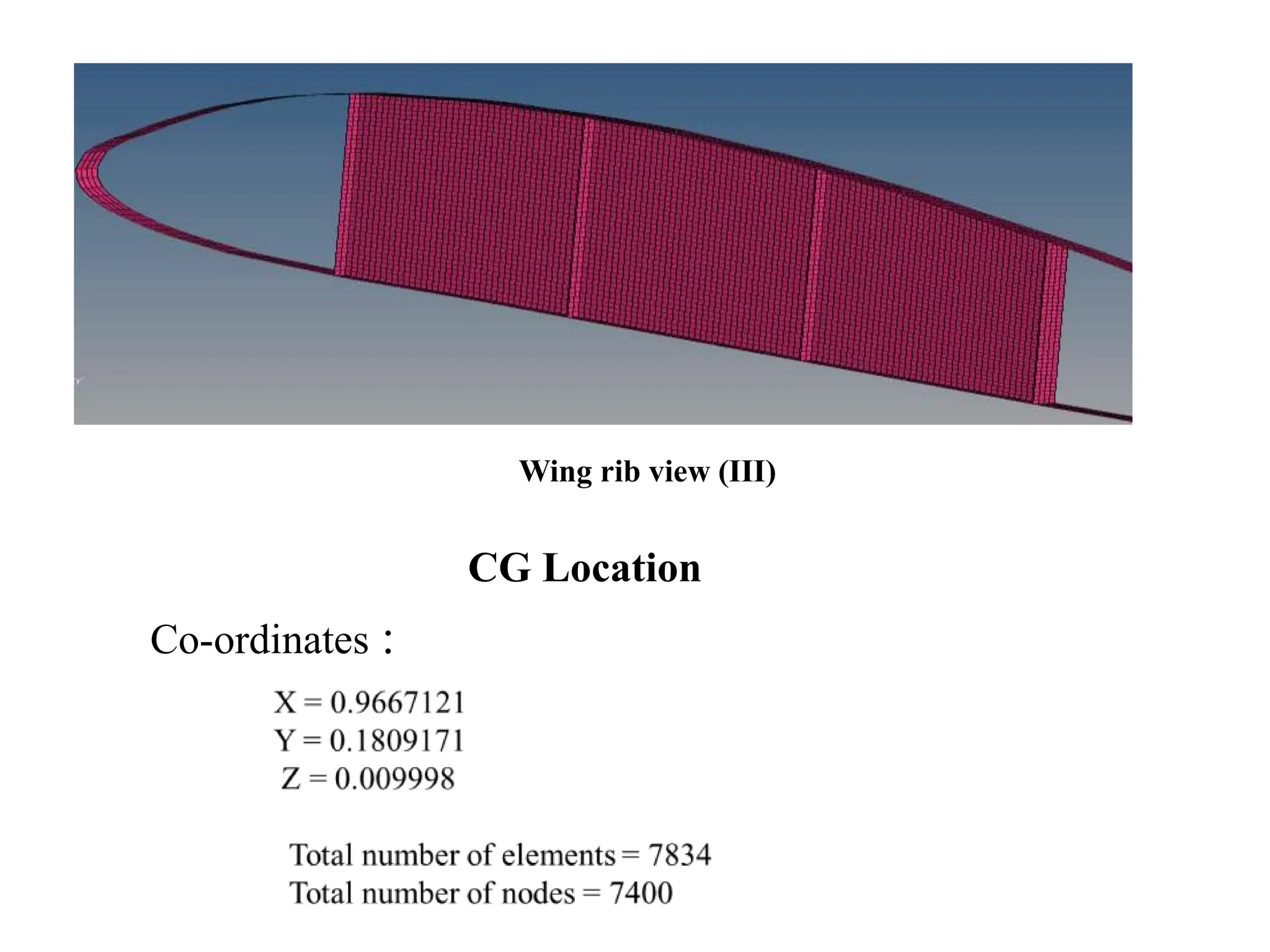
Wing-rib Geometry Meshing
• 2D Shell element is considered for FE modeling throughout
the Wing-Rib structure
Wing rib view (I) & (II)
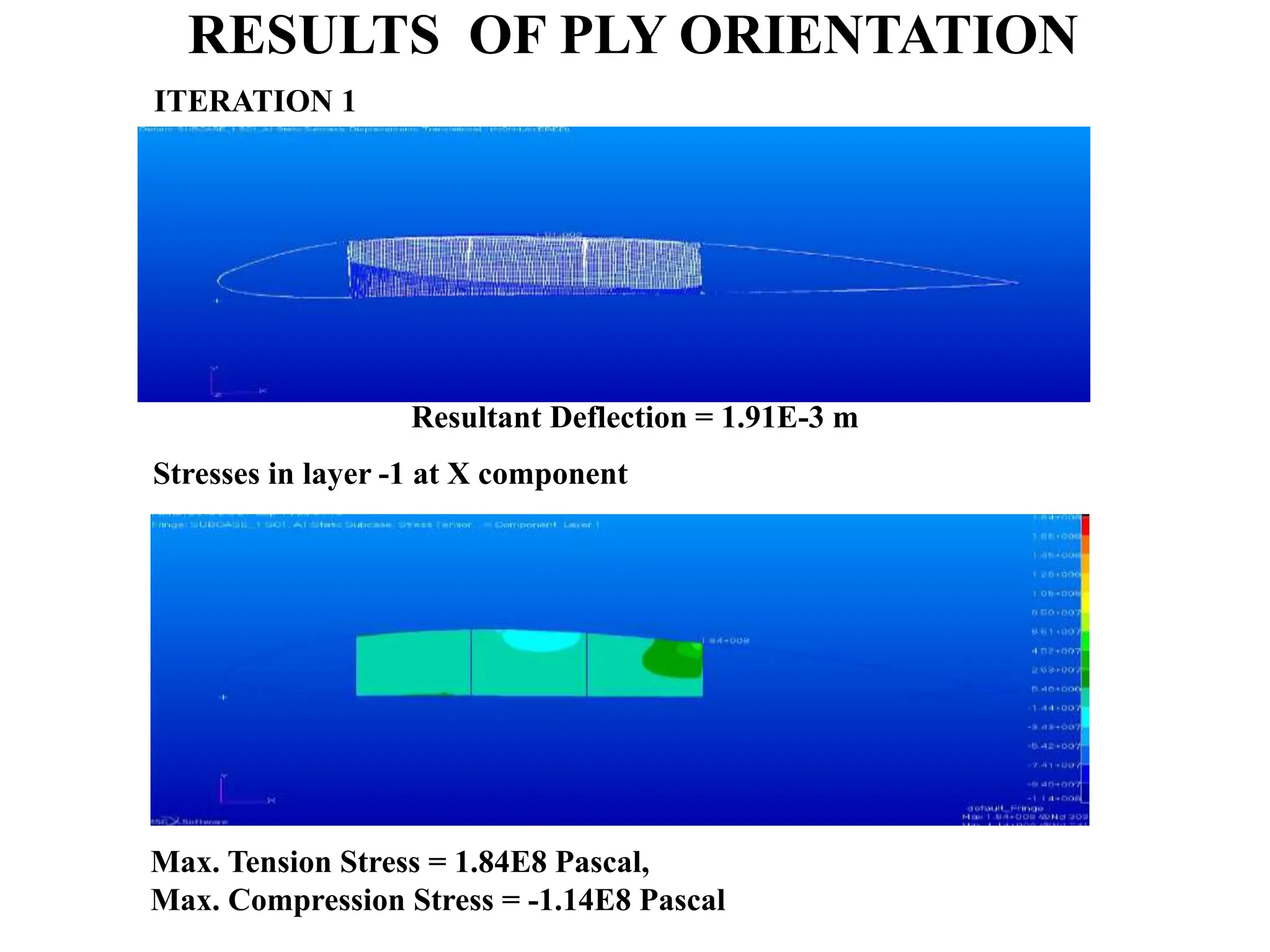
Wing rib view (III)
CG Location
Co-ordinates :
Resultant Load Details In Patran
Load at nodal points
Various loads at nodes
RESULTS OF PLY ORIENTATION
Resultant Deflection = 1.91E-3 m
ITERATION 1
Stresses in layer -1 at X component
Max. Tension Stress = 1.84E8 Pascal,
Max. Compression Stress = -1.14E8 Pascal
Stresses in layer -2 at X component
Max. Tension Stress = 2.99E7 Pascal,
Max. Compression Stress = -2.88E7 Pascal
Stresses in layer -3 at X component
Max. Tension Stress = 1.15E7 Pascal,
Max. Compression Stress = -1.96E7 Pascal
Stresses in layer -4 at X component
Max. Tension Stress = 3.89E7 Pascal,
Max. Compression Stress = -2.81E7 Pascal
Stresses in layer -5 at X component
Max. Tension Stress = 4.26E7 Pascal,
Max. Compression Stress = -3.04E7 Pascal
Stresses in layer -6 at X component
Max. Tension Stress = 1.27E8 Pascal,
Max. Compression Stress = -1.40E7 Pascal
Stresses in layer -1 at Y component
Max. Tension Stress = 3.42 E6 Pascal,
Max. Compression Stress = -4.11E6 Pascal
Stresses in layer -3 at Y component
Max. Tension Stress = 1.08E7 Pascal,
Max. Compression Stress = -6.76E6 Pascal
Stresses in layer -4 at Y component
Max. Tension Stress = 9.78E6 Pascal,
Max. Compression Stress = -6.34E6 Pascal
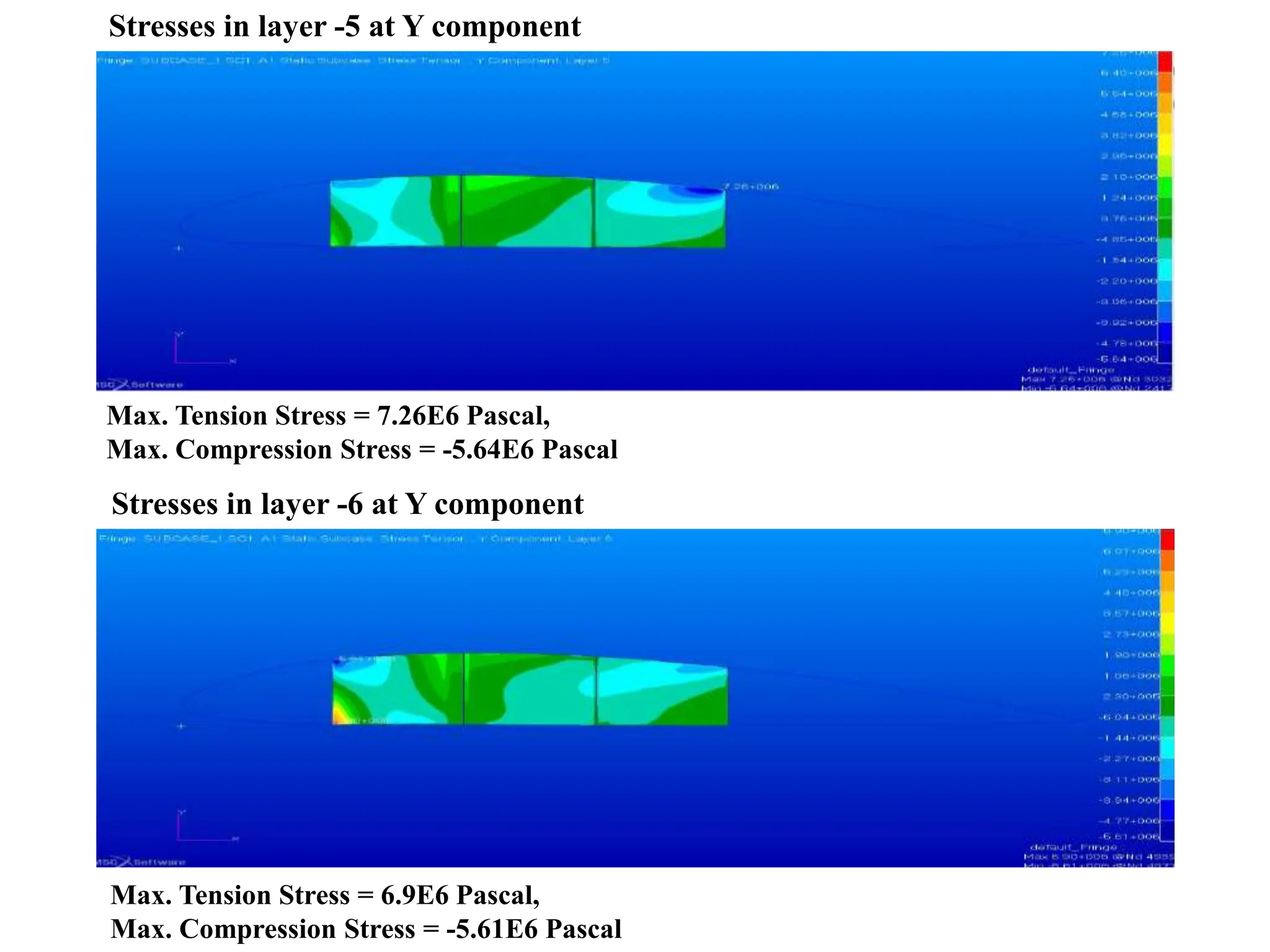
Stresses in layer -5 at Y component
Max. Tension Stress = 7.26E6 Pascal,
Max. Compression Stress = -5.64E6 Pascal
Stresses in layer -6 at Y component
Max. Tension Stress = 6.9E6 Pascal,
Max. Compression Stress = -5.61E6 Pascal
Stresses in layer -1 at XY component
Max. Tension Stress = 1.65E6 Pascal,
Max. Compression Stress = -3.81E6 Pascal
Stresses in layer -3 at XY component
Max. Tension Stress = 2.91E6 Pascal,
Max. Compression Stress = -1.39E6 Pascal
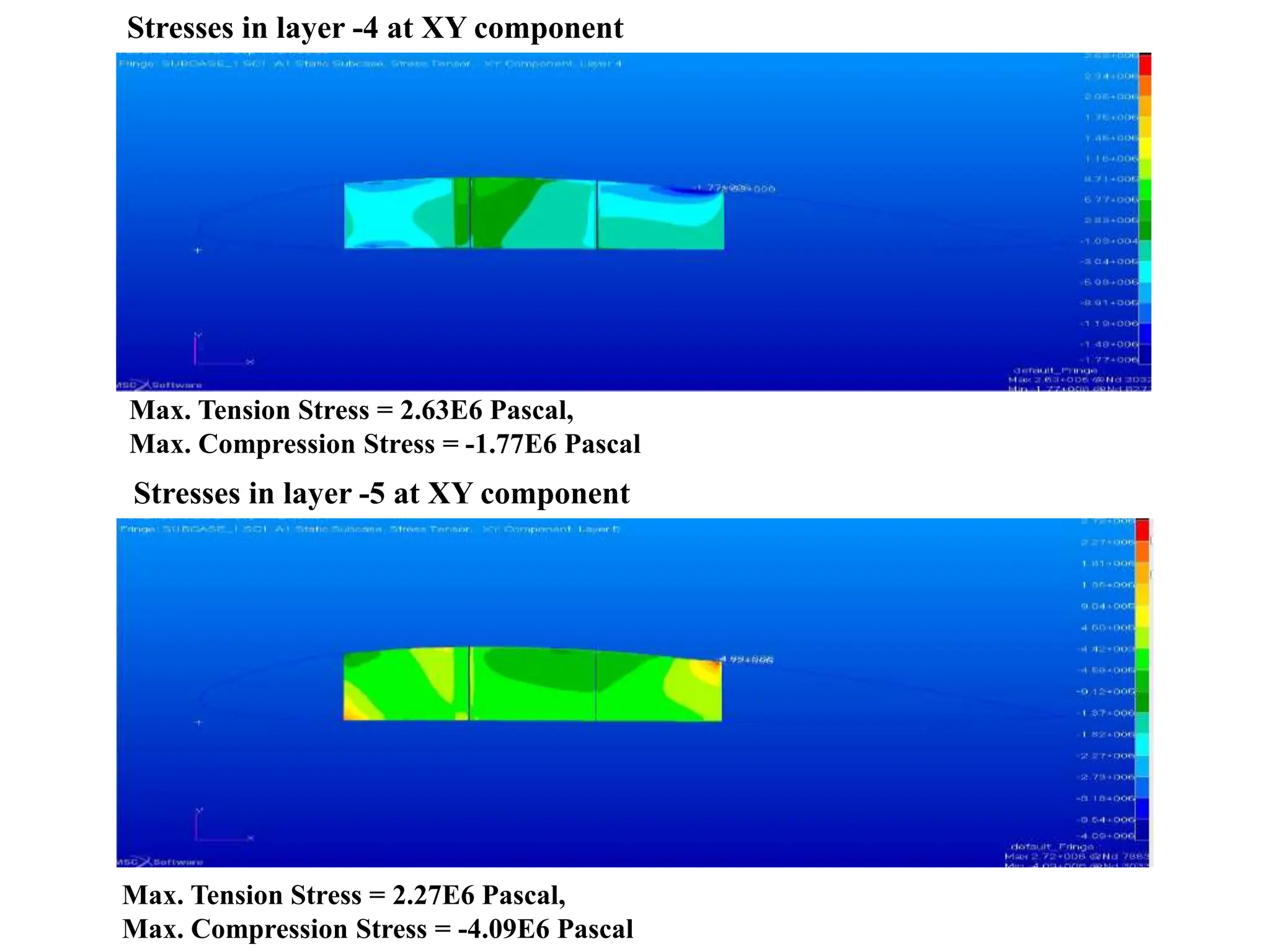
Stresses in layer -4 at XY component
Max. Tension Stress = 2.63E6 Pascal,
Max. Compression Stress = -1.77E6 Pascal
Stresses in layer -5 at XY component
Max. Tension Stress = 2.27E6 Pascal,
Max. Compression Stress = -4.09E6 Pascal
Stresses in layer -6 at XY component
Max. Tension Stress = 3.40E6 Pascal,
Max. Compression Stress = -3.41E6 Pascal
Continued….
Result Validation
Iteration-1 Results of X, Y&XY Direction
Orientation
Detail
Layers No.
X Direction
Allowable
considered
RF in
tension
RF in
Compres-
sion
Critical
RF
Max Stress Min Stress
Pa Pa Pa
0/45/90/90/45
/0
Layer 1 204295152 -120383104 760000000 3.72 6.31
3.72
Layer 2 34252396 -37941276 760000000 22.19 20.03
Layer 3 22130704 -36845248 760000000 34.34 20.63
Layer 4 65532040 -40580336 760000000 11.60 18.73
Layer 5 55600776 -49659020 760000000 13.67 15.30
Layer 6 133911024 -174860992 760000000 5.68 4.35
Orientation
Detail
Layers No.
Y Direction
Allowable
considered
RF in
tension
RF in
Compres-
sion
Critical
RF
Max Stress Min Stress
Pa Pa Pa
0/45/90/90/45
/0
Layer 1 3930982 -4663110.5 28000000 7.12 6.00
2.50
Layer 2 11004487 -5261050 28000000 2.54 5.32
Layer 3 11202616 -6974120.5 28000000 2.50 4.01
Layer 4 9815930 -6444062.5 28000000 2.85 4.35
Layer 5 9027870 -6150916 28000000 3.10 4.55
Layer 6 11115873 -7396589.5 28000000 2.52 3.79
Orientation
Detail
Layers No.
XY Direction
Allowable
considered
RF in
tension
RF in
Compres-
sion
Critical
RF
Max Stress Min Stress
Pa Pa Pa
0/45/90/90/45
/0
Layer 1 2114860.75 -3821076.75 68000000 32.15 17.80
13.50
Layer 2 3272625.25 -5038519.5 68000000 20.78 13.50
Layer 3 3380191.5 -1443327.125 68000000 20.12 47.11
Layer 4 3495811.75 -2087791.75 68000000 19.45 32.57
Layer 5 3457449 -4239710 68000000 19.67 16.04
Layer 6 3659359.25 -4261850.5 68000000 18.58 15.96
Continued….
Comparison For Different Ply Orientations
ITERATIONS Ply Orientation
Critical RF
in X
direction
Critical RF
in Y direction
Critical RF in XY
direction
Iteration 1 0/45/90/90/45/0 3.72 2.50 13.50
Iteration 2 0//30/60/60/30/0 3.95 1.43 11.53
Iteration 3 0/15/30/30/15/0 4.24 1.00 9.20
Iteration 4 0/10/20/20/10/0 7.28 0.91 7.67
Most reliable ply orientation based on stresses in X, Y & XY
Components is 0/45/90/90/45/0
DEFLECTION PLOTS FOR DIFFERENT PLY ORIENTATION
ITERATIONS Ply Orientation
Resultant
deflection in mm
Iteration 1 0/45/90/90/45/0 1.91
Iteration 2 0//30/60/60/30/0 1.93
Iteration 3 0/15/30/30/15/0 1.99
Iteration 4 0/10/20/20/10/0 1.99
Minimum Resultant deflection = 1.91 mm
Conclusion
• Based on stresses in X, Y and XY directions, iteration 1 gives
more reliable than any other ply orientation. Based on
Resultant deflection values, iteration 1 gives minimum
resultant deflection value of 1.91 mm.
• Hence it is reasonable to conclude that iteration 1 is more
reliable ply orientation for modeling of composite wing-rib.So
that it concludes, the ply orientation of 0/45/90/90/45/0 is safer
based on strength values of the composite wing ribs
THANK YOU

Airfoil analysis using ansys in airplanewing ribs.pptx

  • 1.
    SURYA GROUP OFINSTITUTIONS DEPARTMENT OF CAD/CAM ENGINEERING FINAL YEAR PROJECT WORK PHASE – II DESIGN AND ANALYSIS OF WING RIB USING FINITE ELEMENT METHOD Presented by, J.Muthuraman (REG:NO:422217402006) Guide Name: Project Co-ordinator: Dr. M.Shankar M.E,Ph.D., Mr.M.Vivekanandhan M.E, (Ph.D)
  • 2.
    Abstract • Composite materialshave received considerable attention as alternatives to other structural materials in the construction of aerospace industries due to a high strength-to-weight ratio, a high stiffness-to-weight ratio, corrosion and fatigue resistance, ease of handling, and ease of fabrication. • This research paper deals with the design and analysis of aircraft structural wing- rib using composite materials. The optimum design parameters for an aircraft structural wing-rib are suitably selected based on the classical approach. • The three dimensional structural wing-rib is designed based on the design parameters using Computer Aided Design (CAD) software. • Wing-ribs are exported to the CAE tool and Finite Element Modeling is prepared based on the design parameters. Composite Material properties and boundary conditions are executed with suitable conditions in CAE tool. • A complete set of finite element analysis were conducted on different fiber oriented composite systems. Critical displacement and Stress tensor were obtained from Finite Element Tool and the results are compared based on the fiber orientation. • Key words: Wing-Rib, Composites, fatigue resistance, Finite Element Method.
  • 3.
    Introduction • Widespread useof composite materials in industry is due to the good characteristics of its strength to density and hardness to density. The possibility of increase in these characteristics using the latest technology and various manufacturing methods has raised application range of these materials. • Modern materials engineering, the term usually refers to a “matrix” material that is reinforced with fibers. For instance, the term “FRP" (Fiber Reinforced Plastic) usually indicates a thermosetting polyester matrix containing glass fibres. • Ribs are forming elements of the structure of a wing, especially the ribs attach to the main spar, and by being repeated at frequent intervals, form a skeletal shape for the wing. • Usually ribs incorporate the airfoil shape of the wing, and the skin adopts this shape when stretched over the ribs. ribs which must absorb and transmit large concentrated applied loads such as those from landing gear reactions, power plant reactions and fuselage reactions.
  • 4.
    Literature Review Title AuthorYear Project detail Wing Rib Stress Analysis And Design Optimization Ramin Sedaghati 2006 This paper explains the improvement of the available structural analysis modules and performs a structural design optimization of the wing box by adding an optimization loop around the analysis code. Design And Analysis Of A Typical Wing Rib For Passenger Aircraft Bindu H.C, Muhammed Mushin Ali.H 2013 This paper explains about the usage of composite materials to reduce the weight. In order to increase the buckling strength of the plate, the number of holes has to be increased. Meanwhile stress in the component keeps on increased as the number of holes increased Finite Element Analysis Of Aircraft Wing Using Composite Structure Dr. R.Rajappan ,V.Pugazhenthi 2013 A monocoque aircraft wing is made of laminated composite with fiber angles in each ply aligned in different direction. Various airfoil thickness and ply angles were considered to study the effect of bending-torsion decoupling.
  • 5.
    Literature Review Title AuthorYear Project detail 4 EFFECT OF RIBS AND STRINGER SPACINGS ON THE WEIGHT OF AIRCRAFT COMPOSITE STRUCTURES Arun kumar K.N. and Lohith N. 2014 This paper discusses about the efficient design of Aircraft components that are required to reduce the cost. For components with compressive loading, ribs and stringer spacing and stringer cross-section play a major role for weight efficient design and weight. 5 DESIGN OF AIRPANE WING RIBS FROM THE NACA REPORT Naca report 2013 Design of Wing-Rib is considered based on the airfoil section which is referred from the NACA report. NACA report No. 345 examines various types of wing –rib design. From the above mentioned report gives the Design of Airplane Wing-Ribs.
  • 6.
    Methodology • Naca seriesdata collection • Comparing various maneuvers loads • Designing the rib section using CATIA software • Applying the boundary conditions • Meshing the rib structure • Analyzing the structure using Nastran and Patron • Results comparison
  • 7.
    Design By Catia AirfoilGEOMETRY SPECIFICATION: X in m Y in m X in m Y in m 0.004253 0.125173 0.869036 0.392405 0.015594 0.157195 0.91837 0.388912 0.021265 0.163017 0.968271 0.384835 0.02807 0.171168 1.017608 0.381925 0.042247 0.182811 1.070912 0.376685 0.059259 0.196784 1.120813 0.370281 0.077972 0.207846 1.171283 0.363875 0.102923 0.227641 1.218349 0.357472 0.138082 0.250347 1.271087 0.347574
  • 8.
    0.171539 0.271305 1.3204220.337678 0.203862 0.289936 1.370891 0.328361 0.233916 0.302163 1.426464 0.318465 0.257734 0.314389 1.497914 0.304493 0.283251 0.323705 1.576738 0.285862 0.30877 0.333019 1.625506 0.2748 0.357538 0.346992 1.674274 0.261991 0.418214 0.361549 1.720774 0.249765 0.465849 0.367952 1.768975 0.236956
  • 9.
    0.513481 0.374937 1.818876 0.225312 0.5662190.382506 1.86878 0.211339 0.614421 0.386583 1.916979 0.196202 0.667156 0.388328 1.966882 0.181065 0.717626 0.391239 2.017352 0.16651 0.768096 0.392405 2.065551 0.149626 0.818566 0.392986 2.113186 0.133907
  • 10.
    2.16252 0.11644 1.375428 0.002911 2.2112880.099557 1.278458 0.002329 2.260623 0.079762 1.147465 0.004658 2.307123 0.064624 1.045393 0.006404 2.359294 0.044829 0.972241 0.006986 2.381976 0.035514 0.92234 0.007569 2.401824 0.029692 0.874138 0.008151 2.383112 0.028528 0.768096 0.008733 2.357026 0.024453 0.619524 0.01048
  • 11.
    2.323 0.020959 0.42275 0.008733 2.2952150.020377 0.304234 0.013391 2.254954 0.015719 0.260568 0.015137 2.20108 0.012808 0.23505 0.016302 2.152312 0.01048 0.203862 0.021541 2.101845 0.008733 0.166435 0.026199 2.055345 0.006404 0.137514 0.032021 2.028124 0.002911 0.108027 0.039008 1.989564 0.002329 0.088746 0.045994
  • 12.
    1.931723 0.002911 0.05699 0.057638 1.8670780.002911 0.034308 0.071029 1.804132 0.001747 0.020698 0.083255 1.747992 0.002911 0.012759 0.091406 1.676542 0.002329 0.008223 0.100139 1.580139 0.002911 0.005954 0.109454 1.48147 0.002329 0.004253 0.119352
  • 13.
    Airfoil diagram (WINGRIB ) 0 0.1 0.2 0.3 0.4 0.5 0 0.5 1 1.5 2 2.5 3 AIRFOIL AIRFOIL Length(m) X 2.401824 Height(m) Y 0.392986 Drafting model of airfoil 0.4m 0.35m 0.35m 0.35m 0.95m • Number of spars = 2 • Number of web = 2 • Panels = 3 • Thickness of skin = 0.02m
  • 14.
    Wing rib designby CATIA 3-D View Of Wing Rib
  • 15.
    Material Properties • Young’smodulus along axis 1 ( E1) = 172 Gpa • Young’s modulus along axis 2 ( E2) = 12 Gpa • Shear modulus ( G12) = 4.5 Gpa • Poisson’s ratio ( ν12) = 0.30 • Density (ρ) = 1550 kg/m3 • Stress in axis 1 ( F1) = 760 Mpa • Stress in axis 2 ( F2) = 28 Mpa • Stress in axis 12 ( F12) = 62 Mpa • Thermal expansion along axis 1 ( α1) = 0.54x10⁻⁶ mm/mm/C° • Thermal expansion along axis2 ( α2) = 35.1x10⁻⁶ mm/mm/C° Note: The above values are validated from “DEPARTMENT OF DEFENSE HANDBOOK” in composite materials handbook volume 3.
  • 16.
    Final Load ForAnalysis Fastener Fx in N Fy in N Fz in N 1 -3545 2490 1257 2 -2605 2519 1131 3 -1731 1746 1341 4 -1358 871 1597 5 -1289 746 1513 6 1156 -13 1080 7 1328 -546 668 8 -1898 -1428 514 9 -1353 -917 904 10 1568 621 1312 11 308 -98 1788 12 1881 1400 1718 13 1218 3141 747 14 2984 2554 484 15 2051 4943 1128 16 2032 4876 1146 17 1899 1378 1699 18 3229 3151 746
  • 17.
    Boundary Conditions • Sinceshell element is having 6 Degrees of freedom, all 6 Degrees of freedom is constraint at the spar locations. Wing Rib Boundary Condition (I) Wing Rib Boundary Condition (I) & (II)
  • 18.
    Wing Rib BoundaryCondition (III) Wing Rib Boundary Condition (IV)
  • 19.
    Wing-rib Geometry Meshing •2D Shell element is considered for FE modeling throughout the Wing-Rib structure Wing rib view (I) & (II)
  • 20.
    Wing rib view(III) CG Location Co-ordinates :
  • 21.
    Resultant Load DetailsIn Patran Load at nodal points Various loads at nodes
  • 22.
    RESULTS OF PLYORIENTATION Resultant Deflection = 1.91E-3 m ITERATION 1 Stresses in layer -1 at X component Max. Tension Stress = 1.84E8 Pascal, Max. Compression Stress = -1.14E8 Pascal
  • 23.
    Stresses in layer-2 at X component Max. Tension Stress = 2.99E7 Pascal, Max. Compression Stress = -2.88E7 Pascal Stresses in layer -3 at X component Max. Tension Stress = 1.15E7 Pascal, Max. Compression Stress = -1.96E7 Pascal
  • 24.
    Stresses in layer-4 at X component Max. Tension Stress = 3.89E7 Pascal, Max. Compression Stress = -2.81E7 Pascal Stresses in layer -5 at X component Max. Tension Stress = 4.26E7 Pascal, Max. Compression Stress = -3.04E7 Pascal
  • 25.
    Stresses in layer-6 at X component Max. Tension Stress = 1.27E8 Pascal, Max. Compression Stress = -1.40E7 Pascal Stresses in layer -1 at Y component Max. Tension Stress = 3.42 E6 Pascal, Max. Compression Stress = -4.11E6 Pascal
  • 26.
    Stresses in layer-3 at Y component Max. Tension Stress = 1.08E7 Pascal, Max. Compression Stress = -6.76E6 Pascal Stresses in layer -4 at Y component Max. Tension Stress = 9.78E6 Pascal, Max. Compression Stress = -6.34E6 Pascal
  • 27.
    Stresses in layer-5 at Y component Max. Tension Stress = 7.26E6 Pascal, Max. Compression Stress = -5.64E6 Pascal Stresses in layer -6 at Y component Max. Tension Stress = 6.9E6 Pascal, Max. Compression Stress = -5.61E6 Pascal
  • 28.
    Stresses in layer-1 at XY component Max. Tension Stress = 1.65E6 Pascal, Max. Compression Stress = -3.81E6 Pascal Stresses in layer -3 at XY component Max. Tension Stress = 2.91E6 Pascal, Max. Compression Stress = -1.39E6 Pascal
  • 29.
    Stresses in layer-4 at XY component Max. Tension Stress = 2.63E6 Pascal, Max. Compression Stress = -1.77E6 Pascal Stresses in layer -5 at XY component Max. Tension Stress = 2.27E6 Pascal, Max. Compression Stress = -4.09E6 Pascal
  • 30.
    Stresses in layer-6 at XY component Max. Tension Stress = 3.40E6 Pascal, Max. Compression Stress = -3.41E6 Pascal Continued….
  • 31.
    Result Validation Iteration-1 Resultsof X, Y&XY Direction Orientation Detail Layers No. X Direction Allowable considered RF in tension RF in Compres- sion Critical RF Max Stress Min Stress Pa Pa Pa 0/45/90/90/45 /0 Layer 1 204295152 -120383104 760000000 3.72 6.31 3.72 Layer 2 34252396 -37941276 760000000 22.19 20.03 Layer 3 22130704 -36845248 760000000 34.34 20.63 Layer 4 65532040 -40580336 760000000 11.60 18.73 Layer 5 55600776 -49659020 760000000 13.67 15.30 Layer 6 133911024 -174860992 760000000 5.68 4.35 Orientation Detail Layers No. Y Direction Allowable considered RF in tension RF in Compres- sion Critical RF Max Stress Min Stress Pa Pa Pa 0/45/90/90/45 /0 Layer 1 3930982 -4663110.5 28000000 7.12 6.00 2.50 Layer 2 11004487 -5261050 28000000 2.54 5.32 Layer 3 11202616 -6974120.5 28000000 2.50 4.01 Layer 4 9815930 -6444062.5 28000000 2.85 4.35 Layer 5 9027870 -6150916 28000000 3.10 4.55 Layer 6 11115873 -7396589.5 28000000 2.52 3.79 Orientation Detail Layers No. XY Direction Allowable considered RF in tension RF in Compres- sion Critical RF Max Stress Min Stress Pa Pa Pa 0/45/90/90/45 /0 Layer 1 2114860.75 -3821076.75 68000000 32.15 17.80 13.50 Layer 2 3272625.25 -5038519.5 68000000 20.78 13.50 Layer 3 3380191.5 -1443327.125 68000000 20.12 47.11 Layer 4 3495811.75 -2087791.75 68000000 19.45 32.57 Layer 5 3457449 -4239710 68000000 19.67 16.04 Layer 6 3659359.25 -4261850.5 68000000 18.58 15.96 Continued….
  • 32.
    Comparison For DifferentPly Orientations ITERATIONS Ply Orientation Critical RF in X direction Critical RF in Y direction Critical RF in XY direction Iteration 1 0/45/90/90/45/0 3.72 2.50 13.50 Iteration 2 0//30/60/60/30/0 3.95 1.43 11.53 Iteration 3 0/15/30/30/15/0 4.24 1.00 9.20 Iteration 4 0/10/20/20/10/0 7.28 0.91 7.67 Most reliable ply orientation based on stresses in X, Y & XY Components is 0/45/90/90/45/0 DEFLECTION PLOTS FOR DIFFERENT PLY ORIENTATION ITERATIONS Ply Orientation Resultant deflection in mm Iteration 1 0/45/90/90/45/0 1.91 Iteration 2 0//30/60/60/30/0 1.93 Iteration 3 0/15/30/30/15/0 1.99 Iteration 4 0/10/20/20/10/0 1.99 Minimum Resultant deflection = 1.91 mm
  • 33.
    Conclusion • Based onstresses in X, Y and XY directions, iteration 1 gives more reliable than any other ply orientation. Based on Resultant deflection values, iteration 1 gives minimum resultant deflection value of 1.91 mm. • Hence it is reasonable to conclude that iteration 1 is more reliable ply orientation for modeling of composite wing-rib.So that it concludes, the ply orientation of 0/45/90/90/45/0 is safer based on strength values of the composite wing ribs
  • 34.